Terrible Lizards arrives on PC, Xbox Series and PS5 on October 29th! The wait is almost over... the doors to Dalton's Dinos open in just a couple of months, and we can't wait to show you what we've discovered buried... I mean, uh, what we've been working on! You can also check ou
Terrible Lizards arrives on PC, Xbox Series and PS5 on October 29th!
The wait is almost over... the doors to Dalton's Dinos open in just a couple of months, and we can't wait to show you what we've discovered buried... I mean, uh, what we've been working on!
You can also check out our latest trailer, featuring a few familiar faces you might know. And a couple of faces you will get to know as they try to disembowel you in terrible ways.
There is even more news coming as well, so keep an eye out because if you're excited to check out Dalton's for yourself, you'll be glad not to miss a thing. If you haven't given the game a wishlist yet, be sure to add it so you get notified at launch, and it helps us get the game in front of more people!
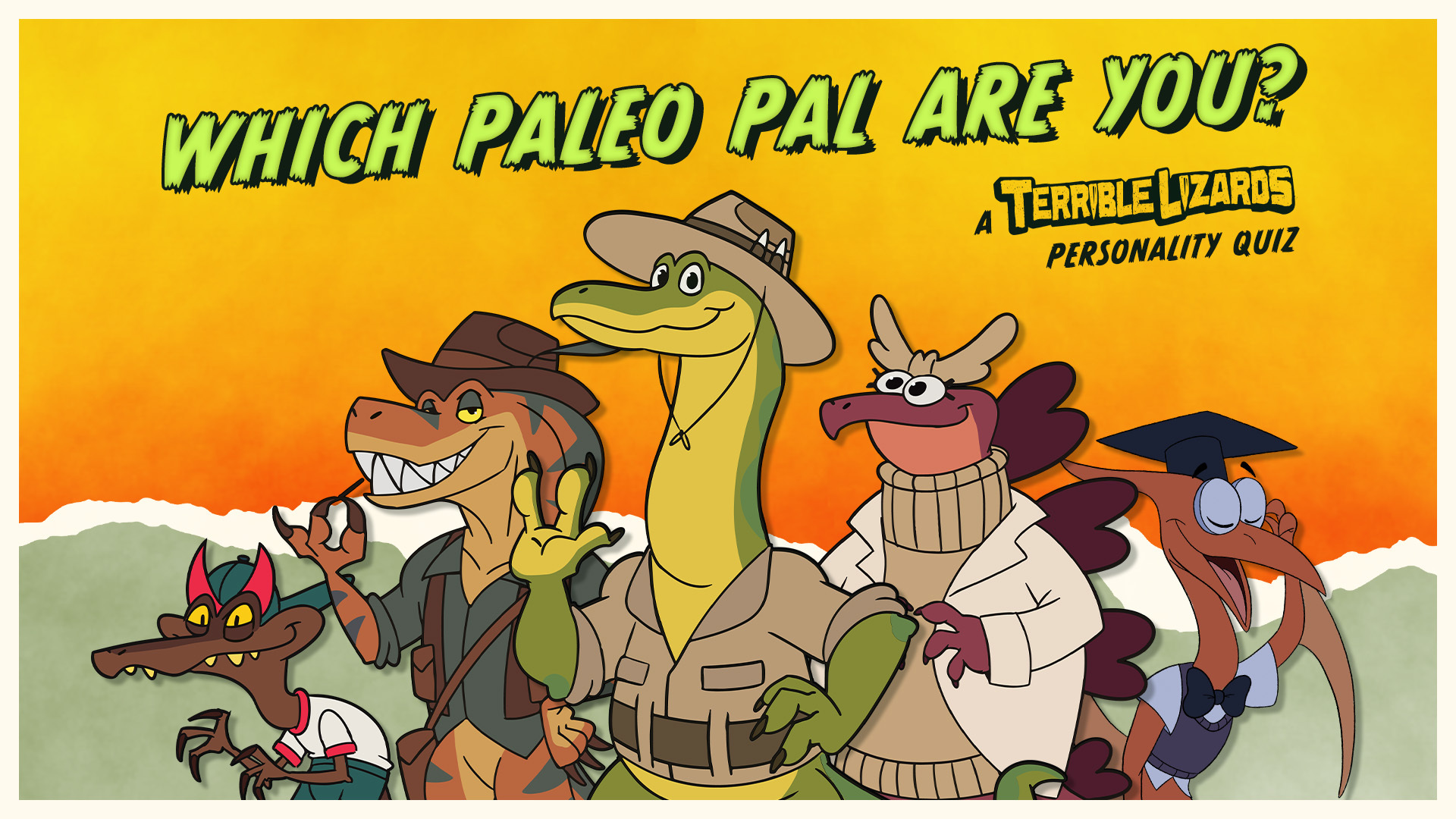
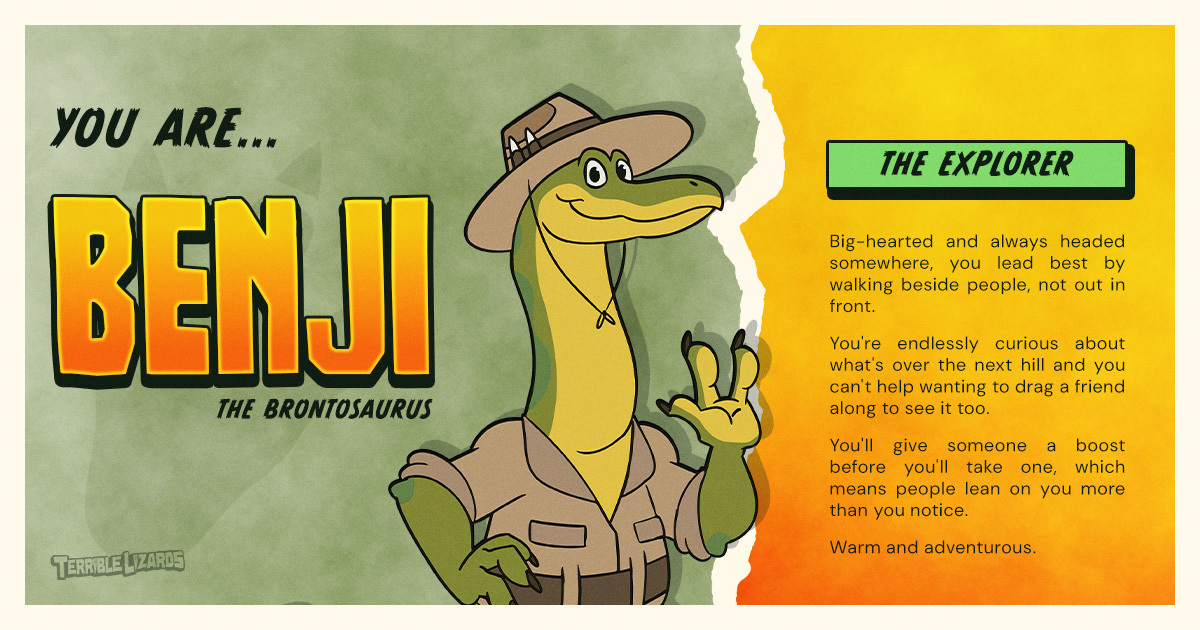
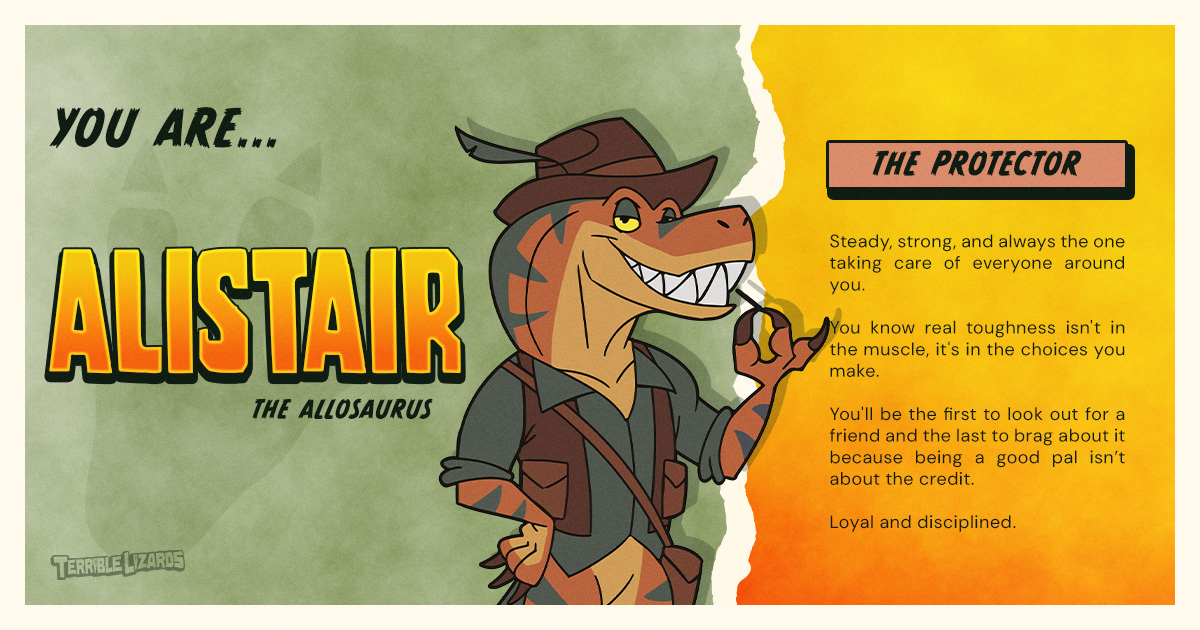
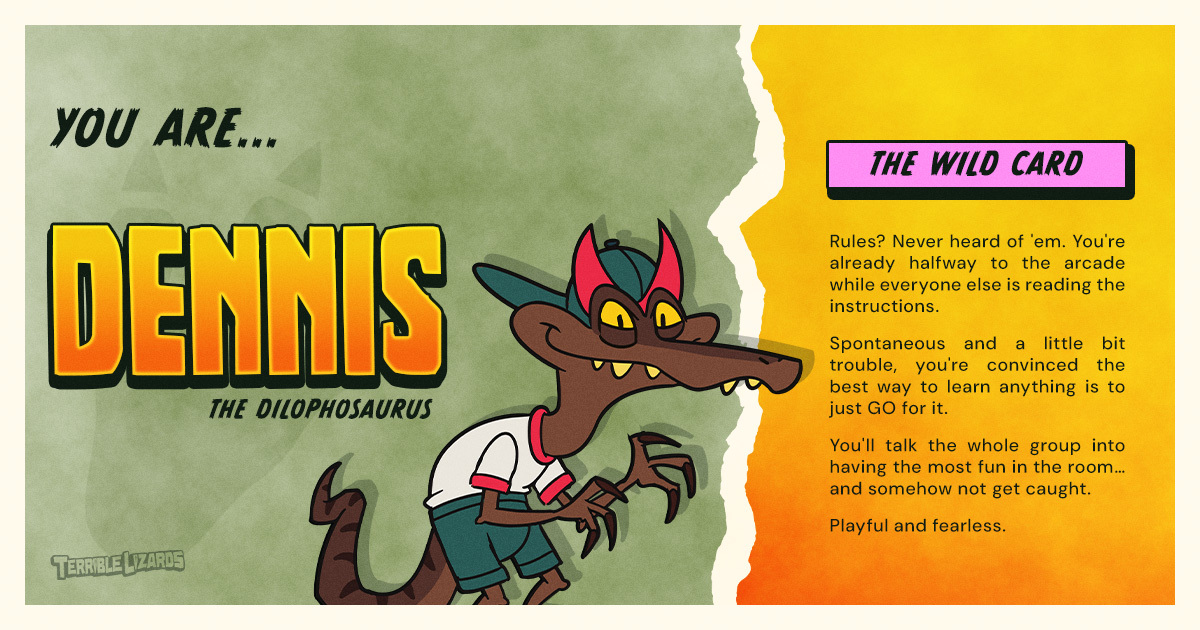
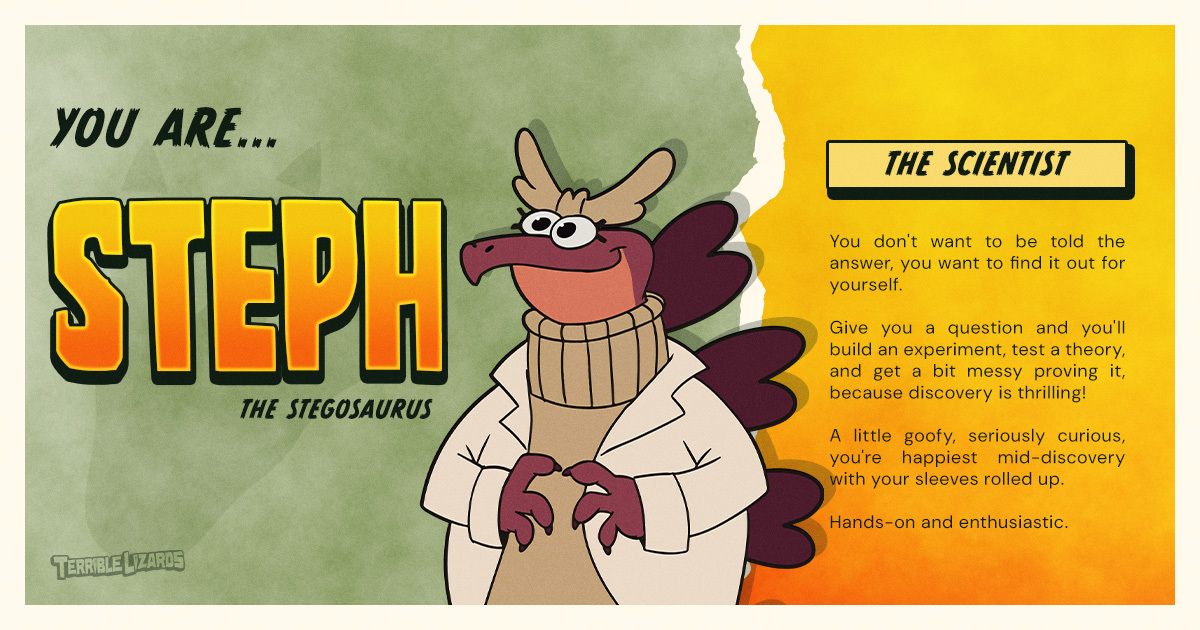
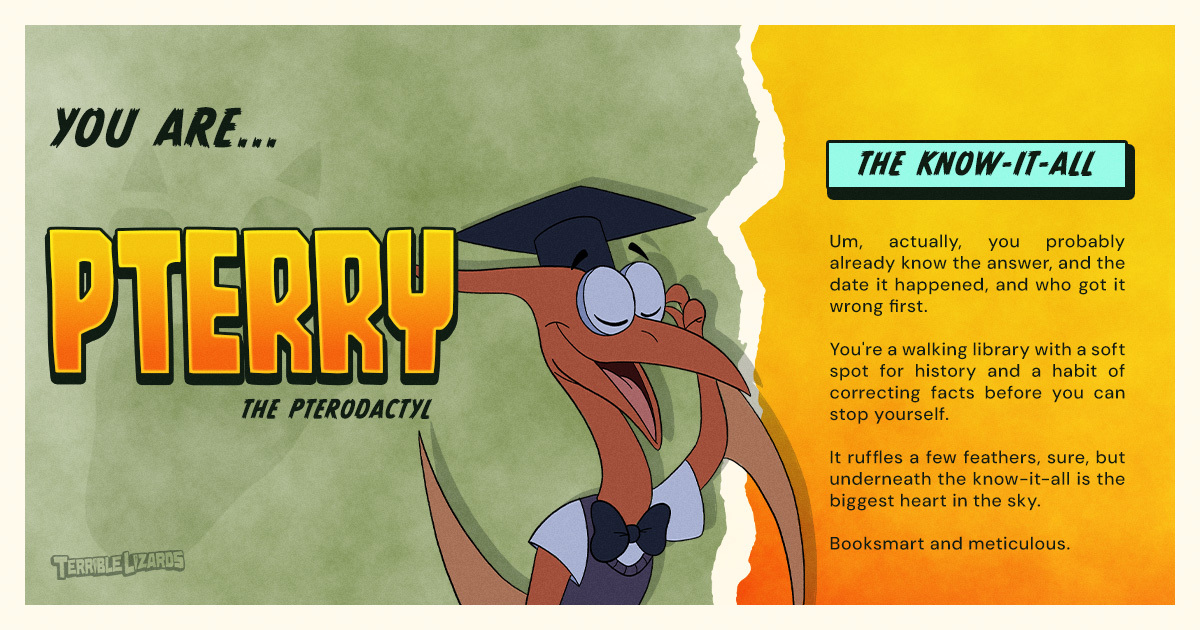
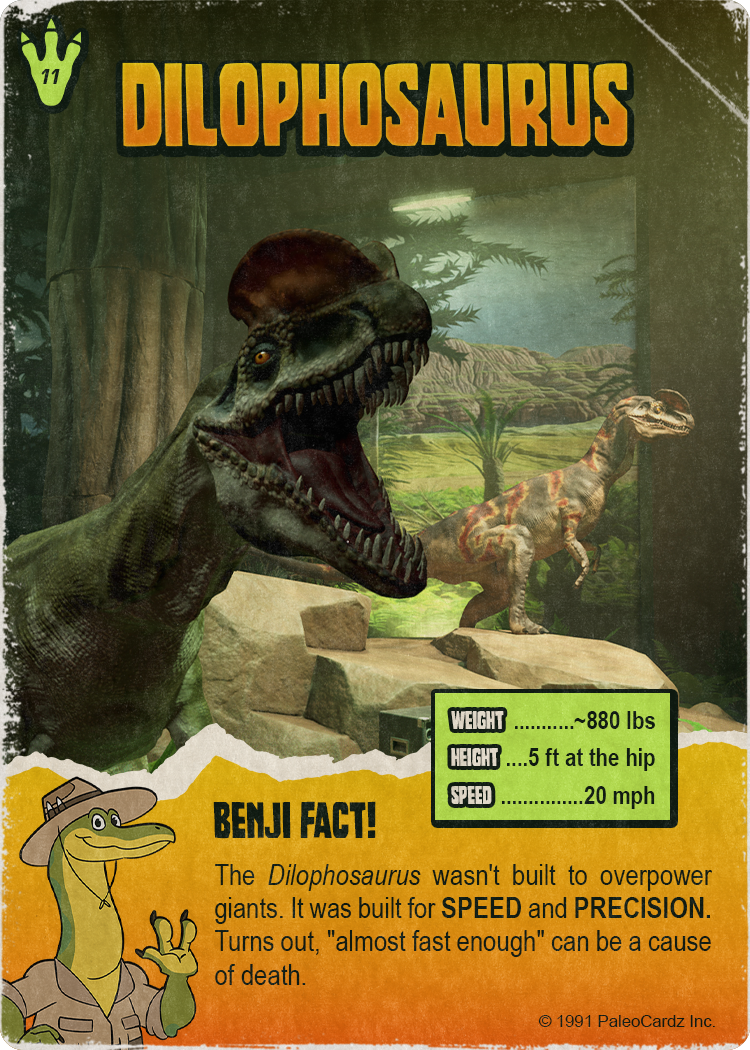
To help tide you over, we've put together a personality quiz to help you find out which of these dynamic dinos you are most like! In the world of Terrible Lizards, the Paleo Pals are the mascots and guides for Dalton's Dinos, and they help bring in the money to run the place and fund questionable scientific research.
This quiz might help you learn something about yourself, but more importantly, it'll help you know what your next visit to Dalton's Dinos might be like...
We're incredibly excited to announce that Terrible Lizards will be playable at the XBOX booth at Gamescom 2026! From August 27–30, attendees can find us in Hall 7 at the XBOX booth (A-0.61) and get their hands on the game. This will be the first time Terrible Lizards has been pub
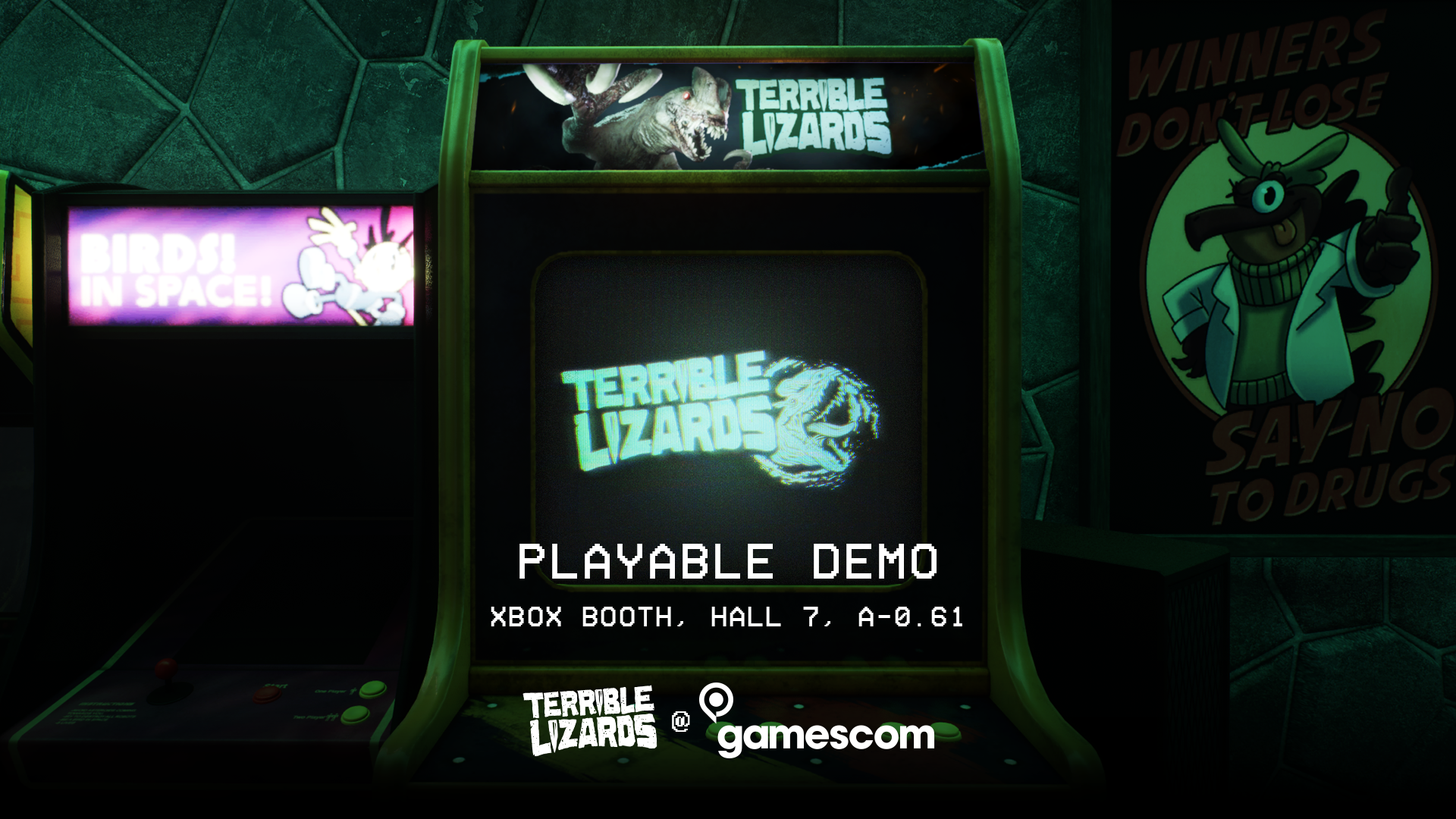
We're incredibly excited to announce that Terrible Lizards will be playable at the XBOX booth at Gamescom 2026!
From August 27–30, attendees can find us in Hall 7 at the XBOX booth (A-0.61) and get their hands on the game. This will be the first time Terrible Lizards has been publicly playable since PAX West last year, and this time we're bringing two different demos to choose from.
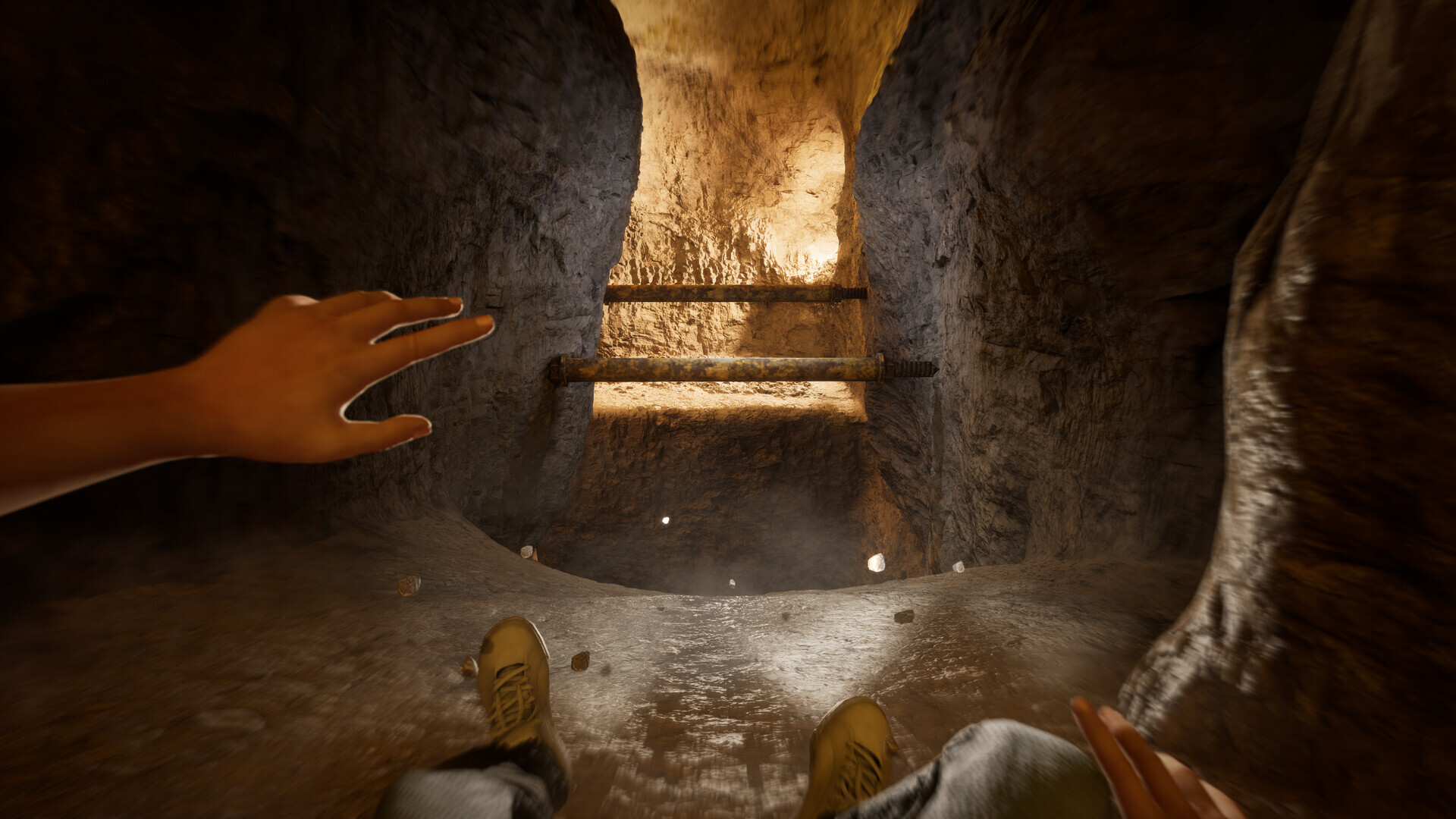
The Story Demo introduces you to the world of Terrible Lizards and Dalton's Dinos, with a focus on exploring the attraction, its setting, and the mystery unfolding around you.
The Gameplay Demo drops you closer to the action, with a bigger focus on the first-person platforming and fast-paced movement at the heart of the full game.
Both demos feature plenty of gameplay and culminate in their own climactic encounters with dinosaurs. You'll be able to choose one per turn, and if you want to try the other, you're welcome to hop back in line. If you played Terrible Lizards at PAX West last year, the Gameplay Demo will also give you something completely new to experience.
We're incredibly honored to be part of the XBOX booth this year and can't wait to put Terrible Lizards back into players' hands. If you're heading to Cologne for Gamescom, come find us in Hall 7!
Hello paleo pals! We are hard at work getting Dalton's Dinos ready for you to visit, but the doors aren't quite ready to open just yet. In the second edition of our devlogs, learn more about the origins of Terrible Lizards - where it came from and what inspired it. You can expect
Hello paleo pals! We are hard at work getting Dalton's Dinos ready for you to visit, but the doors aren't quite ready to open just yet. In the second edition of our devlogs, learn more about the origins of Terrible Lizards - where it came from and what inspired it.
You can expect a new entry every month or so, where we'll talk to our dev team and share insights, concepts, and other tidbits to satisfy your curiosity before Terrible Lizards launches soon™. Without any further ado, let's chat with John of JT Music about the origins of this toothy adventure.
(Also, have you wishlisted the game yet? Be sure to click that button so you don't miss our launch!)
Where did the idea for Terrible Lizards come from?
The idea for Terrible Lizards actually came together from two different directions.=
The first was simply that making a game had always been a dream of ours. At JT Music, we've spent over a decade creating songs inspired by video games, but we've also always looked for ways to branch out creatively. Whether it's our live event, documentaries, or other side projects, we enjoy building things that challenge us. A game was always at the top of that list, and as lifelong gamers, we felt it was the most exciting creative leap we could make.
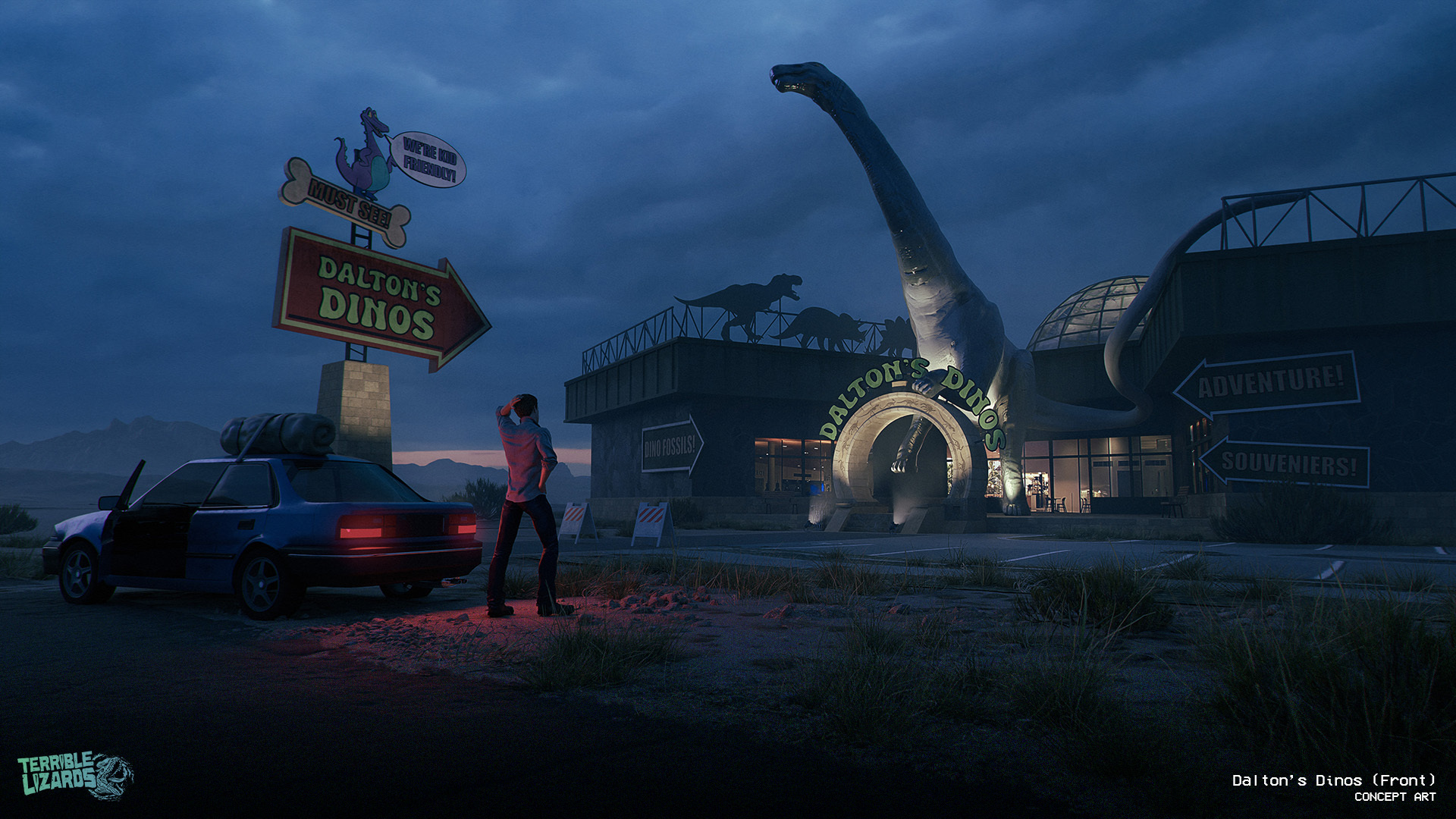
From there, we started asking ourselves what kind of horror game we wanted to build. We loved the idea of taking something familiar and nostalgic, then twisting it into something unsettling. Roadside attractions along Route 66 felt like the perfect setting. They have this uniquely American charm that's equal parts fascinating and eerie, especially when you imagine one sitting alone in the middle of nowhere. Once we had that, the dinosaur theme came naturally. Jurassic Park was a huge part of our childhood, and dinosaurs capture that same sense of wonder that so many kids grow up with. They also gave us the opportunity to create monsters that feel familiar at first glance but become something much darker as the game unfolds.
The gameplay side actually came before the setting. As a first-time studio, we wanted to build around a strong, achievable foundation, and platforming was the obvious choice. Great platformers prove that you don't need dozens of mechanics to create a deep, rewarding experience. If the movement feels satisfying and the level design consistently poses interesting questions to the player, a simple toolset can go a long way. I've always loved the rhythm and flow state that platformers create, and we wanted to bring that feeling into horror. Too many horror games rely on slow movement, fetch quests, or simply walking from place to place. We wanted Terrible Lizards to feel fun every second you're holding the controller. By combining fluid first-person movement with tense chases and horror, we found something that felt fresh while still playing to our strengths as a team.
How did you decide on this genre (horror & platforming) and the first-person perspective? Was the game almost something else in its early stages?
Horror was always the natural fit for our first game. It's a genre we genuinely love, but it's also one our audience has embraced for years through JT Music. Some of our favorite projects have been horror-related, and that overlap gave us confidence that we could create something players would be excited to experience while still pushing ourselves creatively.
How we came upon first-person platforming stems from our desire for Terrible Lizards to be a game about movement and flow. The goal was to create that feeling where you're completely locked in, reacting instinctively to what's in front of you and stringing together jumps, climbs, swings, and wall runs without thinking about each individual input. First-person naturally amplifies that feeling because your focus is limited to what you can see right now. Every obstacle arrives in real time, and overcoming it feels more immediate and personal.
Ironically, that feeling reminds me of the classic 2D platformers I grew up with. Games like Donkey Kong Country on a 4:3 screen gave you very little time to react, so success came from finding a rhythm and trusting your instincts. That's the feeling I wanted to recreate, just in a modern first-person perspective. Games like Mirror's Edge and Dying Light proved that first-person movement could feel incredible, and we wanted to bring that same sense of momentum into a horror game.
Once we landed on that vision, we never really looked back. Terrible Lizards was always envisioned as a first-person horror platformer. The details evolved throughout development, but the game's core identity has remained the same since the beginning.
What is your process for game design? What do those early pre-production stages look like?
Because this was our first game, our process was probably less conventional than I'd recommend. We were learning how to make a game as we made one. I was constantly researching game direction, production, and level design while applying those ideas in real time with the team.
Looking back, I realized we accidentally built a prototype without ever calling it one. We started with only the core movement mechanics (running, jumping, sliding and swinging), and I built simple obstacle courses to see what felt fun. At the time, I thought I was learning how to use Unreal, but I was really validating the game itself. If those gray-box obstacle courses were fun without art, story, or polish, then we knew we had a foundation worth building on.
From there, those gameplay blockouts became the backbone of the project. Art, animation, audio, and every other discipline grew around the gameplay experience rather than the other way around.
Regarding pre-production, it's probably not exactly how we'd approach our next game, but it worked because the vision for Terrible Lizards never really changed.
What is your own personal goal for the project?
My personal goal for Terrible Lizards is pretty simple: I want it to be successful enough that we get to make another game.
For me, success isn't just about sales. It's about creating an experience that genuinely resonates with people. If players connect with the world, the story, and the gameplay we've built, then we've done our job. Game development is one of the hardest things I've ever done professionally, but I love the process of creating worlds with a talented team.
If Terrible Lizards gives us the opportunity to keep doing that, whether it's a sequel or something completely new, I'll consider it a success. I just want to keep making games people enjoy.
Are there any challenges or setbacks you’ve had to overcome during development?
I don't think we had any major setbacks during development. The biggest challenge was simply that this was the first commercial game for almost everyone on the team, myself included.
The hardest part wasn't even making the game itself; it was learning how to make games while making one. Every discipline has its own workflow, and then you have to figure out how all of those workflows fit together. Programming, art, animation, audio, design... they all depend on each other. On top of that, I was learning how to manage a project at this scale for the first time. Figuring out how to organize people, prioritize work, and keep everything moving was easily the steepest learning curve.
Looking back, I think the biggest thing I underestimated was production. Once we found the right way to organize the team and the work, everything became dramatically more efficient. There were definitely growing pains getting to that point, but they're the kind of lessons you only really learn by doing. It's experience we'll carry into every game we make from here on out.
What makes for a good horror game? What elements do you believe are essential?
For me, great horror always comes back to two things: tension and dread. You don't need something frightening happening every second. Often, it's the anticipation that something might happen that makes horror so effective. The right environment, framing, or even a moment of silence can put players on edge before anything has happened.
Terrible Lizards approaches that a little differently than most horror games because movement is our core mechanic. Instead of making players feel vulnerable by slowing them down or giving them clunky controls, we ask them to survive through movement alone. You can't fight back; you run, climb, swing, and think your way out of danger.
Tonally, we're closer to Jurassic Park than psychological horror. We want players to feel tension and dread, but also excitement. The goal is for players to leave a chase feeling exhilarated as much as they feel relieved, and that balance is what we've tried to build throughout the game.
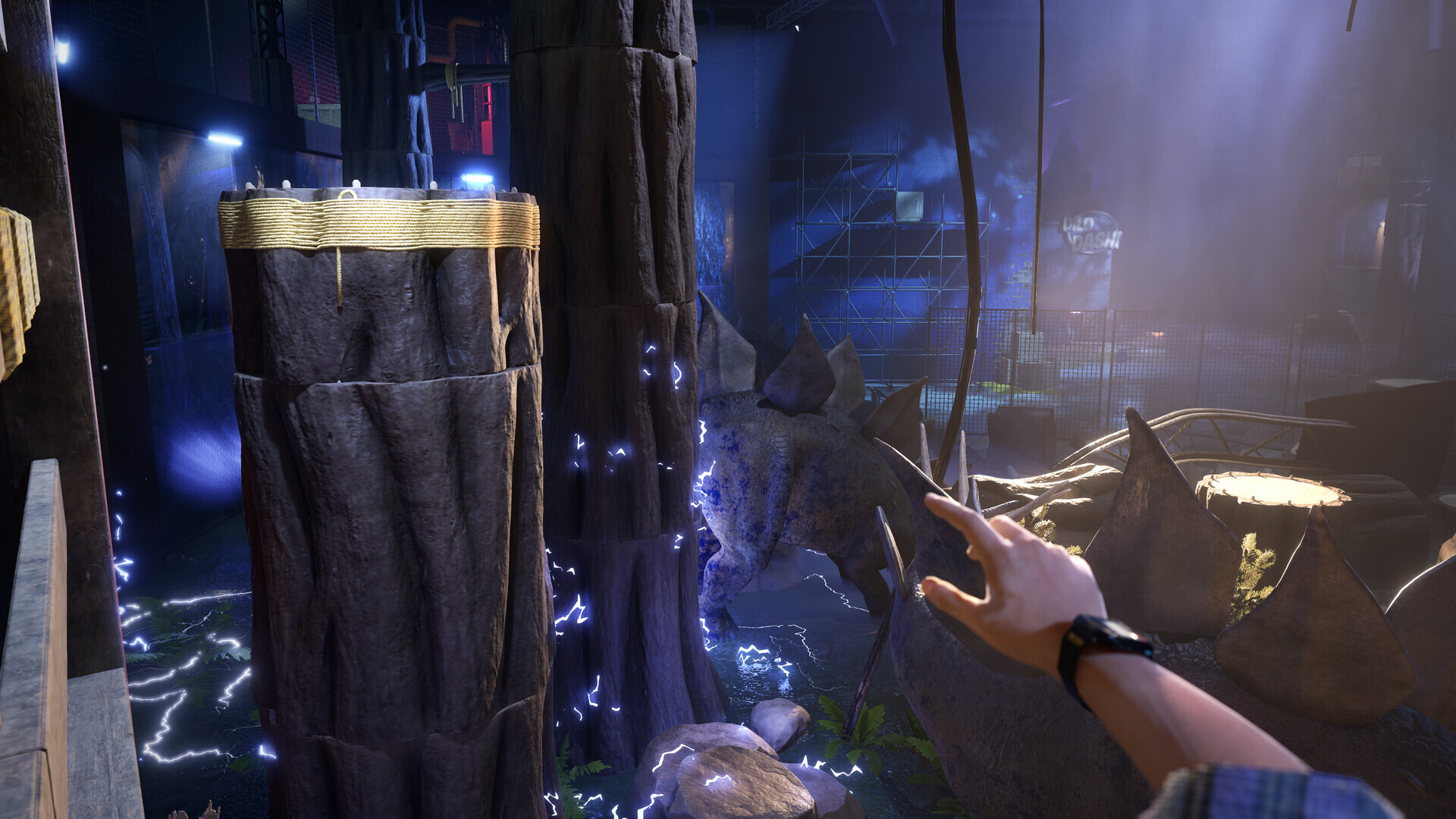
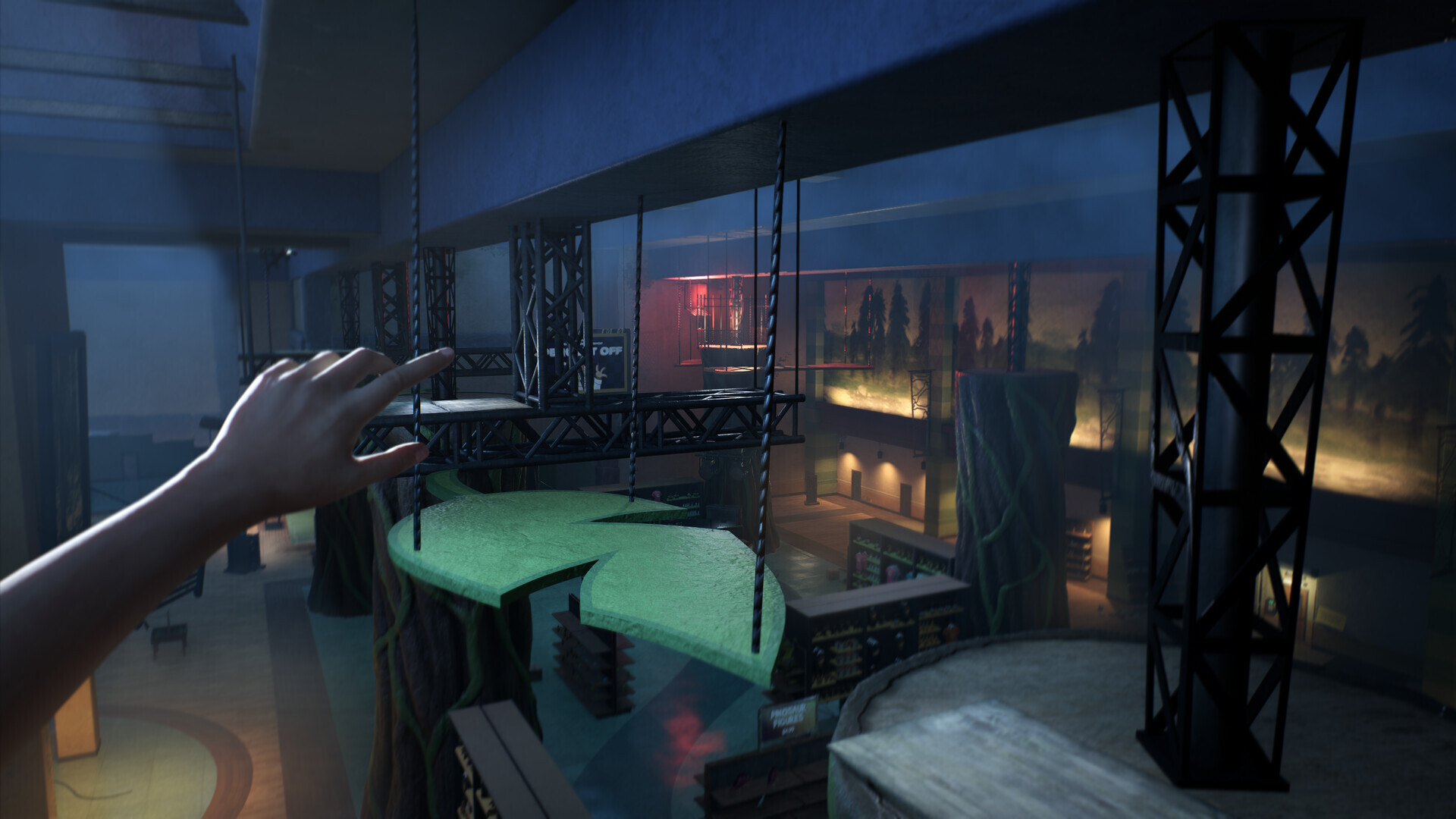
Early concept of the exhibits
How do you make platforming something that is easy to understand, but not frustrating for less experienced players?
One of our biggest goals was making the platforming approachable without taking away the satisfaction of getting good at it. We wanted someone who's relatively new to platformers to have a great time, while still giving experienced players enough room to push the mechanics and express their skill.
A lot of that comes down to two things: aerial control and mantling. Aerial control lets players adjust themselves in midair, which feels natural, especially for newer players. We've seen it over and over in playtests where someone instinctively tries to correct a jump, and the game lets them do it. At the same time, experienced players can use the same mechanic to optimize routes and chain movement. Mantling works the same way. If you're just short on a jump, it's forgiving. If you really know the movement system, it can open up shortcuts and let you string things together in ways newer players probably won't even notice.
The other piece is respecting the player's time. Checkpoints are fairly generous because once you've overcome a challenge, we'd rather keep the momentum going than ask you to replay the same section five times. The movement is where the satisfaction comes from. Skilled players can fly through the game because the mechanics feel good, while newer players can enjoy the adventure without constantly feeling punished.
Are there any assumptions about making games that you had going into development that have been challenged as you worked on the game?
The biggest thing that changed for me wasn't realizing how hard game development is. I expected it to be difficult. What surprised me was just how much everyone in this industry cares.
Before making a game, I'd worked in music, storytelling, production, and event management, so I had some appreciation for creative collaboration. But game development brings together so many disciplines that all have to succeed at the same time. Programming, art, animation, audio, writing, level design, production, every part depends on every other part. It's an incredibly collaborative medium.
What really stood out to me, though, was the people. I've met so many talented developers who genuinely care about what they're making and want to create something players will love. That passion is contagious, and it's given me an even deeper respect for the craft. It's also made me appreciate just how difficult it is to make games. When you see how many moving pieces have to come together and how deeply everyone is invested, you gain a whole new appreciation for every game that makes it across the finish line.
Is there anything personal, something from your own life or experiences, that has made it into the game? (Do you have any fond memories of roadside attractions?)
There are definitely many personal influences throughout Terrible Lizards. The setting is probably the most obvious one. I grew up in New England, and while I've never driven Route 66 itself, I spent a lot of time on road trips with my family. My parents loved taking Sunday drives, and we'd stumble across quirky roadside attractions, old advertisements lost in time, and places full of character. That feeling of nostalgic Americana stuck with me, and Route 66 felt like the perfect shorthand to capture it.
The other big influence is our relationship with mascot horror. Through JT Music, we've spent years writing songs about these games and watching the genre evolve. We genuinely love it, and it's been an important part of our creative journey. At the same time, spending so much time in the genre gave us ideas about where it could grow.
In many ways, Terrible Lizards is both a love letter to mascot horror and our own take on where it can go next. We wanted movement to be as engaging as the scares, so our chase sequences are built around skill and momentum rather than simply running down a hallway. We wanted the monsters to feel grounded in the world rather than exist purely as a horror gimmick. More than anything, we wanted to build a game that celebrates what we love about the genre while putting our own spin on it. That's probably the most personal part of the entire project.
What is your favourite horror game?
My favorite horror game is probably F.E.A.R. It was the first horror game that really pushed me out of my comfort zone. I was honestly a bit of a scaredy-cat growing up, but the gameplay was so good that I wanted to keep playing despite my fear. The shooting mechanics, the enemy AI, and the pacing were all fantastic, and then the horror would creep in through these brilliantly timed moments, like climbing down a ladder or walking through an otherwise ordinary hallway before Alma suddenly appeared. It taught me that a horror game could be genuinely fun to play while still being incredibly unsettling.
Another huge influence is the original Five Nights at Freddy's. I think it's one of the smartest pieces of horror game design ever made. The core mechanic is incredibly simple, but every decision forces you to trade safety for information. That constant tension is what makes it so effective. More recently, I've loved the modern Resident Evil games as well. They strike a great balance between action, exploration, and horror.
Hello paleo pals! We are hard at work getting Dalton's Dinos ready for you to visit, but the doors aren't quite ready to open just yet. We've cooked up a closer look at the dangerous denizens that will cross your path, though, in our very first developer's log! You can expect to
Hello paleo pals!
We are hard at work getting Dalton's Dinos ready for you to visit, but the doors aren't quite ready to open just yet. We've cooked up a closer look at the dangerous denizens that will cross your path, though, in our very first developer's log!
You can expect to see a new entry every month or so, where we'll be talking to our dev team and sharing insights, concepts, and other informational tidbits to satisfy your curiosity before Terrible Lizards launches soon™. Without any further ado, let's learn about how terrible these lizards really are.
(Also, have you wishlisted the game yet? Be sure to click that button so you don't miss our launch!)
When & how did you first decide that the monsters had to be… more than just dinosaurs?
Pretty early on, we knew we wanted the dinosaurs to be monstrous. Jurassic Park has already explored Dinosaurs as both animals and monsters, and we've seen that a lot in Dino media since. We wanted to take the cool, neat factor of dinos and put a horror twist on them. Also, the game takes place underground for a lot of it, so we needed to create monsters that were also cave-dwelling beasts.
What makes for good horror creature design? How do you make something universally scary or creepy?
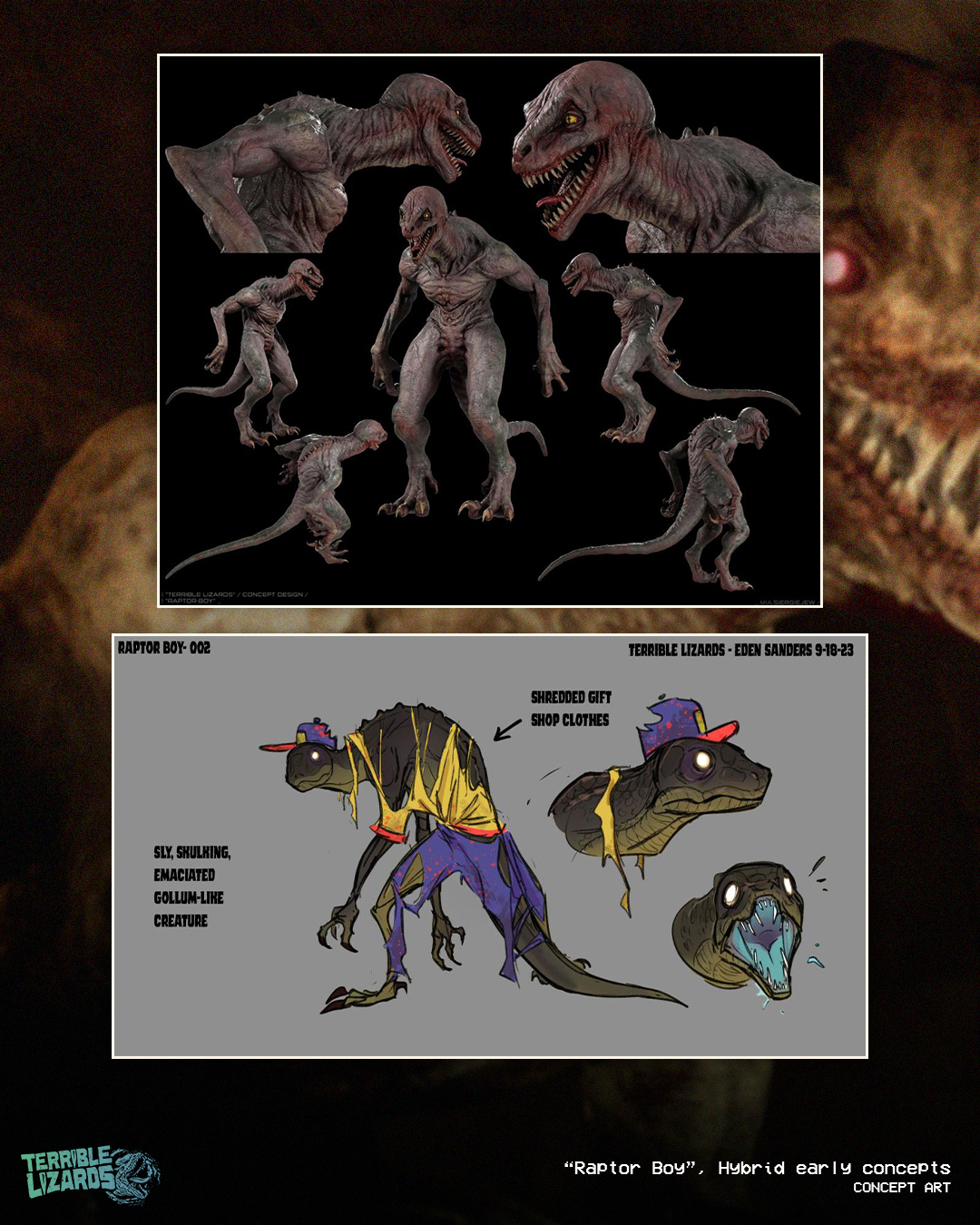
We worked with RJ Palmer on the principal creature design, and he talks about it in a Q&A video we did with him. He shares how striking a balance between the familiar and the disconcerting is key to creating an unsettling, scary creature. Taking that idea even further is exploring novelty within the familiar. The monsters were designed so that they could exist in our world. Specifically, using real-world inspirations in key design elements of the monsters. For example, taking inspiration from the porous texture of a coral reef skeleton for The Hybrid’s ribcage.
What is the process for the design of a creature? From concept to in-game, how many people does it pass through?
We started the dino design process with moodboards. After some internal brainstorming sessions, we set out to gather as many reference materials as possible on existing monsters, dinosaurs, textures, and characters in media to get a feel for what we liked and didn’t like, and to generally validate the vision. From there, we prepared some light prompts, paired them with the mood boards, and had a handful of concept artists create monster concepts. A few iterations with each artist helped inform us on what we liked and didn’t like in monster designs.
Once we had a solid sense of the monster's direction from our mood boards and iterative concept art passes, we collaborated and presented our final prompt to RJ to create the principal designs. He provided us with 2-4 concepts per monster, and then we narrowed it down to one design per monster and then finalized it.
After that, it’s working with 3D artists and animators to model and rig the design for game implementation. From there, the animators bring it to life! So in the end, the creatures took the work of ten people from concept to realization.
What inspired the design of the Dalton’s Dinos mascots?
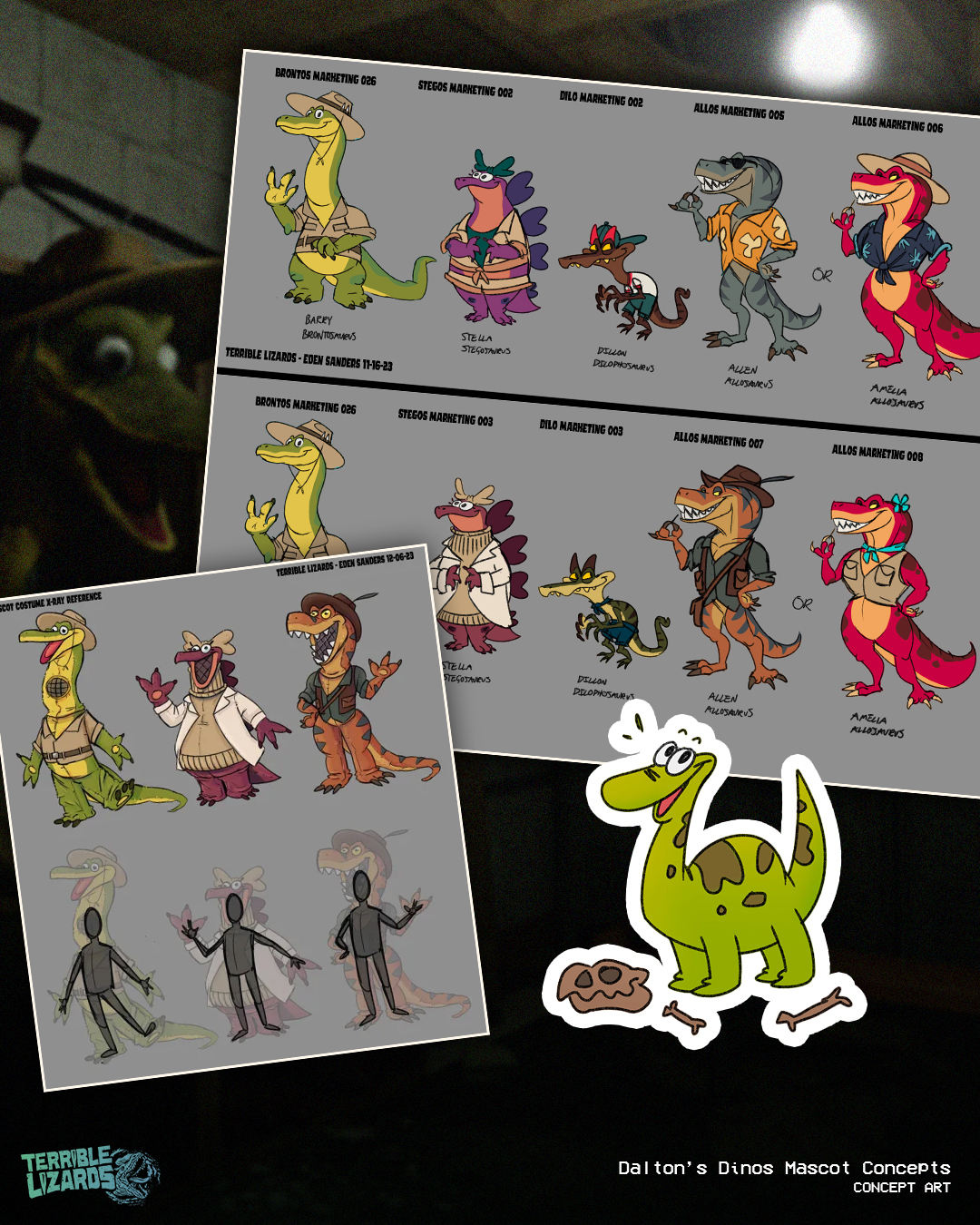
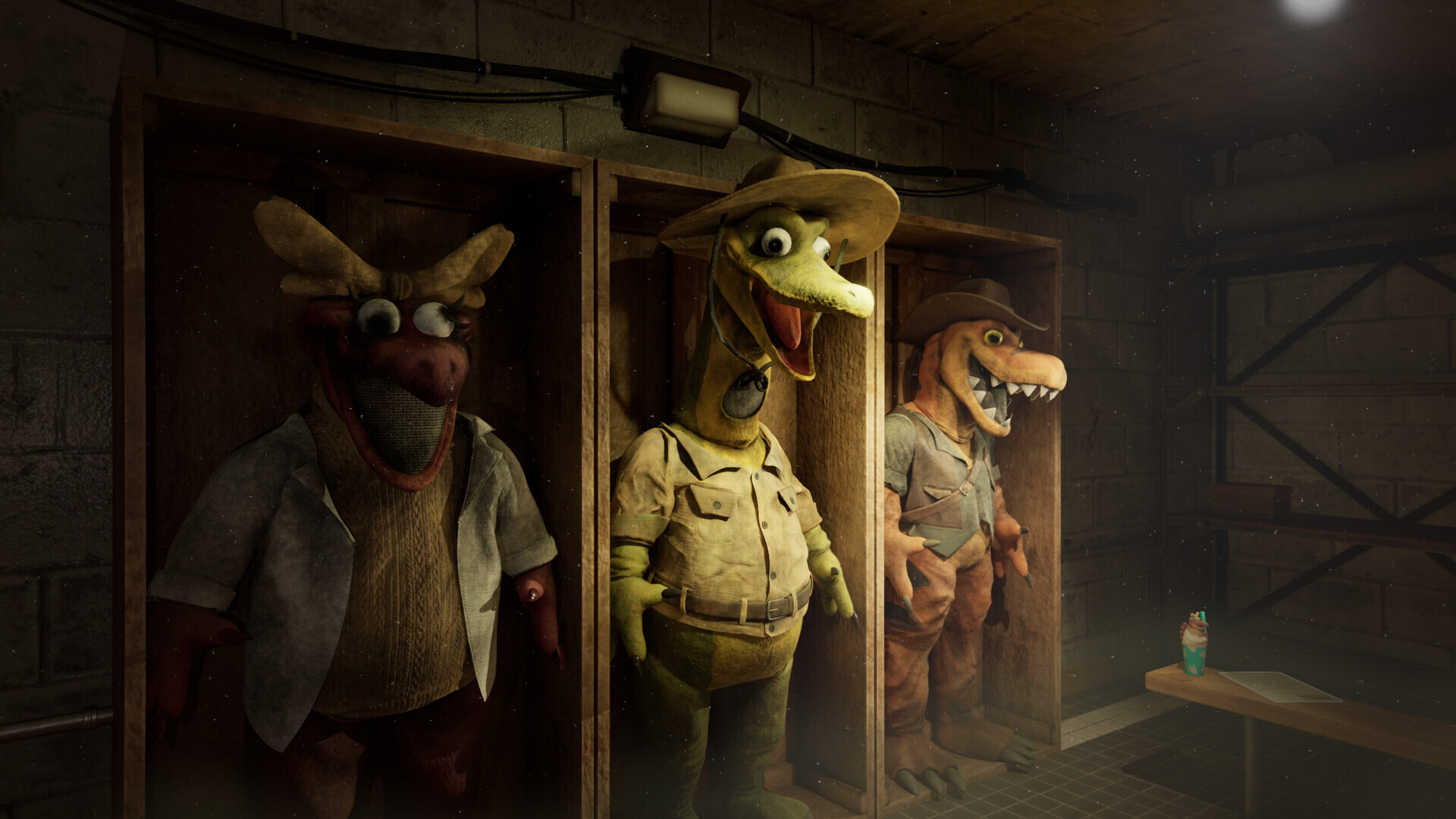
We wanted our mascot suits to feel like an homage to FNAF, but also just be mascot suits you’d see in the 90s. There was also a practical aspect in that they needed to be suits people could reasonably wear, with the fun, creative choice of the Benji suit having a viewing hole at the base of its neck to pull off the Bronto's long-necked look. The designer of the mascot look, Eden, was very in sync with us on the vibe and direction, and we found really solid designs for our Paleo Pals pretty quickly.
For the dinosaurs themselves, what made you go with the traditional understanding of them, rather than their feathered counterparts?
Since the game takes place in the early 90s, we had to pull back 30 years of dinosaur knowledge and research when building on how we presented and talked about our dinosaurs in-game. It wasn’t easy, and there are possibly holes paleo-enthusiasts will find, but we did our best to present things from a 1990s perspective. For example, paleontologists were aware of feathers on dinosaurs, but the fact was not widely known within the general zeitgeist.
Are there any monster concepts that didn’t make it into the final game that you can share here?
Nope! Luckily, we were able to execute all our mascot and creature designs, even adding an extra midway through production with Pterry!
Are there any funny bugs or glitches with the creatures during development that you can share?
Too many to count. We had one where our Bronto monster was on a cosmic scale in our levels for some reason. The same Bronto monster probably had the most issues. Sometimes he’d float, sometimes his legs would stretch out funny while walking, and sometimes he’d only walk on his front legs. There is one bug with the Allo monster where you don’t die when he gets you, and it looks like you’re just being carried around by him, which is a pretty terrifying experience even for a bug.
He's doing a little dance! 💃
Do you have any tips for prospective players on what to expect from the creatures and how to handle them in the full game?
What non-game sources did you pull inspiration from?
Inspiration came from everywhere. On the conception side of things, we looked at any and all forms of Dinosaur media, as well as a lot of body-horror and cave-dwelling monster stuff. We also referenced the Jurassic Park 4 hybrid concept unearthed years ago. Then, in our Q&A video, RJ talks a lot about how the skull-face creature designs from The Void and the newborn alien from Alien: Resurrection were the sources of inspiration for the hybrid.
A very important final question: what is your favorite dinosaur?
I can’t really pick. The Hybrid is so full of character and emotive. The Bronto is just such a fun and different take on the species. And the Allo, the Allo is just cool and lethal. But if you’re twisting my arm, I’d go with the Allosaurus monster.
A peek behind the curtain in the process we took in designing one of our monsters for Terrible Lizards. We are also joined by the principal designer, RJ Palmer, to gain insight into his approach and inspirations in the design! Wishlist Terrible Lizards on Steam page here: View ga
A peek behind the curtain in the process we took in designing one of our monsters for Terrible Lizards. We are also joined by the principal designer, RJ Palmer, to gain insight into his approach and inspirations in the design!
Our new cinematic teaser trailer is live. Get a feel for the world and an intro to one of our monsters! Watch it on the Steam page here: View game page
Our new cinematic teaser trailer is live. Get a feel for the world and an intro to one of our monsters!
On December 13 at 2PM EST , we’ll be joining Game Theory for a live discussion on indie horror games, game development, and the journey of building Terrible Lizards . The stream will also feature the world premiere of our announcement teaser trailer . The trailer will go live acr
On December 13 at 2PM EST, we’ll be joining Game Theory for a live discussion on indie horror games, game development, and the journey of building Terrible Lizards.
The stream will also feature the world premiere of our announcement teaser trailer. The trailer will go live across all WDR Studios channels immediately following the event.
Hope to see you there, and thanks as always for the support.
We’re excited to share that Terrible Lizards has been officially selected for the PAX Rising Showcase at PAX West 2025 ! This will be the first public hands-on demo for Terrible Lizards , and we can’t wait for players to step into the world we’ve been building. Where: PAX Rising
We’re excited to share that Terrible Lizards has been officially selected for the PAX Rising Showcase at PAX West 2025!
This will be the first public hands-on demo for Terrible Lizards, and we can’t wait for players to step into the world we’ve been building.
Where: PAX Rising Showcase, PAX West – Seattle, WA When: Aug 29-Sept 1
What: Play a slice of the game featuring:
Heart-pounding chase sequence
First-person platforming & traversal
A glimpse at our terrifying prehistoric predators
Whether you’re a fan of indie horror, intense movement-based gameplay, or just want to survive against something with far too many teeth, we’d love to see you there.
📍 Find us in the PAX Rising area at booth #825 and let us know what you think!
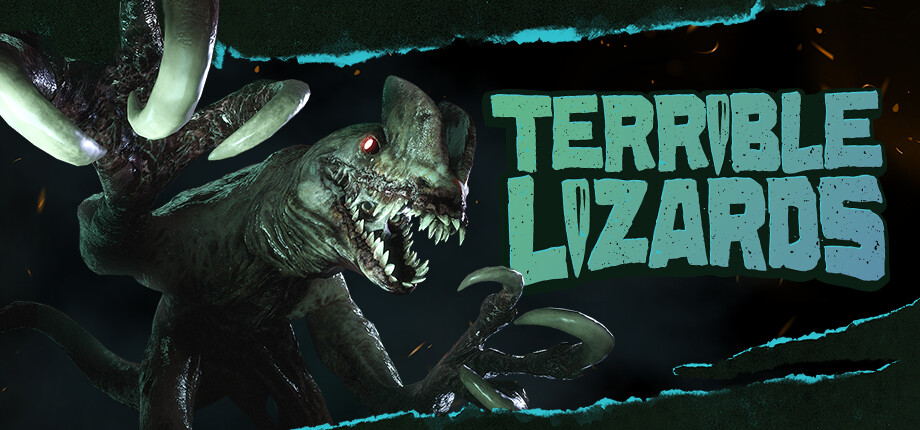


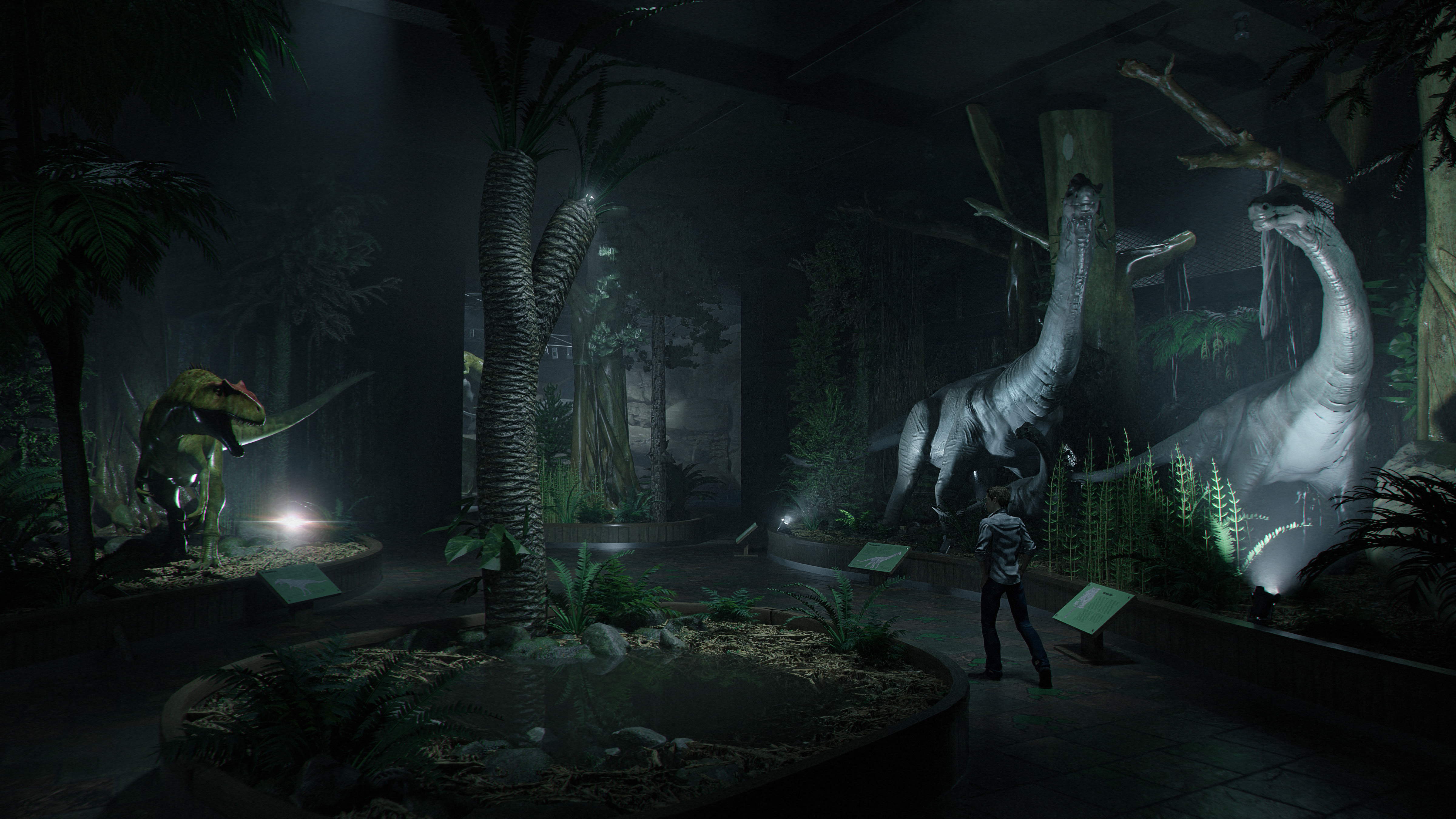 Early concept of the exhibits