
 Hello paleo pals! We are hard at work getting Dalton's Dinos ready for you to visit, but the doors aren't quite ready to open just yet. In the fourth edition of our devlogs, we dive into the beeps & boops, voice acting, and soundtrack of the game!
You can expect a new entry every month or so, where we'll talk to our dev team and share insights, concepts, and other tidbits to satisfy your curiosity before Terrible Lizards launches soon™. Without further ado, let's chat about the game's audio design!
(Also, have you wishlisted the game yet? Downloaded our demo? Be sure to click the corresponding buttons!)

What went into the audio production of the game? What is the process like for sound design and music composition?
Put simply, a lot. We thought a lot about how we wanted the game to feel through sound. Sound and music are integral to how a game feels. The process kept changing depending on what we needed. A lot of it involved making sounds on my own or mixing in licensed library elements that I would change and make bespoke. For music, I wrote, arranged, recorded, mixed, and mastered the track. Then we’d test it in the game to make sure it was what we wanted.
Sounds and music can sound great on their own, but when placed in context, they can feel wrong. So the name of the game was iteration. Lots, and lots, and lots of iteration. But sometimes you nail it on the first go. If only it were always that simple. There’s a ton of sound and music on the cutting room floor, so to speak. Maybe we’ll make a lost archive. Or perhaps it’ll end up forgotten to time, lost in the depths of a spooky cave…
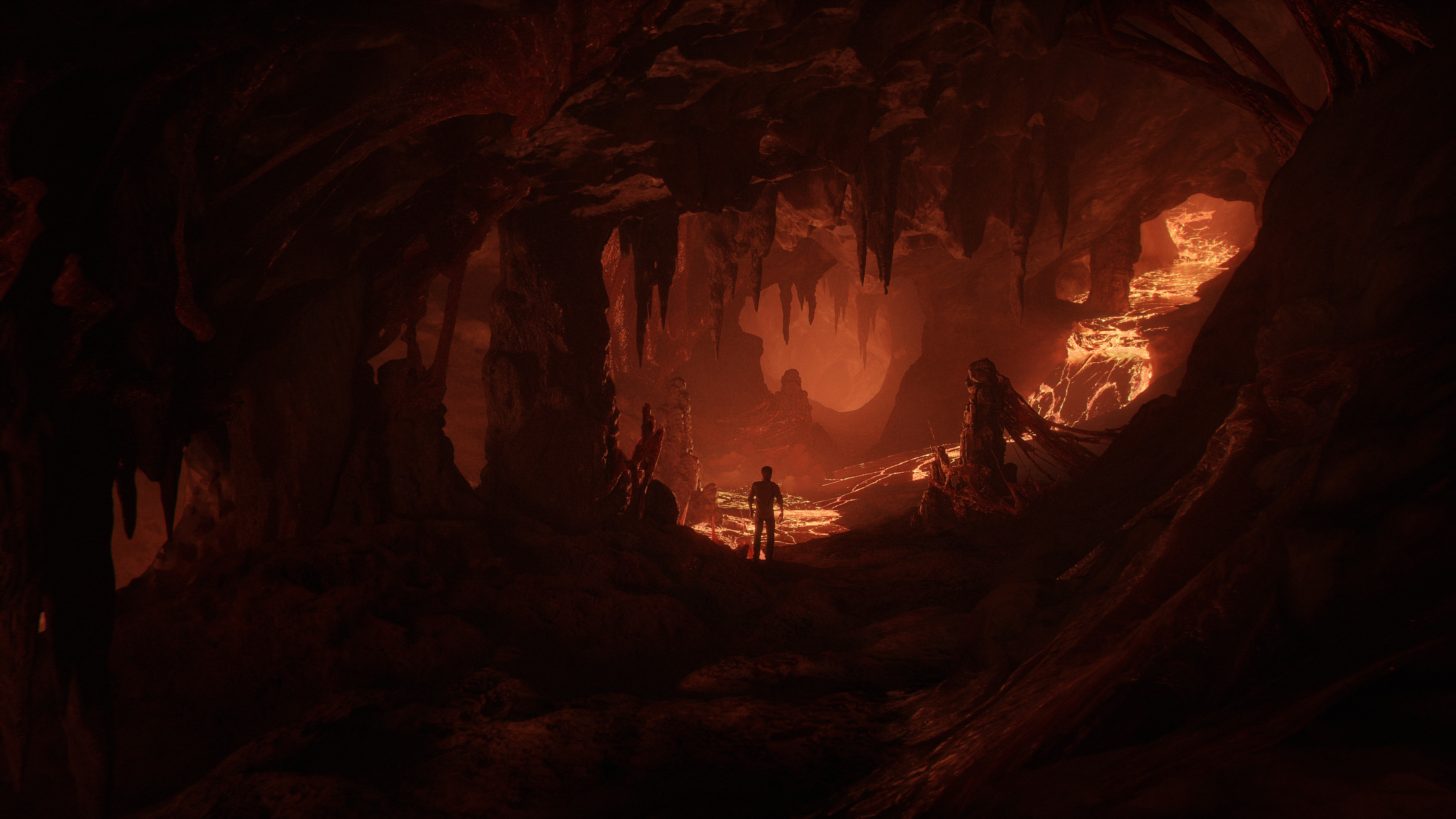 Caves concept render
How do you make music “scary” for a horror game? Why is music such a key part of a horror experience?
A lot of dissonant sounds and chords that don’t resolve. Typically, music has tension and release. In this game, it’s mostly tension, and it only releases at specific moments we want the player to feel. Music plays a huge role in giving a specific vibe, no matter what you’re making. Sometimes, though, you need no music at all. For instance, the Hitchcock movie The Birds has no music in it at all. That’s what makes it feel eerie. Using all these tricks, and many more, hopefully achieves the desired effect. Sometimes you just play creepy sounds, and that works, too.
As a period piece (the game is set in 1992!), what considerations do you have to make for sound design to ensure accuracy?
We definitely considered the time period, especially when making the diegetic music heard in the attractions in Dalton’s Dinos. We wanted a John Williams-esque theme for that aspect. Many of them have tape-warble that would come with using a well-loved cassette tape from the era. Once we get into more non-diegetic territory, the period music dissolves, and we’re less concerned with the time period. It's a mix of traditional orchestral instruments, synthesizers, and rhythm sections. Some soundscapes also include real elements and instruments.
Is there a particular music track or (without spoiling too much!) moment in the game that you’re most proud of?
I’m really proud of so many of the moments. I think my favorites would have to be in the attractions at Dalton’s. The theme song in the lobby in particular, which is echoed many times throughout the game, is probably my favorite. It fits in all kinds of situations and gives the game a cohesive thread to tether itself to.
Sound design is often subtle when implemented, but noticeable when it is missing. What are the key sound effects that most people might not notice when they’re there?
We spent a lot of time on ambient tones and background sounds. If they’re off or not there, it’s noticeable in a bad way. But if it’s right, it feels like a real place, and shouldn’t be noticeable at all. The best is when in-world sounds, tones of specific rooms/caverns, and very subtle musical elements come together. It creates a rich, dynamic feel that’s often otherworldly, and it falls right where it should.
What does a typical day for a sound designer look like?
It’s different every day! Some days it’s working on making or editing sounds. Some days are about writing and producing music. Other days are all about implementing them into the game. It makes for a very interesting job. Sometimes it’s fun and creative; other times it’s detailed and technical. It’s an insane amount of work, especially alone for a game this size, but hearing your work in the game is unlike anything else. (I did have help toward the end of the project from Matt Merino, shout-out to Matt!)
Are there any games or other media that inspired the music & sound of Terrible Lizards?
Definitely! We tried to source ideas from lots of different places. For music in Dalton’s Dinos, we emphasized a John Williams-type score. Soaring, epic, adventurous. Then once you get into the meat of it, it’s more about texture and dread, with some mystery. So, all told, films like Indiana Jones, Jurassic Park, and Godzilla were big influences. For games, Indiana Jones and Alien: Isolation. But mostly, it was years of influences that built up in my head and work.
How do you test dialogue timing & direction before the voice actors actually record their lines?
We would demo all the lines first, with me as Jordan, Amanda (our writer) as Stella, and John as whoever else was needed. That gave us a good idea of what we wanted and the timing needed. It also let us iterate as much as we needed before bringing in the voice actors.
What is your favorite sound effect in the game?
I love them all, but I’d have to say any of the monsters/dinos. Making those sounds was a blast.
What’s the best dinosaur roar? (real or fake!)
Can’t beat the original Jurassic Park T-Rex!
