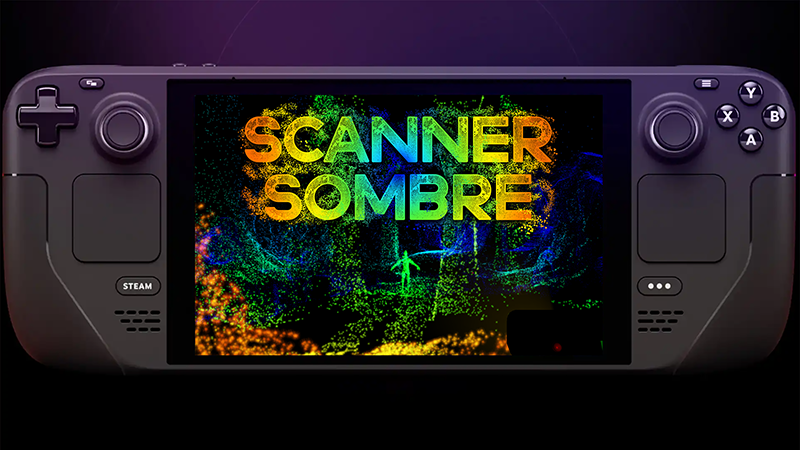
We are delighted to announce that Scanner Sombre has now been approved as Steam Deck Verified. Scanner runs like a dream and looks absolutely gorgeous on this amazing handheld gaming device, especially on the OLED model. We have loved the Steam Deck ever since we first got our ha
We are delighted to announce that Scanner Sombre has now been approved as Steam Deck Verified. Scanner runs like a dream and looks absolutely gorgeous on this amazing handheld gaming device, especially on the OLED model. We have loved the Steam Deck ever since we first got our hands on one, and Scanner was the first Introversion game we wanted to bring over. If you own Scanner and you are lucky enough to own a Deck then you'll find Scanner is now playable and works brilliantly with the handheld controls.
All Changes in the latest version
Steam Deck and Steam Machine compatibility fixes
D-Pad can navigate menus
Game Controller Mapping updates:
Button naming / Icons match SteamDeck controller
Hold LT to zoom. Release = Unzoom.
Aperture control: D-pad up and down
RB: Toggle continuous scan
Extras Prototypes disabled on SteamDeck (they only work on Desktop).
Save Game Menu display formatting fixes.
Button tooltip presentation fixes
This build should also include the previous fixes to VR mode.
We have been workling mainly on SteamDeck compatibilty: = Steam Deck and PC usability, compatibility fixes. - D-Pad can navigate menus - Game Controller Mapping updates: - Button naming / Icons match SteamDeck controller - Hold LT to zoom. Release = Unzoom. - Aperture control: D-
We have been workling mainly on SteamDeck compatibilty:
= Steam Deck and PC usability, compatibility fixes. - D-Pad can navigate menus - Game Controller Mapping updates: - Button naming / Icons match SteamDeck controller - Hold LT to zoom. Release = Unzoom. - Aperture control: D-pad up and down - RB: Toggle continuous scan - Extras Prototypes disabled on SteamDeck (they only work on Desktop). - Save Game Menu display formatting fixes. - Button tooltip presentation fixes
This build should also include the previous fixes to VR mode.
Please let us know your exoeriences (please mention how you are trying it - Windows Desktop, Steam Deck, VR.
Greetings, We wanted to say a big thank-you to everyone who has supported Introversion through the years, and especially to those that love our oddball art exploration game Scanner Sombre. We were all in a pretty dark place after working on Prison Architect for five years plus, a
Greetings,
We wanted to say a big thank-you to everyone who has supported Introversion through the years, and especially to those that love our oddball art exploration game Scanner Sombre. We were all in a pretty dark place after working on Prison Architect for five years plus, and something sinister and dark was just dying to come out. Scanner Sombre is how we felt!
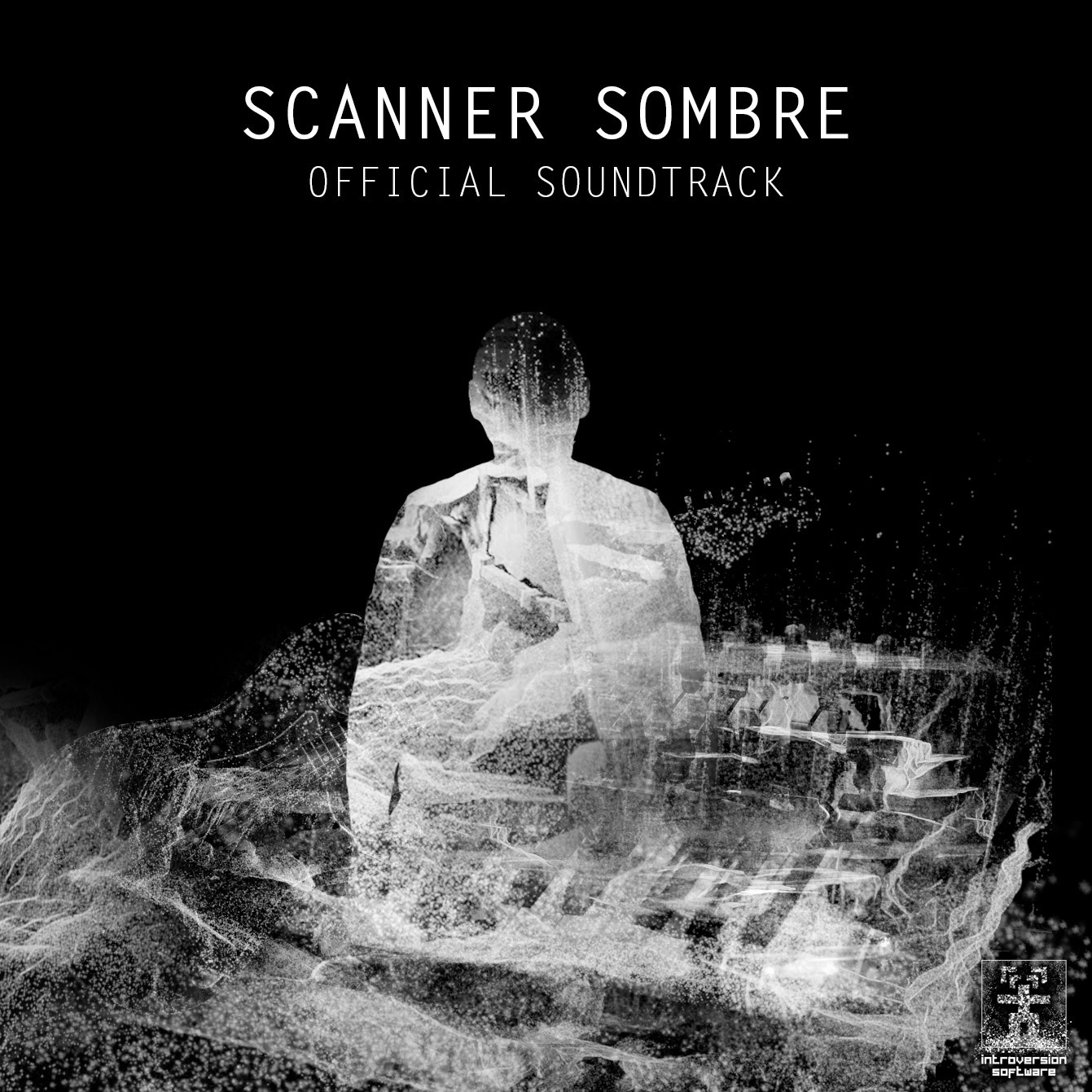
As a thank-you gift we have released the Official Soundtrack as a free download, for anyone who owns Scanner Sombre. Thank you so much!
Track Listing:
1 As Above So Below (Surface Ending) 2 Know our Truth (Temple Ending) 3 The Souls of the Many (River) 4 Don't Fall in (Lake Part 4) 5 Somebody Was Here Before (Base Camp) 6 A Serpent Bites its Own Tail (Base Camp) 7 Halls of the Fallen (The Mine) 8 The Ascent (Lift Shaft) 9 What Darkness Awaits You (Lake Part 2) 10 Behind the scenes with the composer
We'll leave you with these words from our head of audio, and composer of the Scanner Sombre soundtrack, Alistair Lindsay. Thanks and enjoy!
Just prior to commencing work on Scanner Sombre I had experienced an intensely busy and emotionally brutal couple of years in which I had lost, to terminal illness, all three of my cats, my dog, and finally my Father too. During this period I had designed sounds and composed music for several games most notably Ludeon's 'RimWorld', and Introversion's BAFTA Award winning 'Prison Architect'.
To stay 'professionally positive', and therefore be able to write the (mostly) emotionally neutral or happy music that these games required was not easy but was nonetheless essential. On many such occasions, alone in my studio, I could feel the proverbial thumbs of my own truth pressing remorselessly ever harder into the eyeballs of my soul, as I forced myself not to externalise (in my musical compositions) the pain and loss I was feeling inside.
As it turned out we had just finished Prison Architect when my Father died. What should have been a time for joy, jubilation, and a sense of pride and victory was instead usurped by feelings of nausea, anger, and devastating loss.
In all truth henceforth what I desperately needed most of all was to be authentic. I needed a new project to write for that could offer me a legitimate vessel into which I might pour all of that dark, rancid, despair and negative energy that I had bottled up inside for so long.
What I needed was a bottomless pit of never-ending doom, where all hope must be abandoned, where only pain and grief can thrive. Somewhere that would need the kind of music I had wanted to give birth to for an entire year!
And that, ladies and gentlemen, turned out to be Scanner Sombre.
Scanner Sombre, as it turns out, hasn't sold very well, at least compared to Introversion's previous game: the 2-million-copies-sold-and-counting Prison Architect. By comparison, the developer's first-person cave-mapping game Scanner Sombre has only rustled up around 6,000, or in
Scanner Sombre, as it turns out, hasn't sold very well, at least compared to Introversion's previous game: the 2-million-copies-sold-and-counting Prison Architect. By comparison, the developer's first-person cave-mapping game Scanner Sombre has only rustled up around 6,000, or in the words of Introversion's Chris Delay, "It's bombed".
Delay, and Introversion co-founder Mark Morris, chatted about the game, and its sales, in a frank new YouTube video, while also finding the time to show off Scanner's previously teased VR mode, which is now live in beta form, and playable on HTC Vice or Oculus Rift. Click here to learn how to opt in to that beta on Steam.
Here's Delay speaking about Scanner Sombre's sales, via Gamasutra: "It's bombed. I didn't think that was possible. It's not that I arrogantly believe we're the best people in the world or anything, it's that our last game sold over 2 million. So I kind of wrongly assumed that would just give us a minimum number of people looking at our game. So that numbers like [6k] would be impossible."
Scanner Sombre is currently 50% off in the Steam Summer sale. You can read Tom Marks' review here.
We are very proud to announce you can now play Scanner Sombre in VR, using a HTC Vive or Oculus Rift. We've been busy working on this since Scanner Sombre launched, and we think it's one of the most atmospheric experiences we have ever created. Let us know what you think! Mark &a
We are very proud to announce you can now play Scanner Sombre in VR, using a HTC Vive or Oculus Rift.
We've been busy working on this since Scanner Sombre launched, and we think it's one of the most atmospheric experiences we have ever created. Let us know what you think!
Mark & Chris made a video demonstrating the new Vr mode, and also discussing the critical and commercial response to the games launch. It's a difficult but honest discussion.
https://www.youtube.com/watch?v=y4a7K-I-F5s
This update is on the steam branch 'beta', meaning you must manually switch to that branch to see this new version. - Right click on Scanner Sombre in your games list - Click 'Properties' - Click 'Betas' - Select 'beta' from the list. (Restart steam if it doesn't show up) - The update will then download.
Full list of changes
- Experimental VR mode Supports HTC Vive or Oculus Rift.
- Translations The game has been translated into this massive list of languages: Bulgarian Czech Danish Dutch Finish French German Greek Hungarian Italian Japanese Korean Norwegian Polish Portugese Portugese-Brazil Romanian Russian Simplified Chinese Spanish Swedish Thai Traditional Chinese Turkish Ukranian
- You can now invert your mouse Y axis (options menu, 'Invert Y axis')
- Experimental Linux support added
Stay up to date: Like us on the FB Subscribe to our Blog Subscribe to our Youtube channel Follow us on Twitter Join our mailing list Follow our twitch.tv livestream - we sometimes code live on twitch
We are very proud to announce you can now play Scanner Sombre in VR, using a HTC Vive or Oculus Rift. We've been busy working on this since Scanner Sombre launched, and we think it's one of the most atmospheric experiences we have ever created. Let us know what you think! Mark &a
We are very proud to announce you can now play Scanner Sombre in VR, using a HTC Vive or Oculus Rift.
We've been busy working on this since Scanner Sombre launched, and we think it's one of the most atmospheric experiences we have ever created. Let us know what you think!
Mark & Chris made a video demonstrating the new Vr mode, and also discussing the critical and commercial response to the games launch. It's a difficult but honest discussion.
https://www.youtube.com/watch?v=y4a7K-I-F5s
This update is on the steam branch 'beta', meaning you must manually switch to that branch to see this new version. - Right click on Scanner Sombre in your games list - Click 'Properties' - Click 'Betas' - Select 'beta' from the list. (Restart steam if it doesn't show up) - The update will then download.
Full list of changes
- Experimental VR mode Supports HTC Vive or Oculus Rift.
- Translations The game has been translated into this massive list of languages: Bulgarian Czech Danish Dutch Finish French German Greek Hungarian Italian Japanese Korean Norwegian Polish Portugese Portugese-Brazil Romanian Russian Simplified Chinese Spanish Swedish Thai Traditional Chinese Turkish Ukranian
- You can now invert your mouse Y axis (options menu, 'Invert Y axis')
- Experimental Linux support added
Stay up to date: Like us on the FB Subscribe to our Blog Subscribe to our Youtube channel Follow us on Twitter Join our mailing list Follow our twitch.tv livestream - we sometimes code live on twitch
‘Terrible’ only in the sense of their gaming capability. Honestly, I’m sure your laptop is lovely to look at and it was definitely a extremely sensible idea to spend all that money on it instead of buying a holiday or helping to save the pandas. Truth is, though, that playing rec
‘Terrible’ only in the sense of their gaming capability. Honestly, I’m sure your laptop is lovely to look at and it was definitely a extremely sensible idea to spend all that money on it instead of buying a holiday or helping to save the pandas. Truth is, though, that playing recently-released games on the vast majority of laptops is about as effective as starting an online petition to uncancel your favourite television show.
A little discretion goes a long way, however. Sure, you may be denied the glossiest of exploding viscera, but it is entirely possible to keep up with the Joneses even on a Terrible Laptop that has no dedicated graphics card. Here are but twelve contemporary games – either recently released or still-evolving going concerns – that will indeed run on your glammed-up toaster. Additional suggestions below are entirely welcome.
Introversion Software surprised us recently by releasing its first-person adventure Scanner Sombre just a few days after announcing its existence, an interesting move considering Introversion's last game, Prison Architect , spent about six years in Early Access. Now comes the new
Introversion Software surprised us recently by releasing its first-person adventure Scanner Sombre just a few days after announcing its existence, an interesting move considering Introversion's last game, Prison Architect, spent about six years in Early Access. Now comes the news that Scanner Sombre will soon be available to play in VR, which Introversion's co-founder, Mark Morris, didn't formally announce but simply mentioned to me during a conversation at PDXCon this week in Stockholm, Sweden.
The news arrived when I asked Morris and fellow co-founder Chris Delay if they were still experimenting with VR, since the developers had expressed excitement about VR on our podcast in 2015 and released Defcon VR back in February of this year. While Morris is definitely a fan of VR technology, he also admits it's still a bit of a niche market.
"I think about seven people downloaded [Defcon VR]," Morris told me. "That's the reality of VR. So, we're not doing exclusive VR games, I think that would be just nuts at the moment."
Hence Introversion's decision to release Scanner Sombre for PC first, and hold off on making it a VR compatible game until later.
"We deliberately didn't want people thinking Scanner Sombre is a VR game and then not buying it thinking 'I've got to have a headset.' It's a PC game, but if you happen to have a headset you'll be able to play Scanner [in VR]."
It seems like a good strategy: I don't own a VR headset, and so when browsing games on Steam I pretty much ignore anything labeled as a VR game. Even if a game says it can be played both with or without a headset, if it's made for VR I usually assume that's the optimal way to play it. And so I don't play it.
As for when it's coming, it won't be long, as Introversion plans to have the game VR-ready in approximately six weeks. It'll be compatible with both Oculus Rift and Vive. I expect Tom will certainly be happy to play it again in VR, as he called Scanner Sombre "tense and captivating" in his review.
A beautiful and novel game suffering from something of an identity crisis, Scanner Sombre is the latest from Introversion Software , making a play for artfulness after a few years of successfully popularising themselves with Prison Architect . But though Scanner’s central conceit
A beautiful and novel game suffering from something of an identity crisis, Scanner Sombre [official site] is the latest from Introversion Software, making a play for artfulness after a few years of successfully popularising themselves with Prison Architect. But though Scanner’s central conceit – using a laser scanner to ‘paint’ dot-array colours and shape onto your pitch black, subterranean surroundings – is gloriously atmospheric, it lacks the lightness of touch needed to achieve the emotional clout it so clearly wants to have. … [visit site to read more]
Scanner Sombre is Introversion’s curious LIDAR-inspired exploration game. It caught my eye last year at Rezzed because it had such an unusual art style – the only thing close to it is A Light In Chorus and that does very different things with the specks of colour which make up it
Scanner Sombre [official site] is Introversion’s curious LIDAR-inspired exploration game. It caught my eye last year at Rezzed because it had such an unusual art style – the only thing close to it is A Light In Chorus and that does very different things with the specks of colour which make up its environments. In Scanner Sombre you use a scanning gun to reveal the world around you and to navigate its secrets.
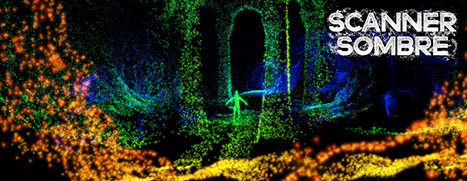
A spectrum of colour helps you parse the terrain with bluer areas being far away and reds indicating what’s nearest. Yellows and greens mark out the middle ground. It’s an atmospheric game although it cleaves to a narrative I wasn’t particularly interested in. That said, it managed to get under my skin to the point where I quit out forever about halfway through because I was TOO SCARED. But the art style is the thing which drew me in and which continues to absolutely fascinate me. Chris Delay, one of the studio’s directors, was on hand to talk more so we delved into particle systems, maps and the secret mouse button function: … [visit site to read more]
Scanner Sombre is Now Available on Steam and is 20% off!* Inspired by Gone Home and Dear Esther, Scanner Sombre is a cave exploration experience. With stunning visuals and a terrifying theme, it is the 6th major video game released by Introversion Software - creators of the BAFTA
Scanner Sombre is Now Available on Steam and is 20% off!*
Inspired by Gone Home and Dear Esther, Scanner Sombre is a cave exploration experience. With stunning visuals and a terrifying theme, it is the 6th major video game released by Introversion Software - creators of the BAFTA award winning Prison Architect as well as Uplink, Darwinia and DEFCON.
We are very excited to announce that our sixth game ‘Scanner Sombre’ is finished, and is launching this Wednesday 26th April! Watch our launch trailer here: Scanner Sombre began life as a short experimental prototype, created in a little over a week during the long Prison Archite
We are very excited to announce that our sixth game ‘Scanner Sombre’ is finished, and is launching this Wednesday 26th April! Watch our launch trailer here:
https://www.youtube.com/watch?v=8NFlo9FEfaY
Scanner Sombre began life as a short experimental prototype, created in a little over a week during the long Prison Architect alpha. We wanted to create something completely different to Prison Architect, and very different from any game we’d made before. Scanner Sombre is intended to be a deeply atmospheric experience, inspired by similar games such as Gone Home, Dear Esther, and Proteus.
Armed only with a LIDAR gun, you must explore and ultimately escape the cave. As you explore your ‘point cloud’ becomes more and more detailed and expansive.
Scanner Sombre will be on sale on Wednesday 26th April. The price will be $11.99, reduced to $9.99 for launch.
We hope you enjoy playing our latest game! http://www.scanner-sombre.com
Stay up to date: Subscribe to our Blog Subscribe to our Youtube channel Follow us on Twitter Join our mailing list Follow our twitch.tv livestream - we sometimes code live on twitch
We are very excited to announce that our sixth game ‘Scanner Sombre’ is finished, and is launching this Wednesday 26th April! Watch our launch trailer here: Scanner Sombre began life as a short experimental prototype, created in a little over a week during the long Prison Archite
We are very excited to announce that our sixth game ‘Scanner Sombre’ is finished, and is launching this Wednesday 26th April! Watch our launch trailer here:
https://www.youtube.com/watch?v=8NFlo9FEfaY
Scanner Sombre began life as a short experimental prototype, created in a little over a week during the long Prison Architect alpha. We wanted to create something completely different to Prison Architect, and very different from any game we’d made before. Scanner Sombre is intended to be a deeply atmospheric experience, inspired by similar games such as Gone Home, Dear Esther, and Proteus.
Armed only with a LIDAR gun, you must explore and ultimately escape the cave. As you explore your ‘point cloud’ becomes more and more detailed and expansive.
Scanner Sombre will be on sale on Wednesday 26th April. The price will be $11.99, reduced to $9.99 for launch.
We hope you enjoy playing our latest game! http://www.scanner-sombre.com
Stay up to date: Subscribe to our Blog Subscribe to our Youtube channel Follow us on Twitter Join our mailing list Follow our twitch.tv livestream - we sometimes code live on twitch
First-person spelunker Scanner Sombre will launch this very Wednesday, April 26th, developers Introversion Software announced today. They’re sending us to explore a deep and dark cave network with the aid of a LIDAR scanner that visualises the world with squillions of coloured do
First-person spelunker Scanner Sombre [official site] will launch this very Wednesday, April 26th, developers Introversion Software announced today. They’re sending us to explore a deep and dark cave network with the aid of a LIDAR scanner that visualises the world with squillions of coloured dots. It’s a curious game to see from Introversion, who are known far more for exploring systems than places in games like Prison Architect, Uplink, and Defcon. I like the concept and look but I have premonitions of lurking horrors and do not want to know. … [visit site to read more]
After developing Prison Architect for six years, three of which were in Early Access, developer Introversion Software's next game is getting a much quicker turnaround. In fact, the first-person exploration game called Scanner Sombre will be coming out this Wednesday, April 26. No
After developing Prison Architect for six years, three of which were in Early Access, developer Introversion Software's next game is getting a much quicker turnaround. In fact, the first-person exploration game called Scanner Sombre will be coming out this Wednesday, April 26. No Early Access, no beta, just a full launch later this week for what Introversion's lead designer Chris Delay tells us is a "palate cleanser" after Prison Architect.
Scanner Sombre uses a unique visual mechanic that mimics a real-life LIDAR scanner. The game's world is completely invisible, but you can send out thousands of points of light to cover the landscape and slowly reveal the space around you. Delay told us the whole game is essentially one giant particle cloud with no limit to the number of LIDAR dots you can create, and every dot's position is saved exactly where you put them. A rainbow color scheme indicates distance and depth as you slowly work your way through the game's mysterious cave system.
Scanner Sombre is a shorter game compared to ones Introversion has made in the past, obviously with a much shorter development cycle than Prison Architect, and Delay said that was the goal from the very beginning. "We've actually spent longer on it than we initially intended. We wanted it to be a really quick turnaround, nice breath of fresh air, nice palate cleanser as we called it internally."
It was also apparently no small task to get this particle effect working. "It was really hard," Delay said. "It took us ages. We started out using a particle system that stopped working after about 10,000 particles, and then ended up [restarting] basically entirely from scratch just so that we could have enough particles on screen to make it look as dense as it does."
We'll have a full review of Scanner Sombre when it comes out on Wednesday. You can read the whole interview here with Delay and Introversion's producer Mark Morris, where they talk about the inspiration behind the LIDAR effect, the game's incredible audio design, and how they feel about Prison Architect "clones" like RimWorld.
After six years of working on Prison Architect , developer Introversion Software announced today that its next game would be coming out in just a couple days on April 26. Scanner Sombre is a short first-person adventure game with one of the most unique mechanics I've ever seen: t
After six years of working on Prison Architect, developer Introversion Software announced today that its next game would be coming out in just a couple days on April 26. Scanner Sombre is a short first-person adventure game with one of the most unique mechanics I've ever seen: the game's world is pitch black, and you have to send out thousands of dots of light using a LIDAR scanner to reveal the terrain around you.
It's a beautiful game, and we'll have a full review when it launches this Wednesday. But before that I got a chance to speak with Introversion's lead designer Chris Delay and producer Mark Morris about the inspiration behind Scanner Sombre, its incredible audio design, how making games is (and has always been) hard, and how working on the studio's sixth game was a "palate cleanser" after Prison Architect.
PC Gamer: Where'd you get the idea to make a game with this LIDAR mechanic?
Chris Delay: It's quite an old idea, it's a pre-Prison Architect idea actually. And although it may seem like an odd source of inspiration, it's actually based on a music video that was made by Radiohead. They used this crazy LIDAR effect to kind of—they got hold of some city data or some data of buildings and trees and things, and they just kind of had it blowing around in the wind whilst this Radiohead track was playing over it making everyone really sad.
There's just something about the look of it that I really like, like all humanity has been taken out of it somehow and all you're left with is just the raw data of what's in the area. I just really wanted to use it to represent a game world, you know? Because I thought that we would be able to create a really strange atmosphere and a really strange feeling in the players when they were playing in that in that world.
How'd the structure around that mechanic come around then?
We're trying to create a certain feeling in the player, and I wouldn't quite want to say exactly what that feeling is...
Chris Delay
CD: During Prison Architect we were getting a little bit burned out, and so I took a month out from Prison Architect and I took Alistair, our audio guy, and Leander, another programmer, and we kind of just holed up in my house for like a month and made these two prototypes. And one of them was Scanner Sombre, and the other one was a bomb defusal game called Wrong Wire, and I think we prototyped Scanner Sombre in about eight days. And that was the first time we had taken the concept of a world rendered in LIDAR or a world rendered as a point cloud and actually made a game out of it. Because it seemed to me that you would naturally need to have a reason as to why there's absolutely no light. Like why can't you just see the geometry around you? Why can't you see everything? Well the answer in this particular case is that you're so deep underground that there is no light.
Scanner Sombre has suspenseful, almost horror-like moments, but it doesn't feel like that's really the point of the game—it doesn't seem like that's its genre. What are you hoping people would get out of it?
CD: Yeah, I think you're right. We do have a little bit of horror because the mystery of it and the atmosphere of it lends itself quite well to horror. And I'm very well aware that we could have done a lot more horror if we really wanted to. But I really didn't want to. I really didn't want to do a 'jump scares in the dark' type game. There's plenty of them around. I just wanted to be a little bit more like an atmospheric kind of a mood piece, so it would be uncomfortable and it would be unnerving but it wouldn't be full on horror.
The "shadow" behind this figure is just a product of it blocking LIDAR particles from that angle.
We're trying to create a certain feeling in the player. And I wouldn't quite want to say exactly what that feeling is, but it's certainly very different from the feeling of playing Prison Architect. I guess it's like exploring a strange place, you know? Exploring somewhere that not only you've never been to but also looks completely different, like the effect of just seeing it as a rainbow point cloud creates a feeling in you that is very different from just having like a small flashlight that has a really limited range. It creates a very different feel, because you can't see anything but at the same time you can kind of see everything all around you, like everywhere you've been.
From a technical standpoint, how'd you go about implementing the LIDAR effect? I imagine saving the position of all those teeny tiny dots and having what seems to be an infinite number of dots possible on the screen would be demanding.
CD: Yeah, it is. It is. I don't know how to describe it, it is just a giant particle system. And people have been saying, "Why on Earth do we have to have unlimited particles? Why can't we just cap it or something?" But a lot of effort behind-the-scenes has gone into making it possible to have this enormous particle cloud. And if you look behind you [in the game], everything you see is all the particles that you've created and scanned. It's almost like you've painted the whole map yourself.
Scanner Sombre's map shows you every tiny dot you've placed, exactly as you left them.
Mark described it as programmer art because you don't see any of the visuals that we've created. All you can see is the cloud of points that you've created by walking around with this gadget. And yeah, that's the short answer. Yes, it was really hard. [Laughs] It took us ages. We started out using a particle system that stopped working after about 10,000 particles, and then ended up [restarting] basically entirely from scratch just so that we could have enough particles on screen to make it look as dense as it does.
It was stunning to look back at the in-game map and think, "Those can't possibly be all the exact dots I placed, right?" But they are, and it makes the levels feel very personal.
[The map] really is all the points that you've created, it's definitely not faked.
Chris Delay
CD: The map is definitely there to help for a lot of different reasons, but part of it is just that it's such a nice way to visualize the location as well. And it really is all the points that you've created, it's definitely not faked. I've never really seen a video game map like that, you know? When you go at the video game map, it's normally a much simpler polygonal-type flat surface with some ramps and things, and you can tell it's been modeled separately. I really didn't want it to be like that, I wanted it to look like a real LIDAR scan that you were looking at, that you could spin around and move the camera around and view it from different angles.
You mentioned the Wrong Wire prototype, which is actually available to play within the game, but what made you choose to do Scanner Sombre over it?
Mark Morris: Chris very much likes to go and sort of do his own thing and rebel a bit. And often he'll do that whilst in the middle of critical phases on other projects. I think it's kind of part of his sanity is to take that time away and flex his creative muscles. And this time, for the first time actually—
CD: [Laughs] It's like you're speaking about your own child when you're discussing this. “He occasionally likes to act out.”
MM: Yeah, that's how you behave. [laughs]
CD: "It's all part of his charm, really. We like him, really."
MM: So Chris does that and this time, at the end, he sat me down with Scanner and Wrong Wire and said "you know, Mark what do you think we should take forward?" And my view is more a sort of commercial point of view, Chris is all about creativity, and both of us felt that Wrong Wire was probably the most commercial of the two—the safer bet if you like. But even the very first prototype of Scanner, I found it to be really emotionally engaging. We were just in a coffee shop in London, and I finished my 20-minute play through with loads of people around and I was sweating all over. It just really got under my skin. And even though we sort of put it on the backburner a bit and thought, "Well, that's alright, but Wrong Wire is better," we showed it to the team and the team kind of had exactly the same reaction. They said, "Well, I think that Wrong Wire is going to be a bigger game, it's going to find a market easier. But there's something quite unique and special about Scanner."
I think it's probably been the most rigorous process we've ever applied to deciding on an Introversion game.
Mark Morris
And that's when Chris and I started thinking, "Well, hang on a second; actually making a game that touches you in that way is very, very difficult, and it's very, very difficult to design for that." You can't really put down in your design brief, "It's going to be emotionally stimulating" or whatever, that just kind of happens I think. Which is why we thought, "Well, we've got [EGX] Rezzed, we've got this consumer show, we're going to have a thousand people or something coming through the doors over the three days. Why don't we test out what we think about the game with them?" Rather than saying, "What do you think the next game should be?" Because that sort of suggests that the other one will never be made, we just asked them, "What game do you think we should work on next?" And about three quarters of them said, "We think you should work on Scanner Sombre next." So we took that as good confirmation of the way we were leaning.
And then finally, we did do a kind of online vote with a couple of videos just to rule out that we were telegraphing to people that we really wanted to do Scanner at the show. Just off the back of a couple of videos, what do the interwebs think? And the results of that were about 50/50, and we kind of felt that that was a very positive indication that there were a lot of people out there who were interested to play Scanner. So that was the process that we went through this time to down-select, if you like. I think it's probably been the most rigorous process we've ever applied to deciding on an Introversion game.
On the next page: Why Scanner Sombre is a "breath of fresh air" after Prison Architect, how their audio guy went "absolutely mental", and what they think of games like RimWorld.
Were you surprised that there was such a positive response to the game?
CD: It's hard to say. I mean I'm always a little bit surprised, to be honest. I can never really predict what people's responses are going to be. I think that there's something magical about it when you first see the colours and you see the depth. You scan the first room that you're in and it just looks like a load of noise, and you can't really see anything. But then as you move, and you see the points moving around you, you start to see the layout of the room and the depth of the room. There’s something kind of weirdly magical about that. And I definitely thought that at the start, and I just wasn't sure if other people were going to feel the same way.
It's completely the opposite end of the spectrum to Prison Architect, and it's a real breath of fresh air.
Chris Delay
I'm really quite glad we picked this one. I think because it's such a different game to Prison Architect as well. It's completely the opposite end of the spectrum to Prison Architect, and it's a real breath of fresh air, you know? But at the same time it's also way out of our normal comfort zone. We've never really done a first-person game before, we've never done a game where you're walking around a 3D environment, exploring it. We've never really done anything like this game internally, so it's all been quite new and I think that's been really good.
Scanner Sombre is not only a big shift from Prison Architect in terms of gameplay, but also development time. You spent six years on Prison Architect, whereas this is coming out on Wednesday.
CD: Yeah, it's fucking cool though, right? [Laughs] We're actually releasing something in a reasonable time frame for the first time ever. I think Defcon was the only other game that we ever did in a year or less. I think we really wanted it to be that; we've actually spent longer on it than we initially intended. We wanted it to be a really quick turnaround, nice breath of fresh air, nice palate cleanser as we called it internally. It would be our sixth game, but it wouldn't be like this behemoth like Prison Architect. It would just be something really strange and arty and creative, and we would just run with it and not think too much about what we were doing—just try and do something creative.
Why did you want to go that way? Why not make this LIDAR mechanic part of a larger game?
CD: It doesn't really work like that for us. It doesn't really work in the sense that we would come up with a LIDAR mechanic and then try and craft an enormous game around it. We knew that it's just one mechanic, and so I think if we tried to extend it over this enormous game, it would have probably outstayed its welcome in quite a serious way. It's kind of a visual style to some extent as well as a game mechanic, so the whole game is built around that.
One thing that stood out to me is that you backup the visual mechanics with some really phenomenal sound design. Was that an important part of the game?
CD: Yes, it is. Sound is absolutely critical in this game. I mentioned originally that when we did the prototype I took one of our programmers, Leander, and I took Alistair, audio guy, because I knew the audio was going to be 50% of the game as far as I was concerned. Because you can't see anything, but there's no reason why you can't hear exactly what you would hear if you were there, and you can get all these hints from the size of the room that you're in and the terrain that surrounds you just from listening to the sound. And Alistair Lindsay has been an audio guy since Darwinia, so he's done the audio on every project of ours. So he did all the Darwinians by getting cats to scream and mewl and stuff, and he did all the music in Defcon, he did Multiwinia. He's just been with us for almost everything we've done.
[Audio designer Alistair Lindsay] just went absolutely mental on this game, there's no other way to describe it.
Chris Delay
MM: I'm not sure he got cats to scream, mate. He might have used samples of it, but if he was actually screaming cats, that would probably be— [Laughs]
CD: [Laughs] Oh yes, I forgot. Oh yes, yes. It wasn't a real cat, that's what you're saying. The cat was already injured. How about that? Should we go with that? [Laughs]
MM: Yeah, that's right. [Laughs] He just captured the injured cat.
CD: Yes. Maddie the cat, I believe the cat's name was. It just made these really strange sounds, it was perfectly healthy. I'm digging myself further into this hole. [Laughs] Moving on from the Darwinian cat. Yeah, Alistair just went absolutely mental on this game, there's no other way to describe it. He told me that this was basically his dream project. It's classic audio designer, he wanted a video game where there were virtually no visuals so it would just be audio selling everything. And the things that he did—I mean the footsteps allude to it, there's got to be hundreds and hundreds of different footsteps, different types of like 'walking fast', 'walking fast on gravel', 'walking fast on stone', 'stepping on wood', 'falling on wood', 'landing on wood', [laughs] 'turning on wood', it just goes on forever. He just went completely beyond the call of duty on this game and the results are just amazing.
It also gives you the emotional meaning of each level as well, and so the moments when it's quiet or the moments when it's anxious or the moments when it's scary are almost entirely coming from the audio, because nothing's really changing in the visuals. I think that Ali is basically our secret weapon. Ages and ages ago, back on Darwinia, I remember telling him that I thought that his audio made all the animations look better even though we hadn't changed the animations. They just looked visually better when they had Al's audio attached to them.
Introversion has been around for 16 years now, what's it been like to watch the indie dev revolution over the last few years?
MM: When we first started, our real crusade was the tyranny of the big publishers. We've grown up during the '90s… everything was very similar, reskins, clones, sequels. The publishing developer model I think was... 'fundamentally broken' is what I would have said at the time, you know, on stage and very vitriolic. But what it did is it only allowed a certain subset of games to be made.
I don't think [game developement is] any harder than it's ever been... this has always been a very difficult industry to thrive in.
So when the the revolution sort of started, and I'm going to quote World of Goo [as the start]. That was the first time (and we launched Multiwinia at the same time) that another small studio released something that was a hit. That was the wake up call for us. And at the start, for the first seven or eight years of our business, we traded on being like the smallest game development team in the world, and so therefore, play our stuff and help us out because we're tiny. And suddenly all of that went away. Suddenly we're just one in a sea of indies all producing great, creative output. And once I'd sort of realized that, actually, it didn't matter that we weren't the only tiny team anymore, it was just wonderful to see the creativity and the number of games that are being made nowadays.
It is interesting to me, having been in the industry for 16 years, monitoring some of the conversations and the complaints and the whining. "Oh, it's so difficult to get press to cover your game." It's always been difficult. It's always been hard. Pre-Valve, just getting the game in the hands of customers was a really tough problem, working with retail and all the rest. And Valve kind of made that problem go away, and then, you know, obviously XBLA and PSN came along and back-filled that. And the problem now is one of getting awareness out for a game, and yeah, it's very, very difficult indeed to do that. But it's better than it used to be. In the old days, if I wanted a million people to hear about me, I needed to—I don't know—have some kind of crazy relationship with the BBC or something that I didn't have. Whereas nowadays there are tons and tons of YouTubers out there, all of whom have hundreds of thousands, millions of subscribers.
Internally we had the discussions about whether we should do School Architect and whether we should do Airport Architect and all the rest of it...
Mark Morris
Now I'm not saying it's easy, I'm really not. I'm just saying I don't think it's any harder than it's ever been. And that's something that I sort of sit at the back sometimes at conferences listening to panels and things, listening to the perceived changes in the industry that suddenly made it impossible to be a success. And I look and I think it's always been like this, this has always been a very difficult industry to thrive in.
So it's just as difficult, but with different specific challenges.
MM: Yeah, exactly. So I don't need to worry about getting paid from retailers anymore. In the old days I would have to spend part of my time just chasing money from unscrupulous retailers who just wouldn't pay it. That's all gone. Your Steam back end, you get paid monthly. I mean we used to get paid a month after the end of the quarter, so you had a cashflow issue that you had to wait four months before you were going to see any money from your sales.
I think my summary is that the problems have moved, but nowadays we've got a lot more levers to pull. There are a lot more potential solutions to these problems, whereas the old days it literally was get in the elevator with the buyer from Walmart or whatever and you've got 20 seconds to get him to take your game. That's what it was like when we first started. And I'd much rather have the same problem being "there are 100 YouTubers who I need to get to cover me, I've just got get one of them or two of them."
RimWorld
How do you feel about so many other indie developers using Prison Architect as a model nowadays? Games like RimWorld and the more recent SimAirport are clearly heavily inspired by it.
MM: Yeah, it's interesting. I feel great about it. I certainly don't feel, and nor does Chris, like jealous or kind of embittered or, "Oh, look at that, they're ripping us off." It's very much more you do something, and obviously Prison Architect just blew away our wildest expectations and just did really well, and you realize you've tapped into something that just resonates for so many people. And then that's why you get—I mean, you could call them clones I guess, or just people that want to explore construction sims and god games in the same way. I guess part of it is that because we grew up with all those great Molyneux classics like Theme Hospital and all the rest back in the day, we don't feel like we invented this genre.
You know it would be great for me to sit here and go, "Well, we created this amazing new genre and everyone is copying us, and that's brilliant." We sort of feel like we just reminded everybody that it was there, you know? It had always just been sitting there, and then we just came along and thought "well, no one's ever done that with prisons." Did it, and it really resonated. And internally we had the discussions about whether we should do School Architect and whether we should do Airport Architect and all the rest of it, and then obviously we decided to go down a different path than that.