
Your hand is in the world now: the towns ask you for works and raise them themselves, blessings rest on the things you touch, four new powers join the bar, and towns grow into their land instead of arriving full-grown.
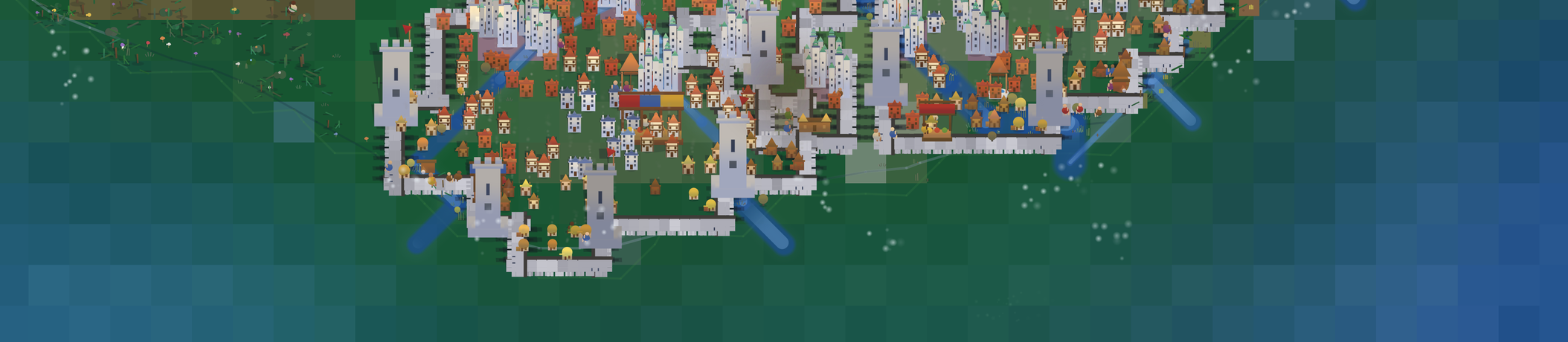
You can ask a town for a work. Walk among your people, name the ground for a Well, a Granary, a Bridge, a Terrace, a Cistern, a Shrine, a Kiln, a Market Green, a Watchtower or a Hallowed Yard, and the people decide whether to raise it — the asking is yours, the raising is theirs. Every work you named is in The Works, and a click takes you to it. The tutorial teaches the asking at the door, in your own words: “You may ask.”
Blessings rest on things and stay while they stand. Seven of them — a Blessed Hearth, a Vocation Dream, a Witness Tree, First Fruits, a Gathering Ground, a Shared Table and the Herald — and everything you have blessed is listed in Blessed Things, where every row takes you to it. A blessed table gives its town a feast day; stand among them and the street gathers to eat together. Bless a herd with a Herald and you can watch the blessing work: inside the wardstones the herd fills out while the country beyond stays thin.
Portents, and what the street needs. Write a sign on the sky over a place — a comet, a strange dawn, wheeling birds — and the people beneath read it; some heed it and act, and those who do are remembered. A chip on the bar counts the needs standing legible right now — a household short of its want, hands waiting at a stalled work, an appointed day held — and opens a panel that takes you to each one. Three quiet powers put a thought in a sleeping mind, and sometimes the waking act follows.
Four new powers. Strike Fire: put flame on the ground and from that moment the fire is the world's, walking with the wind through old forest and dying on thin grass, the ash coming home as fertility; soaked ground and snow refuse you, and say why. Hard Frost: killing cold on a region that lifts on Warm Region's own clock. Cut a Channel: drag a ditch and, if the water finds it, you have a river — and the ground you drained goes thirsty for it. Cleanse: plague now marks sick ground and streets, and Cleanse lifts it. The bar is in a fixed order now — land, weather, people, ruin — and a new power joins its end, so the shortcuts you learn stay where they are.
The power bar tells you before you click. Hover a power and it says what it needs; with a power armed, the ground under your cursor answers before you click, in the same words the world would have said after. When a power cannot land, the reason rises where you tried to cast it. When it lands, its name rises from that spot with what it changed. A stalled work now names the power that would answer it, and a warning pin on the map flies you there when you click it.
Towns that grow into the land. A new village starts small and adds neighbourhoods as the land can support them. A town's outline follows valleys, water and slopes, and its wall follows the same outline whether you look from far above or stand among the houses. What a town builds stays where it was built, ruins included. In Free Play a village has to take root before it is a place, so new towns arrive more slowly and keep opening new regions over the centuries. A burnt town's people come home to its heart, and in time its heir founds there again and carries the old name back — except on Emberfall, whose whole story is that everyone dies.
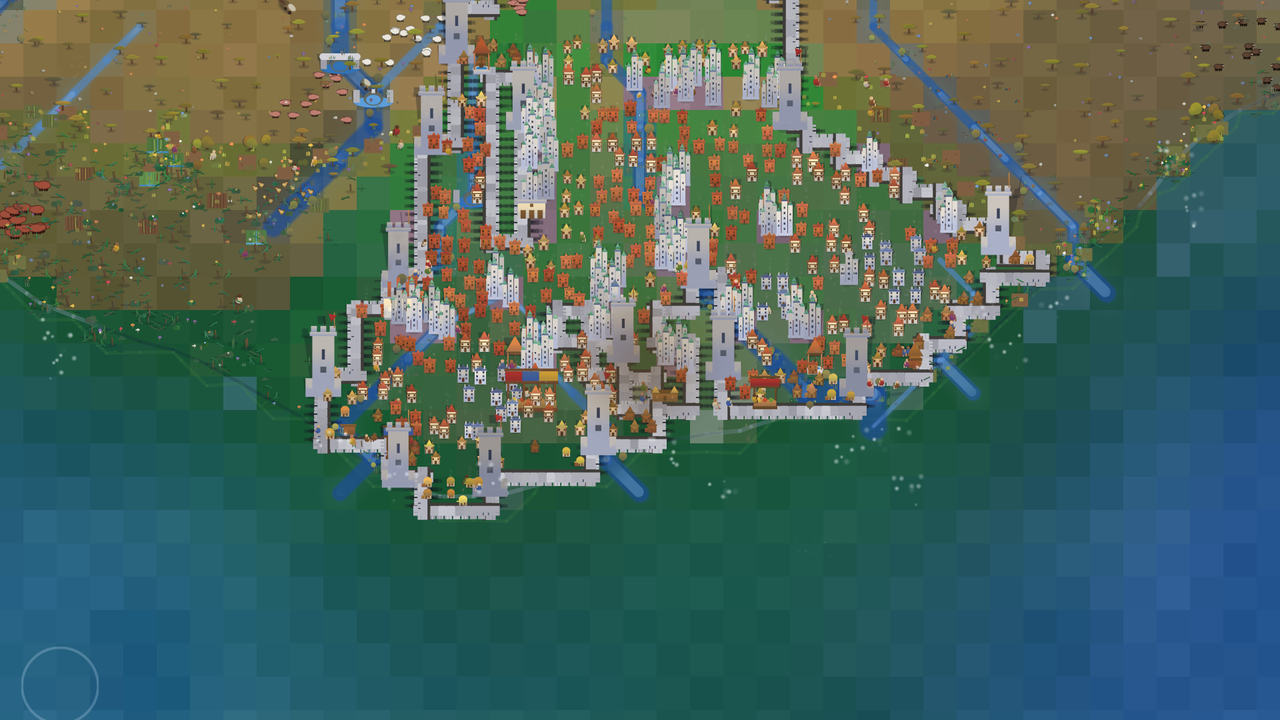
The far map tells the truth. Towns you see when you zoom in are drawn when you zoom out, at the age they actually are; walled towns show their walls at every zoom, and at night every walled town wears a ring of tower lanterns around its glow. A town emptied of its people goes dark inside and reads as a ruin, never as a town asleep; a town that has died leaves its wall standing and its lanterns out. The country is named: nine regions to a world, written on the far map, on the cursor's plate and in the Key, each name true to its land.
The night sky. Pull the view back past its widest until the world curls into its ring, and when your side is in night, a faint band of lights appears above it — your own towns on the far side of the world. Every world has a lantern star that rises on the seed's own schedule, once in six to eight hundred years, and the Chronicle marks its going.
The animals keep to their country. Herds walk around what blocks them, thin at the edge of their range and never vanish, and an animal the world takes falls where it stood. Farm animals keep to the farms. Seals hold their own coasts, elephant herds are seen far more often on their warm wet ground, and no seal or walrus is ever seen in a forest again.
The world answers you in every language. The works your towns raise, the blessings, the Portents and the Feast now speak in all eleven languages. A soul you follow remembers a wound — a town struck, sunk, frozen, burned or blighted — in a grief's own words, not a thanksgiving's. A channel you cut is remembered as the land opening for the water; a fire you strike, as a fire. The Chronicle names the town a turn of the land happened in, and a town is called by one name everywhere.
Quiet teaching. The first time something easy to miss happens to you, a quiet sentence says so, once ever, beside the thing it is about; Settings ▸ Gameplay & HUD lets you set it to All, Quiet only or Off. After the tutorial hands First Valley back to you the world runs at quarter speed, so the first hard season lasts minutes rather than seconds.
Coming back to a world. Continue opens on your own page, The Saga So Far, with the beats of your last chapter marked and your last acts named; click one and the camera goes there. The Library's Saga opens again from its shelf.
Smaller things you will notice. A plain “Rise” button in the nano view. A new game opens on the living layer. The layer bar sits beside the main toolbar. A struggling town still has people in its streets. A right-click no longer empties your peep tracker. Achievements count only in the world you are playing. Small numbers are no longer shown as zero.
Honestly, then.
Your saves carry over. A world saved under an earlier version rebuilds its town layout the first time you continue it, with a notice before the replay; that first load can take longer, and towns may not look exactly as they did.
Known and owned, riding the next updates. In a town that has lost most of its people, the few you see in its streets are part of the scene and cannot yet be followed — the fix is built next: every visible person a person you can follow. The plague's purple ground does not yet say what it is when you hover it, and the sickness is easier to cure than to read. A wall's tower lanterns appear only on the world's biggest towns. The tutorial does not yet teach the asking of works beyond the door.
Nothing here is behind a flag. The staged nano-agency flag is deleted, so every surface above is on for every player.
And nothing in this update is dated. Future work is named here, never dated.