
This update introduces an architectural redesign of the timeline Composer into a dual-pane overview and detail editor, adds 4 modular devices, and enables direct CV modulation on discrete pill and dropdown selectors.
Here is the technical breakdown of the change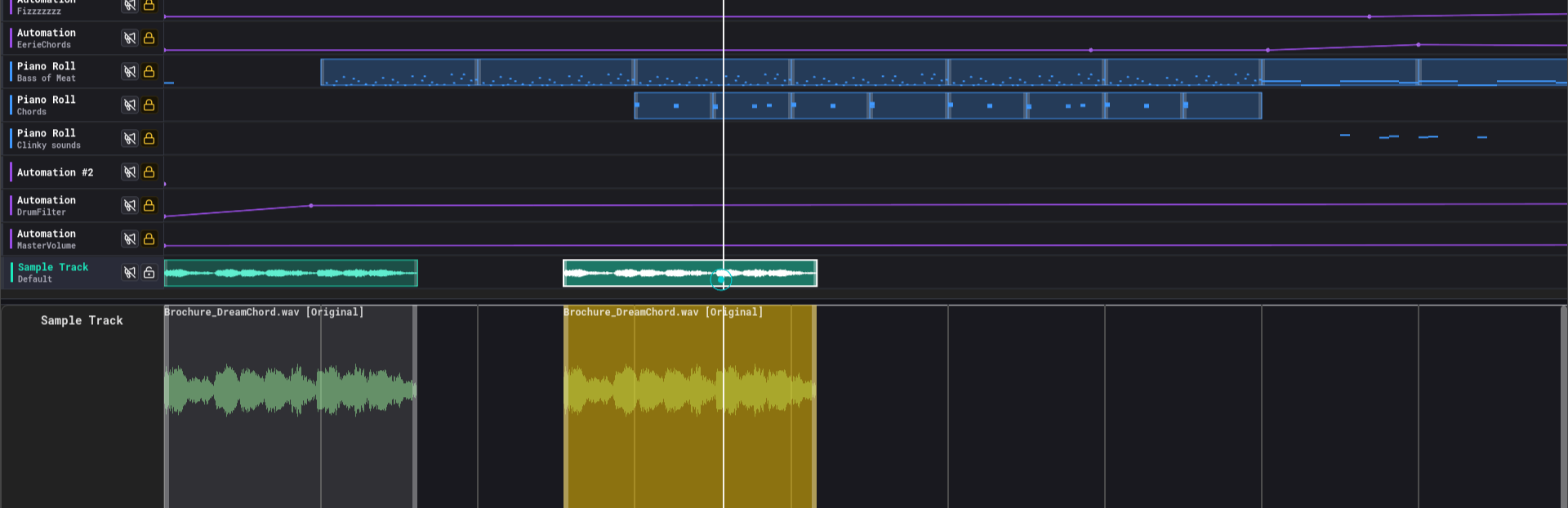 s.
1. Dual-Pane Composer Architecture
The timeline arrangement and detail editing workflows have been decoupled into a dual-pane layout:
Dual-Pane Split: The upper pane renders full-song arrangement tracks as compact 40px strips. Selecting any track opens its full editor in the lower pane (Piano Roll grid, Automation curve editor, or Sample waveform view) without layout recomputation stalls.
Interactive Clip Boundary Resizing: Drag clip boundaries directly on the timeline to adjust start and end offsets without splitting clips.
Marquee Multi-Selection: Click and drag a bounding box across tracks to move, duplicate, or delete multiple clips in one operation.
Real-Time Automation Recording: Incoming knob sweeps, fader adjustments, and external CV signals record directly into active automation lanes during playback.
Canvas Culling: When the Composer overlay is active, background modular canvas draw calls and node updates pause automatically, dedicating CPU and GPU resources to audio DSP and timeline rendering.
2. Four New Modular Devices
Gamepad Device (Hardware Gamepad Control) Provides direct HID input from standard gamepads (Xbox, PlayStation, Nintendo Switch).
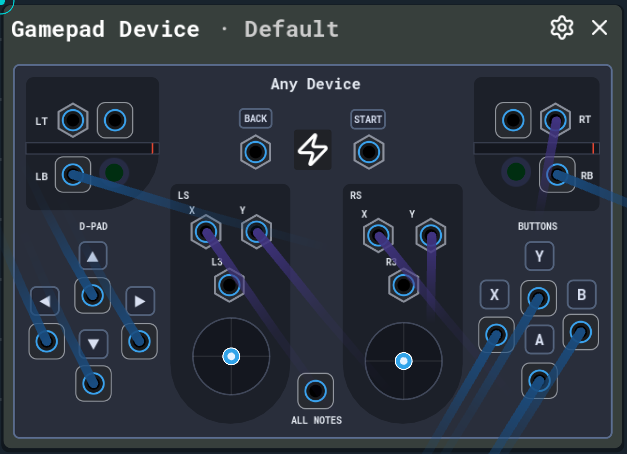
Dual Thumbstick CV: Exposes analog axes as independent bipolar or unipolar CV streams.
Analog Trigger Sweeps: Analog triggers function as continuous modulation or threshold-based gate comparators.
Button & D-Pad Note Mapping: Maps controller buttons to discrete MIDI note pitches or control CV values. Stretch Device (Phase-Vocoder Time-Stretching & Spectral Smear) An STFT phase-vocoder processor for decoupling playback duration from pitch.
Extreme Time-Stretching: Independent stretch factor scaling without pitch shifting.
Spectral Smear Core: Blurs phase coherence across consecutive FFT frames to diffuse transient energy into sustained textures.
Crossfader Device (Dedicated Stereo Audio Crossfader) Utility crossfader with CV-controlled mix position.
Selectable Mix Laws: Linear, Equal Power (+3 dB boost at center detent), Smoothstep S-Curve, and DJ Cut (instant threshold).
CV Modulation: Mix position is fully modulatable via incoming control voltage.
Comment Device (Canvas Annotation) Resizable text blocks for patch documentation, routing diagrams, and performance notes on the modular canvas.
3. Discrete Parameter CV Modulation
Control voltage can now be patched directly into selected discrete parameter selectors (dropdowns and pill buttons):
CV Quantization: Incoming 0.0 to 1.0 CV is quantized and scaled evenly across the available enum options.
Supported Targets: Matrix Arp playback directions, step counts, root keys, scales, and Distortion transfer curves.
*Some selectors are not supported due to the cost of updating values at higher modulation rates.
4. Audio Engine & Architecture Refinements
Calibrated Unity-Gain Knobs: Mixer channel faders, master output, and Crossfader gain knobs calibrated to exact 0 dB unity gain at 12 o'clock center position.
Button Control Upgrades: Added a latching Switch mode alongside momentary Press, plus a Switch In CV port for automated triggering. This allows stateful patch tweaking.
Note Map to Gate: Added a Hold Latest latch mode to hold gate outputs high until the next note arrives.
5. Technical Tips
Gamepad Control: The Gamepad Device converts HID controller inputs into CV. Map analog axes to continuous modulation, analog triggers to CV sweeps or comparators, and buttons to note pitches.
Phase Vocoder Smear: Use the Stretch Device to stretch the sound live without affecting the pitch. Useful for ambient droning and texture generation.
Discrete Modulation: Drop modulation cables onto discrete pill selectors to cycle through settings. The 0.0 to 1.0 CV input is quantized across the target enum range.
Canvas Organization: Use Comment Devices to label signal flow and modular routing on complex patches. Notes support undo/redo and background color categorization.
Latching Logic: Set Button Control to Switch mode for latching behavior, or patch a gate into Switch In to toggle button state via external CV pulses.
Links & Reference
Steam Community Hub: https://store.steampowered.com/app/4765870/Sigilgraph_Audioworkbench/
Subreddit: https://www.reddit.com/r/Sigilgraph
itch.io: https://sigilworks.itch.io/sigilgraph-audio-workbench