
Updated data and fixed a few bugs as follows.
Planetary terrain using Digital Elevation Models (DEM):
Enceladus 200 m
Charon (partial) 300 m
Ceres 410 m
Pluto (partial) 600 m
Earth’s Moon 666 m
Mars 1,000 m
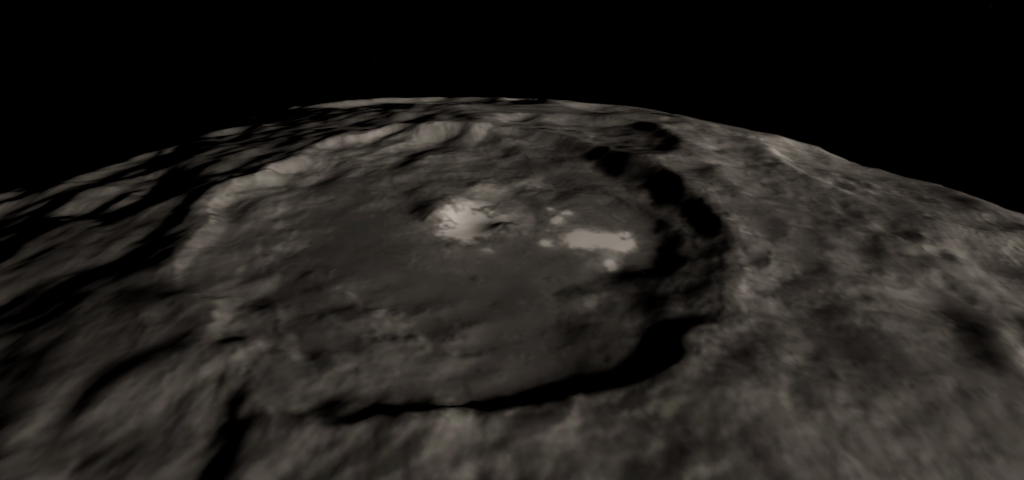 Ceres
Updates and Corrections
More accurate orbits and stellar systems. Exoplanets now follow eccentric Keplerian orbits. Improved orbital-plane orientation, companion-star motion, stellar pole alignment, and tidal-distortion handling make multiple-star systems more consistent.
Smoother VR navigation. Stellar-plane transitions now accelerate and decelerate smoothly. The revised transition path avoids the star dipping and returning vertically, while surface exits preserve the player’s position near the planet.
Better object interaction. Improved VR selection and hand spinning, repaired desktop right-click selection, and made distant-star selection use the same arrival behavior as menu navigation. Manual star selection remains authoritative over automatic proximity selection.
Expanded astronomical content. Added 250 moons across Jupiter, Saturn, Uranus, and Neptune. Expanded and reconciled the confirmed-exoplanet catalogue, added stellar companions, and removed duplicates and unconfirmed planets. Now 6,859 stellar systems and 7,555 individual stars.
More trustworthy scientific information. Updated physical properties, rotations, distances, and orbital data throughout the catalogue. Reworked descriptions and explicitly marked missing or estimated values, including improvements to black-hole and neutron-star systems.
Improved stability and efficiency. Terrain unloading now reliably releases large elevation arrays, meshes, and GPU buffers. Fixed repeated light-meter texture allocations, reduced release-build logging and diagnostic overhead, and limited expensive atmosphere passes to the selected body.