
Observation
Screen Burn · Devolver Digital
- Released
- May 21, 2020
- Platforms
- Last updated
Updates & announcements
 Developer post
- Rock, Paper, Shotgun
The Epic Games Store is having a grand old halloween sale
Is there anything scarier than buying products at below the recommended retail price? Almost certainly, which is why I’d hesitate to call the Epic Games Store Halloween Sale particularly spooky. It is, however, taking a massive knife to game prices across the platform, with some
Original postIs there anything scarier than buying products at below the recommended retail price? Almost certainly, which is why I’d hesitate to call the Epic Games Store Halloween Sale particularly spooky. It is, however, taking a massive knife to game prices across the platform, with some pretty hefty discounts of up to 80% going on a number of range of fantastic games until the sale wraps on November 3rd.
- Developer post
Observation v1.17 Now LIVE, with fixes!
We've just pushed a fresh new build of the game, that introduces a few much-requested features as well as some vital fixes for those on ultra-wide displays/resolutions previously not supported. If you've tried and had issues before with some of these, give it another spin and let
Original postWe've just pushed a fresh new build of the game, that introduces a few much-requested features as well as some vital fixes for those on ultra-wide displays/resolutions previously not supported.
If you've tried and had issues before with some of these, give it another spin and let us know if your issues are resolved. We hope you enjoy the game!
PC:
New Features:- Extended range of supported keys for Key Binding (Keypad)
- Game Resolution options limited to the maximum resolution of their display to prevent other issues
- Improved support for various screen resolutions
- Master Audio Level Slider in Options
- Improved Mouse Sensitivity values on slider in Options
- Achievement support added to various platforms
- A new backspace icon...
Fixes:
- EAS Module Diagnostics back button not responding on certain resolutions
- "Zoom Not Achieved" on several hatch locks when on some ultra-wide displays, preventing progress.
- Cursor 'jumping' around screen when holding R
- Missing text in controls options page.
- Issue with some text characters displaying incorrectly when playing in English on a Turkish system, also causing a progression block.
- Control Glyphs not updating when keys are re-bound.
- Some graphics settings being reset between play sessions
- Some Localisation text fixes
- Control Rebinds not being saved in some versions of the game
- Developer post
Trading Cards now live!
Due to some scheduling and technical issues we were unable to get the Steam Trading Card content approved and live before the launch of the game, however they are definitely now live! Collect the set! Make some badges! Etc! ❤
Original postDue to some scheduling and technical issues we were unable to get the Steam Trading Card content approved and live before the launch of the game, however they are definitely now live! Collect the set! Make some badges! Etc! ❤
- Rock, Paper, Shotgun
Space station thriller Observation has landed on Steam and GOG at half price
Observation , the game that’s akin to 2001: A Space Odyssey if you played the role of HAL 9000, has exited the Epic Games Store airlock after a year of exclusivity. You can find the space thriller over on GOG and Steam now, complete with a tasty debut discount. (more…)
Original post, the game that’s akin to 2001: A Space Odyssey if you played the role of HAL 9000, has exited the Epic Games Store airlock after a year of exclusivity. You can find the space thriller over on GOG and Steam now, complete with a tasty debut discount.
- Developer post
Observation wins "Best British Game" award at the 2020 BAFTA Game Awards!
We are absolutely thrilled to share that at a glittering (home-recorded) ceremony on Thursday night, No Code's Observation picked up the award for Best British Game at 2020's BAFTA Game Awards. In a category full of incredible games, we are truly honored to take this award, and i
Original postWe are absolutely thrilled to share that at a glittering (home-recorded) ceremony on Thursday night, No Code's Observation picked up the award for Best British Game at 2020's BAFTA Game Awards. In a category full of incredible games, we are truly honored to take this award, and it represents years of hard work from a dedicated team.
You can watch the full ceremony here, and don't forget to wish list the game, coming very soon on the 21st May to Steam!
Watch on YouTube - PC Gamer
Observation is great because it understands that less is more
I like my science fiction slow, thoughtful, and creepy, which is why one of my highlights of 2019 was Observation. Riffing on stylish, muted '70s sci-fi flicks like Solaris, Alien, and Silent Running, No Code's game tells its strange, eerie story with real class and restraint. Se
Original postI like my science fiction slow, thoughtful, and creepy, which is why one of my highlights of 2019 was Observation. Riffing on stylish, muted '70s sci-fi flicks like Solaris, Alien, and Silent Running, No Code's game tells its strange, eerie story with real class and restraint. Set aboard a stricken space station, whose design is based on the real-world International Space Station, you play as an artificial intelligence named SAM that has, somehow, become self aware.
While this sounds a lot like 2001: A Space Odyssey: The Game—which the marketing leaned heavily into, including press being invited to a screening of Kubrick's movie—the comparison is ultimately quite superficial. SAM is not HAL. They're both advanced AI struggling with a newfound sentience, in charge of the fragile lives of vulnerable astronauts. But SAM is much more benevolent, with motives that are never really clear—at least until that mind-bending finale.
But even then, a lot is left unanswered—which is, again, another quality Observation shares with the classic sci-fi that influenced it. Dig into the crew's computers and you'll discover enough information to piece together a narrative—but a lot is also left to interpretation, to your own imagination. I really respect this approach and how developer No Code resisted the urge to hand players everything on a plate. Great sci-fi makes you do some of the mental legwork yourself.
The station itself is a brilliantly sinister, claustrophobic setting. I like how No Code set Observation in the near future, because that familiar technology helps ground the game. We've all seen astronauts smiling and floating around in the ISS, which gives exploring a dark, abandoned version of it extra resonance. I also appreciate the amount of research that went into realising the station, with hundreds of tiny details giving those head-spinning corridors a real richness. You could imagine people living and working here before things went bad.
Puzzles are at the heart of Observation, which are all presented in the form of arcane futuristic computer interfaces. No Code founder Jon McKellan was the lead UI designer on Alien: Isolation and brought some of that same utilitarian, retro-futuristic design sensibility to his own game. I found it interesting that he had to break his own rules of usability to create interfaces that were, in the game's universe, designed as readouts for SAM, not humans. This let the designers create puzzles that are as satisfying to figure out as they are to solve.
I'm just glad a game like Observation exists, and that its publisher, Devolver, was willing to take a risk on something so, well, weird. This is a smart, understated, slow-burning game; an anti-blockbuster that asks you to think about what's happening on the screen, not just sit there and passively absorb it. For all those reasons it was never going to sell five million copies. But if you want a game that gives you something a little more nutritious to chew on, it's worth investigating. No Code is already hard at work on its next thing and, after this and similarly unique Stories Untold, I can't wait to see what they dream up next.
- PC Gamer
Observation's devs tell us what it's like to release a game into the wild
After years of pre-production, pitches, and prototypes, then 25 months of solid development, Glasgow-based developer No Code finally released sci-fi adventure Observation in May, 2019. I reviewed it for PC Gamer, calling it a "stylish, understated, and subtly chilling psychologic
Original postAfter years of pre-production, pitches, and prototypes, then 25 months of solid development, Glasgow-based developer No Code finally released sci-fi adventure Observation in May, 2019. I reviewed it for PC Gamer, calling it a "stylish, understated, and subtly chilling psychological thriller", and other critics shared my enthusiasm for the game, which sees you playing as an artificial intelligence aboard a stricken space station.
That’s a long time to work on anything, and I’ve always wondered: what does releasing a game feel like? So I asked Observation’s writer/director Jon McKellan, founder of No Code and former UI designer on Alien: Isolation, about the immediate aftermath of releasing a new videogame to the world.
"We were so guarded during development because we didn’t want story spoilers getting out," he says. "Then on release day you’re watching people playing it on Twitch and it feels wrong. You’ve kept this thing internal for so many years, and it’s been on your mind constantly, and suddenly it’s out in the wild. It’s a really bizarre feeling. The rules no longer apply."
No Code makes weird games. Its debut, horror anthology Stories Untold, was a supremely strange puzzle game based around a series of archaic machines. Observation sees you operating a space station as its governing AI. Nevertheless, both games have sold enough to keep the studio open—and it has, in fact, recently moved to a larger building to accommodate more staff.
Even so, towards the end of Observation’s development No Code was having something of a crisis of confidence. "You lose perspective when you’re working on a game, because you’re so close to it," says McKellan. "And in the last six months, all you’re doing is fixing all the imperfections. They’re brought to your attention every day, so it’s only natural that you start to lose confidence. You only see the bad things."
Critical mass
Observation currently sits at 79 on Metacritic for the PC version and 74 for the PlayStation 4 version. Not too shabby for a niche puzzle game about a malfunctioning computer. “We were really happy when the reviews came in,” says McKellan. "Then a couple of days later people started talking about it on social media and discussing the story. At that point it was clear the game wasn’t a total car crash after all. Maybe we got it right."
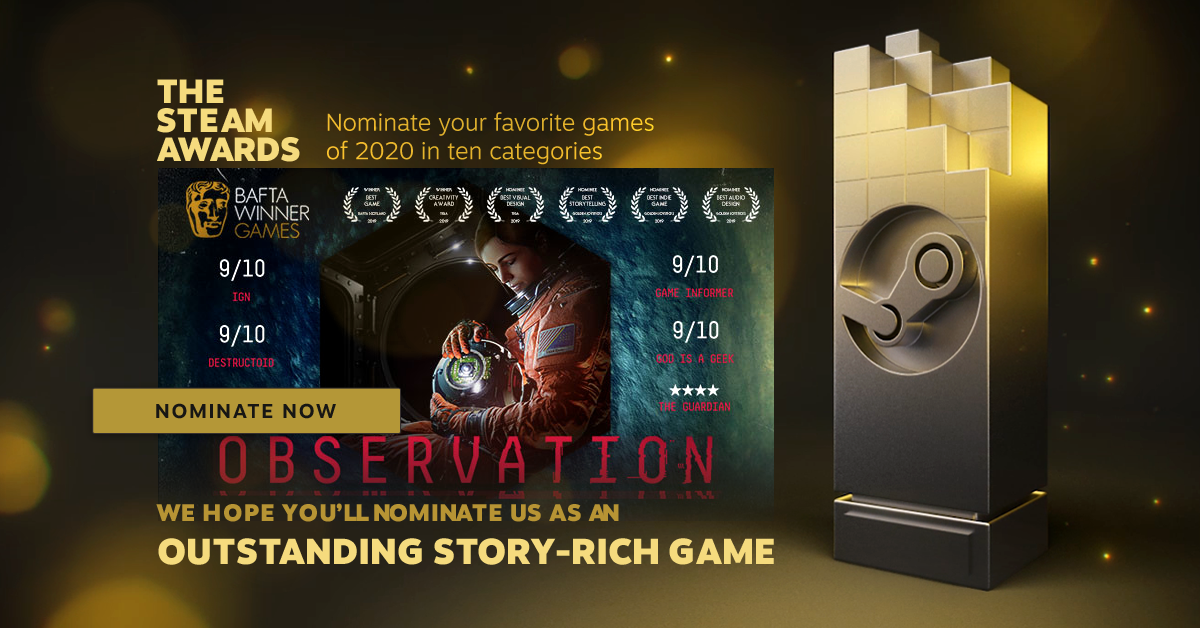
The first review of Observation the team at No Code read was from Game Informer, who scored it an impressive 9/10. "That wasn’t even a punch the air moment for us," says McKellan. "It was more like a massive sigh of relief. We can sleep now!" The game also received 9/10 reviews from Gamespot and Destructoid, although there were some lower scores too.
When the game was launched on Tuesday, May 21, publisher Devolver Digital sent No Code a crate of celebratory champagne. "We decided to down tools," says McKellan. "We were burned out, so we ordered in food, drank champagne, and jumped between random Twitch streams. When someone solved a problem we’d all cheer, or groan when someone got stuck at something, taking a mental note that we might have to patch it."
But Observation’s development was far from over. The game underwent extensive QA testing, but when a game is released to the world, and is played on hundreds of thousands of different PC configurations, unexpected bugs are always going to pop up. "We had stuff like, ‘I’m playing on Windows XP with an ultrawide monitor and this weird thing just happened'," says McKellan. "I can’t even replicate that setup, let alone fix it!
"But by the time the game was released we’d been in bug fixing mode for half a year, so it was easy to stay in that frame of mind. It wasn’t like we started a new phase of development. We just kept going. It can be exhausting, but the joy of seeing people playing and enjoying the game balances it out. That keeps you going. It would have been much worse if the game was poorly received and we had to keep working on it."
I wondered if McKellan was frustrated or surprised by parts of the game where people were getting stuck or lost. "There weren’t many surprises, actually," he says. "A few months before Observation shipped we put the game through a series of focus tests. We had people test the game then submit a written report, and through that we worked out where the main sticking points were. Then we went into the game and changed a few things."
Final frontier
As for the future of Observation, I ask McKellan if he has any desire to tell another story in the space station he and his team spent so long researching and building. "We have a lot of pots on the boil at the moment," he says. "But we did get so used to spending time in that environment, and building it, that it feels a bit weird just throwing it away when you’re done with it.
"Our main takeaway from Observation is that we’re never making a zero gravity game ever again. We’ve been talking about the next game quite a bit and we’re all delighted that it has gravity. That’s like a feature for us."
No Code’s next game is currently unannounced, but it’ll be a step up from Observation in terms of scope. "We were at capacity towards the end of Observation’s development. So after the first couple of months of bug fixing and patches we decided to move. This gives us a lot more options. Now we’re in a much better place."
Subscribe to PC Gamer magazine
This article was originally published in PC Gamer UK issue 336. For more quality articles about all things PC gaming, you can subscribe now in the UK and the US.
- Rock, Paper, Shotgun
Learn about the making of Disco Elysium, Observation and more at EGX on October 18th
Do you like hearing indie devs spilling the beans about the secrets of game design? Would you also like to see the lovely faces of RPS coaxing said developers to spill those beans at the same time? Well then, you better get yourself over to the Rezzed Sessions stage on Friday Oct
Original postDo you like hearing indie devs spilling the beans about the secrets of game design? Would you also like to see the lovely faces of RPS coaxing said developers to spill those beans at the same time? Well then, you better get yourself over to the Rezzed Sessions stage on Friday October 18th at EGX 2019, as we’ll be hogging the stage from 2.30pm onwards as we grill some friendly developers that just happened to walk into our big indie dev net. From the making of NoCode’s space horror game Observation to how to make an RPG like Disco Elysium, here’s the line-up for the second day of EGX 2019, which runs October 17th-20th at London’s ExCeL.
- Rock, Paper, Shotgun
Wot I Think: Observation
Developer: No Code Publisher: Devolver Digital Release: May 21st On: Windows From: Epic Games Store For: 20/$25 I can’t think of another game that has so quickly made me care so much. I’m staring at Emma Fisher, adrift in zero gravity after (another) unknown calamity has buckled
Original postDeveloper: No Code
Publisher: Devolver DigitalRelease: May 21st
On: Windows
From: Epic Games Store
For: 20/$25I can’t think of another game that has so quickly made me care so much. I’m staring at Emma Fisher, adrift in zero gravity after (another) unknown calamity has buckled our space station and briefly disabled my camera feed. I’m looking at what might be a floating corpse, aghast at the idea that I’m responsible for it. She isn’t moving. She isn’t telling me what to do. In some ways, I’m more lost than she is.
I’m the AI, you see.
- PC Gamer
Observation review: A chilling sci-fi thriller
The space station Observation has broken away from its Earth orbit and is drifting somewhere near Saturn. Its systems are malfunctioning, a fire has broken out, and the on-board artificial intelligence, SAM, is acting strangely. Things are not looking good for Dr. Emma Fisher, th
Original postThe space station Observation has broken away from its Earth orbit and is drifting somewhere near Saturn. Its systems are malfunctioning, a fire has broken out, and the on-board artificial intelligence, SAM, is acting strangely. Things are not looking good for Dr. Emma Fisher, the reluctant, resourceful hero of this sci-fi thriller from the studio behind Stories Untold.
But what's interesting about Observation is that you don't play as Fisher. Instead, you play as SAM, her AI helper. The station is an extension of you, and its cameras are your eyes and ears. You can, when asked, open doors, cycle airlocks, assess damage, and all manner of functional duties. But something seems to have awoken in you. A flicker of self-awareness, perhaps. And an ominous command from an unknown party has infiltrated your programming: BRING HER.
The Observation is reminiscent of the real-world International Space Station: a strangely low-tech warren of claustrophobic corridors with no up or down, littered with laptops, science equipment, vacuum-sealed space food, and the personal effects of the crew. Who, by the way, are also missing. There's a powerful sense throughout that, until very recently, this place was bustling with life. People performing science experiments, socialising, watching the Earth looming below. Fisher is alone, but as she floats through the station in zero gravity there are echoes of the vanished crew all around her.
Fisher is justifiably distressed by the discovery that she has somehow, inexplicably, ended up almost 900 million miles from where she's supposed to be. But she's also a trained astronaut and immediately sets to work repairing the stricken station—with your help. At any time you can pull up a schematic of the Observation and jump between stationary cameras, panning and zooming and scanning for objects of interest. The game is largely silent except for the ambient rumble of the station and the whirring and clicking of these cameras, which is enormously atmospheric and quietly unnerving.
You can pull up a schematic of the Observation and jump between stationary cameras
Observation also makes subtle use of video effects, with simulated interference, grain, and distortion giving the image a tactile, analogue quality. This along with the grounded realism of the station, as well as some beautifully natural lighting, makes for a remarkable looking videogame. It also reinforces the idea that you're playing as a machine, viewing your small world through the curve of a lens, and that the technology wired through the wounded station is as fallible as anything else. This feeling of being at the mercy of technology, with only a thin layer of aluminium between you and an endless cosmic void, adds an undercurrent of tension.
When you've located something Fisher is looking for with one of your cameras—a damaged module, say, or the source of a fire—you can respond to her request. SAM will answer in the kind of calm, reassuring, but also slightly unsettling voice so beloved by sci-fi AI. She will also ask you to unlock jammed doors, recover data from laptops, and reboot systems, including re-establishing communications with Earth and activating a tracker to find the lost crew.
SAM isn't always confined to the Observation's network of cameras. In some parts of the game you can possess guidance spheres: little orb-shaped drones that allow you to fly freely around the station, interacting with things the same way you can with the cameras. Flying takes a bit of getting used to, particularly when it comes to orienting yourself in a place where up and down is an outdated concept. But the spheres are the best way to explore the station, poking around for hidden documents and audio logs that will help fill in some of the blanks of the game's enigmatic story. But more on that later.
More than once I found myself reaching for a pen and paper
The Observation is a place worth exploring. The station is made up of four sections: Salyut 10, the Russian arm; Horizon, the European and American arm; Shenzhou XII, the Chinese arm; and Universal, a central hub shared by the entire crew. Each section of the station has its own distinctive aesthetic, atmosphere, and personality, reflecting both the nations who built them and the people who live and work there. The station is extremely detailed, from the intricately designed computers and machines that keep it running, down to pens and rolls of tape tethered to people's workspaces.
Finding a problem is one thing, but to fix something that's broken—such as the experimental fusion reactor powering the station—you often have to dive in and get your circuits dirty. The station is governed by a series of arcane, complex computer systems that are beyond even Fisher's considerable talents, leaving SAM to make sense of them. Here the puzzle-solving aspect of the game fully emerges as you attempt to untangle these systems, and more than once I found myself reaching for a pen and paper. It was a little jarring, I must admit, playing as a super-intelligent, self-aware computer, but still having to use a notepad to make up for the limitations of my stupid organic brain.
Each puzzle is represented by a wonderfully stylised interface, with the kind of hard, functional design you'd expect from something that was only ever meant to be accessed by a machine. It's no coincidence that the game was directed by the person responsible for Alien: Isolation's similarly utilitarian AI. Tasks include adjusting a magnetic field in the aforementioned fusion reactor, running diagnostics on your own damaged memory core, fixing the clamps that hold the station together, and rebooting a faulty cooling system. And all of these jobs have their own unique interface and means of interaction, rooted in smart, well-designed puzzles that are immensely satisfying to solve.
Each puzzle is represented by a wonderfully stylised interface
Many of them involve referencing schematics or diagrams which are usually found pinned to walls or hidden on laptops. Other solutions I uncovered more instinctively, prodding at a particular system's sliders, buttons, and other sci-fi doohickeys until it started to make sense. The sheer variety of puzzles in Observation is impressive—both in terms of how you interact with them and their visual design. As a puzzle game it offers a fairly stiff challenge, but nothing that will truly stump you.
The only real struggle I had was getting lost in the labyrinthine, maze-like tunnels of the station while controlling the spheres—at least until I discovered a waypoint system that, when you choose a module on the map, leads you right there. I also noticed while floating around in an aimless daze that the game, correctly guessing I was lost, automatically set a waypoint for me. In general, however, Observation leaves you to your own devices, rarely revealing much about where to go next or how to solve a particular problem. You can ask Fisher to repeat her last command, but a lot of the time this acts more like a cryptic clue or a subtle hint than an explicit instruction.
Observation's other great strength is its story and how it tells it. The influence of 2001: A Space Odyssey is obvious, but not in the way I expected. SAM's rebellion and flutters of self-awareness are not as sinister or immediately obvious as HAL's. Instead, it's in the restraint of the narrative where I felt the strongest echoes of Kubrick's austere sci-fi epic. Observation's plot is incredibly compelling, with a fascinating, mind-bending sense of mystery that kept me hooked from beginning to end. But it never spells anything out for you, encouraging you to think and observe as the story slowly unfolds.
You can fatten your understanding of the plot up with those optional audio logs and documents, but even then a lot is left to your imagination. My only gripe is that I never really felt like SAM was experiencing any kind of moral conflict, or that he was battling the mysterious forces invading his programming. In fact, he's not much of a character at all, which I found a little disappointing. Fisher is the heart and soul of the game, really, and I felt more connected to her overall. But the important thing is that, long after I finished Observation, I was still thinking about it: the mark, for me, of any great sci-fi story.
I was relieved to discover that Observation wasn't just another horror game set in space. It has the measured pacing, knife-edge tension, and twisting narrative of a great thriller. It's scary, but only under the surface, quietly eating away at your nerves rather than shocking them. And it's the best kind of science fiction: exciting and entertaining, but also making you think about humanity's place in the cosmos and, perhaps, the deeper mysteries of universe.
- Rock, Paper, Shotgun
Epic Games Store starts its first big sale with a Stories Untold giveaway
It’s a busy day over on the Epic Games Store. On top of the expected fortnightly giveaway – this time the excellent horror-adventure Stories Untold – they’ve launched their first big sale. You can snag Stories Untold here for free , and I highly recommend it even if point & c
Original postIt’s a busy day over on the Epic Games Store. On top of the expected fortnightly giveaway – this time the excellent horror-adventure Stories Untold – they’ve launched their first big sale. You can snag Stories Untold here for free, and I highly recommend it even if point & click (or even parser-based) adventures aren’t usually your thing. Developers No Code’s upcoming followup, the space-disaster AI thriller Observation, isn’t out until May 21st but pre-orders are down from 20 to a surprising 7.99/ 8.89/$12.49 in this sale. Many games are similarly discounted until June 13th.
- PC Gamer
Observation is coming in May, but only on the Epic Games Store
Observation , No Code's spooky sci-fi thriller, is only a couple of months away. The Stories Untold developer and publisher Devolver Digital announced the impending release with a flashy new story trailer, which you can watch above. The news was also accompanied by the game vanis
Original postObservation, No Code's spooky sci-fi thriller, is only a couple of months away. The Stories Untold developer and publisher Devolver Digital announced the impending release with a flashy new story trailer, which you can watch above.
The news was also accompanied by the game vanishing from Steam. Now it's just coming to "PS4 and the Epic Games Store", so it looks like Epic got itself another exclusive. It's available for pre-order on the store now.
While Observation is shaping up to be quite a bit different from No Code's previous horror game, both tell their stories unconventionally. Stories Untold plays with text adventures and has you interacting with the world exclusively by fiddling with retro machines and computers. Observation puts you in the role of a space station's AI, rather than a member of the crew. You can still talk, control some of the station's systems and watch through the station's cameras, which should come in handy as you try to figure out why all the humans are vanishing.
Check out Andy's interview with No Code for more details.
Observation is due out on the Epic Games Store on May 21. Like other Epic exclusives, it may end up on Steam and other stores in the future.
- Rock, Paper, Shotgun
Observation no longer observable on Steam [confirmed]
Update: Yup, publishers Devolver Digital today confirmed that Observation will now be exclusive to the Epic Games Store for one year. The good news is that Observation – the intense-looking sci-fi thriller from Stories Untold developers No Code – has a release date. Announced dur
Original postUpdate: Yup, publishers Devolver Digital today confirmed that Observation will now be exclusive to the Epic Games Store for one year.
The good news is that Observation – the intense-looking sci-fi thriller from Stories Untold developers No Code – has a release date. Announced during Sony’s PS4-centric “State Of Play” stream, it’ll be out on May 21st. The concerning news is that the game’s Steam store page has vanished, as has any mention of Steam (or any PC storefront, for that matter) on its official page. Publisher Devolver make no mention of a PC version in their Twitter release date announcement, either. Below, the new trailer for the PS4 version of the game, which admittedly looks very nice.
- PC Gamer
How AI thriller Observation is the spiritual successor to Alien: Isolation
Observation is an upcoming sci-fi thriller from No Code, the team behind horror anthology Stories Untold . In it you play as SAM, an orbital space station's advanced artificial intelligence that has suddenly become self-aware. Something has gone horribly wrong on the station, lea
Original postObservation is an upcoming sci-fi thriller from No Code, the team behind horror anthology Stories Untold. In it you play as SAM, an orbital space station's advanced artificial intelligence that has suddenly become self-aware. Something has gone horribly wrong on the station, leaving it drifting near Saturn, and it's up to you to help survivor Dr. Emma Fisher escape to safety—a job made complicated by the fact that a sinister presence is interfering with your computer brain, and doesn't seem to have Fisher's best interests at heart.
The game is viewed through cameras that litter the station, which you can remotely control. These are SAM's eyes and ears, and through these he can interact with stuff to help (and maybe, later, even hinder) Fisher. You can open and close airlocks, activate devices, read data on laptops, and more. You'll solve intricate puzzles via a series of complicated computer interfaces, talk to Fisher and respond to her commands, and hopefully find a way to rescue her. But the ominous phrase BRING HER keeps appearing on your glitchy interface, suggesting some kind of manipulation from an outside force.
While Observation is not at all like Alien: Isolation mechanically, both games have a lot in common. A future setting where some magical technology won't save you; a general feeling of dread and claustrophobia; beautifully emulated VHS and video distortion; and a distinctive '70s sci-fi atmosphere, albeit with a near-future setting. And this is no coincidence: many of the people who've worked on Observation also worked on Alien: Isolation. And with no proper Isolation sequel planned, this might be the closest we'll get.
Last month I visited No Code's studio in my hometown of Glasgow, Scotland to play an early demo of the game and talk to its creative director, Jon McKellan, about what inspired his team, its spiritual connection to Alien: Isolation, and what it has in store for us when it's released later this year.
PC Gamer: Alien: Isolation had the xenomorph, but the threat in Observation seems less overt. How do you build tension in a game like this?
Jon McKellan: It's tricky, because there's no clear antagonist. The story is more about what you're doing. When it comes to building tension, music and lighting have huge parts to play, of course. But we said right from the start that we didn't want this to be a straight up horror game where you're terrified all the time, because that doesn't lend itself to deeper thinking. It's a surface level fear, worrying about whether you're going to get eaten or whatever.
Isolation was this constant chase, and when that's going on you don't really get a chance to think about anything deep or existential; it's more about the immediate dread of wondering if you're going to die. But here we're trying to do something a bit different and plant these thoughts in the back of your mind. In some cases you'll be forced to do something you're not entirely comfortable with. You don't know what the meaning of what you're doing is, but it's unsettling enough to make you feel like it's a bad thing.
At the end of my demo I was communicating in a bizarre language with some otherworldly presence, and that was pretty unnerving...
It's menacing. You don't know what this thing is, what it's saying, or what you're saying back to it. You don't know anything about it, yet you're compelled to communicate. We looked at stuff like Close Encounters of the Third Kind, where they communicate with the alien craft using music. They don't know what they're saying, and it's concepts like this that really build the tension in Observation, rather than a minute to minute rise and fall. It's a plot-driven tension, which is harder to do. But we do play with that a bit, and some sections in the game are creepy in a more traditional way. As Stories Untold hopefully proved, we're not afraid to jump genre, switch gears, and take you by surprise.
Despite telling a continuous story, will Observation have something of the anthology feel of Stories Untold?
Observation actually started off as episodic, with a similar setup to Stories Untold. It wasn't going to be totally individual stories, but five distinct sections of an experience. But then the story developed to a point where it was hard to fit it into five chunks, and we wanted to do something more full-length. Internally we still refer to each section of the game as an episode, but they're more like acts, really. The first act is about learning what it's like to be an AI, be SAM. The second is more about exploration and getting to know yourself. So there is some of that anthology feel. Certain acts will lean more heavily into certain mechanics to suit that part of the story, but overall it'll be pretty seamless.
You used the word existential earlier—does Observation have a similar tone to those pessimistic sci-fi films from the 1970s?
It's not pessimistic. It's more about questioning what things mean, and the game has, in some ways, more in common with optimistic sci-fi such as Close Encounters or Contact. 2001: A Space Odyssey is a big inspiration, of course, but we're looking at the evolution of Dave Bowman from another angle. What's actually happening there? Who is driving that, and why? We're looking at sci-fi from the '60s and '70s, but we're evaluating it in a different way.
I love 2001 because, in the film at least, nothing is spelled out. It's enigmatic. Is this something you want to bring to Observation?
We talk a lot about the justification for things happening in the game. If something is supposed to be beyond your comprehension, but then we explain it, it no longer has any power. So we're writing things that almost don't make sense, at least on the surface. But it's not a cop out, or a way to let anything go. The characters will acknowledge that certain things don't make sense, so we are pulling it into the story rather than just doing things for the sake of it.
There are answers, and the main answers will come. I hope people will feel satisfied by the end and feel like they've gotten something out of the story. But there's a much deeper level to it, and so much of those answers will be open to interpretation. There will still be things to question. We've built a narrative that encourages you to think about what things mean, and there are things that are never answered explicitly, but have been thought about.
Is the entire game viewed through the lens of SAM?
We haven't shown this yet, but the story actually cross-cuts with another narrative back on Earth, in Houston. The mission controllers are having a kind of tribunal about what went wrong on the station. So everything you're seeing when you're playing the game is past tense, and is video being viewed by these people. It's kind of like found footage in space, and these characters will have their own theories about what things mean, which should give players a few starting points for figuring the story out.
I love shows like Lost that are heavy on mystery and abstract sequences, and I love discussing that stuff and theorising with people. But singleplayer games are more insular, and you don't often discuss them around the watercooler. So the characters in the tribunal kind of play that role. They'll discuss the footage they've just seen, and specialists will propose theories about it.
You've gone for a recognisable near future setting, rather than something in the far flung future. What was the thinking behind this?
We wanted it to feel grounded, which I know sounds stupid in a game where you're floating around in zero gravity. In more futuristic sci-fi you have holograms and other fancy technology that's basically magic, which lets you get away with murder, and lowers the stakes. So we used the International Space Station as a point of reference, because most people are familiar with it.
And when you see Saturn, it's not like EVE Online or something. There aren't colourful nebulas everywhere. It's more like it is in reality: this big, ominous ball hanging in blackness. It's not beautified or dressed up. It's stark. And these details take getting used to a weird futuristic environment out of the equation, so you're left to focus on the story. The ISS is still fairly lo-fi. Some of the laptops are still running Windows XP. And we play with that a bit.
You start in the Euro American Space Agency arm of the station. This looks very similar to the American side of the ISS. But later you move into other arms, which are more themed on the Chinese and Russian sections. So the aesthetic of each arm does change quite a bit. It's all contemporary, so we researched the real thing rather than inventing all new stuff.
In this universe, are AI purely functional, or is it common for them to have the same apparent level of intelligence as SAM?
AI is not that advanced in our universe, and SAM is the first to exhibit any kind of self-awareness. Without going into the story too much, SAM is the first of his kind, driven by a quantum supercomputer. And that starts to play into the story as you go deeper into why this is happening to you and not some other computer intelligence. Our universe is set about seven years from now and not much has changed in terms of technology. It's all based on contemporary tech, whereas if the game was set 10-20 years from now we'd have to design new versions of everything, and we didn't want to get caught up in all that.
The puzzles I played were pretty abstract and difficult, but satisfying to solve. What's your philosophy when it comes to puzzle design?
It's the No Code way, isn't it? [laughs] We just drop you in, and working out how the puzzle works is the actual puzzle. A puzzle can be hard to solve, like in The Witness. You know how it works—you have to get the line from here to here—but you can still struggle with it. But with our method of puzzle design, inputting the solution is usually quite straightforward. It's working out what the puzzle is in the first place that's challenging. We're putting these weird computer interfaces in front of people and saying: make it do this.
We'll drop you in a room with all this stuff around you, and you'll know what to do narratively. The prompt will be something like: get the reactor online. But you then have to work out the steps you have to take to actually do that. Rather than knowing how to do everything, but it's a really complicated puzzle to solve. I prefer that kind of challenge, where the elements are slowly revealed to you. I find that more rewarding. You're not challenged by your manual dexterity or anything like that, it's more about just watching and thinking.
Observation definitely feels like a spiritual successor to Alien: Isolation, but what are some of its direct connections to that game?
Jack Perry and Ranulf Busby were character artists on Alien: Isolation, and they designed all the characters in Observation. Stefano Tsai, who did a lot of the concept work for Sevastopol, is our main concept artist. He designed our station and a lot of the interior props. Basically anything that didn't have a real-world reference, we'd go to Stefano and he'd come up with some crazy geometry. And of course Kezia Burrows and Anthony Howell, our voice actors. Kezia played Amanda Ripley in Isolation and plays Dr. Emma Fisher in Observation, and Anthony played Samuels, who is the voice of SAM here.
I remember seeing Anthony's audition for Alien: Isolation and thinking he was amazing. I had to work with him at some point. There's no processing on his voice at all in Observation: that's how he delivers it, with all the stutters and broken timing. He just does it. When we put together our pitch prototype a few years ago, we had him read a few lines. I told him he's an AI, but he doesn't sound like a robot. And as soon as he read the first line, that was it.
We took a long time to cast Emma. We had a few actors try out for it, but we weren't quite sure what we wanted. Some of them were great, some didn't quite work. Then it was time to do a demo, and we didn't have an actor lined up. I'd kept in touch with Kezia, so I asked if she could record some lines for it at her home recording studio. And when she sent it back, it was perfect.
We have Will Porter as well, who was one of the writers on Isolation. He's contributed some of the background story. We've kept in touch with Gary Napper too, who was a lead designer on Isolation and gave us some feedback. I've tried to hire as many of that team as I can. I like that people have said the trailer has given them Alien: Isolation vibes, because that's my UI style coming through, and Stefano's environments. It's nice people have noticed that.
- Rock, Paper, Shotgun
Pekken = Tekken with pigeons
“Get this tweet to 10k RTs and we will make Pekken” says Jon McKellan of No Code, the studio behind the lovely Stories Untold and upcoming Observation . Pekken is a two-player fighting game starring violent pigeons, in the Tekken paradigm. A short video of a prototype build delig
Original post“Get this tweet to 10k RTs and we will make Pekken” says Jon McKellan of No Code, the studio behind the lovely Stories Untold and upcoming Observation. Pekken is a two-player fighting game starring violent pigeons, in the Tekken paradigm. A short video of a prototype build delighted the hearts and minds of the internet yesterday, because PS1-styled pigeon brawlers is an inherently wonderful concept.
I… I don’t really want it to happen. Am I a bad man?
- Rock, Paper, Shotgun
Playing Observation has made me question my treatment of rogue AIs
Whenever I ask Siri — other virtual helpers are available — to do something for me, I always say please and thank you. I tell people this is because I don t want to get into the habit of barking orders at Siri, and thus people in real life. The actual reason is that I want Siri t
Original postIn movies where the AI becomes self aware or sentient, just that happening seems to make the AI evil, because ‘Oh its thinking for itself, that must be a bad thing!’ This point is raised by Graeme McKellan, designer at No Code Studio. I am talking to him, Jon McKellan, and Omar Khan — Graeme s brother and the game director, and the audio lead and producer, respectively — about their new game Observation. We are in a function room in the sort of London Private Members Club where the receptionists are suspicious of people wearing trainers, and I have just played their demo.
- PC Gamer
Stories Untold dev reveals sci-fi thriller Observation, due in 2019
No Code, the studio behind 2017 sleeper hit Stories Untold , has announced its next game. Observation is a contemporary sci-fi thriller that lets players control a sentient space station AI. It's due next year, and its announcement trailer features above. As reported by IGN , Obs
Original postNo Code, the studio behind 2017 sleeper hit Stories Untold, has announced its next game. Observation is a contemporary sci-fi thriller that lets players control a sentient space station AI. It's due next year, and its announcement trailer features above.
As reported by IGN, Observation takes place on an Earth-orbiting facility where players control an AI system named S.A.M. Viewing a mysterious and seemingly distressing event "through the lens of artificial intelligence", you'll endeavour to help one Dr Emma Fisher by operating the facility's systems and tools in setting things straight. Expect collaborative puzzles as you piece together what the hell is going on.
And try to work out where all of the ship's crew have disappeared to. And try to decipher the rogue signal's ominous "BRING HER" message. I won't lie: I'm shitting myself already, folks.
Observation is without a hard launch date, but is due in Spring 2019. Its Steam page lives here.
If you missed Stories Untold, you should absolutely give it a whirl before then. I'd also suggest checking out Andy's interview with studio head Jon McKellan (who also worked on Alien: Isolation). Sam's thoughts on why Stories Untold shows we need more anthology series in games are worth your time, too.
- Rock, Paper, Shotgun
Observation is a sci-fi thriller from the makers of Stories Untold
What would you do in HAL 9000’s position? Beyond venting everyone into space, I mean – that’s the question that Observation looks to be posing. Announced today and due out early next year, it’s a sci-fi thriller from No Code, creators of the excellent Stories Untold . Similar to
Original postWhat would you do in HAL 9000’s position? Beyond venting everyone into space, I mean – that’s the question that Observation looks to be posing. Announced today and due out early next year, it’s a sci-fi thriller from No Code, creators of the excellent Stories Untold. Similar to their previous game, it’s an adventure where you’re cleverly limited in your interaction with the world. In Stories Untold it was because you were using mechanical and computer interfaces – in Observation, it’s because you’re a space station AI. Check out the debut trailer below, hosted by IGN.