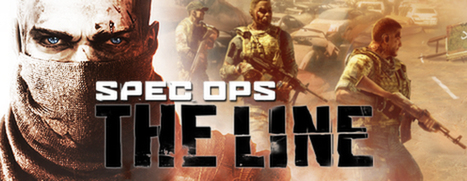
We didn't want it to be true, but Spec Ops: The Line is indeed coming to the end of the road, and 2K has now released a statement regarding the decision to pull the title from all digital storefronts. The good news is, if you already purchased the shooter, you can still play it.
We didn't want it to be true, but Spec Ops: The Line is indeed coming to the end of the road, and 2K has now released a statement regarding the decision to pull the title from all digital storefronts. The good news is, if you already purchased the shooter, you can still play it. The bad news is, if you're yet to buy the game, you may be too late.
Highly-regarded third-person military shooter Spec Ops: The Line has been removed from sale on Steam and other digital storefronts, and nobody seems to know why—not even the game's designer and director... Read more.
Highly-regarded third-person military shooter Spec Ops: The Line has been removed from sale on Steam and other digital storefronts, and nobody seems to know why—not even the game's designer and director... Read more.
Chinese conglomerate Tencent now holds a majority stake in Yager, the Berlin-based developer behind cult favourite 2012 shooter Spec Ops: The Line. Tencent first acquired a small stake in the company back in February 2020. At the time, Yager said it would put the funds towards it
Chinese conglomerate Tencent now holds a majority stake in Yager, the Berlin-based developer behind cult favourite 2012 shooter Spec Ops: The Line.
Tencent first acquired a small stake in the company back in February 2020. At the time, Yager said it would put the funds towards its free-to-play multiplayer game The Cycle, and then unnamed future projects.
Today's news was revealed in an interview with Yager boss Timo Ullmann by German site gameswirtschaft.de, and picked up by Niko Partners analyst Daniel Ahmad. In it, Ullmann says the move comes ahead of a relaunch for The Cycle based on early access feedback.
Hello, and welcome to our new series which picks out interesting things that we'd love someone to make a game about. This isn't a chance for us to pretend we're game designers, more an opportunity to celebrate the range of subjects games can tackle and the sorts of things that se
Hello, and welcome to our new series which picks out interesting things that we'd love someone to make a game about.
This isn't a chance for us to pretend we're game designers, more an opportunity to celebrate the range of subjects games can tackle and the sorts of things that seem filled with glorious gamey promise.
Computer games are made out of a lot of things. Level geometry and music, shader effects and AI, physics systems and sound effects, textures and scripting. And words. Words of dialogue, plot, lore and backstory. Words for the menus and tutorials. Words for store pages and pitch d
Computer games are made out of a lot of things. Level geometry and music, shader effects and AI, physics systems and sound effects, textures and scripting. And words. Words of dialogue, plot, lore and backstory. Words for the menus and tutorials. Words for store pages and pitch documents and documentation of their systems. Even games that do their damnedest to avoid using words to tell their stories—even games that apparently have no stories at all—they're all still built on thousands of the things.
Writers therefore take a central place in game development, perhaps more central than you might expect. Working alongside artists and designers and every team, they help to build a game's world, stitching all its often divergent parts together into a form that makes sense to you, the player. To put it succinctly, writers make the glue that holds a game together.
Tom Bissell, who was lead writer on Gears of War 4 and has credits on What Remains of Edith Finch, Battlefield: Hardline, and the Uncharted series, boils down game writing to three fundamental roles: "Understanding what a game is trying to do; creating an involving space for the player's experience; and working collaboratively with dozens and sometimes hundreds of human beings, not all of whom will have your taste or inclinations."
But how do game writers work? What do they write? Where do they fit in that grand collaboration? And can they do their job better?
Writing from the start
Increasingly, writers get started on a game from its very beginnings. "Having a writer on the team in pre-production essentially gives you someone who has the broad view of the whole game," says Walt Williams, who was lead writer of Spec Ops: The Line, is author of excellent game development memoir Significant Zero, and has credits on many other games, including Star Wars: Battlefront II and The Darkness II. "The designer is thinking about the systems they want to build, the environment and character artists are thinking about the style, and they're not necessarily crossing over much, whereas the writer is meeting with all the different teams and taking their ideas, brainstorming and coming up with more stuff in their realm."
"If there's not someone concentrating on the narrative from the beginning, that can often feel very disjointed and you'll end up with the game not feeling right," says Phil Huxley, a former writer at Rocksteady who's now behind adventure game Du Lac & Fey: Dance of Death. "Why is the character suddenly doing this? Why are we suddenly here?"
The shape that writing takes during preproduction varies, but artists might come to a writer with an idea for an environment, and the writer will then imagine a story that will help the artists to draw concept art for it. They'll imagine who lives in this world, what else is in it, a fictional history that explains how its present came to be.
Writers might also meet with a game's designers to discuss its core design and start to plan how the narrative will be told within it. So we've a game about pirates looking for a lost treasure. What kicks off their quest, and how did they find out about the booty? What's the twist when they find it? If it's some free-roaming game that allows players to tackle its goals in whatever order they wish, how might the story work?
"You're constantly just generating, throwing stuff at the wall, and the wall is the creative director and you’re seeing what sticks," says Williams. “During this period you’re dealing with a lot of, 'I don't know what I want but I'll know it when I see it' mentality."
Place in the pecking order
So writers can play a central role making games, but let’s be real about the place of story and narrative in them. As Williams says, "As much as we like to say that videogames can be a narrative medium, financially they're really not. It can elevate a great game to a legendary game, and it can elevate a bad game, but Spec Ops [The Line], that's a game that has earned the label of cult classic but people play it because it's on sale for three dollars. Everyone knows Spec Ops so it feels like it was a successful game, but it was not successful at all."
And the writers' place in a game project comes down to who's leading it. Think about some of the strongest narrative-driven games, where story and theme and play are all bound together, like the BioShock series and Naughty Dog's games at Sony, and the creative directors who forged them—Ken Levine, Amy Hennig—all came from writing backgrounds. "It's only truly important if the creative director identifies as a writer," Williams says. "If they don't, then writing is expendable." Writers' place in the pecking order can therefore change drastically between projects.
Bissell has found his position on the games on which he’s worked has been largely a matter of happenstance, because he’s a freelancer, depending on what capacity he’s been brought in. "But the games I've been a lead writer on, I've always felt like I had a seat at the table, and have worked with people who understand that there’s no such thing as the 'game' part of the game and the 'story' part of the game; it's all the same thing. You have to view a game and the experience you’re trying to provide players holistically."
Huxley has been lucky to work at studios, like Rocksteady, which value writing. There were always meetings that he didn't get to go to, usually just the high-level director ones, but he's felt his expertise has been sought and that writing has always been valued. "You hear the horror stories of where it isn't, and writers get referred to as narrative paramedics, but that's definitely changing, at least from my perspective."
Call the narrative paramedic
Narrative paramedic. A term coined by Tomb Raider writer Rhianna Pratchett, it refers to the situation in which a game goes through a major change, such as a level or feature getting cut, and writers are asked to glue it all back together so the story makes sense and everything ties up again. It's an example of the way in which writers are important and deeply involved, and also can also be tossed around by the tumult of game development.
Words are, after all, cheap. They're not painstakingly sculpted, textured and rigged like character models, or meticulously planned, laid out and scripted, like levels. They're just words, easily reordered, deleted, and re-written. "You have to throw out stuff you're passionate about, trashing ideas you love," says Williams. “No other discipline in game development has to deal with that as much as writing. Everyone else has a certain amount of autonomy, they're considered the masters of their domains."
Games can go wrong in so many ways that have nothing to do with who the writer is or how well or poorly he or she or they are treated
Tom Bissell
And anyone can type words. "Everyone writes, whereas not everyone designs or codes, and I think people feel they have a stake in it," says Huxley, who has also found that other departments tend to feel they can take an active role in writing, but the buck stops with the creative director.
"I've seen changes take place and you can voice your opinion of what they might do to the story or the game as a whole, but I've not been in a position to push back. It's quite challenging sometimes, but you've got to appreciate that it's someone else's vision and that experience matters. You have to trust they're making the right decisions."
Making cuts
Still, cutting and editing is an essential part of writing. And game writers are commonly asked to cut their scripts from, for example, a projected 90 minutes of fully animated cutscenes to 70 minutes because the full thing doesn’t fit into the budget.
If the dialogue can be shortened and streamlined across multiple scenes to achieve the cuts, then that's great. But writers can also employ smarter—or sneakier, depending on the way you look at it—ways of retaining their script, by presenting some scenes as part of gameplay rather than as discreet cutscenes.
"Someone's still going to have to create that explosion and all the assets, but it’s not falling under the cinematic budget, it's now falling under the level design budget,” says Williams. “It's about finding the spare resources on the project and fitting it into them."
But when a scene is entirely canned, it's not a disaster. It's a design challenge. Since the writer knows what narrative beat it was intended to accomplish, they'll rewrite in a way that takes the restrictions into account while also accomplishing the same beat, and then bridge the gaps left by the scene's removal.
How open worlds are written
As writing, cutting and re-writing continues throughout a game's development, one of the big challenges for writers is ensuring the dialogue and narrative remains consistent. Huxley finds that even keeping a full view of Dance of Death, on which he's the sole writer, is tricky. Expand that out to the non-linear and vast scale of an open world and you can appreciate how difficult to maintain a coherent voice.
"It's about having a writer own certain systems rather than spreading it across several people. That's when you can lose that consistency of voice," Huxley says. Rocksteady gives its writers ownership of specific parts of the game so they see them from beginning to end, such as a single character, like Riddler, or the conversations you hear as you grapple around the city.
Our biggest mistake is that we've decided to consider AAA games as something better than they are
Walt Williams
"And it's had the shit played out of it," he adds. Huxley and his writing colleagues played Batman: Arkham Knight for months before it shipped, so Huxley could get a sense of how thugs' conversations fitted into the flow of play and tweak them as necessary, even if their voice performances were already done. "That's the beauty of that level of polish."
Williams says, however, that the lead writer's role on an open world game really should keep a handle on everything, whether systems designers writing their own NPC barks or artists designing their own signs. "You have to be the one to constantly have your eye on all of it and then fucking yell at people when they step out of line and do stupid stuff that doesn't match with the tone of everything else. You also need to accept the fact that while the game will be better, you will not be liked."
How can games be better written?
But whether writers really hold the key to better stories, that's another question. For Bissell it's a misconception that they'd improve if only writers were more integral with development. "Sorry, but that's just not true in my experience. Games can go wrong in so many ways that have nothing to do with who the writer is or how well or poorly he or she or they are treated. Sometimes cleaning up the mess in a wayward game falls on level design and sometimes art and sometimes narrative, but this idea that games have 'shitty stories' because there aren't good writers in the industry, or that writers aren’t listened to, is, to be perfectly frank, a deflection."
Bissell says that games have 'shitty stories' because games are often simply absurd. "That’s not a criticism, it's an acknowledgment of the reality that stares anyone working on an action game right in the face." These aren't his examples, but think about Lara Croft weeping over killing an enemy soldier in a cutscene and then happily murdering a platoon of them fifteen minutes later, or crashing your Far Cry 5 airplane, befriending a bear, and then getting into a serious conversation with a prepper who's torturing a cult member.
"The only way you escape the absurdity problem is through sheer force of will, and you can do that only when the prime creative force behind the game is also overseeing virtually every aspect of it," Bissell says. "That's not a position most game writers will ever find themselves in, obviously." And so for Bissell, the best common solution is to lean into the absurdity, to celebrate the gaminess of games.
Williams agrees. "Our biggest mistake is that we've decided to consider AAA games as something better than they are," he says. "We like to think our super-silly destruction derby arena is a piece of serious art that can say something meaningful."
Writing spans every aspect of the making of games, and is both utterly integral to them and also the first to be cast aside. That makes writing one of the most challenging roles to do well, as Bissell explains: "When I'm asked, and I'm often asked, by younger people, 'How do I get into writing videogames?' I ask them, 'Do you want to tell meaningful, personal stories?' When they say yes, and they always say yes, I say, 'Then maybe don't write videogames.' I'm not trying to be snide when I say this, or discouraging. But the fact is, videogames are highly collaborative and complicated, possibly the most complicated popular art form ever created."
Spec Ops: The Line is a hell of a game. On the surface it's a conventional third-person military shooter, but it goes places and does things that you don't very often run into in videogames. I will say no more! Except to say that it is currently free on the Humble Store . Spec Op
Spec Ops: The Line is a hell of a game. On the surface it's a conventional third-person military shooter, but it goes places and does things that you don't very often run into in videogames. I will say no more! Except to say that it is currently free on the Humble Store.
Spec Ops was definitely not a hit when it came out in 2012, probably because it looked at a glance like an unremarkable shooter, where you and the rest of Team Ooh-Rah go in and shooty-bang-bang some guys and 'save the world' and whatever. Nothing about it appeared to stand out, and the parts of it that did prove exceptional were neither immediately apparent nor the kind of things that lead to "that was awesome!" moments on Discord.
But it is a hell of a game, and if you haven't played it yet, this is a perfect opportunity to correct that oversight—or add it to your pile of shame will all the best intentions. However that works out for you, you've got until 10 am PT/1 pm ET on March 31 to grab it. Don't forget while you're there that the Indie Mega Week Sale, with up to 75 percent off all kinds of indie games, is also still rolling.
Spec Ops: The Line is free over at the Humble Store right now. It’s only available for 48 hours, ending March 31st at 10am Pacific, so I advise you to go there now . Congratulations! You are hopefully now the proud owner of a game about the horrors of war. It’s hell, in case you
Spec Ops: The Line is free over at the Humble Store right now. It’s only available for 48 hours, ending March 31st at 10am Pacific, so I advise you to go there now. Congratulations! You are hopefully now the proud owner of a game about the horrors of war. It’s hell, in case you hadn’t heard, and many people are unsure what it’s good for. Hu-ah.
Game designer Jennifer Scheurle Remember that metro train in Fallout 3 that was actually, according to the game's code, an "arm" inexplicably worn on the head of an ordinary character model? My favorite stories about games give us a glimpse at the kinds of workarounds and crazy t
Game designer Jennifer Scheurle
Remember that metro train in Fallout 3 that was actually, according to the game's code, an "arm" inexplicably worn on the head of an ordinary character model? My favorite stories about games give us a glimpse at the kinds of workarounds and crazy tricks game developers pull to make their games fun (or to make them work at all). Designer Jennifer Scheurle gave a talk on that subject at GDC, drawing from a viral Twitter thread she started last fall. She pulled out some of the best examples from that thread to explain in her talk, and these are the PC games that stood out to me.
BioShock
The first bullet a splicer fires at you in BioShock will almost certainly miss. This lets the designers spring surprise attacks, but still give the player time to react to incoming fire. It's the kind of thing you likely never notice while playing the game, but is blindingly obvious once you see a video example. A splicer will waltz up and miss their first shot from short range.
Scheurle got her information from Ken Levine, who said the first shot will always miss, but Bioshock's AI designer weighed in to say it's actually a bit more complicated than that. Enemies have an accuracy curve that increases the longer they're in a battle, so they start extremely inaccurate and become quite accurate over the length of an encounter.
The more surprising tidbit, though, was that a single shot will never kill you in Bioshock, but instead bring you down to 1 percent health. If a splicer targets you with a tommy gun and unloads—a bunch of bullets hit you in sequence—you're probably going to die, because you'll be taking a hit at 1 percent damage. But that first shot won't do it. This gives the player the rush and tension of just barely surviving, without feeling like a cheap hit took them out.
It's the kind of game design balance that isn't realistic or necessarily "fair." We think all bullets should do the same amount of damage, right? But that small touch is something most players will probably never notice, and if it works as designed, means Bioshock's combat will be more fun.
Gears of War
This was the only secret that totally shocked me, and it was one that generated plenty of discussion in the Twitter thread last year. In the original Gears of War, the developers realized that something like 90% of players would never touch multiplayer again if they didn't get a single kill in their first couple matches. So how do you ease new players into a very high skill, challenging multiplayer mode? The Gears team decided to give them an invisible buff.
Players who haven't gotten a multiplayer kill before get a damage bonus on their shots, akin to the higher damage you get from Gears' active reload mechanic. Except the new players didn't actually have to pull off an active reload to get that damage buff. Once newbies had a couple kills, the game would dial back their bonuses.
This one made some people mad because it's a competiive game and not fair. But some designers argued the advantage for new players was there to offset the many advantages skilled players had already—knowledge of the map, the ability to pull off active reload, and so on.
Spec Ops: The Line
This was my favorite detail of the talk, because it touches on two things: designers taking shortcuts that players will never notice, and bending the truth to make the game more fun. In Spec Ops: The Line, enemies will shout at you to let you know they're about to throw a grenade. They'll step out of cover and trigger a wind up animation. But they never actually throw a grenade at you.
Instead, the grenade simply spawns in midair, on an arc headed towards you. Scheurle explained how it all worked, thanks to input from a designer at developer Yaeger. "Nobody has found out since the game came out, and I'm spilling the beans today," she said.
This implenentation of grenades fulfilled the game design goal of having grenades as a threat, but was much less work than programming a full ballistic system for the AI. As Scheurle said, "it didn't really matter."
Yaeger hid the system by having grenades spawn at the feet of an enemy if you shoot them before the "throw" takes place. That helps complete the illusion.
The trick that makes Spec Ops more fun is also pretty simple. When you throw a grenade at enemies, there's a reaction radius that will tell the AI to run away. That's called the panic radius. Smart AI! Except, the AI is actually programmed to stay within the blast radius, so they'll still take damage. That's not so smart. But isn't it way more fun to blow up the AI with a grenade than it is to miss?
There are plenty of other tidbits hidden inside Scheurle's Twitter thread. If you missed it, give it a read. And then try calling yourself from inside Surgeon Simulator:
Yager's Spec Ops: The Line was as brutal as it was brazen, but was ultimately a commercial failure. This fact alone is enough to rule out a sequel, however its lead writer has spelled out some other reasons the 2012 shooter won't be revisited. In response to one Twitter user's qu
Yager's Spec Ops: The Line was as brutal as it was brazen, but was ultimately a commercial failure. This fact alone is enough to rule out a sequel, however its lead writer has spelled out some other reasons the 2012 shooter won't be revisited.
In response to one Twitter user's query about why Spec Ops: The Line won't get a sequel, Walt Williams responded rather explicitly: "Because it was a brutal, painful development and everyone who worked on it would eat broken glass before making another. Also it didn't sell."
Yager has made clear its thoughts on returning to Spec Ops: The Line in the past, but never with such conviction as Williams, whose recent book about the games industry, Significant Zero, explores the development of Spec-Ops and other games in raw detail.
Which is a shame, because Spec Ops: The Line is a good game for reasons I don't want to spoil. Instead, here's an excerpt from Samuel's Why I Love column last year:
Spec Ops is essentially an adaptation of Heart of Darkness, as the name John Konrad suggests. Heavier inspiration comes from Apocalypse Now, itself an adaptation of the same work. In all versions of this story, the protagonist is sent to track down a colleague who has gone off the reservation.
That journey takes them through a strange land, where the circumstances and environment become stranger the closer the hero gets to their target, a process represented perfectly by the river in both the book and Apocalypse Now. The quarry in each story is found to be playing god over their new domain, succumbed to a form of madness created by the circumstances of their surroundings.
Update: For the sake of clarity, Williams underscores the above is him being hyperbolic, and that more about the development of big budget games can be gleaned from his book Significant Zero.
Today's Deal: Save 80% on Spec Ops: The Line !* Look for the deals each day on the front page of Steam. Or follow us on twitter or Facebook for instant notifications wherever you are! *Offer ends Wednesday at 10AM Pacific Time
Today's Deal: Save 80% on Spec Ops: The Line!*
Look for the deals each day on the front page of Steam. Or follow us on twitter or Facebook for instant notifications wherever you are!
As you might ve spied last month , the 34th edition of the Golden Joystick Awards is open to the public for the first time in the ceremony s 33 year history. As always, winners are voted for by the public, and doing so this year will net you a Golden Bundle from Green Man Gaming
As you might ve spied last month, the 34th edition of the Golden Joystick Awards is open to the public for the first time in the ceremony s 33 year history. As always, winners are voted for by the public, and doing so this year will net you a Golden Bundle from Green Man Gaming for just 1/$1/1 .
That ll get you three games including Spec Ops: The Line, the remake of Sid Meier s Pirates! and a Mystery Game . Exciting. Furthermore, you ll even be able to claim your quid back in Green Man Gaming credit by playing Spec Ops: The Line.
So how do you get all that? Simple: vote on your favourite games of 2015/2016 across the 21 public voted categories be heading this-a-way. Step by step instructions on how to claim your games will be communicated to voters by Green Man Gaming in October.
The 34th Golden Joystick Awards take place November 18 at the Indig02 at London s O2 Arena. Tickets cost 10 each on sale here and are sold on a first come first serve basis.
WHY I LOVE In Why I Love , PC Gamer writers pick an aspect of PC gaming that they love and write about why it's brilliant. This week, Sam enjoys the madness of Spec Ops: The Line. Uncharted is voice-and-mo-cap actor Nolan North s most famous work, casting him as Whedonesque, like
WHY I LOVE
In Why I Love, PC Gamer writers pick an aspect of PC gaming that they love and write about why it's brilliant. This week, Sam enjoys the madness of Spec Ops: The Line.
Uncharted is voice-and-mo-cap actor Nolan North s most famous work, casting him as Whedonesque, likeable treasure hunter Nathan Drake. One common criticism of that PlayStation hero is that he s presented as a positive, empathetic protagonist who experiences no trauma from his actions, despite gunning down hundreds of baddies. That s now a very tired point, but it s also why his casting as Captain Walker in 2012 s Spec Ops: The Line was such a smart call.
Walker starts that game as an action hero too, sent into sandstorm-ravaged Dubai to find out what s happened to former brother-in-arms John Konrad and his battalion, the Damned 33rd. That s all the mission is supposed to be: reconnaissance. But under your control and against orders, Walker engages with the conflict playing what he thinks is the role of the hero, despite never being fully aware of the facts. It s soon apparent that the 33rd s methods aren t sound, and that at the very least they re torturing CIA agents and firing on other soldiers. Stopping them is not your job, but Walker and his gung-ho pals decide it is, for the greater good. No wonder this game seems to have generated more think pieces than copies sold.
It was the noisy release of the PlayStation s Uncharted 4 that got me thinking about Spec Ops again. Nolan North was a subversive casting choice who better to portray a protagonist who kills as many people as a typical videogame hero, but exists in a context where those actions finally have consequences? This meta commentary was not deliberate: North worked on the game for four years, right from the pre-production stage, which may explain why Walker s increasingly weathered rage and gradual disassociation with reality is so convincingly played. What accidental good fortune, that the actor behind one of gaming s most well-known icons plays someone who tries to be a hero, but comprehensively fails.
Spec Ops is essentially an adaptation of Heart of Darkness, as the name John Konrad suggests. Heavier inspiration comes from Apocalypse Now, itself an adaptation of the same work. In all versions of this story, the protagonist is sent to track down a colleague who has gone off the reservation. That journey takes them through a strange land, where the circumstances and environment become stranger the closer the hero gets to their target, a process represented perfectly by the river in both the book and Apocalypse Now. The quarry in each story is found to be playing god over their new domain, succumbed to a form of madness created by the circumstances of their surroundings.
I think Spec Ops is as valid and interesting an adaptation of this story as Apocalypse Now. It lacks the river as a metaphor for the journey, but it s cleverly molded around the tropes of third-person shooters, leaving just enough control to make you feel complicit. It plays on your desire to press the trigger at any opportunity, and even breaks the fourth wall during a turret section to comment on repetition in these games. But more so than Apocalypse Now where Willard s journey to Kurtz morphs him from the army s reluctant assassin into a man who no longer associates himself with the army at all Spec Ops is Walker s journey into becoming Kurtz.
Do you feel like a hero yet? Konrad asks in the game s finale, after hours of wearying, increasingly violent firefights against the 33rd and everyone else in Dubai. You spend the game thinking you re chasing the warlord of Dubai down, but you re turning into him. With every reckless action, with every disobeyed order, with every instance you pull the trigger even when the game doesn t make you do it you re accelerating that transformation. The ending underlines that notion in a pointed, metaphorical way, explaining the horrific reality of what Walker has brought upon Dubai, and finally detaching him from the selfdelusional sense of heroism that s powered him through to this final moment. The ending offers choices that result in four possible outcomes, but it s hard to believe there s anything left of Walker, no matter which path you pick. I chose an ending where he simply walks away from the chaos, as close to a good ending as this bleak finale allows.
Spec Ops left me emotionally exhausted. I think the first thing I played after finishing it was Sonic 2, just to cleanse my palate a bit, since it s a little lighter on the dehumanising effects of war. The carnage deliberately goes on for slightly too long in Spec Ops. It beats you down, tires you out, in an effort to make your own state of mind align with Walker s. No other game has tried anything like it, and as a result it s one of the only cover shooters I d recommend without question.
All Walls Must Fall is the first commercial release from inbetweengames, the indie studio founded by former members of Yager, developers of Spec Ops: The Line. It’s a “tech-noir tactics game” set in Berlin 2089. This is a Berlin still divided by a wall and a world where the Cold
All Walls Must Fall [official site] is the first commercial release from inbetweengames, the indie studio founded by former members of Yager, developers of Spec Ops: The Line. It’s a “tech-noir tactics game” set in Berlin 2089. This is a Berlin still divided by a wall and a world where the Cold War never ended. To navigate its perils and its nightlife, you’ll use a combination of social stealth, time travel and combat. It looks delicious, like a propaganda-powered, post-Syndicate dream.
Have You Played? is an endless stream of game recommendations. One a day, every day of the year, perhaps for all time. Spec Ops: The Line is a pretty fun third-person cover shooter about shooting people in their faces, then sometimes feeling a bit bad or confused about killing th
Have You Played? is an endless stream of game recommendations. One a day, every day of the year, perhaps for all time.
Spec Ops: The Line [official site] is a pretty fun third-person cover shooter about shooting people in their faces, then sometimes feeling a bit bad or confused about killing them. I think BioShock made folks a bit excited about shooting games where shooting people was sometimes a bad thing, so reactions to Spec Ops were over-enthusiastic, but it’s still pretty decent as face-shooters go. Its sandstorm-swept Dubai is a heck of a sight too.
We all have different ways of dealing with loss. Some of us lash out and hurt others while some of us turn inwards and dwell on that pain. The Mammoth: A Cave Painting is a free game about loss and how we choose to overcome it. …
We all have different ways of dealing with loss. Some of us lash out and hurt others while some of us turn inwards and dwell on that pain. The Mammoth: A Cave Painting [official site] is a free game about loss and how we choose to overcome it.
Books! They’re like films without pictures, or games that are all cutscene. Old people and hipsters really like them, teenagers think they’re like totally lame, and quite frankly we should all read more of them. There are countless games inspired by books – most especially Tolkie
Books! They’re like films without pictures, or games that are all cutscene. Old people and hipsters really like them, teenagers think they’re like totally lame, and quite frankly we should all read more of them. There are countless games inspired by books – most especially Tolkien, Lovecraft and early Dungeons & Dragon fiction – but surprisingly few games based directly on books. Even fewer good ones.
Perhaps one of the reasons for that is that a game can, in theory, cleave closer to what a book does than a film can – with their length and their word counts, their dozens of characters and in some cases even their own in-game books, they can to some degree do the job of a novel. They don’t need to be based on books – and often they can do so much more, thanks to the great promise of non-linearity. Of course, the real reason for the dearth is that novels are so rarely the massive business a movie is these days. You might get a forlorn Hunger Games tie-in here and there, but suited people in gleaming office blocks just aren’t going to commission an adaptation of the latest Magnus Mills tale, more’s the pity.
I suspect that, over time, we’ll see the non-corporate side of games development increasingly homage the written word, but for now, these ten games (and seven honourable mentions) are, as far as I’m concerned, the best, and most landmark, results of page-to-pixel adaptation to date.
Today's Deal: Save 80% on Spec Ops: The Line !* Look for the deals each day on the front page of Steam. Or follow us on twitter or Facebook for instant notifications wherever you are! *Offer ends Tuesday at 10AM Pacific Time
Today's Deal: Save 80% on Spec Ops: The Line!*
Look for the deals each day on the front page of Steam. Or follow us on twitter or Facebook for instant notifications wherever you are!
Starting today Linux gamers can now play Spec Ops: The Line on their platforms! For more info, click here: Spec Ops: The Line is an action-packed Third-Person Shooter that delivers heart pounding physically close combat through a squad-based play mechanic. Players lead a team of
Starting today Linux gamers can now play Spec Ops: The Line on their platforms!
For more info, click here: http://store.steampowered.com/app/50300/http://store.steampowered.com/app/50300/
Spec Ops: The Line is an action-packed Third-Person Shooter that delivers heart pounding physically close combat through a squad-based play mechanic. Players lead a team of three characters, Captain Martin Walker, Lieutenant Adams and Sergeant Lugo. Each character has his own distinct personality and specialized skills, and the mature story they each play a role in explores the dark side of war in a realistic way, in which there are no good outcomes, only hard choices.
Starting today Linux gamers can now play Spec Ops: The Line on their platforms! For more info, click here: Spec Ops: The Line is an action-packed Third-Person Shooter that delivers heart pounding physically close combat through a squad-based play mechanic. Players lead a team of
Starting today Linux gamers can now play Spec Ops: The Line on their platforms!
For more info, click here: http://store.steampowered.com/app/50300/http://store.steampowered.com/app/50300/
Spec Ops: The Line is an action-packed Third-Person Shooter that delivers heart pounding physically close combat through a squad-based play mechanic. Players lead a team of three characters, Captain Martin Walker, Lieutenant Adams and Sergeant Lugo. Each character has his own distinct personality and specialized skills, and the mature story they each play a role in explores the dark side of war in a realistic way, in which there are no good outcomes, only hard choices.