All in-game footage in this blog post comes from an EA beta build and may differ from the final game. Not a fan of reading? Check out the dev vlog instead! Ah, Vagabond! How nice to see you again! Come on in, have a seat by the fire! The vibrant summer sun is slowly turning paler
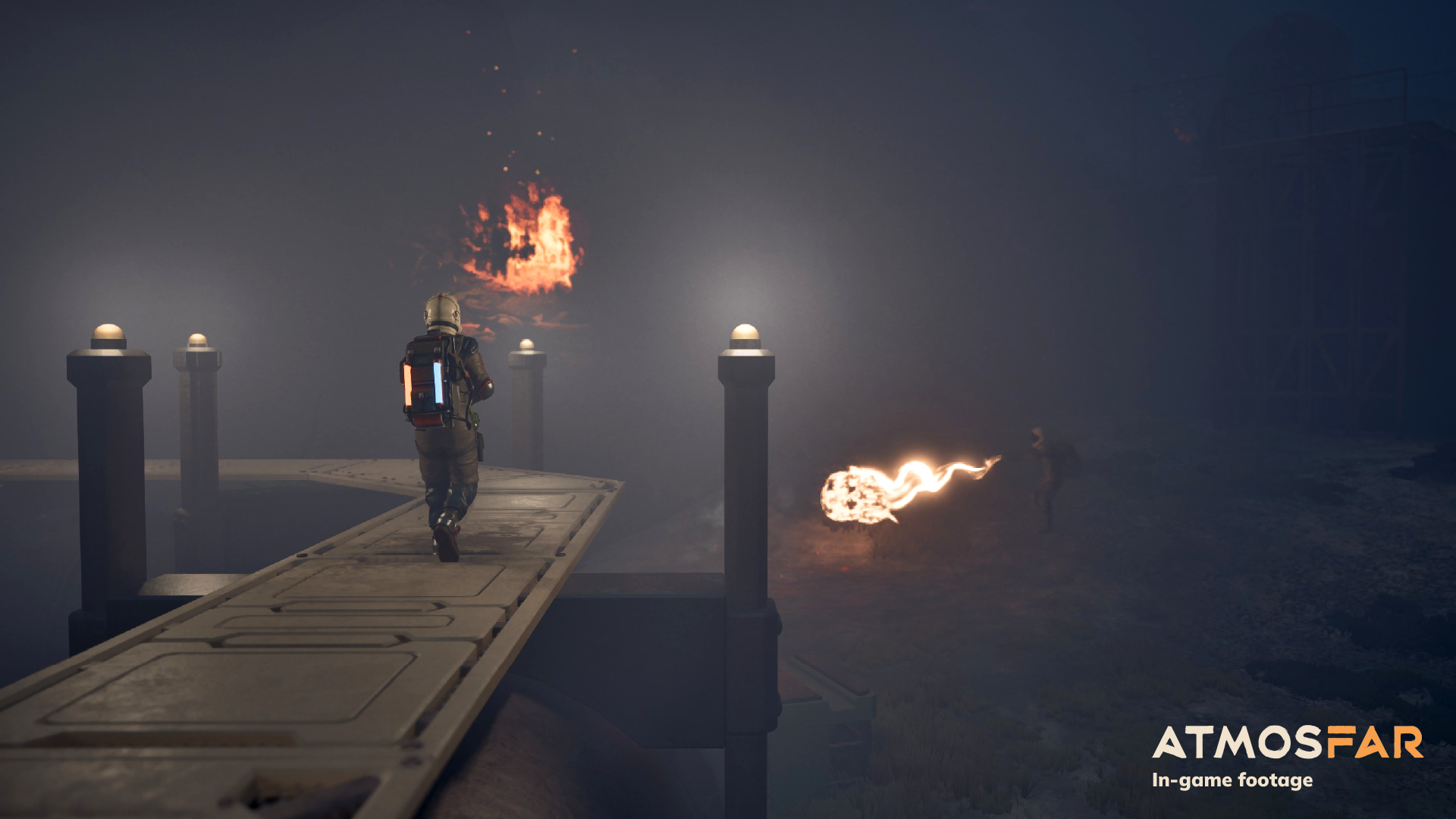
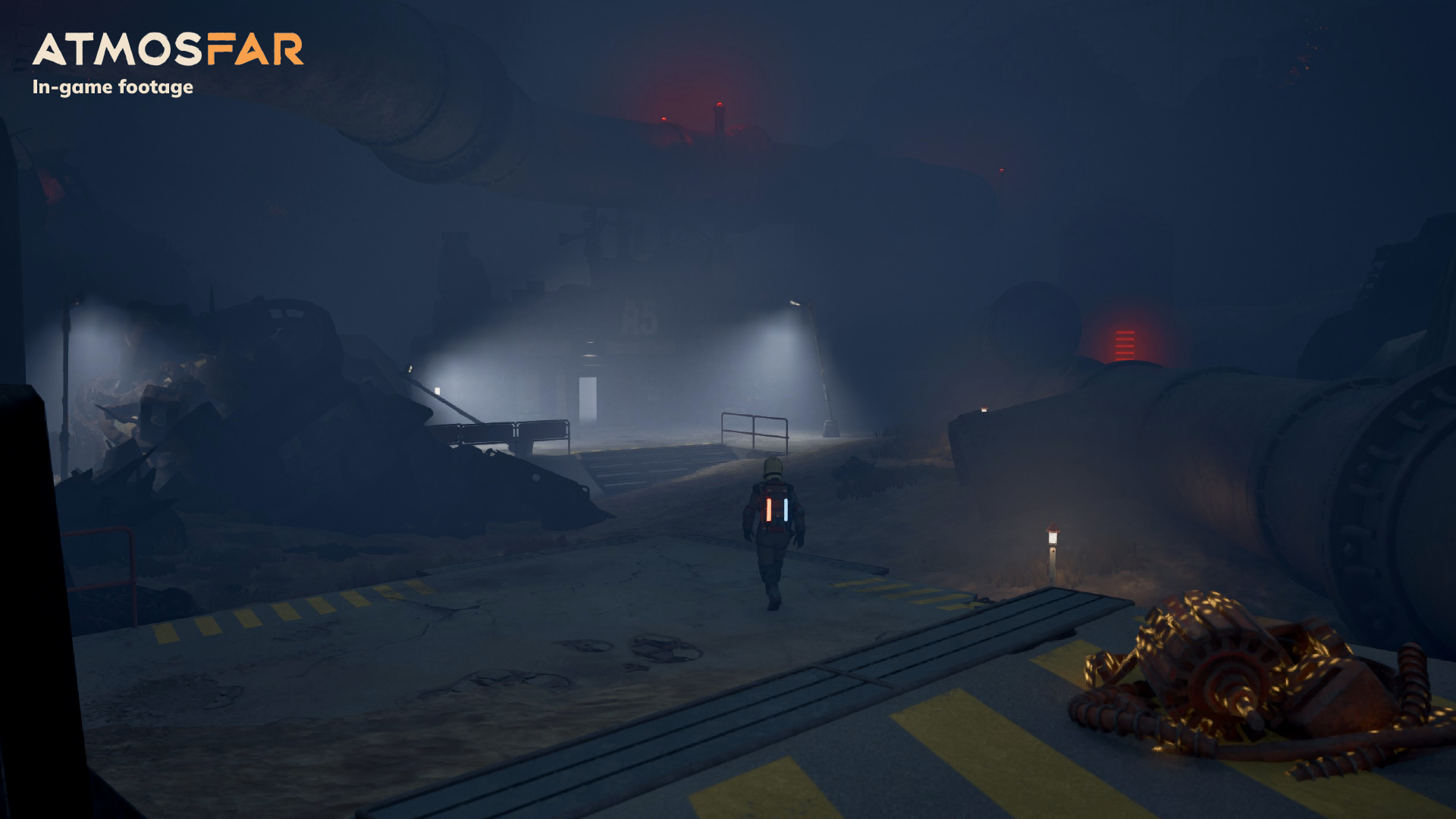
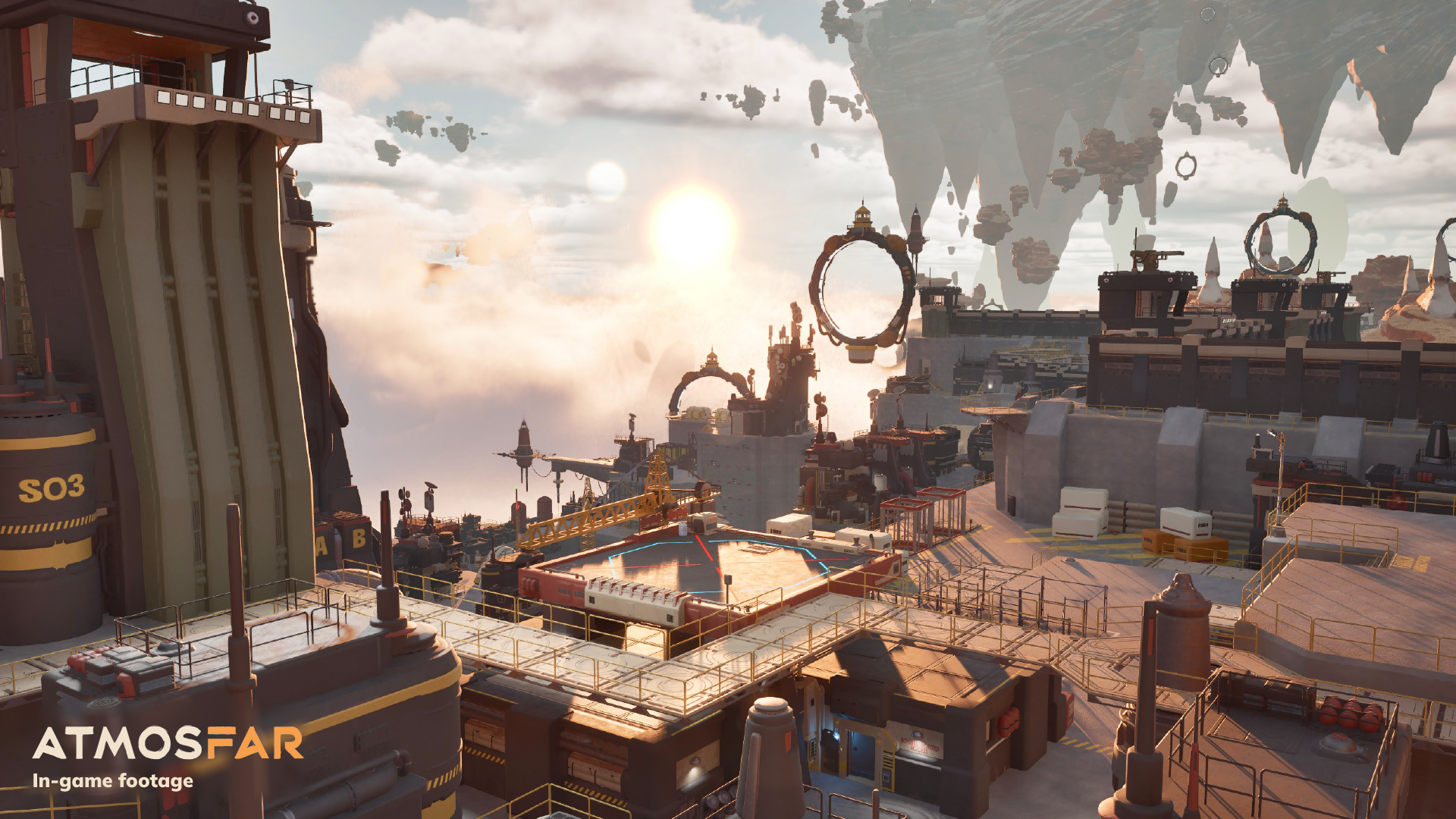
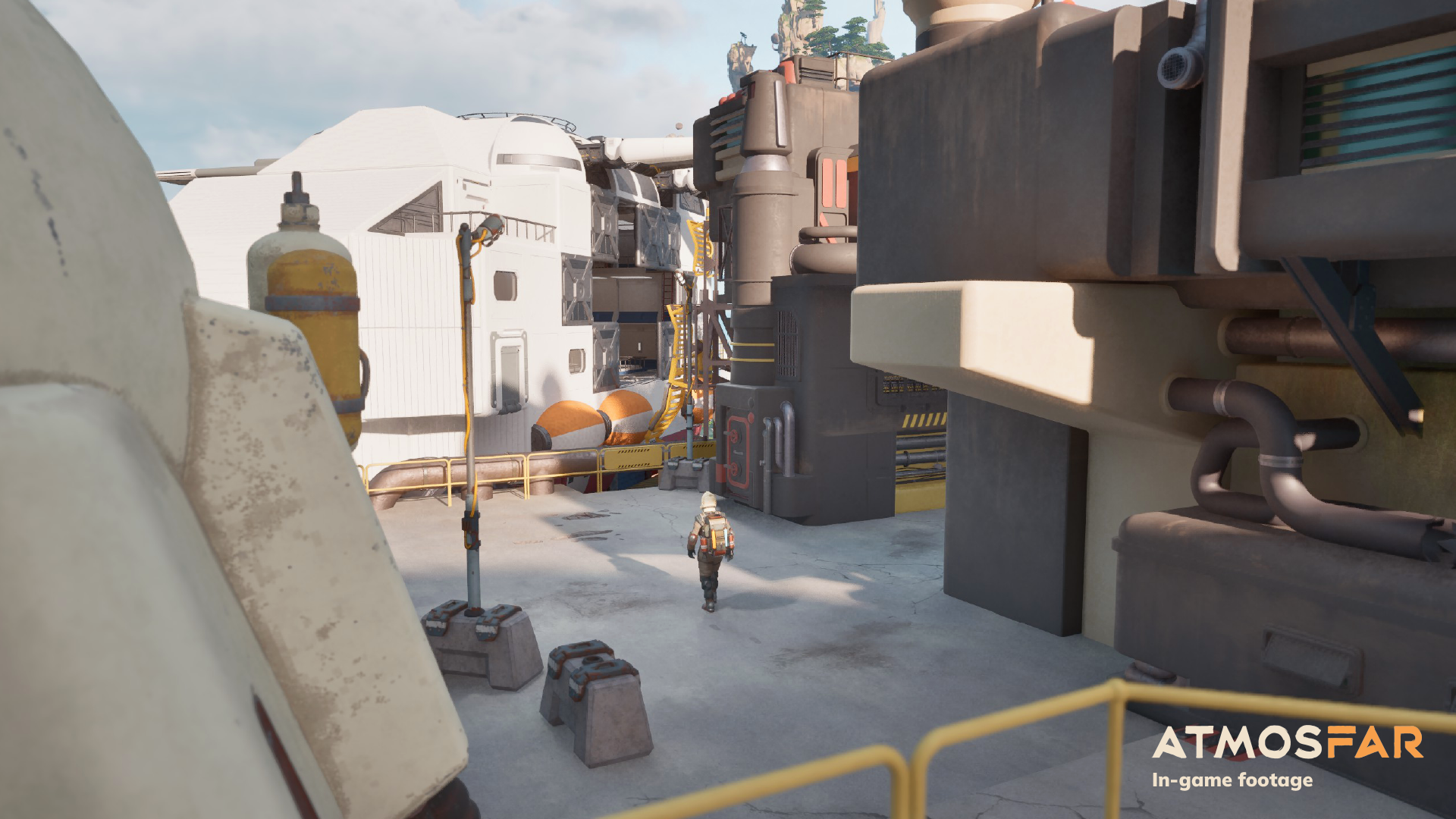
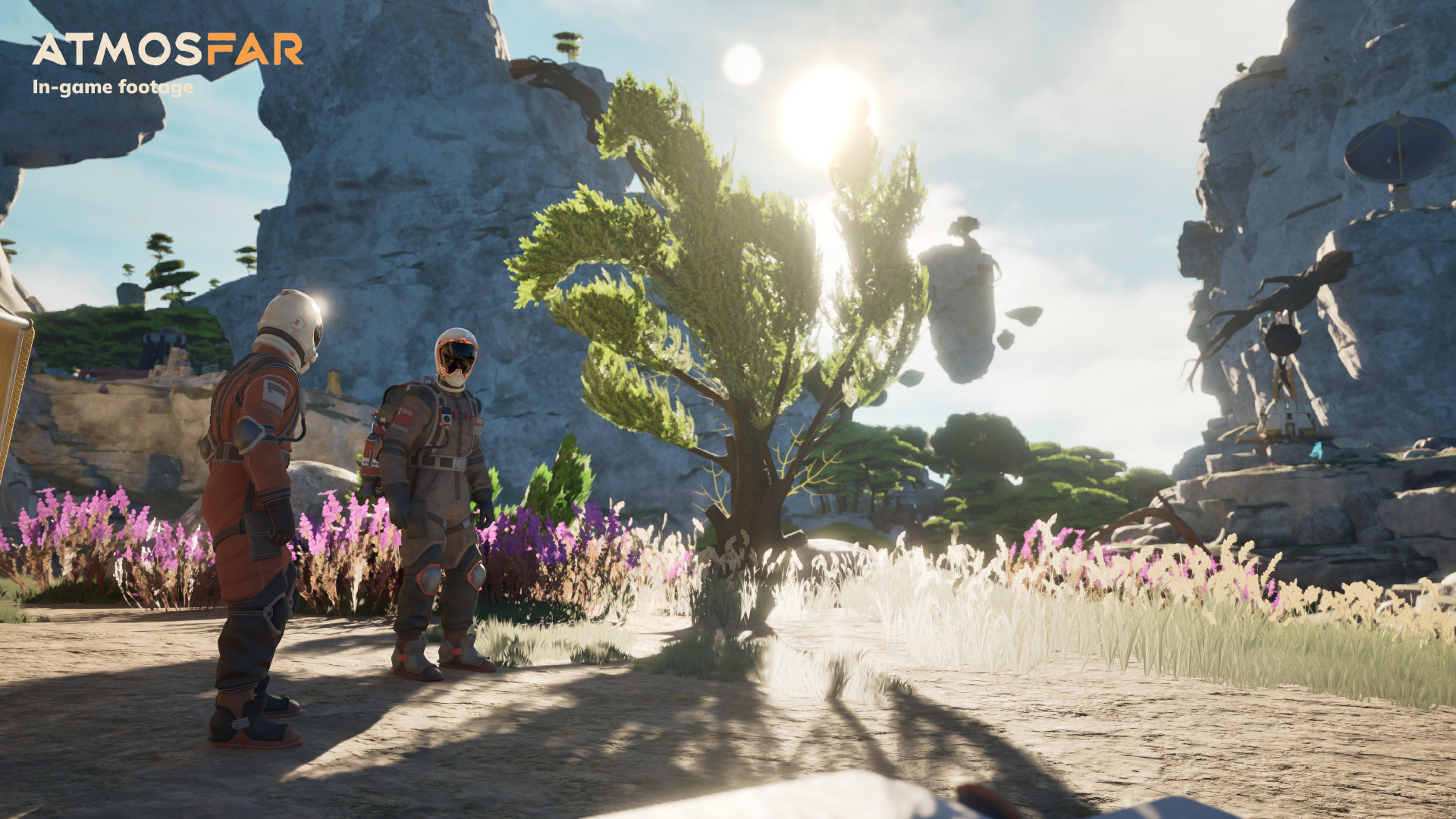
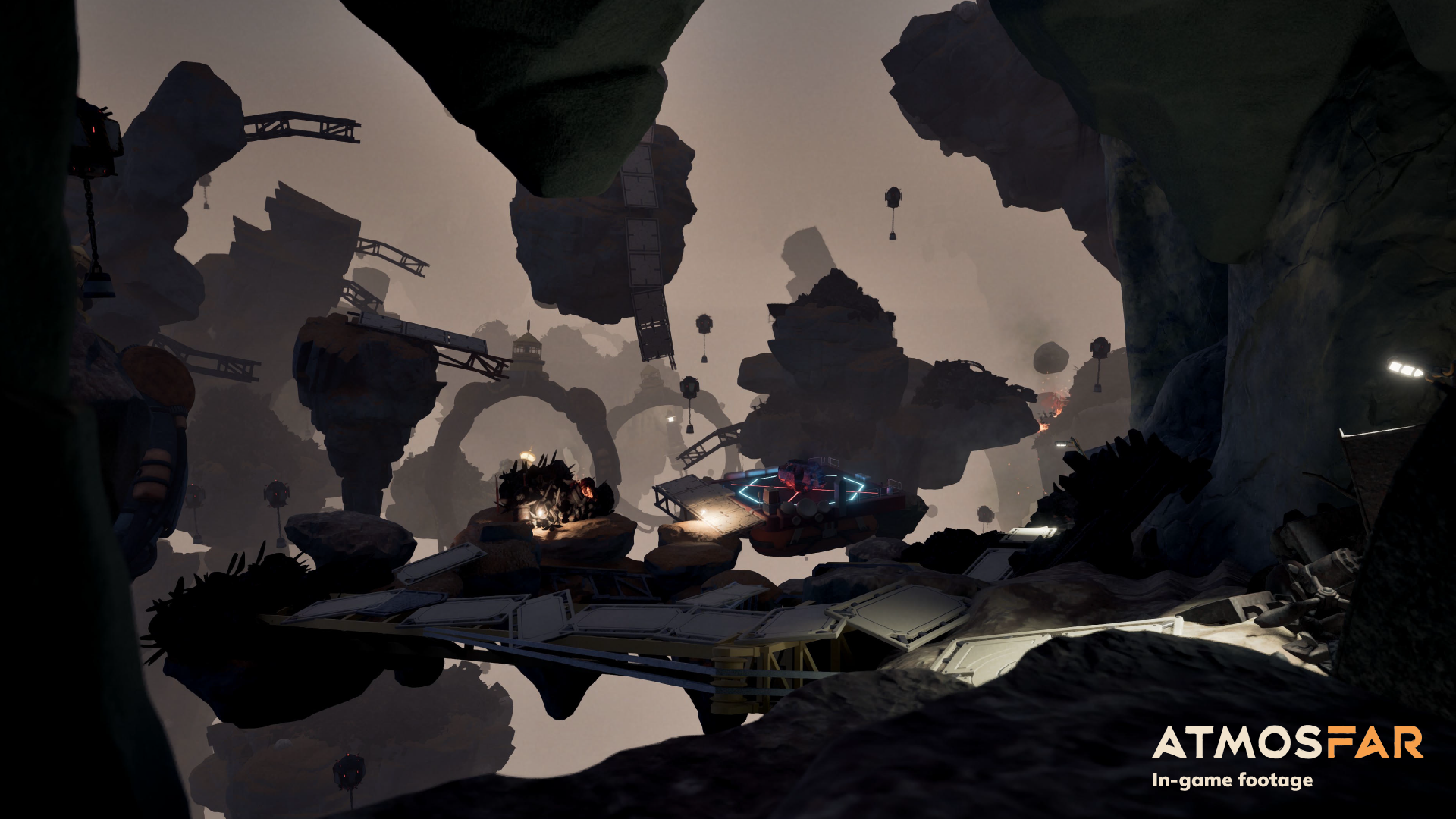
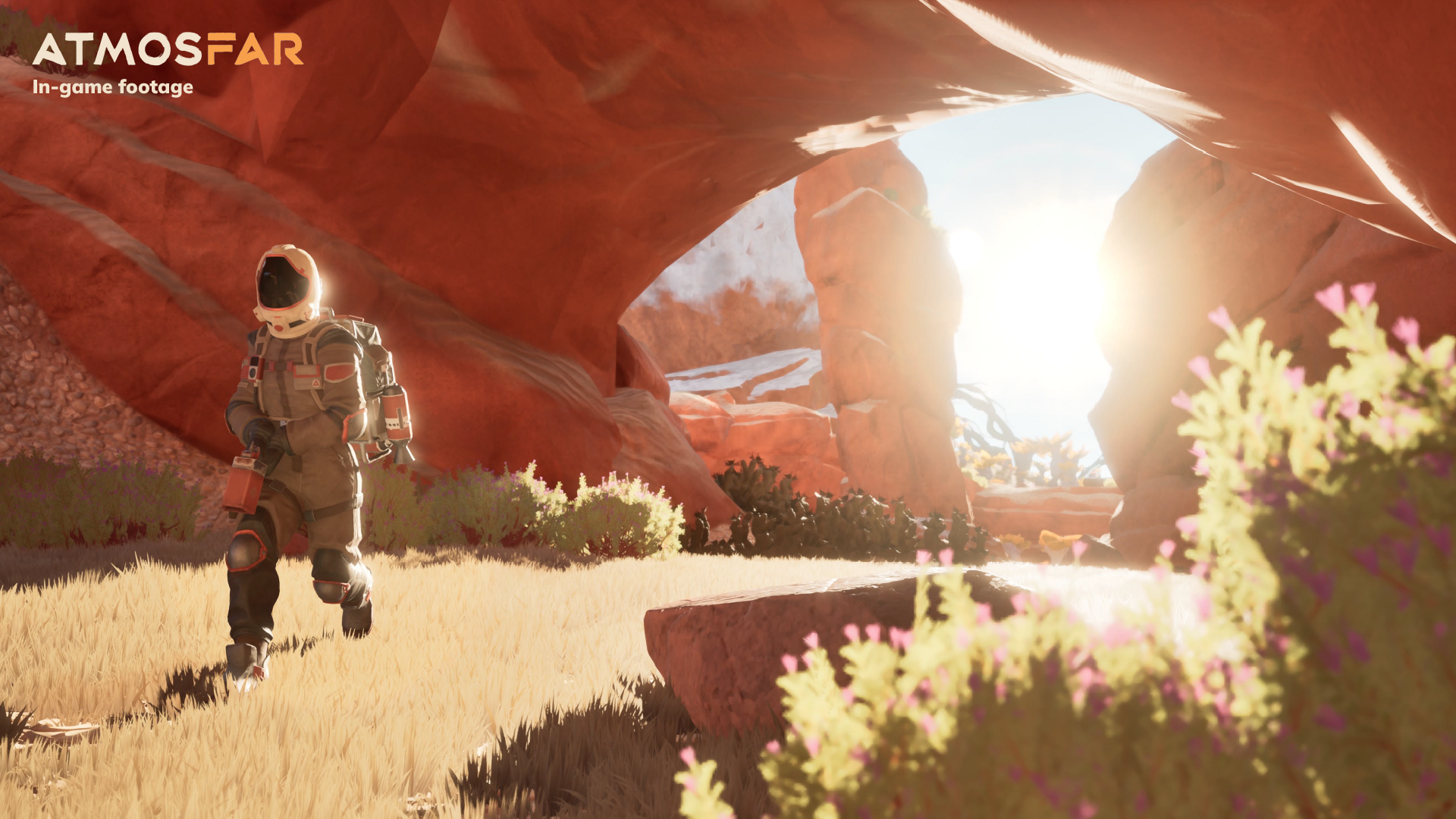
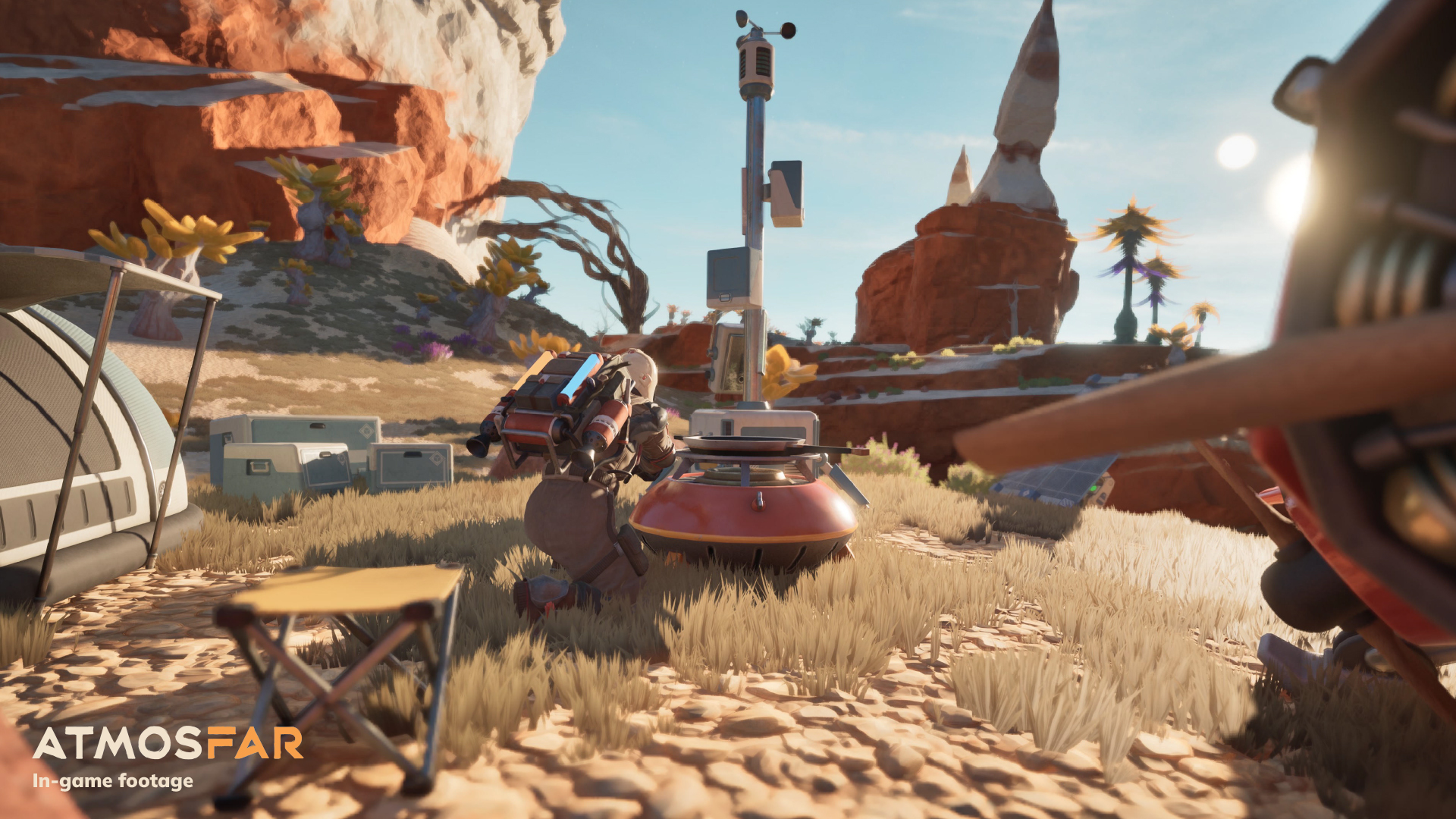
All in-game footage in this blog post comes from an EA beta build and may differ from the final game.
Not a fan of reading? Check out the dev vlog instead!
Ah, Vagabond! How nice to see you again! Come on in, have a seat by the fire!
The vibrant summer sun is slowly turning paler, winds are getting chillier and some of the leaves are starting to turn crisp. Nature is once again reminding us that fall is soon at our doorstep.
For the team behind ATMOSFAR, this means that we’ve now returned from our summer break and are ramping up to our normal production speed once again. However enjoyable it might be to take some time off, we’ve got a game to release! And we look forward to it!
While we’re at it, we’d like to thank all of you for your patience and support. We know that you are looking forward to the EA release as much as we do, and that you’ve been waiting for it a long time. Having your support means a whole lot to us, and we are doing everything we can to get ATMOSFAR to you as soon as possible. Until then, we’d like to advise you to keep an eye out on our Steam page or join our Discord server for the latest updates on the game.
Level Design: The architecture of games
In our last dev blogs, we’ve been able to learn about different aspects of game development, and how they are combined to form the unique experience that we call ATMOSFAR. Today, we’re going to continue this series (because there are still important aspects of game development we haven’t reached yet!), by learning about the processes behind a large, but extremely central discipline: Level Design. To guide us through this topic, one of our Level Designers has graciously offered lend a hand. The stage is yours!
“Level Design is essentially designing and building the areas that the player will experience; the layout of the space and placing the gameplay elements that go in it. For ATMOSFAR, this means designing the layout of POIs (Points of Interest) and entire islands.
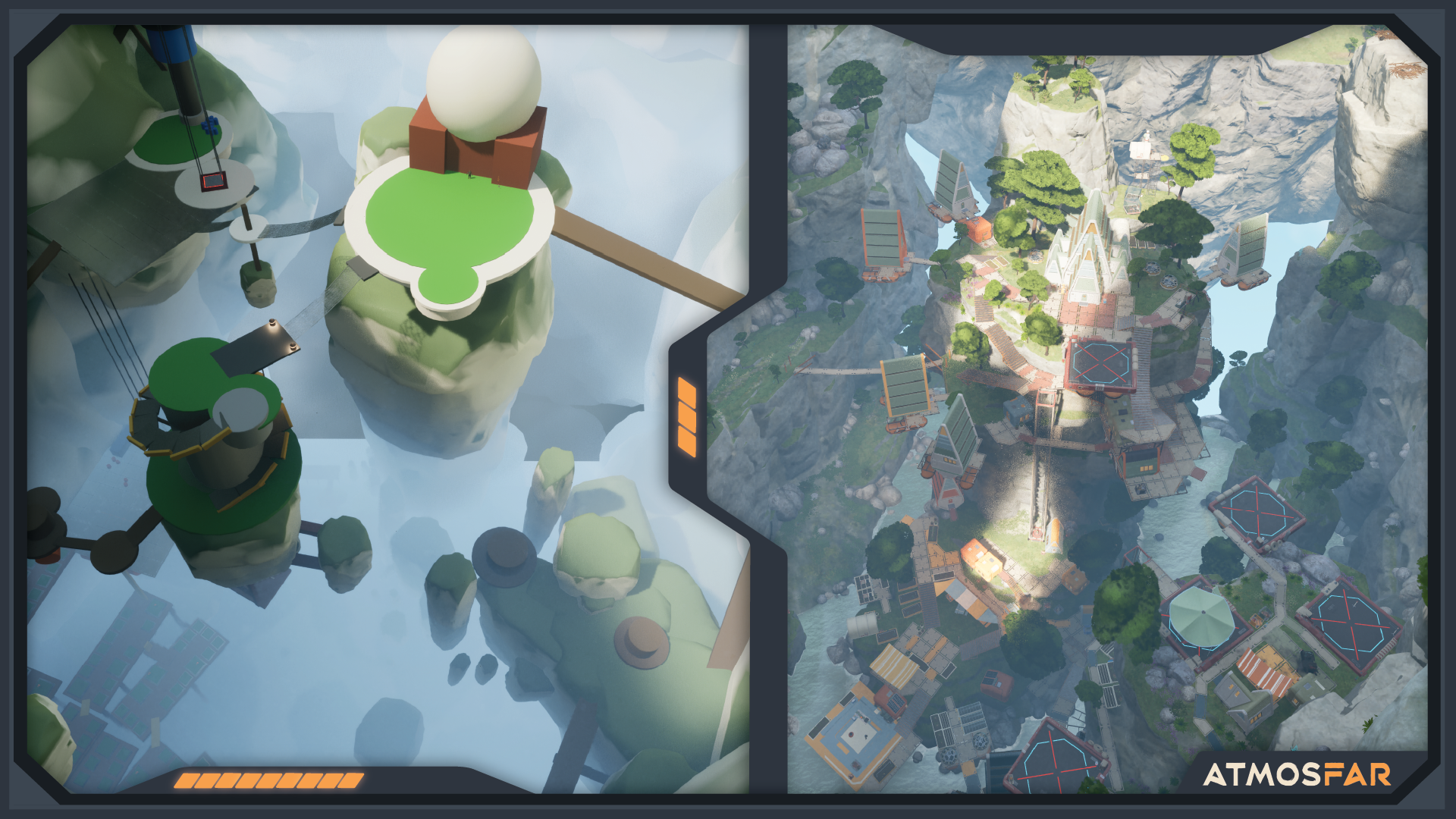
POIs differ in size, sometimes it is simply a lighthouse or a crashed crate. For a bigger POI the process often starts with RnD (research and development) which include gathering inspirational pictures and doing rough sketches of the layout. Sometimes we take a screenshot of the intended area and request a paint-over from the art team as part of gathering inspiration.
The next step would be to do a rough blockout. Earlier in production we built the POIs with basic shapes to test out the layout and size with the player character to make sure the space isn’t too small or too large and that the metrics (slope angles, jump and jetpack distance, and vaulting height) are correct. In later production, we started using finished art assets from the start to do rough layouts. When we feel like the layout and size is good, we go in to add gameplay elements like resources and challenges. The final step would be to have the art team come in and add that final touch to give the area the right feeling.
Throughout the steps we would ideally playtest and iterate upon the space, a process that never really stops because you always find something you want to tweak.
We also need to figure out what the player’s goal should be at a specific location, keeping in mind what tool and puzzle mechanics they have learned, what faction the POI belongs to and sometimes the history of the place. All these things can influence the design. We also need to plan how the challenge will increase, if the player will learn a new mechanic and what the tutorial for that will look like. These elements are often tweaked during production and therefore so are the designs.
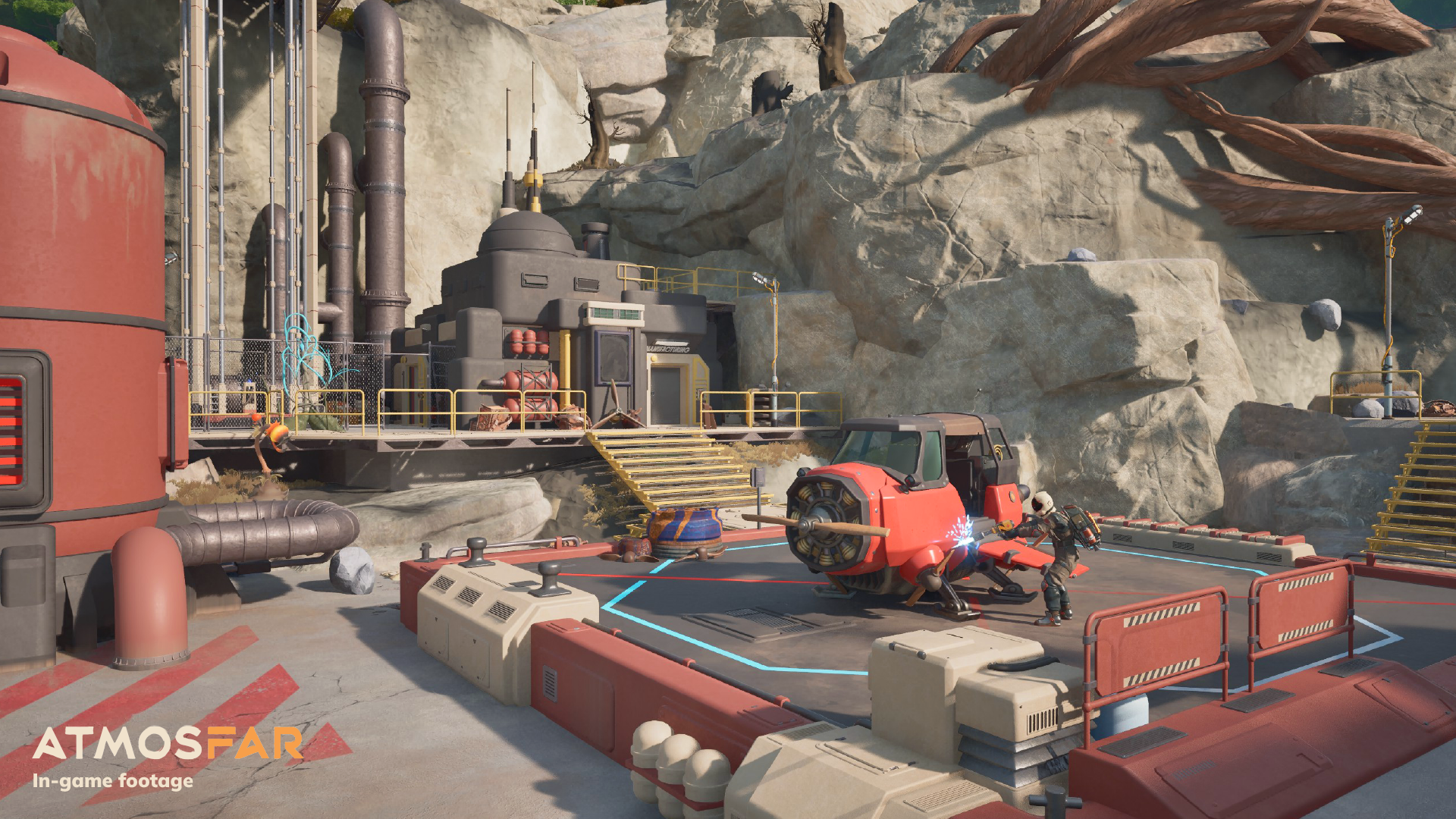
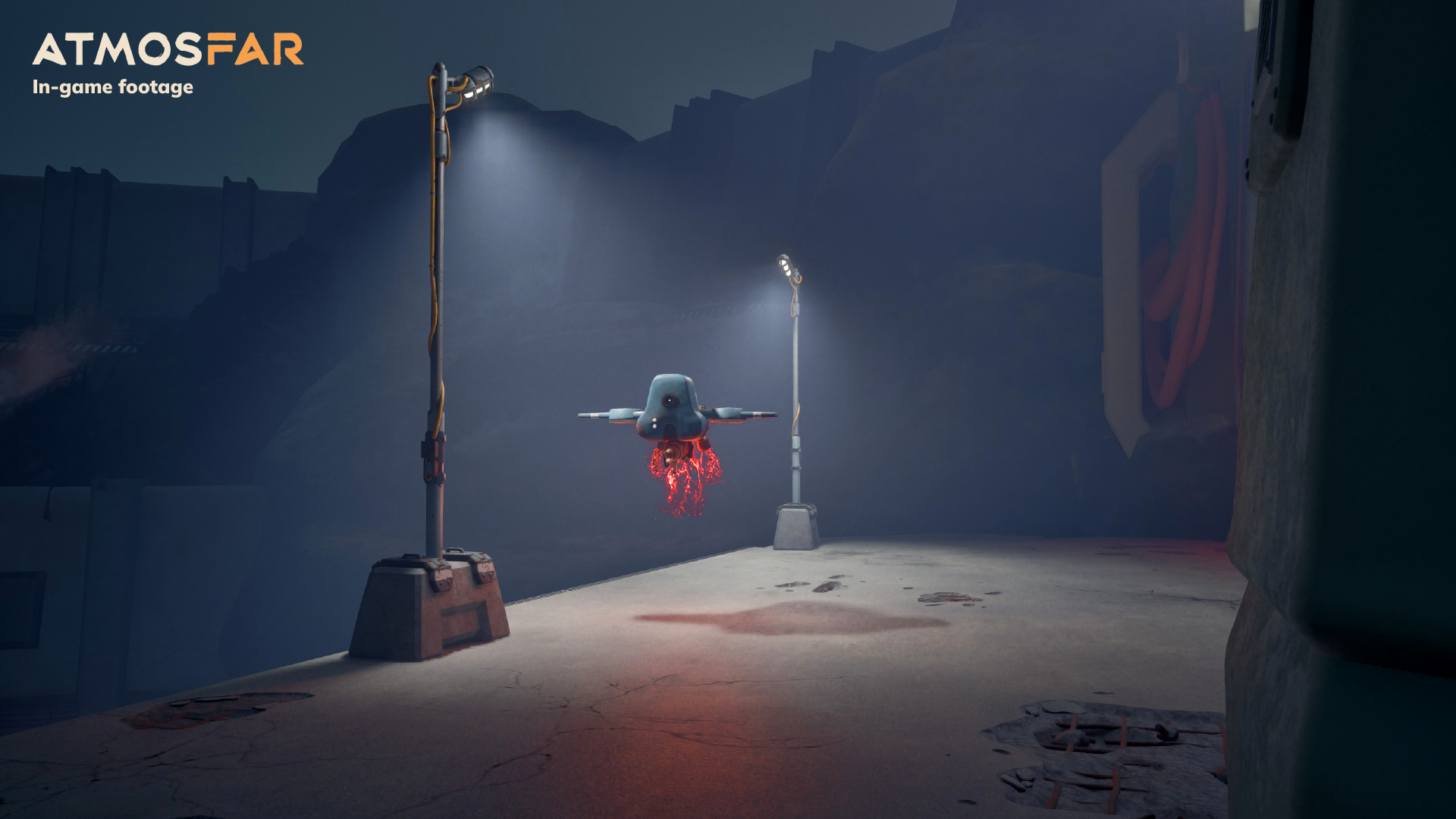
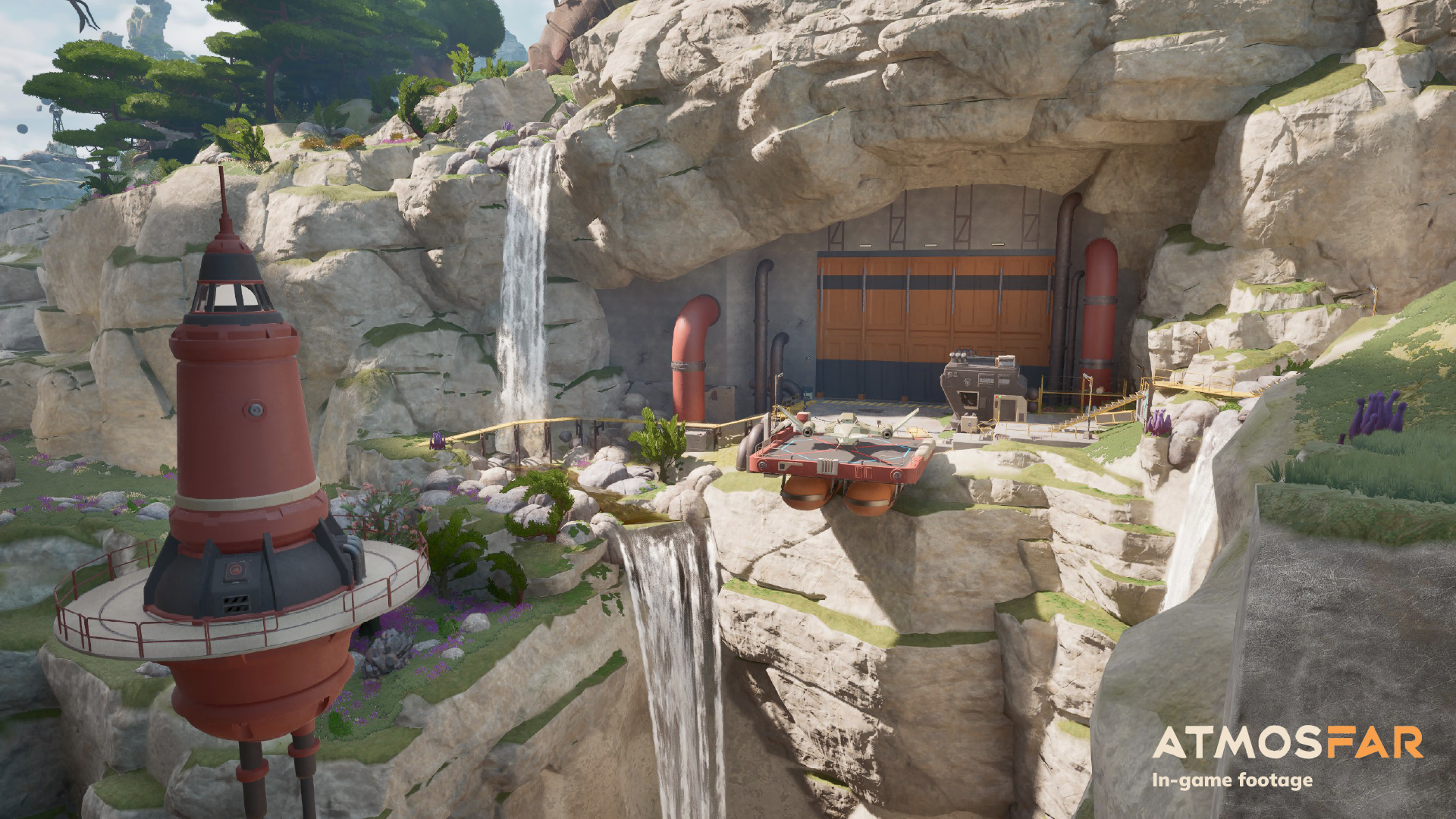
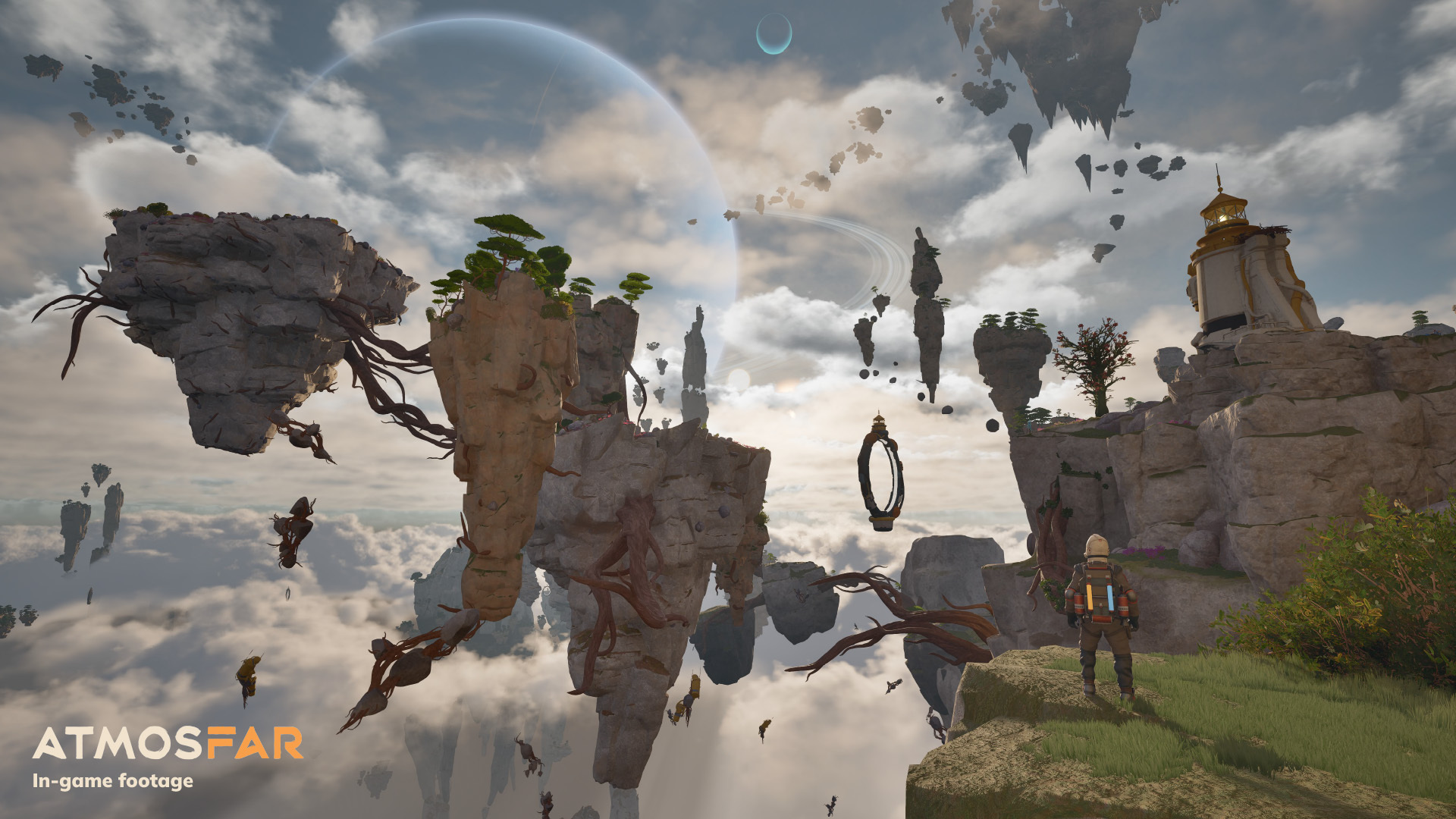
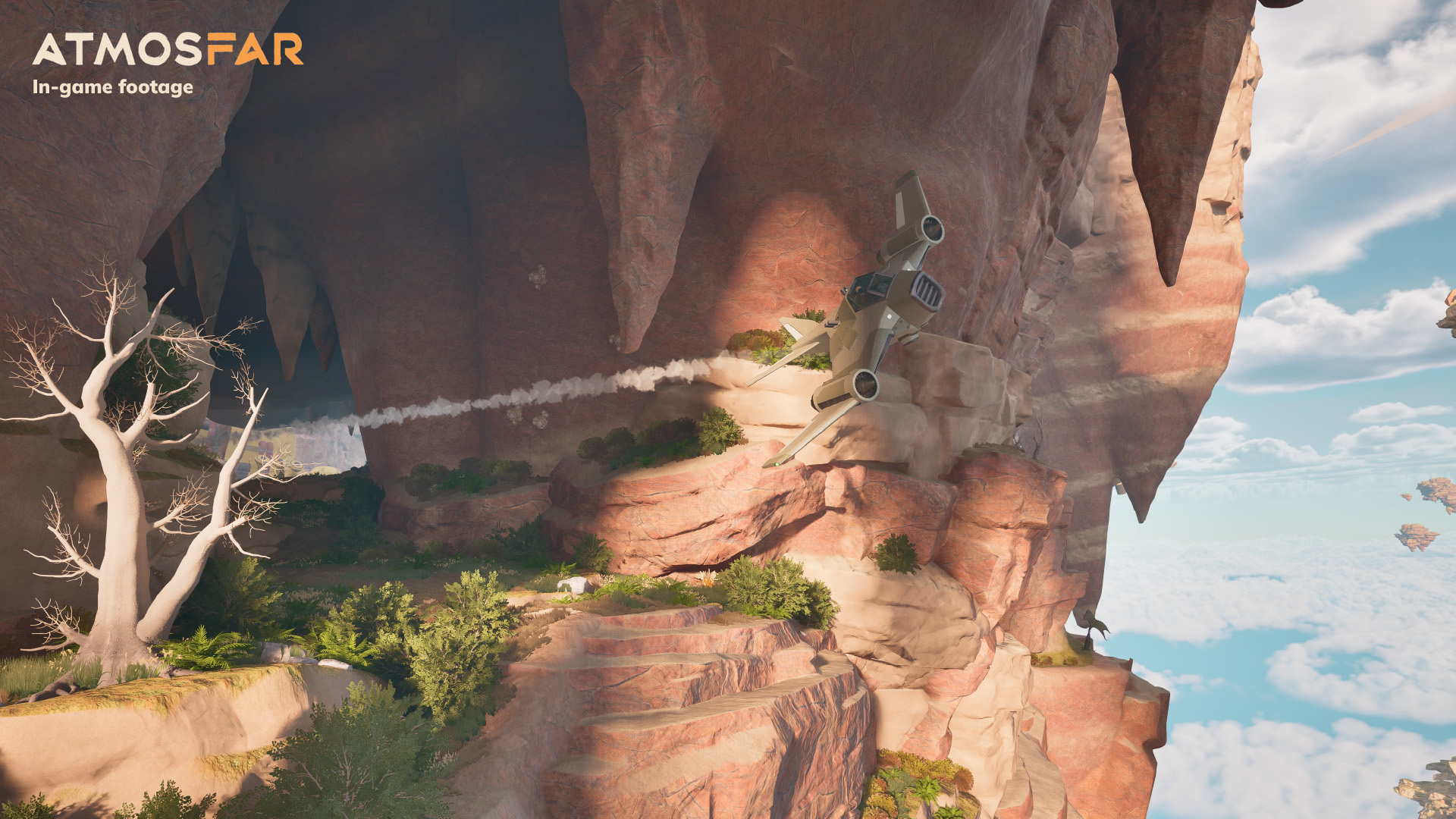
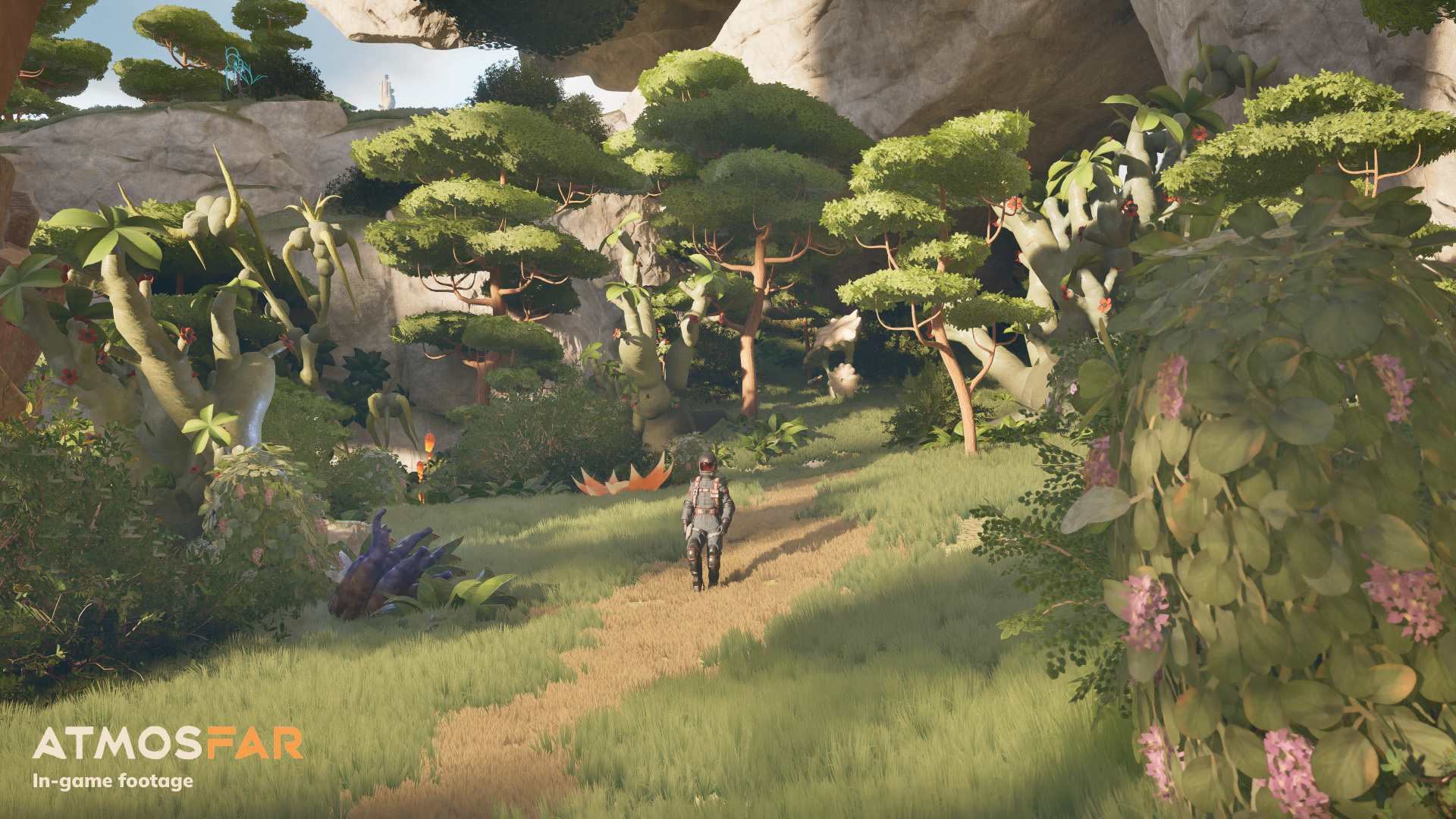
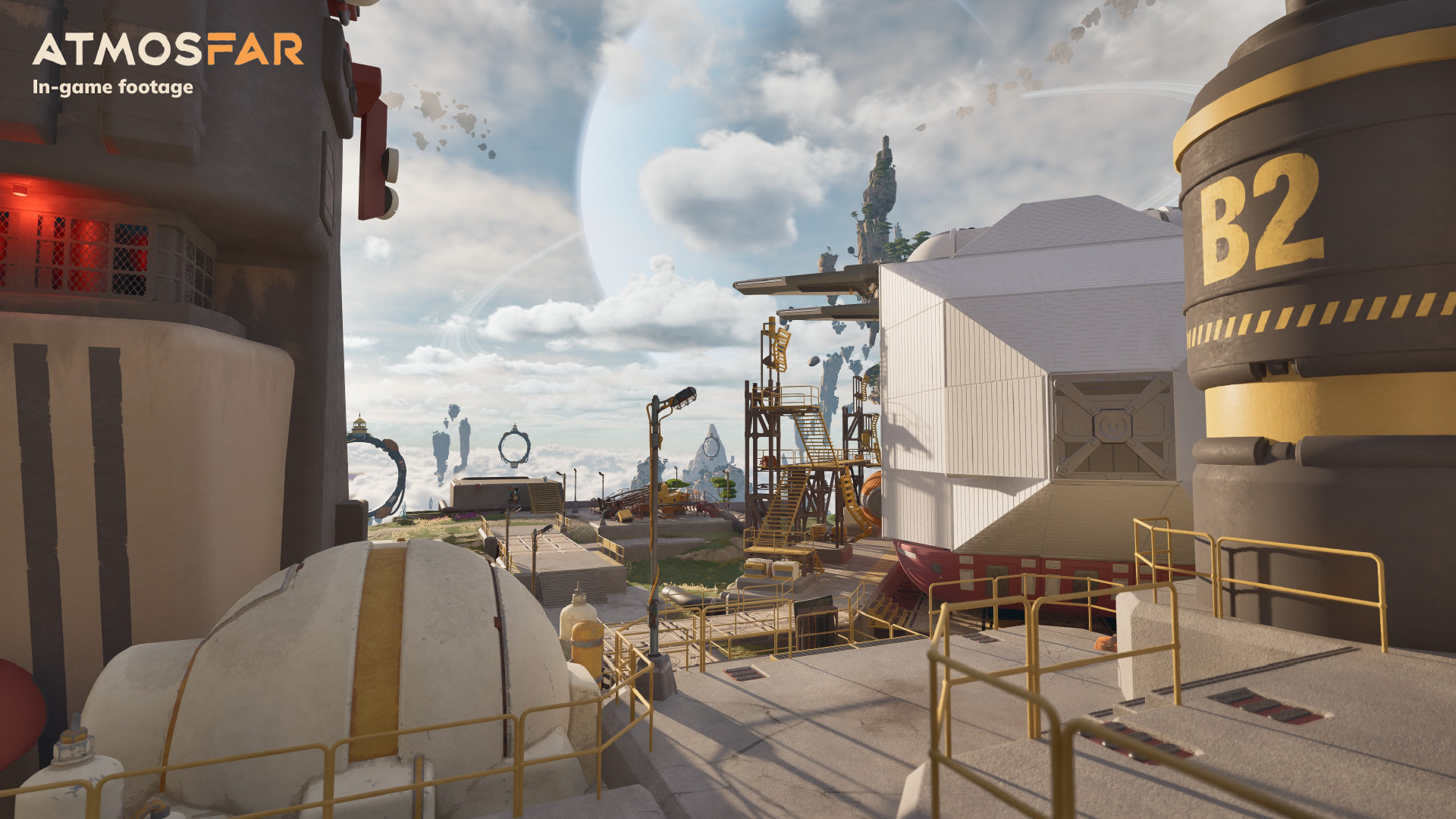
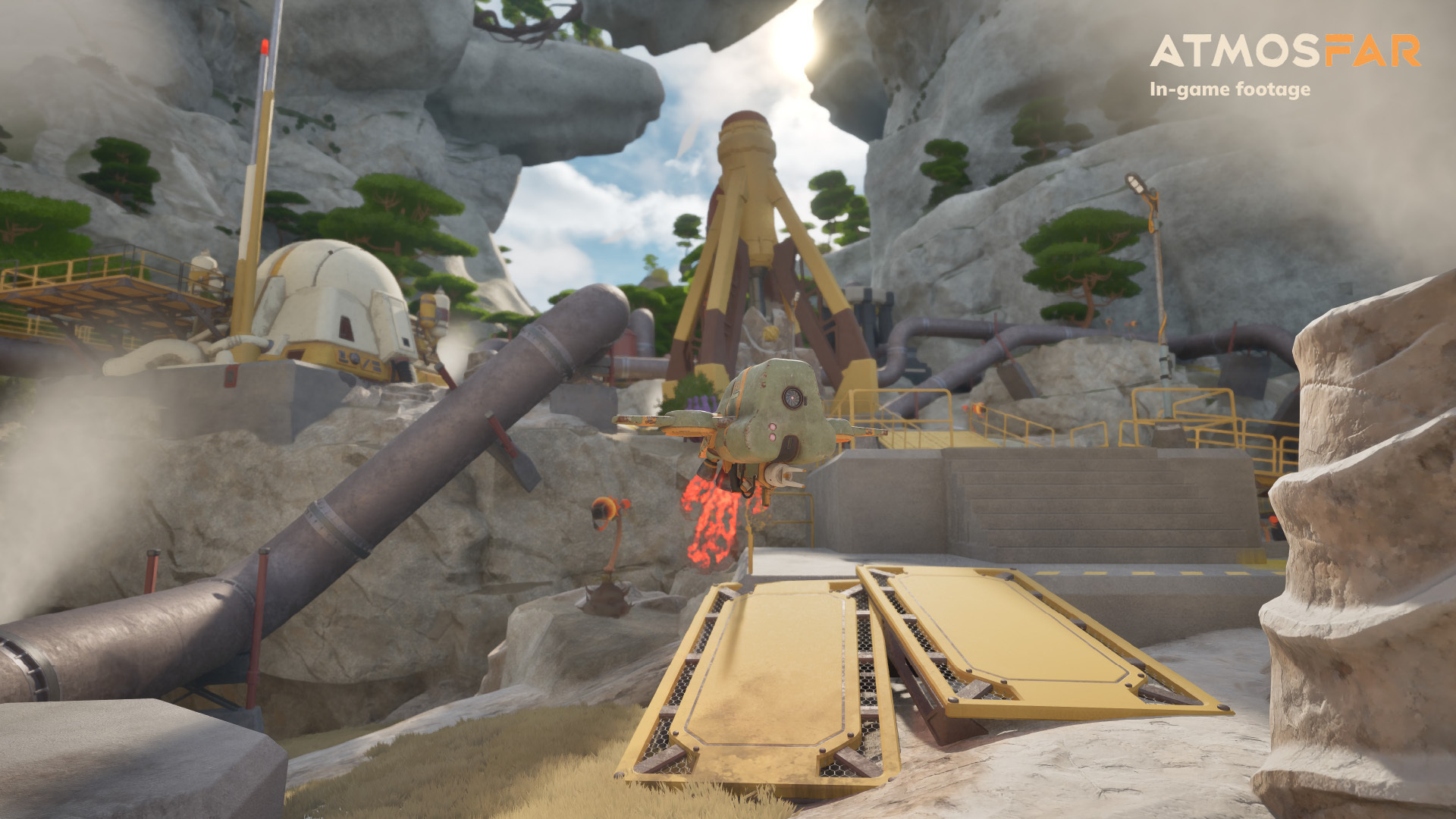
Since ATMOSFAR is an open world game where the player has Wasps and a jetpack, we can’t really dictate where they will land and where they will approach a POI from and therefore can’t design from a linear perspective. Instead, we need to think of POIs as biomes. A biome has a certain flora and fauna, the player can find specific resources tied to that biome, and there may be unique dangers that they need to look out for. As an example: a PACE POI “biome” would often be caked in concrete and pipes, where the player might run into hostile drones, but also solve puzzles and find a variety of scraps.
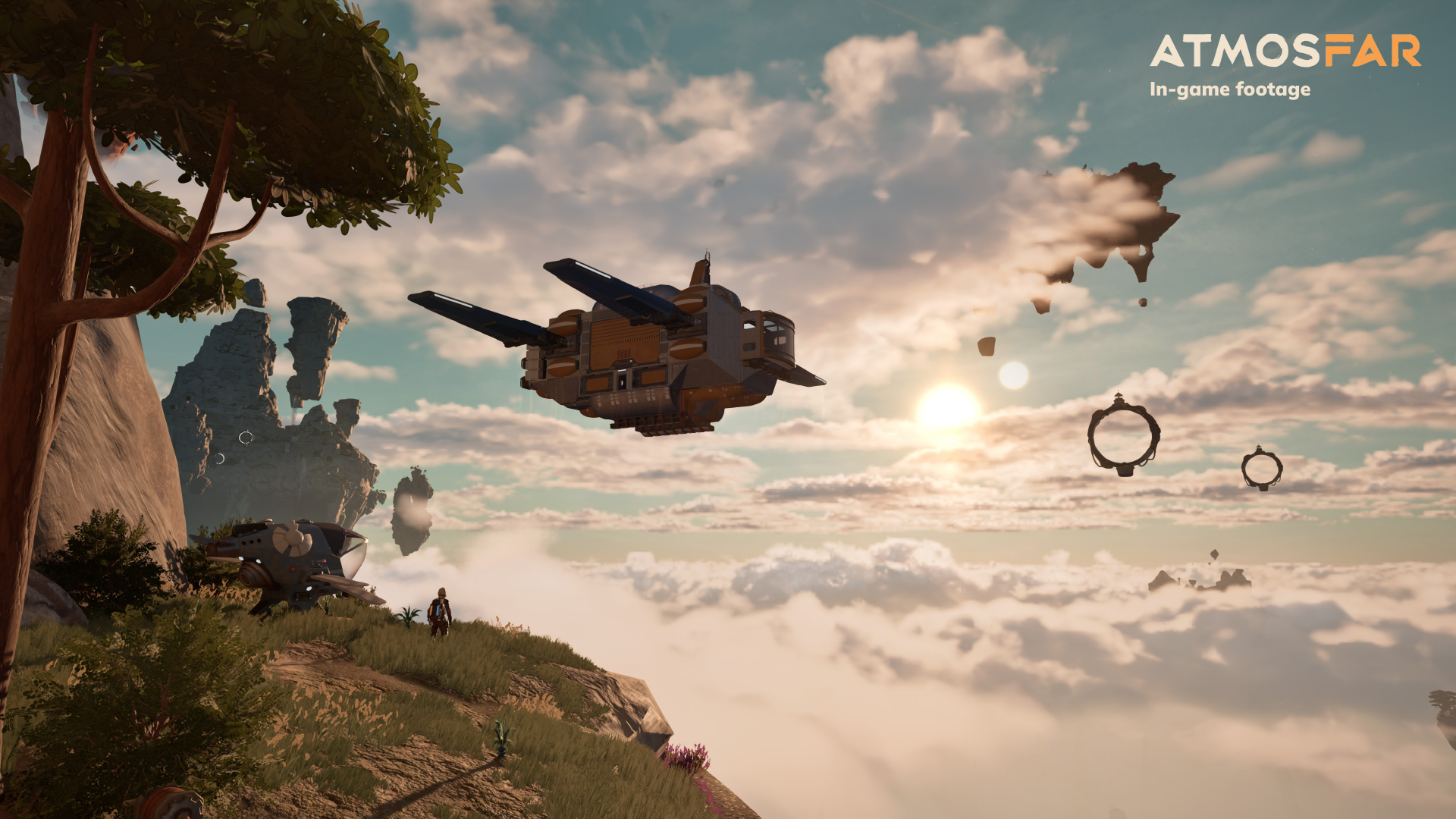
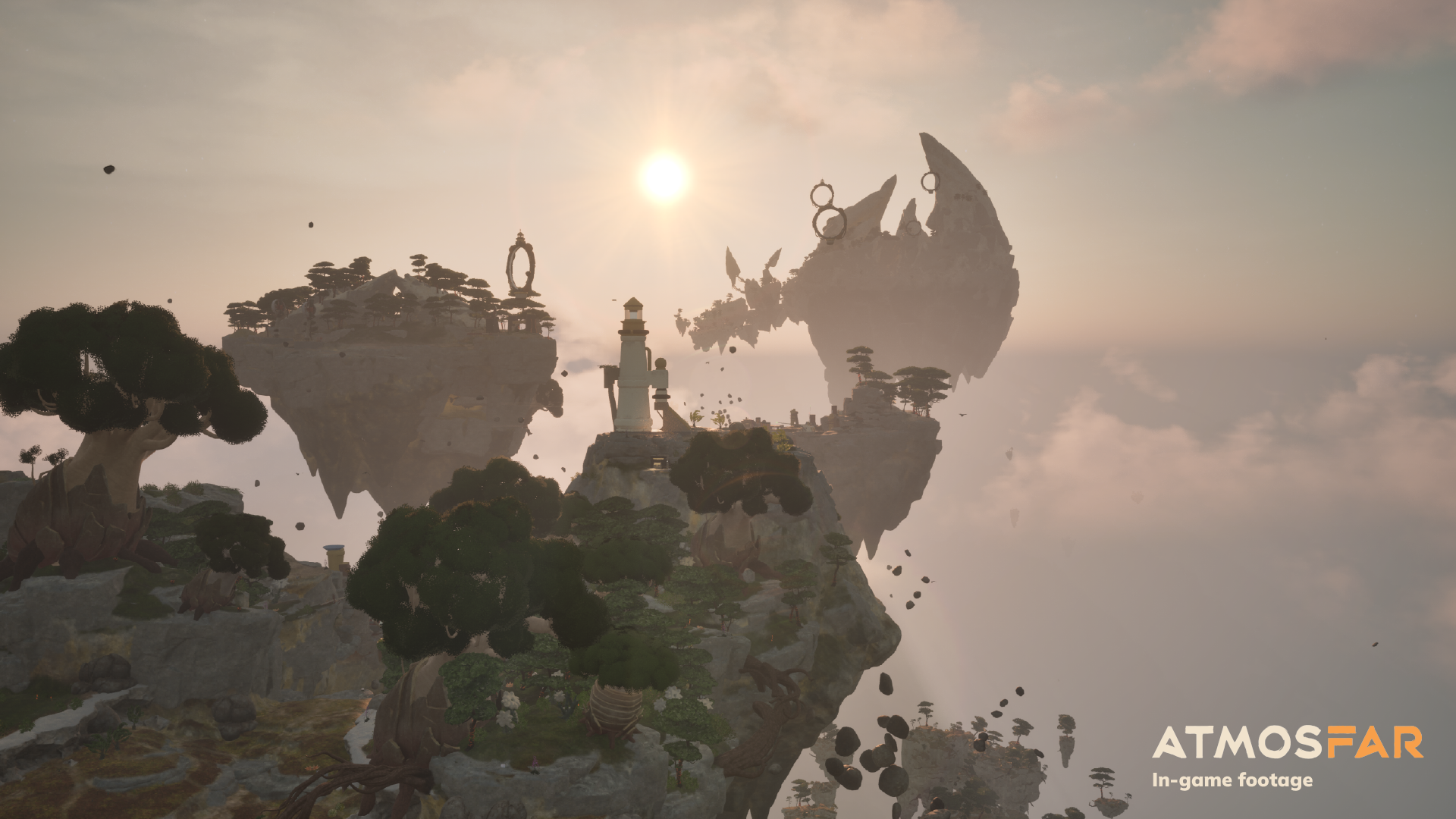
We can still guide the player in certain ways or help them navigate. We work a lot with composition/framing and landmarks. The player should be able to see something interesting that they might want to explore from certain points of an island or up in the sky or arrive at a POI and quickly realize if they’ve already explored it. If you play multiplayer, you should be able to describe an area to your friends to help them navigate.
I’m eager and curious to see players experience and navigate the islands and the POIs for the first time. Seeing people running around in the areas we’ve built will be both exciting and scary, but most of all it will be valuable to me as a designer. I hope everyone who plays will have fun exploring and I’m curious which areas will be the most popular camp spots!”
Yet another interesting breakdown from one of the team members here at the studio! Game development is essentially one giant collaboration across different disciplines and fields, and Level Design illustrates this very well. In this example we got to see how our Level Designers must keep track of art direction, game design, challenges, story line, lore, composition and readability in order to successfully create an interesting and exciting POI. That’s a lot of things to keep in mind at the same time!
Continuing the series
Yes, there is still more to game development than the subjects we’ve gone over this far! Sometimes it can seem like it is never ending… But we will get to the end of it! Eventually…
Anyways! For the next dev blog, you can expect a continuation of this series. Next time we will however move away for art slightly. The main topic of the next dev blog will be about code! Or programming, or software engineering or development or… Well, you get it. “A beloved child has many names”, like one would say in Swedish.
Speaking about code… Maybe it’s time to get back to work before something breaks. See you in the next dev blog, and thank you for being here!
All in-game footage in this blog post comes from an EA beta build and may differ from the final game. Not a fan of reading? Watch the dev blog in a vlog format here instead! 👆 School’s out for summer! Sun is out, people are at the beach, and the Apog team is… inside! Working on
All in-game footage in this blog post comes from an EA beta build and may differ from the final game.
Not a fan of reading? Watch the dev blog in a vlog format here instead! 👆
School’s out for summer! Sun is out, people are at the beach, and the Apog team is… inside! Working on ATMOSFAR! Where else would we be? Well… some of us actually do have vacation, so this blog will we a bit shorter than usual.
About two months have now passed since we announced that we’re postponing the game. This means that there is… even less time left before ATMOSFAR releases into Early Access! Wohoo!
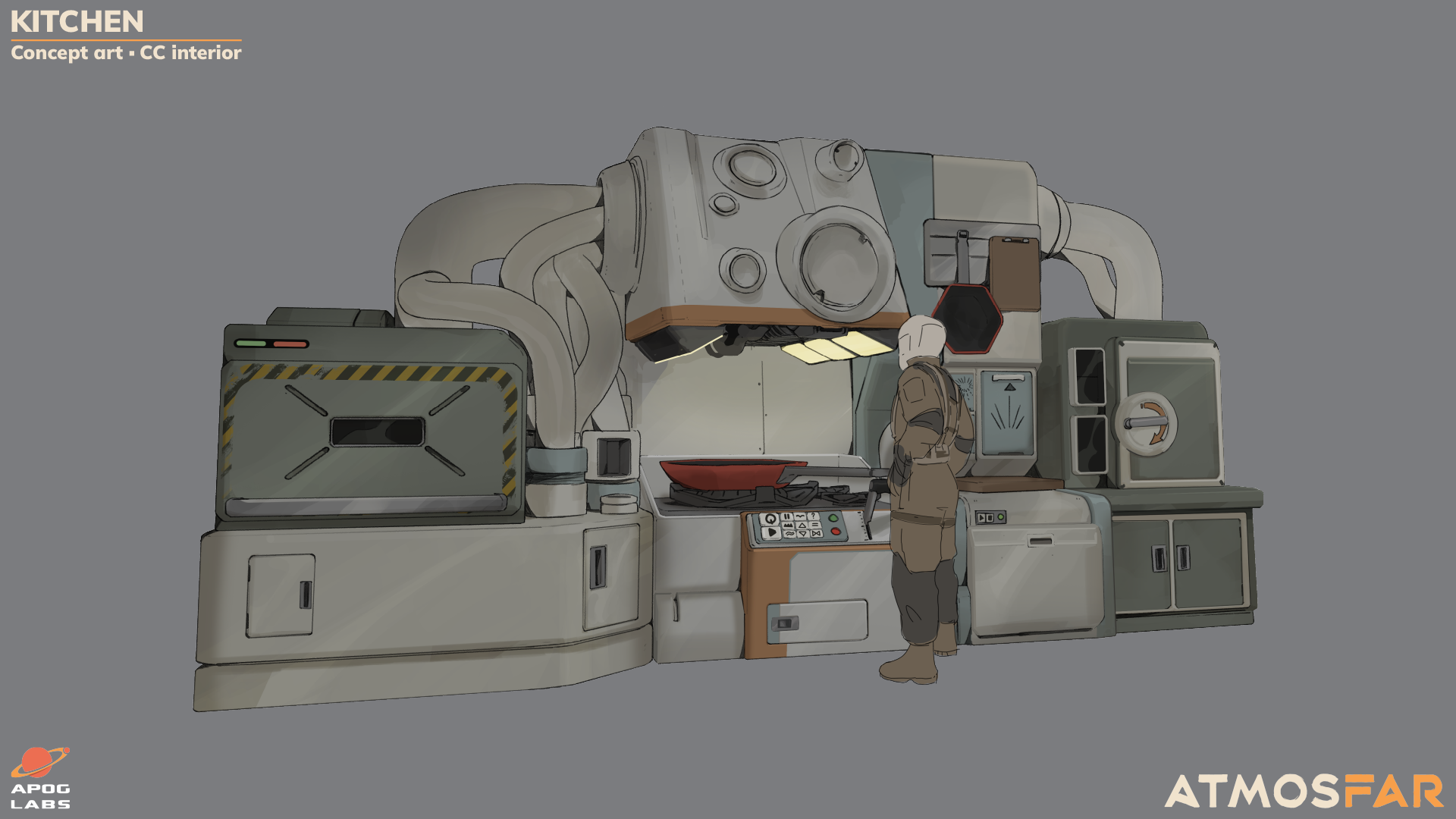
Well, you kind of already know the drill by now: We’re continuing to polish and tweak the game to get it as balanced, beautiful and fun as possible. What a shocker! Instead of giving you brief explanations of the overall development, we want to continue to give you more in-depth descriptions of some of the various aspects of the game that we’re working on. In our last blog post, we took a deep dive into level art. Today we’re focusing on an adjacent topic: Concept art!
Finding the throughline
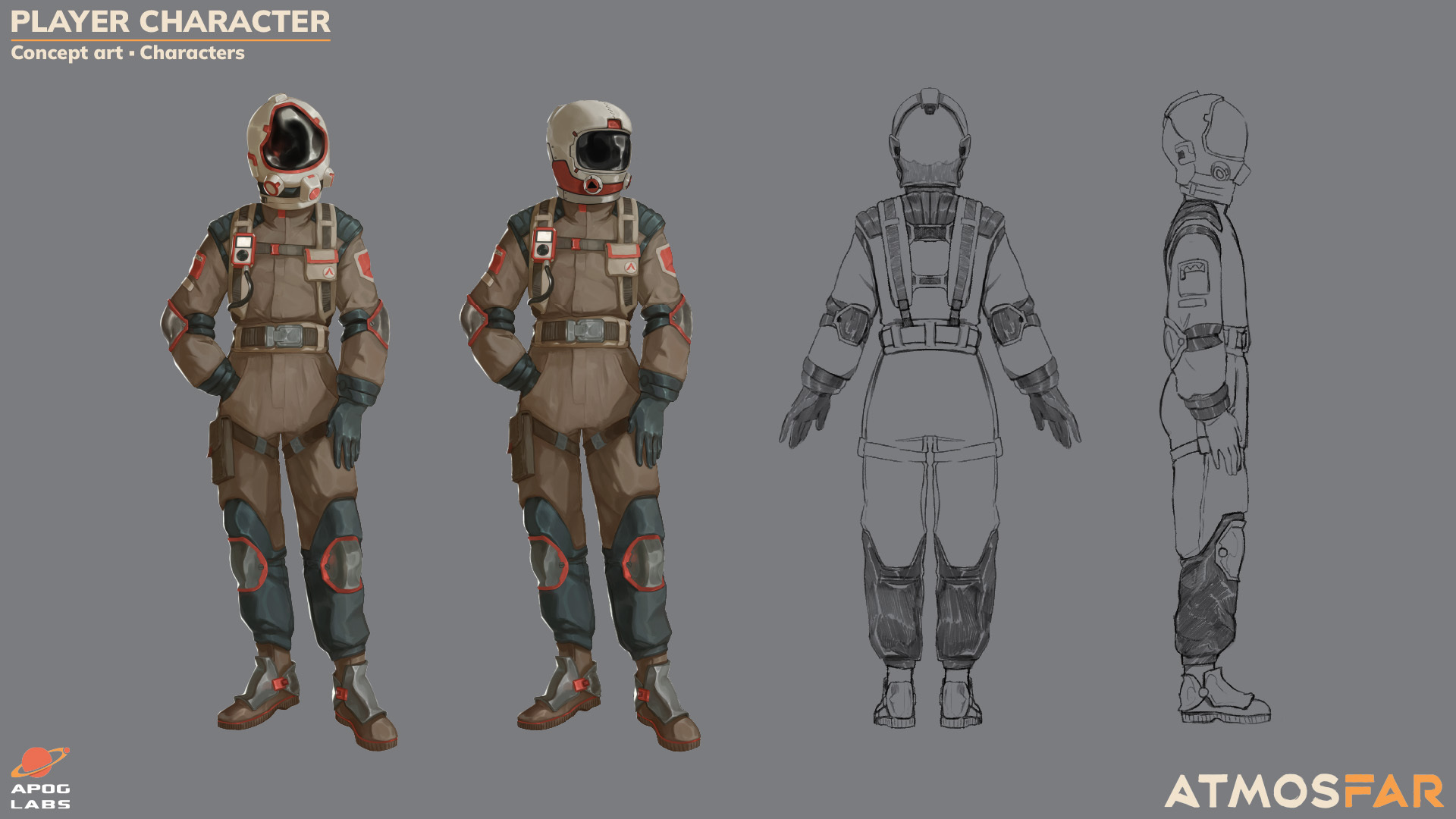
Instead of reading about what our Community Manager thinks a Concept Artist does, you’re going to hear it all straight from the source! Today, our Concept Artist (yes, the only one at the studio!) is sharing her thoughts and reflections on her job. Take it away!
“Hi!! I’m the artist! I’ve been asked to explain my job, which is actually harder than one might think (my parents still don’t understand it, for example…), and give y’all some insight into my part of the game making process!
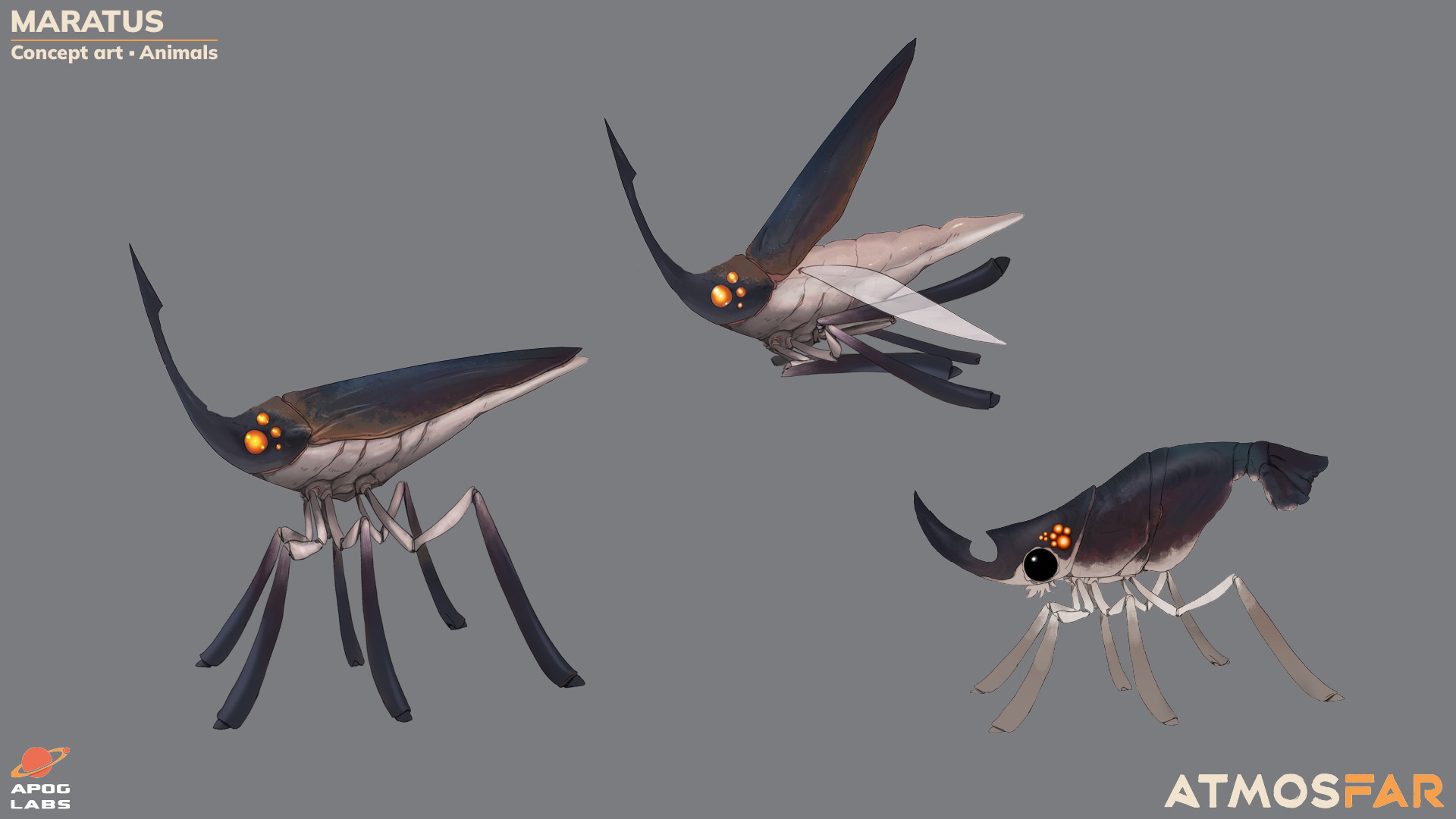
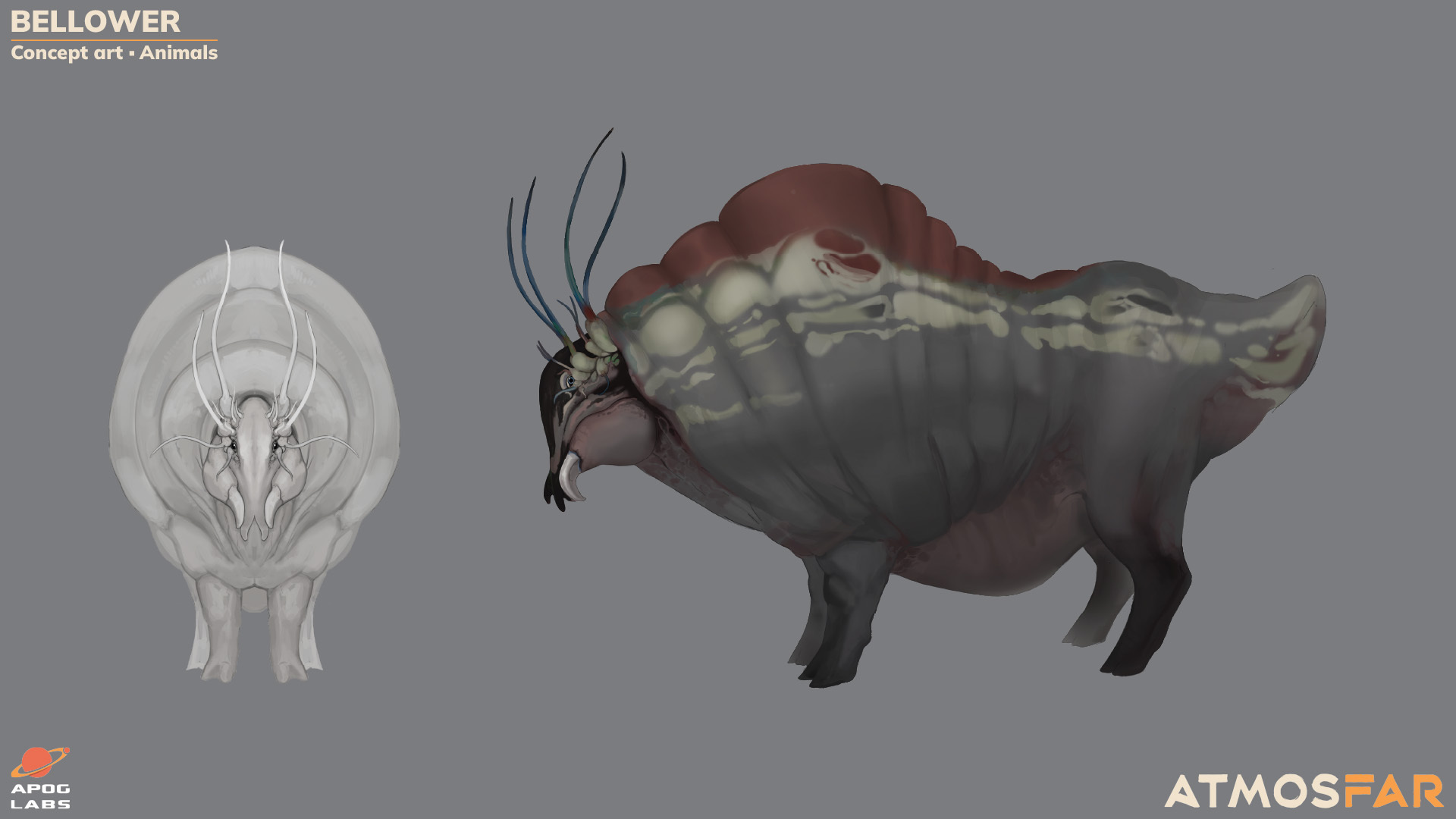
I’m a Concept Artist, which means my job is to come up with interesting designs for the game. My main way of doing this is through sketches, drawings and paintings. The reason why it’s done in 2D like that is that it’s much quicker and easier to test ideas this way. So instead of having our 3D artists build everything from scratch just to realize that we don’t like it, I’ll just paint what it could look like and save everyone a lot of time to ensure that the 3D artists can focus their energy on making amazing looking models. By working in 2D, we can also test multiple ideas in very quick succession, which makes us more likely to arrive at a design we really really like. So while concept art consists of a lot of drawing and painting, it is more than just that! It’s a way to test new ideas and solve problems visually.
I work very closely with our Art Director, whose job it is to set the tone for the game visually and create the unique visual style that we want ATMOSFAR to have. He plans the artstyle, the color palettes, and the overall feel and tone of the nature, animals, factions, tech, UI etc. He lets me know what the goal is for a particular design, how it should feel, what colors could work and so on and sometimes gives me inspiration pictures or references to use as a starting point. After that I usually have free reign to use my imagination. My favorite part is the early stages where I just brainstorm and try out a lot of different things. It’s perhaps a bit surprising, but I’ve found that an important skill to have when you do this kind of work is grit and persistence, maybe more than technical artistic skill (though that is obviously very important too). As artists, I think there is a tendency to want to give up if your first idea doesn’t pan out the way you wanted it to. I’m certainly guilty of this when I draw things in my free time. But with concept art, it’s necessary to continue pushing even if the first couple of things turn out bad or less than ideal. That’s how you get to the good and really good ideas!
For me the most fun thing to work on with this project has been the environment and the animals (but designing the character was very fun too!). There is something about getting to breathe a bit of life into a new world that is incredibly rewarding. I especially enjoy creating various animals for the game world as well. Speculative biology (imagining what life could look like on other worlds) is a hobby of mine, so crafting new species and figuring out how they might fit into their specific ecological niches while being visually appealing and fit the game design requirements is a very fun challenge. Designing plants and landscapes is fun too, but I love how in the end the creatures become a core feature the player interacts with, it’s a bit more dynamic.
I’m very eager to see what the players will have to say about this world that we have crafted! This will be the very first game I work on that gets released, and after spending years on the designs and slowly seeing it all come together to form this unique and, if I say so myself, beautiful world, it’s both nerve wracking and very exciting that people soon will be able to experience it for themselves! I really hope you will enjoy exploring it as much as we’ve enjoyed creating it!”
Woah, there definitely is more to concept art than what might meet the eye! Let’s give it up for our incredible Concept Artist!
Make it alien, but familiar
One thing we’re constantly working on when it comes to creating the world of Tycos, is the balance between “alien” and “familiar”. Tycos is a planet far out in space, light years from planet Earth. This needs to be conveyed through our art direction, and it needs to be alien enough for players to want to continue to explore and experience the strange flora and fauna that make up the planet. At the same time, the vegetation, animals and all other elements need to be familiar enough for the player to understand what they’re looking at. Trying to orient oneself in a world where literally nothing is recognizable would only frustrate and wear out the player (or might be an idea for a new game?!). As explained by one of our Level Artists in our previous blog post, the environment itself serves as a support for gameplay by highlighting mechanics, drawing attention to important areas, and helping players understand what actions are available to them. Utilizing for example vegetation and animals as cues is only doable if they’re understood by the player.
Using both familiar and foreign elements together can also be a way to make the alien features stand out even more, as explained by our Audio Lead Joe in an earlier dev blog: “The first step in creating a believable natural environment through sound is to reference the world around us! We as humans are incredibly sensitive to changes in the environment, and sound is no exception, so in order to sell this natural world we need to create it with flora and fauna that actually make sense to exist there. By doing this not only will our world feel natural and immersive, but we also get to subvert that natural soundscape with our more… unique plant and animal life. By keeping the soundscape familiar, the player is even more alerted by sounds that don’t belong, which lets us drive greater curiosity, discovery, and every once in a while a touch of fear.”
On the topic of the creative processes behind ATMOSFAR, we’d also like to point out that everything in the game is completely hand made by the team here at the studio. This includes everything from the first, rough sketches to the final, polished model for the game. We believe that coming up with your own ideas and executions stimulates creativity, which then makes it easier to come up with even more, or new things. As our Concept Artist just said: “it’s necessary to continue pushing even if the first couple of things turn out bad or less than ideal. That’s how you get to the good and really good ideas!”
Time to take a break
As you’ve noticed, if you ask us about art, or well, any aspect of the game ever, we will go on for hours and hours about it. Guess that’s what happens when you’re really passionate about something! Believe us when we say that we have a lot of other, in-depth topics we’d like to share with you all. But that’s going to have to wait until later. If we don’t stop this dev blog anytime soon it won’t be shorter than usual, like we promised in the beginning!
We’re soon going to ramp up to our usual speed again, but first, the Apog Labs team needs a well deserved break. However much fun it is to develop, progress and create, rest is important! And that goes for all of you as well. We hope that you have a wonderful summer, and that you come back well rested and ready to take on Tycos!
All in-game footage in this blog post comes from an EA beta build and may differ from the final game. Prefer to watch instead of reading? Watch the full vlog here! Dear Vagabond, As you know, times have changed a bit since we last saw you. Things can indeed change during the prod
All in-game footage in this blog post comes from an EA beta build and may differ from the final game.
Prefer to watch instead of reading? Watch the full vlog here!
As you know, times have changed a bit since we last saw you. Things can indeed change during the production of a game! At Apog Labs, we sometimes seem to pivot at the speed of light!
Jokes aside, here at the studio, we are trying to stay as flexible as possible in order to quickly adapt to changes in both the development of the game and the world around us. For example, it is no secret that the games industry has gone through a lot changes and challenges during the last couple of years. Even though we try to stay agile, the bigger the project becomes, the harder it is to pivot quickly. Think of it like steering boats: It takes a lot more force and time to change the course of a large cruise ship as opposed to a skiff. During the span over the years, ATMOSFAR has grown, and is now closer to a ship rather than a row boat.
In this dev blog, we’ll talk a bit about the bittersweet delay, as well as dive a bit deeper into some of the aspects of the game that we’re working thoroughly with right now.
The delay
The delay. Could we have used a more inspiring and positive heading? Yes. But let’s call things for what they are! A delay is a delay. Nothing more, nothing less.
Enough about headings! Yes, we delayed ATMOSFAR. It happened.
Why did we delay ATMOSFAR? Well, as we explained in our delay message, it simply boiled down to that we weren’t quite satisfied with the state that the game was currently at. It was playable, sure, but when putting down years of planning and development, we naturally want to give ATMOSFAR the time, care and attention it needs in order to blossom into the experience we’ve envisioned all this time. The decision was not only done with the game’s vision in mind. All of you Vagabonds also played a big part when we decided on how to move forward with the game.
“But!” You say, “We never asked you to delay the game!”. It’s true! You didn’t!
Creating ATMOSFAR means that we are making our vision come to life. A large part of that vision is to create something that will give players an exciting, immersive and challenging experience, something that they’ll want to play and advance in. One of the most rewarding things as a developer is to have external people partake in and enjoy what you’ve created for them. To put it short: We are very keen on making your first impression of ATMOSFAR a good one. We want you to sincerely enjoy the world, with all its adventures, challenges and experiences. While we believe that you still would have enjoyed the game at its initial release date, we had identified a few aspects where we felt that further polishing would elevate the game even further, and thus making your first impression even better.
And… Uh, yeah. That pretty much sums it up. Making games is hard. The world is unpredictable. You’ve got to do what you think is best, and try your hardest.
But on the topic of the delay, one thing that has become evident to us is that how much support and patience all of you have for us and for ATMOSFAR. Having a community like this, where communication and respect goes both ways, while the excitement and hype for the game brings us together, makes game development a hundred percent more fun! Reading all your comments, ideas and compliments genuinely makes us happy, and a lot of times we share your messages internally so that everyone at the studio gets to see all the nice things you say to us. What a joy it is to have a community like you! Thank you!
Tweaking, balancing, polishing…
So, ATMOSFAR is bound to release in a few month’s time. What are we going to do in the meantime? Probably chill……. NOT!!!!
No, what we’ll do (and are are currently doing) is the good ol' classic “further polishing the game” like we’ve said so many times. But what does that mean, exactly?
Well, it depends a bit on which aspect of the game you’re looking at. Code wise, we’re hunting down and smashing bugs. On the narrative side, we’re going over the last pieces of dialogue, objectives and journal entries to ensure that everything holds the standard we want before sending it off for localization. For concept art, we are going through all assets in the game to ensure that we have concepts for everything. Apart from these examples, there are about a million other aspects that we now are busy to asses. Is the gameplay challenging enough? Rewarding enough? Does it feel satisfactory to pilot a Wasp? Are the sound effects immersive? Is the UI intelligible? The list can be made long, and we are essentially going through all the aspects of the game to ensure that they hold the required and envisioned standard.
One quite large aspect that we’ve been working thoroughly with the last months, and will continue with up until the EA launch is level art. In this blog post, one of our skilled and creative Level Artists has shared her thoughts and ideas regarding this subject:
“At first glance level art may look like it's mostly about making environments beautiful and visually coherent. While aesthetics are certainly important, level art is actually much closer to a mix of architecture, path finding, and environmental storytelling. Just as architecture influences how people experience and move through a space, level art helps players understand, navigate, and interact with the world around them.
At its core, level art is about supporting gameplay. Through visual cues, landmarks, composition, and environmental storytelling, it helps communicate information, encourage exploration, and guide players naturally through the game world.
Every visual element in an environment has the potential to tell the player something. Is this biome dangerous? Does it contain valuable resources? Is there a hidden secret nearby? Good level art can answer these questions without relying on quest markers, pop-ups, or explicit instructions.
Gameplay always comes first. A Level Artist's role is to support the work of game and level designers by highlighting mechanics, drawing attention to important areas, and helping players understand what actions are available to them. Storytelling is also an important part of the process, but it comes after gameplay needs have been met. When level art is successful, players naturally understand where to go, what to investigate, and how to interact with their surroundings.
One of the most interesting challenges in level art is giving identity to areas that don't necessarily have a strong gameplay purpose or visual direction. In open worlds games, especially those without maps or GPS systems, players often rely on the environment itself to find their way. This means creating memorable landmarks and distinctive features that help players orient themselves and build a mental map of the world.
Landmarks and points of interest are powerful tools for achieving this. A large rock formation, an unusual tree, a ruined structure, or even a unique color palette can become a recognizable reference point. In a multiplayer setting, a player might tell a friend, “I just passed that huge strange-looking rock,” knowing they'll immediately understand which location they're talking about! These landmarks can also communicate gameplay information, hinting that a certain resource can be found nearby or that specific creatures spawn in the area.
In that sense, set dressing, or level art, is about much more than making an environment look good. Every prop, structure, and visual detail can contribute to the player's understanding of the world. Level art supports both game design and level design by helping players navigate, discover opportunities, and better understand their surroundings. Sometimes this guidance is direct, while other times it's subtle, encouraging players to observe, explore, and make discoveries for themselves.
Ultimately, level art acts as a bridge between design and player experience. It translates gameplay intentions into visual language, helping players intuitively understand and engage with the world around them. Through landmarks, composition, environmental storytelling, and visual guidance, level art does far more than decorate a space: It gives the game world meaning, direction, and identity.
I can’t wait to see all of you Vagabonds discover the hidden wonders and challenges that Tycos has in store! Even I still struggle in this world, getting lost more than once in its endless caves, countless crevasses and secret locations that are still waiting to be discovered. When you reach Tycos, remember to stay aware of your surroundings!“
Open skies ahead
Now that was an impressive crash course in level art!
Gazing into the future of ATMOSFAR is like gazing out over the horizon. What’s hiding in the distance? Success? Turbulence? Something else? We simply don’t know until we get there. But with members like this on our team, with this level of knowledge, strategy and creativity, we feel confident that the vision we have for ATMOSFAR will come to life. And then we’re sincerely hoping that all of you will like the vision as much as we do. But that’s another story!
Thank you all for the patience and hype you’re giving us. We are looking forward to the release as much as all of you! In just a few month’s time, you’ll be able to explore all the hidden secrets, caves and crevasses that we’re preparing for you right now!
Until then, we’ll catch you up in the skies. Keep the blue side up!
Dear Vagabonds, Today we have an important and tough announcement to make. As you may have already seen from the release date update on Steam, ATMOSFAR will now instead be launching into Early Access in a few months. Despite our best efforts to reach the original May 20th launch
Dear Vagabonds,
Today we have an important and tough announcement to make. As you may have already seen from the release date update on Steam, ATMOSFAR will now instead be launching into Early Access in a few months.
Despite our best efforts to reach the original May 20th launch date, we’ve sadly had to make the decision to take additional time to ensure that your first flight across Tycos is as smooth and free of turbulence as possible.
While ATMOSFAR today is fully playable, it’s not how we’d like you to experience it, and we can clearly see the positive impact that this extra development time will have on polish and refinement.
During production, the game’s ambition, scope and creative direction has grown a lot. Our vision has always remained the same, but development detours required to create a really great game can sometimes take more time than expected. Adding new gameplay mechanics and expanding the world, has taken a lot of additional time and resources and, as we’ve touched upon in our dev blogs, creating a game like ATMOSFAR is a balance of weighing the cost and time of production against the content and experience for the player.
Our Steam Next Fest demo earlier this year was an excellent way for us to focus in on which parts of ATMOSFAR were working well, and the parts that could do with some more refinement. We’d like to say a huge thank you to everybody who played the demo and gave us feedback. While we were excited that so many players saw the game’s potential, everybody here at the studio agrees that spending a few extra months preparing its departure will help elevate ATMOSFAR to new heights.
The winners of our recent Steam key competitions will, of course, still receive their prize when we enter Early Access.
Thank you for reading this, we can assure you that this is not a decision we have taken lightly. We are so incredibly proud and thankful for your support and we can’t wait for you to experience ATMOSFAR in a few months.
Vagabonds! We're happy to let you know that starting today, we will arrange weekly community competitions , where a handful of winners will win individual Steam Keys to use for ATMOSFAR once it enters Early Access. Alongside this announcement, we'd also like to let you know that
Vagabonds!
We're happy to let you know that starting today, we will arrange weekly community competitions, where a handful of winners will win individual Steam Keys to use for ATMOSFAR once it enters Early Access.
Alongside this announcement, we'd also like to let you know that we will be taking the demo down from Steam this Thursday (April 30), which means you won't be able to play the demo after this date.
We would however, like to go out with a bang! Which is why our first ever community competition will be... Yup, you guessed it: A good ol' speedrun! Head on over to our Discord server to participate in this competition!
Good luck out in the skies, and remember to keep the blue side up!
Vagabonds! For everyone who prefers watching a video to reading a blog post, we've now done a video where we cover the first part of yesterday's dev blog: Everything about the demo! Tune in to listen to our reflections, thoughts and lessons learned. In the spirit of feedback and
Vagabonds!
For everyone who prefers watching a video to reading a blog post, we've now done a video where we cover the first part of yesterday's dev blog: Everything about the demo! Tune in to listen to our reflections, thoughts and lessons learned.
In the spirit of feedback and suggestions, we're also happy to announce that right now, we have a ongoing challenge on Discord! We would like to give you the opportunity to truly decorate and build your Cloud Cruisers to your very own liking, and so we're currently opening our suggestions inbox for ideas on posters and pictures to hang on the walls of your mobile homes!
The suggestions inbox will be open until Friday the 17th of April. The top suggestions will be iterated on and put in the game for all players to craft. Join our Discord server today and make sure to read the regulations of the challenge. Hit us up with your best ideas!
All in-game footage in this blog post comes from an EA beta build and may differ from the final game. Vagabond! It was quite some time since you last saw us in one of our dev blogs. Instead we’ve been seeing you… on Tycos! It has indeed been two very exciting months since our l
All in-game footage in this blog post comes from an EA beta build and may differ from the final game.
Vagabond!
It was quite some time since you last saw us in one of our dev blogs. Instead we’ve been seeing you… on Tycos!
It has indeed been two very exciting months since our last dev blog. Things have been moving fast at the studio, and the entire team has been developing, producing, concepting and creating like never before. Just as we thought we’ve reached our peak speed, the team has leveled up into yet another gear. The fantastic team behind ATMOSFAR never seizes to amaze. Make sure to buckle up, ‘cause you’re in for a ride!
ATMOSFAR: The Demo
One of the most palpable things during the last two months has of course been our demo. Releasing at Steam Next Fest, the demo managed to climb up to be one of the top 50 most played demos during the online event, with over 70K individual players this far. This placement is more than we could have ever hoped and wished for, and we are incredibly grateful and humbled by every single one who decided to give the demo a try. In addition, we’re getting closer and closer to reaching 1000 members on our Discord server, a goal we did not expect to reach before Early Access! If you’re not a member already, you should become one today!
It has been so much fun to see players overcome obstacles, finding secrets and solving challenges in a creative way. We’ve watched a lot of streams, and it has truly been a blast to see you all! We cannot emphasize enough how much joy all of your participation has brought us.
Alongside the pure amazement over all of our players, the demo has also brought us something else: A learning opportunity, and with it, invaluable insights, ideas and feedback. When we decided to release the demo, we did so due to a number of reasons. Being a relatively small studio, everything we decide to put work and time into must always be weighed towards the time and effort lost on other things, as we cannot do every single thing we wish we could. There is simply not enough time and resources for every idea we wish to implement. In a sense, you could say that a large portion of ATMOSFAR's development is resource management… in real life!
But let’s get back to the topic! The point that we’re trying to convey is that the demo was not an obvious choice for us, as it meant we had to use valuable resources to make the demo itself. But in hindsight, we can proudly say that we definitely made the right decision.
One of the main points of ATMOSFAR is, and has always been our players. We are making this game as much for the players as we are making it for ourselves. Even if a game can be described as multiple disciplines combined into an advanced piece of art, that very piece of art is not tangible or understandable until someone decides to try it out. To offer some food for thought: Is art still art if someone never experiences it? While we don’t hold the answer to that very question, we do know that ATMOSFAR always have been designed with every single one of you in mind. While a game can be beautiful on its own, it is nothing without its players.
This was one of the major reasons as to why we decided to release a demo. The demo has been an excellent way for us to see how ATMOSFAR have been perceived and experienced by all of you. After all, how can we make sure that we created a fun and exciting game for you, if we never get to hear what you think about it?
This brings us to another major topic regarding the demo: All the feedback! Since we released the demo, all of our social media channels have been flooded with feedback, and we love it! Getting feedback means that our players are passionate and invested. Feedback also give us an excellent rule of thumb as to which processes work and are enjoyable, as well as which mechanics need further polishing. At the end of the day, even if we are truly trying our hardest create as good of an experience as possible, a game like ATMOSFAR is an incredibly large task to take on. Multiple loops, mechanisms and processes need to be functioning and tuned to each other. Controls, cameras, animals and challenges need to be balanced. Art and sound direction need to be matched, decided on, concepted, created and modelled. It is a tall order, and even if our team is incredibly talented, we are humans, at a limited number. Which is why we’re extremely grateful for every comment, idea and bug report we’ve been getting. It has been an immense help to us on our road to ATMOSFAR. So without further ado, we’d like to say a big THANK YOU to each and everyone of our players all around the world. Honestly, we could literally not have done it without you!
The road to Early Access
As we hope that most of you have seen by now, we have finally been able to give you somewhat of a closer estimation to the release of Early Access: Q2 2026! This means that ATMOSFAR is bound to release in just a matter of months. Gaah!
As we’ve stated in almost all of dev blogs by now, things are moving fast at the lab. Actually, now, it’s faster than ever (maybe we’ll reach the speed of light by the next blog post. Who knows?). Right now, our focus is divided into two major aspects, with one being iterating on all the feedback, and the other being continuing to further developing the game. The demo was just a small appetizer of what’s to come, and even though we’ve done a large portion of the main game already, there is still a lot left!
In the world of Tycos, we’ve turned our gaze towards the upper regions and islands to continue with primarily level art to get everything in place before continuing on making them look better through set dressing. The further up in the atmosphere you go, or should we say the atmosfurther you go, the more the biomes change. This means that we are currently working, and are in a sense getting to know a new region, that players have not seen yet. Even though we of course have the idea and art direction in place, it always takes a while to get to know a new region or island. Just like a player is exploring the world before them, so are we, in a sense. Development of islands and regions is planned to continue through Early Access, and we are also planning on releasing a roadmap further on, so that you can follow the development process continuously.
As some of us have flown higher up in the skies, others have turned around to go back to islands well-known to all of you: Pearl Island and Mawknest Cluster. Even though further polishing was planned on these islands, the feedback on the demo has helped us see and understand what we need to revise once more.
The Utility Wasp camp
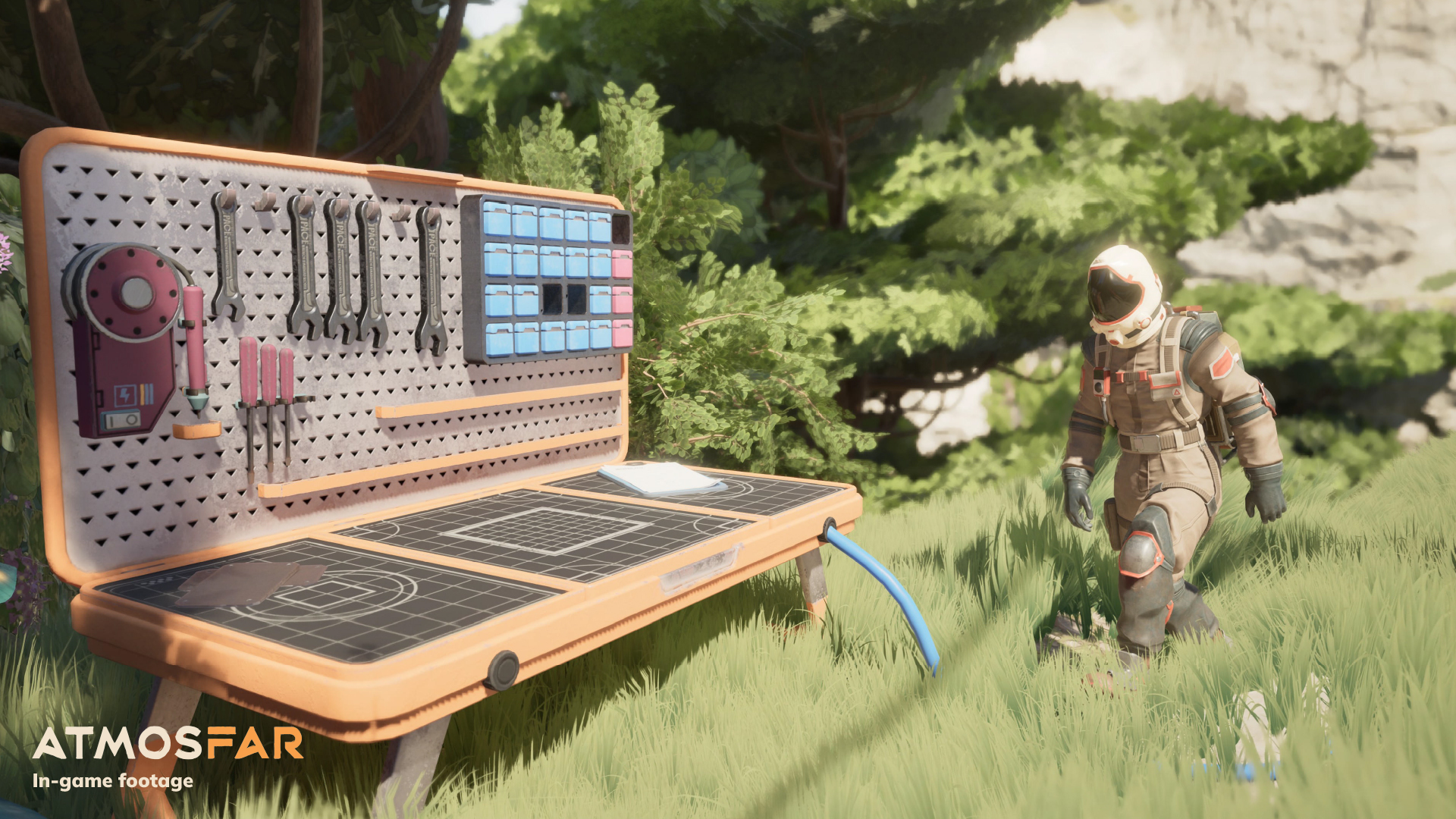
One of the things that was planned for further polishing and additions is the Utility Wasp camp, that most of you have interacted with and tried out by now. While most of its key modules and functions already are in place, like the camp hub and crafting table for example, some of the assets are still in need of models.
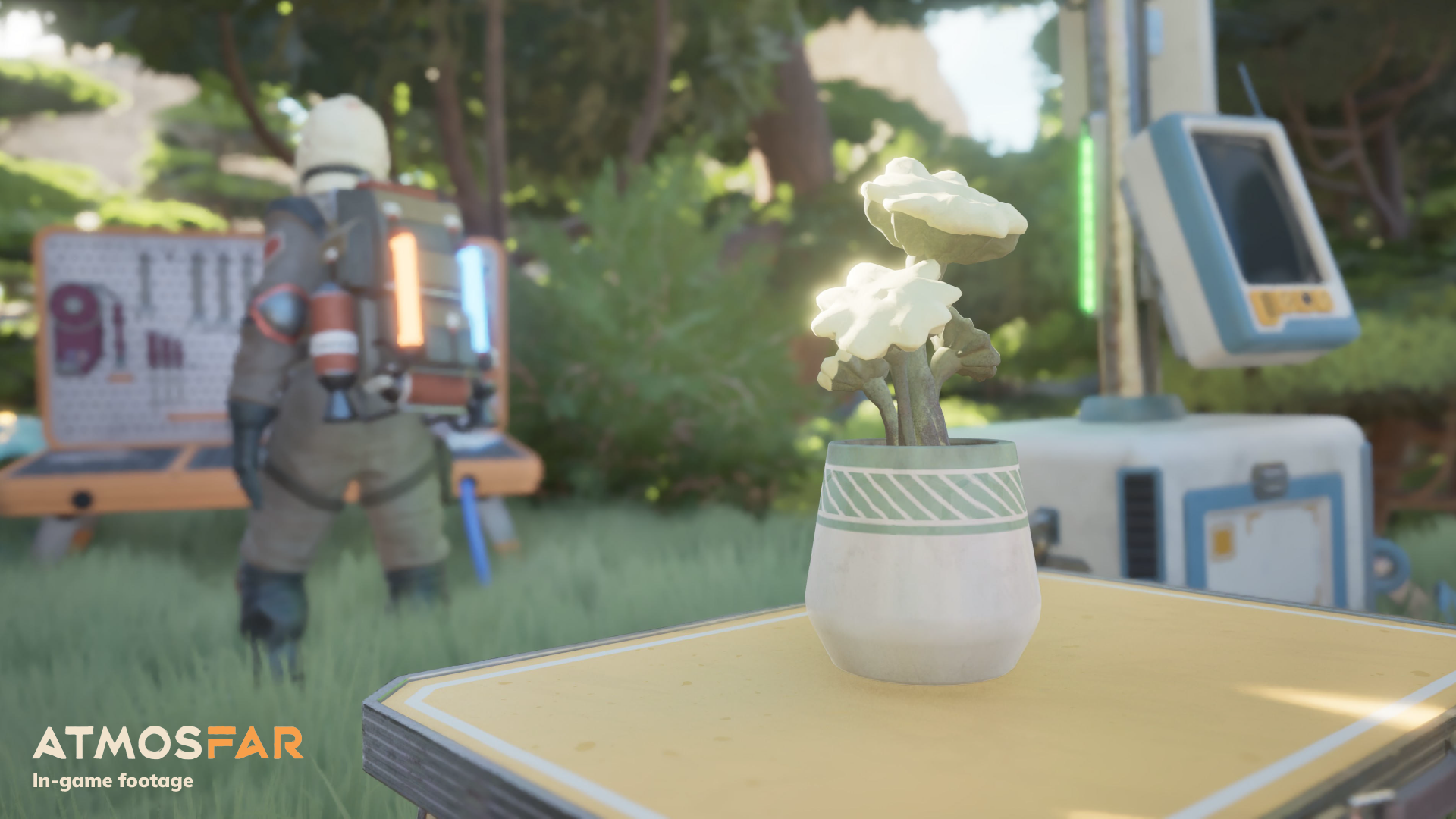
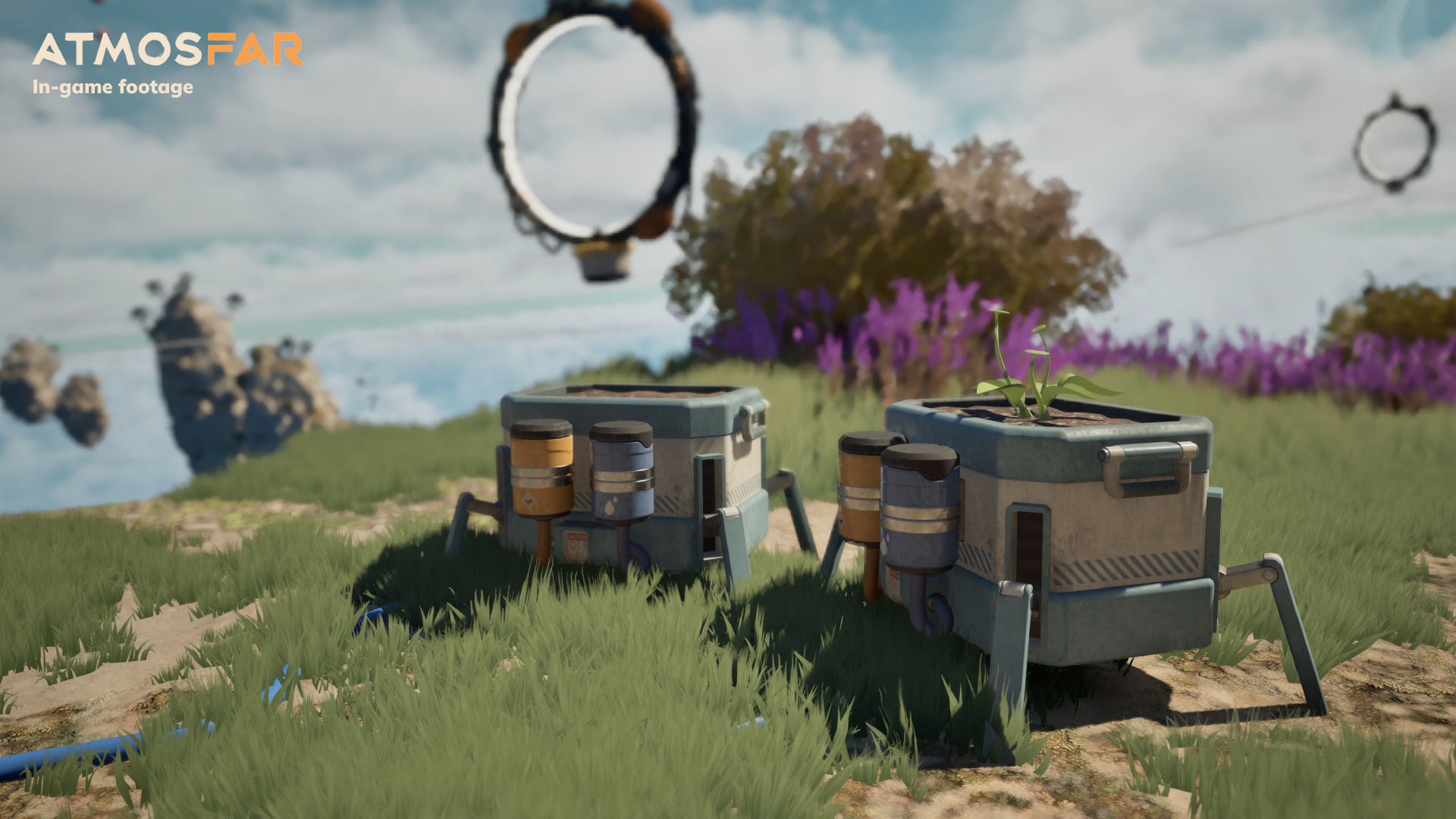
How does having your own, portable garden sound? Well, soon it’s possible! Right now, we’re working on models for portable planters for the Utility camp, that will allow you to plant the various seeds you may find. In addition to this, we’re continuing to crank the camp coziness up even more by adding chairs, tables, oil lamps and flower pots. The crafting table is also getting a visual makeover to look a bit more interesting and detailed.
Further on, we’re also updating some of the core functions of the camp hub to make the gameplay loop smother and more enjoyable. By Early Access, the camp hub will allow you to store your camp layout as a template, meaning that just as you pack down your entire camp by just removing the camp hub, you will also be able to build the entire camp by just placing out the camp hub. This allows you to quickly and effortlessly set up camp in new spots without having to manually place each and every piece of camp equipment. After reading some of your feedback, we noticed that the cue for packing down the camp hub was hard to spot as it was placed in the bottom right corner. This has now been moved to the middle of the screen to be more evident to players.
Cloud Cruising to new heights
The Cloud Cruiser was, as you unfortunately know, not part of the demo (we gotta leave some treats for EA, right?!). There are several reasons for this, where the main reason was that you gain access to the Cloud Cruiser a bit further on in the game than what was covered by the demo.
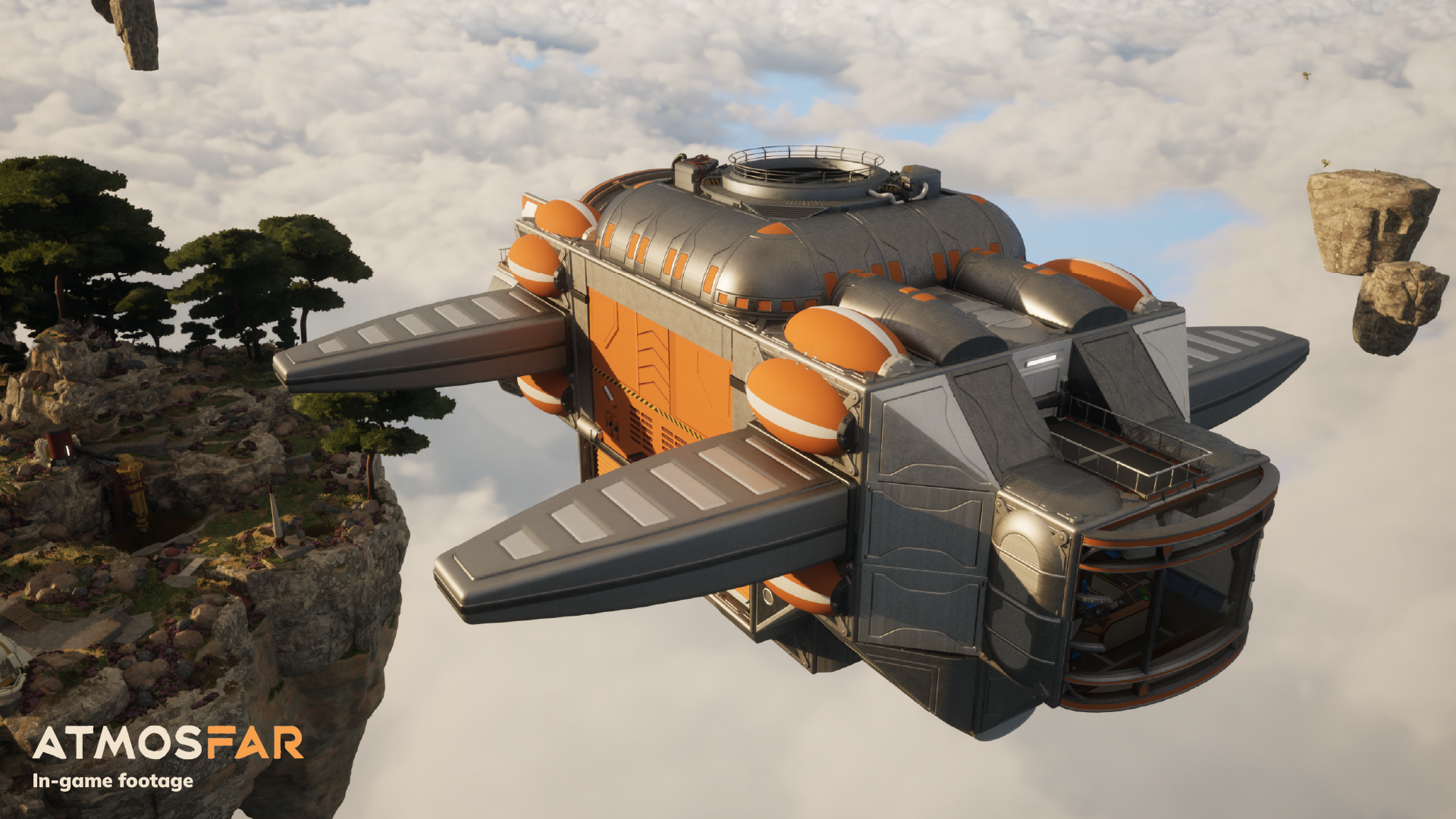
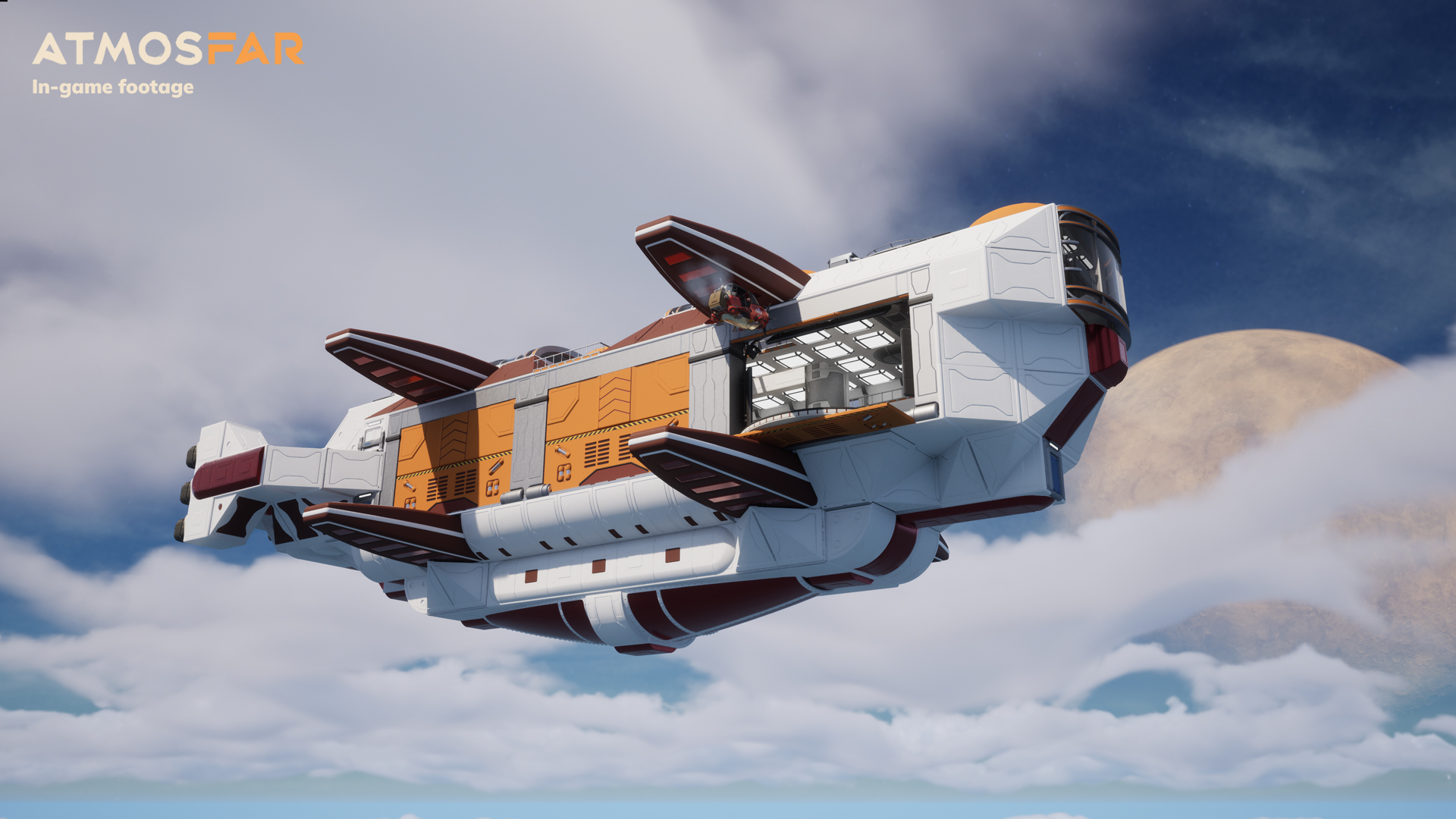
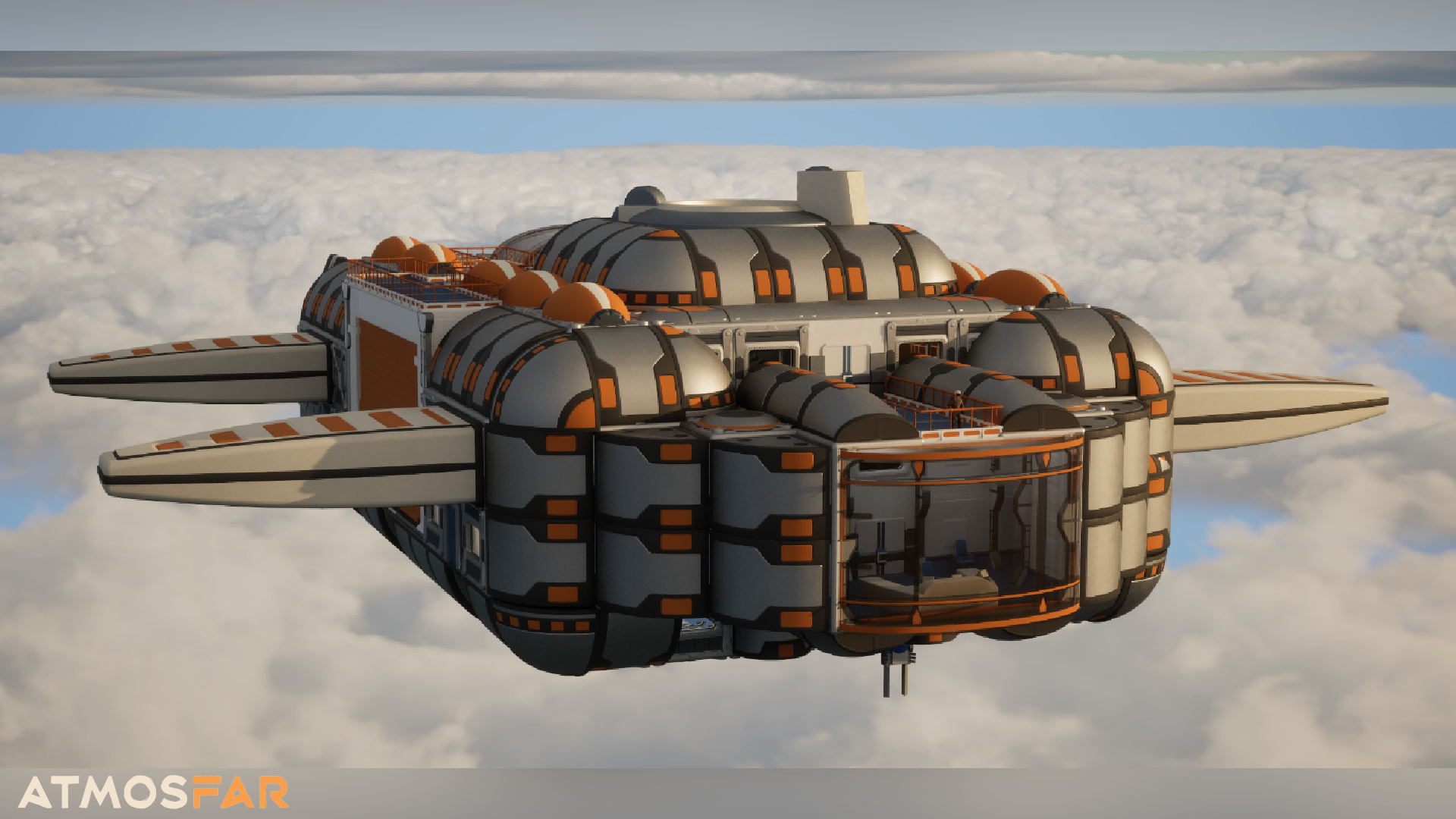
Since the Cloud Cruiser will be fully base buildable and customizable, we need to plan the parts it’s comprised of carefully so that the end product will be visually satisfactory to all players, regardless of how they decide to build it. This is quite a challenge! Here are some words from our Art Director:
“Designing a vehicle that players could build almost any way they want while also potentially being pretty huge can be quite a challenge. Every part needs to be modular and fit in many different configurations (configurations which we as developers might not completely be able to predict); parts should also not be too detailed as this will create a huge overly detailed mess of a ship. We’re also tied to the gameplay functions here more than for most other vehicles as the Cloud Cruiser is a very large and important feature of the game itself. And somehow the design still needs to come together into a single, unified, cool-looking whole that ties into the rest of the art direction of the game, our overall design philosophies while also being recognizable as The Cloud Cruiser from ATMOSFAR.
We chose to focus on a few pillars for the visual design of the Cloud Cruiser to achieve this: Keeping many surfaces (like walls and the hull) clean and not cluttered with detail noise (both in color and materials), focusing our detail on tech-sections and features (like jet engines, turrets, wings and the like), and really honing in on connecting the overall look of the Cloud Cruiser with a few references from the real world (a combination of modern military vessels, container ships, and contemporary spaceships).
We wanted the Cloud Cruiser to feel majestic, comfortable, and in the end not read as a battleship. This is the mobile base, scientific hub, and cozy home of our players, not the Death Star. I can’t wait (with terrified delight) to see what wondrous, mad, and clever configurations players will build when the game comes out!”
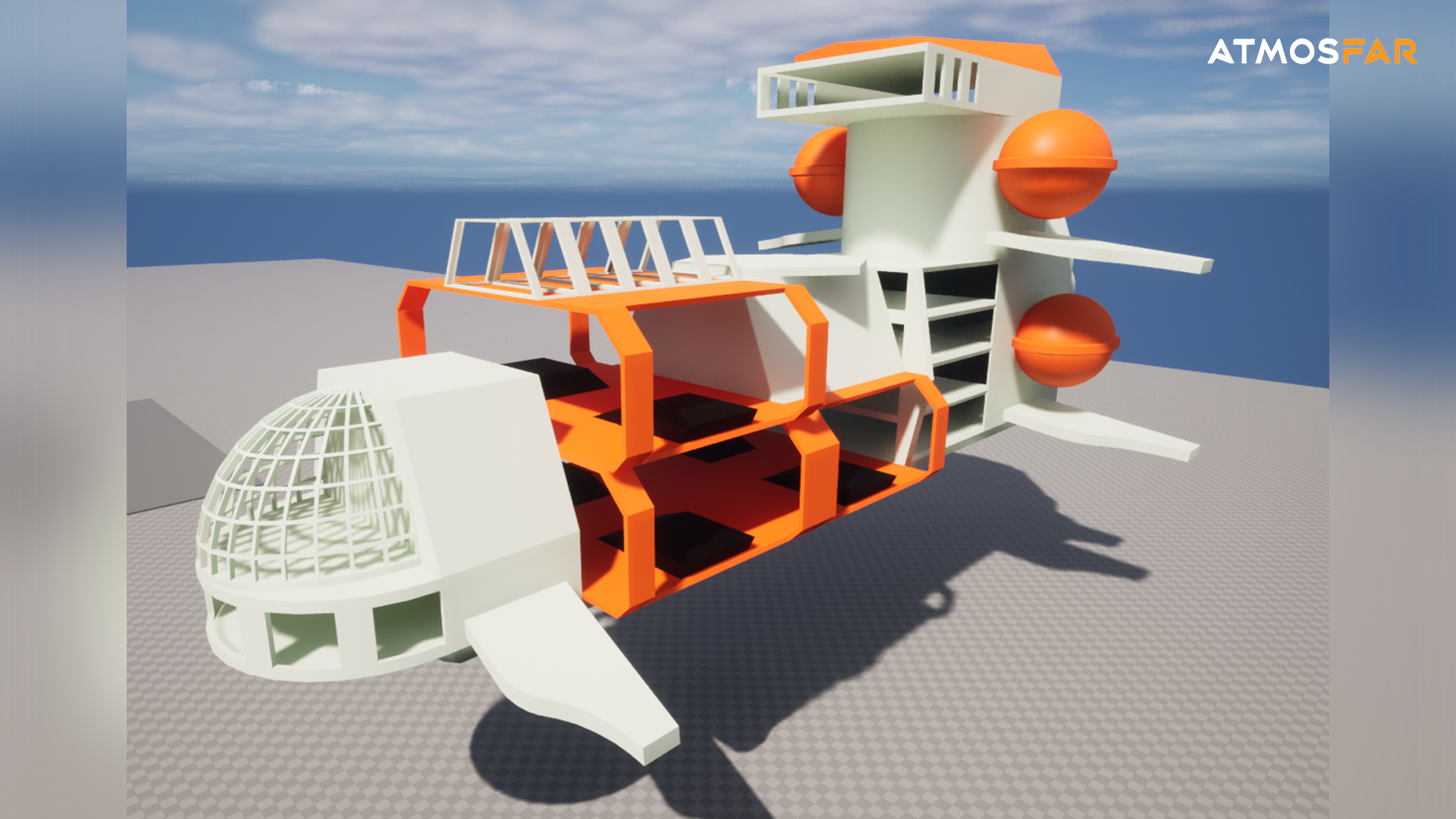
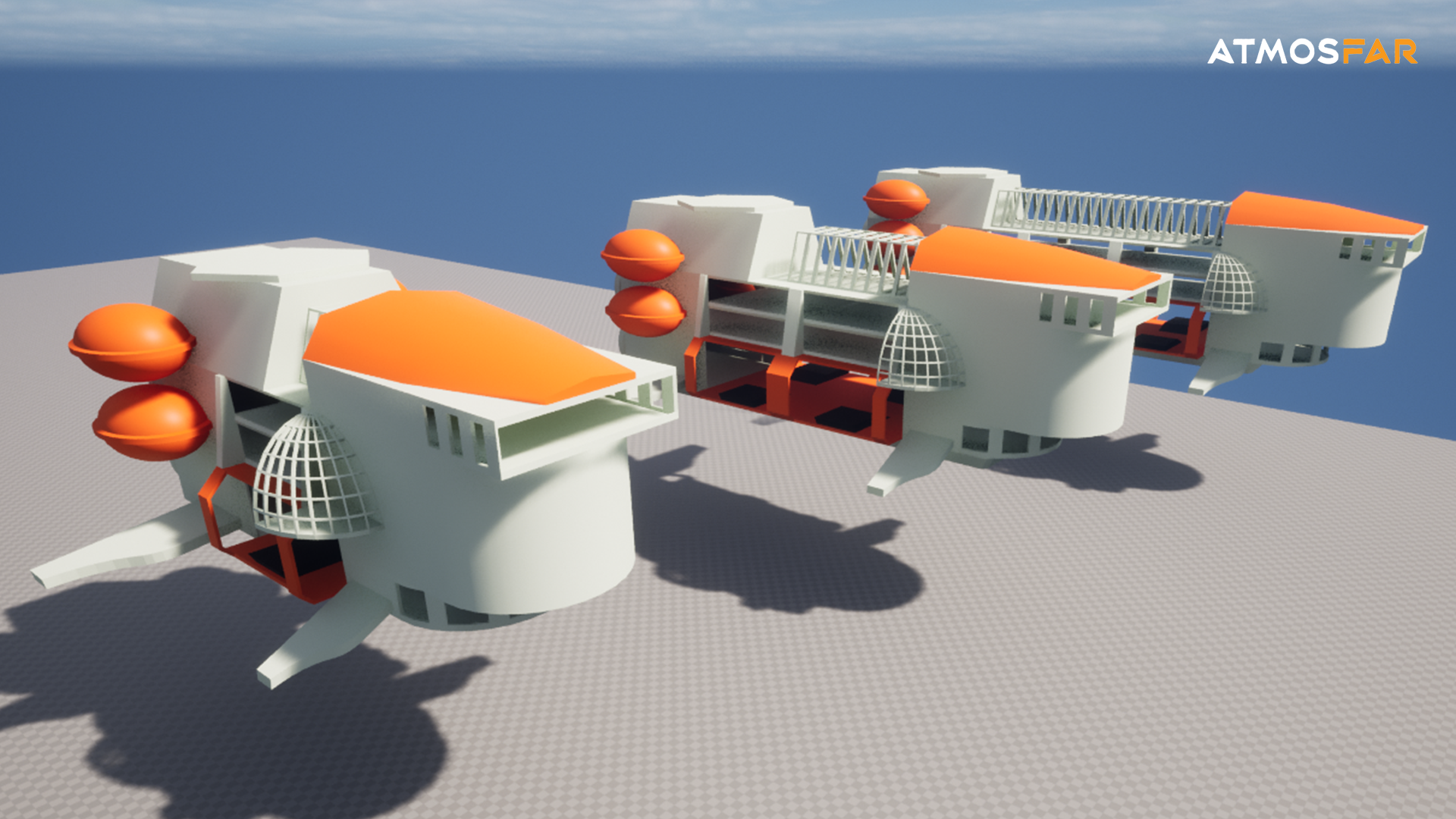
Even though we haven’t really shown the Cloud Cruiser until little over six months ago, the massive ship has actually been in development for far longer. If you go waaaay back in our dev blogs, you can see that the Cloud Cruiser was first introduced in 2023. That’s three years ago! Let’s take a closer look on the development over the years. A trip down memory lane, if you will!
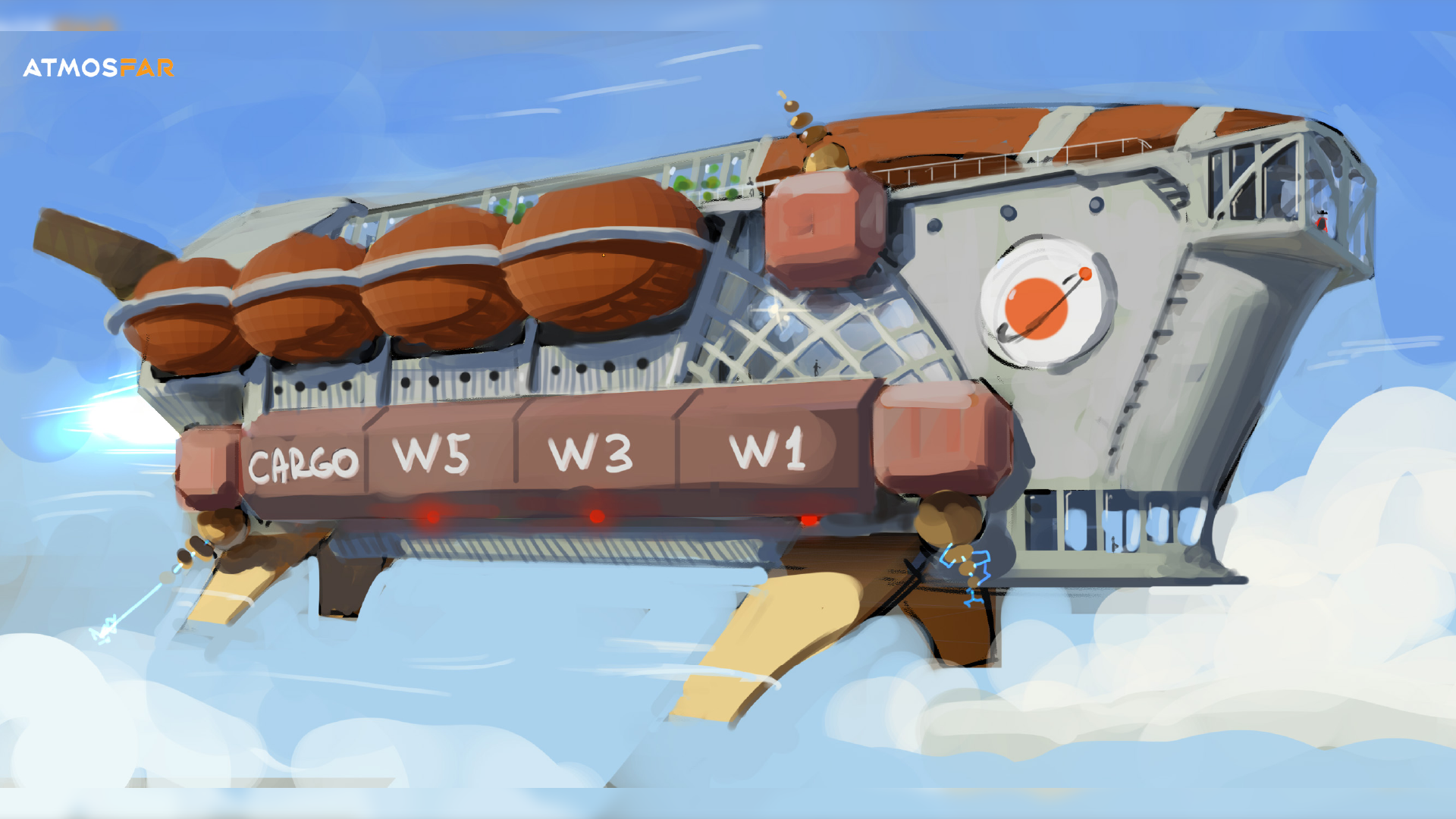
Here are some very early iterations of the Cloud Cruiser. These are evidently directly based on one of the first pieces of concept art for the vessel:
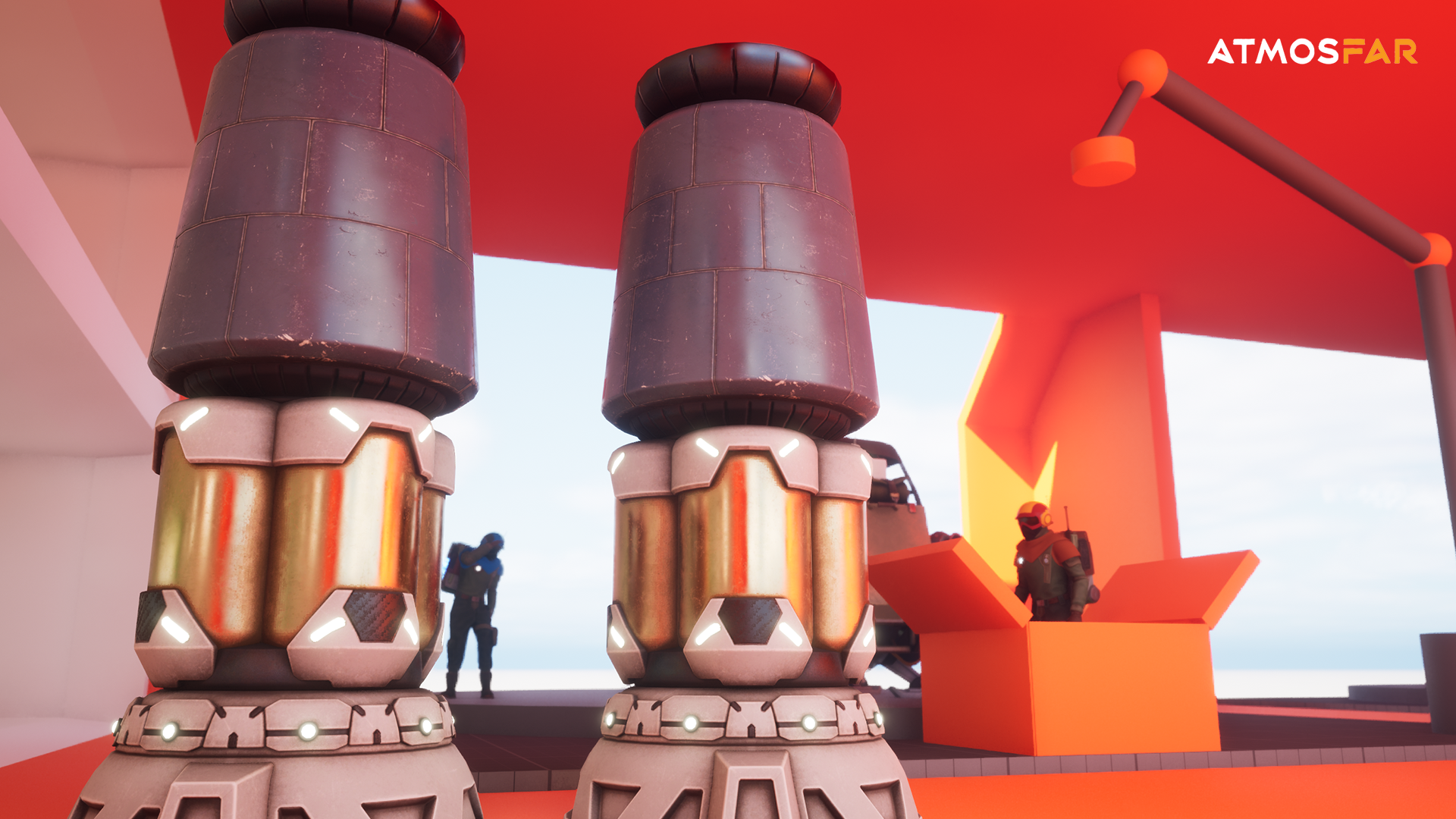
The ship has indeed changed quite a bit since we first presented it to the world. One thing that you however still might recognize is the hydrogen refinery! This model has not changed yet since we first created it all those years ago. Sometimes you just hit the bullseye right away!
After this initial presentation of the Cloud Cruiser, things moved a bit slower on its development as… well, we had an entire game to work on. The next time we really focused on the mobile home base was last summer, which resulted in quite the makeover for the vessel. This makeover was however not only visual, as the task force also covered its core functions, gameplay loops and the foundations of its customization system. In other words, this was essentially when we got things up an running properly! This was also the first time we got to try out the building system by creating our own vessels without relying on concept art or art direction:
After building Cloud Cruisers in different shapes, sizes and colors, it became evident to us that we still needed to put in some more work on the visual side, especially when it came to the size and shape of the different modules. We also realized that we needed to simplify both silhouette and color balance, as the ship became too noisy fairly easily:
So, as described by our talented Art Director, what we’re now focusing on is simplifying the shapes and color, to reduce noise and clutter. This is still a work in process, but the mobile base is already looking slicker, with even more new parts to come:
Needless to say, the Cloud Cruiser is a beast when it comes to development. And not only on the visual side! It is filled with different kinds of mechanisms and gameplay loops that all are dependent on each other in various ways, that all need to be working simultaneously. Adding fully customized base building and of course the multiplayer aspect complicates things even further, as all visual and mechanical changes need to be functioning and moving at the same time across different clients. To solve this issue, we’ve come up with an approach internally labeled as Cloud Cruiser mirroring tech, which we’re planning to dive a little deeper into in the future.
But on the other hand, the development matches the gameplay experience. Just as much a beast it is for us developers, it will be for players! As the Cloud Cruiser is thought to be one of the major aspects of the game, it would only make sense for us to spend a considerable amount of time designing and developing it. After all, building, planning and tending to your Cloud Cruiser is almost like a game in itself.
And on that note, it’d probably be wise to let you know that this is far from the last time you’re going to hear us talk about the Cloud Cruiser. Our approach to this monster is very much: “But wait, there is more!”.
Exciting times ahead
As we’ve already touched upon in this blog, the best thing about all of this is that we still have the most exciting part before us! Believe us when we say, that we are as excited as all of you to release ATMOSFAR after all of these years. It is almost unbelievable that this insane, creative and above all, massive teamwork effort so soon is about to reach its goal. Even though we’ve been planning for it since day one, nothing could have prepared us for the joy, excitement and nervousness that we are feeling right now (yes, of course we’re nervous as well!).
Before we end this dev blog, we’d once again like to say thank you to each and everyone of you who’ve played the demo, given us feedback, checked out our trailers, or are even reading this blog post right now. Believe us when we say, that we could never have done this without you.
We're incredibly grateful and humbled to announce that our upcoming title ATMOSFAR now as hit over 200 000 wishlists! We had high hopes for the demo, but reaching over 200K wishlists in less than a month after the demo release is incredible. We'd like to take the opportunity to o
We're incredibly grateful and humbled to announce that our upcoming title ATMOSFAR now as hit over 200 000 wishlists!
We had high hopes for the demo, but reaching over 200K wishlists in less than a month after the demo release is incredible. We'd like to take the opportunity to once again thank everybody who's played the demo, given us feedback or joined our Discord. It has been an immense help!
Alongside this, we'd also like to highlight that a closer estimate on the Early Access release of ATMOSFAR has been given, which is in Q2 2026. This means that we'll see you all, relatively soon, on Tycos again! In the meantime, we recommend that you check out our Horizon Burns trailer, to get a jumpstart on the lore and mysteries that revolve planet Tycos.
Dear Vagabonds! Once again we'd like to thank all of you so much for playing the demo, joining the Discord and for giving us so much feedback. We are immensely grateful and humbled for every single one of you being here. But, as you all know, ATMOSFAR doesn't stop with a demo! At
Dear Vagabonds!
Once again we'd like to thank all of you so much for playing the demo, joining the Discord and for giving us so much feedback. We are immensely grateful and humbled for every single one of you being here. But, as you all know, ATMOSFAR doesn't stop with a demo! At the studio, we're working as hard as ever to be able to give you more of Tycos!
So, as a special treat, we've prepared yet another trailer, to give you some more clues for your alien journey. World premiere will be on Future Games Show: Spring Showcasetonight! The show is starting at 8pm GMT, but we don't know exactly when we will be featured during the show. If you don't want to watch the entire show, the trailer will be posted on YouTube at 9:30pm GMT tonight.
Stay tuned, Vagabonds, and remember to keep the blue side up!
Dear Vagabonds, Thank you once again for playing the demo! With Steam Next Fest now done and dusted, we've wound down the maintenance of the demo to continue EA development and will soon be back to our regularly scheduled programming with dev blogs, short clips and everything in
Dear Vagabonds, Thank you once again for playing the demo! With Steam Next Fest now done and dusted, we've wound down the maintenance of the demo to continue EA development and will soon be back to our regularly scheduled programming with dev blogs, short clips and everything in between. As mentioned before, we've gotten tons of great feedback that we'll bring with us going forward and it was an absolute joy to see the ATMOSFAR Demo making it into the top 50 most played demos during this Steam Next Fest of February 2026; thank you!
We've got some exciting stuff to share down the line in a not too distant future so stay tuned for that, but first...
One final update
... all right, we're actually not done just yet. As a continued response to some of the feedback on the demo's performance we've, on the experimental branch, just released ATMOSFAR SNF 1.0-5 which contains DLSS and FSR support for Nvidia and AMD GPUs respectively. If you're interested, feel free to swap over to this branch and give this version of the demo a spin. We'd love to hear your feedback in the comments below.
That's it for now, thank you for being here, have a great weekend and keep the blue side up!
Hello again Vagabonds, We hope that you've had a pleasant week and that you've been enjoying the open skies of Tycos. As previously mentioned, we're wrapping up this week by deploying the final ATMOSFAR SNF update which takes a stab at some of the most commonly feedbacked gamepla
Hello again Vagabonds,
We hope that you've had a pleasant week and that you've been enjoying the open skies of Tycos. As previously mentioned, we're wrapping up this week by deploying the final ATMOSFAR SNF update which takes a stab at some of the most commonly feedbacked gameplay mechanics. This update, amongst various bug fixes, brings a bigger inventory, snappier controls and some changes to the currenta plantimal's game design.
Here's today's release notes:
ATMOSFAR SNF 1.0-4 release notes
Bug
VENU-7085: Settings reset key does not always properly reset settings
VENU-7342: Quit confirmation displays settings “apply changes” prompt when quitting to menu after exiting settings
VENU-7474: Overall quality is always changed to custom after applying another quality preset
VENU-8011: Default Wasp pitch setting inverted
UI
VENU-8332: Selected item resets to first item in inventory on consume action
Balancing
VENU-8186: Slightly reduce extractor tool extraction time
VENU-8187: Replace hold to harvest interaction with instant interaction
VENU-8188: Slightly increase player character backpack inventory size
Dear Vagabonds! Thank you once again so much for the continued influx of feedback, bug reports and kind comments across this Steam Next Fest demo release. Over the past week we've continuously been watching your chatter and as a result of that deployed fixes specifically targetin
Dear Vagabonds!
Thank you once again so much for the continued influx of feedback, bug reports and kind comments across this Steam Next Fest demo release. Over the past week we've continuously been watching your chatter and as a result of that deployed fixes specifically targeting the most frequent points of feedback we've been getting.
We wanted to take the opportunity to loop you in on the work we've been doing, and what's still to come for the rest of the week as we continue to watch your feedback until Steam Next Fest ends! Here's what's going on...
SNF 1.0-1: Deadlocking scenarios and critical bugs
Given ATMOSFAR's aerial world circumstance, there are a lot of interesting ways in which a player can get either stuck or deadlocked across the world. While most of those scenarios had been patched in the run-up to the release of the demo, some of you managed to find new interesting ways to say the least, as well as a critical bug with the Wasp recall button not functioning, which affected a significant portion of players. As of the week's first update, these issues were addressed to ensure that there's always a way to continue on in the world.
If you're still managing to find a way to get stuck across this demo, we'd love to hear from you either in a bug report or in the comments below.
SNF 1.0-2: Performance improvements!
The second update addressed, amongst other things, a widely reported issue with mid to high end GPUs on 2K and 4K monitors experiencing very poor frame rate across the demo. This was caused by an improperly scaled graphics setting and were as of this update fixed. We'd like to give a huge shout-out to the ATMOSFAR Discord community who graciously worked with us in validating this fix: Thank you so much! As of this demo going live, we've through your reporting gotten a lot of valuable data on how ATMOSFAR performs on different devices and will be bringing all of this with us to the Early Access release.
That said: If you're playing the latest version on a mid to high end machine that you think should reasonably run ATMOSFAR well and are still experiencing performance issues, we'd again love to hear from you in the comments what your rig's specs are, and in which instances you're experiencing poor performance, so that these scenarios can be further addressed going forward.
SNF 1.0-3: Gameplay settings improvements
Today's release is a bit of a wider release but mainly focuses on improving some of the settings that you can interact with to get your preferred play style. We've improved the keybinding system, and also added support for inverting the player camera. Feel free to let us know if there's anything you feel is missing from this panel so we can bring it with us to EA.
This week's final update will focus on gameplay balancing and resolving some of the most common nuisances we've been getting feedback on. However, more on that tomorrow in it's associated release notes post! :)
Again, please don't hesitate to let us know if you're still experiencing issues after these updates. You can report your problems both here on Steam in the forum or via this comment section and via the bug reporting tool in-game.
Thank you so much for trying out the demo, and for being here! We sincerely appreciate it.
Hey Vagabonds! Today's update is targeting a wider range of feedback points, including balancing tweaks and LD improvements. More specifically though it addresses an issue with keybindings not being applied, as well as added support for more control inversions! Here's today's rel
Hey Vagabonds!
Today's update is targeting a wider range of feedback points, including balancing tweaks and LD improvements. More specifically though it addresses an issue with keybindings not being applied, as well as added support for more control inversions!
Here's today's release notes:
ATMOSFAR SNF 1.0-3 release notes
Bug
VENU-8130: Welder tool drains power when not actually repairing
VENU-8226: Single hydrogen crystal can generate infinite amount of fuel when taken back to inventory before it generates 10 fuel units
UI
VENU-8219: Moved analytics opt-out to own privacy panel accessible directly from the main menu
Art
VENU-8076: Island base blocks can appear overlapped
Code
VENU-8073: Player can get stuck at Relief island if venturing down below infrastructure
VENU-8079: Extractor tool laser can in rare instances not turn off properly
VENU-8129: Welder repair interaction accuracy improved to better track with camera
VENU-8183: Key bindings are not always applied properly
VENU-8200: Camp light pole string lamps do not update when position is moved
VENU-8202: Plant fruit dropped on ground not interactable
VENU-8203: Stacks not added correctly between inventories on double-click
VENU-8229: Wasp ground check can hit itself when upside down causing undesired physics behavior
Level design
VENU-7678: Floating grass near a tree above Mawknest Cluster's PACE weather station
VENU-7928: Player can get stuck in a collision trap during escape from Pearl island
VENU-8055: Player character can get stuck by a specific type of pipe during the escape part from Pearl island
VENU-8081: Player character can in rare instances be left unable to get up after ragdolling
VENU-8087: Floating grass in cave at Mawknest Cluster
VENU-8088: Visible Z fighting by Mawknest Cluster hydrogen geyser field
VENU-8090: Distorted decals visible on foundation pillars at Mawknest Cluster hydrogen geyser field
VENU-8199: Players can get stuck by a specific set of stairs on Pearl island
Gameplay
VENU-8184: Added full support for player, Wasp and camera inverted settings
We wrote a longer update today as well on the updates of the ATMOSFAR demo that you can check out here.
Hello again, vagabonds! Following up on yesterday's release and the promise to keep stabilizing the first ever public release of an ATMOSFAR version, we're back with today's update focusing specifically on performance. This update addresses a widely reported issue with medium to
Hello again, vagabonds!
Following up on yesterday's release and the promise to keep stabilizing the first ever public release of an ATMOSFAR version, we're back with today's update focusing specifically on performance. This update addresses a widely reported issue with medium to high end GPUs struggling to achieve decent FPS especially on 2K and 4K monitors which this deployment now solves. Beyond that, a number of other points of feedback and bugs have been addressed and here you can check out today's patch notes:
ATMOSFAR SNF 1.0-2 release notes
Code
VENU-8115: Overhauled resolution scale setting to significantly improve rendering performance on mid to high end GPUs running 2K or 4K displays
VENU-8079: Extractor tool laser is sometimes not turning off properly
VENU-8084: PACE guard drones can in rare instances be interacted with from large distances
VENU-8085: Player character can't always get up after being set on fire
VENU-8094: Player can interact with items inside of tent causing sleeping deadlock
VENU-8109: Lingering fog density debug key could be triggered in demo build causing various rendering issues
VENU-8113: Player can become deadlocked due to too low fuel spawn rates in certain areas
VENU-8114: Tutorial logs do not always serialize correctly
VENU-8120: Include application release version number in bug reports
VENU-8126: Replace unique items with spawner system to avoid resetting on save reload
VENU-8128: Player character ragdoll does not always properly reset
VENU-8051: Using bandage in passenger seat can cause the player to fall through Wasp
VENU-8054: Player can exit Wasp while trying to use inventory items
VENU-8012: Player character exiting Wasp passenger seat can causes it to snap violently
VENU-8130: Welder tool drains power when not actually repairing
VENU-8129: Welder repair interaction accuracy improved to better track with camera
Crash
VENU-7188: Improperly handled Wwise audio stop call can cause the application to crash on quit
If you're still experiencing performance problems with this update, we'd love to hear from you in the comments.
Thank you again for playing the ATMOSFAR Demo, and keep the blue side up!
Hello Vagabonds! First off, and for the first time... thank you so much for playing the ATMOSFAR demo, sharing your feedback, opinions and reporting bugs! After years of initial development behind closed doors, you never quite know what to expect when putting something out there
Hello Vagabonds!
First off, and for the first time... thank you so much for playing the ATMOSFAR demo, sharing your feedback, opinions and reporting bugs! After years of initial development behind closed doors, you never quite know what to expect when putting something out there for the first time, but we can't thank you all enough for taking time out of your day to take a seat behind the yoke piloting the ATMOSFAR demo. Secondly, as mentioned, we've been monitoring your feedback and bug reports as of the initial demo launch and are now bringing you the following update to the demo branch:
ATMOSFAR SNF 1.0-1 release notes
Code
VENU-8020: Wasp recovery button can in certain instances fail to fetch a Wasp
VENU-8022: Static clouds do not always update AD settings based on sky light values
VENU-8038: Repair objective retriggers if standing in crash zone after completing it and reloading
VENU-8040: Slightly reduced max fog values for pollution and foggy weather
VENU-8045: Camp gear doesn't get reset if camp hub panel is opened
VENU-8047: Currenta plantimal electricity flow not properly reversed when evening starts or night ends
VENU-8048: Field hydrogen refinery popup widget UI accessible in incorrect positions
VENU-8056: Cinematic camera uncontrollably accessible in demo build
VENU-8065: Repair interaction sphere slightly increased for broken buttons
VENU-8066: Added fuel canisters to several islands to avoid deadlock
We'll continue to watch your feedback through the rest of the week and beyond, and will of course continue to stabilize ATMOSFAR accordingly. Please feel free to share your feedback in this post or elsewhere.
Thank you once again for playing and stay tuned for the journey toward early access!
After decades of unwavering perseverance, commitment and determination, PACE is now pleased to present the Cloud Cruiser, a cutting-edge mobile aerial base engineered to precision by PACE's lead science and engineering teams! This monstrous main base has now entered production an
After decades of unwavering perseverance, commitment and determination, PACE is now pleased to present the Cloud Cruiser, a cutting-edge mobile aerial base engineered to precision by PACE's lead science and engineering teams!
This monstrous main base has now entered production and will be available to you all later this year. In the meantime, PACE advices you to have a look at the presentation of this massive vessel to learn and prepare yourself for all the possibilites that the Cloud Cruiser brings.
PACE Industrial: By today's engineers, for tomorrow's settlers
Vagabond! Are you ready? Your expedition starts now! Be one of the first Vagabonds to ever set foot on Tycos and seize your opportunity to experience what true freedom is really like. That's right, the demo has now gone live and is available for you to play! We're extremely eager
Vagabond! Are you ready? Your expedition starts now!
Be one of the first Vagabonds to ever set foot on Tycos and seize your opportunity to experience what true freedom is really like.
That's right, the demo has now gone live and is available for you to play! We're extremely eager to see you on Tycos, and we'd like to thank you for joining us on this incredible journey.
Should the demo need any bug fixes and/or updates, we will of course prioritize this and send out appropriate patch notes here on Steam once we've done so. The demo also includes an in-game bug reporting feature, available by pressing ESC while in game. Don't hesitate to report any bugs!
If you have any questions, or just want more ATMOSFAR, join our Discord server for all the latest news and updates!
We're very excited to share with you all that we will be participating in Steam Next Fest, meaning that from February 23rd, a downloadable demo of ATMOSFAR will be available to all of you! Be one of the first Vagabonds to ever set foot on Tycos. Embark on an expedition on an unex
We're very excited to share with you all that we will be participating in Steam Next Fest, meaning that from February 23rd, a downloadable demo of ATMOSFAR will be available to all of you!
Be one of the first Vagabonds to ever set foot on Tycos. Embark on an expedition on an unexplored planet and seize your opportunity to experience what true freedom is really like.
Experience the beginning of ATMOSFAR’s story-based adventure, piloting your trusty Utility Wasp to explore uncharted islands high above the clouds. Navigate extreme weather conditions, including the deadly Firesky phenomenon, and discover the flora, fauna, and occupational hazards of an astronomical pioneer. Scavenge scrap, deploy camp, and take the first steps in building your interstellar outpost on an unknown alien world.
We're excited to let you know that a playable demo of ATMOSFAR will be available on Taipei Game Show 2026 (January 29 - February 1, TaiNEX 1)! Step into the shoes of a Vagabond and pilot two different Wasp classes, the Utility and the Cargo while you're searching for a nuclear co
We're excited to let you know that a playable demo of ATMOSFAR will be available on Taipei Game Show 2026 (January 29 - February 1, TaiNEX 1)! Step into the shoes of a Vagabond and pilot two different Wasp classes, the Utility and the Cargo while you're searching for a nuclear core for your Cloud Cruiser. Explore one of the floating islands on an alien planet filled with treacherous weathers, strange animals and foreign plants. Get acquainted with some of your most trustworthy tools and scavenge your surroundings to repair your vehicles.
All in-game footage in this blog post comes from an EA beta build and may differ from the final game. Greetings from the Audio Sector of Mission Control, pleased to make your acquaintance! I’m Joe, the Audio Lead on ATMOSFAR. It is my job to build the audio vision of Planet T
All in-game footage in this blog post comes from an EA beta build and may differ from the final game.
Greetings from the Audio Sector of Mission Control, pleased to make your acquaintance!
I’m Joe, the Audio Lead on ATMOSFAR. It is my job to build the audio vision of Planet Tycos with our wonderful audio team and the whole crew at Apog Labs. While I do spend lots of time creating, recording, synthesising and implementing sounds into our game, the biggest part of what I do is thinking up how and why the world of ATMOSFAR sounds how it does. This could be from the shifting of the player’s backpack to the blast of a Wasp booster, everything in the game has a purpose and vision that seeks to immerse our soon-to-be players into this exciting planet!
In this blog post I’d like to take you all on a little ‘sound safari’, giving you a small peek behind the curtain of what we think about when we create sound for a world such as Tycos, including the ambience, player sounds, and the life that resides on these isles.
Let’s buckle up…
Rehoming the real world
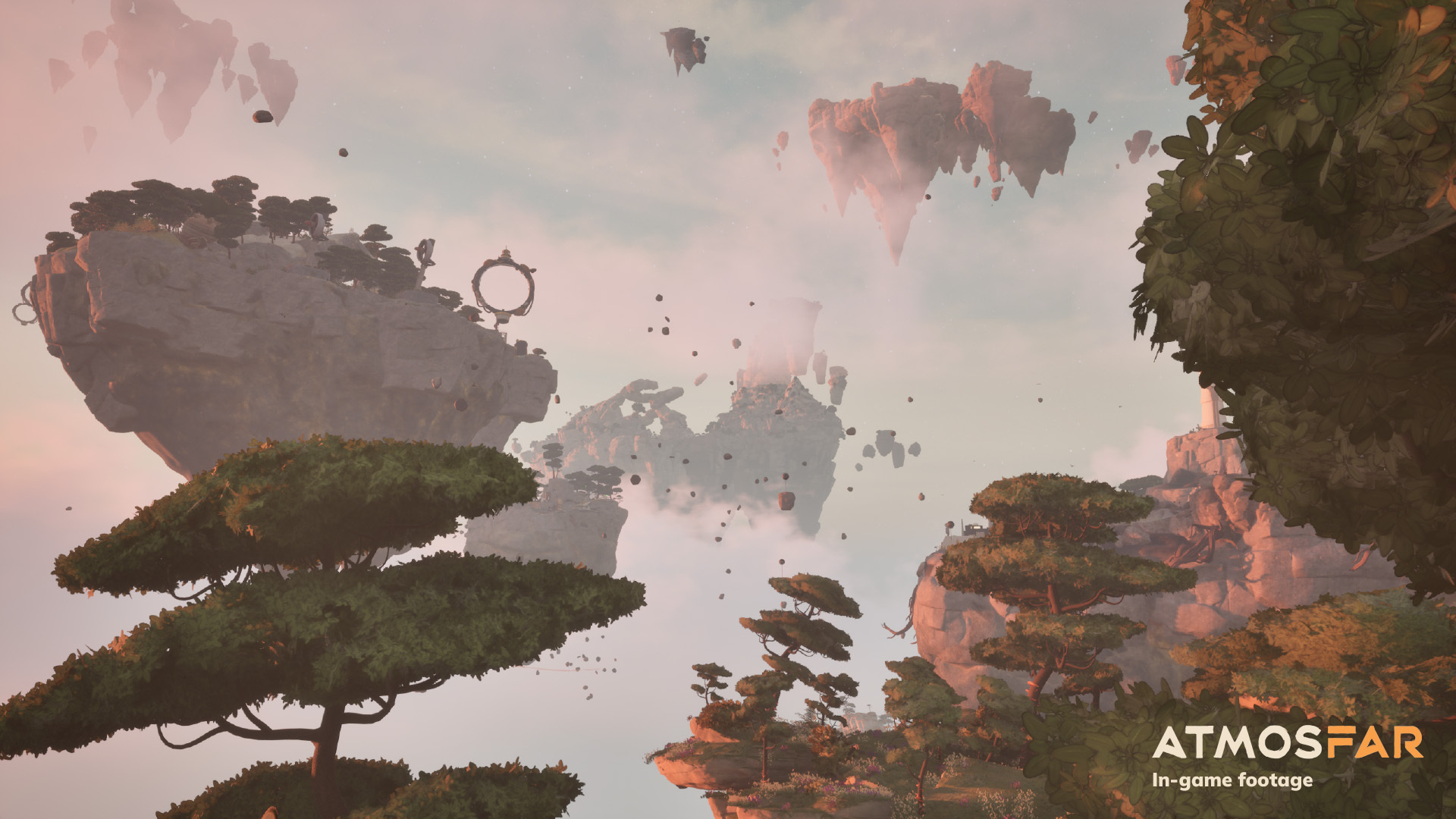
Alright everyone, please keep your arms and legs inside the vehicle. If you hear any monstrous squawking we advise you enter the brace position as we perform combat maneuvers! We are first going to make a fly by of some of the landscapes in Tycos.
A key part of audio concepting and creation is to establish what I call ‘audio lore’. We’ve all encountered video game lore before, right? Whether it is a page in a notebook, an audio log that tells us a little more about our surroundings, or a relic from a bygone civilization that explains the history of a world long forgotten. But, why do we just have to see ‘lore’? Why not hear it too?
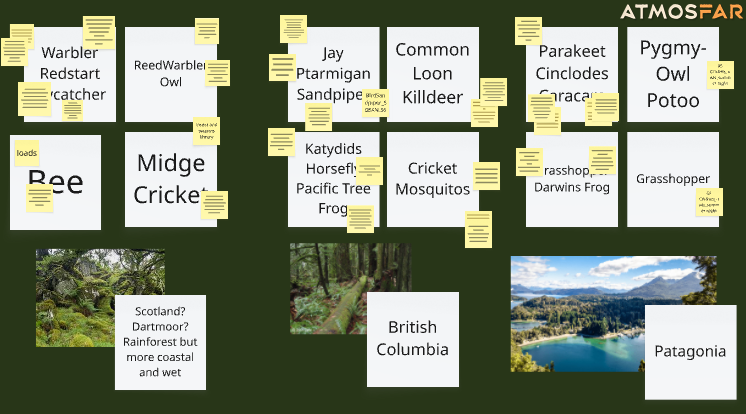
When we first approach an audio pillar of a game we should first reflect on what our world is trying to portray and emphasise this story through sound. ATMOSFAR takes inspiration from the natural world and specifically coastal habitats, with its subtle nautical design of buildings and equipment as well as foliage that is reminiscent of coastlines in Scotland, Patagonia and British Columbia. There is even a touch of British moorlands with heather and moss, something my northern-english connects strongly with. Once we have this basis to work off, we can consider how we can support this scene with our ambient sound. Get your pens out folks, it’s time to get some field notes!
The first step in creating a believable natural environment through sound is to reference the world around us! We as humans are incredibly sensitive to changes in the environment, and sound is no exception, so in order to sell this natural world we need to create it with flora and fauna that actually make sense to exist there. By doing this not only will our world feel natural and immersive, but we also get to subvert that natural soundscape with our more… unique plant and animal life. By keeping the soundscape familiar, the player is even more alerted by sounds that don’t belong, which lets us drive greater curiosity, discovery, and every once in a while a touch of fear. Eyes peeled gang, stay sharp!
After having built up a board of the types of animals and insects we expect to hear in our real-world environments, we can then expand this out with related and soundalike fauna for even more variety that isn’t too unique to stand out to the player. This is the perfect time to shout out the incredible Macaulay Library, which has a database of nearly 150,000 audio recordings of 9,000 animal species, perfect to use as a reference point when gathering ideas for our biomes in ATMOSFAR. What this leaves us with is a huge diversity of natural sound on our islands that feel like a truly natural ecosystem. Quiet down everyone, let’s do some birdwatching.
Now that we’ve seen, and heard, about the islands from a distance how about we get in a little closer? Take us in, and let’s go on an expedition! Tycos is a world filled with life that, while alien, has parallels with the world back home on Earth. The very first piece of ‘audio lore’ on the flora and fauna in ATMOSFAR is that it should very rarely be seen as monstrous, and the Planet Tycos is their world, their habitat. Look, don’t touch! This crucial decision means that, when creating sounds for plants and animals we should ground them in a natural world similar to our own. This will help Tycos feel like a natural planet, rather than a fantasy realm of fantastical creatures, and one where life has evolved to survive and thrive through science and evolution. Let’s go find one of the more friendly animals of this world, shall we?
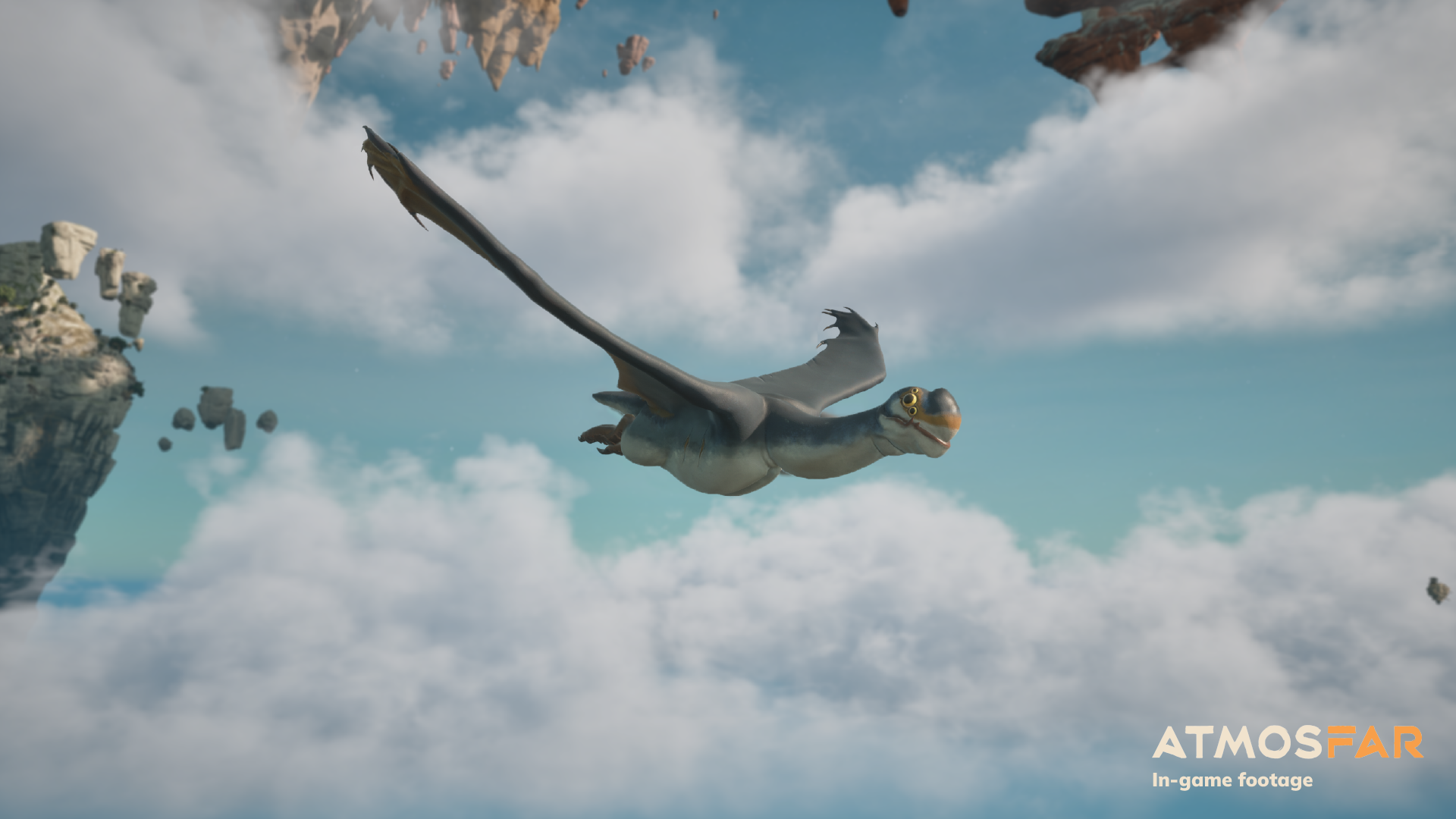
The Mawk is graceful in the skies, with huge powerful wings. It is also the epitome of ‘bird-brained’. With its long neck and bulbous head it is hardly a looker, but its visual appearance allows the team to use its anatomy as a foundation for how it would sound. We know that ATMOSFAR is grounded in coastal environments, so we can firstly consider birds that nest on coastal cliffs around the world. After this we can assess how the long neck bears similarities to geese and swans, although the lack of beak means that there will be a less nasally honk to the animal than our classic silly goose. So let’s go back in time a little, to the age of dinosaurs! Like our dear Mawk, Hadrosaurs had a similarly strange protrusion from their head, only this big lump was completely hollow. There is a theory that this cavity was used like a resonant chamber to produce bellowing honk sounds that were able to travel longer distances than your usual vocal sound. Perhaps the Mawk needed a similar anatomy to warn others of predators, or to sound bigger in order to protect their young? While we don’t actually need to explain any of this, by crafting some ‘audio lore’ and the why of a sound we can make something far better grounded in the world we are making. Looks like there is one flying overhead now, let’s take a listen!
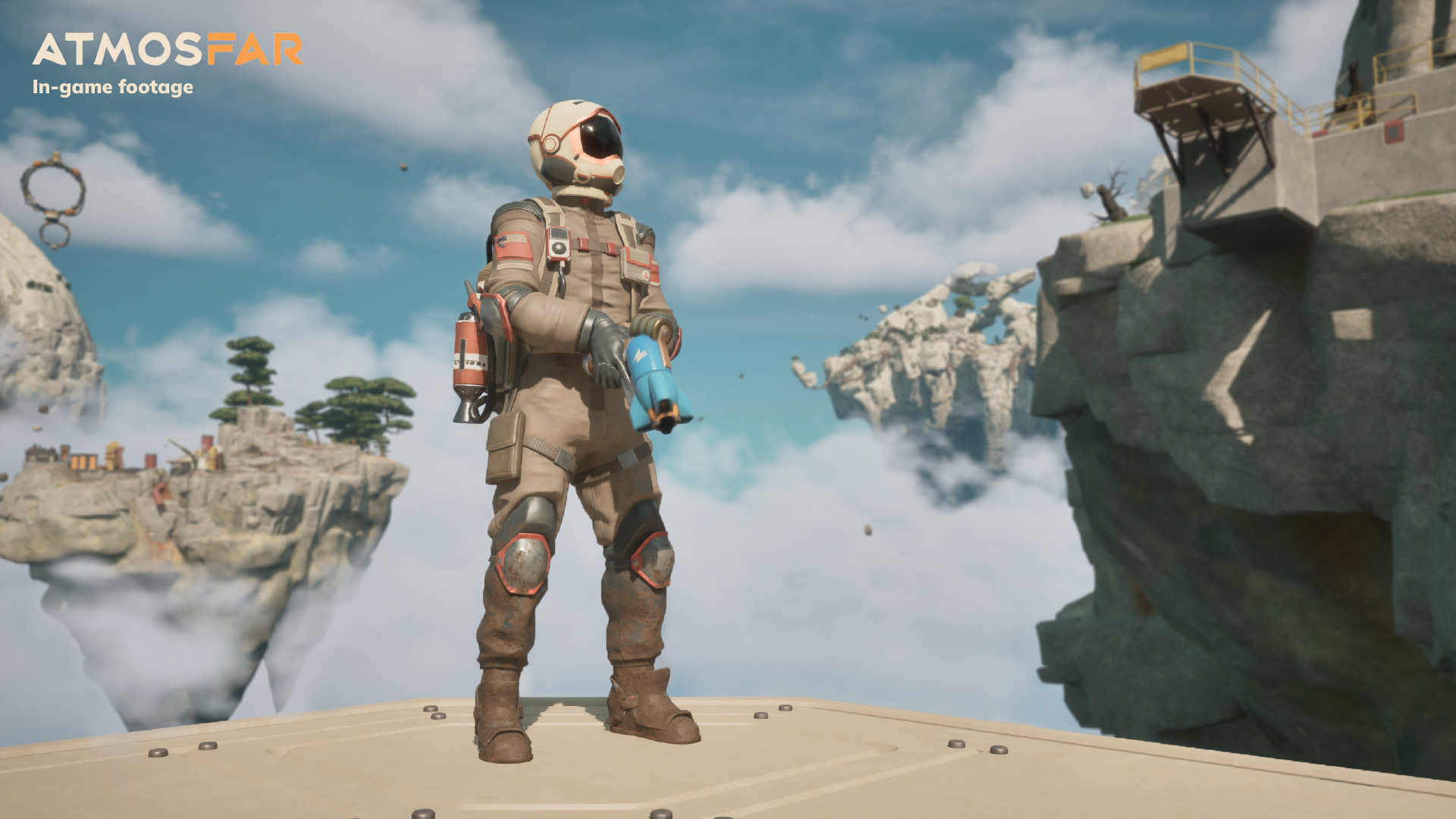
This world is not just a home to animals, not anymore at least. Look over there everyone, it seems we have bumped into one of the natives! Another aspect of ‘audio lore’, is breaking down a scenario or object into its component parts in order to create a detailed and interesting sound. The players themselves are a great example of this, with so much interesting detail and equipment to use as a foundation for our sound design.
First off let’s look at that flight suit, mostly fabric with lots of pockets and zips along with a bit of rubberised areas to avoid too much wear and tear.
On their back is their backpack which is.. Well, a lot to unpack! The pack is sturdy, likely reinforced by a solid metal frame on the player’s back to prevent breaking important artifacts or squashing their sandwiches.
The backpack itself looks like it is quite simple in design and carries any inventory inside it loosely. Lots of bits and bobs to rattle around as the player is running, jumping and exploring. Importantly from a gameplay standpoint, it would be good for the backpack rattle to reflect how full the player’s pack is. Eventually the player may know exactly how much room they have using sound alone, no need to open the inventory to check!
Attached to the base is the backpack fuel, allowing players to remotely fuel up their Wasp with emergency reserves amongst other machinery. Just like the inventory, we should have some audio clues as to how much fuel we are carrying with us from splashing and sloshing alone!
Finally on our pack is the all important electricity, it powers our tools and is an important lifeline for our players as they traverse the isles. A subtle humming lets the player know that they still have some juice, but as the electricity depletes you may start to notice that the gentle tonal whirring gets more unstable and laboured. Probably time to find a plug socket…
One last little element of the backpack is how your tonal humming harmonises with your crew in multiplayer, driving home the point that exploration really is more complete when you do it together. Perhaps you heard this in our reveal trailer!
Thank you for your time, Vagabond. Let’s continue with our safari!
The danger zone
As we have already said a couple of times, the main purpose of audio in any game should primarily be to support and heighten the player experience. A big part of any exploration game, is of course unveiling the story behind the world they are traversing. Audio can often be something that is only noticed when it is ‘bad’, but otherwise never noticed at all, but this view I think ignores that music and sound can create so much more narrative impact when we want it to. On the flip side of this, we have to be careful. It is easier than you might think to completely change the intended perception of a scene or scenario with ill-considered sound. One wrong move and we can ruin the moment faster than you can say ludonarrative dissonance (which, to be fair, takes a little while to say I guess)! If you imagine Super Smash Bros with hyperrealistic gory crunches on every hit, or The Last of Us but all the clickers are singing Vengaboys, you may get a good idea of what I mean here. Audio matters, even when it doesn’t appear to!
With this in mind let’s take a look at some key players when it comes to the narrative of ATMOSFAR. Things might get a little bumpy everyone, we’re going into hostile territory!
If you look to your left, you’ll see a PACE outpost. Full of resources, but armed to the teeth…
Hopefully by now, you have all heard about some of the key factions in ATMOSFAR and if you haven’t you should read our other blogs and vlogs about them! You, the player, step into the shoes of one of the Vagabonds of Tycos, known as exiles of the PACE regime that teamed up to cobble together a new way of life that seeks to live alongside the natural world and not against it. Let’s talk about PACE and how their story influences their sound.
PACE sits strangely in the world of Tycos. A relic of history that yet carries a unique threat to the player, dilapidated and broken but their influence is still felt by the natural world. Not only does the player need to be informed of the danger that PACE encounters bring through sound, but also reveal a history about them that ties into the unfolding narrative. As a result of this, we treat PACE as its own character in the world as if it were a being, and craft an audio personality that can inform all of the ways the player may experience it in the world. The most common of which may be the drone. Please stay well back, these things pack a punch!
Like a lot of PACE tech, there is a sombre tone to the guard drone when viewed from a distance. It hums along in a melancholic tone, with little chirps and whistles as it patrols indefinitely as it may have for years. The boosters and rotors sound pained and often waver, as if to suggest that this drone may be on its last check of the perimeter. This PACE tech wasn’t made to last this long, it’s military after all, designed for conflict and not long-term operation. It sounds notably industrial, rattly, and inefficient. Don’t underestimate them, one thing you should learn fast on Tycos is that things are rarely as they seem…
The facade of a somewhat pitiful and weak machine is whipped away in an instant the second a player is spotted. It is clear that these drones used to have a working voicebox, loaded up with combat barks and warnings to make instructions perfectly clear to whoever hears them, but any semblance of a human voice is gone. We are left with a deteriorated and wild vocalisation that feels more like a beast than it does a piece of equipment. The guard drone is as much an animal as the fauna surrounding the outpost, and equally dangerous. While heavy and clunky, the firing mechanism aches into life and blasts unrelentingly at the player. Time to go, I think!
The audio is intended to give the player a historical and emotional connection to the drones, and gives a greater sense of curiosity towards the PACE regime and what on Tycos they were doing here. Why would they have deployed such a heavy combat force, and clearly they haven’t been recalled for an age. Where are PACE now?
Over in the Vagabond settlement things sound quite different. Where PACE seems to push against the natural world, the Vagabonds invite it into their lives. Vagabond tech is recycled from PACE, but they have progressed it with new understandings of this world. What this leaves us with through sound are clear influences of PACE technology, but less mechanical and more energy-based. Where PACE drilled into island hydrogen reserves the Vagabonds researched clean nuclear power with the same technology, so while parts may be sonically similar the sound of their power is in harmony with each machine made by the Vagabonds. And no place better represents this harmony than the player’s own camp. Let’s regroup back at base!
Back at base
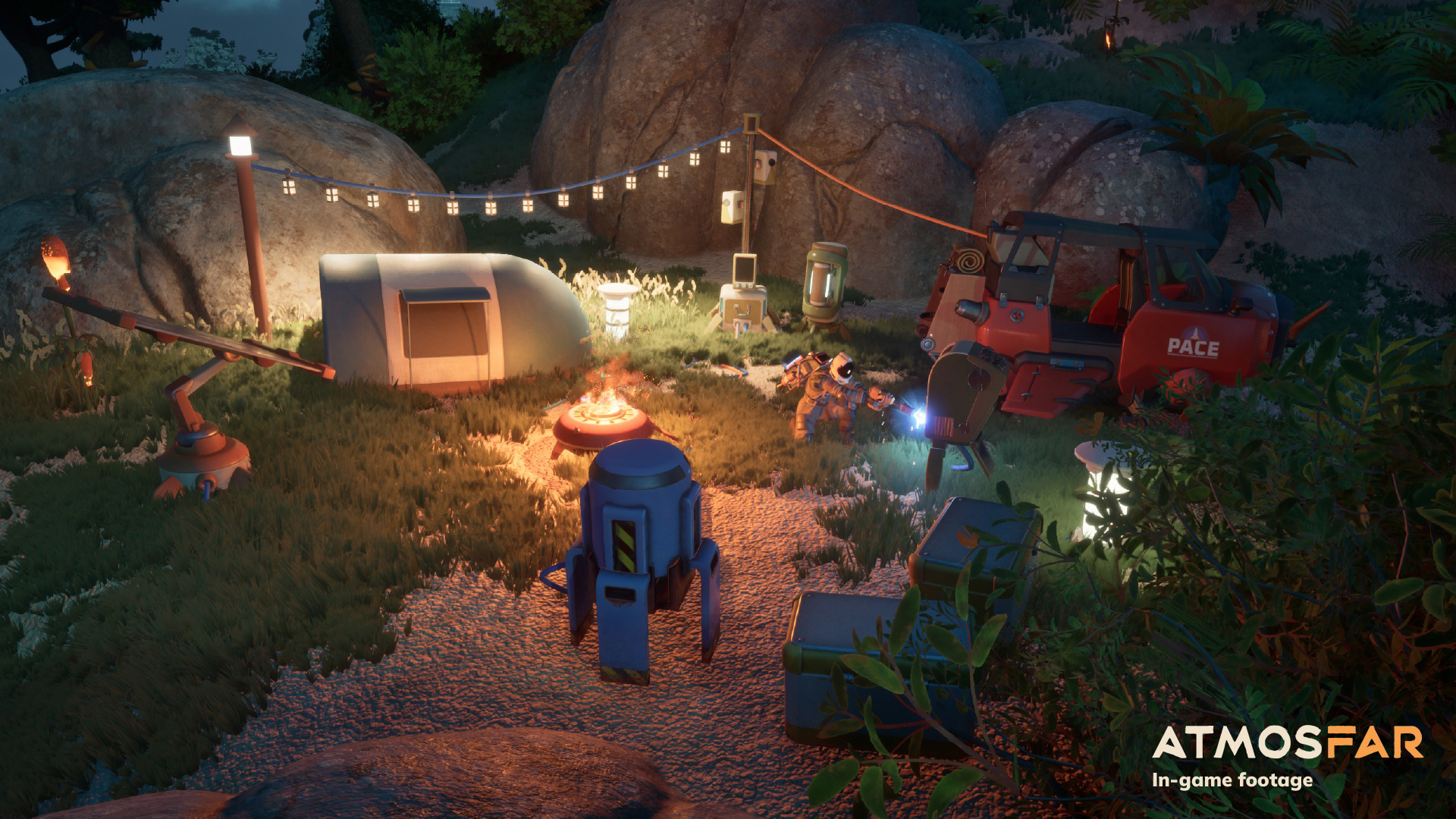
A player’s camp can be their sanctuary, unless they are pitched up by a Maratus hive! Vagabonds, being as resourceful and prepared as they are, tend to venture out with the world on their Wasps. The camp hub, attached to the trusty Utility Wasp, and its components are a good place to hear just how much has changed since the PACE regime. It also takes us into our third and final audio topic. Let’s round off this safari with a bit of Rest, Relaxation and a discussion on sounds that directly support the gameplay and the player.
The Utility Wasp’s camp hub is the player’s source of on-the-go crafting, research and rest, so we can safely assume that this is a gameplay element that will be engaged with frequently and for long periods. As a result, this needs to be one of the most satisfying and enjoyable audio experiences the player can have in ATMOSFAR. Any interaction players have with their own Vagabond-modified equipment has to be engaging and repeatable. With many of these interactions being passive processes, the sound also acts as a crucial message to the player regarding progress, completion and failure of camp machinery around them. Before we get to all that though, let’s talk about ‘machine harmony’ and what on earth that means.
The portable camp in ATMOSFAR is powered by a central camp hub, which distributes electricity to each of the components connected. This hub is the root note of our camp choir, humming along and even getting the antenna involved when connected to the player’s Wasp.
Next in the bass section is our hydrogen refinery, which happily rumbles along in tune with the hub. Notice how whatever component we add builds a pleasant chord of sorts? We want the player experience to feel calm and safe (save for the previously mentioned unfortunate Maratus hive placement) and so the audio experience can’t sound dissonant and tense.
In the non-tonal area of camp components we have the campfire, a crucial cooking resource as much as it is an icon of cozy nighttime chillouts. The flame is powered by natural gas, offering a soft hiss with the fire itself not too intense. This provides a lovely sustained wash of white noise, not dissimilar to sleeping with rain sounds or ocean waves playing in the background.
Next, the lamp. Surely I can’t say that much about a lamp!? Well, you’re right, I can’t. But nonetheless it is neatly tuned to the hub and sure sounds nice to me!
Into the proper machinery, and what could be considered more of a rhythm section to our choir... or, orchestra I guess? Let’s bring in some of our crafting, refining and processing modules. Notice how none of these processes are ‘loud’? There is an intentional approach here to ensure nothing stands out too much, leaving the player to enjoy the overall soundscape that is created.
There are tons more things we could look at but that is for another day. Let’s instead end with the all important question, what happens when the power runs out? Exactly like we said previously, sound often sticks out only when it is incorrect. Or, in this case, sound can stand out when it is stopped abruptly. From a player perspective the moment the power is gone, and our camp falls eerily silent, is a really sudden and unnerving feeling. What was once safe and cozy is threatening, and the player gets a very explicit gameplay incentive to get the power back ASAP!
But, once the power is back up and running, that cozy feel comes right back. ATMOSFAR, I believe, is built on these moments of contrast. It is the goal of the audio team here to present a soundscape that can have a profound effect on a player’s emotions. Whether it is serenity by a campfire, wonder when looking over a natural vista, or panic in a deep cavern with creatures lurking in the darkness, audio has the power to emphasise a moment to really give that feeling that the player has been transported to a new and exciting land light years from their own. That’s all for today’s safari folks, time to sit back and enjoy the tranquility.