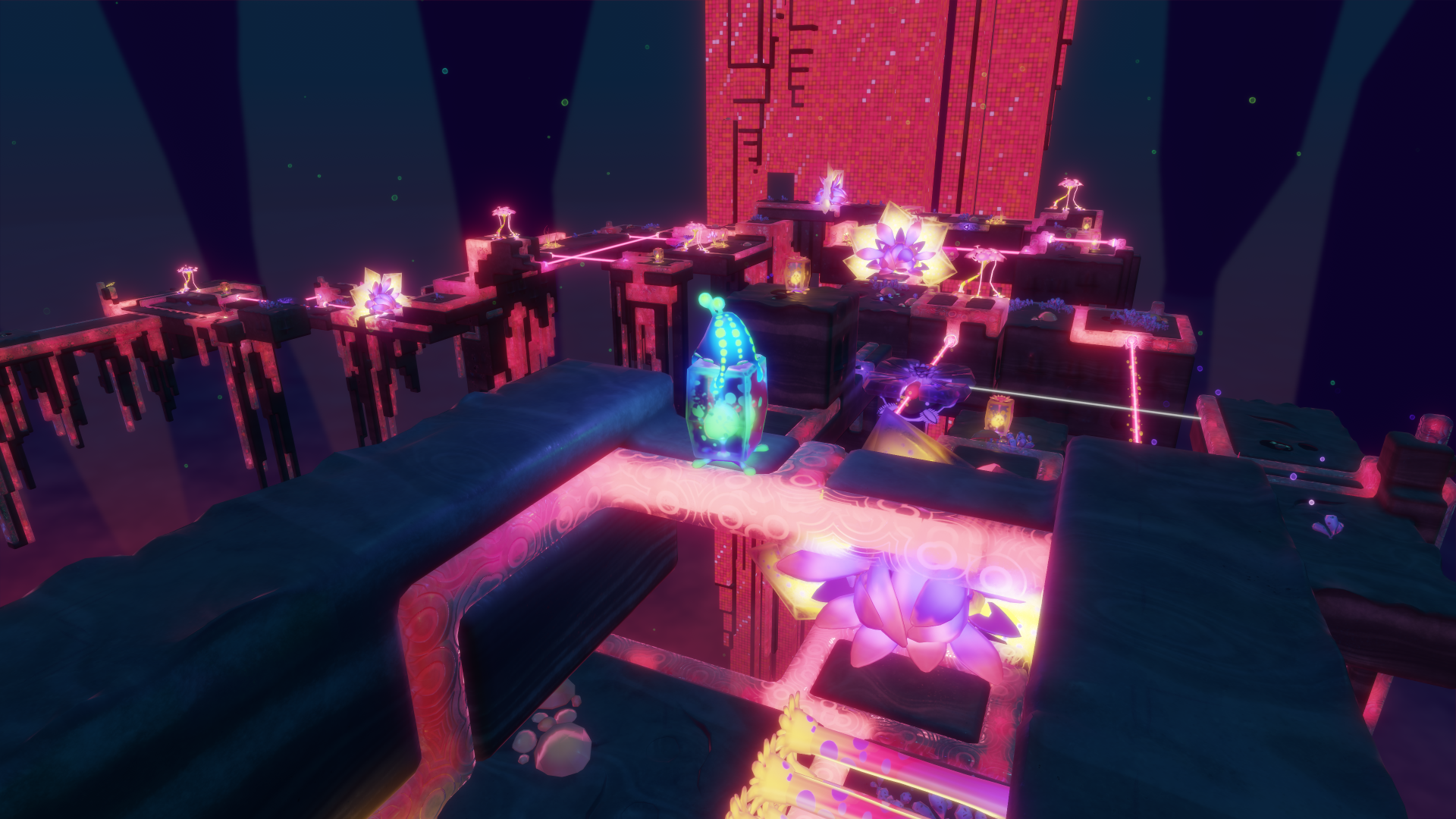
The latest update to Lumote adds DLAA technology to the game, allowing Lumote to appear smoother and squishier than ever! Here's a quick run down of what DLAA is and what it means for lumote!
Q: What is DLAA?
A: DLAA stands for Deep Learning Anti-Aliasing, it's an anti-aliasing feature that uses the same kind of pipeline as Deep Learning Super Sampling (DLSS), with a twist! Instead of upscaling the image it uses A.I assisted tech to work for better anti-aliasing at native resolution!
Q: Okay neat, what is Anti Aliasing?
A: Anti-aliasing solves the problem of aliasing in video games. Pixels are arranged in a grid on your display, so when a diagonal line shows up on screen, it creates a blocky, stair-stepping effect. These are known as jaggies. Anti-aliasing techniques try to fill in the gaps between pixels, leading to a smoother edge on objects.
Q: But my games already have Anti aliasing? Why do I need this?
A: A lot of games do have AA features, however some of them can be quite resource demanding especially at higher levels of implementation - much like DLSS allows higher resolution through A.I implementation at a fraction of the cost resource wise, DLAA does the same with aliasing!
Q: Okay sounds good, can I use DLAA right now?
A: Yup! But with a caveat, like DLSS, DLAA requires the Tensor cores to do the magic A.I needed to use this tech, a feature that is currently only seen on Nvidia RTX cards. As such - to use DLAA for smooth squishy AA - you will need an RTX 2000 or RTX 3000 series graphics card.
Q: Is this the start of the machine uprising?
A: Hopefully not, but at least if it is the A.I will render us smoother than ever - so there's that.
Learn more about the tech behind DLSS and DLAA here : Nvidia Blog
Wired Facebook | Wired Twitter | Wired Youtube | Wired Discord | Wired Instagram | Wired Twitch | Wired Reddit | Wired Imgur