
Hello, Commanders!
The war drew varied people and armies from across the world into very different circumstances. Some lived under occupation; others fought as part of allied forces, colonial units, or as states aligned with the major powers of WWII. These people could end up far from home fighting in the greatest conflict the world had ever seen.
Now, their stories take center stage.
The KARDS winter expansion, Call to Arms, deploys on December 8.
The wait is over. Spoiler season begins today, with the first wave of card reveals from Call to Arms!
Every nation receives new tools and strategies in this expansion. Today’s reveals offer a first look at what each nation is bringing to the battlefield, from new mechanics and powerful synergies to fresh ways of reinforcing your ranks. And this is just the beginning. There's plenty more to come as spoiler season unfolds.
Call to Arms at a Glance
- Release date: December 8
- 95 new collectible cards: 16 for each main nation and 3 for each ally nation
- 4 new spawn-only cards
- New mechanic: double targeting
- Reworked mechanic: Mobilize
- New terms: Muster and Advance
- 25 cards returning from Reserves
- Pre-orders: Available now in the in-game shop
- Spoiler season begins TODAY: 15 new cards revealed!
What’s New
Double Targeting
Call to Arms introduces double targeting, allowing a single card effect to hit two different targets. Strike two enemy units at once or strengthen two of your own. With double targeting appearing across multiple nations, you'll have new ways to make every card count.
One example is SAMPAIO REGIMENT, featured in today's reveals below. Take a look at how it puts double targeting to work!
Mobilize, Reworked
As revealed in our Call to Arms: Returning Cards announcement, Mobilize is back with a new approach.
The core idea remains the same: Mobilize provides a delayed reward, giving your opponent an opportunity to deal with the unit before you reap the benefits. The reward, however, has changed:
When a unit with Mobilize starts a controller’s turn on the battlefield, choose 1 of 3 neutral units to add to hand and remove Mobilize.
The three choices are always NEUTRAL GUARD, NEUTRAL FORCE, and NEUTRAL BATTALION.
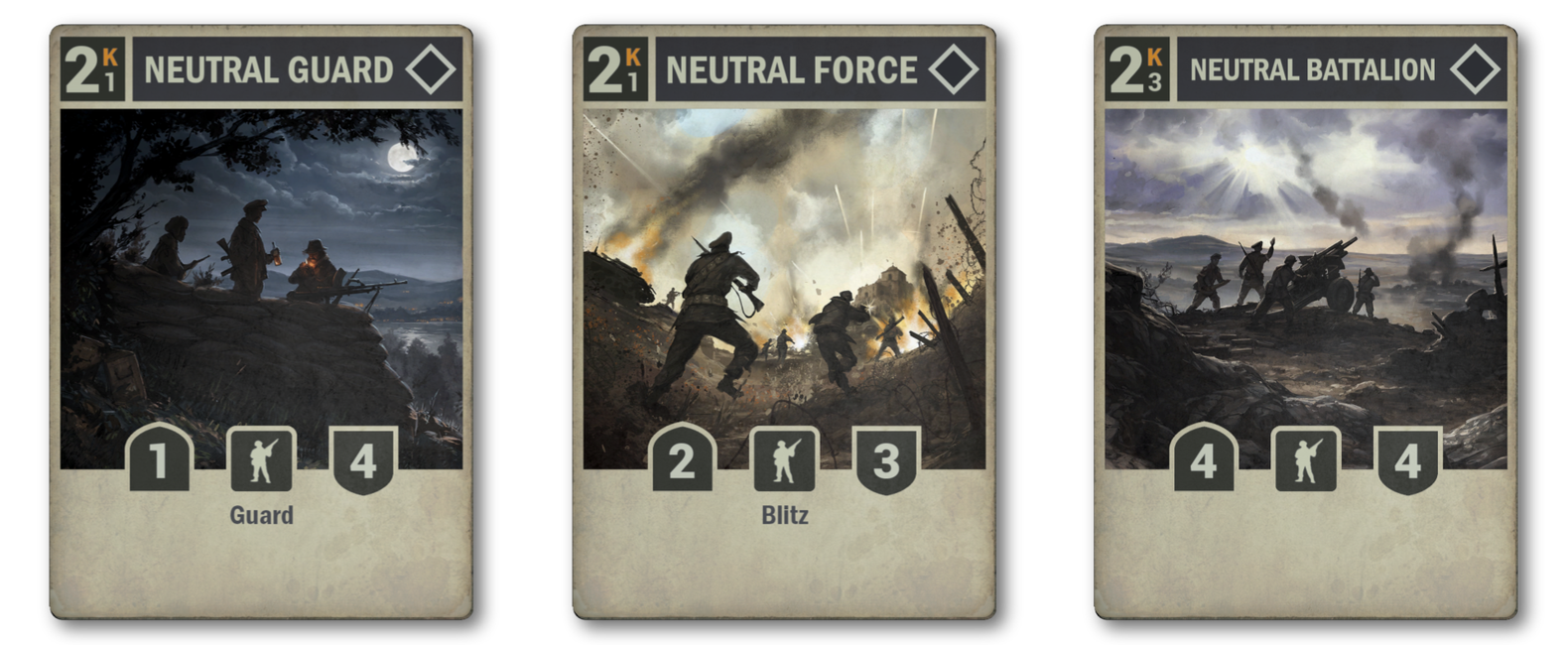
France remains the home of Mobilize, but this time the mechanic is spreading to other nations as well. Keep an eye out for new ways to put those neutral reinforcements to work!
Muster and Advance
Call to Arms also introduces two new terms for familiar battlefield actions:
- Muster: a unit is added to the battlefield. Mustered units go to your support line, unless stated otherwise on the card.
- Advance: a unit moves into the frontline.
These aren't new keywords or mechanics. They're simply shorter, clearer names for actions that already take place on the battlefield. Existing cards that add units to the support line or move them into the frontline have also been updated with the new wording.
You'll spot both terms in some of the new cards revealed below.
Britain
Britain drew strength from across its empire and from the armed forces of occupied nations. Pilots from many countries flew Spitfires for the RAF, bringing their skills to the Allied war effort. In Call to Arms, Britain's strategy puts the Spitfire in the spotlight, backed by Guards and neutral units.
SHADOW SCHEME
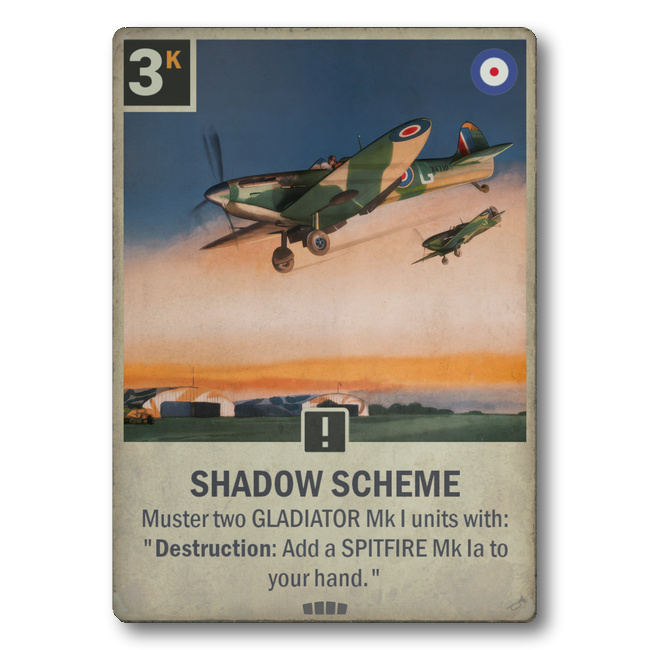
Muster two GLADIATOR Mk I units with: “Destruction: Add a SPITFIRE Mk Ia to your hand.”
The Shadow Scheme was a plan created by the British government to rapidly increase aircraft production, by bringing motor manufacturers into the aviation industry. Developed during the mid-1930s, it provided government-backed factories and extensions where civilian firms could manufacture aircraft, engines, and components alongside their existing businesses.
METAXAS LINE
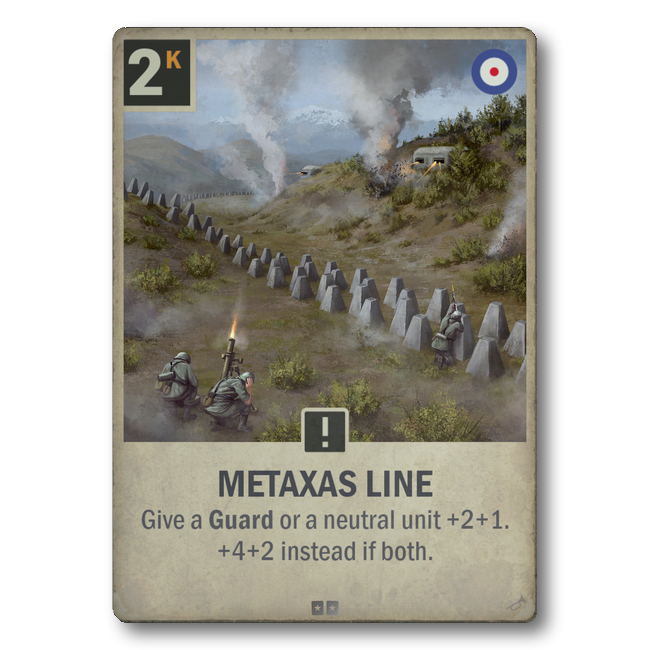
Give a Guard or a neutral unit +2+1. +4+2 instead if both.
The Metaxas Line was a Greek defensive system built along the Bulgarian frontier before WWII. German troops attacked the line on 6 April 1941, the first day of the invasion of Greece. Several forts resisted repeated assaults, forcing the attackers to bring artillery, aircraft, and engineers to clear those positions.
Germany
Germany's armies overran much of Europe early in the war, drawing soldiers from occupied and allied territories into the conflict. In Call to Arms, German units strike as they advance, and some of Germany's tricks place neutral units on the enemy's side of the battlefield.
CROATIAN LEGION
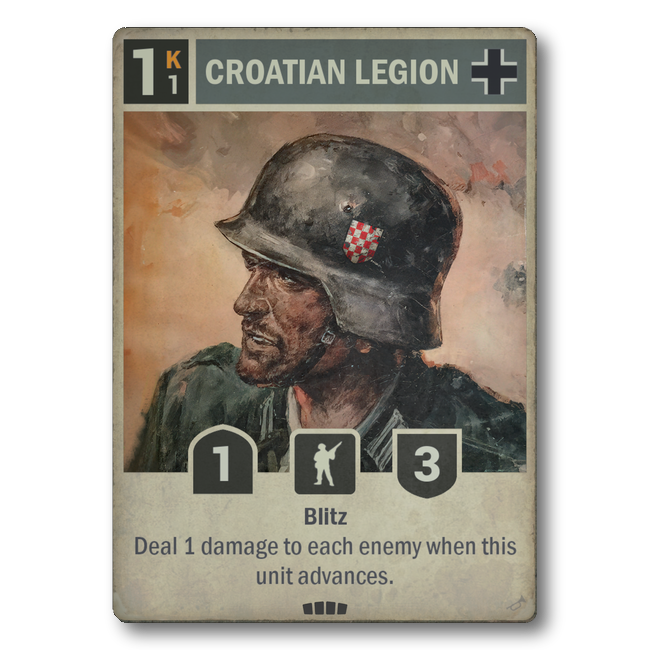
Deal 1 damage to each enemy when this unit advances.
The Croatian Legion was the common name of the 369th Croatian Reinforced Infantry Regiment, formed in 1941 to fight against the Soviet Union. Recruited in the Axis-aligned Independent State of Croatia, it included infantry and artillery and served within the German Army.
SET UP TO FALL

The enemy musters two NEUTRAL GUARDS with: “Destruction: The enemy draws 2 cards.”
In February 1943, Field Marshal Erich von Manstein launched the counteroffensive often known as the “Backhand Blow” against Soviet armies that had overextended themselves after Stalingrad. The counteroffensive then drove on Kharkov, culminating in the Third Battle of Kharkov.
Soviet Union
The Soviet Union suffered losses on a scale unmatched by any other nation, yet continued to rebuild its forces and return to the fight. In Call to Arms, the Soviet Union turns damage to your own HQ into an advantage, while LIGHT INFANTRY units swell the ranks.
TUVAN PEOPLE’S ARMY
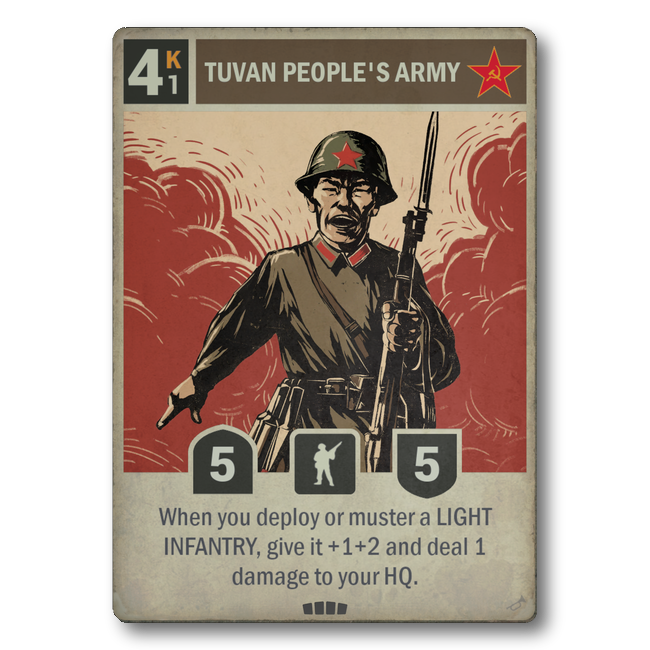
When you deploy or muster a LIGHT INFANTRY, give it +1+2 and deal 1 damage to your HQ.
The Tuvan People’s Revolutionary Army was the small armed force of the Tuvan People’s Republic, a Soviet-aligned independent state located north of Mongolia. After Germany invaded the Soviet Union in June 1941, Tuva supported the Soviet war effort with horses, livestock, clothing, gold, and other supplies. Later Tuva would formally join the Soviet Union in 1944.
PLANNED OFFENSIVE
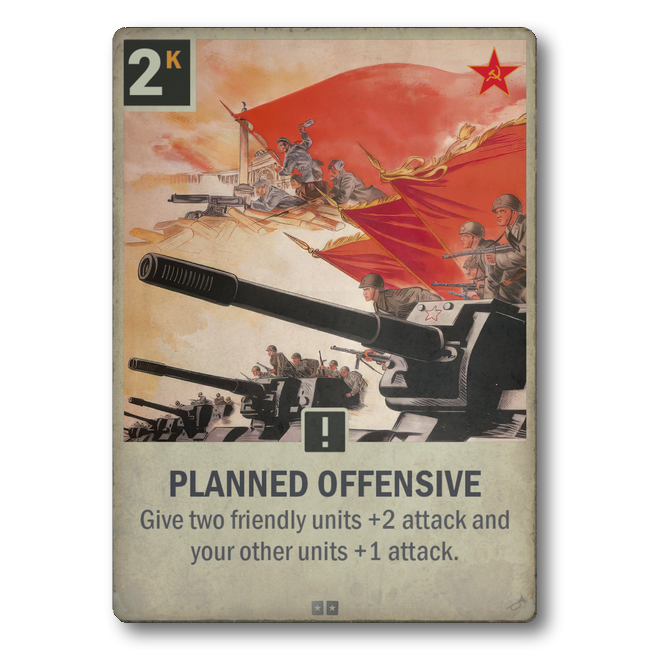
Give two friendly units +2 attack and your other units +1 attack.
Operation Bagration was a major Soviet offensive launched against Germany’s Army Group Centre in the summer of 1944. Soviet planners concentrated forces on selected sectors, assembled ammunition and supplies, and concealed the intended direction of the main attack.
USA
American industrial might earned the United States its reputation as the “Arsenal of Democracy”, while its armed forces fought alongside allies from across the Americas and beyond. In Call to Arms, US cards offer bonus effects when you have kredits to spare, while friendly units push forward into the frontline.
AZTEC EAGLES
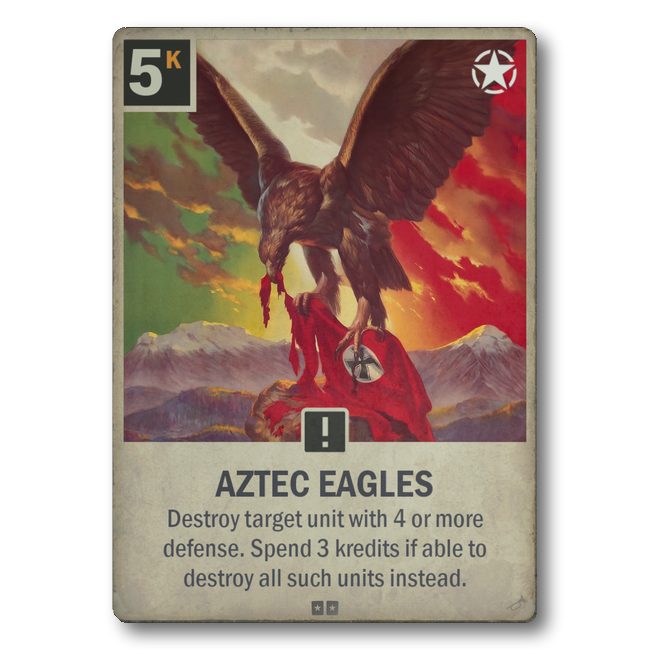
Destroy target unit with 4 or more defense. Spend 3 kredits if able to destroy all such units instead.
Mexico’s 201st Fighter Squadron was known as the Aztec Eagles and served in the Pacific during the final year of WWII. After Mexico entered the war in 1942 against the Axis, the squadron’s pilots and ground personnel trained in the United States before sailing to the Philippines in 1945.
SAMPAIO REGIMENT
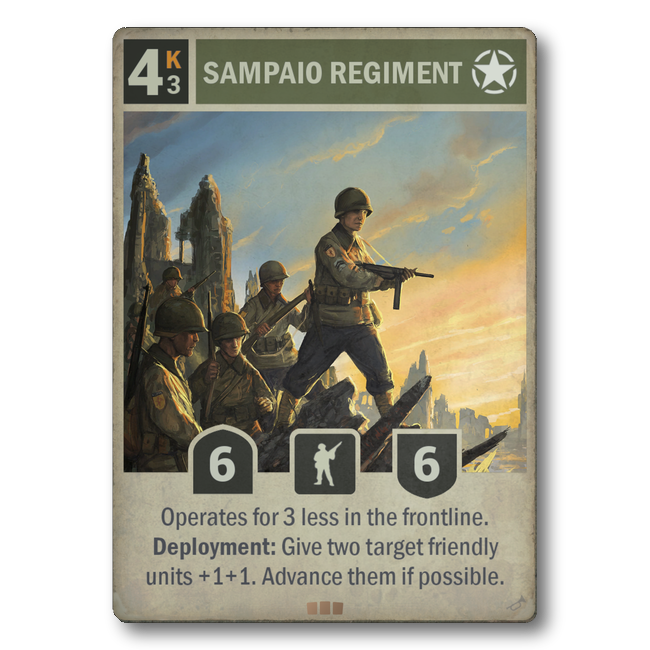
Operates for 3 less in the frontline. Deployment: Give two target friendly units +1+1. Advance them if possible.
The Sampaio Regiment, officially designated the 1st Infantry Regiment, is an infantry unit of the Brazilian Army that served in Italy during WWII with the 1st Expeditionary Infantry Division of the Brazilian Expeditionary Force. The capture of Monte Castello opened the way for further operations and became one of Brazil’s best-known accomplishments during WWII.
Japan
Japan's expansion across Asia and the Pacific brought occupied territories and client states into its war effort. In Call to Arms, Japan grows stronger under pressure, with effects that become more powerful when your HQ has 10 or less defense.
VICTORY MONUMENT
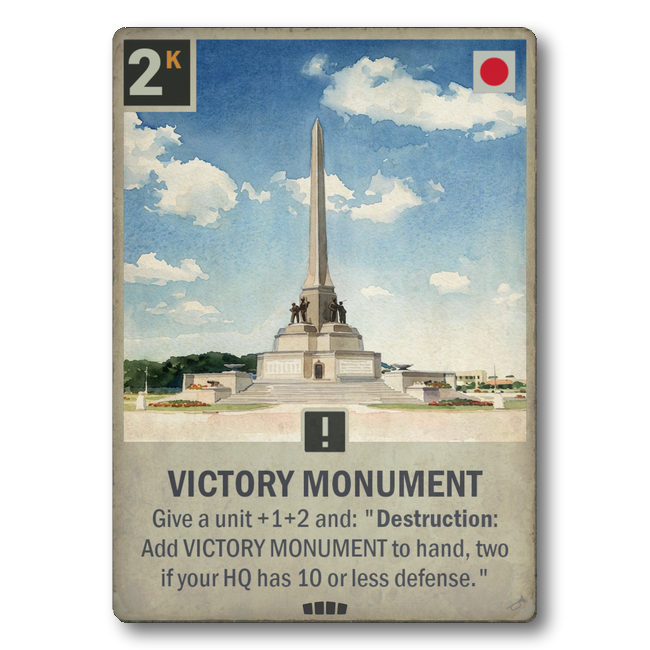
Give a unit +1+2 and: “Destruction: Add VICTORY MONUMENT to hand, two if your HQ has 10 or less defense.”
Bangkok’s Victory Monument was erected in 1941 to commemorate Thailand’s territorial gains after the Franco-Thai War. The fighting produced mixed military results, but Japanese mediation secured a settlement transferring territory to Thailand.
ROAD TO RANGOON
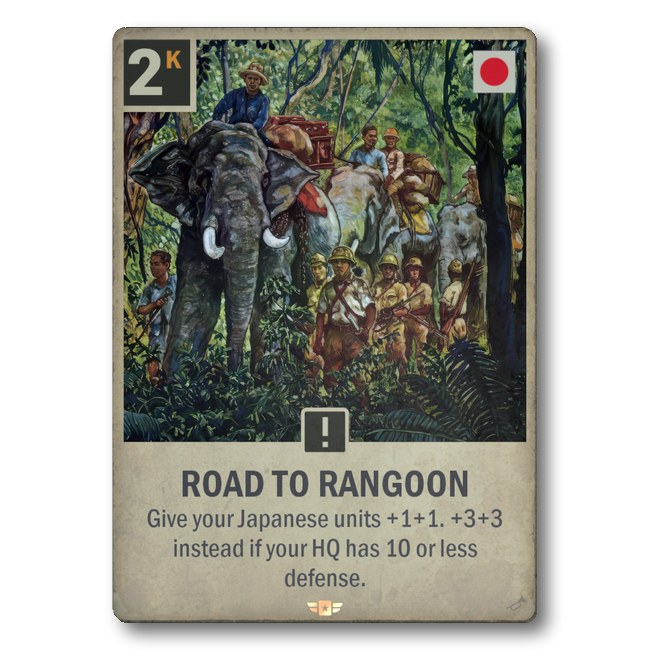
Give your Japanese units +1+1. +3+3 instead if your HQ has 10 or less defense.
Japan’s advance on Rangoon in early 1942 threatened both British control of Burma and an important supply route to China. Japanese occupation of Rangoon deprived the Allies of Burma’s main maritime gateway and placed further pressure on the remaining routes north.
Ally Nations
France, Italy, Poland, Finland, and ANZAC each receive three new cards in Call to Arms, building on their established national identities. Today's reveals offer a first glimpse of the reinforcements joining their ranks.
1er SPAHIS MAROCAINS
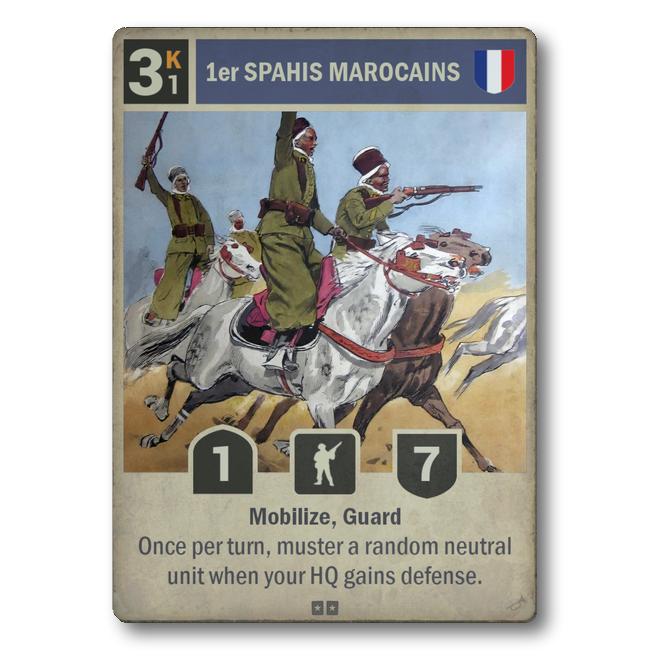
Once per turn, muster a random neutral unit when your HQ gains defense.
The 1st Moroccan Spahi Regiment is a cavalry unit of the French Army created in 1914. On 30 June 1940, part of the regiment refused the Vichy armistice. It is the most decorated cavalry regiment of the French Army, and still serves today as the 1er Régiment de Spahis.
7th PRESTINARI
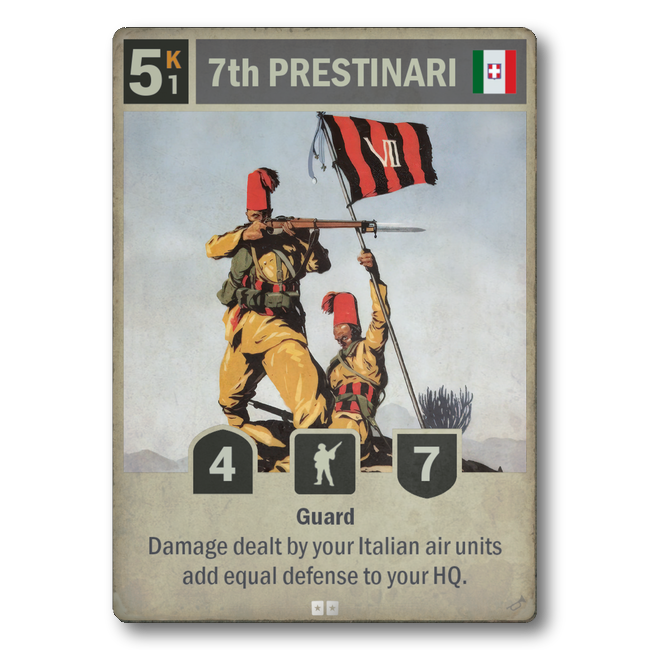
Damage dealt by your Italian air units add equal defense to your HQ.
The 7th Eritrean Battalion “Prestinari” was a colonial infantry unit composed of Eritrean askari, African soldiers serving under Italian command. Eritrean units fought in the defense of Keren during 1941, but the eventual Allied victory brought Italian colonial rule in East Africa to an end.
M3A1 STUART PL
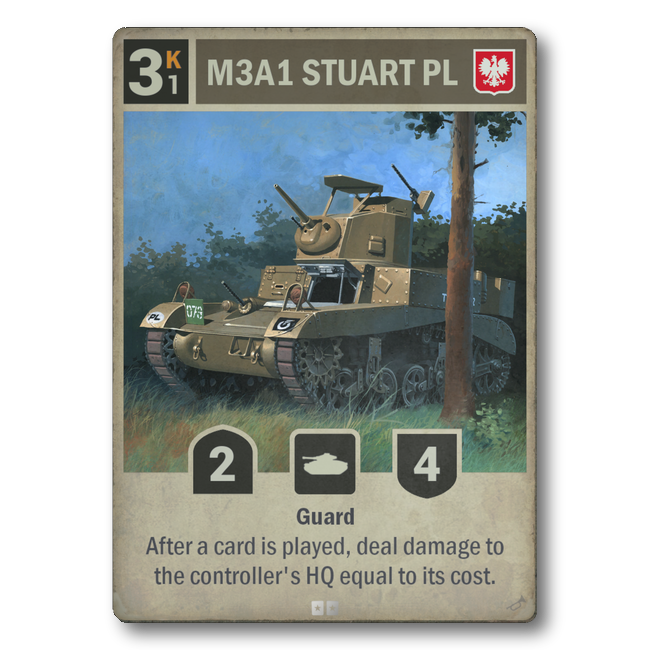
After a card is played, deal damage to the controller’s HQ equal to its cost.
The M3A1 Stuart was an American light tank used by the Polish Armed Forces in the West during WWII. Stuarts served with the Polish II Corps in Italy and with the 1st Armoured Division in northwestern Europe.
GO TIME
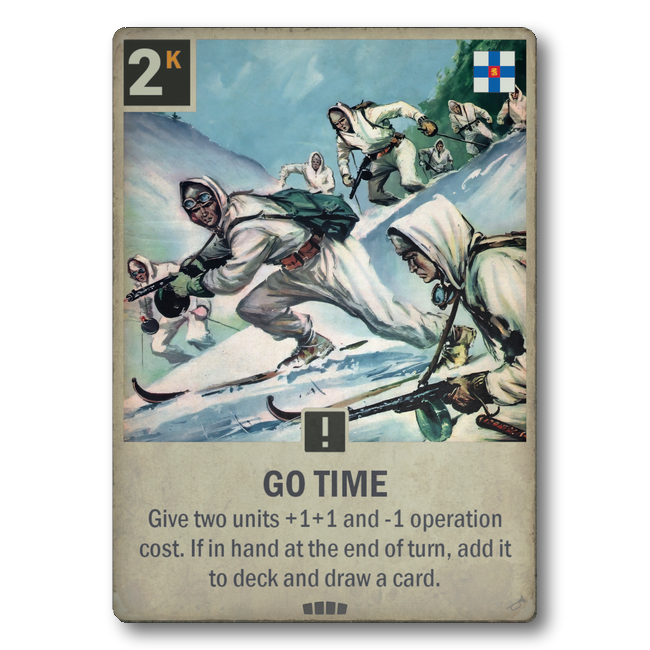
Give two units +1+1 and -1 operation cost. If in hand at the end of turn, add it to deck and draw a card.
Finland’s offensive in East Karelia in 1941 depended on turning local breakthroughs into rapid advances before Soviet forces could establish new defensive lines. On 4 September, a heavy artillery bombardment supported the 5th Division’s breakthrough near the Tuloksa River.
THE ADELAIDE RIFLES
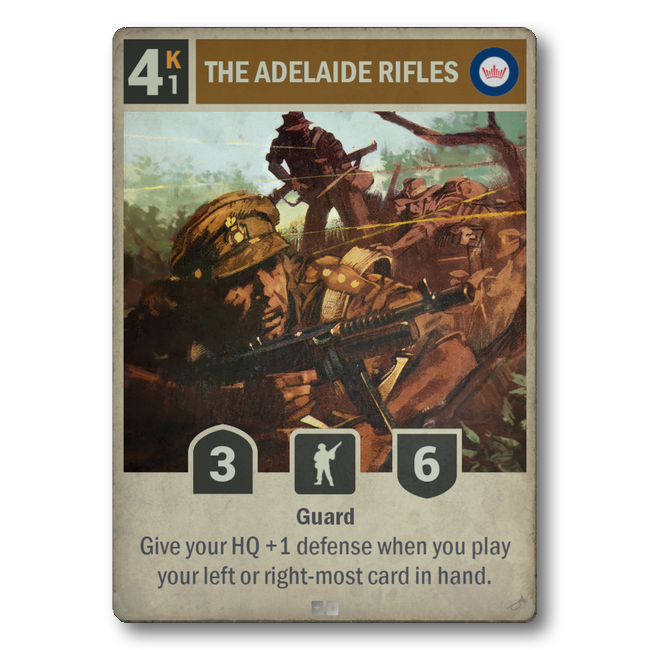
Give your HQ +1 defense when you play your left or right-most card in hand.
The 2/10th Battalion, nicknamed “The Adelaide Rifles”, was a South Australian infantry unit raised in October 1939 for the Second Australian Imperial Force. The 2/10th resisted the Japanese landing force at Milne Bay and faced fortified positions, tropical disease, and severe supply difficulties at the Battle of Buna-Gona.
Card Rotation
Call to Arms is the first expansion to launch with the new annual rotation in full effect.
When the expansion deploys on December 8, cards from the following releases will move to Reserves:
- Covert Operations
- Blood & Iron
- United Front
Cards in the Permanent Card Pool remain active. At the same time, 25 cards return from Reserves, a few of which are returning to the field reworked.
For the full list of returning cards and more details on the rotation, check out our Call to Arms: Returning Cards announcement.
Pre-Orders Are Available
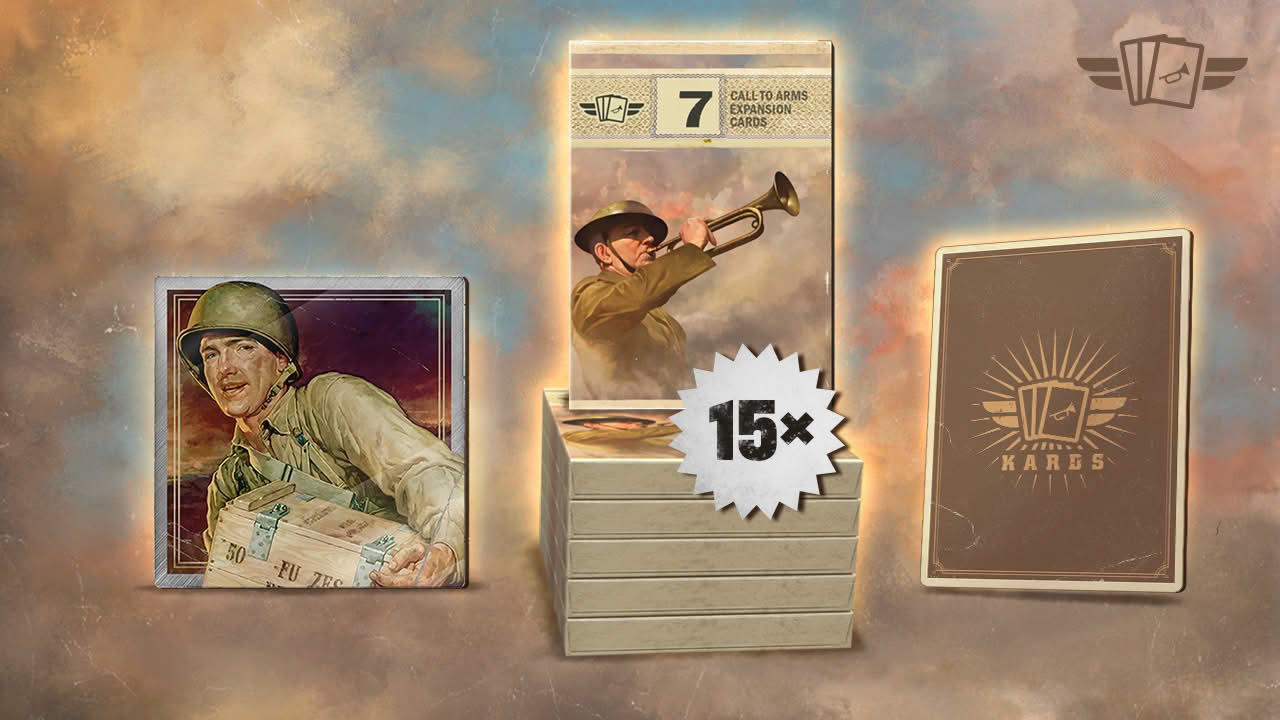
Call to Arms pre-orders are now available in the in-game shop! Get your hands on a bundle of expansion packs and exclusive cosmetics, at special limited-time early-bird prices.
Stock up on reinforcements ahead of deployment and secure your pre-order before the offer ends on December 8.
More Intel Incoming
That's just the beginning, Commanders!
From now until Call to Arms deploys on December 8, new cards will be revealed across official KARDS channels and through selected community partners.
Don't want to miss a single reveal? Our Card Reveal Overview page is updated daily with the previous day's reveals, making it easy to keep track of all the new additions.
Call to Arms Card Reveal Overview
Stay sharp, Commanders. There's plenty more intel on the way!