
Foreword
First of all, thank you to everyone who clicked in, left a comment, or added the game to a wishlist.
One thing we should have said at the start: every question below is a real question from real players in the Chinese-speaking community where this game was first shown. We collected them over the past month and answered them one by one ourselves.
And a note for anyone reading this in English: almost everything we have published so far — the trailer, the screenshots, most of the discussion — has been in Chinese. That is why a few of the questions below refer to things you may never have seen. From here on, whatever we publish in English will appear on this Steam page; and if something in this post is unclear, ask in the comments — we read them.
We had planned to write a proper devlog and set out exactly what Fronts of Steel is meant to be. But the schedule is genuinely tight, so this Q&A is standing in for one. And it is only standing in: from here on we will publish proper devlogs on a regular schedule.
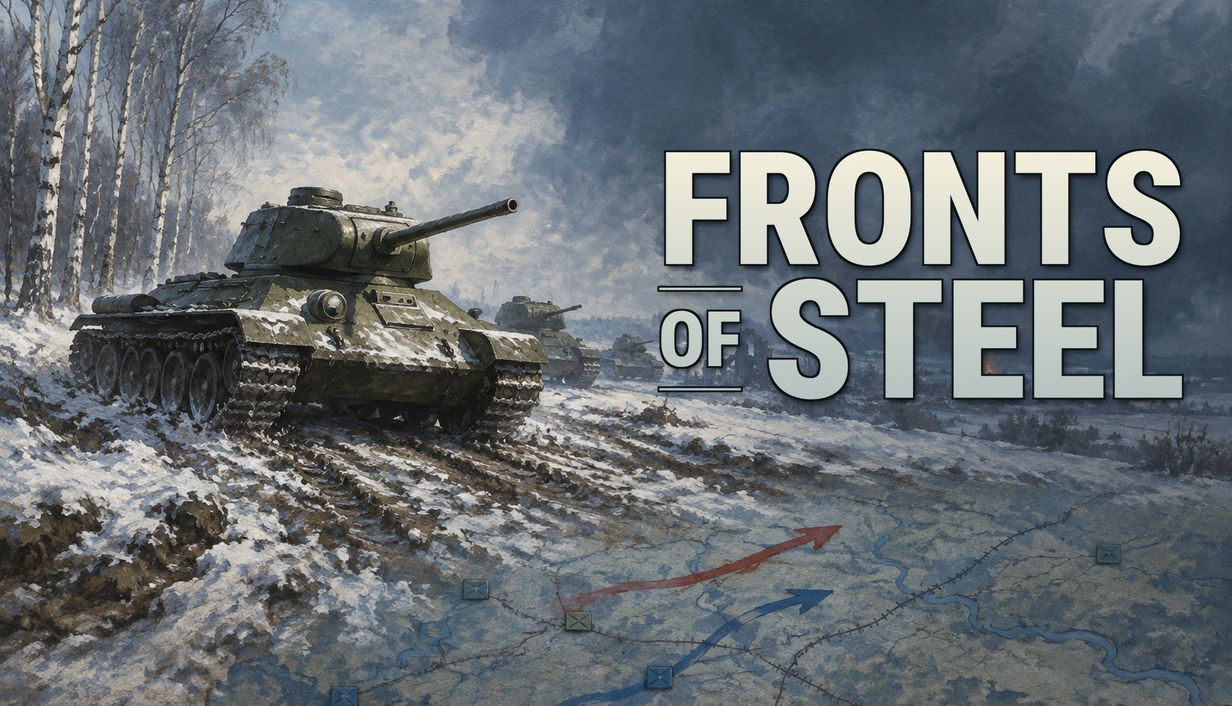
What we are making: a campaign-level wargame set on the Eastern Front of the Second World War, drawn as a staff map. You play not a single division but one side's headquarters: on a staff map rebuilt from real geographic data you lay out defensive lines, organise breakthroughs, arrange supply, and watch the front creep across the map. One counter is one division (corps and armies exist as well).
The one thing we want to solve: existing games in this space are either hex-by-hex, turn-based wargames — deep, but slow — or tactical-scale real-time games where you have to break a division down to companies and platoons and click on every one of them. We want the layer in between: campaign-level command that is real-time, pausable, and free of the hex grid's constraints — decisions, not busywork.
1. Release and Buying
Q1: When can we play it, and how much will it cost?
A free demo comes first; the full release is planned for February 2027.
The price is settled: USD 9.99 full price, with a 20% launch discount (USD 7.99) for the first 7 days at launch.
Q2: When does the demo come out? Will there be a gameplay video?
As it stands, the demo comes out towards the end of the year, and a gameplay demonstration video will arrive before the demo does. Once dates are fixed we will post them here.
Q3: Will there be a mobile version? Can my computer run it?
Yes. The order is: get the PC version stable first, then build the mobile version on top of it — so mobile is definitely coming after PC. We would like to ship on iOS as well, but that depends on how the porting actually goes. (On a web version, since people ask about that too: the finished game is only a few gigabytes, so a browser build could only ever be extremely crude. Not a priority for now.)
As for specs: our own development machine is an office laptop with no dedicated GPU, and I am not going to release a game that stutters on my own machine. Minimum specs will be published along with the demo.
Q4: Will mods and multiplayer be supported?
Openness and modding were something we wanted from the very beginning, and it will be supported if things go smoothly. Multiplayer is planned: hot-seat doesn't work well for a real-time game, so the direction is online play; 2v2 is one part of that, but the final shape isn't settled.
2. What Kind of Game Is This?
Q5: Real-time or turn-based? What if I can't keep up with the clicking? Then why not just make it an RTS?
Real-time, pausable at any moment, with four speed steps: 0.5 / 1 / 2 / 4×.
On the workload: you actually command at corps / army level or above. On the map you can draw battle-plan lines (defence line, withdrawal line, encirclement, attack line), and divisions carry out the orders you assign; you can also take over any unit and micro-manage it directly.
As for making it an RTS: the level of command is different. Almost every RTS out there is tactical command (squads, platoons, companies); this is operational level — one counter is one division, a campaign runs 110–150 game days, and the target is 45–60 minutes per session. It does have RTS elements (continuous positions, real-time, pausable), but it is more than an RTS.
Q6: Is it HOI4-style front lines, or do I have to move one unit at a time? Will it turn into a micromanagement simulator?
Closer to HOI4: you can draw plan lines and let units move themselves, or give individual divisions direct orders — but the game won't force you to control everything.
The design goal is "operations decide whether you win, execution decides how well you win": you can finish a campaign without micro-managing, and win more cleanly if you do. The usual shorthand among wargamers: the macro is the game, the micro is optional.
Q7: How does it compare to other games in the genre? Hardcore or casual? Can a newcomer get into it?
Our algorithms were genuinely inspired by games like War of Dots, some of our ideas come from Steel Division 2, and a number of mechanics are similar to Lines of Battle — but there is far more content and far more mechanics here. In positioning terms it is not the same thing as hex-by-hex, pure turn-based wargames like WITE2 or Unity of Command 2: the barrier to entry is much lower.
Hardcore and casual aren't opposites for us. Our standard is "how the game feels": hard where it should be hard (supply, terrain, weather, order of battle), and no unnecessary friction anywhere else. We will put everything into the tutorial and keep the controls uncluttered — our aim is a game that works as a hardcore wargame and can also be someone's first wargame.
3. What Does "No Hexes" Actually Mean?
Q8: No hexes — but roads and terrain boundaries still run along 60-degree directions?
Yes, the terrain layer still keeps a hex grid. Removing hexes completely would mean rebuilding the terrain, the map editor and the whole data pipeline from scratch, which is far too much work — so for now it is a temporary compromise.
Q9: Then you have just hidden the hex lines, haven't you? Is combat still resolved per hex? How do I judge distance?
Two separate things:
The terrain layer does keep a hex grid, but its only remaining job is to describe terrain.
Unit movement and combat resolution do not depend on it: positions are continuous, movement is pixel-level, and contact is determined by actual distance — entering within one cell counts as contact, opening the gap beyond 1.5 cells breaks it — rather than "you must stop on a particular hex". That is why you can do things a hex-based game cannot: delay, infiltrate, slip around, slide past an enemy flank. Put more plainly: the feel is closer to RTS positional movement, but underneath, damage, supply and contact resolution are still wargame logic.
For distance, there will be a dedicated measuring tool that shows distance and estimated time of arrival, so you don't have to eyeball it.
Q10: Without hexes, how are control zones calculated? How do you solve holding the line? Can I set frontage by hand? Can units stack?
The enemy can't just slip through anywhere. What we do now is this: every unit radiates a "field" of control/influence, and an enemy that wants to cross it has to fight you for it. The boundary is no longer a straight polyline but a smooth curve that shifts with unit positions — which is also why you can't see hex edges on screen.
Frontage is currently set from historical tables of organisation (each division has a base frontage, and the combat front is derived from the arcs actually in contact). Manually widening or narrowing it has not been implemented yet.
Units can stack. The "how many units per cell" restriction of hex-based games doesn't apply to us — stacking is a workaround that hex games need in the first place.
4. Command, Combat and Logistics
Q11: What levels of command are there? Can a division be split into regiments? Is there morale, and do commanders matter?
Mechanically all four levels exist — corps, army, army group (Soviet Front) — and the span limits follow history: corps 4 divisions / army 4 corps / army group 3 armies; for the Soviets, from the second half of 1941 to the end of 1942 there was no corps level, and armies commanded 6 divisions directly. The scenarios built so far are mostly capped at army level. Whether the higher levels are laid out in scenarios depends on whether the workload stays manageable.
Splitting isn't implemented yet, but it isn't hard to do and it will be in the finished game. The unit granularity is mainly division, with separate corps-level and army-level brigade, regiment and battalion counters; corps and regiment-sized units can both be added later. Support units exist, but they work differently from WITE2's, and their owning level follows history (in years when the Soviets had no corps level they fall automatically under army control). One thing to be clear about: headquarters currently provide no numerical bonus — they govern subordination and the propagation of orders.
Morale does not exist yet; it may be added later. Commanders and headquarters have a chain of command and command economics, but there are currently no numerical bonuses; putting a commander who performed badly in history in charge will indeed go badly.
Q12: Is combat dice-based or fixed values? Can I order feints, assaults and delaying actions? Are there front/flank/rear aspects, and fatigue?
Fixed values with modifiers, no dice. Terrain, weather, entrenchments, night, river crossings and unit stats all feed into the resolution.
As for orders: you can issue feint, assault and delay orders. There are also unit-level settings for entrenchment, rearguard (delaying action) and hold fast, and withdrawal lines themselves come in two modes, delay and disengage.
Front/flank/rear aspects do not exist at the moment; they may be added later. Fatigue is represented through organisation — we don't run a separate fatigue stat.
Q13: Do terrain and weather give modifiers? What about firing from higher ground? Are there unit-type counters?
Terrain and weather do give modifiers. Attacking from higher ground is not implemented for now: it would pull the game too far towards the tactical scale, which conflicts with campaign-level positioning.
Unit-type counters exist, expressed through numbers — we follow the classic Hearts of Iron soft attack / hard attack approach rather than rock-paper-scissors hard counters.
Q14: Is there supply? Otherwise I'll just break through and drive straight at Moscow. Can I run partisans behind enemy lines?
Yes, and it is a core system. Every map cell has its own supply ceiling, affected by terrain and weather; railways, trunk lines, hubs and truck capacity are all accounted for, and a cut railway has to be repaired (rails reopen in half a day, bridges take three days).
Logistics units can raise the ceiling, and enemy partisans can cut the supply line. This is exactly what the supply system is there to prevent: the further you are from the railheads and the worse the weather, the less supply you get — so the front doesn't become mindless pushing with one panzer division carving up the whole map.
Q15: How do factories, oil, production and replacements relate to each other?
Factories are the production system (queues advance by the day to build units); supply is the logistics system. The two are not directly linked. Oil was added early on and will probably not be kept. A resource economy (manpower/oil and the like) is not currently planned.
There is a production system: you build units from templates, with build time advancing by the day. The templates available in the current scenarios are incomplete — we are still filling that in.
On replacements and rebuilding: small scenarios use a reinforcement mechanism (arriving by day, with a popup); large scenarios are player-controlled with a small amount of fixed reinforcement.
5. Scenarios, Maps and the Editor
Q16: Is it only the Soviet-German front? Will all the Eastern Front allies be in? What about Bagration, Kursk, the Second Sino-Japanese War (1937–45)?
The Eastern Front is the main stage, and all the allied nations involved in the Eastern Front will be included. Bagration, Kursk and the like will be made; we will stay with campaign scenarios rather than a single whole-world map.
The Second Sino-Japanese War is difficult: the terrain, order of battle and source material differ too much from the Soviet-German theatre, and it is not in the current plan.
Q17: Can the map be bigger and more detailed? Will it be rebuilt? The scale looks off — and are the counters the right size?
It will be rebuilt. The current map is reconstructed from real terrain data, and its precision is limited by the data sources and by what we can produce; how big the map can get is constrained mainly by hardware and scenario production capacity. We will redo it later.
Counters are currently at division level, and the scale is declared by the scenario and kept in line with the real geography. Regimental units can be added later. Counter size is still being adjusted.
Q18: Can I set up a fictional battle of my own, or just watch the AI fight itself? Will there be an editor?
Yes. The sandbox play you are describing is basically "build your own map + let the AI fight", and that road is open.
The editor ships with the game: both scenario editing and map editing.
Q19: Is there air and naval combat? Can I conduct amphibious landings? What about fog of war?
Yes. Air missions are role-based: interception, close air support, fighter-bomber and strategic bombing. Naval forces use role-based counters with salvo resolution: battleships fire one salvo per day, torpedoes only work at very close range (same grid cell), and armoured targets take half damage. Yes to landings, yes to naval support, and there is also sea transport.
Fog of war is the front-line-driven territorial kind: you see only as far as you have advanced. As for tactical line-of-sight where each unit sees only its immediate surroundings — that would be hard, because we never prepared for a tactical view.
6. Visuals, AI and Progress
Q20: Can I rotate the map 360 degrees? Is there 3D and day/night? Can the counters be replaced with 3D models?
Both. The game switches between the 2D map and the 3D view; day and night are computed from solar declination and hour angle, and night affects penetration, artillery, march speed, recovery and entrenchment accumulation.
They can be replaced with 3D models — in fact the game already has a 3D view, it is just computationally heavy and still being optimised. Symbol styles will be adjusted later too.
Q21: How well does the AI fight? Can I hand my units over to it?
The first version of the ground AI is already running, and you can hand units over to it — but how good it really is will take a lot more playtesting to say. It is still improving.
Q22: Will the AI-generated illustrations and icons be replaced?
Yes. Those are placeholders for now — we have no artist on the team, so they have to hold the fort. Once the systems and the interface are locked, that layer will be redone by a dedicated artist.
Q23: How is optimisation? Are there a lot of bugs? How far along is development?
The finished version will get the best optimisation we can deliver; right now new mechanics keep going in, so optimisation falling behind is normal. On bugs: we will do a great deal of testing before release and hunt down as many as we can first.
Development is roughly seventy percent done. The project has been torn down and rebuilt several times; what is left is filling in mechanics (command groups, attachment, fire missions, air missions, intelligence, pursuit, relief in place, replacements and repair, and so on), saving and loading, and a lot of polish. We would rather be late than ship a half-finished game as a finished one.