
In IGIGI: Cold Horizon, you get to explore procedural alien worlds in a roguelike adventure with distinctive HD-ASCII visuals. Gather samples, loot strange materials, battle hostile creatures, craft gear, and uncover the mystery of your missing partner and the IGIGI. Wishlist now on Steam!
A game I want to discover, not just design
I've been developing different kinds of games throughout my life. I released a retro JRPG called Whispers in the Moss on Steam a couple of years ago, and it was well received. The fire of game dev still lives strong in me, but lately I've felt a different kind of fire.
I want to create a game that can surprise even myself.
A game that will feel fresh even to me, its creator.
That is the motivation behind IGIGI. Procedural generation in IGIGI is not only about terrain shape, loot and crafting. My long-term goal is for each planet to become a storied mini-ecosystem with its own biome, history, events and anomalies. A planet should not be remembered by what color it was, but by what happened there.
Procedural generation shakes hands with authored content in IGIGI. The game will include hand-built elements, scripted events and things that need to stand out from the procedural generation. That is my goal, at least. The spaceship/planet loop is also there to reinforce this contrast between the familiar, the spaceship as a home hub, and the uncertainty of the procedural planets.
The central test is this: can the game eventually create moments that don't feel explicitly scripted? To build a game capable of surprising even me, I also have to allow the development itself to surprise me.
Development itself is exploratory
IGIGI is not being built from a carefully planned design document. Instead, development itself is an adventure of its own.
New systems are often created because something in the existing game suggests a new possibility. Something designed purely as a visual effect can become a mechanic. A companion drone that began as a cosmetic curiosity can become a key system (and it did!). Designing new procedural loot and planet biomes can force the crafting system to evolve.
At this point it's almost like the game has a will of its own, and development becomes a question of what the game itself wants to become.
A great example is combat. I'll be honest: combat is going to be central to this game, but it's something I haven't even touched yet in development. The iterative approach has its risks, but it's also a major source of the game's identity.
That same approach applies to the visuals.
Old-school foundations, modern presentation
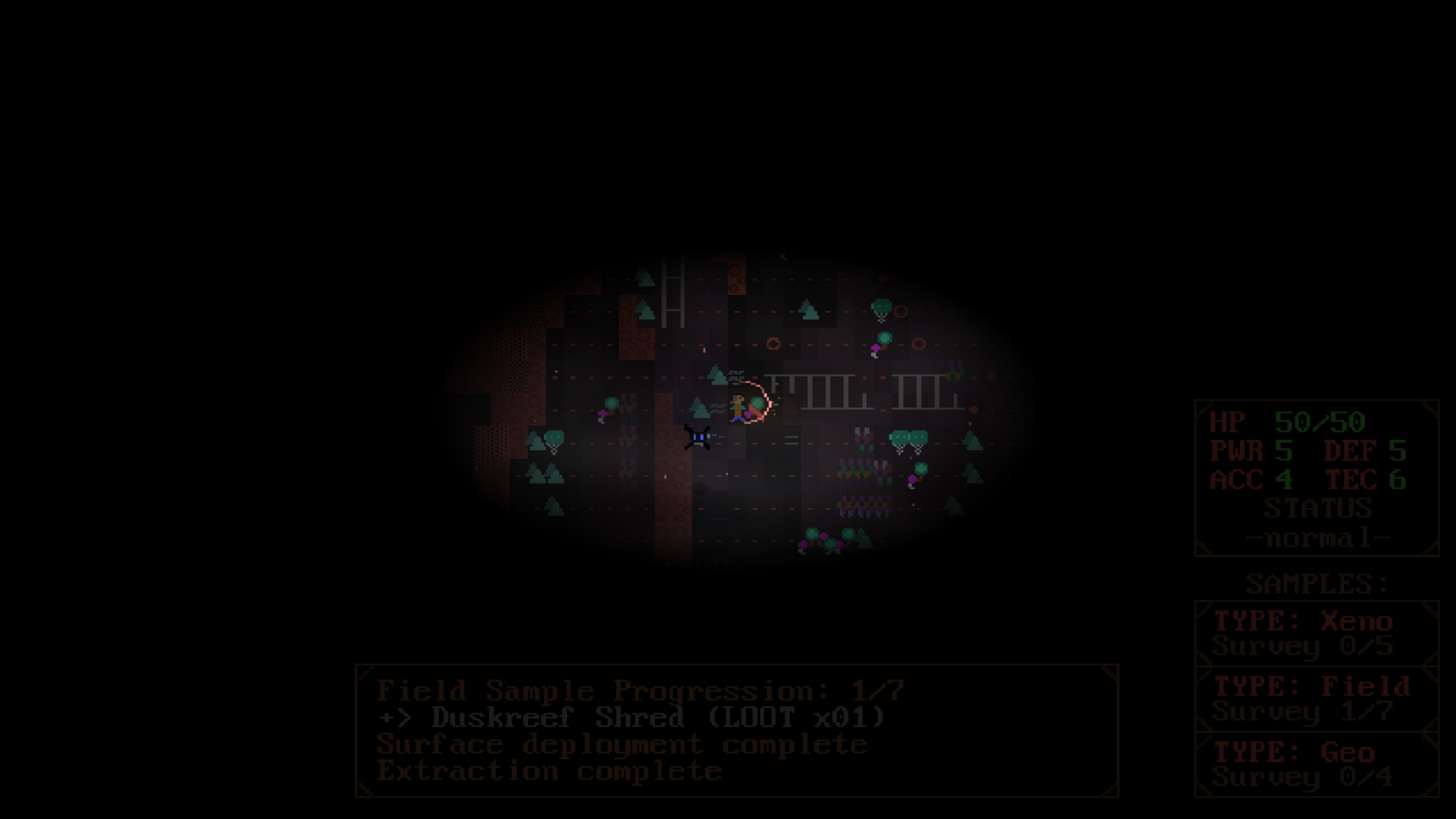
IGIGI is heavily rooted in classic ASCII and roguelike visual language, but it's getting a strong visual identity of its own.
In my last game, Whispers in the Moss (available on Steam), I stretched the limits of classic DOS ASCII while keeping it real with 16 colors, strict glyph-based placement and by sticking fully to text mode. This time, I'm going for something very different.
I've always seen ASCII as a style, never as a limitation. I have never treated ASCII as a symbolic shorthand, instead I’ve always treated it as a representational visual medium that can be used illustratively and not just symbolically. IGIGI also uses modern techniques such as true-color rendering, alpha layers, lighting effects, particles, pixel movement, shadows, depth backgrounds, parallax-like effects and overlays to give it a very unique look. Inspired by the idea of HD-2D, a concept coined by Square Enix, I like to call my approach HD-ASCII.
However, I've been careful never to wander too far from the ASCII identity. Instead of moving into conventional pixel art, for example, I've opted for custom ASCII tiles that can consist of several overlapping glyphs drawn over one another. I use ASCII symbols as building blocks to keep the identity intact while creating something new and perhaps richer.
All of these systems and visual experiments ultimately have to answer one very simple question.
The ultimate test is: does the next planet make me curious?
The core expedition loop of the game will only work if deploying to the next planet feels genuinely tempting. What will the next place look like? Who lives there, if anyone? What can I harvest? How can I progress my goals? Can I find something that moves the meta storyline forward?
Curiosity is the central building block of IGIGI.
My personal benchmark is harsh: if I, after building all these systems myself, still want to select "Deploy" and head out to the next planet just to see what it's like, then the game is doing what I hoped it would.
I know what I'm building, but I need to build it in a way that keeps me in the dark about what it will actually produce. Sounds difficult because it is.
Please follow me on this development journey by wishlisting the game, and if you think it has potential, do spread the word, too!
– Tapio / Uncultured Games
A fire bearer of the IGIGI