
Hello, and welcome to the first developer log for Southern Exile & Northern Restoration (《衣冠南渡:北伐大业》).
The game has been in development for some time, but only recently did we decide that it was worth documenting not just what we are building, but why its design has taken this particular shape.
This is not the beginning of development, nor is it a list of everything added since v0.1.0. Instead, we are starting with the recently completed internal v0.1.6 build and one of the principles at the heart of the game:
You are not the emperor. Every form of power available to you must first be earned by your clan.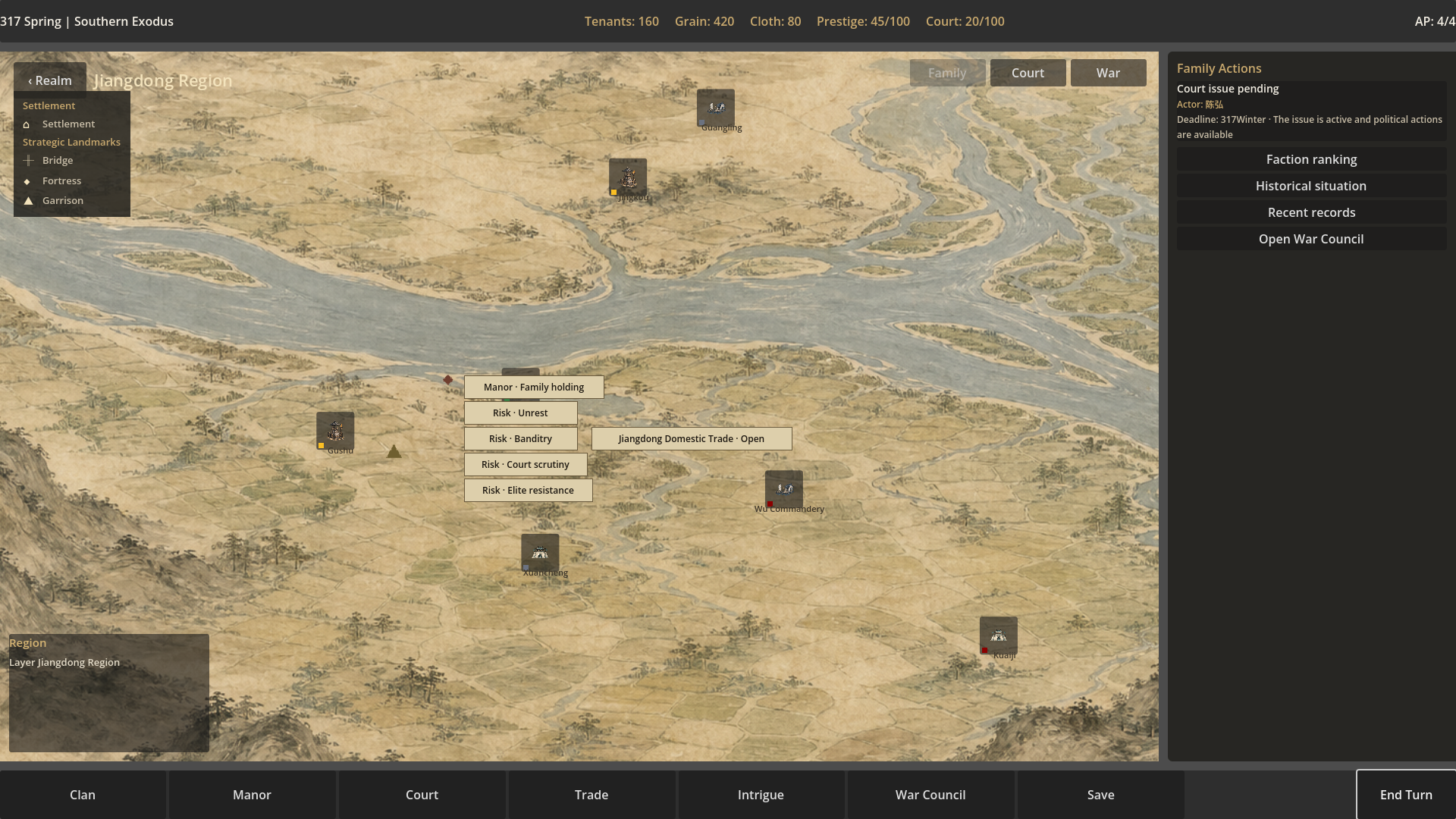
The Jiangdong regional view. The first question is not “Which territory belongs to me?” but “What does my clan have here, whom can we reach, and what opportunities or dangers face us?”
Beginning in 317 CE
Southern Exile & Northern Restoration is a historical grand strategy and clan-management game set during the rise of the Eastern Jin.
The story begins in 317 CE. The Western Jin has fallen, warfare continues across northern China, and refugees and aristocratic families have crossed the Yangtze in great numbers. A new regime is struggling to establish itself in Jiangnan.
You do not play as the emperor, nor as one of the already dominant Wang, Xie, Yu, or Huan clans. You lead a fictional, mid-ranking shizu clan: a hereditary elite family newly arrived from the north, with a modest estate near Jiankang and only a handful of relatives ready to carry its responsibilities.
You will manage estates, settle displaced people, educate younger family members, arrange marriages, enter government service, and find a place among competing clans and political factions.
One day, your family may take part in northern expeditions, shape decisions at court, or even alter the fate of a dynasty.
At the beginning, however, the realm does not belong to you.
When Identity and Interface Disagree
Earlier builds described the player as the leader of a newly arrived clan, but the interface still inherited several conventions from traditional grand strategy games.
Large amounts of information were immediately visible, while important political and military controls were always within reach. This was convenient, but it created a contradiction we could no longer ignore:
The story said that you were a vulnerable, mid-ranking clan. The interface treated you like the ruler of the entire realm.
If a family with no military appointment, no troops under its command, and little access to central power can freely move armies and choose invasion routes, then “clan management” risks becoming little more than a historical coat of paint.
That is the problem v0.1.6 set out to address.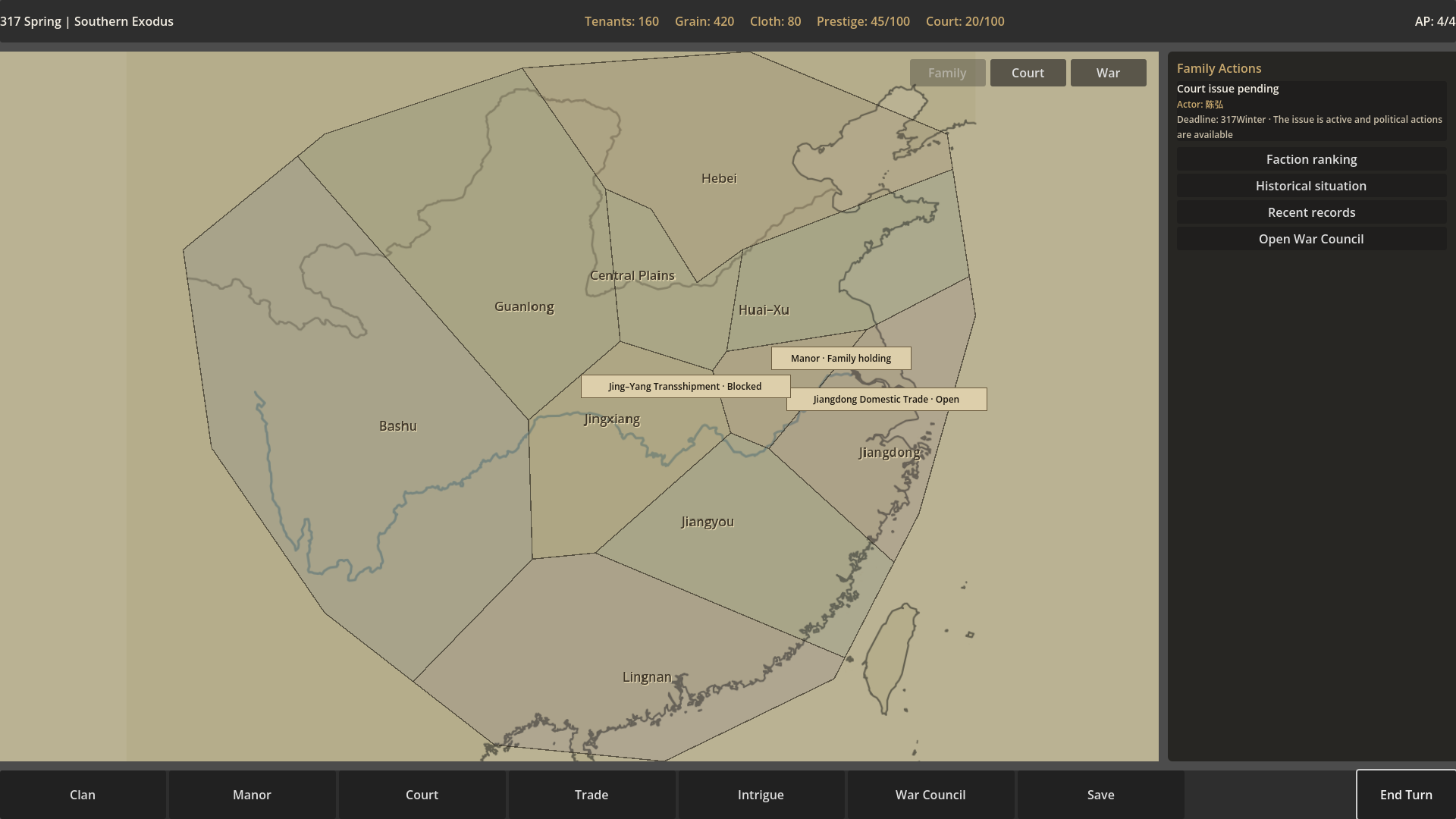
The national view helps the player understand the wider situation. Regional boundaries indicate strategic context and navigation; they do not imply that the player owns or directly controls those lands.
What Needs Your Attention Now?
The right-hand side of the main interface is no longer a second overview of the entire country. It is now an action queue for matters that directly concern the clan.
It prioritizes decisions and commitments that need an answer, time-sensitive court appointments, risks affecting your estates, and trade or military opportunities relevant to your current position.
Rather than placing every system in front of the player at once, we want this part of the interface to answer a more immediate question:
Given my clan's present circumstances, what deserves my attention next?
Where possible, an action should also identify who will carry it out, what qualifies them to do so, and the likely cost in resources, time, and risk.
One Map, Three Ways to Read It
The strategic map was also reorganized in v0.1.6.
Instead of building unrelated maps for estate management, court politics, and warfare, we use a shared historical geography with three semantic views: Estates & Local Affairs, Court & Connections, and War & Council.
The estate view focuses on what your family actually owns or can influence: estates, local industries, trade routes, risks, and reachable characters. A commandery belonging to a particular regime does not mean that it belongs to the player. The first question is: What does my family have here, and through whom can we act?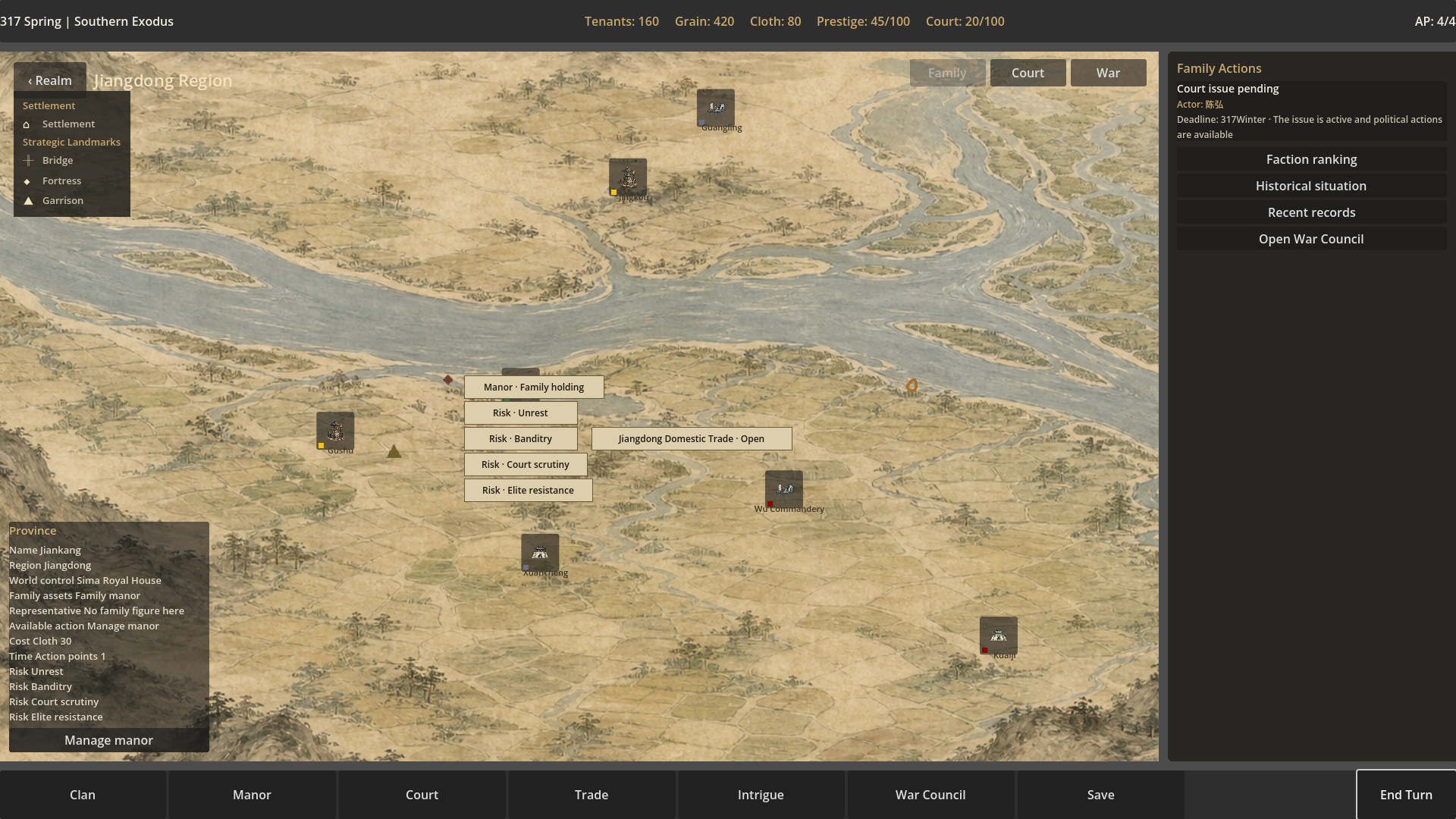
Selecting Jiankang first shows the clan's estate, available local actions, and the risks attached to operating there.
The court view presents people, political groups, offices, and commitments connected to your clan. Influence at court should not come from pressing an abstract “politics” button; it should grow out of specific relationships, appointments, and past choices.
The war view only displays active theatres, routes, supplies, and military conditions when a conflict actually exists. Wars that have not begun in 317 are not placed on the map merely to fill empty space, and national military information is not presented as if it were your natural command authority.
No Command Does Not Mean No Participation
Preventing an unqualified clan from commanding armies does not mean that the player can only watch.
An ordinary family can still contribute resources, recommend officers, contact allies, dispatch its own retainers, or take a political position on a campaign. As family members gain appointments, earn military merit, or obtain real command authority, further responsibilities become available.
Only a character who has actually acquired the right to direct a campaign can decide routes, commanders, supplies, and major operational choices.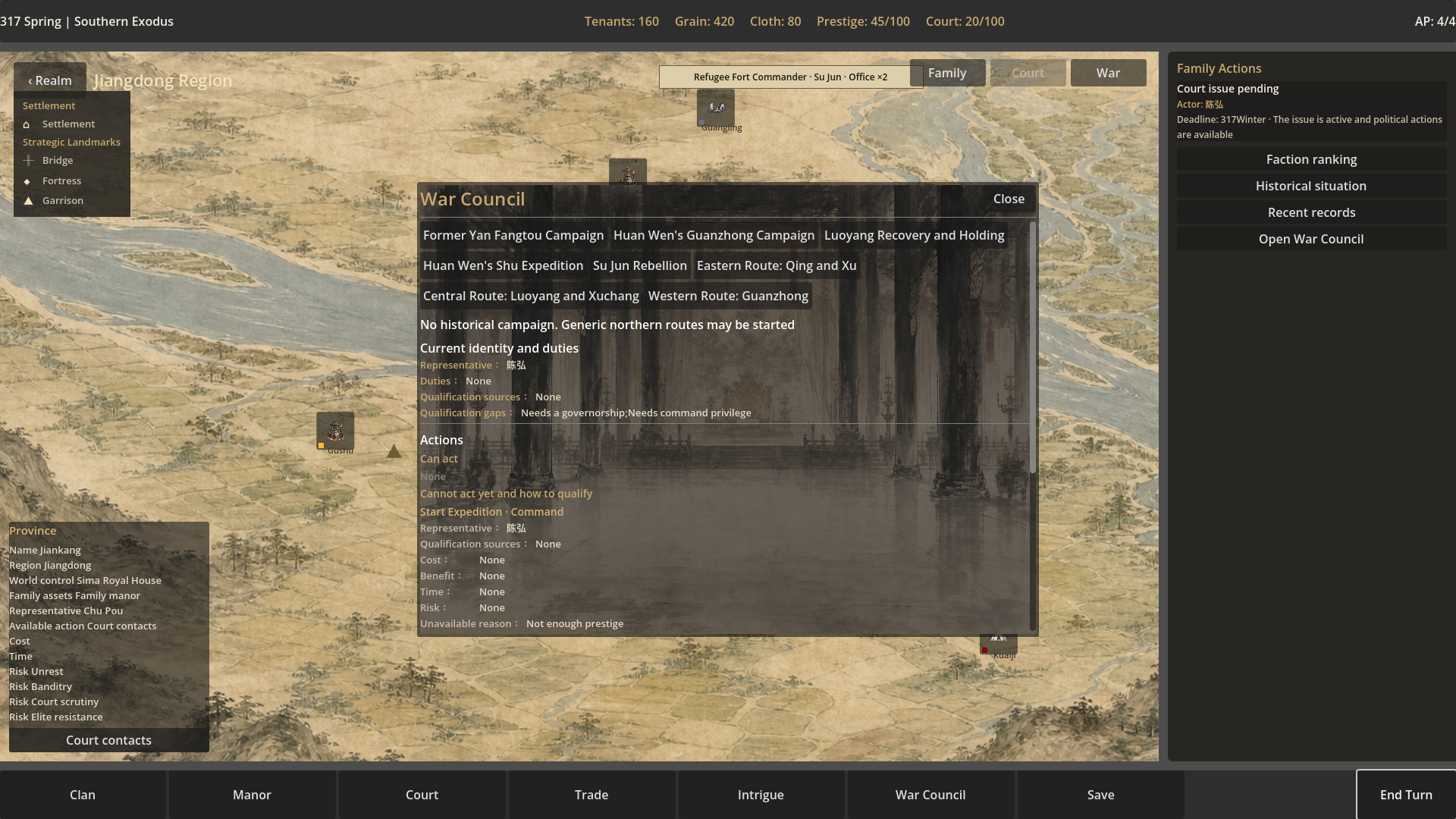
Without the appropriate office or military authority, command-level actions remain unavailable. The war council explains the current role, the missing qualification, and possible ways to obtain it.
The war council is therefore designed to do more than say, “You cannot press this button.” It should explain what is missing, which offices or powers would satisfy the requirement, and how the clan might pursue them.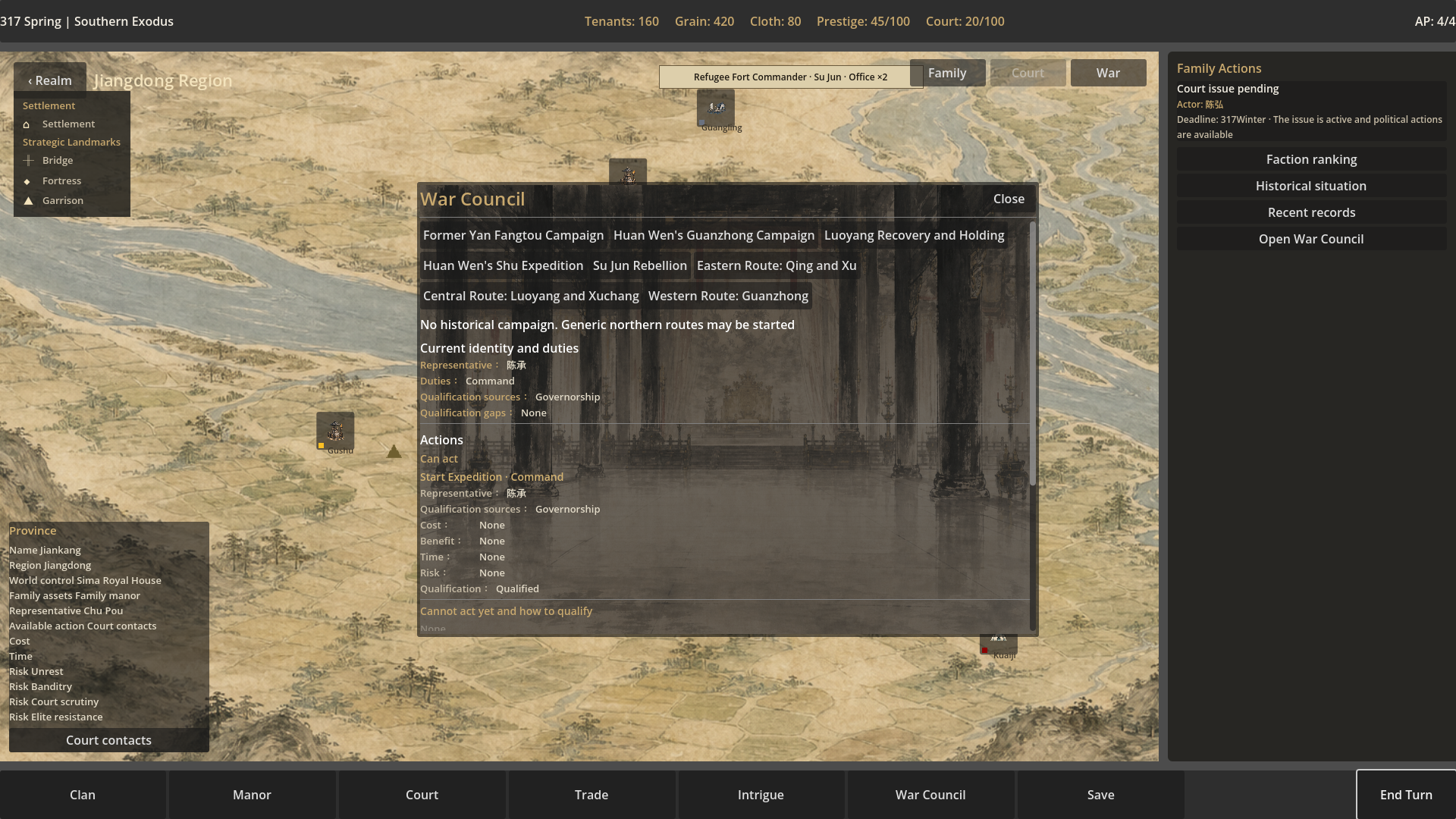
Higher-level campaign actions become available only after a family member gains a legitimate appointment and command authority. Power is a result of the clan's growth, not a default ability granted at the start.
Restrictions Can Become Progression
While working on this version, we came to see that restricting the player is not necessarily the same as taking freedom away.
If a restriction merely greys out a button without explanation, it is frustrating. But when players understand why an action is currently beyond them—and can see how office, relationships, commitments, resources, or military achievement might unlock it—the restriction becomes more than a wall.
It becomes a visible path of advancement.
For Southern Exile & Northern Restoration, the important question may not be how many buttons the player receives on the first turn, but whether every power they eventually gain has a believable origin.
Current Development Status
The internal v0.1.6 build completes this round of work on information architecture, the strategic map, and clan authority. It does not represent a newly released public Steam build.
The relevant systems have completed automated and runtime checks. We still need continued hands-on playtesting to answer several important questions: Do players quickly understand their current status? Are missing requirements and paths of advancement clear? Do the three map views reduce information overload? Does the action queue help players choose their next move?
Those unresolved questions will also shape future development logs.
What We Would Like to Discuss Next
Future logs will explore why the game begins in 317 rather than the more familiar Three Kingdoms era; how cloth, estates, and dependent households form the economic base of an aristocratic clan; how the phrase “The realm is shared by the Wang and the Sima” becomes a playable political structure; and why a northern expedition involves far more than comparing army sizes.
If you are interested in aristocratic politics, multi-generational clan management, and a historical strategy game that does not treat the emperor as the only meaningful point of view, please follow Southern Exile & Northern Restoration and add it to your Steam wishlist.
Which of these topics would you most like to read about next? Let us know in the comments.