
The youngster who looks strongest today might not have the highest ceiling. In President FC: Football Club Owner, building an academy means following that uncertainty—and deciding who deserves a chance.
Three things tell different parts of the story:
- ABI: ability right now, measured on an adult scale.
- K/T: an assessment, made at that age, of how far the youngster might go—not their ability today.
- POT: the ceiling for long-term ability development.
1. Your academy: the years before a professional career
Youth covers U9–U16. These youngsters cannot yet be selected through the normal match system. Player includes the first team, U21 and U18: all use the same full player attributes, scouting, transfer and match systems.
Your academy starts with six youngsters in each age group: 48 in total. You can follow your own prospects, but cannot browse other clubs' academies and directly negotiate for any child you choose. Youth Camps and the Youth Network provide specific recruitment opportunities; more on those next time.
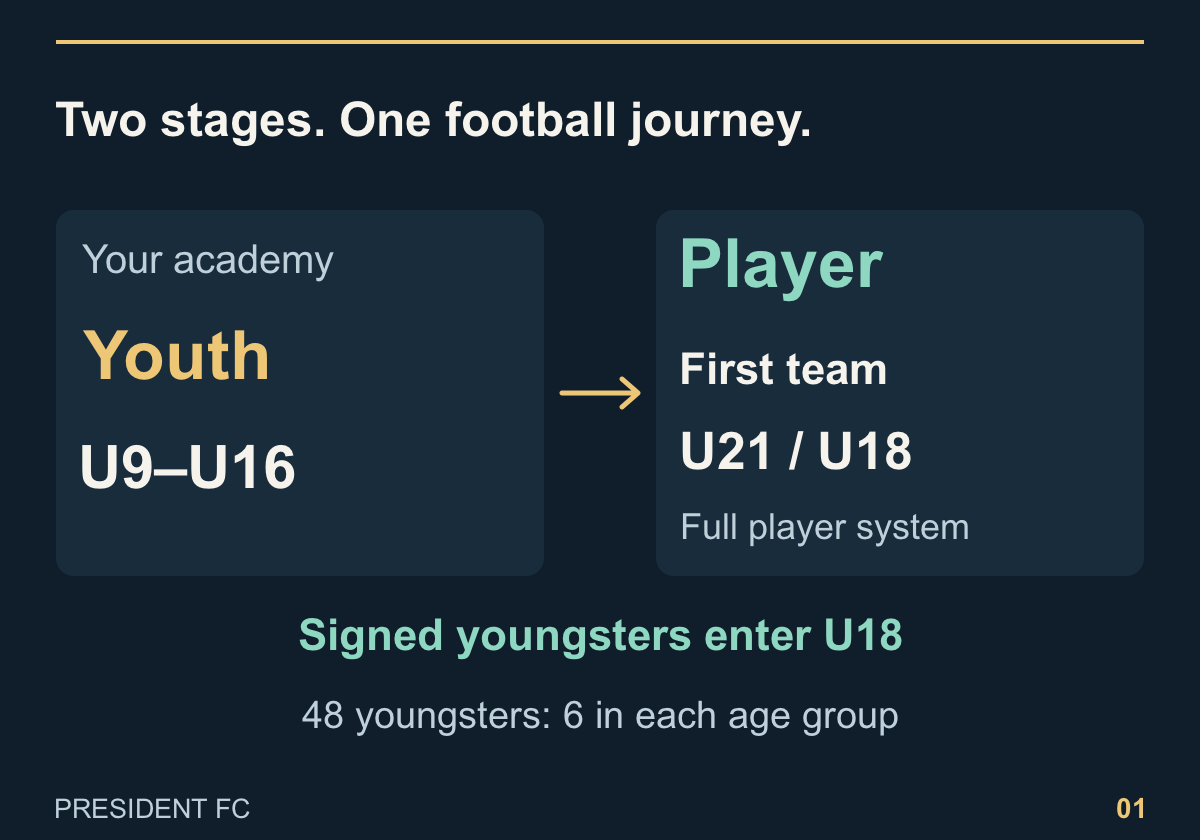
48 youngsters: 6 in each age group
2. Low ABI does not mean low potential
ABI uses the same scale as adult players, not a ranking within an age group.
A brilliant U9 youngster may stand out among their peers while still lacking the strength and physical readiness to compete with adults—even at amateur level. A very low ABI is normal at that age.
ABI generally develops more slowly in younger groups. The age-based rate increases during the teenage years, reflecting skills developing alongside a body becoming more ready for adult football. Individual progress still varies.
Small early ABI gains do not, by themselves, mean a youngster lacks potential.
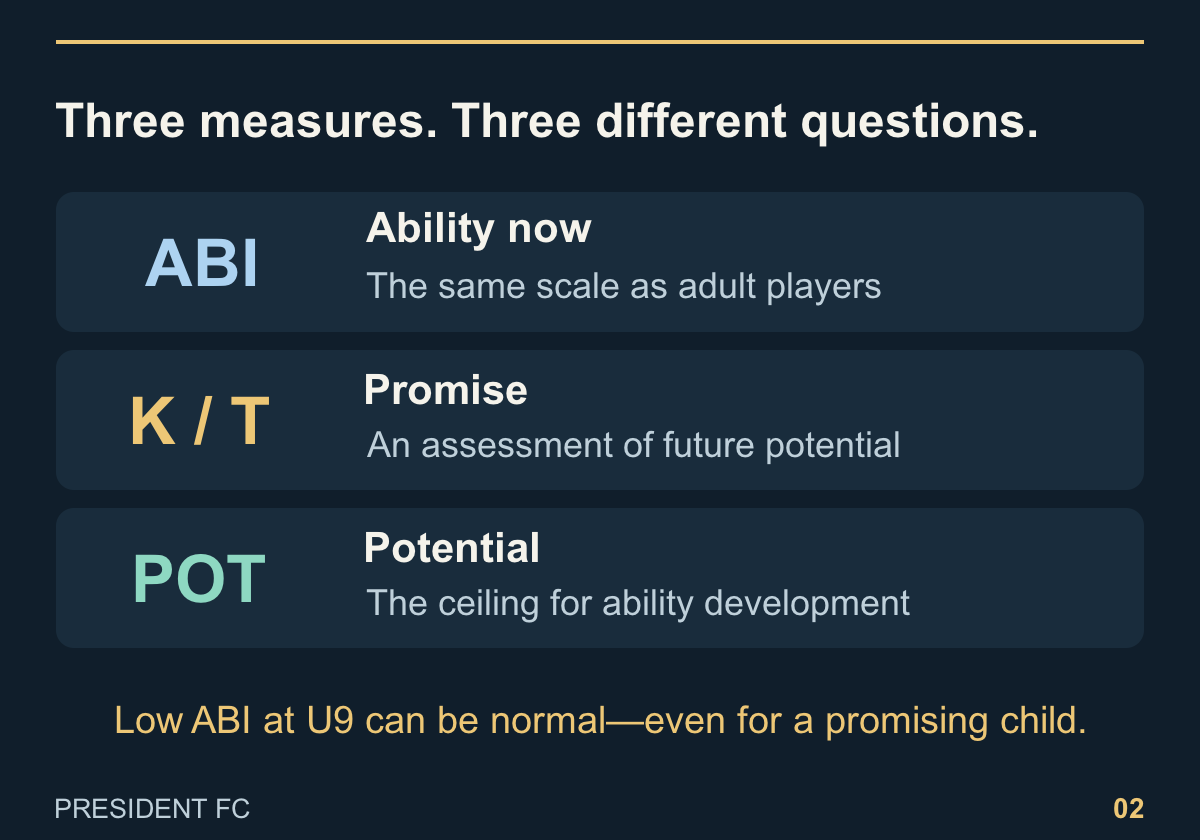
Low ABI at U9 can be normal—even for a promising child.
3. K and T: promise becomes clearer with age
Higher assessments suggest a better chance of a high potential ceiling. They are indications, not guarantees.
- U9–U12: K1–K12. An early range such as K5–K9 narrows over time. By U12, the K assessment is clear—for example, K7.
- U13–U16: T1–T15. The teenage assessment starts as a range again and becomes clearer until a definite T level is visible by U16.
Some ranges become clear earlier. K and T are different scales: K7 does not mean T7.
A high K makes a good T more likely, but an early standout can be assessed less favourably later. Others emerge from an unremarkable early assessment. The same uncertainty exists between T and POT: a lower-rated teenager can have a higher ceiling than a higher-rated one.
POT is carried forward into the Player system, not newly rolled when you offer a contract. Reaching that ceiling is another challenge.
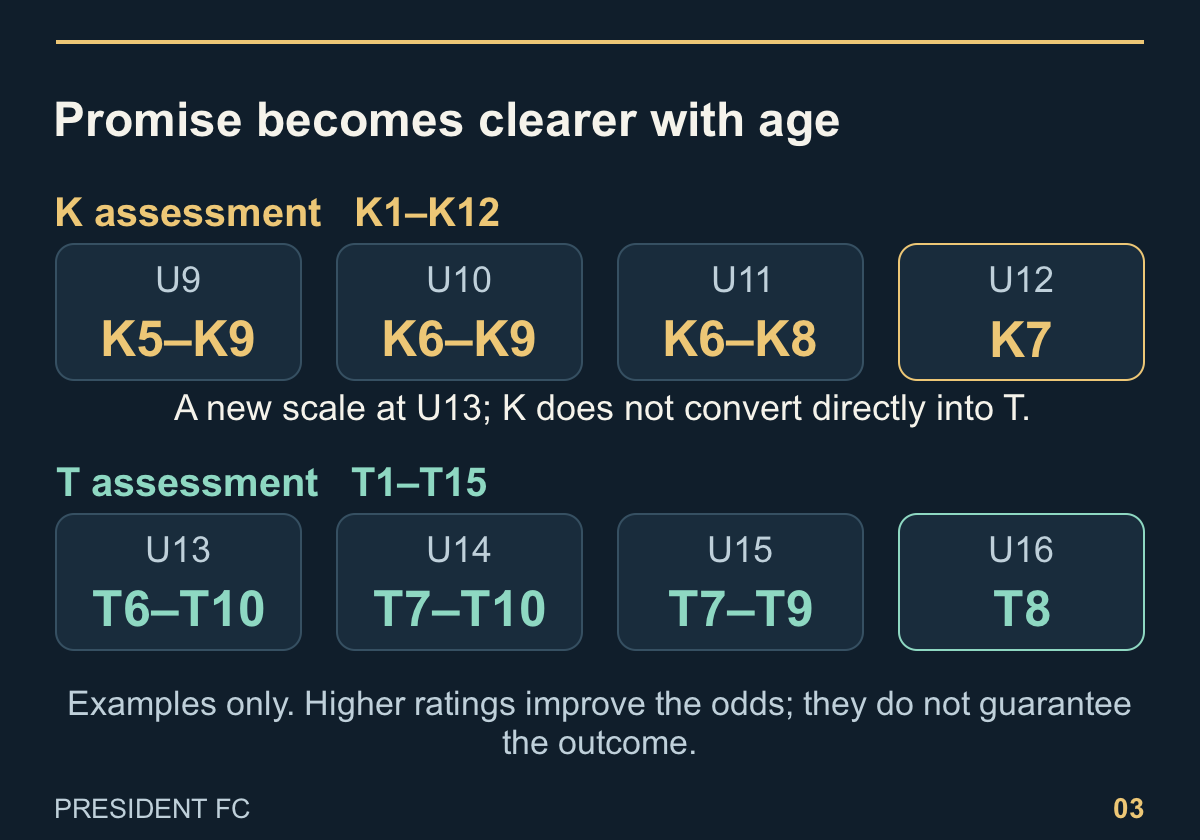
Examples only. Higher ratings improve the odds; they do not guarantee the outcome.
4. Growth speed and potential tell different stories
Each youngster has a hidden tendency for ABI development speed during their Youth years. It is separate from the K/T assessment: a promising youngster may develop more slowly than a peer. Once they become a Player, that Youth growth tendency stops applying and normal player development takes over.
Academy level helps in two ways:
- Development: a bonus to your youngsters' ABI growth.
- Recruitment: better odds of high-potential new arrivals, with stronger K/T assessments more likely.
Investment improves conditions and odds. It does not guarantee a star in every intake or automatically raise the POT of youngsters already at the club. A less developed academy can still produce a special prospect.
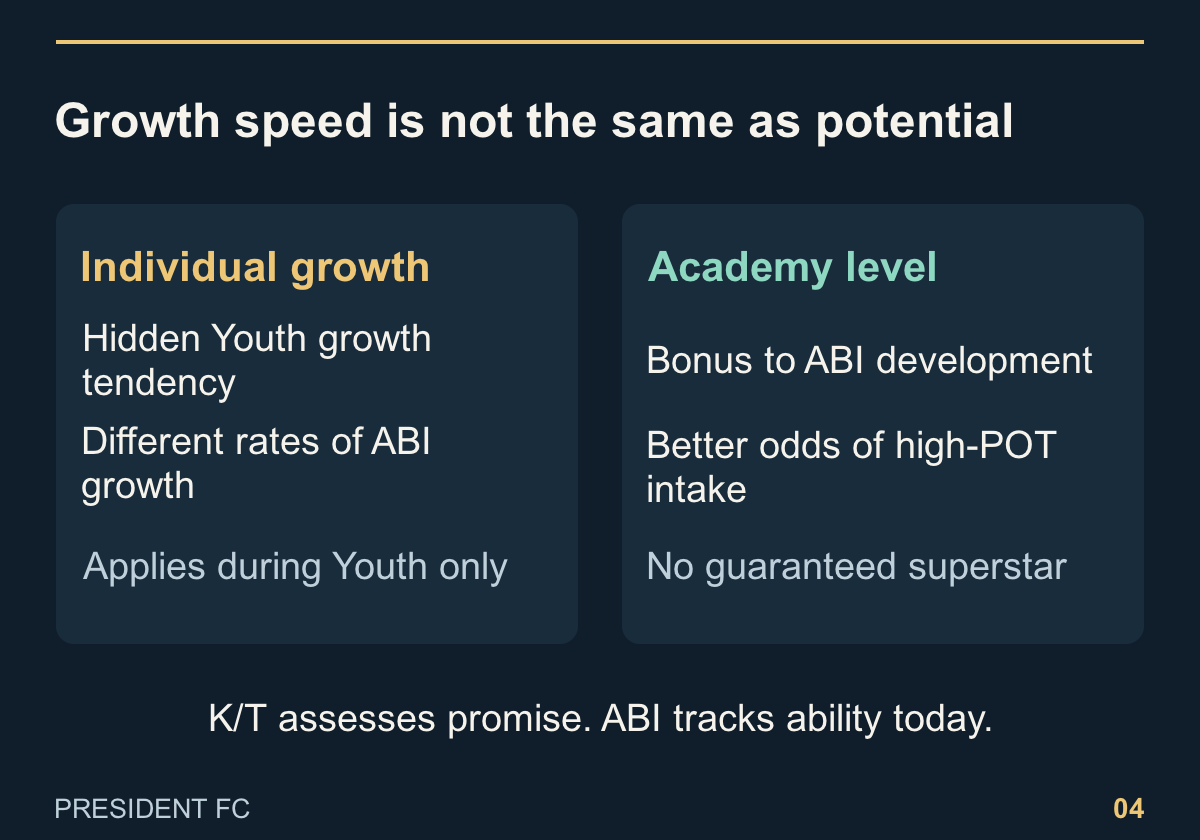
K/T assesses promise. ABI tracks ability today.
5. U16: who gets that first contract?
During their final academy year, you can offer U16 youngsters a professional contract in advance.
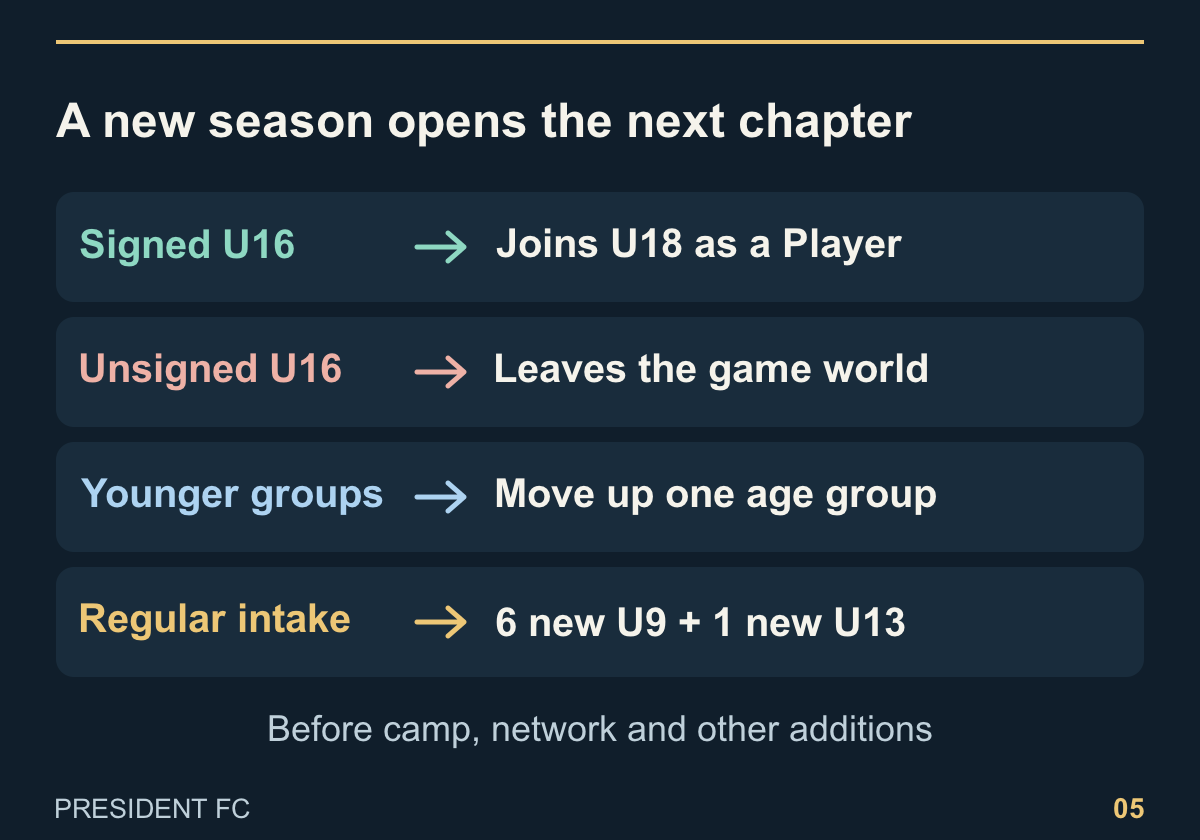
At the season rollover:
- Signed U16 youngsters join U18 as Players. They carry their ABI forward, gain their full player profile—including secondary positions and traits—and become eligible for normal match selection.
- Unsigned U16 youngsters leave the game world. They do not stay for another academy year or become free agents you can sign later.
- Younger age groups move up one group.
- The regular intake adds six U9 youngsters and one U13 youngster, before extras from Youth Camps, your club network or other bonuses.
Signing does not move a youngster to U18 immediately. Turning pro also does not automatically reveal perfectly accurate POT: normal player information and scouting still matter.
Before camp, network and other additions
U labels follow the club's age-group cutoff, so they do not always match a youngster's age on their birthday.
Who will get a chance at your club?
Youth development is about more than today's ABI. It is about giving youngsters time, watching the picture become clearer, and deciding who gets to start a career with you.
Before offering that first contract, what would matter most to you: current ability, the latest assessment, or progress across several seasons? Tell us in the comments.
Next time: Youth Camps and the Youth Network—building a presence in cities around the world, welcoming local youngsters, and finding selected prospects at other clubs who become available to approach.
Want to build an academy of your own? Wishlist President FC: Football Club Owner on Steam and follow the game for the next development diary.
The game is in development. This article describes the current design. The cover is an illustration; the diagrams explain systems and are not gameplay screenshots.
— Komochigame