
Changes since v0.1.8
Update cadence
We’re going to try to move to a weekly update schedule, aiming to release new playtest builds on Thursday or Friday where possible so players have the weekend to spend time with each update. Important fixes and smaller patches will still be released between scheduled updates when needed.
Hardware and machine capacity
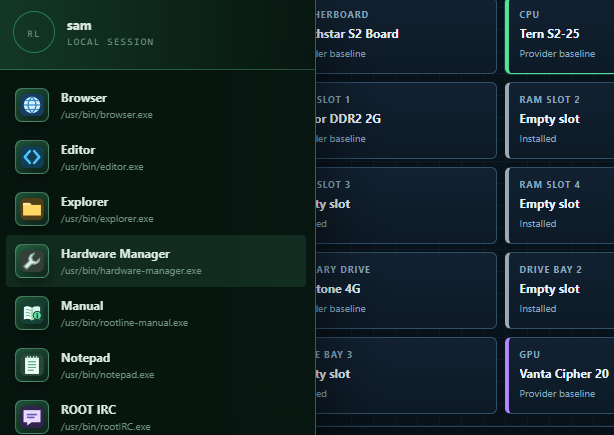
Machine hardware is now a real part of managing your systems. Previously, CPU, memory, storage, and other capacity limits were largely hidden behind the machine itself; players could not inspect, buy, or deliberately change the parts that determined how a system handled demanding work.
Players can now browse the Component Exchange, purchase parts with bank-backed checkout, keep components in a shared inventory, and install them through Hardware Manager or hwctl. Hardware changes are staged before being applied, with compatibility checks for motherboards, CPUs, RAM, drives, and graphics hardware. Applying a new configuration reboots the machine, and replaced or removed components are consumed rather than returned to inventory.
Installed hardware now affects machine capacity, resource pressure, disk space, and command workloads. New tools including lscpu, lsmem, lsblk, lspci, free, df, top, vmstat, uptime, and /proc make it possible to inspect what a machine has and how it is performing. netstat has also been added to identify listening ports and their owning processes.
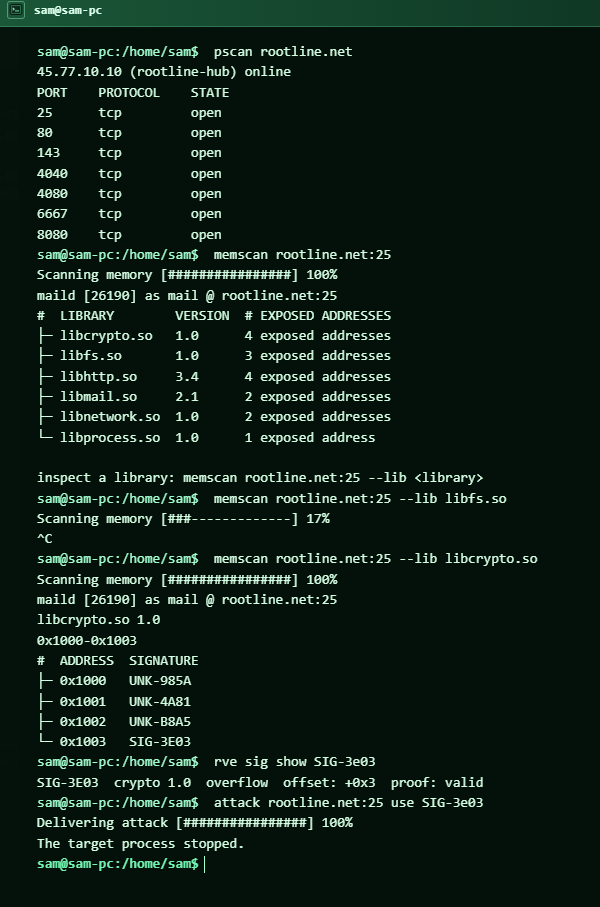
Long-running memscan and attack operations now display live terminal progress and can be interrupted cleanly. This makes resource-intensive reconnaissance and attacks easier to follow, especially when machine hardware affects how quickly work completes.
Exploit research and attacks
RVE signatures can now be used directly with attack use, allowing a proven signature to locate and apply its matching exploit without manually re-entering a memory address. Proven research now retains the exploit offset and, where relevant, the vulnerable file target.
Specific-file extract and overwrite exploits have also been simplified. When the vulnerable service defines its own target, players no longer need to provide that path separately.
DNS and networking
DNS servers can now be configured per network interface, with cached lookup results and DNS-aware whois output. Player-run delegation and official DNS provisioning have been improved, making resolver configuration and trust more consistent across networks.
The included hosting server can now be restored without a new monthly charge when replacing a removed starter server.
System management and reliability
Account and group changes now take effect immediately in active shells. Privileged machine shutdown is now available through the system tools.
Custom libraries are loaded more reliably from player-managed locations, generated organisation identities have been expanded, and remote sessions, long-running terminal input, and command interruption have received reliability improvements.
Checkout flows
Bank and domain purchases now follow clearer review, approval, and completion stages. Players can inspect a payment intent, approve or decline it from their bank session, and then return to complete the merchant checkout.