
TL;DR
Every people can have its own custom: each of the ten kindreds leans toward the traits its homeland breeds and can carry a custom of its own, and every beast kind has a trait that says what it is.
A guided first day: the opening walkthrough helps better guide your first day with you, starting with a shared duty.
Undying: a new founding term. A blow that would kill one of yours leaves a grave wound instead.
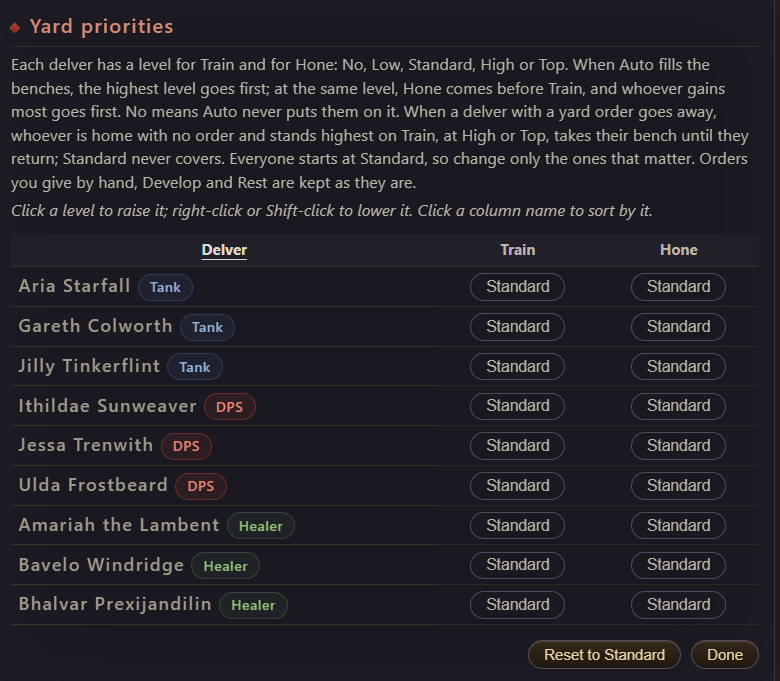
The priorities grid: who is kitted first and who is trained first, calling by calling, on one grid.
Not every body comes home, and the Stillroom grows: foragers, stores for the Stair, and a feast paid from the shelf.
Racial traits
The lean. Each kindred is likelier to roll the ordinary traits its homeland breeds. A dwarf is still anyone, but more often steady than flighty.
Ten customs, one for each kindred, carried by some of that people and never by anyone else: Cold-Tempered (dwarf), Ash-Hardened (tiefling), Keeper of the Scorch (dragonborn), Long-Rooted (elf), Market-Day Friend (halfling), Horn-Called (half-orc), Tally-Keeper (goliath), Bearer of the Fallen (aasimar), Deeps-Taught (gnome) and Crucible-Raised (human). Each answers its own kind of dark: the deep cold, the burning ground, the moor's cursed ground, old friendships and quarrels, the muster horn, the missing, the fallen, the Deeps' traps, the Gatherings.
Every beast carries its kind's trait: the Brute is Hard-Headed, the Troll Bog-Bred, the Drake Gold-Nosed, the Gargoyle Stone-Still, the Stalker Night-Eyed, the Myconid Cave-Grown, the Naga Sun-Warmed, the Thrall Hollow-Willed, and the Hag has the Old Voice. Beasts already in your hall gain theirs when you load.
A born trait says whose it is ("Dwarves only", "Every Troll") on the sheet and in the Compendium. None changes attributes or combat stats; each changes how a kind of place, or a kind of moment, goes for them.
A first game
The guided first day. Set a shared duty from the Archivist's tip, choose the pair in the Guild Hall and read what came of it, then who can go today, the days ahead, the coffers, and how to move time on.
No skipping by accident: on a first game there is no Skip until the last card, and a step that asks you to do something waits for it. Replaying from Settings still offers Skip.
The usual terms. A first founding is offered "Found with the usual terms": name your guild, choose its arms, and go straight to The Signing. Every page is still there to turn back to.
Every screen's intro is up to date, and Trials are explained as they play now: guild against guild. Turning back at the boss room is a draw; before it, a loss.
The league card on the guild screen says what its number means when you hover it.
Founding
Undying, a new term among the Stakes. A blow that would kill one of yours, in a delve, a Trial, a war or at the hall, leaves a grave wound instead, with a long mending ahead. Rival halls still lose their people. It stacks with every other term.
Kit and the yard
The priorities grid, in the style of Oxygen Not Included: who is kitted first (weapon, armour, trinket) and who trains and hones first. Sort by any column, reset a row to Standard. When a bench frees up, the highest on Train at High or Top takes it.
Lock a worn piece with one click beside it on Kit & orders, and the Cache is called Locked everywhere now.
The Armoury says when everyone who could wear a piece already wears better. Training's Away tab clears the orders of those away in one press. Refining never drains a young delver.
Quests and the Stillroom
The quest picker keeps two columns in narrower windows, and can show only Tanks, DPS or Healers. A line under the title says how the party is likely to fare.
Send when rested: hold a quest party until nobody in it is worn out, then send it. Every pair on a quest comes home changed.
Foragers: send one to three delvers from the Stillroom on a three-day run to a realm you choose, for stores.
Lay stores by for the Stair, pay for a feast from the Stillroom, and a bigger shelf: 20, 32 or 44 by level, 60 with the Great Larder.
Delves and fights
The body left behind. About one fallen delver in seven cannot be carried home. A loyal or dutiful delver, kin, or a close friend always brings them home. Left behind means no burial and no cairn, and a later delve into that kind of place may find them.
"Furthest foe" holds its pick until that foe falls. Two blademasters on that order used to turn back and forth and never land a blow.
On the Stair, a wave that stalls breaks the floor, as the Stair has no way back. Those knocked down face the usual risk; those standing walk out.
The fight log adds up to the Dealt total, the Standout breaks a tie on the role-aware score, and the pickers say how long a delver has sat idle.
The Stand has its own switch in Settings.
The hall, the market and the record
Each Guild Hall wing says what it does in numbers, now and at the next level, on a hover. Stars and the rating say what they are wherever they are shown.
A specialist out of contract leaves when the year turns, and you are warned three times first.
The courting price is said where the price is, and the Market's Search shows your division and below by default.
Sales says when the roll is about to close, and an offer a day from lapsing reads Last chance.
The Roster marks who gave up their bed, a delver named in an event shows their hover card, and the Chronicle's History and Legend stay pinned on a long saga.
Translations
Every new line is in all twelve languages.
The Druid is now 德鲁伊 in Chinese. It had been showing as 祭司, a priest, so the Druid was easy to miss.
Thank you to everyone reporting on Discord and Steam this week, and to everyone joining us for Next Fest.