
What is new
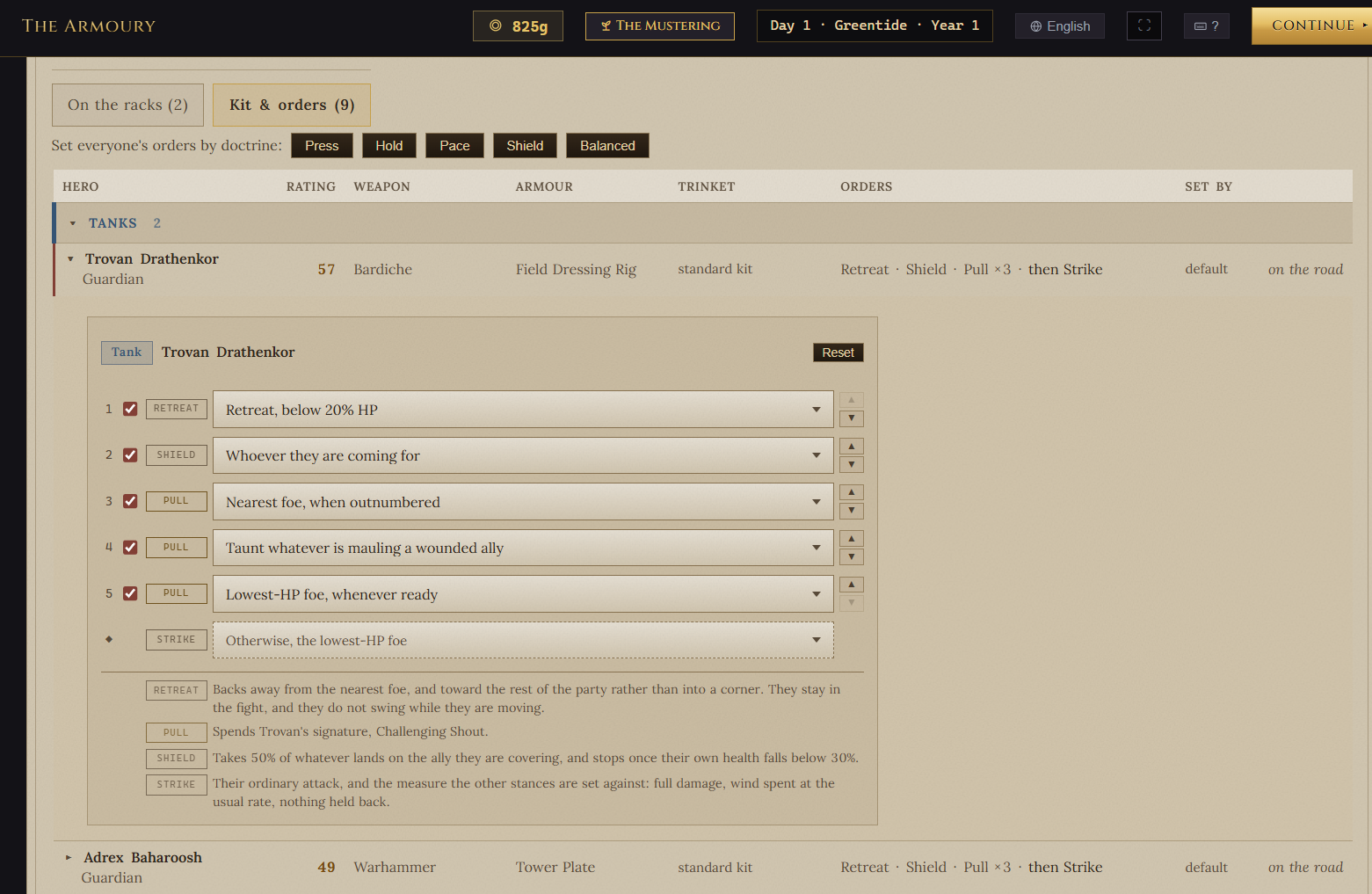
The whole hall's kit and orders on one screen. The Armoury has a Kit & orders tab: every delver a row, their three slots and their orders side by side, changed in place. Racks are grouped by what a piece is. A row of doctrines sets every hero at home to orders built for their own calling in one press, so a Cleric told to hold gets a healer's way of holding. A hero out on the road can now be given orders too; only their kit waits until they are home.
One kit button before a delve. "Kit for this delve" kits the party for the place they are going: it fills what is empty and puts a piece that answers the dungeon's condition ahead of any piece with bigger numbers on it. The Cup and Crucible have the same button, reading "Kit for this tie".
A tank holds the line against another guild. As a fight opens, every tank challenges the rival heroes within earshot, and a challenged hero must answer them for one to three seconds before going back to hunting your healer. A Guardian's or Paladin's shout challenges again during the fight, and a Warden's cleave now reaches as far as the shout. Area blasts are turned as well as blows. Discipline shortens it. Delves against monsters are unchanged.
Missing a fixed date costs a share of your name, not a few flat points. Withdrawing from a Trial or the Crucible takes a thirtieth of your renown, never less than six. Forfeiting a Cup tie takes a hundredth. Passing a Gathering is the lightest. A famous hall now feels a missed date as much as a young one does, and the planner on your Dashboard prints the bill beside each date before you decide.
Holding everyone back from a War is judged. Sending nobody at all costs a tenth of your name, never less than twenty, with the Beacon's charge on top if your brazier stood dark. Sending even one hero answers the call. Separately, a hero with kin in that land who is kept home loses half their heart over it, and costs you a hundredth of your name.
The Cup and the Crucible take any side you can muster, down to a single hero, and the way out is offered on any day.
A short contract when a Trial is close. When the next Trial is four or five days off and nothing on the board would be home in time, the board posts a short one: four rooms at most, three days on the road.
The Tavern Wing is a rumour mill. As well as more names on the recruit board, it buys the realm's talk: scrying a rival's delver costs less, and a full wing reads the whole Buying board for nothing.
Simulate to the boss. The run resolves itself as far as the room before the boss and hands the last room back to you. Your orders still run while you are not watching and heroes can still fall. What you save is the watching.
Selling down past a side is allowed. A sale that would leave you short of a full party names what you would be left with and asks again, then goes through.
A new patron house is of your own kin. A house that takes the guild over is drawn from the same kindred as the one before it.
The rail follows the order of play: Dashboard, Roster, Training, the Armoury, Dungeon, then your Guild, the Guild Hall, Staff and Finances.
A delve card posts its terms in columns: Rooms, Purse, Away, Closes, in the same four places on every card.
The Compendium learns all of it, with eight new entries and nine corrections.
The look, and the words
Every emoji in the game is gone, replaced by 163 hand-drawn ledger marks in the same ink as the page.
Square corners, no drop shadows, nothing that lifts or slides under the cursor. A chosen row is marked in the margin rather than filled. Icons on parchment are inked.
Around forty tooltips cut or shortened, and a tooltip whose words already appear on the thing it sits on no longer opens.
Dark mode reads. The ink is chalk rather than near-white, a delve's condition no longer sinks into the page, and a returning delver's mark on the calendar is legible.
Career stages explain themselves wherever the stage is shown.
Fixes
"Shake on it" did nothing. A sale that would have left the hall short of a full party was refused in silence, with the button still pressable. It warns now, and closes.
A delver out on loan was told the wrong reason they could not be sold.
The Patron's verdict printed English inside every other language.
The odds strip flickered at one scroll position on delve prep.
The Fallen card's crest jumped when a fold was opened.
A Trial would not be entered short-handed. It warns now, and counts the side your tier actually fields.
An elf's epitaph could speak of two hundred years of patience for a hero who had not lived that long.