
RPG companionship has a ritual we all know by now. Agree with someone’s values and their approval rises. Help them deal with the childhood trauma and it rises a great deal. Finish the personal quest and loyalty unlocks. Walk a little farther and perhaps you unlock the hug and kiss, or the fully performance-captured campfire heart-to-heart. Congratulations. You have completed one of videogames’ oldest rites, commonly known as passing the videogame exam for basic human decency.
A character tells you about their past. You stand with them at the crucial moment. You help them take revenge, or persuade them to let it go. On some carefully arranged evening, the relationship is formally acknowledged.
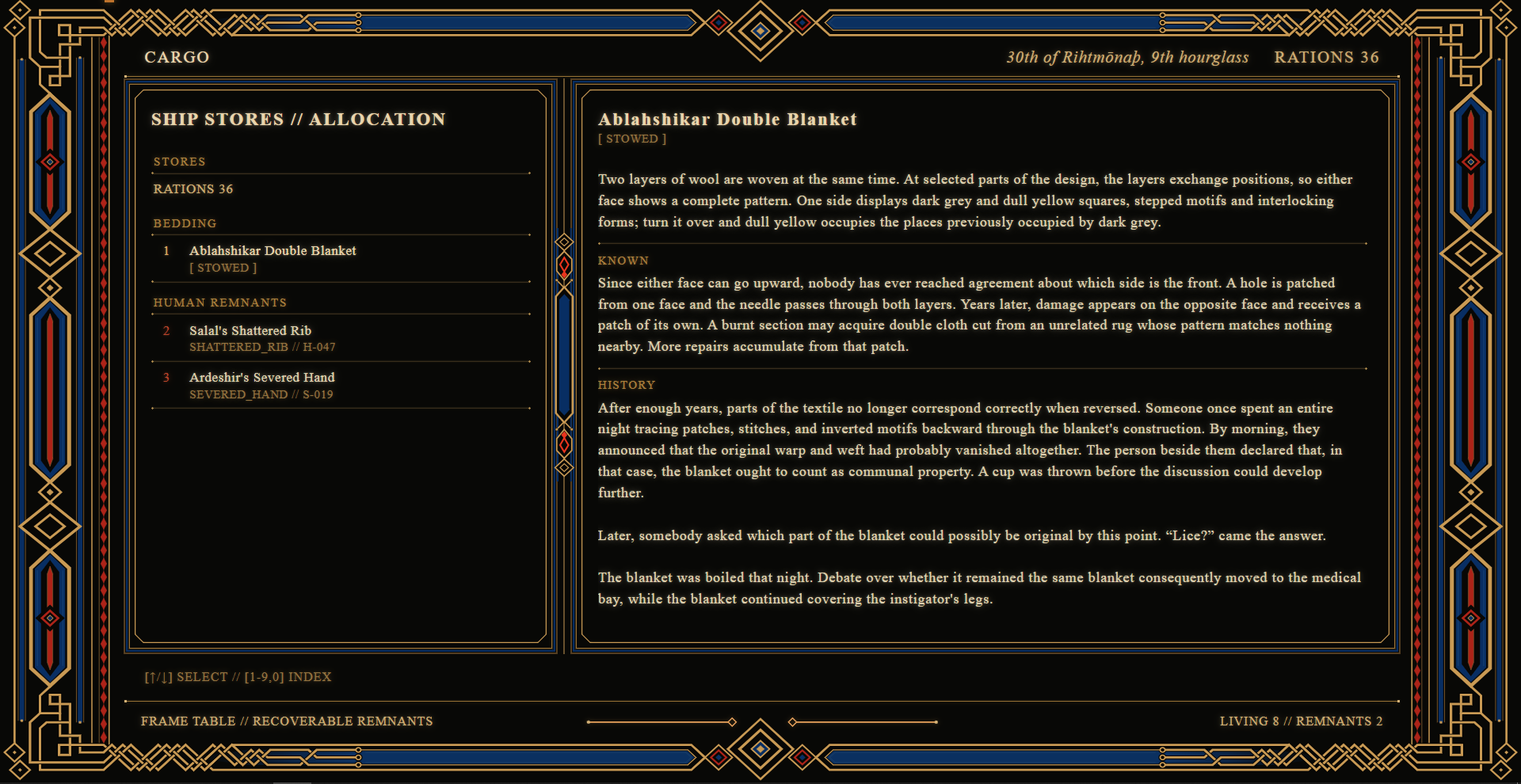
Well, if I absolutely have to place this ship somewhere on the usual map: BioWare likes relationship arcs, Larian likes narrative collisions, Bethesda likes characters judging what you do, Obsidian likes ideological friction. Ablahshikar is most interested in what happens later, when something genuinely goes wrong aboard ship and the person you never formally appointed to any position of authority locks a door and refuses to return the communal blankets. It feels rather like discovering that the roommate you have been feeding for six months has quietly established a local government, because apparently I do not believe human society can be understood without discussing blankets.
For now I shall spare you the details. The best part of the blanket hustle is stumbling into some tiny consequence you had no idea was there. I can only reveal that the author has devoted considerably more thought than the normal safe human dosage to the question of what happens when someone keeps the same cheap household object for a very long time. By rough estimate, I have spent about half the development of this game wrapped in a blanket myself, which may explain why the ship has no reliable labor law yet possesses an unusually advanced bedding culture.
What you think Ablahshikar is
A tasteless roguelike gets drunk and crawls inside a gothic warship. Very funny, until you decide to deal with someone who has mutinied.
What Ablahshikar actually is
Headstrong:
“People believe they shape violence. Violence waited for us all the time...”
Cowardly:
“Wolves don't usually start arguments about whether wolves are better than wolves.”
Arrogant:
“I leave the maze today. You are the one trapped in the gears.”
Sentimental:
“… A terrible cost to keep moving. I gave you my days...”
Fanatic:
“The secret of the world is an endless hunger.”
Numb:
“The revelation is that zero meaning exists. The ocean is forever cold. The flesh fails.”
Disinhibited:
“A creature to build a machine to build another machine...”
If some of this looks familiar, Ablahshikar shares a timeline with Dentata(my grimdark novel, WIP).
Looking at it this way, perhaps the real Steam description should have been:
Ablahshikar is a turn-based ASCII salvage-survival game in which you accidentally develop a centuries-old maritime labor society, watch interpersonal attachment metastasize into constitutional crisis, and eventually receive a seven-part philosophical critique from the employee you are currently preparing to dismantle for spare parts.
Actual tags: Institutional Decay / Maritime Theology / Accidental Intimacy / Blanket Bibliothek / Philosophical Mutiny / Oh Gods He Has The Firing Keys
This probably would not sell many copies, so the store page still says “tear organs direct from rival vessels” and lets you assume the organs are the worst part. The actual volume of the thing is roughly equivalent to stuffing a whaling ship into a matchbox. You only find out by trying it.
Anyway, I am keeping the actual surprises where they belong. Just keep half an eye on it when the game casually mentions something being “a hundred years” old. It usually is not making small talk.
Right. Another matter.
Everyone aboard has a personality except the developer, whose personality is a row of heart emojis pointed at biological hazards.
The source of this particular evil is that, from CRPGs to Paradox games, I refuse to reload outside the initial setup screen. Ablahshikar therefore allows manual saving in port, but no instant save wherever you happen to stand.
Reloading and choosing a different personality option is one of the most ordinary things people do in videogames. If humanity ever acquires time travel, our first use of it will probably be saying the same sentence four different ways to see which result is more interesting.
Yeah. That works rather poorly here.
The ship contains timber, copper, iron, rope, bone, fat, leather and, more importantly, things we still do not quite know what to call. Crew members are, in the strict material sense, also made of several things on that list. So when a crew member can no longer work and the ship happens to be short on those materials, a very obvious thought presents itself. Besides, flesh-powered machinery is common practice from Dentata through Armamentarium. There is precedent.
Utilitarianism began rotating inside my skull at three hundred kilometers per hour, so I made a button.
I do not actually want to kill them. That has very little to do with whether I should finish writing the route that kills them. A bridge engineer does not need to hope the bridge collapses, but should probably know which axle fails first when it does.
Then I ran into a problem I had not expected.
A newly hauled crew member equals x units of recoverable tissue.
A veteran crew member who froze their fingers during the Dastgerd blockade also equals x units of recoverable tissue.
I tested:
CUT FOR SCRAP
Crew:
“I knew you could ask this of me.”
“I hoped you would not.”
Me: cancel. Test again.
“Captain, I am frightened. There. You've extracted it.”
“Disappointing, isn't it?”
Me: cancel. Again.
“I've spent years making sure nobody ever heard me plead. Waste of effort, after all.”
Me: cancel. Different person.
Crew:
“Will you remember which part was mine?”
Me: all right. Testing complete. Everyone go eat.
I checked the conditions. No bug. Then I went to the kitchen and poured myself a glass of water.
I still have to finish the button after getting attached. A bridge engineer does not refuse to calculate load because they have become fond of a particular rivet. Bridge rivets, however, generally do not say, “You haven’t come by in a few days,” when you approach them. This is a deficiency in modern engineering education. And now, shit, I had to go write dialogue for the captain changing their mind.
Utilitarianism left my body at three hundred kilometers per hour.
So I started wondering what kind of player would actually press it.
One possibility is the player who has already pawned everything aboard that could conceivably be sold. The spare gun is gone. The telescope is gone. Instruments have been stripped. Some extremely expensive object that was theoretically meant to survive until the endgame has been exchanged for food. If rope could be boiled, this person would already be considering the cooking time. They may stare at the crew list for a minute, select the most badly injured sailor, explain to themselves that this person probably would not have survived to port anyway.
Someone else will look at it and think: one body keeps fourteen others alive. Fourteen is greater than one.
Well, yes. Except when that “one” has been aboard for a long time, repaired your guns, been bitten by polyps, later decided the polyps were cute, and started coming over for attention because the captain has ignored them for too long. At that point, one becomes an expensive number.
If a gunner who has lived aboard for forty-nine days differs from a sardine cake fresh out of a cargo crate only by yielding two extra units, then the weeks I spent writing injury, fear, habit and that increasingly inconvenient attachment to the captain have mostly amounted to an unusually elaborate way of wasting electricity.
Some players will decide quite seriously that their captain thinks the crew belongs to the ship down to the bones, and will cut when supplies become scarce. Fair enough I have no reason to stop them. Some will have been trained by other games to think, “Surely it will not actually let me do this,” and press the button. Some will hate a particular crew member at the wrong moment. Certain people are remarkably talented at producing labor trouble during emergencies, sometimes immediately after costing you something very expensive. The player opens the Dossier in fury, moves the cursor over them and thinks, all right then, if you are so clever, you are worth twelve units of material now.
I expect most of those players to close the Dossier once the crew member speaks. Some will not.
And then there are streamers, plus the inevitable YouTuber publishing a video titled Can Ablahshikar Be Built Entirely Out of Former Crew?
Several people in chat are typing CUT HIM CUT HIM CUT HIM. The streamer enters the command for entertainment. The crew member says:
“I hoped you would not.”
Half the chat keeps demanding the execution. The other half instantly becomes a human-rights organization. The streamer starts discussing ethics aboard ship and eventually concludes that the author has been alone with one morbid little question for far too fucking long.
Frankly, I am looking forward to this enormously. A very small button has somehow become mass politics. Eventually the ship crawls into harbor looking like a bird with all its feathers plucked off. Fifteen people are alive. The economy is sitting in the corner crying.
So CUT FOR SCRAP may become one of those strange things everyone knows about and everyone talks about. You need the fire axe to exist. You also hope you live your life without having to pick it up and smash through a door.
So why keep it, if the developer is this reluctant to use it?
Because if something cannot genuinely be lost, keeping it does not mean very much.
Or, well, here is what actually happened: I made a pornographically fucked-up command, then gave its potential victims enough of a life, then wrote more dialogue, and eventually made myself unwilling to press my own button. To conceal the mistake, I renamed it emergent emotional investment.
Half of independent development consists of finding a name that lets your weakness stay in the game.
Also known as: you may conduct extremely unpleasant experiments on someone, but after dinner you should make sure they have a blanket.
This ship can accommodate mutiny. It can occasionally bargain with celestial objects that should not exist. Please do not casually touch another person’s blanket. We still have standards.
This is currently the highest achievement of captaincy ethics. The saints would probably be dissatisfied. The crew may also be dissatisfied. Me? I think I have done what I can.
Q: How can you tell whether a game was made by a particular author?
A: If the Dormant-Polyp Filter Sac eventually becomes a flirting prop, the game was made by Samekh. There is really no ambiguity. A normal development route might go industrial filter → medical use. Here it went industrial filter → medical use → living graft → crew gets used to it → crew starts talking to it → captain installs it personally → “Don’t give this part to the surgeon. You do it.” → oh shit.
Q: Why did this become a flirting prop?
A: No idea.
Q: Who wrote it?
A: I did.
Q: Then you should know.
A: Next question.