
This is the first article in a series explaining the core mechanics of reWinWar.
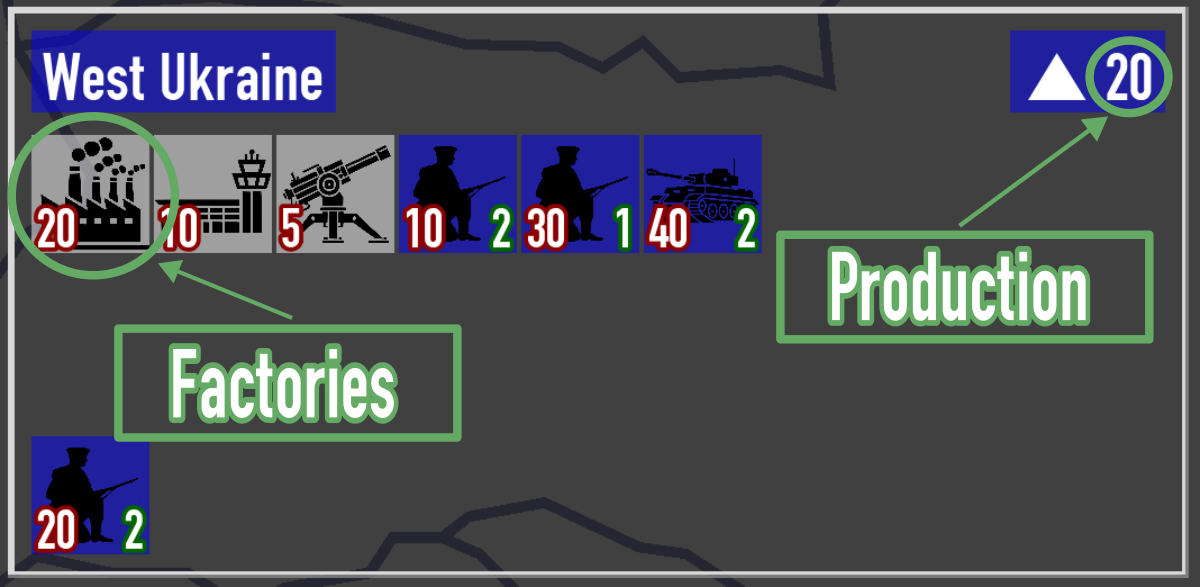
In reWinWar the game world is divided into rectangular-shaped Zones that cover most of that world. Zone's purpose is to hold buildings, military Units and contribute money to the national budget.
Economic-wise the Zone has 2 characteristics: "production" and "Build Points". Production shows the amount of money that Zone provides to the budget every turn. It is a basic characteristic of the Zone that is set at the start of the game and can't be changed (unless I'll add the nuclear bombardment, but it isn't yet decided. But even in that case, there won't be any way to increase the production number)
Of course every Zone (except for oceans and such) belongs to some faction. Player, Enemy or Neutral. Every Zone pays into budget of its owner except for Neutral Zones which try to survive on their own(they have their own budgets and obey the same global economic laws as main factions. No "magically granted" Units for almost burned-down Zone just because "it should make the game more tense").
Build Points determine how much money you can spend in this particular Zone on buildings and Units. Build Points are determined by the number of Factories in the Zone plus a small base value. That base value gives the chance to build-up
even the completely desolate Zones if so the Player wish. Build Points limit how much a Zone can construct Units and buildings per turn, regardless of the available budget. Build Points represent the industrial potential rather than a stockpiled resource. So Build Points are refreshed every turn. Need more Build Points? Build more Factories. That'll cost money and build points though during the current turn.
What are Factories? Factories are just buildings that the Player can build in the Zone to increase the Build Points of that Zone. Factories can be destroyed by enemy bomber airplanes.
All faction's Zones provide money to one unified budget that is a subject to "inflation". To make things more convenient the game does not attempt to simulate real-world inflation. The game will keep the prices constant but impose a small but unpleasant enough budget decrement at the end of the every turn before gathering new money income from the Zones. This "inflation" is expected to encourage players to invest instead of accumulating a massive reserve.
There is no borrowing or state debt mechanics whatsoever. If the Player is out of money, that means no builds anymore for this turn.
The main idea about this approach to economics is to make the game fast-paced.
Every turn you leave money unspent, you lose some of it.
Every turn you delay building Factories, your future construction capacity falls behind.
Every turn you postpone an offensive, the enemy continues conquering Zones, getting more money and production capabilities.
The economy is intentionally simple because the game is about territorial expansion rather than economic optimization. Players are expected to conquer, develop, and keep moving instead of spending turns stockpiling resources or waiting for better opportunities.