
Everything in this diary is work in progress. Numbers, rules and screens may all change before release.
Hey everyone, and welcome to the very first PREEMINENCE dev diary!
Quick intro first, since we haven't said much yet. PREEMINENCE: World on the Brink is a grand strategy game set in today's world:
pick any of the 240 countries on the map, from the great powers to the smallest island states;
the game starts on 1 January 2026 and runs in real time, one day after another;
pause whenever you need to think.
If you've played Victoria or Hearts of Iron, you'll find your bearings fast.
You handle your country's budget and taxes, its laws, its interest rates, its diplomacy and, when it comes to that, its armies. Each diary will dig into one of those parts. We're starting with the one everything else rests on: the economy. Elections, protests, wars: sooner or later, everything comes back to it.
What's under the hood
Every country runs on the same economic model, fed with real data: the World Bank, central banks, academic databases.
Nothing is scripted. No country has its growth written in advance, and there's no "recession in 2028" waiting on a calendar. Only the rules are fixed. The world you get comes out of them, and out of what you and the AI do with them.
The model is built on the kind of tools central banks use to think about policy, adapted to run day by day. It won't tell you the future. It gives you a world that reacts the way economies tend to react.
Two numbers
Each day, the game compares two things for every country:
What it could produce: its workers, its machines and infrastructure, and how productive they are.
What it actually sells: what households, firms and the state spend.
When spending runs ahead, unemployment falls, wages rise and prices follow. When it falls behind, factories slow down, unemployment climbs and a recession is on its way.
The catch is that the two don't move at the same speed. A tax cut, a spending boost or a rate cut moves demand within months. What the country can produce moves over years: capital piles up slowly, and poorer countries catch up with the richest only step by step.
Quick fixes are easy. Lasting growth isn't.
Interest rates and credibility
AI central banks follow a rule, like real ones: raise rates when inflation runs hot, cut them when the economy stalls. In your country, you set the rate yourself.
What makes it tricky is that inflation runs on memory. People remember the inflation they've lived through and set their prices and wages accordingly.
As long as they trust your central bank, a price shock comes and goes.
Miss your target for too long and they stop believing you: from then on every shock sticks, and bringing inflation back down costs a lot more.
And the higher inflation climbs, the more sharply prices react to an overheating economy.
The long game
Institutions matter too. Each country has a rule of law score, from the World Bank's governance indicators. Let it erode (some governments will) and you lose about 2% of potential output for every ten points lost. Not right away: it takes a generation to show.
Surprises
Every day, every country also gets its share of the unexpected: demand shocks, price shocks, and some shocks the whole world shares. Their size is measured on each country's own history, so a steady economy stays mostly steady and a volatile one keeps you on your toes.
A quick test
To check that the model holds up, we run stress tests. Here's one:
Lock France's interest rate at 10% from day one, never touch it again, and let the game run.
2027: borrowing costs too much, spending dries up, and France goes into recession. Unemployment starts to climb.
2028: fewer taxes come in and the state borrows at higher rates, so the debt snowballs, from 116% of GDP to over 140%. A second recession hits, and the risk of default passes 8% a year.
May 2029: with debt at 150% of GDP, markets lose their nerve. France defaults, and 37% of what it owes is wiped out. That's the average haircut across 180 real sovereign debt restructurings since 1970.
Then the government fell. That part wasn't certain: in the game, a default brings the government down one time in two, because that's roughly what history shows. France lost the coin flip. And if that government is yours, the game is over.
Even then, the pain isn't finished. Shut out of the markets, the state can't spend more than it collects. A year later, unemployment peaks at 9.5%, against 6.9% for the same France left alone.
For now, every eurozone country has its own central bank in the game. Yes, we know.
The test, in two charts
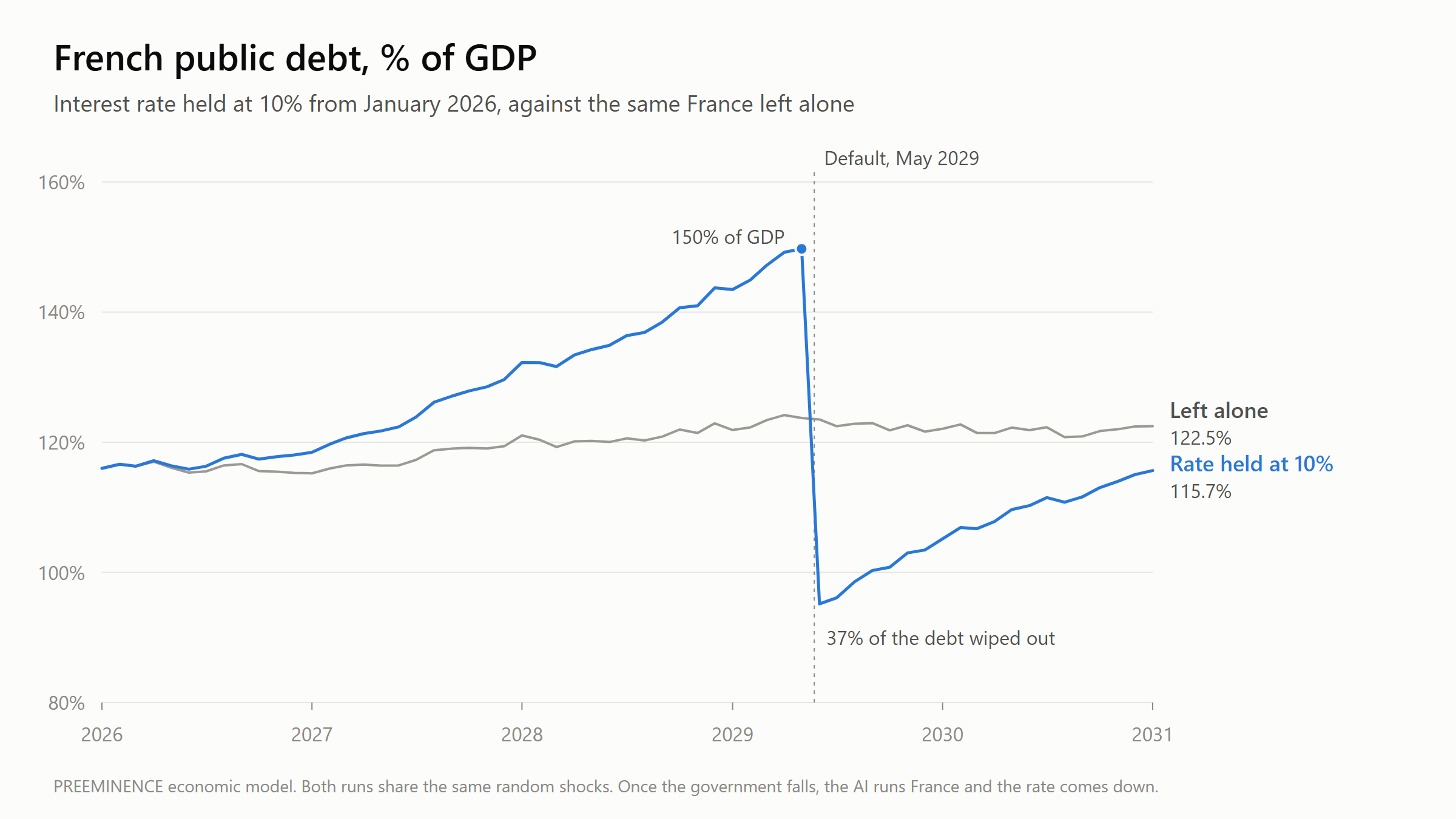 Public debt. In blue, France with its rate held at 10%. In grey, the same France left alone, hit by exactly the same random shocks. The debt climbs from 116% to 150% of GDP in three years, then the default wipes out more than a third of it overnight. And it starts climbing again straight away: the economy keeps weakening, and what's left of the debt costs more to roll over.
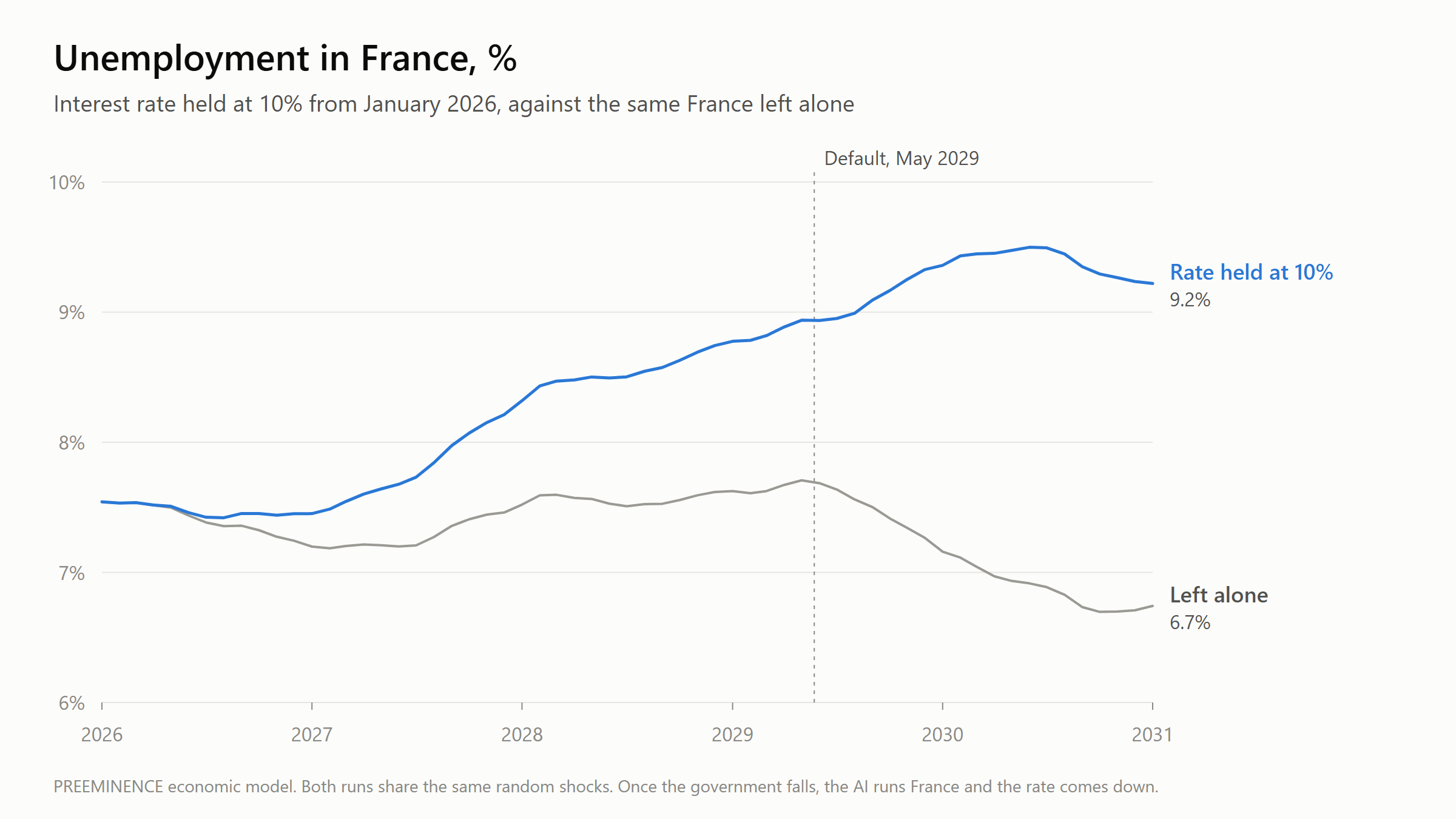 Unemployment. The gap opens slowly at first: barely more than a point after three years. It's after the default that it really widens, up to 9.5% in mid-2030 against 6.9% for France left alone. By then the AI is running France and cutting rates, which is why the blue line finally turns down.
Next time: the interface
Dev Diary #2 will cover the interface: the map, the screens, and how we're trying to fit a whole country's worth of decisions on one screen without drowning you in numbers.
Everything we only brushed past today (taxes, the budget, debt, tariffs, investment) will get its own diary after that.
Want to go deeper?
Everything we talked about today, and much more, is documented publicly: every equation, its sources, and a line on what it simplifies. If you think something's wrong, tell us. We'd love to argue about it.
Read the PREEMINENCE model documentation
Early access is planned for Q1 2027. If you haven't yet, adding the game to your wishlist helps us a lot.
Thanks for reading! Which country would you pick first, and what's the first thing you'd do? Tell us in the comments.
— Clément
As always, everything here is work in progress and subject to change.