
Hi everyone! I'm the solo developer behind Immortal Gambit.
Recently, I've been rebuilding the game's Steam store page and putting together a new gameplay trailer.
At this point, the first complete core loop of Immortal Gambit is playable from start to finish:
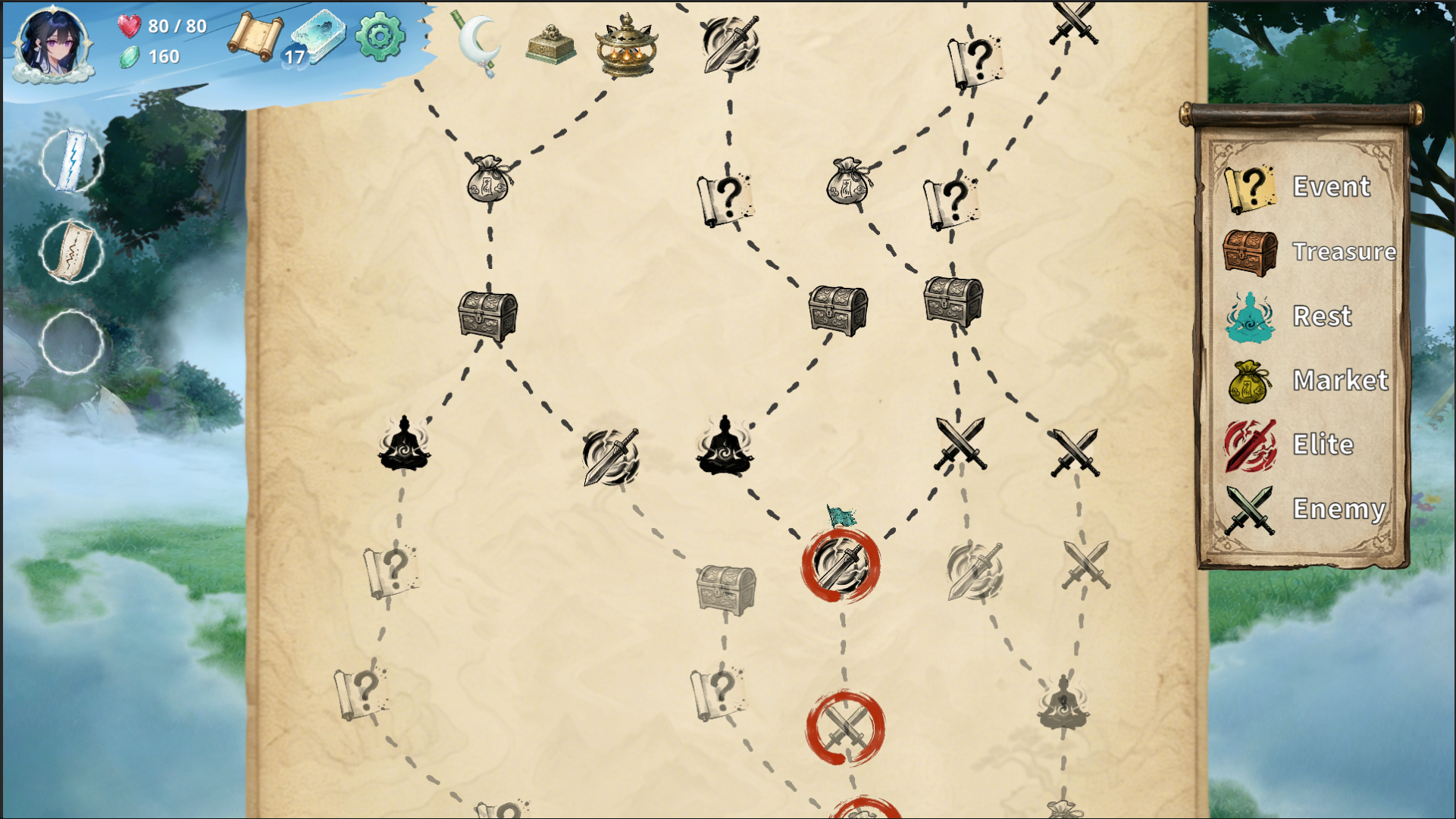
Choose a route → Fight → Gain new cards → Build your deck → Encounter opportunities → Find treasures → Challenge the Boss.
That said, the game is still at a fairly early stage of development.
Most of the current content is concentrated in Stage One, and for now, Yun Qingyao's Water Path is the main Cultivation Path represented in the game.
Many of the systems that I ultimately want to define Immortal Gambit's own identity have not yet made it into the playable build.
So the version you see today is better described as this:
The foundation is in place. The cultivation system that I want to make uniquely Immortal Gambit is only beginning to take shape.
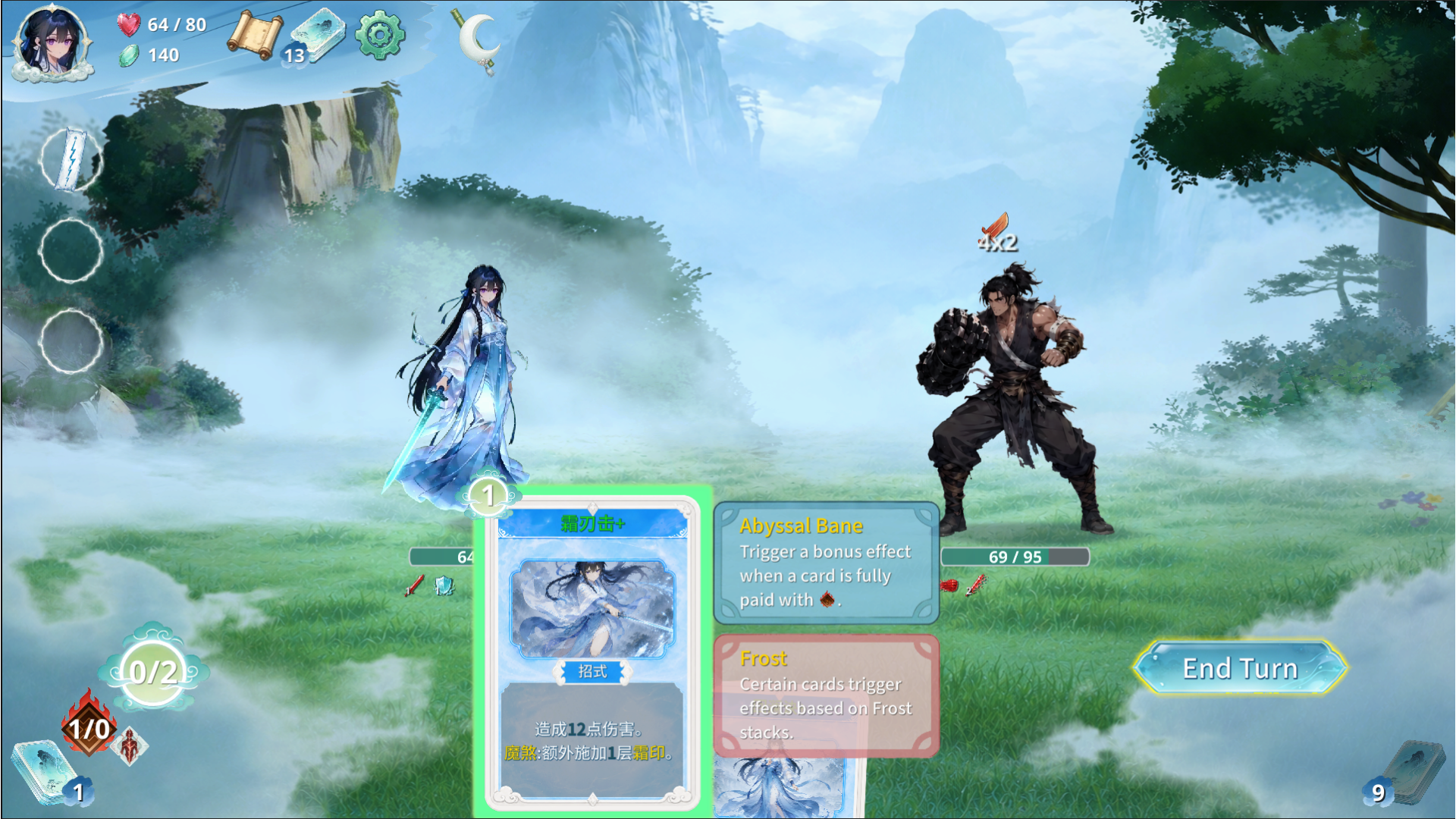
Spirit, Bane, and Refine Bane
One of the game's core systems already in place is the trade-off between Spirit and Bane.
When Spirit runs short, you can choose to Refine Bane, giving yourself more room to play cards right now.
But that power is not free.
Refining Bane leaves behind Residual Bane, turning the power you gain now into a price you will have to deal with in later turns.
I don't want Refine Bane to remain simply a button you press when you run out of resources.
I want it to grow into one of the central axes of deckbuilding:
Do you avoid Residual Bane, remove it as efficiently as possible, or deliberately build around it and turn that cost into an advantage?
Different characters are also planned to develop very different ways of dealing with Residual Bane.
The Three Most Important Directions Ahead
1. Multi-Path Cultivation — What Will You Cultivate This Run?
At the moment, Yun Qingyao primarily builds around the Water Path.
But in the full design, characters will not remain locked to the Cultivation Path they begin with.
The game is planned around ten Cultivation Paths:
Metal, Wood, Water, Fire, Earth, Sword, Body, Qi, Formation, and Divine Sense.
As a run progresses, you will have opportunities to branch into additional Paths.
For example, Yun Qingyao may begin with Water, then choose to cultivate Wood or Sword later in the run. As her cultivation advances further, she may eventually gain access to a third Path.
Characters will not have access to exactly the same Paths, either.
Under the current character design, for example, Yun Qingyao cannot cultivate the Fire Path.
Ultimately, I don't want a run to be remembered only as:
“These were the cards I happened to pick.”
I want it to feel more like:
“What kind of cultivation path did I ultimately walk in this life?”
2. Realm Breakthroughs — More Than Simply Entering the Next Stage
Each stage of Immortal Gambit also represents progress through a cultivation realm.
After defeating a stage Boss, the player will undergo a Realm Breakthrough.
The current design goal is for the rewards from these breakthroughs to directly reshape the way you play and build your deck, rather than simply increasing your numbers.
For example:
One breakthrough effect might reward a playstyle that avoids generating Residual Bane throughout combat, strengthening your Spirit economy in return.
Another might deliberately weaken Spirit recovery while pushing the player deeper into a Bane-focused build.
I want every breakthrough to make your build more defined:
Not simply stronger, but increasingly clear about what kind of cultivator you are becoming.
3. Making Cultivation Paths, Residual Bane, and Treasures Work Together
There are also plans for many more Treasures and build components centered around:
Residual Bane, pure-Spirit builds, Bane, and the different Cultivation Paths.
The goal is not for these systems to exist independently.
I want them to gradually feed into one another.
The Paths you cultivate should affect the kinds of builds that become possible.
The way you use Refine Bane and manage Residual Bane should influence which Treasures are truly valuable to your run.
Realm Breakthroughs should then push the direction you have already established even further.
Ultimately, I want a run to gradually form a complete chain of decisions:
Choose what to cultivate → Decide how to use your power → Accept the cost that comes with it → Break through and commit further to your chosen path.
Ideas Still in Development
Some systems are still in the design and validation stage, so I don't want to present them as firm promises yet.
One idea I'm currently exploring is Dual-Path cards.
These could be special cards that only become available once you have cultivated two particular Paths—or once your build meets certain requirements related to both.
I don't want these to end up as nothing more than “rare cards that require two tags.”
The goal would be for combining Cultivation Paths itself to unlock genuinely new ways to build and play.
This part is still being worked out.
A Cultivation Journey That Remembers Your Choices
Because only Stage One currently exists, it is still difficult to show what I ultimately want the event system to become.
As Stages Two and Three are added, I want to introduce longer chains of connected events.
Some choices made earlier in a run may affect things such as:
Righteous/Demonic alignment, Beast Affinity, and relationships with different factions.
Not every decision will pay off immediately.
Some consequences may only return much later in another event—or even in a later stage.
I don't want events to feel like isolated random choices.
I want a run to leave behind a history that belongs to that particular cultivation journey.
Bosses Will Change as Your Cultivation Deepens
Future Bosses are also intended to be more than enemies with higher health and damage.
Under the current plan:
The Stage Two Boss will revolve around the “Nascent Soul Heart Demon.”
The Stage Three Boss will be the “Phantom of the Dao Ancestor.”
I want these fights to differ not only visually and thematically, but also to interact with the kinds of builds and cultivation choices players have made by that point.
The goal is to create Boss encounters that actually feel like milestones in a cultivation journey.
On Being a Slay-the-Spire-like, and What I Want Immortal Gambit to Become
The basic combat framework of Immortal Gambit is clearly influenced by Slay the Spire and other deckbuilding roguelikes.
I'm not trying to hide that.
But the more important work ahead is turning the systems that currently exist mostly in design into parts of the actual game:
Multi-Path cultivation, Realm Breakthroughs, different ways of dealing with Refine Bane and Residual Bane, interconnected Treasures and builds, events with long-term consequences, and Bosses rooted in the xianxia world.
Ultimately, I don't want Immortal Gambit to be remembered simply because it resembles another game.
I'd like players to eventually think of it as:
“That xianxia deckbuilding roguelike where you choose your Cultivation Paths, borrow power through Bane, and break through realm after realm.”
That's the direction I'll be working toward for a long time to come.
The First Playtest
I'm currently preparing the first player playtest for Immortal Gambit.
This test will not represent the final scope or completeness of the game's systems and content.
Its main purpose is to validate the foundation that already exists:
Is the core combat loop smooth and enjoyable?
Do Spirit / Bane / Refine Bane create meaningful decisions?
Does deckbuilding begin to develop interesting directions?
Is the UI and combat information clear?
Which parts are already beginning to feel like Immortal Gambit, and which still need much more work?
Once the test is ready, I'll post the next update here in the Steam Community.
If you decide to take part, I genuinely want to hear what you think.
Whether something feels fun, awkward, confusing, too similar to another game—or simply not fun—I want to know.
Thank you for following Immortal Gambit.
There is still a long road ahead.
Back to cultivating.