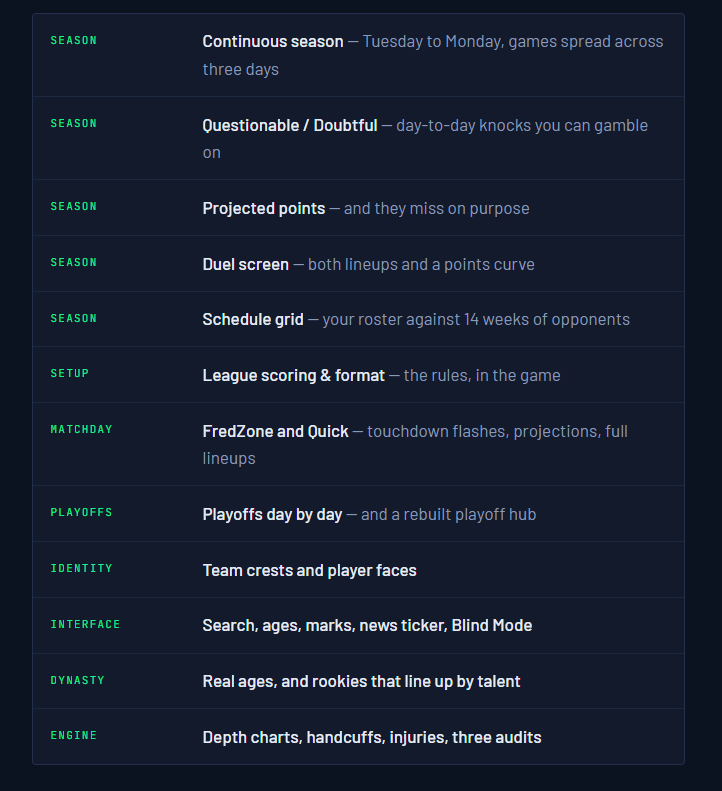
Hi everyone! Major changes have been introduced to the game in version 0.7. Below is a detailed breakdown of all the changes, which will significantly impact gameplay and game progression. Please keep in mind that there may be bugs that need fixing, so if you notice anything unusual, please report it in the community forum. ;-)
The continuous season
A fantasy week used to be a single moment: set your lineup, press the button, read the result. Now it is seven days. The week runs Tuesday to Monday, the real games are spread across Thursday (1), Sunday and Monday (2), and your duel is not settled until the last Monday whistle.
The day is the unit. The hub header reads “Week 4 · Tuesday”, and the main button changes with it: Go to Wednesday, or Play Thursday Night Football (1 game).
A DAY column in every roster table — lineup, bench, free agency, trades, opponent rosters — says which day each player's team plays: THU, SUN, MON, or a dash if they are on bye. It glows if the game is today and dims once it has been played.
Live scores everywhere. Under your opponent's name the duel updates as players finish (“Live: 6.0 – 0.0, 1 of 9 played”), and the Live results panel does the same for the whole league.
Kickoff lock. Once a player's real game starts he is frozen where he is — starter or bench — for the rest of the week. He cannot be swapped, cut or traded. It is the real fantasy rule, and it is what keeps three days of points from colliding.
The market slows down. Accepted trades land the next morning; CPU teams only work the market on Tuesdays and Saturdays. Waivers stay weekly — by the day they would mean nothing.
None of this is compulsory. Fast weeks in league setup restores the old behaviour exactly: one admin moment, one click, the whole week at once.
Questionable & Doubtful
A second, lighter injury system that only exists in the continuous season. These are knocks, not spells on the sidelines: a tagged player can start. That is the whole point — it is a bet.
Projected points
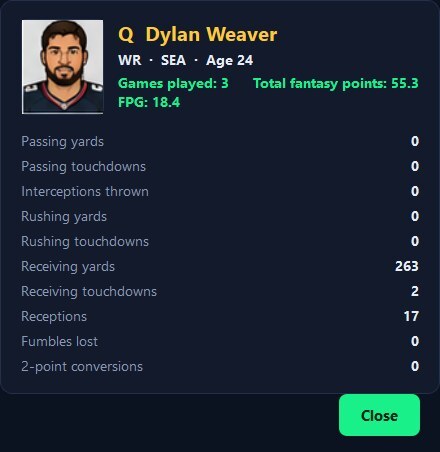
A PRJ column now sits next to every player in your lineup and bench, and under both totals on matchday. It is not a historical average and not a simulation run a thousand times: it is the analytic expected value of the very simulation that plays the week.
It reads the same things you would: the player's attributes, his opponent that week measured channel by channel, where he sits on his team's depth chart, how touchdowns get shared with his team-mates, and whether his quarterback is fit. If the man ahead of him goes down, the number moves on its own.
The duel screen
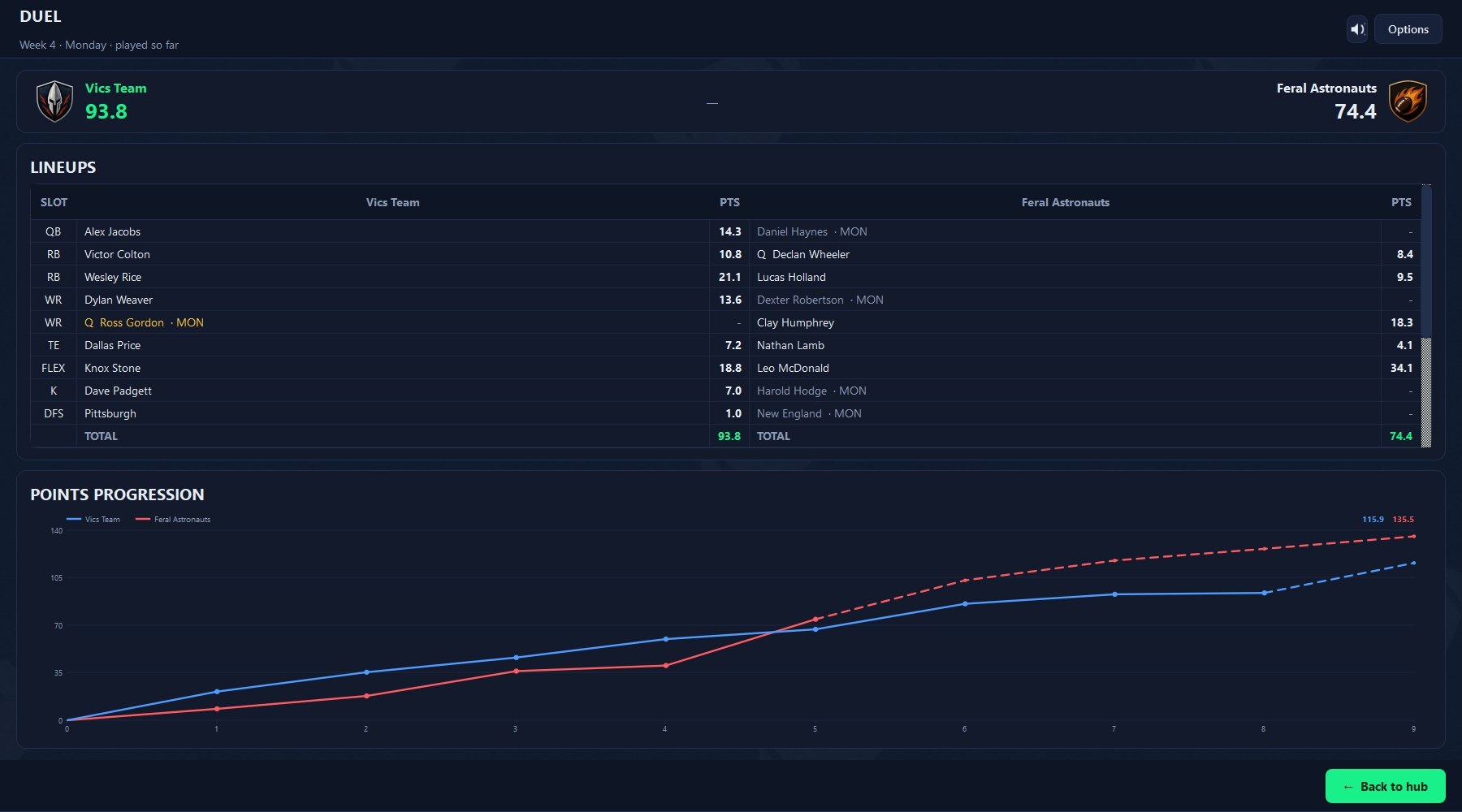
Every matchup in the hub now carries a View duel link, and behind it is a screen dedicated to your week: both lineups head to head, all fifteen players a side, points landing as the games finish.
Duel screen on Monday with both lineups scored and a points progression chart.
Monday, one game left. The chart draws each team's running total in the order their players actually play — solid for what has happened, dashed for what the projection still expects.
Players who have not played yet are dimmed and say why: their injury, BYE, or the day they are on.
The bench is there too, under a divider. It scores nothing, but it is half the story of a week.
The curve starts the week as a pure forecast and turns into a result as the games land. The point where solid becomes dashed is that team's “right now”.
Rookies line up by talent
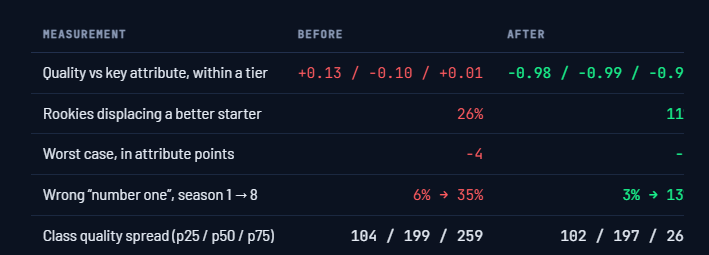
In a dynasty, a player's quality decides where he sits on his real team's depth chart — and the depth chart decides who plays. A rookie's quality used to be drawn independently from his attributes, which meant the wrong man could take the job.
The handcuff finally pays
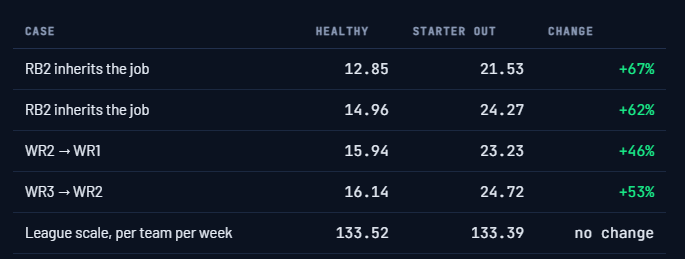
When a starter goes down the backup was already promoted, but the promotion barely moved his output: a second running back inheriting the job gained 32%, a second receiver 15%. The man who inherits a starting job now gets a real usage boost, applied to both his volume and his share of touchdowns.