
1,000 Wishlists!!!
Argosy hit 1,000 wishlists this week!!
For a game that hasn't been announced with any fanfare, has no trailer yet, and is still in early playtesting, that number means a lot. Every one of those is someone who found the game, read what it was about, and decided they wanted to know more. Thank you - genuinely. It's a small milestone in the grand scheme of things, but it's the first one, and it felt worth saying out loud. If you've been following along and haven't wishlisted yet, it helps more than you might think.
First Town View assets
The Town View rebuild has been talked about in previous posts. This week there's something to actually show.
The first two custom building assets are done: the Town Hall and the Market Hall. Below are timelapse videos of both being created from scratch. Watching a medieval merchant building come together out of nothing is, I'll admit, more satisfying than I expected.
These are the first of what will eventually be a full set of hand-crafted buildings replacing the current static Town View. There's a long way to go, but the style is locked in and the pace is picking up.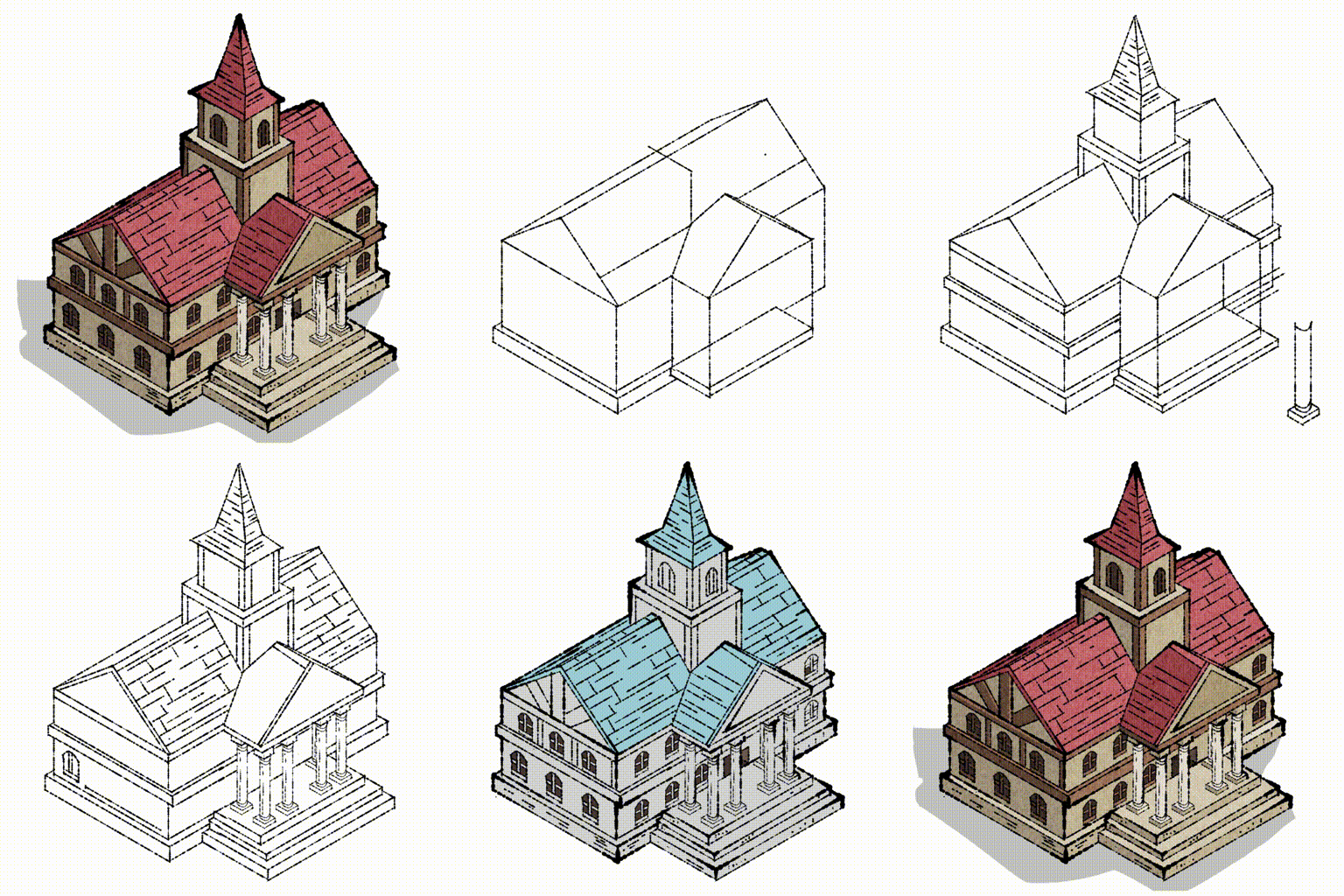

Another dense week on the development side too. The headline additions are a full tech tree, a proper interactive tutorial, famine finally being reachable in the economy, and a new in-game newspaper. Let's get into it.
The Tech Tree
Research is now in the game in full.
Rather than a fixed unlock tree you work through in order, Argosy uses an opportunity-driven system. Research projects appear when conditions are right - the right buildings, the right standing, the right moment. A Scholar arrives in town and offers to investigate something. You fund the work, roll progress over time, and eventually unlock an effect that improves your trading, production, shipbuilding, or legal position.
There's a Research window to track what's active and what's been completed. Projects sync in multiplayer. Funding a project that's hit a setback can boost it back into viability. Neglect an active project for too long and its viability drains until it auto-abandons - you can't just queue everything and wait.
Completing research earns global reputation scaled to the project's base cost, with the boost decaying by distance from your research city. Being known as a patron of learning does reach the far end of the map, just faintly.
Scholars are rarer now and base costs are higher, particularly at the upper tiers. Research is meant to be a meaningful commitment, not a background tap-to-upgrade system. Research access has also moved from the Trading Office to the Guild building, which now requires a Trading Office in the city for membership. The Guild window has been rebuilt to reflect this, focusing on the exclusive services it actually provides. 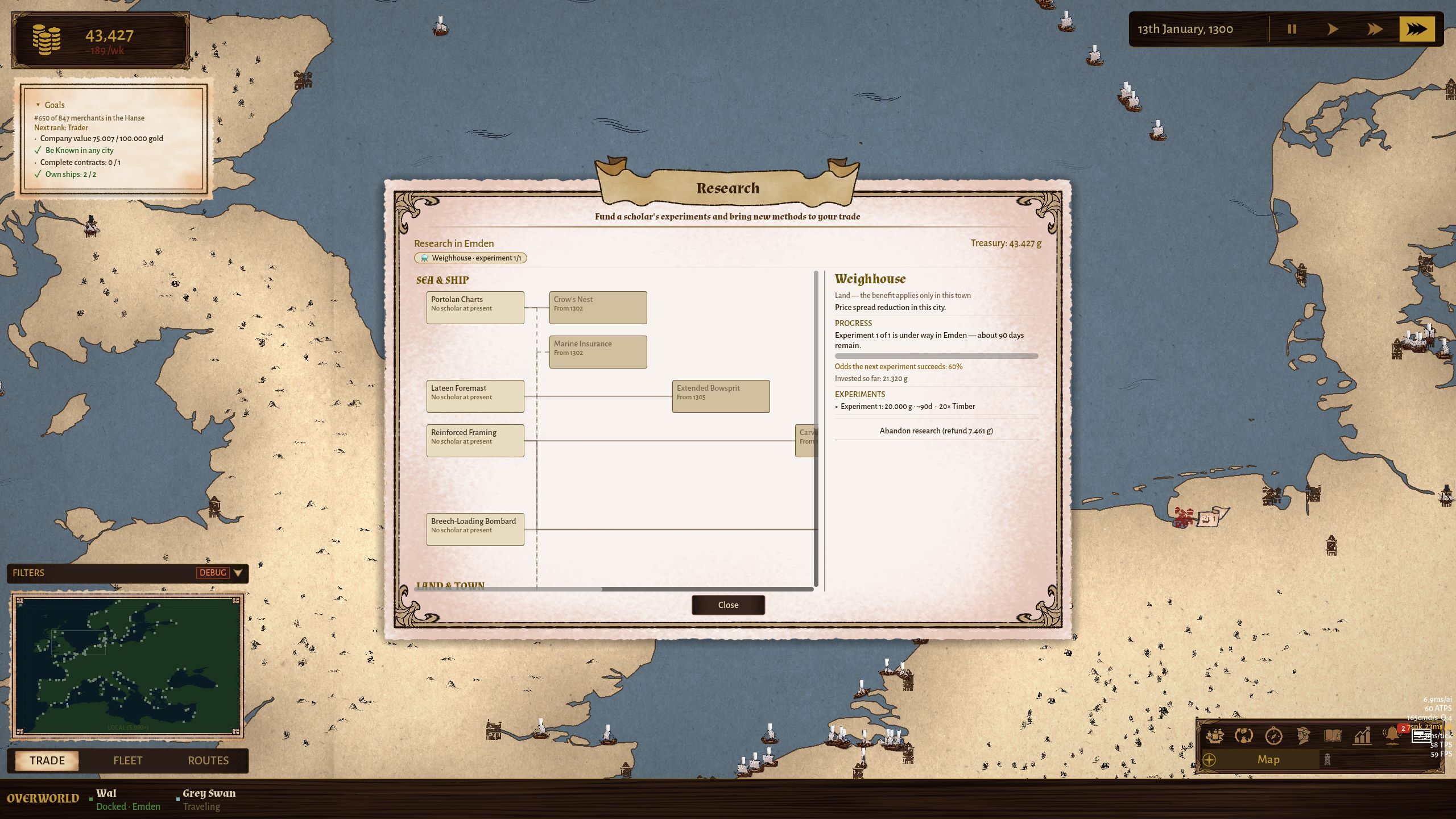
The Merchant's Gazette
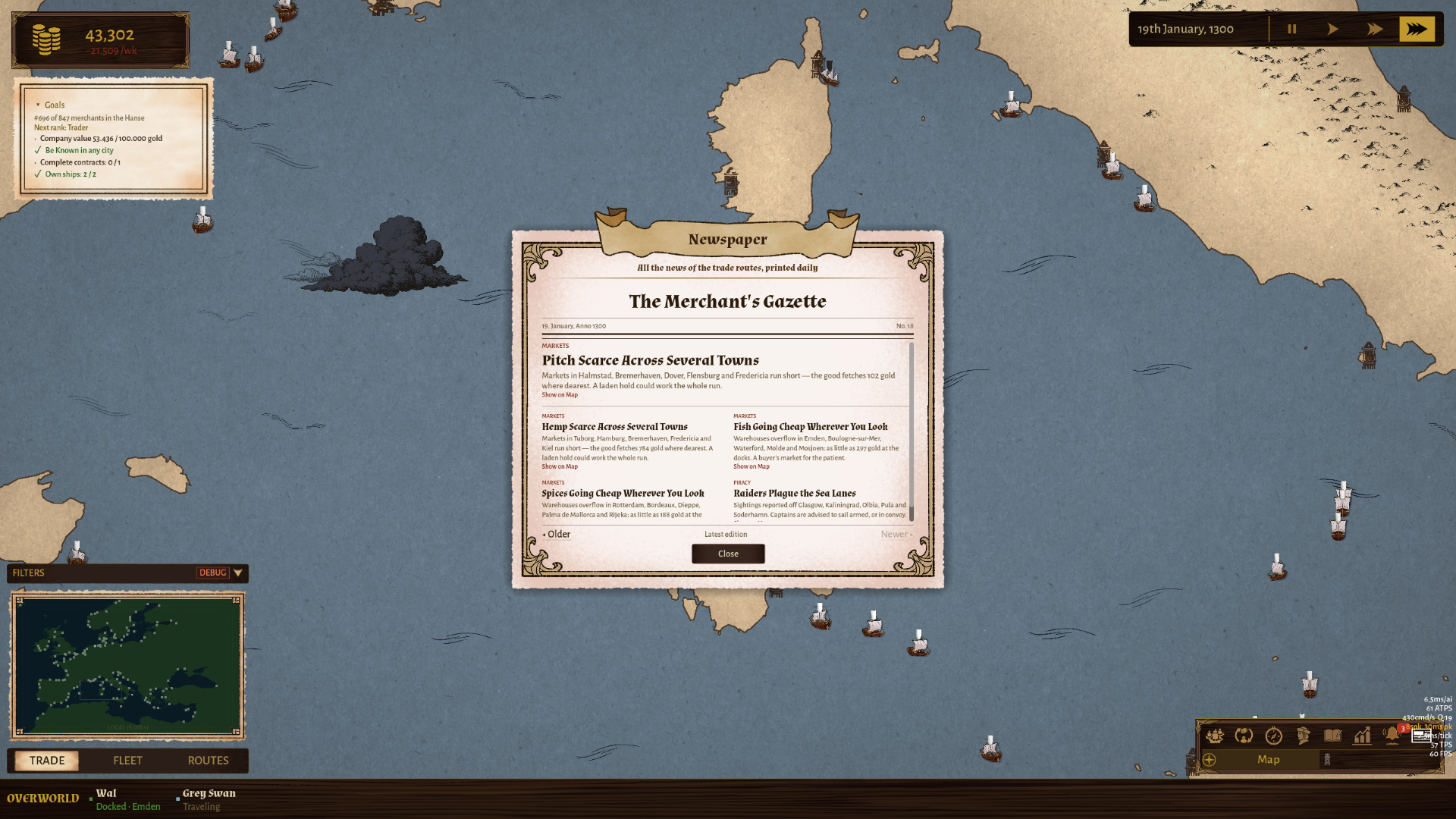
The in-game newspaper has a new name. The Baltic Courier has become The Merchant's Gazette, with broader regional appeal and a tightened news radius so the stories you read are actually relevant to where you're trading. A broadsheet layout groups stories by type, and reader-relevant content (your ships, your rivals, your cities) surfaces more reliably.
Famine
Cities can now starve... better(?)
The starvation counter that was always in the design has been fully wired up. A new blight harvest tier sits below the existing bad harvest, introducing genuine food crises: typically one to three towns flaring at a time, with recovery possible but not guaranteed without intervention. If you're sitting on a grain surplus when word reaches you, that's your moment.
This ties into the broader economy work from last week. With rationing, regional price gradients, and now actual famine risk, the market has real stakes in a way it didn't before.
The Interactive Tutorial
This was a HIGHLY requested feature from early play-tests.
The basic tutorial has been completely rebuilt and drastically expanded as a chapter-based experience with its own scripted game world. Chapters cover trading, production, law, map editing, and piracy and combat. Each one is scripted to a safe starting state so the blockers that plagued the old system can't happen: no missing ship captain, no empty factory, no Courthouse that appears before you have a home city. The Tutorial button now sits on the root main menu rather than being buried in options.
This was a significant piece of work, and it matters a lot for first impressions. A game with this many interlocking systems needs a tutorial that earns trust rather than creating confusion.
New Game overhaul
The new game screen has been rebuilt around five persona start cards - distinct starting situations with different ships, gold, standing, and context. Each one has a name, a difficulty badge, and a brief description. You select a card, confirm, choose your hometown, and start. Map selection now includes a paper-chart preview.
Opening scenarios offer self-contained starting situations for single-player games: a structured early game with clear context for why you're in this port with this ship, rather than a blank slate. 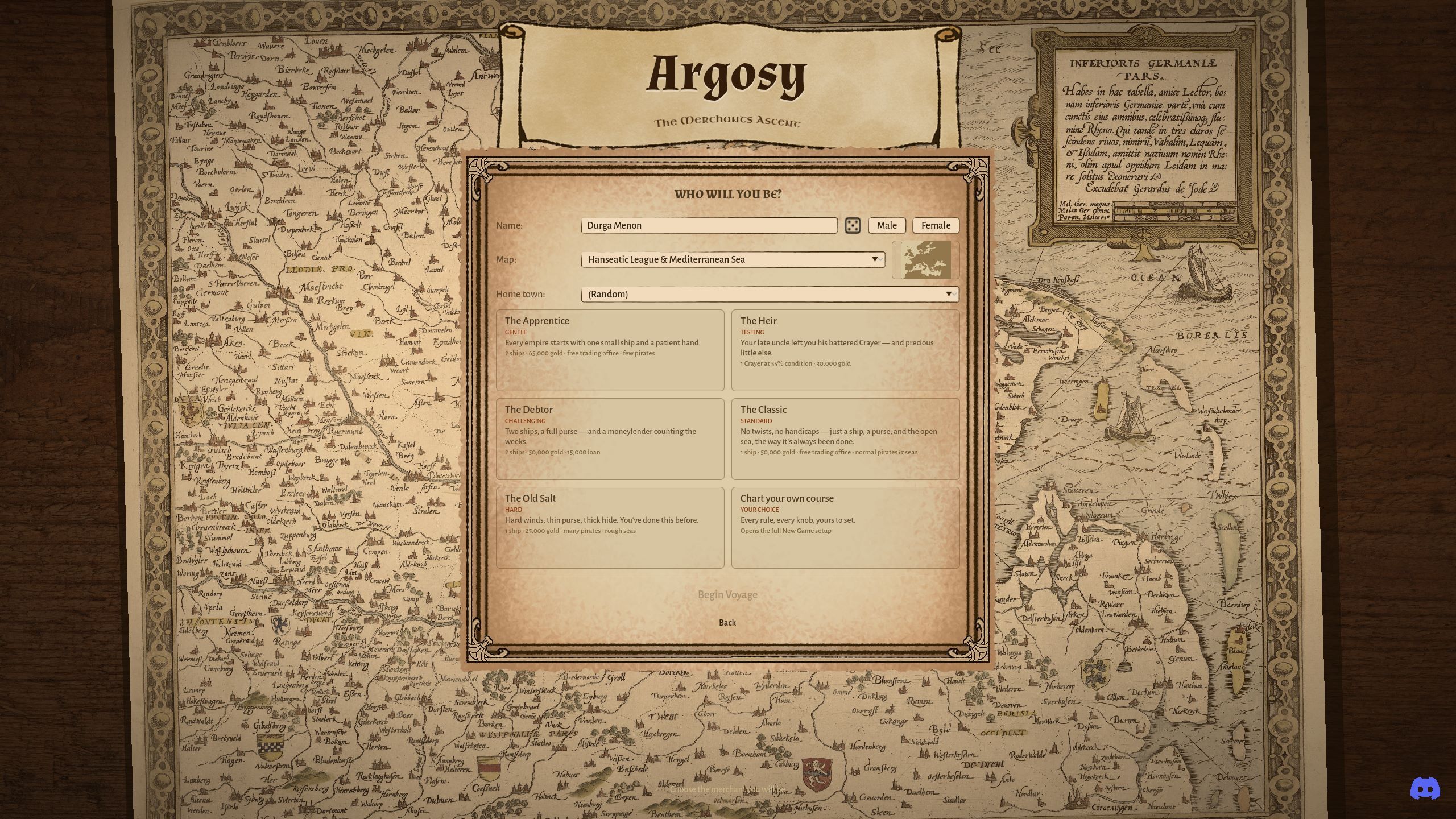
Used ship market
Second-hand ship listings are now stateful. Each listing has an explicit two to four week expiry and rotates out automatically even if you never visit. New listings spawn weekly at a 35% chance per city with a Shipyard. The berth section hides itself when empty rather than showing a "No listings" placeholder.
Used ships now also carry a condition ceiling. A second-hand hull can never be restored to factory-new status regardless of how much gold you pour into repairs. The gap between new and used is now a real trade-off rather than a question of patience.
Other fixes and improvements
Factory goods no longer show as free. Output goods were displaying a price of 0g in the trade menu. Fixed.
Wine over-supply resolved. Consumer towns without a local producer were defaulting to a buy target that caused wine to accumulate without bound. They now correctly default to a non-producer target.
Number formatting now matches your OS locale. Thousands separators and decimal characters now display correctly per region rather than using a hardcoded format that was wrong for much of the world.
Pirates are no longer visible on the map while docked at their hideout. They now correctly stay hidden until they're at sea.
AI merchants now survive longer. Loss-selling now triggers after 60 days of failed cargo rather than immediately, financial retrenchment scales to rank rather than using a flat threshold, and trade throttles have been reviewed across the board.
Regional heads and grand factors can now defend their mayor seat in elections. A loophole previously prevented them from standing as incumbents.
All LINQ removed from engine hot paths. Not glamorous, but this kind of allocation pressure degrades performance on busy maps. It's gone.
Trade window supply column split into two signals. Stock level and price direction were sharing one ambiguous cell. They're now separate: pip icons for stock level, colour for price direction.
Discord
Playtest access, early screenshots, and the fastest route to having your feedback reach the build.
discord.gg/CUSVEaEH2f
More next Friday.