
Perihelion: Rogue Orbit is a game about fitting a ship, flying it badly, realizing the problem was you, and then flying it better.
I want Perihelion to require skill. Not only reaction times and coordination, but spatial thinking and positioning. I want the fitting screen to make promises, and the arena to test whether you know how to keep those promises under pressure.
This is why Perihelion has transversal - the sideways motion that decides whether your guns can track you're target.
The first time I experienced transversal in a game was playing EVE Online. I slapped the biggest artillery I could find on my Cyclone (because bigger alpha was obviously better, right?), undocked, found some belt rats, started shooting, and sat there confused and frustrated by how my guns barely made a dent.
Nothing was broken. I just had no idea what was going on.
As I experimented, the frustration turned into satisfaction. Each fit played differently. You couldn't just fire and forget.
For EVE's pace, the experimentation works. For Perihelion, not so much. Each run lasts 10-20 minutes so the player needs to start building intuition from the first run.
Transversal explained
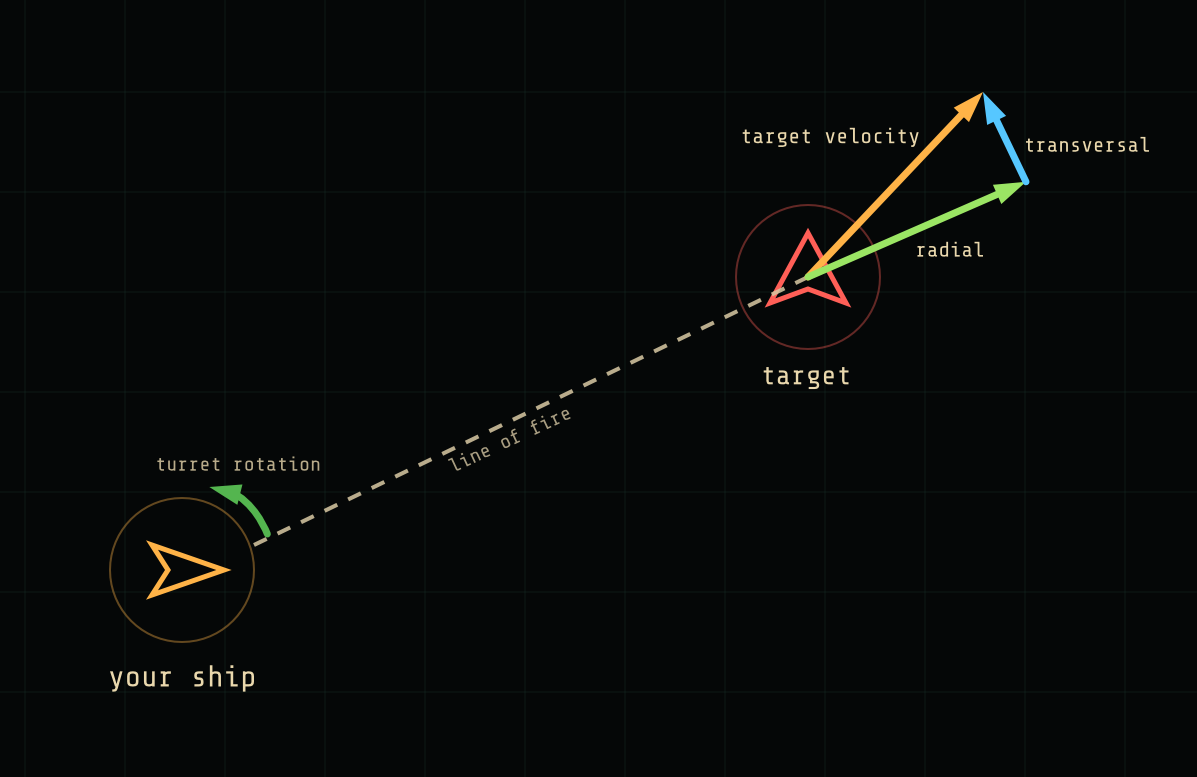
Transversal is the part of a target's movement that crosses your line of fire.
In real-world ballistics, transversal has no effect on damage. A hit delivers it's full damage regardless. The real consequence of high transversal velocity is target tracking. A weapon's ability to keep its aim on target depends on whether its tracking rate can match the angular velocity of the target. If it can't, projectiles miss.
Faithful simulation of that tracking failure produces a binary outcome: shots either do full damage or miss entirely. When we couple that with auto-aim like in Perihelion you get a game that seems broken. Players get no feedback about why they missed.
An alternative to this simulation is using transversal velocity to scale damage. If a ship burns directly toward you, it's moving fast but is easy to track. Your transversal will be low and your damage will be high. If that same ship flies sideways across your line of fire, your guns have to swing to follow it. As that happens damage falls off emulating the effect of poor tracking.
This effect scales with the enemy's distance - a close fast ship requires a higher tracking rate than a ship that's far away.
Transversal is why speed alone isn't what wins a fight. A fast ship burning straight at you is easy to hit. A fast ship crossing your guns up close is a problem. The same velocity can be harmless or decisive depending on the angle and range.
That's the bit I wanted in Perihelion - "more damage" and "more damage that lands" are very different things.
How Perihelion calculates it
Perihelion starts by drawing an invisible line from the shooter to the target. Then it looks at the target's motion and splits it into two pieces:
radial motion: movement along that line
transversal motion: movement across that line
The game measures how much of the target's movement is sideways across the line of fire, then compares that angular motion against the weapon's tracking.
transversalSpeed = how fast the target is moving sideways
angularVelocity = transversalSpeed / rangeToTarget
trackingRatio = angularVelocity / weaponTracking
damageMultiplier = 0.5 ^ (trackingRatio * trackingRatio)
If the target's angular velocity stays within what your weapon can track, damage applies cleanly. Once it climbs past that, application falls away fast.
That's what creates the classic artillery Cyclone mistake. You can fit big, slow-tracking guns and feel powerful on paper, then orbit too close and watch your damage turn into sad little scratches.
This is also where reference frames matter. Transversal is measured from the shooter's point of view. If two ships are drifting sideways together, the target may be moving quickly through space, but it isn't moving quickly across the shooter's guns. From that ship's frame of reference, the shot is steady.
How transversal affects gameplay
Because Perihelion uses transversal, movement isn't only about getting closer or farther away. It's part of aiming, part of tanking, and part of target selection.
A fast ship can use movement to survive, but if it hugs too close with poor tracking, it sabotages its own damage. A heavy gun can pop something when the geometry is right, but it asks you to create that moment first.
That gives every room a handful of live questions:
- burn straight in and finish the target before incoming damage catches up to you
- widen the orbit so your guns can track targets
- cut across hostile guns to reduce incoming application
- hold range because your weapons apply better when angular velocity drops
- switch targets because the current one is moving in a way your guns hate
The move I love most is changing tack at the right moment and killing transversal. You stop dragging your guns across the target, the fire solution tightens, and then pop. The enemy disappears because you fixed the angle before your next salvo.
That feels clever and, honestly, a little smug. That's the satisfaction I want the whole game chasing.
Why transversal isn't intuitive
The challenge with transversal is making it intuitive. Players need to read it on the fly, in multiple reference frames, while piloting a virtual spaceship.
Games already ask players to do absurdly skilled motion reads. A Rocket League player can judge a wall bounce, an FPS player can lead a rocket, and an RTS player can kite without thinking about the maths. Players learn it because the game gives them feedback they can feel.
Transversal asks for a different read. You're not just asking "where will they be when my shot arrives?" You're asking "how fast are they moving across my guns from my ship's point of view, and how does that change as range changes?"
That's the part that fights intuition. The same sideways movement can be a huge tracking problem up close and barely matter farther out. Two ships can look fast on the map but be almost still relative to each other. A clean-looking orbit can be ruining your own firing solution.
Perihelion needs to teach transversal in the same way other genres teach intercepts, spacing, recoil, or timing. The UI has to make the invisible geometry visible while you fly.
The UI fix: show the fire solution
The easy option would be to put a number on the screen and ask the player to interpret it. It'd be accurate, sure, but it's not intuitive. First you have to know why the number matters, then you have to map values to outcomes, and finally you still have to pilot your ship.
So the UI starts with a simpler question: will this shot be good?
Perihelion answers this in two ways: fire-solution bars and direction vectors.
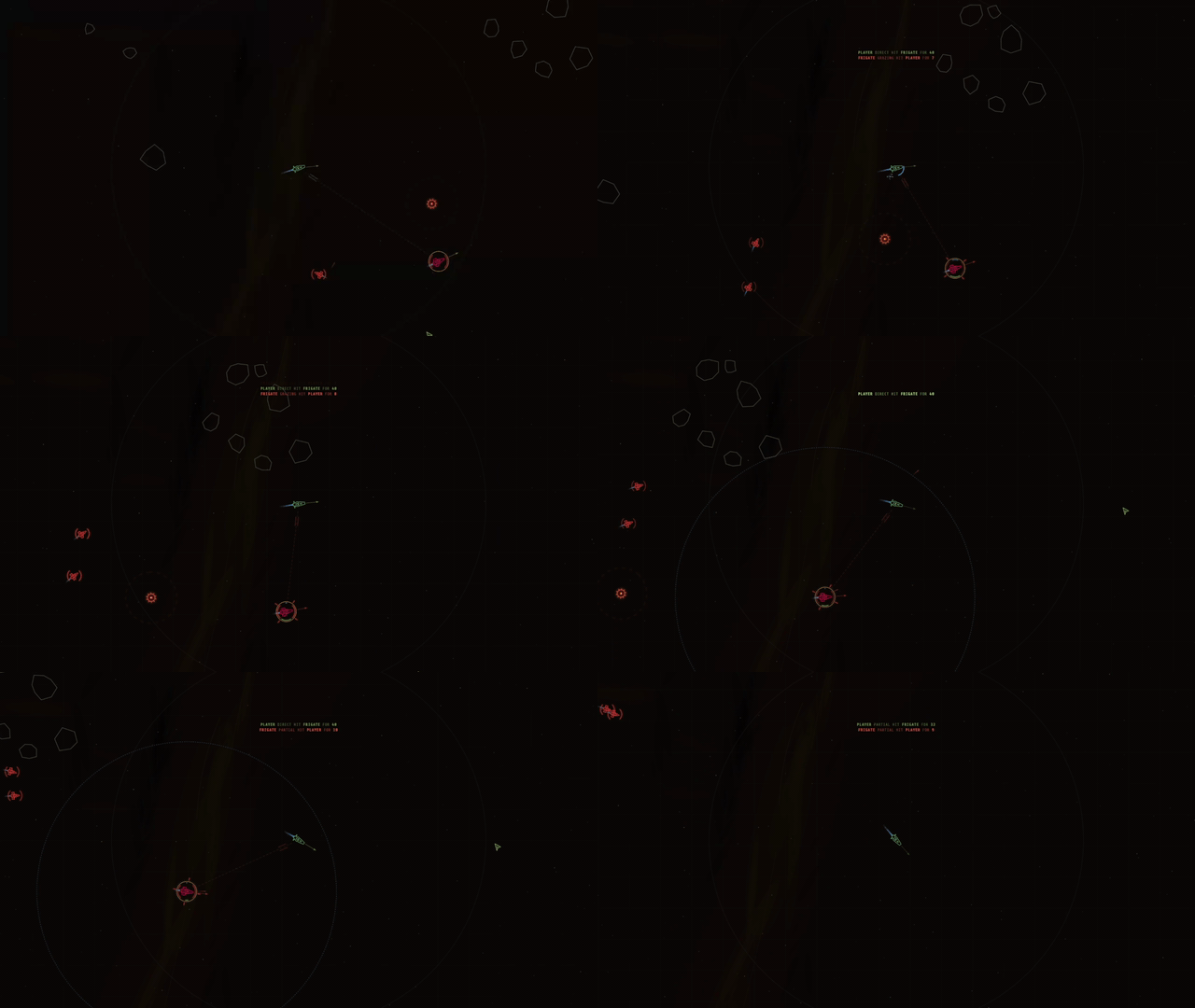
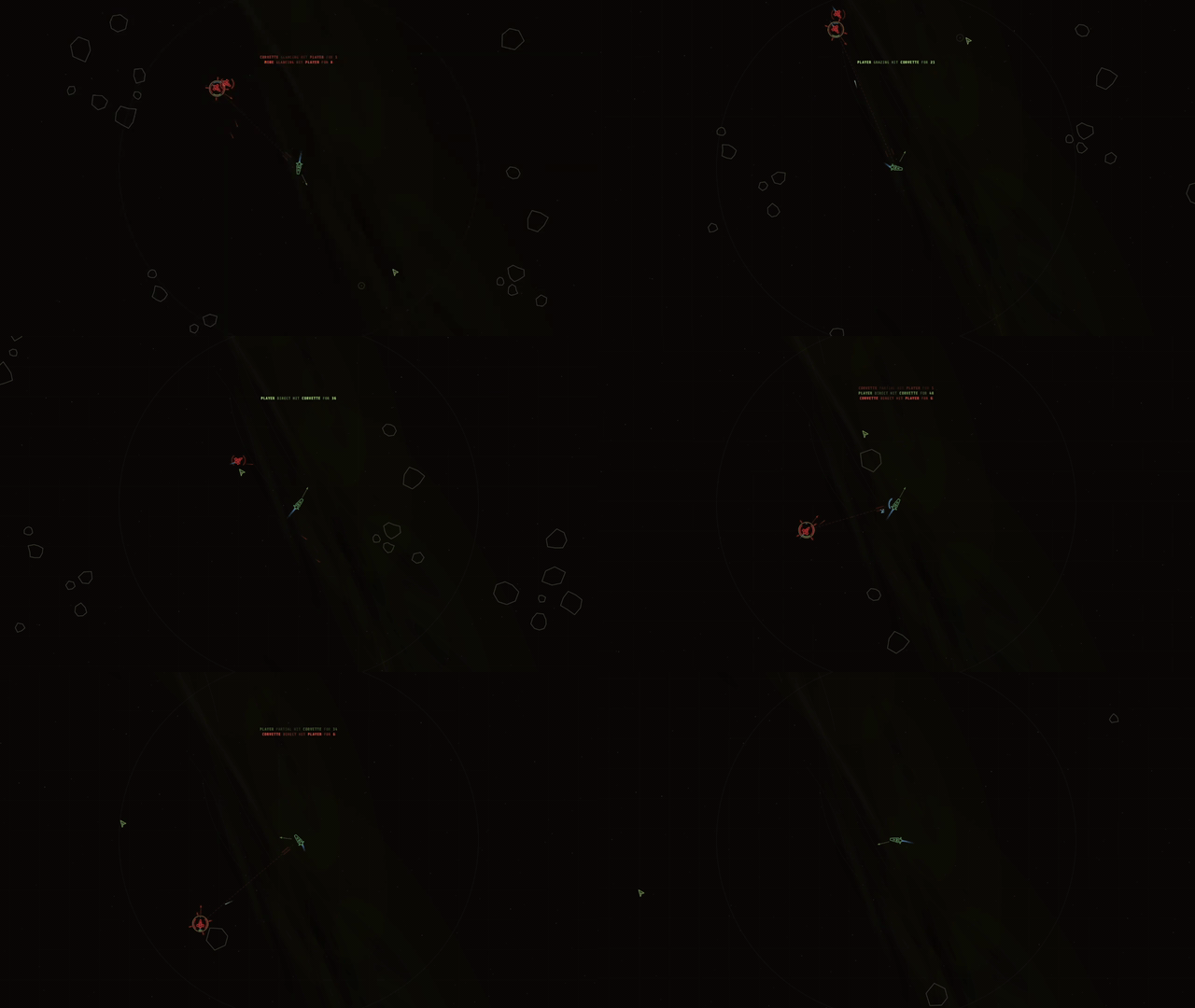
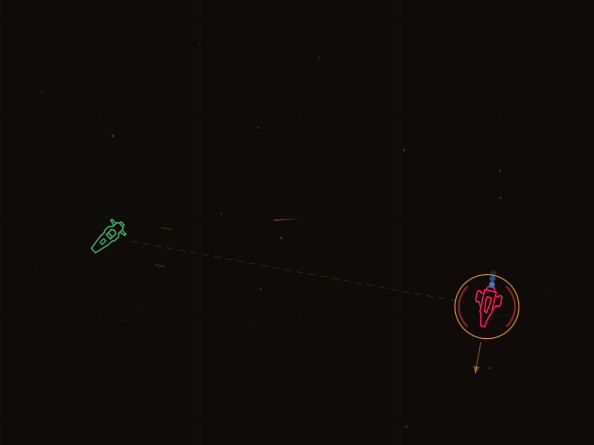
When you have a fire target, the HUD predicts current turret application. It then draws small bars near your ship in the direction of the target. Good application makes the bars tighter, brighter, and longer. Bad application spreads and weakens them. The bars tell you whether the shot is good.
The direction vectors tell you why, and what to do about it. They show where your ship is actually moving and where the target is actually moving, so you can read whether you're crossing, matching, or killing transversal. If the fire-solution bars are ugly, the vectors are the clue: change tack, widen the orbit, match their motion, or force them to cross yours.
The whole thing stays spatial. The bars and vectors live near the ships because the problem lives between the ships, not in a detached readout.
When the bars look bad and you fire anyway, the damage feed confirms it with glancing or grazing hits.
This is how the player begins to learn. They notice the visual clues for what works and what doesn't, then start to optimise their play.
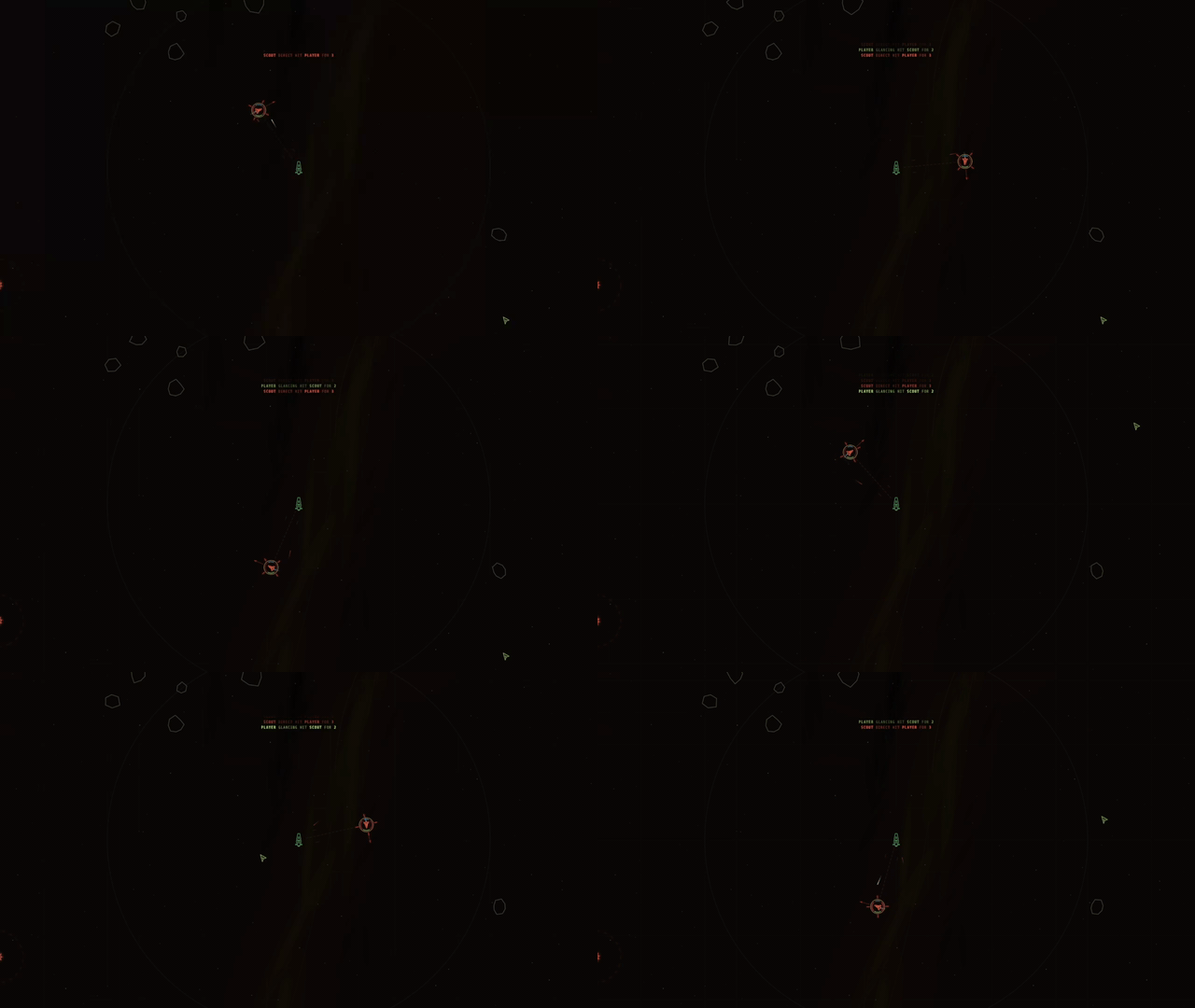
With low transversal the firing solution indicators are close and bold: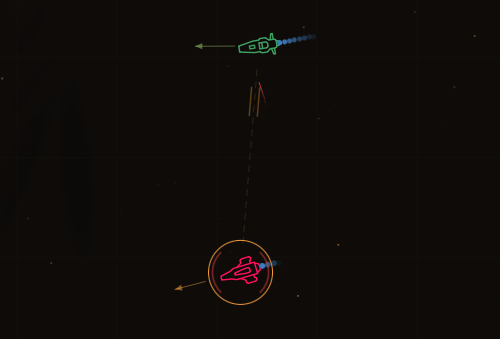
And with high transversal they're sparse and feint:
Giving players a starting range
The range in which your ship wants to fight changes with each setup. Slow-tracking guns want more distance because distance lowers angular velocity. Better tracking lets you work closer. Fast ships can survive by moving, but they still need to think about whether their own guns can keep up.
Asking players to calculate that range mid-fight would be miserable, especially before the system has clicked. Orbit and hold orders give them a starting point: a way to say "fight from about here" and then learn from what happens.
The order doesn't solve the fight. It's just a reasonable starting point. You can break from it. Sometimes you should. Once you understand the system, deciding when to break from it becomes part of the game.
Why keep this complexity?
Because this is where the game gets fun.
If damage is only a number in the fitting screen, the best build becomes obvious. If damage depends on position, movement, target choice, and timing, the same fit can feel brilliant or terrible depending on how you fly it.
A good system lets you make a bad decision with confidence, then understand why it was bad. That is the bit I want from the old artillery Cyclone mistake: not the confusion, but the moment where the geometry finally clicks.
Perihelion: Rogue Orbit aims to make that readable without sanding it flat. The HUD turns transversal into something you can feel in your hands: cross their guns, fix your angle, widen the orbit, null the transversal, take the shot.
If that sounds like your kind of fun, wishlist Perihelion: Rogue Orbit on Steam.
See you in the void!