
The Imperium is the main faction in Imperium of the Stars. It will be most likely the one you will be playing first, and this the one other factions will be compared to. It also has the most politics in the game. It is basically a feudal empire, with the Throne at the centre.
The Court
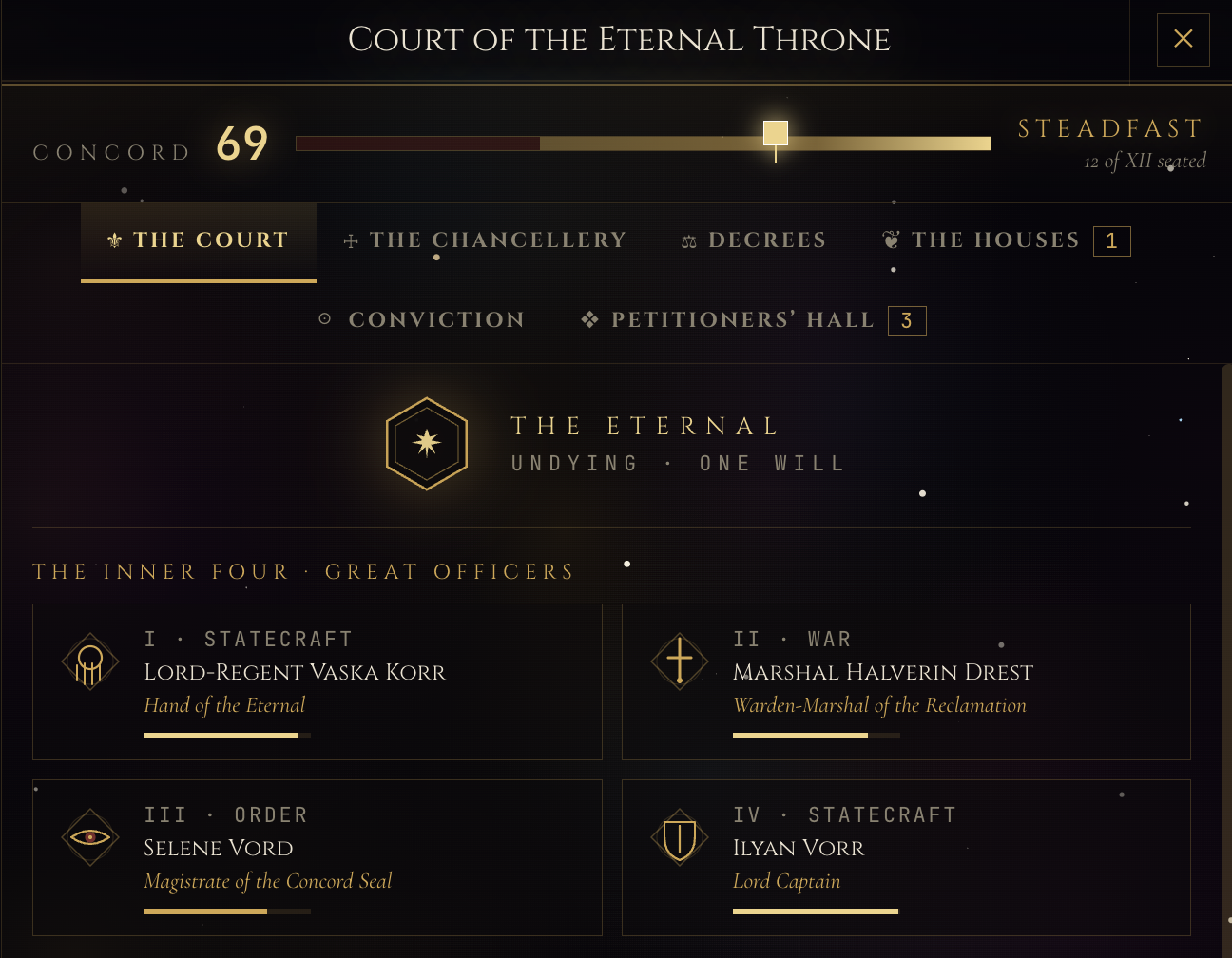
The court has twelve seats: four Great Officers and eight Officers of the Realm. Every courtier has two stats, loyalty and acumen. Acumen is how good they are at their job. Loyalty is their loyalty to the throne. A brilliant courtier who doesn't trust you is barely better than an empty seat, and a loyal-but-average one is worth keeping since you know what you are getting.
Each seat's bonus is tied to its role and provides a bonus to different parts of the empire. The court also feeds directly into Stability, this will make it easier for you to reclaim the galaxy.
Courtiers can go disloyal, which triggers its own events: embezzlement, sabotage, defection, the occasional coup attempt. The court is something you should keep a good eye on.
Decrees
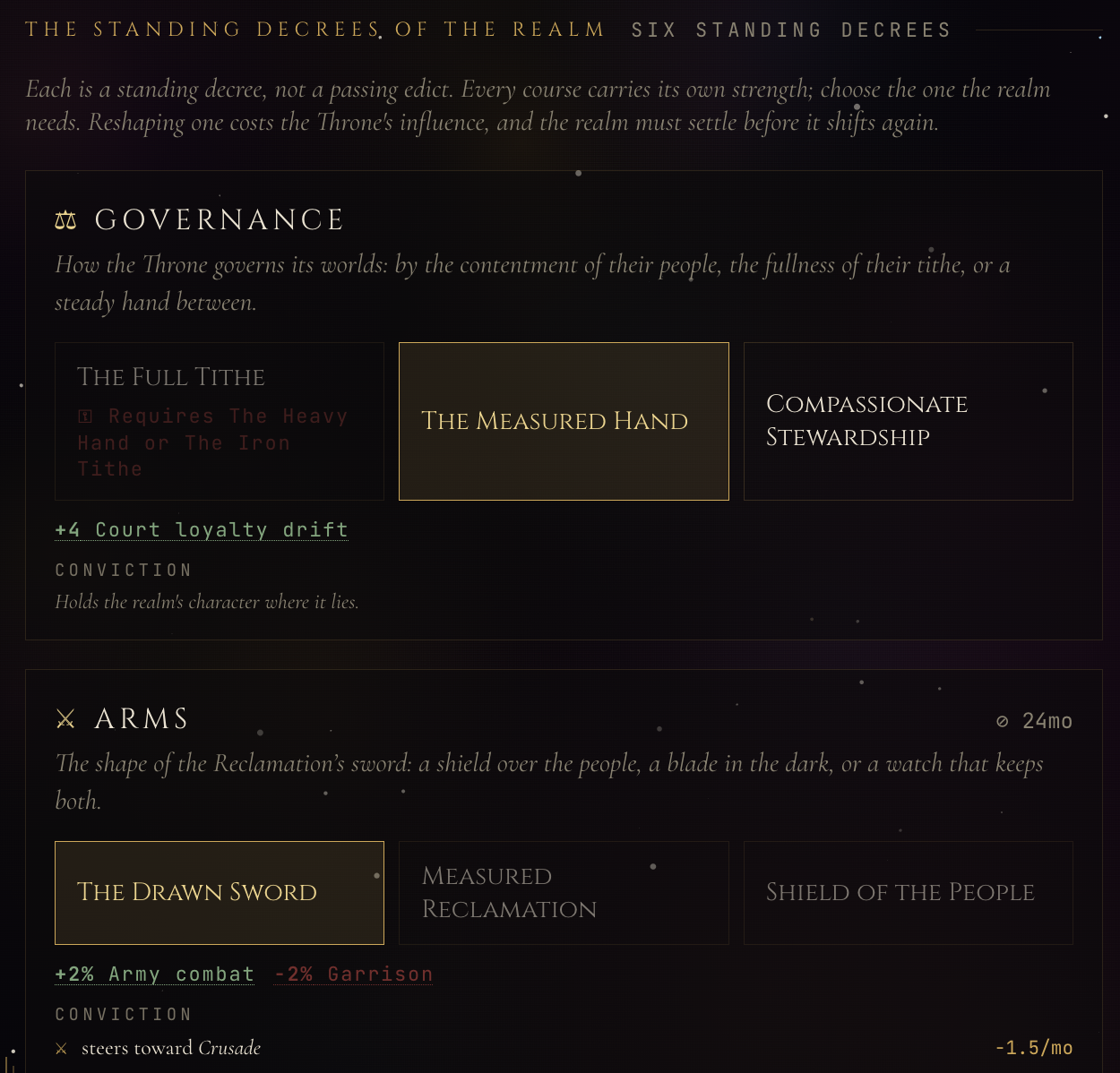
Decrees are the Imperium's standing policy system, Decrees cover six categories and each have three options.
The middle option is always the Measured course, with no bonus and no penalty. That's on purpose. I didn't want balanced to just mean worse than picking a side. The payoff for staying measured comes from the ideology system instead.
The two side options carry a small, symmetric tradeoff, a bit of one thing for a bit of another. But the modifier pair isn't really the point. Every side option also nudges one of the four Conviction axes, and that's the real decision: is not about which bonus I want, but in what direction I want to steer my Imperium.
 The Houses
The Imperium has two layers of politics. The Court is the inner ring, appointed officers close to the Throne. The Houses are the outer layer, the feudal system.
Independent minor nations that broke off during the Long Silence can be absorbed through diplomacy or conquest, and either way they become a House sworn to the Throne. Great Houses get a seat in the Synod, the broader council alongside the Court. Every House has a domain, naval, martial, mercantile, devout, or forge, and that domain shapes what it contributes, plus the kind of officers and governors it sends you.
Keeping a House is its own ongoing problem. Loyalty drifts with how well its home sector is doing, and if it falls too far you get a warning event first, a chance to spend influence, grant a charter, or ignore it. Ignore it long enough and the oath breaks, the House takes its systems back, and you're conquering it all over again. It can also be re-sworn if you retake its home system.
The military and political layers connect here too. When a House's commander earns a promotion in battle, the House gains loyalty and a triumph event. A general who keeps winning makes his House easier to hold onto. But this might also create other problems. Legions and Fleets can also get loyalty towards the commander. And who will the commander be loyal to? His house or the throne?

Conviction
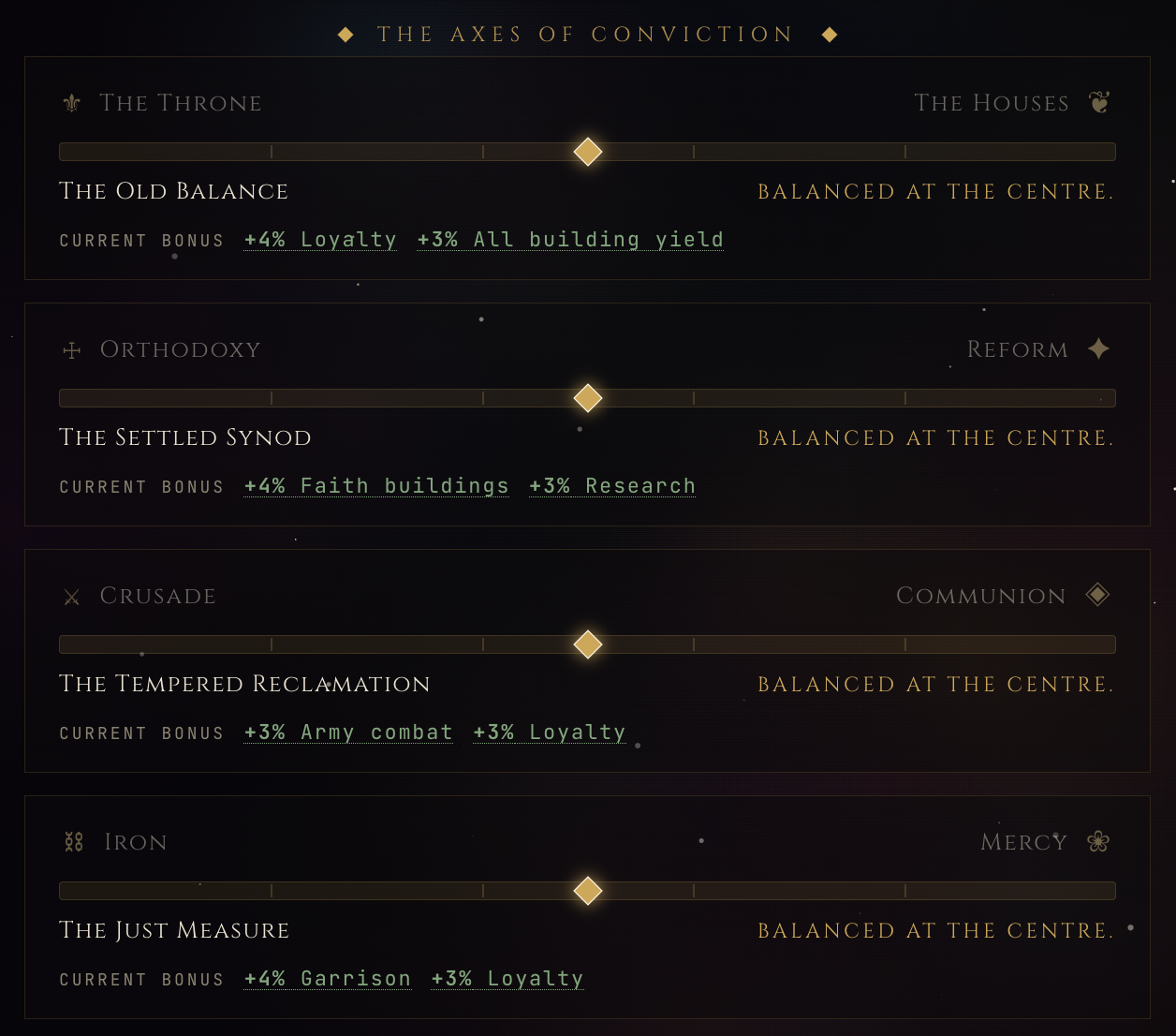
Conviction is what makes Decrees matter beyond their small modifiers. It's four ideological axes, each running from -100 to +100: Throne versus Houses, Orthodoxy versus Reform, Crusade versus Communion, and Iron versus Mercy. Each axis has five named bands running from one pole to the other.
Each axis has three modifiers: one for each full pole, and a separate, more modest modifiers for dead center. Wherever your realm sits, the bonus you get is a crossfade between the center modifiers and whichever pole you're leaning toward, weighted by how far you've leaned. Committing fully to a pole gets you the strongest version of its effects. Sitting in the middle still gets you something, just weaker.
Conviction also feeds the Great Houses. Each pole has an affinity across the house domains, so leaning toward one pole makes some houses more content and others more restless.
But the biggest impact conviction has is on how you actually win the game. It shapes which events show up for you, and those events can also influence conviction. It's the main lever for steering your Imperium down one path instead of another, and different paths lead to different ways of winning. Lean hard enough in the wrong direction and you don't just get more events, you can end up triggering a different kind of crisis altogether, or in the extreme case, your empire becomes the crisis. Nothing else in the game shapes a playthrough as much as Conviction does.
The Reclamation Situation
The Reclamation is the Imperium's core win condition: hold enough of the galaxy, this is adjusted by how stable your realm is. A well-governed, faith-rich, loyal empire needs to hold less of the galaxy to win. A fractious one has to conquer nearly everything.
This is still work in progress and something I will go in deeper in the future.
Crisis and Schism
Crisis is the galaxy-wide layer: dearths, storms, that kind of thing, breaking somewhere in the galaxy on their own schedule, not caused by anything you did. When one breaks in a sector you hold, you get a relief event: pay a tithe to shorten it, or ride it out and eat the cost.
The Schism is an Imperium specific crisis, and it's basically the inward mirror of the Reclamation. Where the Reclamation is the realm's outward arc, conquering the lost stars, the Schism is the internal fault line: the Throne holding everything in one fist while the Great Houses hold their own fiefs in the other. It only starts once the realm has sworn enough Houses. From there it builds slowly based on tension along the Throne-Houses axis. Consistent politics in either direction keep it slow. Contradictory politics make it come faster.
It builds through a few phases and then plateaus at a final one, where you have to make a decision: centralize, devolve, or hold the balance and let the crisis return later, harder, since every deferral re-arms it at an accelerated rate. Indecision gets punished instead of rewarded.
Ending notes
I hope this gave some insight in the Imperium faction. There is still more then this, and I hope to go over more details in the future.