
If we begin with what happened later, the Jiashen year is easy to turn into a countdown:
In the third lunar month, Li Zicheng entered Beijing. The Chongzhen Emperor died on Coal Hill. The situation at Shanhai Pass then changed abruptly, Qing forces entered the pass, one dynasty fell, and another long war began.
But Ming: 1644 does not begin from those completed outcomes.
Our campaign is anchored on 8 February 1644 — the first day of the first lunar month in the seventeenth year of Chongzhen.
On that day, Beijing was still the Ming capital and the central government was still operating. Li Zicheng held the Guanzhong region and had established the Shun regime in Xi'an. Qing had built a formidable military-political order beyond the pass, but remained outside Shanhai Pass. Zhang Xianzhong's forces were active around Huguang and had not already become a stable Sichuan state.
Everyone could see that the storm had arrived. Nobody knew the order in which it would break.
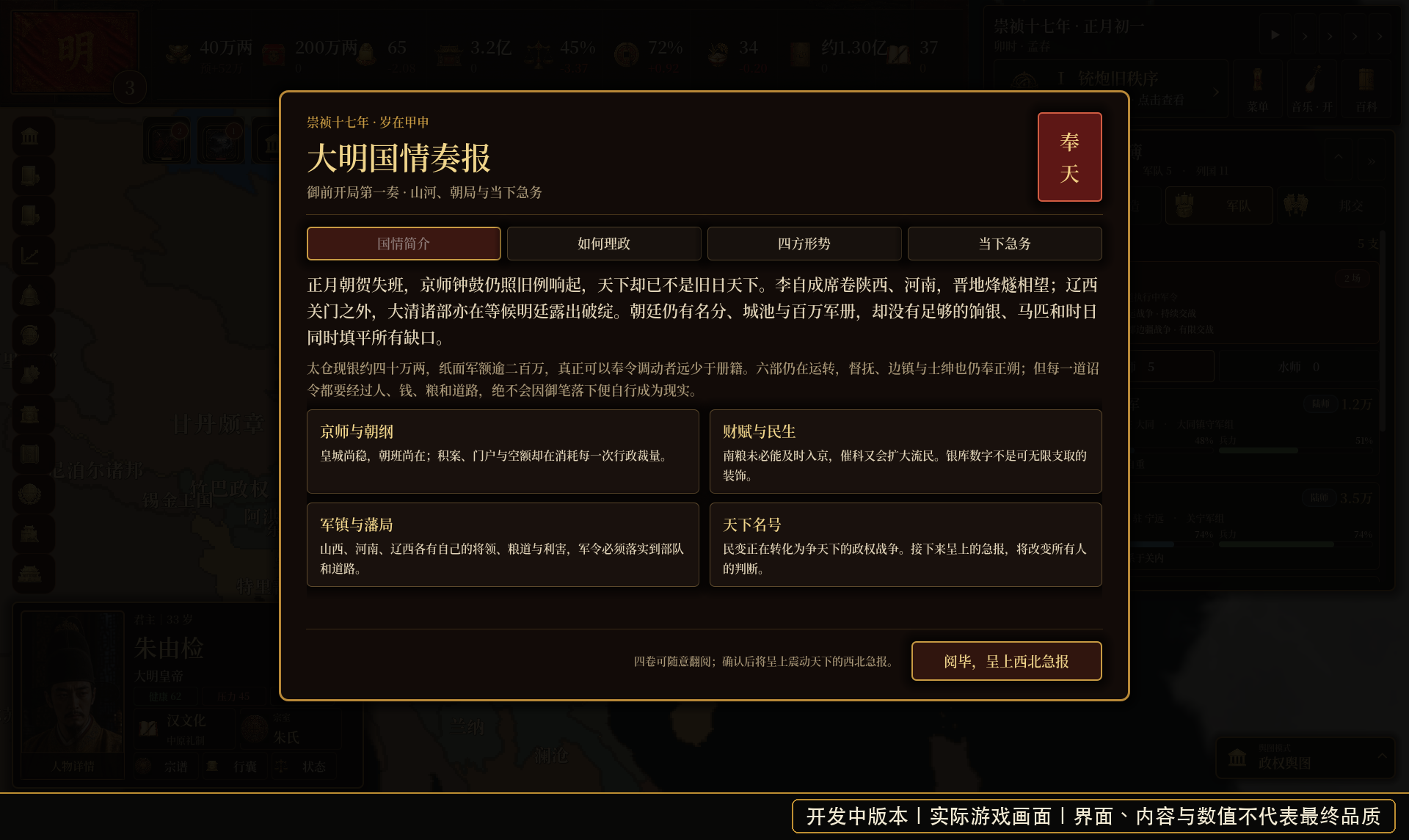
Actual in-game footage from the current build: the Ming opening national briefing. UI, wording, and values remain work in progress.
Why “Jiashen”?
Jiashen is the sexagenary designation of the year. For this game, however, it is more than an evocative historical label.
The year 1644 contained several competing political calendars. In Beijing it was the seventeenth year of Chongzhen. For the newly established Shun state in Xi'an, it was the first year of Yongchang. Beyond the pass, Qing called it the first year of Shunzhi. In the same spring, rival governments used their own era names to declare who had the authority to define time, issue orders, and interpret the realm.
That is why Jiashen is more appropriate for the title than the era name of any single regime.
It does not declare in advance which order must prevail. Nor does it reduce history to a change of dynastic names. It marks a shared moment in which the old system still possessed real power, a new regime had asserted its legitimacy, a frontier power was watching for an opportunity, and local society bore the combined costs of taxation, military provisioning, famine, epidemic disease, displacement, and war.
The crisis of 1644 was an outcome, but not an isolated event. It was preceded by years of fiscal imbalance, unpaid troops, disaster and rebellion, the long drain of the Liaodong wars, and a military-administrative system losing credibility through repeated mobilization. It was followed by much longer wars, reconstruction, and resistance.
In the game, Jiashen is not a scripted apocalypse. It is the moment when state capacity, military organization, political legitimacy, local order, and diplomacy are tested together.
Why Lunar New Year's Day?
We did not choose the first day of the first lunar month because it hosted the year's most famous battle. We chose it because many of the decisions that would determine the outcome had not yet been made.
During the previous year, Shun forces had defeated Sun Chuanting, broken through Tong Pass, and occupied Xi'an. By the first lunar month of Jiashen, Li Zicheng was no longer presenting himself merely as the commander of a mobile army. Renaming Xi'an as the Western Capital, establishing offices, and adopting the Yongchang era meant that Shun was beginning to organize soldiers, resources, and political authority as a rival state.
The project currently uses Lunar New Year's Day as the unified campaign and calendar anchor for this transition. Sources differ over whether a particular proclamation or accession ceremony occurred on the first or third day. If further source review requires an event to move by two days, we will change the event rather than conceal the disagreement to preserve a line of promotional copy.
For gameplay, this date matters because:
- Shun has the organizational base for an eastward campaign, but Shanxi, North Zhili, and Shandong have not been converted into completed conquests.
- Ningwu, Datong, Xuanfu, Juyong, and Beijing still form a Ming defensive chain, although every link suffers from problems of pay, supply, morale, and command.
- Wu Sangui and the Guan-Ning army remain on the Ningyuan–Shanhai corridor. Relief, continued frontier defence, withdrawal, or self-preservation must not be predetermined by the opening script.
- Qing holds the strategic initiative beyond the pass, but receives no automatic licence to enter on day one.
- Zhang Xianzhong's forces remain mobile and expanding. The later outcome in Sichuan has not yet happened.
If the campaign began after the fall of Beijing, too many important questions would already have answers. Beginning on Lunar New Year's Day lets the player confront the process.
Ming: A State Under Strain, Not an Empty Shell
Ming begins in grave danger, but we will not design it as an empty shell waiting for a story event to knock it down.
Beijing remains the political centre of the empire. The emperor, Grand Secretariat, Six Ministries, Censorate, military commissions, and local bureaucracy retain legal authority and institutional momentum. The capital has not fallen. The wealthy regions of the southeast, the grain transport network, local administrations, and a vast population remain within the Ming institutional order.
Ming therefore still possesses resources. The question is whether the state can actually obtain them and deliver them to the right place at the right time.
Tax grain recorded in a ledger is not grain already delivered to a depot. A nominal troop establishment is not a field army ready to march. An imperial order is not the same as a commander being willing and able to obey it. Unpaid soldiers, transport loss, local retention, famine, disease, rebellion, factional conflict, and collapsing political credit can turn every simple command into a chain with several possible points of failure.
The current political, fiscal, and military values are designed to express the gap between nominal and effective capacity. They are historically constrained gameplay measures, not claims of exact statistical knowledge.
The player's central question is not “which option prevents the fall event?” It is: how much usable silver and grain can the court still raise? Should it secure Beijing, reinforce Shanxi, or preserve the Guan-Ning front? Which memorials are credible? Which troops can still be moved? How much local order, political trust, and future revenue must be spent for immediate strength?
Knowing the historical answer does not cause historical resources to appear.
Shun: From Insurgent Army to Rival State
Lunar New Year's Day also marks a change in the nature of Shun.
The Ming–Shun war did not suddenly begin in 1644. Late-Ming rebellion and peasant warfare had continued for many years, and Li Zicheng's forces had experienced defeat, dispersal, reorganization, and renewed expansion.
After establishing a government in Xi'an, however, Li faced more than the next government army. A state competing for the realm needs offices, pay, provisions, discipline, local cooperation, and political legitimacy. It must convert wartime mobilization into administration while managing newly attached soldiers and civilians, former Ming elites, and its own commanders. Military initiative does not automatically create fiscal or institutional capacity.
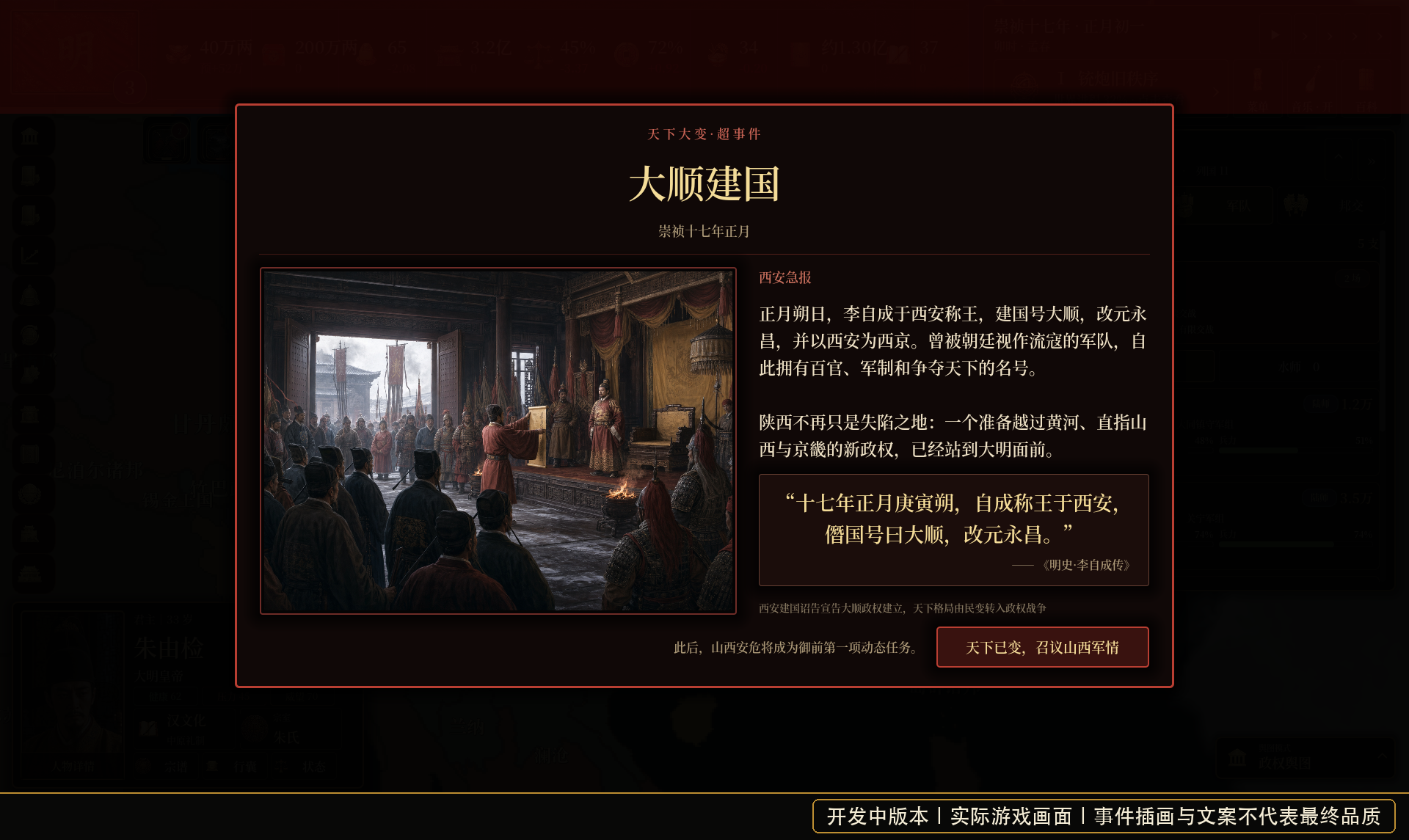
Actual in-game footage: the “Founding of Shun” super event. Illustration, quotation, and trigger details remain in development.
In the current scenario, Shun securely controls its Shaanxi core and exerts pressure along the Henan corridor. The eastward campaign is still being organized and deployed. Taiyuan, Datong, Xuanfu, and Beijing are objectives, not conquests granted at scenario start.
Giving Shun all of North China on day one because we know what happened later would remove the army, logistics, local responses, and enemy failures that made its advance possible. Describing Shun only as politically aimless “bandits” would be equally misleading.
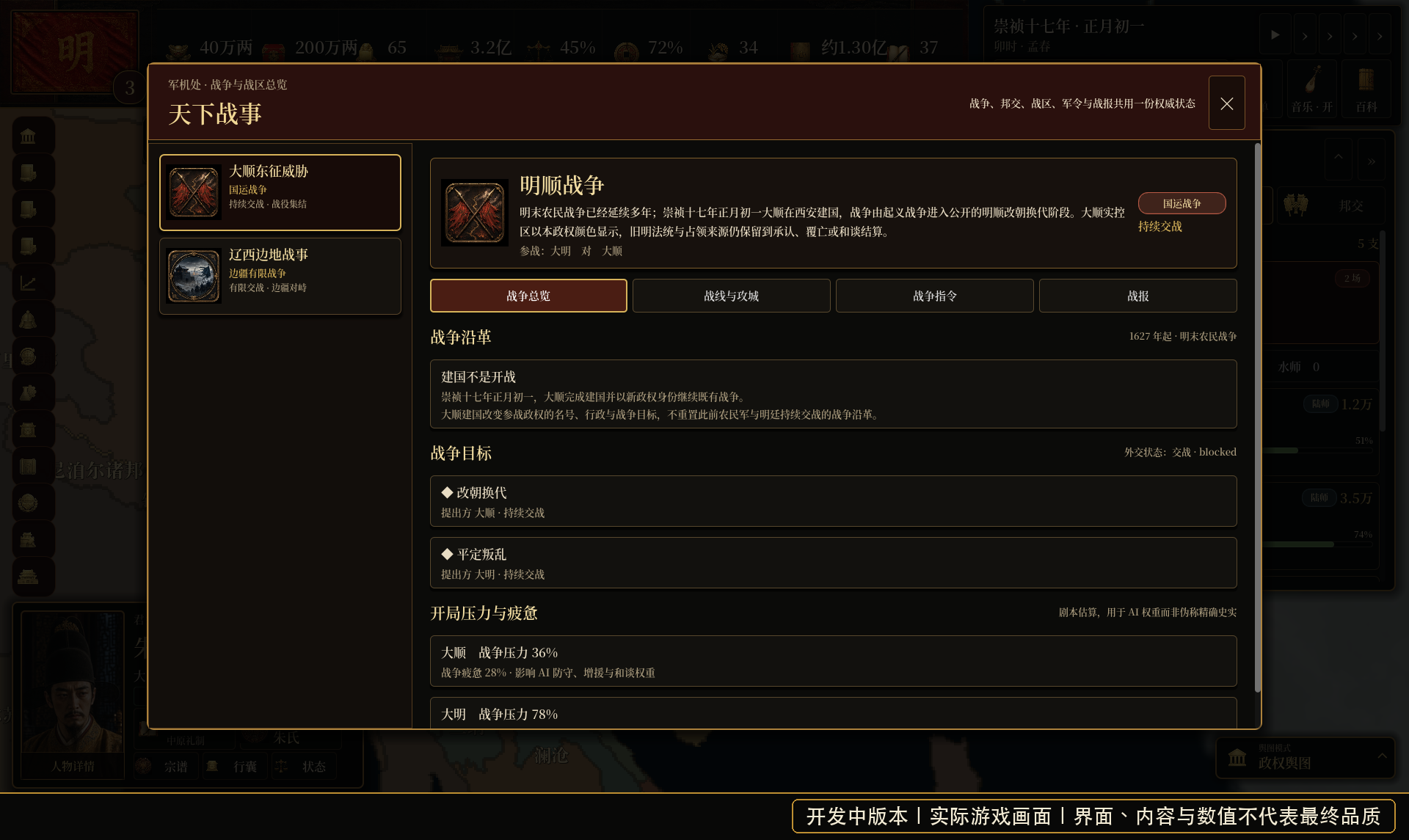
Actual in-game footage: the Ming–Shun war overview. The founding of Shun changes the regime's name, organization, and war aims; it does not pretend that a long war began only on New Year's Day.
Qing: A Power Beyond the Pass, Not Yet the Victor Within
In the first lunar month, the young Shunzhi Emperor occupied the Qing throne while effective military and political power lay with the regency. Through years of war, conquest, and alliance-building, Qing had created a far more complete state and military organization than the early Later Jin. It could employ the Eight Banners, Mongol allies, surrendered Han forces, and Liaodong resources in larger campaigns.
Ming must treat Qing as an active wartime opponent. Yet having the ability to enter the pass is not the same as already having chosen the later historical course.
On Lunar New Year's Day, the Ningyuan–Shanhai corridor remains a front and buffer between Ming and Qing. Qing can scout, probe, pressure, or wait for a political opening. Whether it intervenes rapidly, under what justification, and through which diplomatic contact must be driven by available intelligence, changes on the frontier, and decisions by every side.
The current scenario therefore keeps the Ming–Qing war active while preventing Qing from simply crossing Shanhai Pass without an escalation condition. No faction receives a script sent back from the future.
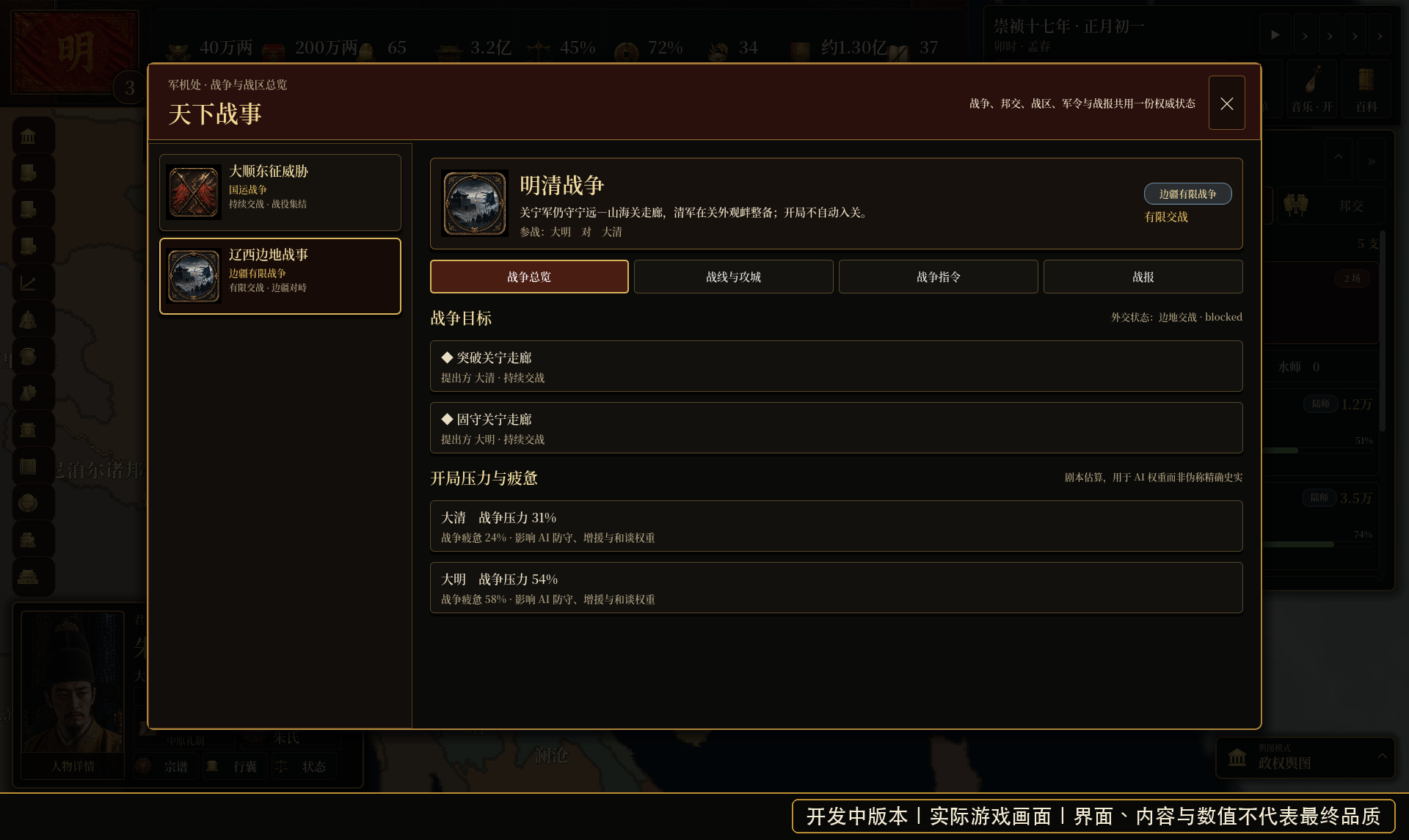
Actual in-game footage: the Ming–Qing war and the Guan-Ning front. Qing holds the initiative, but begins outside the pass in an observing and probing posture.
Joseon cannot be treated as a passive colour on the map. After the 1636–37 war, it was constrained by its tributary and treaty relationship with Qing, while retaining complex political memories and loyalties toward Ming. It is neither a force that Ming can mobilize at will nor a subject without choices of its own.
The Mongol polities are not one state either. Some had entered Qing's alliance and integration network; others retained differing degrees of autonomy. Reducing them to one attitude and one diplomacy button would erase the real complexity of the northern situation.
Daxi, Regional Armies, and a Wider East Asian World
The third major internal-war force was the military group led by Zhang Xianzhong.
Zhang had been active in Huguang and had adopted political titles, but on Lunar New Year's Day he had not yet established the later stable regime centred on Chengdu. Our scenario treats Daxi as a mobile and emerging power moving toward the Huguang–Sichuan corridor, rather than painting Sichuan in advance to produce a cleaner map.
Ming field armies, local officials and elites, urban defenders, displaced populations, and local society also cannot be omitted.
Zhou Yuji at Ningwu, Jiang Xiang at Datong, Tang Tong around Juyong, and Wu Sangui at Ningyuan command more than character cards. They control armies, passes, and information nodes that can change the tempo of the campaign. Central orders, local pay, enemy advances, the safety of dependants and followers, and trust in the court's ability to honour its promises all shape what they can actually do.
We will not write their later surrender, death, retreat, or defection into their opening personalities.
Beyond Shanhai Pass and the Central Plain, the Tokugawa bakuhan order had consolidated; Ryukyu stood within overlapping Chinese investiture and Satsuma control; Taiwan's indigenous societies, Dutch East India Company posts, Spanish Philippines, Macau, and Southeast Asian polities formed a connected world of maritime trade, routes, intelligence, and diplomacy.
They may not all intervene in Beijing's war on the first day, but they must not be decoration at the edge of the map.
Turning Historical Background into Game Rules
Historical background becomes part of a grand-strategy game only when it enters the systems.
We are translating the Jiashen opening into interacting states:
- Politics: legitimacy, authority, court factions, local obedience, and command execution.
- Military: effective strength, arrears, morale, commanders, passes, fronts, and supply.
- Economy: tax sources, available silver, granaries, the grain transport system, local retention, disaster, and market capacity.
- Diplomacy: wars, investiture and tributary relations, passage, trade, alliances, observation, and secret contact.
- Society: livelihood, displacement, disease, security, local elites, and migration.
- Intelligence: reporting delays, credibility, frontier reconnaissance, and what the player actually knows.
These systems cannot remain isolated in unrelated menus.
Calling the Guan-Ning army back to defend Beijing, for example, should not be a button followed by a fixed timer. The court must create an executable order; the army must trust it; the route must supply it; frontier commanders must evaluate the cost of withdrawal; and Qing will observe every change. A military action can become a fiscal, political, and diplomatic crisis at any broken link.
Shun's eastward advance likewise involves more than a comparison of combat values. It must pass fortifications, maintain provisions, obtain or compel local cooperation, judge the posture of Ming commanders, and extend a new government's administrative burden.
Qing's decisions must be constrained by intelligence, frontier conditions, internal politics, and diplomatic opportunity—not by the simulation secretly knowing the historical answer.
Sources and Uncertainty
There are many records for 1644, but abundance does not mean that every value has one certain answer.
Sources may disagree on dates. A unit's nominal establishment, field strength, and later recollections may differ radically. Population, finance, and local control are often known only as ranges, phases, or conflicting reports.
Our approach is:
- Separate confirmed historical anchors, source-based estimates, and relative numbers created for gameplay balance.
- Never backfill later outcomes into the opening. Shanxi and North Zhili remain high-pressure Ming fronts, not completed Shun possessions; Qing remains beyond the pass; Zhang Xianzhong is still moving rather than securely ruling Sichuan.
- Disclose meaningful disagreement instead of manufacturing precision that does not exist.
The power, stability, livelihood, military, and war-pressure values shown in the interface are work-in-progress gameplay scales. They compare states and drive systems; they are not claims that “Ming stability was exactly 45%.”
We want historical research to produce stronger constraints, more credible choices, and less hindsight—not merely more decorative text.
New Year's Day Is Not a Countdown
Players know the history of 1644. The people living through Lunar New Year's Day did not know what would happen in the third lunar month.
Ming still possessed its capital, administration, revenue base, and armies, but increasingly struggled to turn nominal resources into effective action. Shun had built a new political centre through war, but still had to prove that military victory could become order. Qing possessed formidable organization and patience beyond the pass, but had not yet obtained the outcome inside it. Daxi and regional military forces were still moving, judging, and choosing.
That is why we chose this date.
It is close enough to the crisis for every decision to carry weight, and early enough for the outcome to belong to the people inside the game rather than to a written timeline.
In Ming: 1644, Lunar New Year's Day is not a countdown to the fall of Beijing. It is a day when all possibilities still exist at once.
This diary draws on the Palace Museum's Chongzhen material, the Shaanxi Local Chronicles Office materials on Li Zicheng, the consolidation at Xi'an, and Zhang Xianzhong, together with texts including the History of Ming and Mingji Beilüe.
The current project uses 8 February 1644 / Lunar New Year's Day as its campaign anchor while retaining the source disagreement over the exact date of particular Shun ceremonies.
All screenshots come from the Godot build currently in development and carry a work-in-progress mark. UI, illustrations, text, borders, and values are not final.