
All remake screenshots in this post were captured from the current Godot build and are marked “WORK IN PROGRESS.” The interface, values, map, and art do not represent final quality. Legacy-build footage and concept art are labeled separately.
Hello, and welcome to Developer Diary #0 for Ming: The Jiashen Year.
We want to begin by making one thing clear: this is not a new map and a few extra screens bolted onto the old version, nor are we simply expanding a simulator in which an AI improvises history as it goes.
Ming: The Jiashen Year is undergoing a true remake. Our goal is a professional grand strategy game built around the operation of states, warfare, institutions, and historical change.
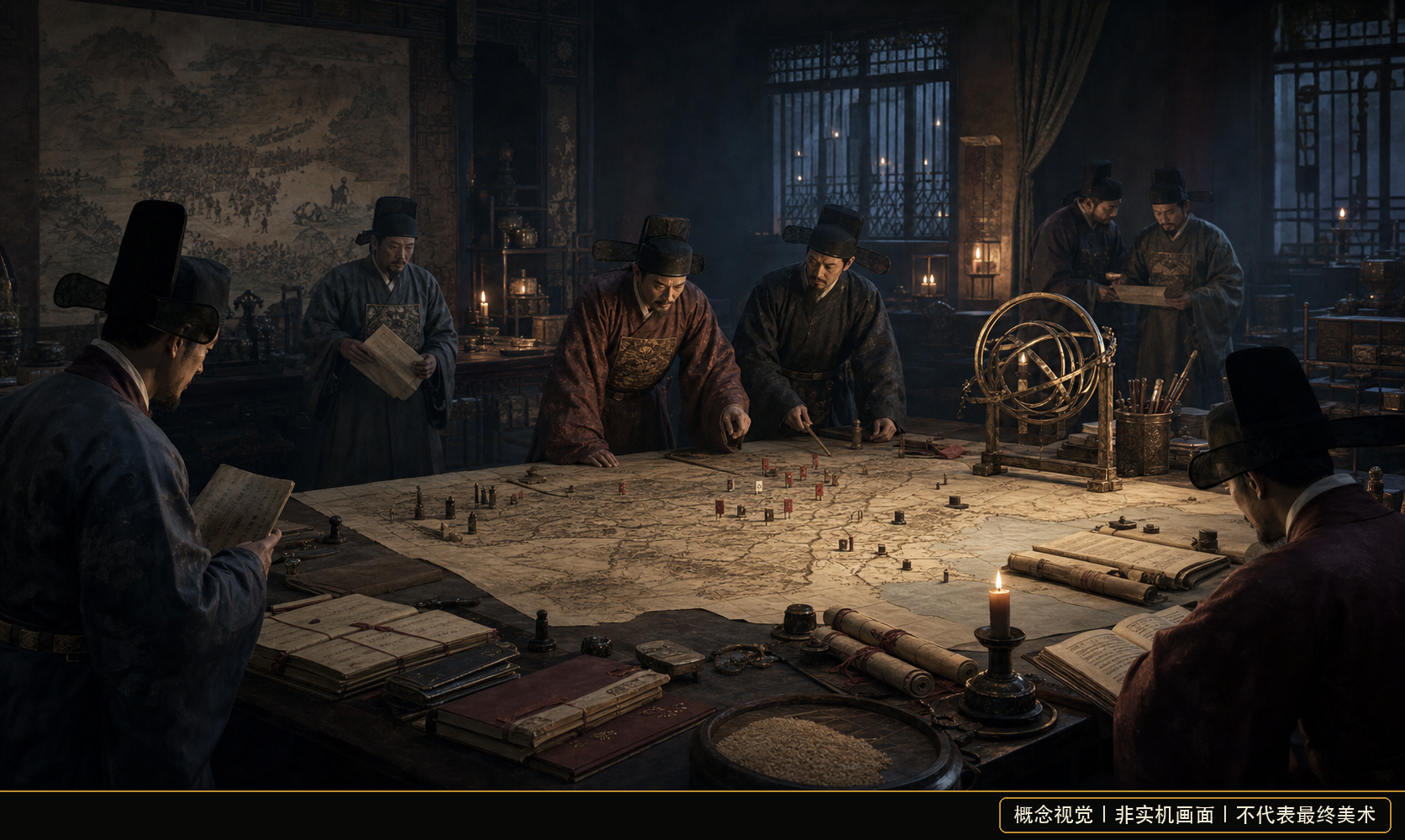
Concept art — not in-game footage. This image expresses the direction in which we want every system to converge around the same table: military orders, memorials, ledgers, transport, knowledge, and foreign intelligence all influencing one another. It does not represent completed gameplay or final art.
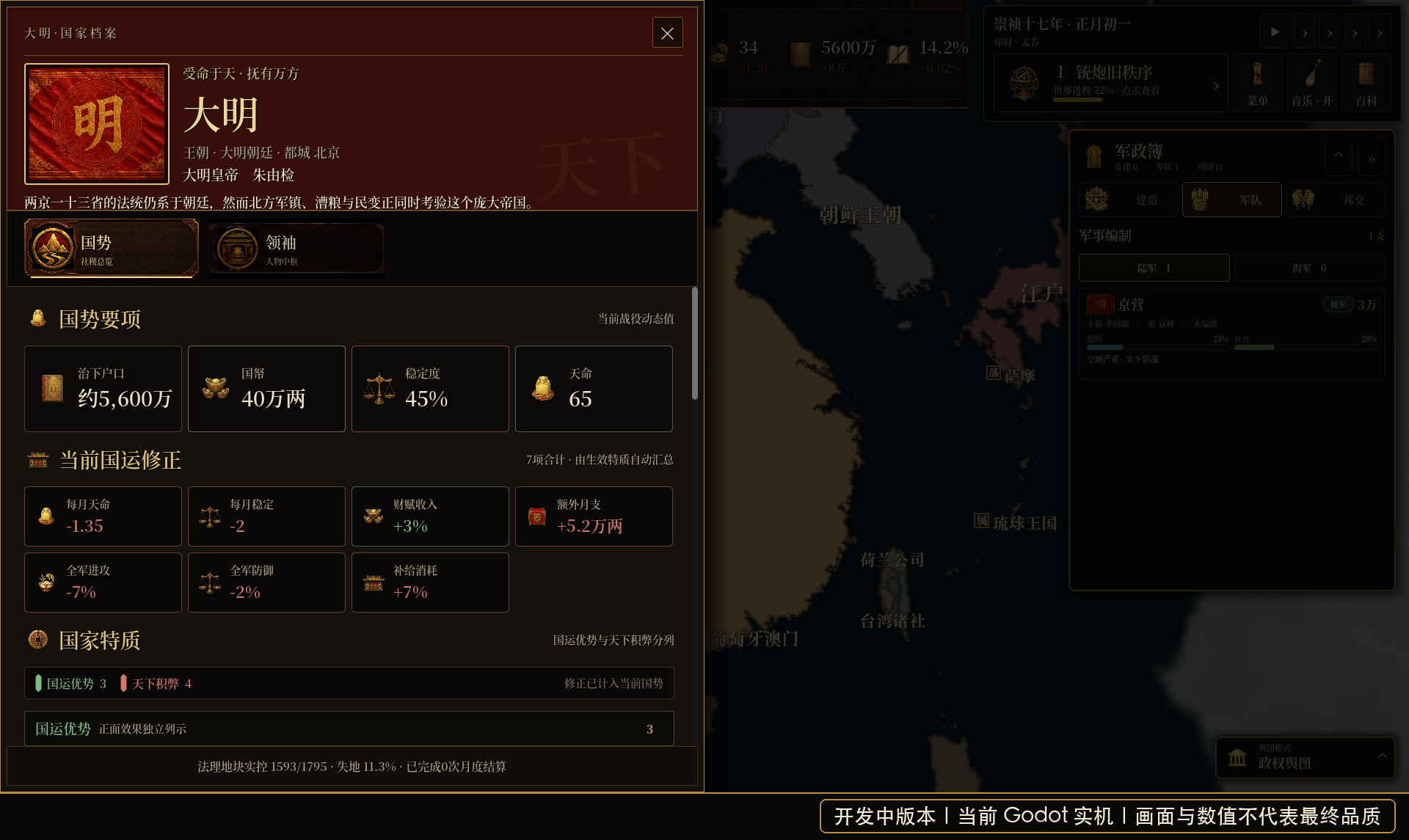
Current remake footage: the “Ming State Dossier” opened by clicking the Ming flag in the upper-left corner. Population, treasury, stability, mandate, and modifiers are current campaign-start data. Several values remain calibration baselines and do not represent a finished economic simulation.
What the Legacy Version Proved
The legacy version was built with JavaScript and Electron. It already brought together memorials, court debate, imperial edicts, officials, military reports, national conditions, events, maps, and AI conversations. It was also the first version in which players could meaningfully experience governing a collapsing empire as the Chongzhen Emperor.
That work will not be discarded. Its characters, historical writing, event concepts, and interaction lessons remain the foundation from which the remake grows. But the legacy version also taught us a conclusion we have to take seriously: text that resembles history is not the same thing as a historical world that is actually running.
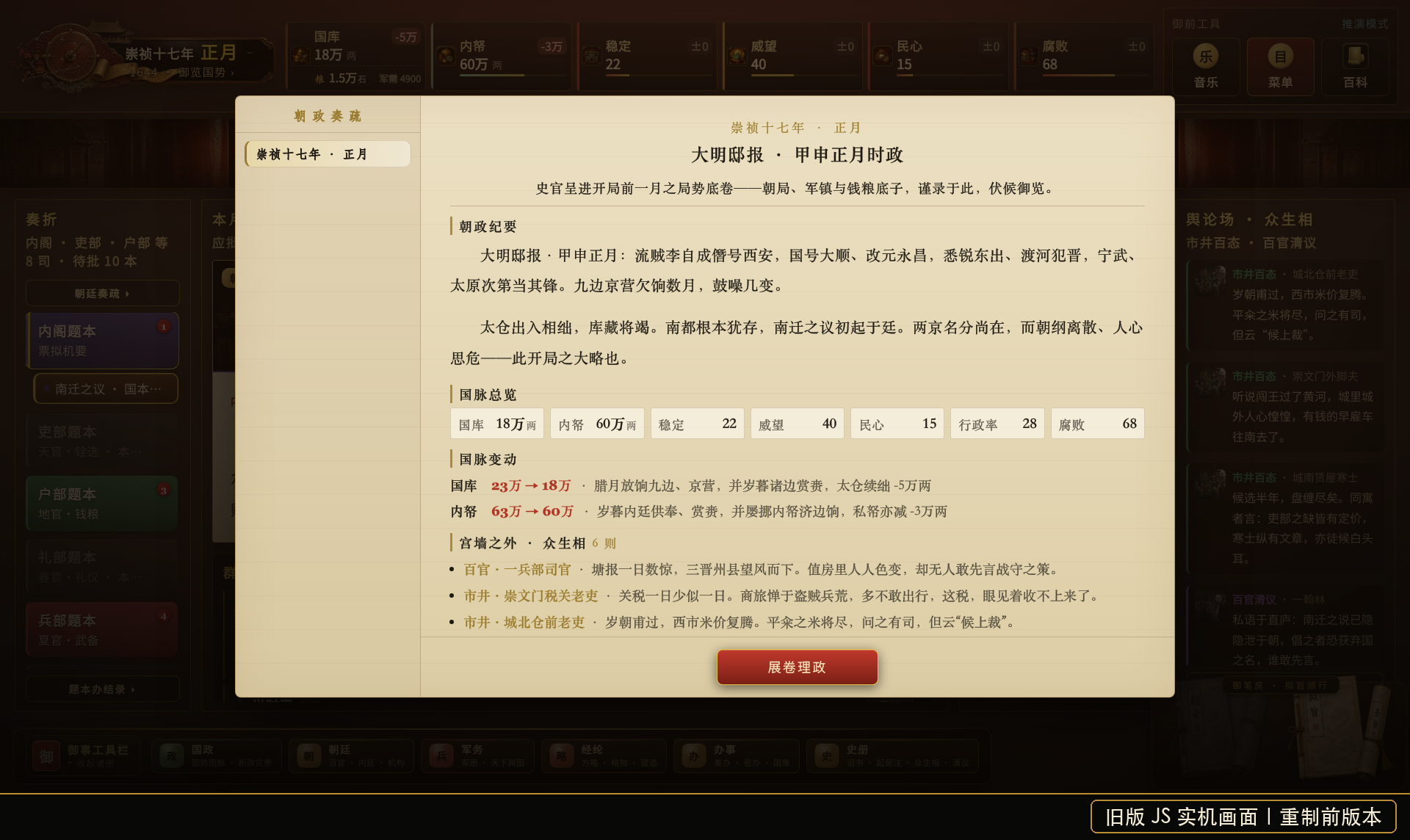
Legacy-build footage: a court memorial after an edict was processed. The old version brought debate, written feedback, and changes in national conditions into one experience. It also exposed the limits of asking the same language model to provide both narrative and authoritative rules.
The legacy onboarding notice openly warned players that AI simulation could hallucinate, that fiscal, population, military, and production figures were imprecise, and that play depended on network access and model services. Those warnings were honest, but they should not remain the permanent premise of a grand strategy game.
To put it plainly: under present technology, allowing generative AI to decide treasuries, wars, individual fates, and the survival of states without rules that players can inspect, reproduce, and understand would be irresponsible to the player.
Players should be judging a world, not guessing what the model will write next.
The Core of the Remake: World First, Narrative Second
In the remake, finance, population, armies, disease, supply, territory, production, transport, technology, diplomacy, and political consequences must all be resolved by explicit game rules.
Players should be able to ask: Where did this money come from, and where did it go? Why can this army no longer move? Through which offices did an edict pass? Who delayed, implemented, or distorted it? Why did grain prices rise in this prefecture? How did defeat at the front propagate back into the court and the provinces?
If two games begin from the same state and the player issues the same orders, their core resolution should produce the same outcome. A narrative layer may describe that result with warmth and personality, but it must not secretly rewrite it.
AI is not necessarily disappearing from Ming: The Jiashen Year. Our current direction is to make AI-assisted narrative an optional official mod. It may help phrase court discussion, answer in-character questions, retell reports, write historiographical commentary, or narrate the situation, but it will not be allowed to modify core state.
The game must remain complete, understandable, and replayable with AI entirely disabled. AI may tell the story of the world; it cannot replace the operation of that world.
A State Is Not a Collection of Unrelated Buttons
A world capable of long-term change cannot divide politics, warfare, economy, technology, and diplomacy into five unrelated minigames. Together with population, geography, institutions, and social organization, they form a single world state.
Politics is more than choosing a policy and receiving a modifier. The ruler, central offices, provincial administration, armies, gentry, and different social groups each control information, resources, and implementation capacity. Orders must travel through real structures of power: who proposes a measure, who raises its funds, who carries it out, why the provinces obey or resist, and how it changes legitimacy, prestige, and competing interests.
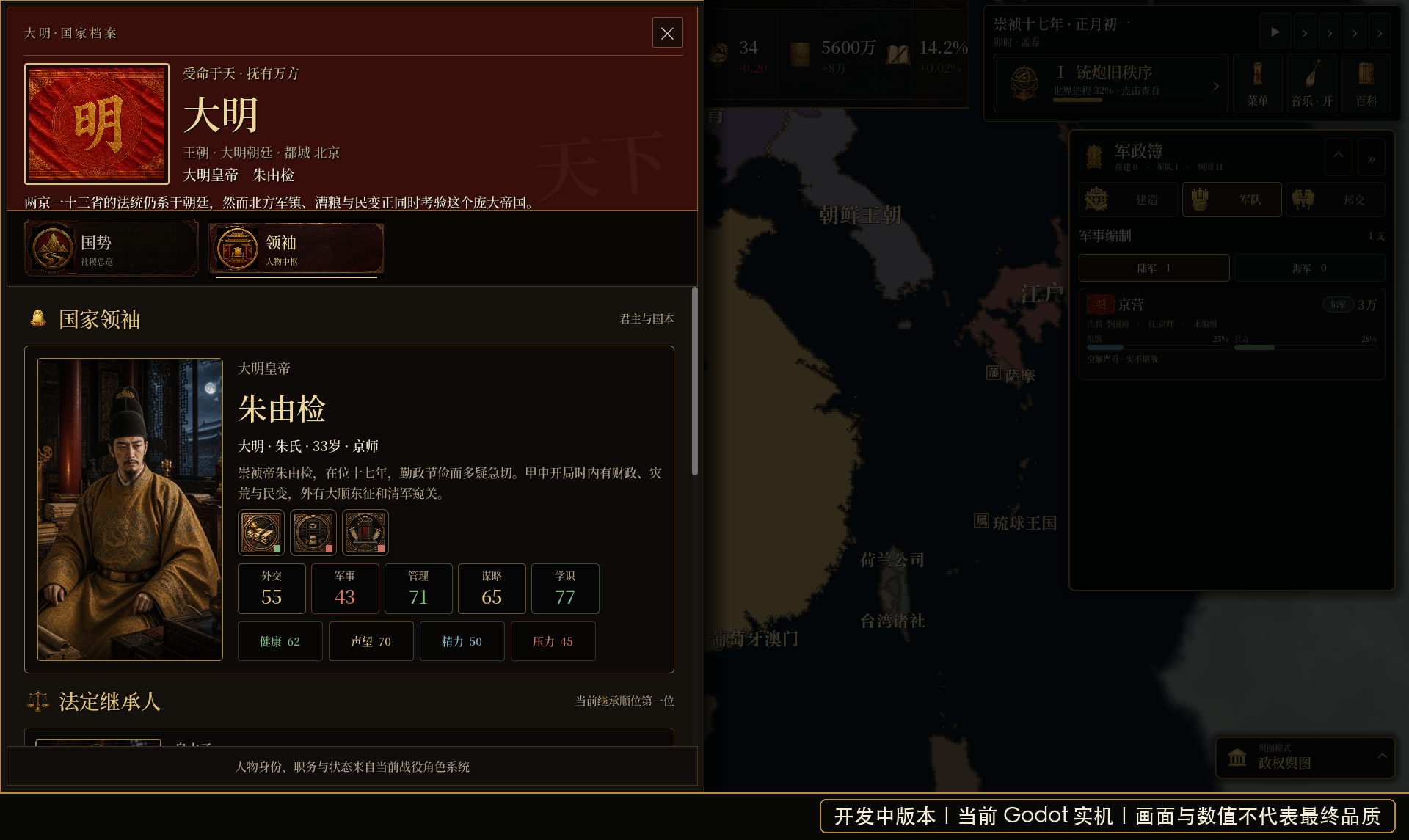
Current remake footage: the leader page in the Ming State Dossier. Identity, reign status, succession order, and character attributes now share one screen. For now, this remains primarily character data and presentation rather than a completed system of court politics and executive power.
Warfare is more than two stacks of numbers colliding. Recruitment, organization, training, commanders, pay, equipment, morale, terrain, roads, intelligence, and supply determine whether an army can arrive, fight, and continue operating after victory. War occupies land, destroys production, interrupts trade, and displaces populations; it also reshapes political power and diplomatic choices.
The economy is more than “treasury” and “economic scale” in the top bar. Households, land, labor, resources, production and consumption, storage, transport losses, local markets, taxation, public credit, and wartime finance must connect. A famine should not simply apply “income -10%.” It should alter output, grain prices, reserves, migration, unrest, and front-line supply. Emergency taxation may solve today’s crisis while damaging next year’s production, markets, and state credit.
Technology should not be an abstract currency spent to illuminate a fixed tree on schedule. Understanding a discovery, producing a craft, maintaining equipment, training personnel, and building the institutions and infrastructure needed for widespread adoption are different problems. Importing firearms is not the same as possessing a stable firearms industry. Seeing a machine does not mean that society has entered a new era. We want to distinguish discovery, introduction, production, diffusion, and institutionalization.
Diplomacy cannot be reduced to an opinion score and two buttons marked “declare war” and “make peace.” Alliances, tributary relations, investiture, vassalage, licensed trade, merchant concessions, local treaty networks, truces, access rights, and practical frontier control are not the same relationship. Ming investiture, Qing alliances with Mongol groups, Ryukyu’s overlapping relations, and commercial privileges held by maritime companies cannot all be forced into a single modern nation-state template.
These systems will support and constrain one another. Political organization determines how much tax and manpower a state can mobilize. Maritime commerce and public credit can finance standing institutions. Production and administrative capacity determine whether new knowledge becomes military power. Victories and defeats reshape domestic influence and international reputation. Treaties open markets, routes, and exchanges of knowledge, while war can destroy networks built over decades.
The current project already contains the State Dossier and leader pages; entry points for finance, markets, technology, and diplomacy; a Capital Army unit that accepts movement orders; and a campaign clock able to support daily, monthly, and yearly resolution. Era-state data already reserves signals for finance, shipping, industry, education, military organization, and social mobilization. The map distinguishes legal claim from practical control, records relations such as independence, alliance, tribute, and vassalage, and reserves data interfaces for maritime trade regions and treaty ports.
We also need to be explicit about what is not complete. Edict implementation, bureaucracy, and interest relations; battle, siege, and supply; fiscal ledgers, commodity markets, and logistics; interactive research, technological diffusion, and industrial upgrading; bilateral relations, treaties, war states, and negotiation are not yet complete gameplay loops. Current top-bar values, units, and faction conditions are campaign baselines and interfaces, not a closed simulation.
What We Mean by “Grand Strategy”
Grand strategy is not simply placing more numbers in the top bar, nor is it only painting a world map. Time, space, states, institutions, organizations, and people must all participate in one continuously operating system.
On the map, we are separating physical geography, historical administration, legal claims, practical control, combat cells, cities, routes, and army positions into distinct data layers. An administrative province is not automatically a battlefield, and a regime’s color must not redefine geography. Losing land, recovering it, marching, besieging, and supplying forces must eventually occur in the same computable world.
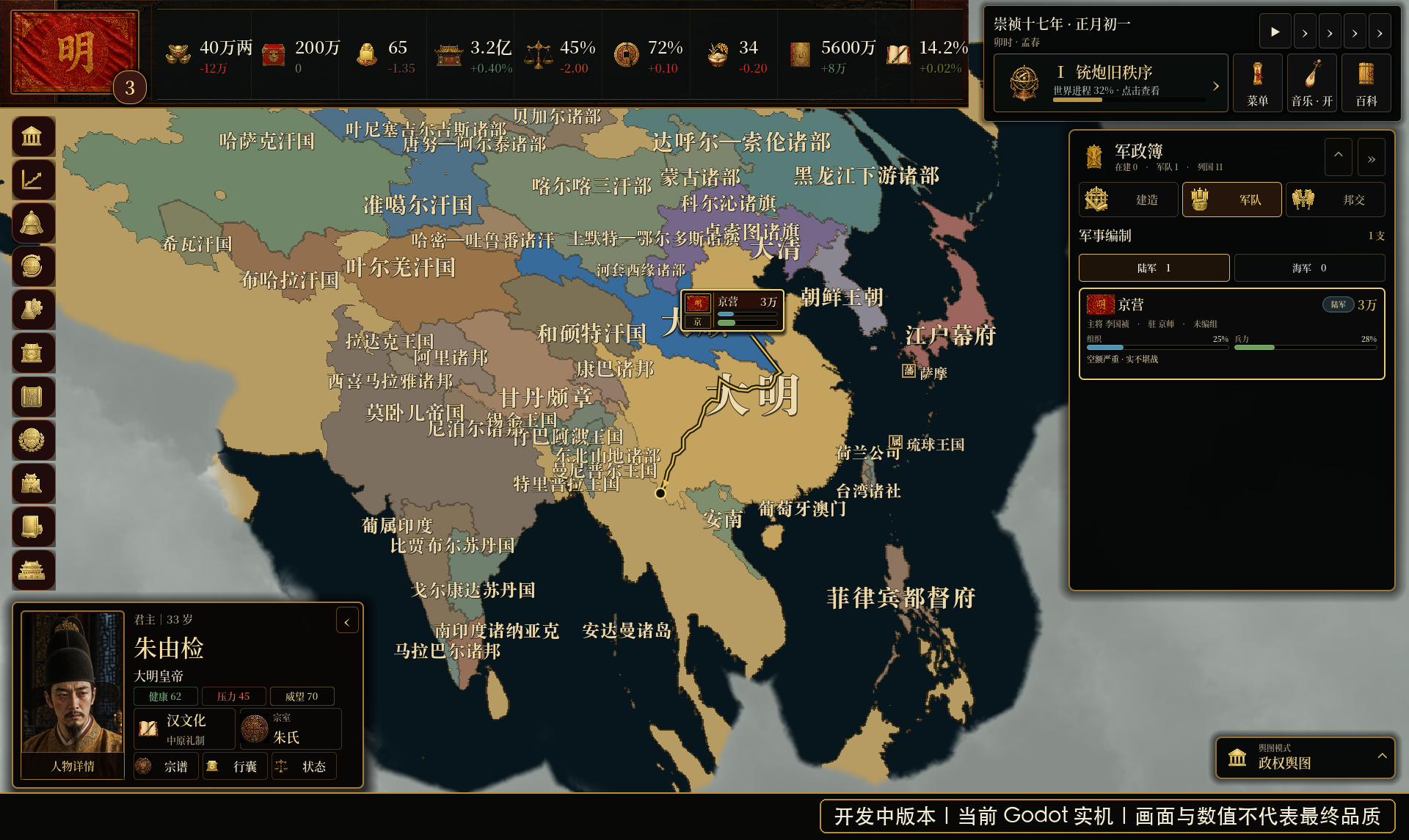
Current remake footage: after selecting the Capital Army and issuing a long-distance movement order toward the southwest, the game calculates and draws its route. This demonstrates the current unit-selection, pathfinding, and order pipeline. Combat, siege, supply, occupation, and AI military orders are not yet complete. Historical borders and cell identities remain under review and do not represent the final 1644 map.
A state cannot be only a container for modifiers. Emperors, imperial relatives, officials, generals, local elites, and ordinary people must occupy concrete institutional and material relationships. A policy cannot instantly cover the realm because the player pressed a button. It requires offices, personnel, money, information, and provincial cooperation, and may be delayed, resisted, or distorted.
History should provide initial conditions and real pressure, not a predetermined ending. The current Jiashen scenario begins on February 8, 1644, the first day of the first lunar month in Chongzhen’s seventeenth year. Knowing later history does not justify drawing the results of March and April onto the map in January. Whether Beijing falls, whether frontier commands defect, whether Shun can establish order, and how Qing enters the passes should be determined by a running world.
Jiashen Is the Starting Point, Not the Limit of the Engine
If a ruleset only works around 1644, it is not yet the historical world we ultimately want to build.
How a pre-industrial empire responds to expanding maritime commerce and finance; how machines, factories, and railways change production and warfare; how mass politics, national mobilization, and later technological societies reshape the state—these questions will not be turned into an exaggerated promise of dates today. They will, however, determine how we design population, economy, technology, institutions, military organization, and transitions between eras from the beginning.
The current project contains era data, world-progression state, and related interfaces. Era transitions are intended to follow material conditions such as industry, finance, military organization, public credit, and social mobilization rather than switch automatically on a calendar date. At present, this is still a framework of data and state, not proof that centuries of complete content already exist.
We will first make Jiashen—the most severe pressure test—work correctly, then give this world the capacity to continue beyond it.
Ming Is the Current Starting Position, Not the Only Perspective
The current Jiashen campaign fixes the player as Ming. Faction selection is not yet available. That is the present reality.
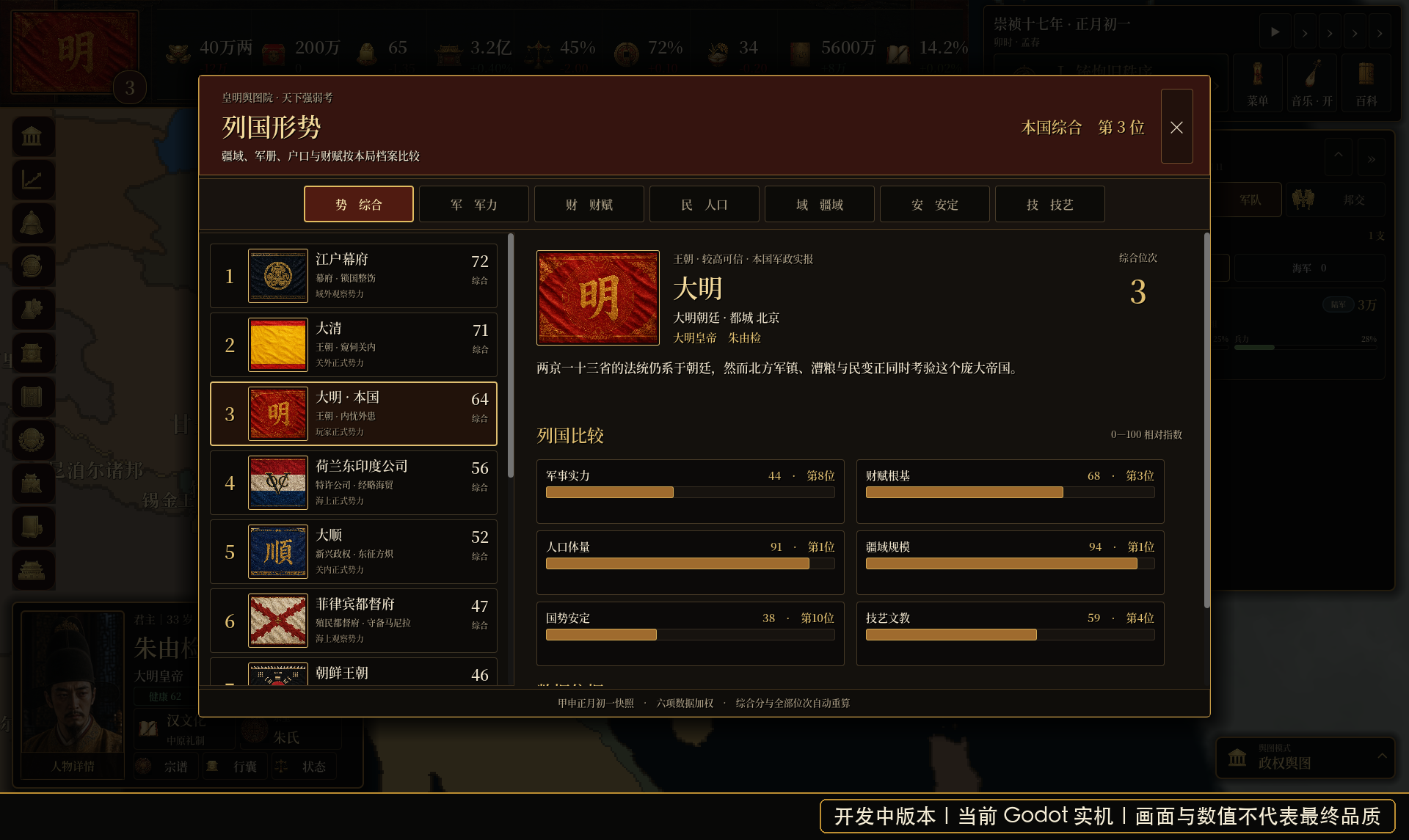
Current remake footage: the “Powers of the Realm” comparison screen places territorial extent, military strength, revenue, population, stability, and technical capacity in the same view. It is currently an observation and data-verification screen, not an available faction selector, and it does not imply that the economic, diplomatic, and technological systems beneath every indicator are complete.
In the final structure of the remake, Shun, Qing, and other regimes and regional powers should also be playable. A different faction must mean more than another map color and a different set of starting values. It should introduce a different structure of rule, resource position, strategic objective, and internal contradiction.
Players may try to rescue an old empire, but they should also be able to participate in creating a new order. Jiashen should be understandable from Beijing, but also from beyond the passes, from the rebel armies, frontier commands, regional governments, and the wider East Asian world.
Where Development Actually Stands
The remake now has a new main project built in Godot. Features currently running in-game include:
- A zoomable strategic map, map labels, and multiple data overlays;
- Campaign-start regimes, legal claims, and practical control for the Jiashen scenario;
- Campaign-time progression and some national-condition summaries derived from live map state;
- The State Dossier, national modifiers, and leader pages opened by clicking the flag;
- Selection, pathfinding, right-click movement orders, and time-based movement for the Capital Army;
- An era registry, world-progression state, and a player-faction context reserved for future multi-faction campaigns.
Equally important, the following are not yet complete gameplay:
- Attack, battle, siege, occupation, terrain, weather, and supply resolution;
- Sustainable population, finance, production, grain-price, market, and logistics systems;
- Edict implementation, bureaucracy, interest groups, legitimacy, and the complete political system;
- Interactive research, technological diffusion, conversion into production, and industrial upgrading;
- Bilateral relations, treaties, war states, and diplomatic negotiation;
- Faction selection, saving, and loading;
- Final historical calibration of borders, cell identities, victory points, and starting control across the whole map;
- Final verification of the complete character and asset set.
Several departmental entries in the present interface are connection points, not finished systems. Some national values in the screenshots are campaign-start baselines used to verify interface and state pipelines. We will not present them as complete.
Multi-platform support has also been an engineering goal from the beginning. Core rules, data, and interaction should not be locked to one operating system or storefront. This is an architectural principle and release direction, not a confirmed platform schedule.
Closing Thoughts
Jiashen was a year in which military, fiscal, political, social, and diplomatic pressures reached the same point at once. That is precisely why it is a demanding starting scenario for a grand strategy game.
Our next task is not to generate even more dramatic passages. It is to make every dramatic result originate in a real chain of causes.
Not to ask players to guess the AI’s next paragraph, but to let them understand how a world operates, make their own decisions, and personally bear the history those decisions create.
That is our vision for the grand strategy remake of Ming: The Jiashen Year.
This is Developer Diary #0, not a feature checklist for an imminent release. Screenshots show the current state of development. Interfaces, values, systems, maps, and presentation will continue to change.
Thank you for following Ming: The Jiashen Year. Future developer diaries will examine map data, the Jiashen starting situation, state resolution, military movement, and how legacy content is being rebuilt inside the new ruleset.