
Hello everyone, and welcome to my very first development diary for Master of the Ages!
The core tenets of my design — historical realism and a radical reduction of micromanagement — forced me to confront one of the genre's oldest and least-questioned sacred cows: Gold.
The Illusion of the Treasury
Look closely and most 4X games run on two currencies at once. The first is Production — the hammers or materials a city earns, spendable only on what that city can build, impossible to stockpile or ship elsewhere. The second is Gold — earned everywhere, hoarded forever, spent anywhere, and (here's the tell) convertible straight back into Production the moment you rush-buy something.
But these two are the same thing. Both are nothing more than your command over physical resources and labor. Production is that command with honest constraints, bound to a place and a moment. Gold is the very same command without the constraints: a time machine and a teleportation device. You bank centuries of revenue, then the instant a frontier is threatened you rush-buy a garrison there, paying with wealth generated an ocean away and decades earlier.
And a nation's true power is not the size of its treasury — it is the physical capacity of its land and its people. That capacity is perishable: if a state-run forge sits idle today because its workers are commanded elsewhere, its potential output is gone forever — it cannot run double tomorrow to recover it. The products of labor can be stockpiled; the labor itself cannot.
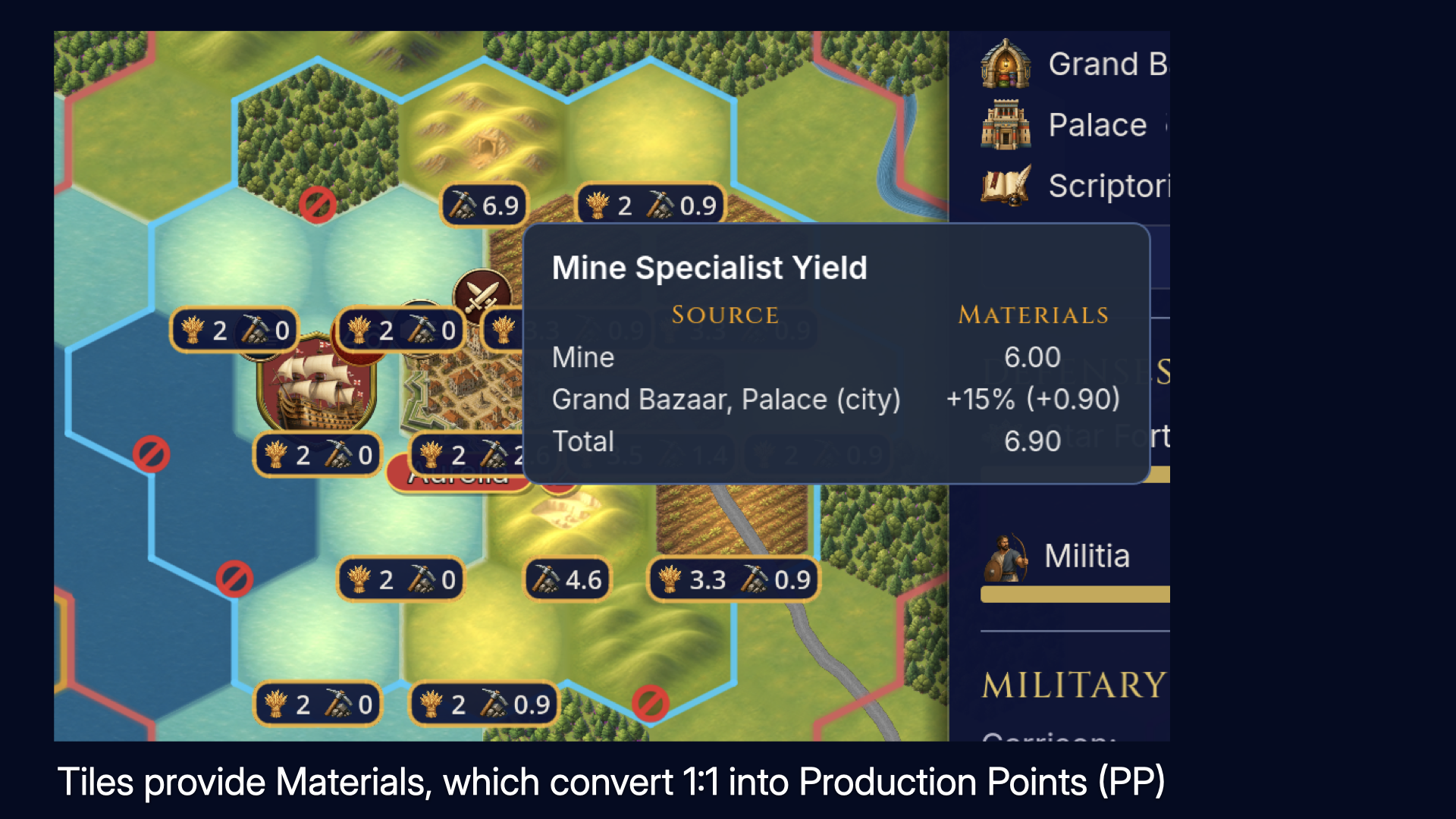
So the flaw was never "gold" itself. It was keeping a second currency at all — one allowed to ignore the physical limits the first has to obey. The fix isn't to ban money; it's to fold both into a single resource that plays by one set of rules.
The one real exception is trade — buying distant goods with your wealth — but that is a system for another devlog, and it needs a willing seller you won't always have.
Money hasn't vanished, either. Your citizens still trade and lend in the streets below, and taxes are still gathered there — you have simply stopped governing at that altitude. Master of the Ages works one level up, at the layer of the physical goods money is a claim on.
Enter Production Points (PP)
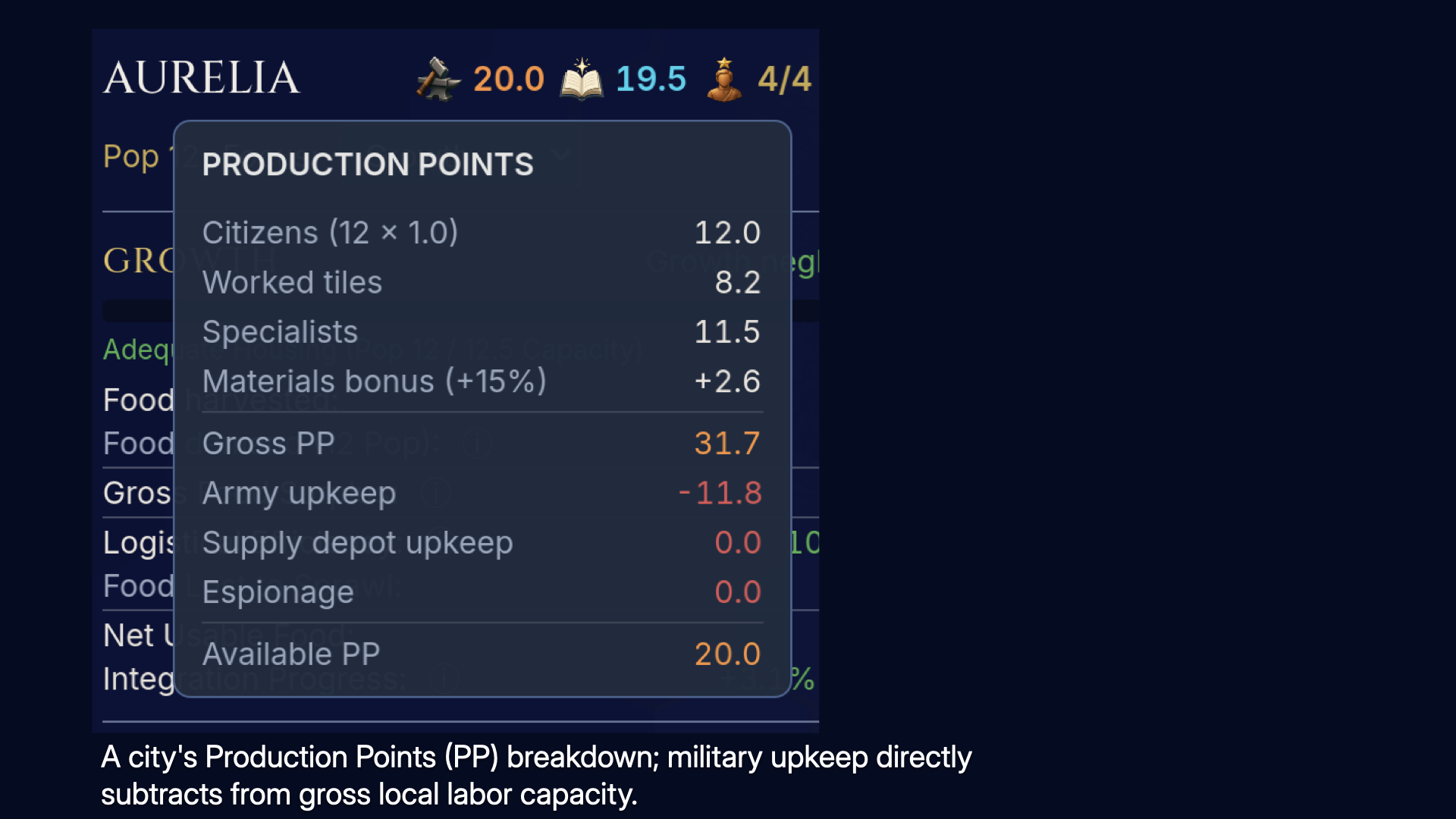
That layer runs on a single resource: Production Points (PP) — the raw materials, infrastructure, and labor your cities generate every turn. It behaves the way real capacity must: it cannot be banked, and it travels no faster than your roads and supply lines will carry it.
Here is how that reshapes your grand strategy:
No Wasted Effort: Because time never pauses, your cities are always working. Whatever your construction queues don't consume flows automatically into research or infrastructure — a peaceful empire naturally grows into an enlightened one. But once a city reaches its Scholarly Capacity, diminishing returns set in; a society cannot function if every citizen abandons the fields for the library.
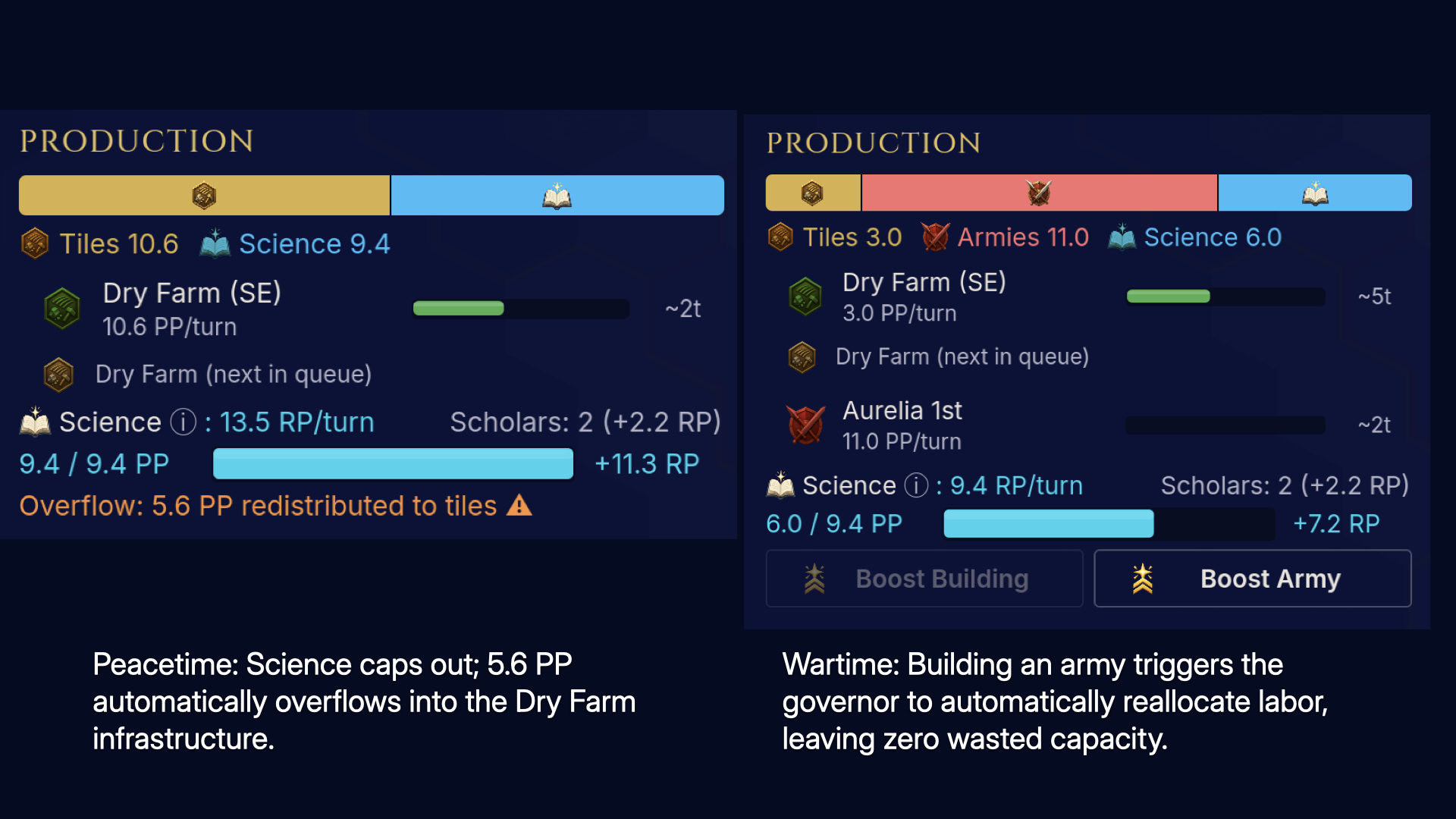
Physical Logistics: You cannot conjure an army from thin air — you must build it. When crisis strikes, there is no treasury to raid; instead you order a Boost, throwing up to 90% of a city's industrial capacity behind a single urgent project.
Real Economic Weight: Buildings are one-time investments, not perpetual liabilities — once raised, a structure simply works. (Charging rent forever on a granary you finished two hundred turns ago is precisely the bookkeeping this game deletes.) What does carry an ongoing cost is what always has: bodies under arms, and minds kept out of the labor pool. A standing army must be supplied and a class of scholars must be fed, breakthrough or no breakthrough, and that upkeep comes off the top of a city's output before anything else is allocated. Field a vast military or a sprawling academic elite, and your material growth slows accordingly.
The Domino Effect: How PP Rewrites the 4X Rulebook
The End of the Safe "Tall" Empire: In many traditional 4X games, a compact empire of a few highly developed cities can neglect its military entirely and still feel safe, trusting a global treasury to conjure defenders the instant a threat appears. A pure physical economy removes that safety net. Without a sprawling labor pool to draw on, you simply cannot buy your way past your infrastructure's physical limits when a border is breached — and clever technology or defensible terrain can stretch a small nation only so far against a larger rival turning raw capacity into arms.
Geographic Specialization & High-Stakes Vulnerability: When capacity is tied directly to the physical land, an empire naturally develops specialized industrial sectors. A mountain-heavy border city becomes your primary military forge, while a lush river valley becomes an academic hub. If an enemy cuts off or captures that specific forging city, you can't just open a magical global bank account to instantly spin up its replacement somewhere else. Losing a territory means losing a specific piece of your empire's physical body.
True Diplomatic Realpolitik: Diplomacy shifts away from sending abstract gifts of gold to manipulate rival neighbors. Instead, treaties have to be grounded in real material trade-offs: trading actual resource yields, arms, intelligence, or luxury goods that directly impact citizen productivity.
By collapsing gold and production into a single resource that obeys the physical world, Master of the Ages turns the economy from a passive spreadsheet into an active, high-stakes game of macro logistics and strategic geography.
So: what do you make of a 4X economy that runs on one currency instead of two? Does merging gold into production feel right to you, or do you think the genre needs its treasury? I would love to hear your thoughts in the comments below.
Join the Journey
Master of the Ages is still in active development, and I want to shape these mechanics alongside the players.
💥 Wishlist Master of the Ages on Steam to show your support and get notified of future updates!
🧭 Join our Official Discord Server to chat directly with me about design philosophy, historical realism, and upcoming alpha playtests.
Thank you for reading, and I'll see you in the next update.