
Flynn selected the cheaper flight.
“Four seats together?” Lina asked.
“Seat selection costs extra.”
“With two children, I’d rather know where everyone is sitting.”
Flynn added the seats.
“One checked bag is included,” he said. “The extra carry-ons aren’t.”
“We can share two.”
“Meal?”
Lina checked the fare details. “Nothing included. They sell food onboard.”
Flynn looked at the new total.
“Still cheaper.”
“Then keep going.”
The fare may be the first number a passenger sees. The product decides what that fare buys. In Flightline, the player makes both decisions.
What the fare includes
An airline can bundle bags, meals, and seat selection into the ticket, or lower the base fare and sell add-ons unbundled. Both are valid approaches.
A passenger traveling alone for a weekend may want little more than a seat and a personal item. Flynn and Lina are buying four tickets, want to sit together, and have enough luggage for a family trip. The low-cost base fare still appeals to them, but their booking decision depends on the final checkout total rather than the advertised headline price.
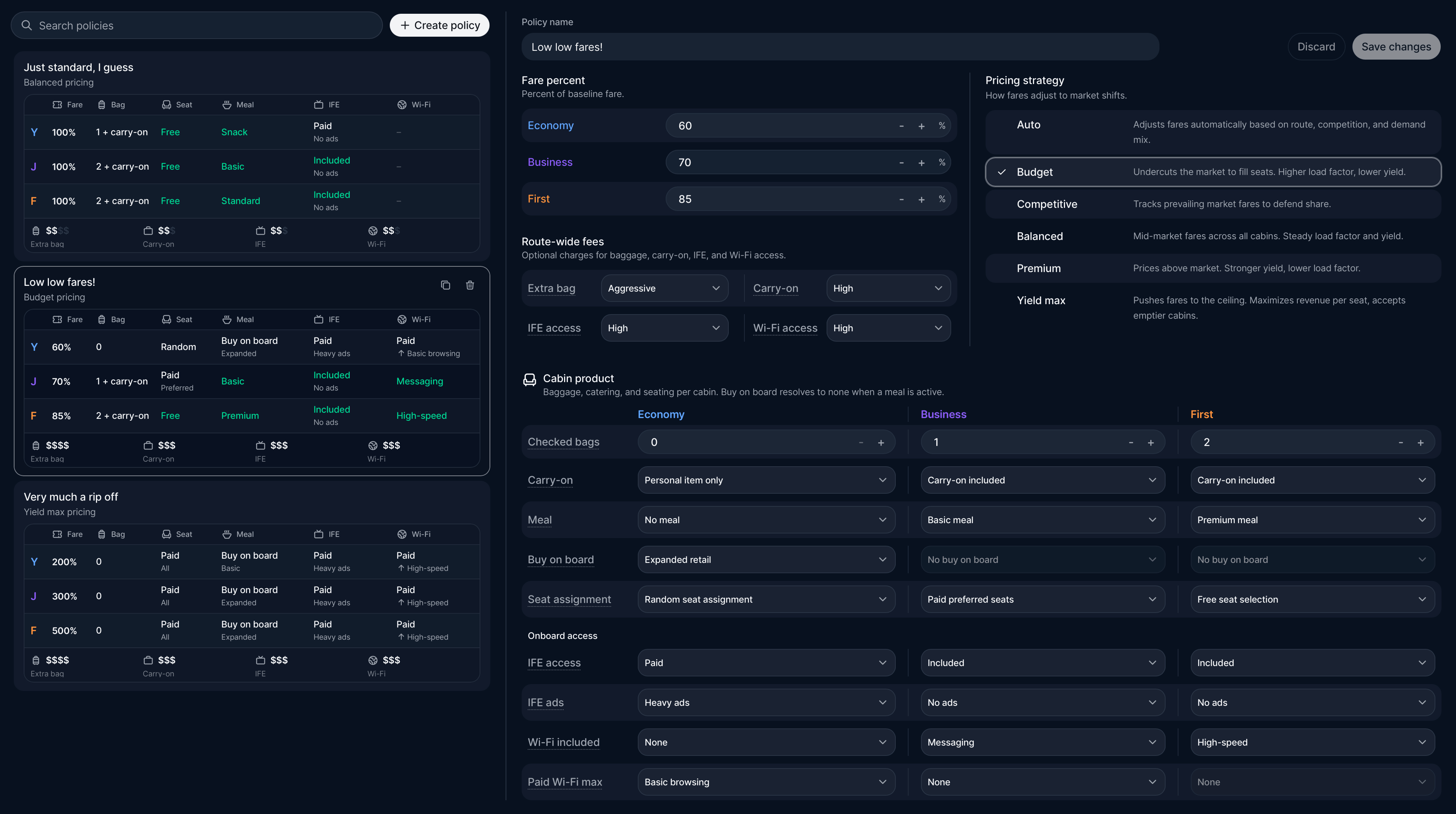
Players build these offers through Commercial Policies. Each policy combines pricing with a Cabin Product for Economy, Business, and First.
The player chooses how many checked bags come with the fare, whether extra carry-ons are included, and how seats are assigned. Free selection gives passengers more control. Paid selection brings in additional revenue. Random assignment keeps the base fare accessible for price-sensitive passengers who do not mind where they sit.
Catering follows the same logic. A cabin can offer no complimentary service, a light snack, a full meal, or dine on demand. When food is unbundled, the airline can operate a buy-on-board retail service instead. Complimentary meals increase operating costs, while retail catering generates revenue balanced against inventory waste and handling expenses.
Setting the product by cabin
Economy, Business, and First do not need to receive the same package. An airline might sell a stripped-back Economy fare while including two checked bags, a premium meal, and free seat selection in Business. First could add dine-on-demand service and another level of flexibility.
Expectations also vary by market. A 45-minute domestic hopper may only warrant water and a light snack. On a long overnight journey, passengers expect a proper meal and enough entertainment to fill several hours.
Flynn pointed at the Business fare.
“They get two bags, a meal, and free seat selection.”
“They also paid a lot more than we did.”
“But their lunch is included.”
Lina looked at him. “You are not upgrading four people for lunch.”
“I was comparing.”
“You were hovering over the button.”
Route-wide Fees define ancillary pricing across the network. These cover extra bags, carry-ons, paid entertainment, and Wi-Fi data access.
The cabin product decides who needs to pay. If Business already includes two bags, the extra-bag fee only applies after those are used. If Economy includes entertainment, those passengers bypass the IFE access charge.
Higher ancillary fees increase revenue per transaction, but fewer passengers will choose to pay for them. Travelers who opt out fly without the perk entirely, missing amenities that directly improve their satisfaction ratings. The challenge is balancing ancillary profit against the passenger experience.
What is available on board
After takeoff, Flynn tapped the screen in front of him.
“At least there are movies.”
Lina looked at the welcome page.
“Entertainment costs extra.”
“There is already a screen.”
“The seat existed too. We still paid to choose it.”
Flynn opened the entertainment menu.
“Fair point.”
Hardware only provides the capability. The airline must license media catalogs, and commercial policy dictates whether access is complimentary or behind a paywall.
Cabin configurations can carry seatback screens, shared overhead displays, in-seat power, Wi-Fi hardware, and Live TV tuners. An operator without seatback monitors can stream video directly to passenger phones and tablets via an onboard wireless portal. Hardware also sets operational limits: narrow-band satellite gear cannot deliver high-speed streaming, and Live TV requires dedicated receiver antennas.
The player configures reusable Onboard Experience Profiles to set what is available across five categories:
• Trip info: ranges from a simple moving map to detailed flight guides with landmarks and points of interest.
• Movies & TV: from no video at all to classic back-catalogs or first-run releases.
• Music & audio: curated playlists, podcasts, and audiobooks.
• Kids & family: cartoons, educational content, and interactive games.
• Live TV: real-time news and sports broadcasts, configured per cabin class.
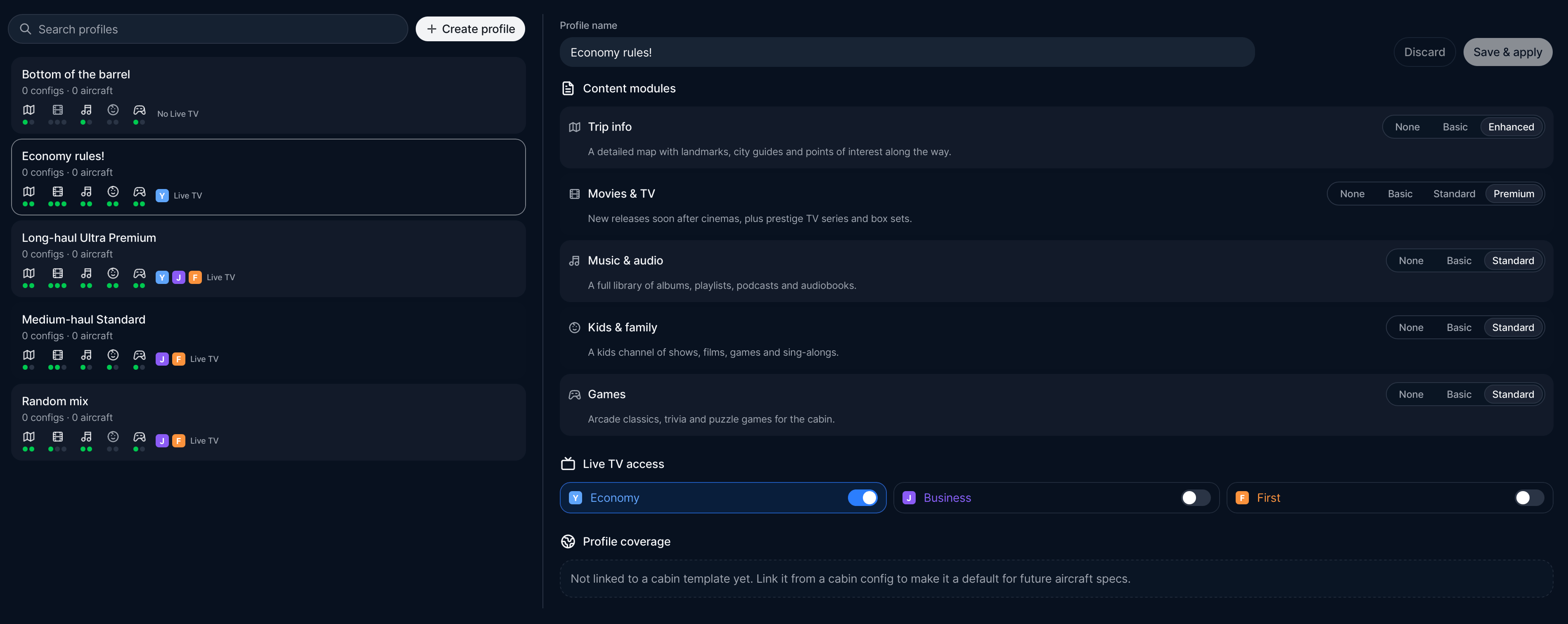
A short-haul airline may decide that a moving map and a wireless BYOD portal are enough. A long-haul carrier can invest in seatback screens, broad movie libraries, universal power outlets, and Live TV broadcasts. Both configurations carry capital and operating costs; the goal is matching onboard investment with passenger expectations.
Included, paid, or supported by ads
Providing entertainment does not require the airline to give everything away. IFE access can be bundled into specific cabin fares or gated behind per-flight access fees. Wi-Fi can include anything from messaging to high-speed access, while faster tiers can remain available as paid upgrades. Airlines can also monetize the system through sponsored content and pre-roll video ads, though high ad frequency reduces passenger satisfaction scores.
Flynn checked the Wi-Fi options.
“Messaging is included.”
“That should be enough.”
“High-speed costs extra.”
“What do you need high-speed for?”
“The movie library costs extra too.”
Lina paused.
“You forgot to download something.”
“I downloaded cartoons for the children.”
“And for yourself?”
Flynn looked back at the payment screen.
“No.”
Different business models demand different product mixes. A low-cost carrier strips inclusions to maintain a rock-bottom headline fare, letting price-conscious travelers purchase only the extras they prioritize. A full-service airline bundles luggage, catering, entertainment, and Wi-Fi into the ticket price, recovering the expenditure through higher yields.
Many carriers operate hybrid strategies: unbundling short domestic routes while maintaining comprehensive inclusions on long-haul sectors, or offering free basic messaging alongside paid high-speed passes.
After the flight
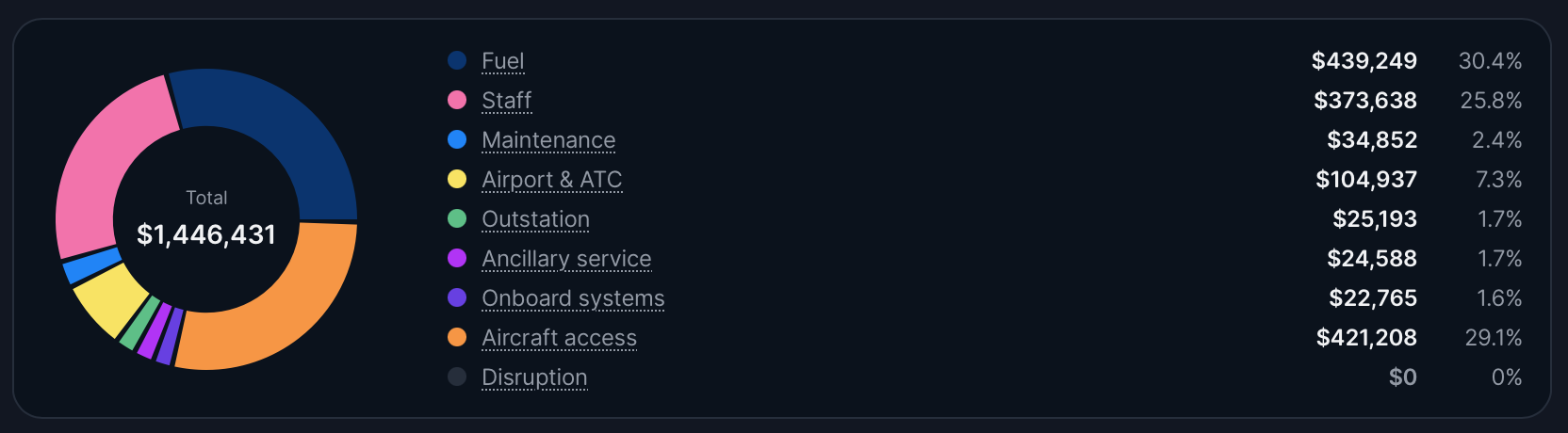
Ancillary revenue is only useful when the wider route economics still makes sense. Flightline tracks these financial streams in Route Analytics, detailing ancillary breakdown by source, catering, cost per seat, and net ancillary yield per passenger across each cabin tier.
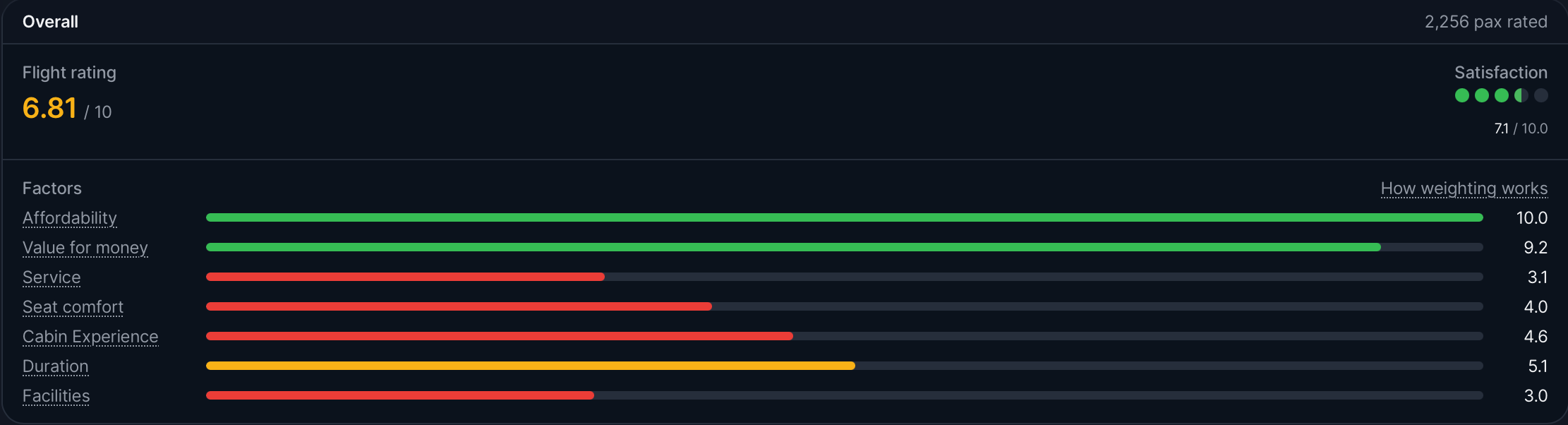
Passengers also evaluate what they received. Meals, bags, carry-ons, seat choice, and onboard retail contribute to Service. Screens, content depth, Wi-Fi speed, seat power availability, and ad frequency drive Cabin Experience scores. A bare-bones ticket cuts operating overhead but risks lower service scores, while an overly generous package can easily outspend what passengers are willing to pay.
The passenger sees a series of small choices. The airline sees their combined result.
Later in the flight, Lina glanced at Flynn’s screen.
“Did you buy the movie?”
Flynn looked at the middle seat, then at the remaining flight time.
“Yes.”
“Still cheaper?”
He checked the total one more time.
“Ask me after the movie.”