
A few months after their London trip, Flynn and Lina were comparing flights again.
“This one uses the same kind of plane we took to London,” Flynn said.
“Then why does it have another seat in every row?”
Flynn leaned closer to the screen.
“You’re right.”
Lina switched between the seat maps.
“The other flight has fewer seats, but it costs more.”
“For the four of us, the cheaper one is still hard to ignore.”
“I know,” Lina said. “I just want to know what we’re buying.”
An aircraft model provides the available space. The airline decides what to put inside it.
Configuring the cabin
Every aircraft model in Flightline has its own cabin dimensions, decks, doors, and exit limit. The Cabin Configuration editor works within those boundaries.
The player divides the available space between Economy, Business, and First. Move a divider and the seat map updates. Give Business more space and Economy might lose several rows.
Pitch and width matter too. More pitch gives passengers extra legroom but leaves space for fewer rows. Wider seats may change how many can fit across the aircraft. The extra space always has to come from somewhere else in the cabin.
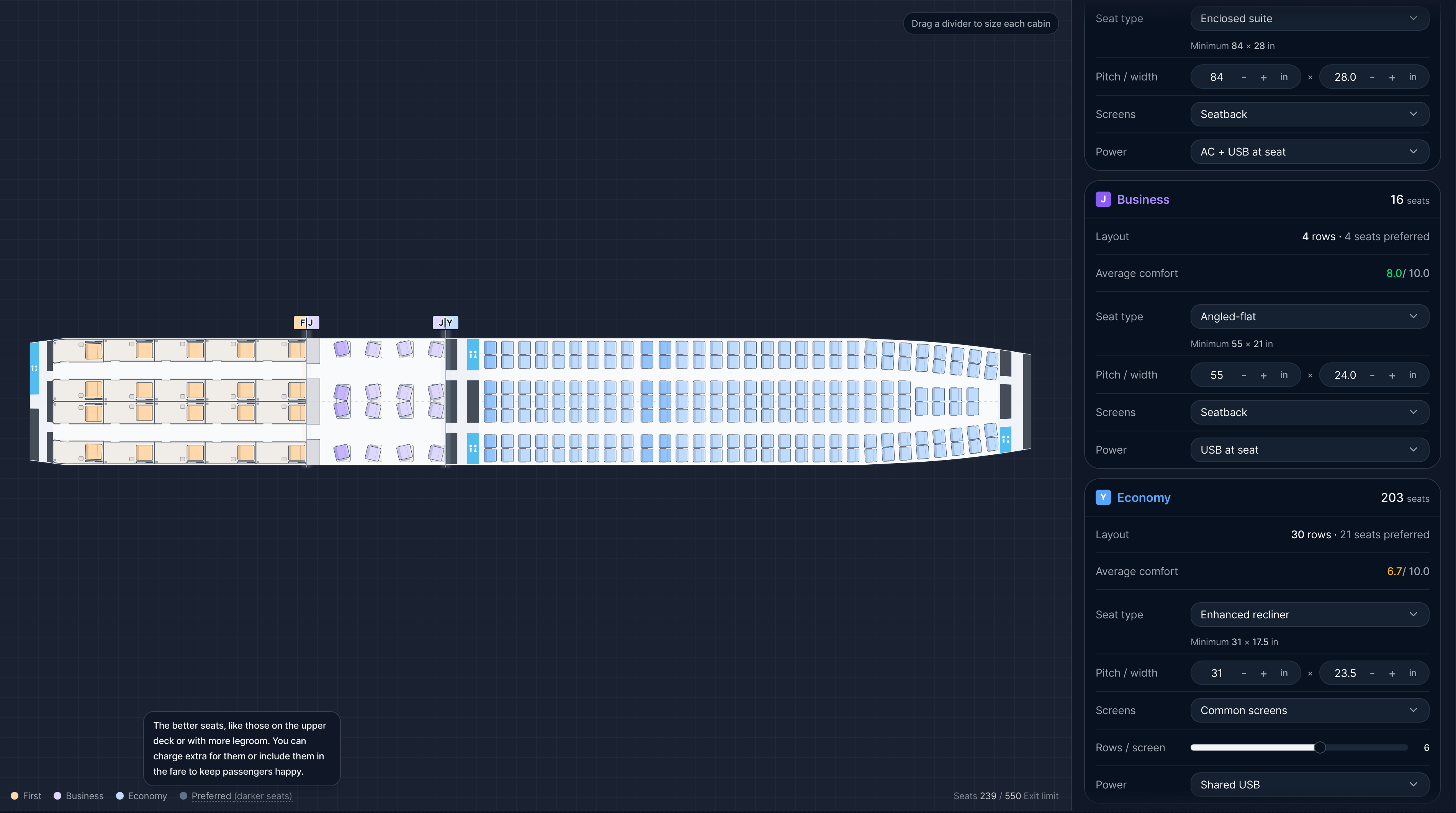
The editor shows how many seats fit in each cabin and how many rows have been placed. It also identifies preferred positions and calculates Average Comfort separately for Economy, Business, and First.
The exit limit is a ceiling rather than a target. Players can build towards it, but space and comfort for each passenger will decrease accordingly.
Matching capacity to demand
Cabin configuration determines how much capacity the airline offers. The market determines how much of that capacity passengers want.
A dense Economy cabin can carry more people on a route with strong leisure demand. If those seats sell, the aircraft earns more from the same flight. Empty rows earn nothing.
A larger Business or First cabin makes a different bet. Each premium seat occupies more of the fuselage, leaving fewer seats to sell elsewhere. The market needs enough premium demand to support the space they consume.
A layout built to pack in as many seats as possible may be uncomfortable for a long flight. A premium-heavy cabin can waste valuable space when most passengers are looking for budget-friendly seats.
“Both are economy,” Flynn pointed out, leaning over her screen. “Would you pay more just to not feel cramped?””
Lina checked the total for four tickets.
“For one ticket, maybe.”
“And for four?”
“That’s out of our budget.”
Choosing the seats
Flynn opened the cabin details.
“Slimline fixed, slimline recliner, standard recliner.”
Lina looked over his shoulder. “Those sound like three different ways of saying Economy.”
“Business has a regional recliner, angled-flat, lie-flat, and a suite.”
“What does angled-flat mean?”
“Flat, but at an angle.”
“You don’t say. So you slowly slide towards the floor?”
Flynn looked at the price. “For this fare, apparently with dignity.”
Economy, Business, and First describe the cabins being sold. The seat type determines what passengers actually find inside them.
Flightline includes slimline and standard Economy seats, regional and long-haul recliners, angled-flat and lie-flat Business seats, and suites for airlines that want to devote even more space to each passenger.
Each type has a minimum pitch and width. Players can provide more space, but they cannot squeeze a large lie-flat seat into the space meant for a slimline Economy seat.
A suite takes up far more of the cabin than a recliner. In return, it offers a different level of comfort and a product that can support a higher fare when the market is there.
The player decides the tradeoff: a seat can be the bare minimum to maximize the occupancy, or give passengers more space to stretch while sacrificing the passenger volume.
Saving different configurations
The same aircraft model may serve several parts of an airline’s network.
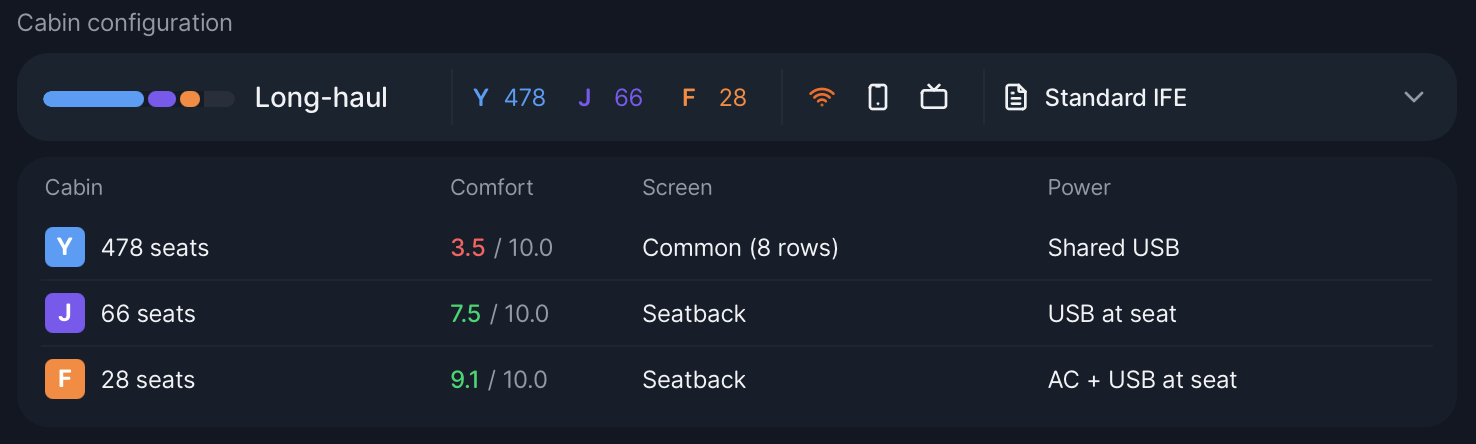
Flightline allows players to save multiple cabin configurations for each model. One layout might carry a large Economy cabin for leisure routes. Another version of the same aircraft could reserve more space for lie-flat Business seats.
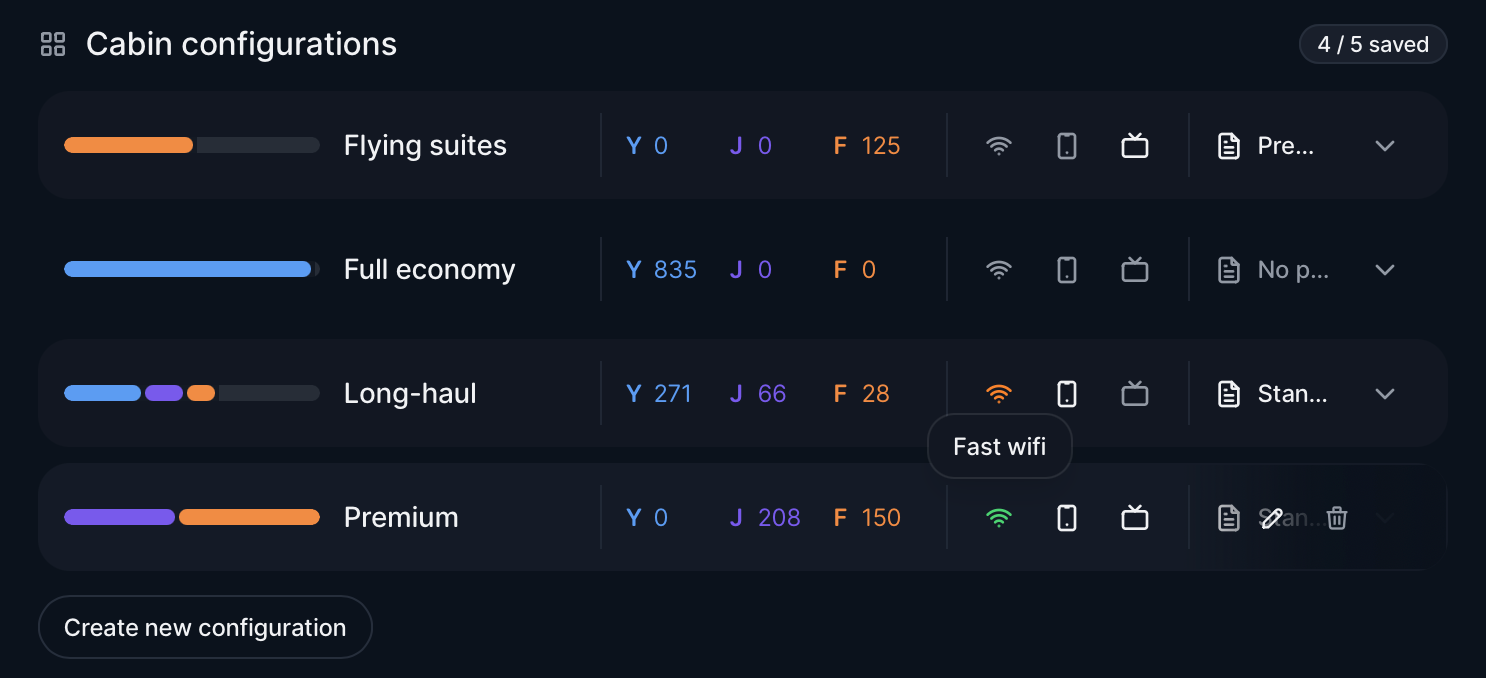
An aircraft prepared for a premium long-haul route will not rearrange itself when the airline schedules it elsewhere. The player must decide whether its existing cabin still suits the new market.
The airline can keep operating an imperfect layout, pay for a refit, move another aircraft onto the route, or wait for a future delivery with the cabin it needs.
Comfort in the sky
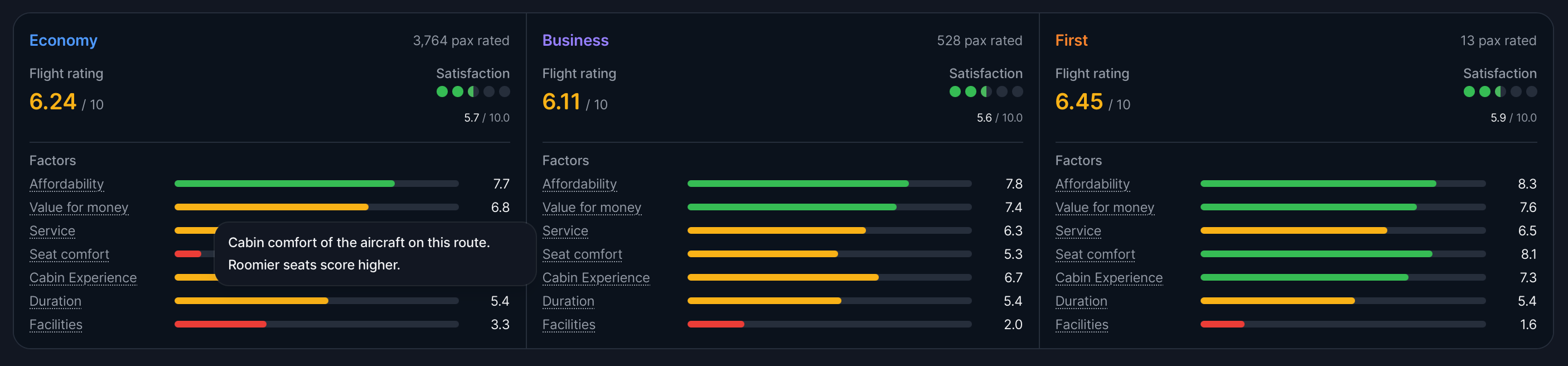
Flightline records Seat Comfort among the factors in Route Analytics. Roomier seats score better, while tighter layouts ask passengers to accept less space.
Comfort remains one part of their journey. Fare, schedule, service, journey time, and airport facilities also shape how passengers feel about the flight.
A cheaper ticket may still win when the cabin is tighter and duration is shorter. Someone travelling alone may pay more for extra space, whereas a family buying four long-haul tickets has to multiply that cost, making the cheaper, tighter seats hard to turn down.
Flynn looked at the two flights again.
“So, which one are we booking?”
“The cheaper one.”
“You just spent ten minutes telling me how cramped it is.”
“I know. There are four of us.”
Lina handed him the laptop.
“You can take the middle seat.”