
“JFK to Heathrow is the obvious one,” Lina said, turning the laptop towards Flynn.
“Obvious for the flight, maybe. Your sister lives south of London.”
“Fine. Then JFK to Gatwick.”
“What about Newark? This one is cheaper.”
Lina looked at him. “From Brooklyn? With two kids? We’d spend half the morning getting to the airport.”
“What about LaGuardia? It’s closer.”
“Not if we have to change in Boston.”
They stared at the screen for a moment.
“Okay,” Flynn said. “Start again.”
We built Flightline’s demand system around arguments like this.
Passengers are not trying to travel from one airport code to another. They are trying to get from where they live to where they need to be. The airport is only one part of that journey.
The choice starts before the airport
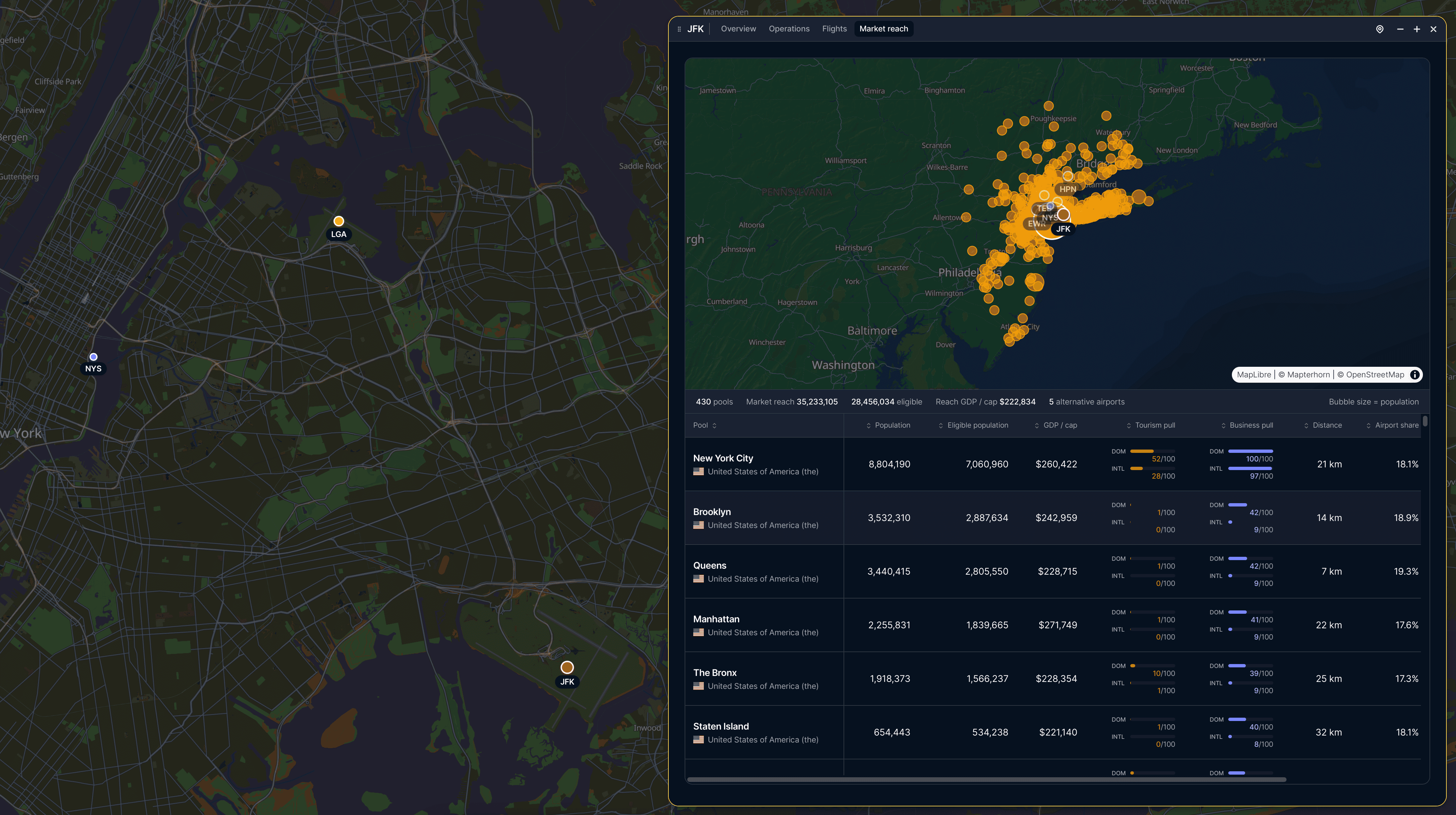
New York has several airports, and their markets overlap. The same is true around London.
That does not mean every traveler considers every airport equally. Each airport reaches a different mix of people. Some home pools have strong access to several airports. Others have just one practical choice.
In Flightline, demand begins in these home pools. They represent the places where passengers start their journeys and the places they want to reach.
A traveler in the New York area might consider JFK, Newark, or LaGuardia. On the other side of the Atlantic, Heathrow, Gatwick, London City, Stansted, and Luton serve overlapping parts of the London market.
Lina pointed back to JFK.
“This still makes the most sense for us.”
“Then let’s compare Heathrow and Gatwick,” Flynn said.
Their decision does not represent every traveler in New York. Someone living elsewhere may find Newark easier. Another passenger may accept the LaGuardia connection for a lower fare. A third may care more about arriving at Heathrow than about which New York airport they use.
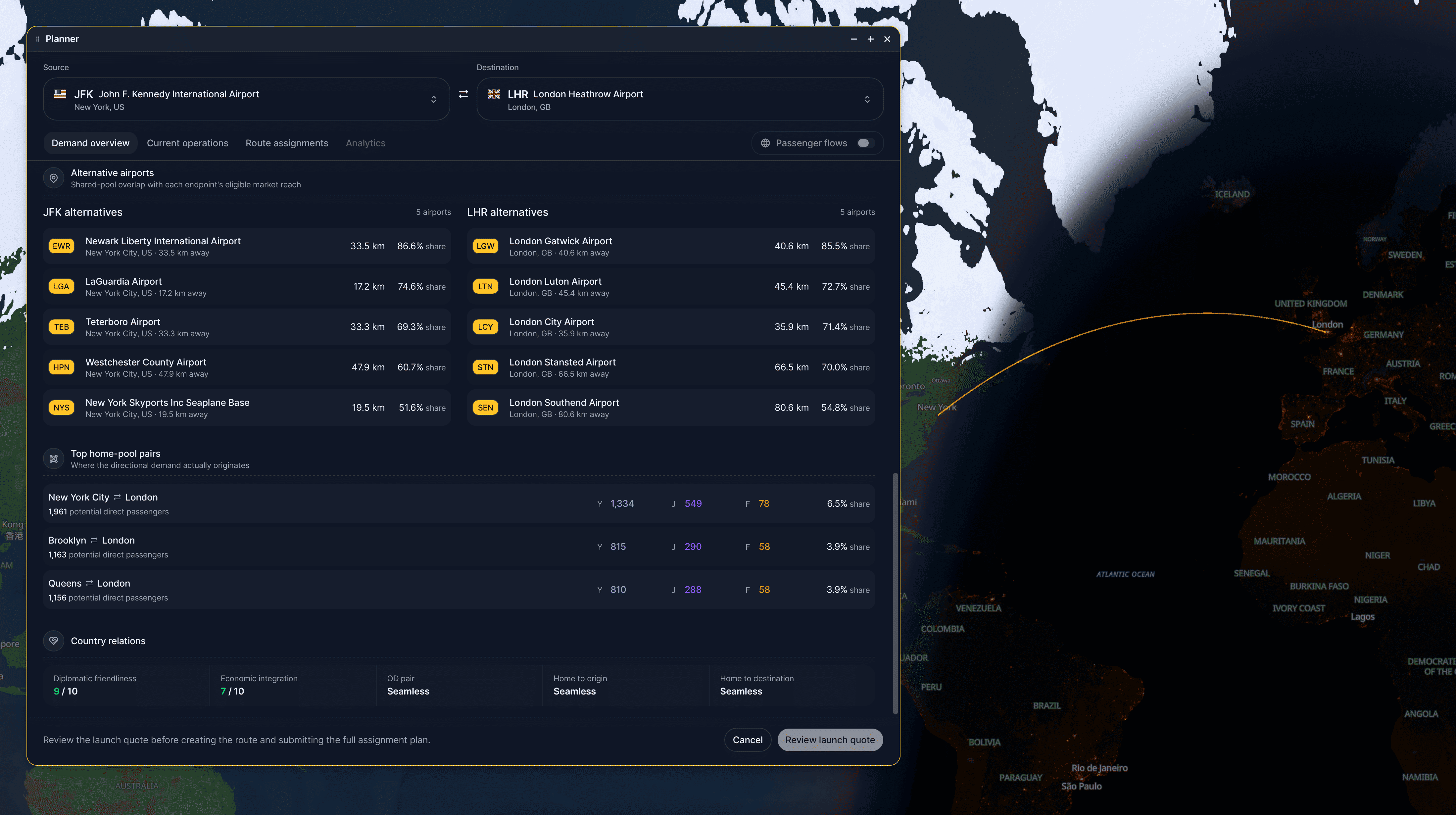
The Route Planner exposes some of this through Alternative Airports and Top Home-Pool Pairs. These are not decorative suggestions. They show where nearby airports draw from overlapping sources of demand.
One market, several airport pairs
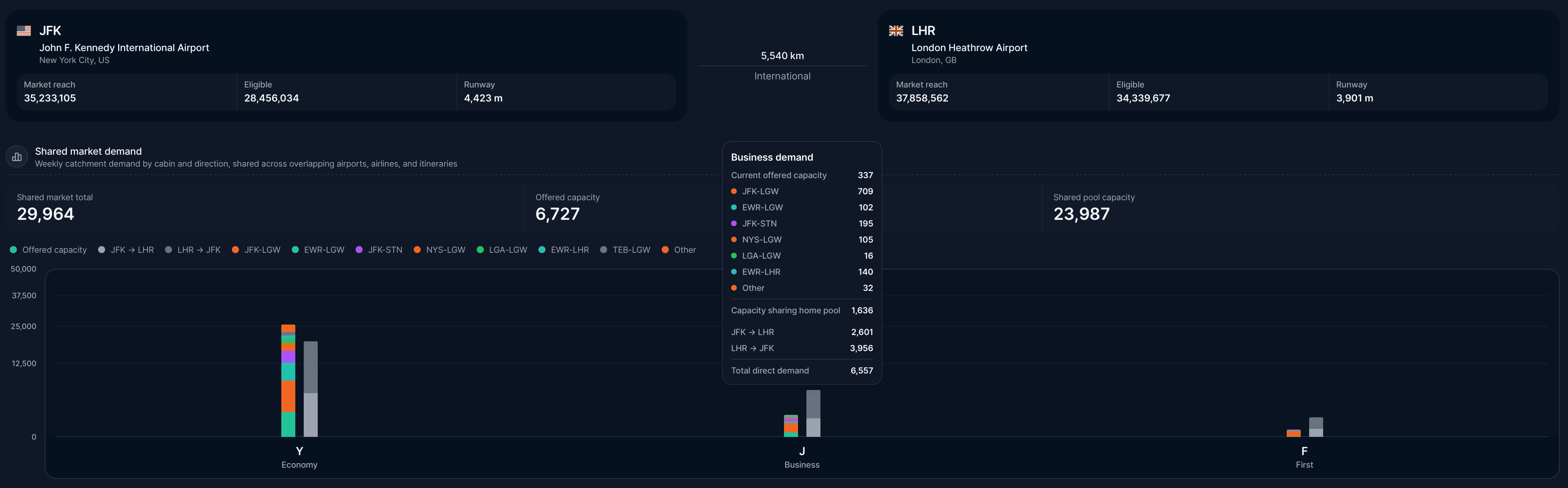
Open JFK to Heathrow in the Route Planner and the Shared Market Demand panel shows the weekly potential by cabin and direction.
That demand does not belong exclusively to JFK, Heathrow, or one airline.
Suppose JFK to Heathrow and Newark to Heathrow already have service. A new JFK to Gatwick flight does not arrive with a completely separate group of passengers waiting for it. Much of its potential demand overlaps with the passengers already considering those other flights.
“Would anyone really choose Gatwick over Heathrow?” Lina asked.
Flynn looked at her. “We might.”
That is the point.
The Gatwick flight could give some passengers better access to their destination. It could offer a more convenient departure, a lower fare, more available seats, or a better overall journey. Those advantages give it a chance to attract passengers from the shared market.
Open JFK to Heathrow in the Route Planner and the Shared Market Demand panel shows the weekly potential by cabin. That demand does not belong exclusively to JFK, Heathrow, or one airline.
Adding JFK to Gatwick does not create another New York to London market. Many passengers who could use that flight were already considering JFK to Heathrow, Newark to Heathrow, or another journey between the two cities.
The new flight gives them another choice. It may serve passengers who could not find an acceptable journey before. It may attract passengers from existing flights. Others may ignore it completely. If it offers no meaningful advantage, having seats available will not be enough.
Routes and their core market demand in Flightline are bidirectional. You are not building one market to London and another back to New York. You are building one service between two airport markets.
Cabin demand still matters. Economy, Business, and First each draw from their own demand, so the aircraft must offer the right capacity for the market it serves.
Connections, or no connections, that is the question
Flynn found another option.
“LaGuardia to Boston, then Boston to Heathrow.”
“It costs less,” he said.
“And adds a connection.”
“LaGuardia is closer.”
“Boston isn’t.”
Flightline compares complete journeys, not isolated flights.
A nonstop starts with a natural advantage because it avoids a transfer. A connection can still compete if the overall journey makes sense. Perhaps it is cheaper. Perhaps the schedule is better. Perhaps the nonstop flights are full.
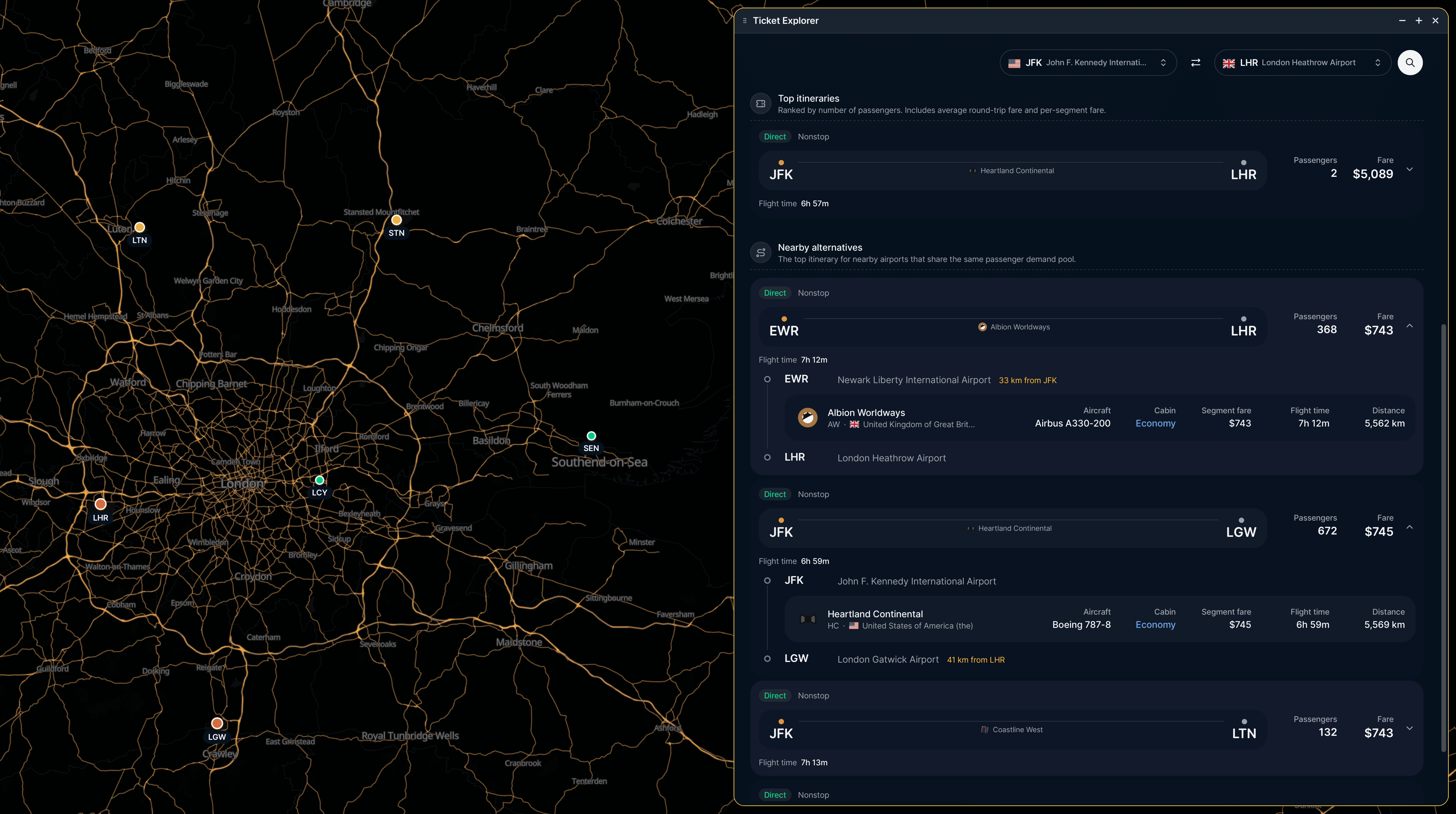
The Ticket Explorer shows the journeys passengers are actually using. Direct flights appear beside same-airline connections. Each entry shows the airport path, cabin, fare, flight time, layover, total time, and passenger count.
Nearby airport alternatives appear because those journeys may be competing for overlapping demand.
The connection also needs seats on every leg. LaGuardia to Boston might have plenty of room, but that does not help if Boston to Heathrow is full. The capacity of the tightest leg limits the entire journey.
That gives a feeder route more than one purpose. It may carry passengers travelling only to Boston. It may also bring passengers into longer journeys across the network.
The cheaper connection deserves a chance. It still has to earn it.
When passengers are spoiled for choice
“What if the Gatwick flight is full?” Flynn asked.
“Then we look at Heathrow again.”
“Even if it costs more?”
“If it’s the best flight left.”
“And if they’re all bad?”
Lina closed the laptop. “Then we wait.”
Choice changes how passengers judge an itinerary.
When several good flights have available seats, passengers can afford to be picky. A slow connection, an inconvenient airport, or an expensive fare may attract very few people while better alternatives remain available.
Take those alternatives away and the calculation changes.
The LaGuardia connection has not become shorter. Newark has not moved closer to Brooklyn. But if the preferred JFK flights are full, those journeys may now be worth considering.
A flight that struggles in a crowded market can become useful in a market with few choices. That is one reason capacity matters beyond the aircraft operating a single route. Filling one service can push passengers towards another airport, another airline, or a connecting journey.
But scarcity does not guarantee a booking.
An empty seat somewhere in the network does not mean a passenger must take it. The remaining journey may still be too expensive, too indirect, too unreliable, or too inconvenient. At that point, the passenger does not fly that week.
Demand is not cargo waiting to be loaded onto whichever aircraft has space.
Passengers may accept a worse option when it is the best reasonable choice left. They will not accept anything.
One family’s choice
Lina went through the options again.
Newark to Heathrow was cheaper, but reaching Newark worked against it. LaGuardia was convenient at the beginning, but the Boston connection added too much time. JFK to Heathrow remained a strong choice, especially for passengers who preferred Heathrow or valued the available service.
For this trip, Lina and Flynn chose JFK to Gatwick.
JFK suited their side of New York. Gatwick suited where they were going. The nonstop gave them the best overall journey.
Another family could make a different choice.
That is why Flightline does not assign one airport to an entire city and send every passenger through it. Airports overlap. Connections compete with nonstops. Available capacity changes what passengers are willing to consider. Sometimes the second-best option gets another look. Sometimes the passenger stays home.
When you open the Route Planner, Shared Market Demand shows the potential market. Alternative Airports and Top Home-Pool Pairs reveal where that demand overlaps. Ticket Explorer shows the journeys passengers ultimately used.
The next passenger may be travelling for work, visiting friends, returning home, or setting off alone. Whoever they are, your airline still has to offer a journey worth choosing.