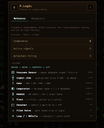
Intorducing analog programming language
- P.Logic
P.Logic (Pneumatic Programming) system lets you build completely automated, self-regulating circuits that read pressure, make logical decisions, and act on your infrastructure without lifting a finger.
🛠️ The Logic Pipeline: Sense → Wire → Compute → Act
Pneumatic programming follows a strict, beautifully simple four-stage architecture. If your circuit isn't working, trace it along this path:
1. SENSE
Before your factory can think, it needs to feel.
⊕ Pressure Sensor: Your primary input. Reads the adjacent steam or fluid percentage directly from your pipe networks.
2. WIRE
Signals need a path to travel.
┼ Signal Line: Carries a single numeric value from 0–100. The best part? Zero signal decay, no matter how long the line stretches across your terminal grid.
3. COMPUTE
This is where the magic happens. You take your raw pressure numbers and apply conditions:
⊽ Gate: Classic logic processing supporting AND / OR / NOT / XOR gates.
◧ Comparator: The threshold gate. Turns ON only when the input is $\\ge$ or $\\le$ a setpoint you dictate.
⧔ Memory (SR Latch): Holds a state using set/reset faces—perfect for maintaining an automated system state until a critical override occurs.
⧕ Timer: A reliable system clock that sends precise pulses over a defined period.
4. ACT
The payout. Your logic tells physical hardware what to do.
⊟ Governor: Remotely switches a target machine completely ON or OFF.
ⱶ Pilot Valve: Gates steam and fluid flow entirely based on incoming logic signals.
⚙️ Lamp / ! Whistle: Visual indicators or loud alarm sirens to let you know right before a catastrophic pressure failure occurs.