
Hello everyone. This is the second development log for Everest Base Camp.
In our last update, we made Zhou He's first BC → C1 mission into something the player actually takes part in. This time, we are looking at the work before departure: if every preparation matters, why not simply complete all of it?
Preparation should not be an automatic checkmark
In an earlier version, some preparations were automatically marked complete when the right facility was operational or enough stock was available. An operational medical tent effectively meant the medical kit was packed; a repaired communications tent effectively meant the radios had been checked. The mission card kept filling up, but the player had not made those choices.
Now, preparation happens at specific places around Base Camp. The player uses the camp map to find the medical area and prepare a basic medical kit, visits the kitchen to pack hot drinks and high-calorie food, and checks radios and backup batteries at the communications area. Limited hands can also be assigned to repair Icefall markers, lighten Zhou He's load, or stash supplies at C1. The mission card records what the player actually did, not a "preparation score" derived in the background.
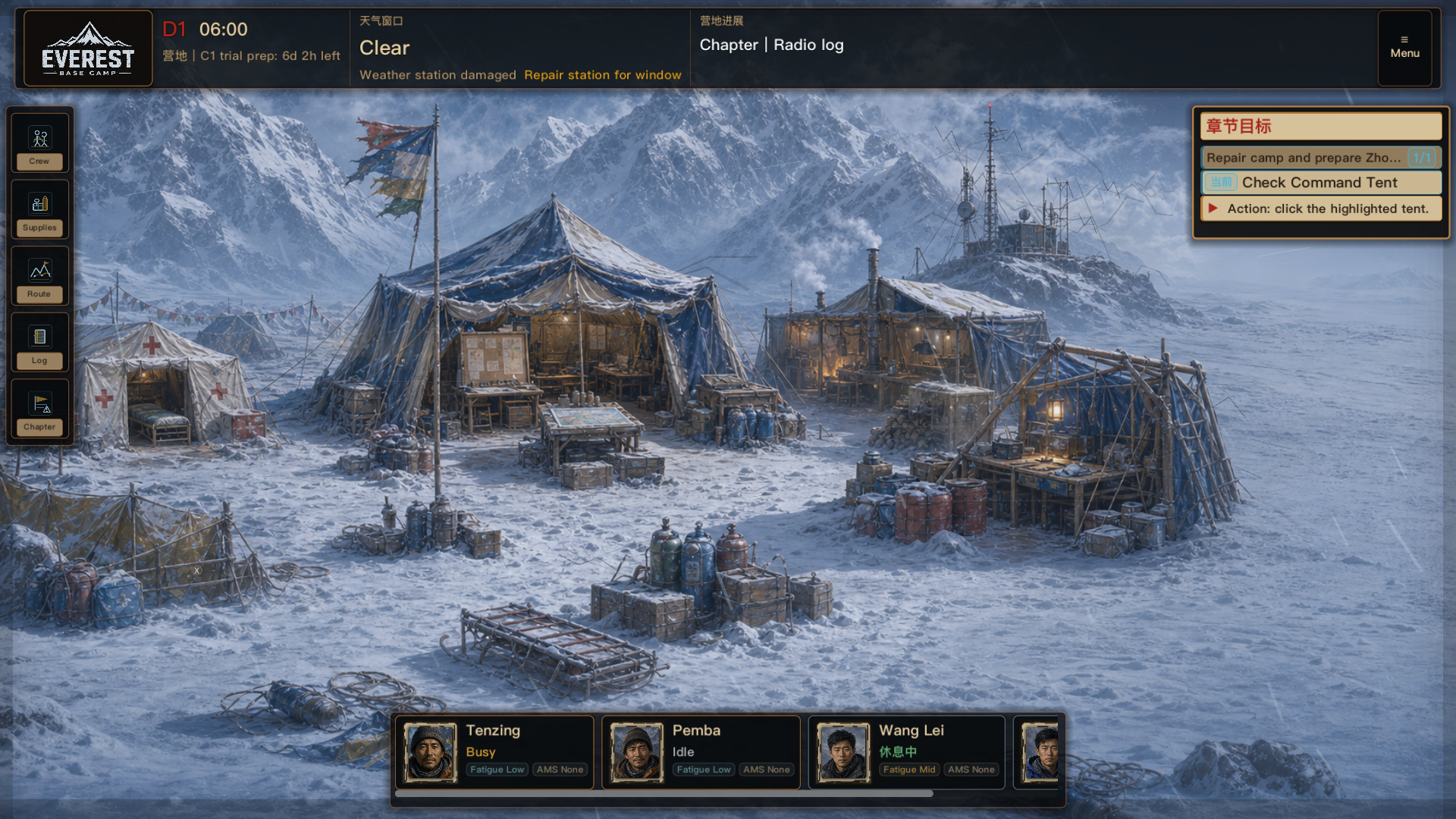
Tradeoffs begin when you cannot do everything
The current BC → C1 slice has its own local preparation budget. Story Mode, Standard Mode, and Hardcore Mode start with budgets of 150, 120, and 95 respectively. These preparations can also consume hands, weather-window margin, or stock. In Standard Mode, there is not enough to complete every preparation.
One player might repair the Icefall markers and check communications first, making the route and radio contact more reliable. Another might reserve the budget for medical supplies, food, and lightening Zhou He's load. Or they might stash supplies at C1 to leave more support waiting at the destination. No matter what you choose in Standard Mode, some preparations will remain undone.
The mission card puts the remaining budget, hands, and weather-window margin in one place, alongside the main preparation gaps and risks. The question is no longer, "How many boxes are left?" It is, "Which gap am I willing to carry onto the mountain?"

The decision to leave still belongs to the player
We do not want preparation to become a gate that only opens at a perfect score. Before departure, there are only two choices: Start Action and Keep Preparing. If key preparations are missing, the success estimate is low, or the risk is high, the mission card highlights Keep Preparing as the default recommendation—but Start Action remains visible and available.
This is not meant to say that taking a risk is always wrong. It is meant to keep the advice consistent with the cost. The player can leave with incomplete preparation, but should know exactly what they chose to leave behind.
Gaps should matter on the mountain
The point of preparation is not the mission card. It is what happens during the mission. Completed preparations open relevant responses; anything left unresolved becomes part of the risk.
Gaps in communications, medical support, supplies, or route work show up in the mission risk and result feedback. Together, the responses during the mission and the result card should answer not "What score did the system give me?" but "Where did my preparation pay off, and where did it leave a cost?"
Still a local model
This is not the full game's long-term economy. The local budget in the current BC → C1 slice does not include wages, suppliers, or contract profit, and it does not carry into later chapters. The current numbers have passed automated route runs and runtime checks, but they have not yet been calibrated through external playtesting. A budget of 120 is still not a final answer.
What's next
Next, we will focus on whether these tradeoffs are clear to a first-time player: whether preparation hotspots are easy to discover, whether the budget pressure is understandable, and whether players can explain which risks they chose to accept before departure.
The direction of Everest Base Camp has not changed: prepare at camp, make decisions on the mountain, and bring the consequences back home. The difference is that preparation no longer means doing everything. It means deciding what must come first.