
Even though Sinemorsk is based on real events, at the end of the day, it’s a game. Personally, I find it more interesting to unlock storylines for the sake of the narrative depth, but I know many players love to "min-max" stats across different playthroughs and test the limits of the system by intentionally lowering or raising certain values. Besides, there is a distinct dramatic element to these stats: the player can see how their decisions cause Lena to burn out faster or, conversely, feel more confident when communicating with other characters.
There’s also a unique drama to the numbers themselves: if Lena forces herself to push through, working despite her fatigue, the burnout counter will start ticking up faster and faster. If she occasionally chooses hanging out with friends over taking on another work shift, listens to her team's input, and spends time with them, her fatigue will drop, while her inner circle's trust will grow.
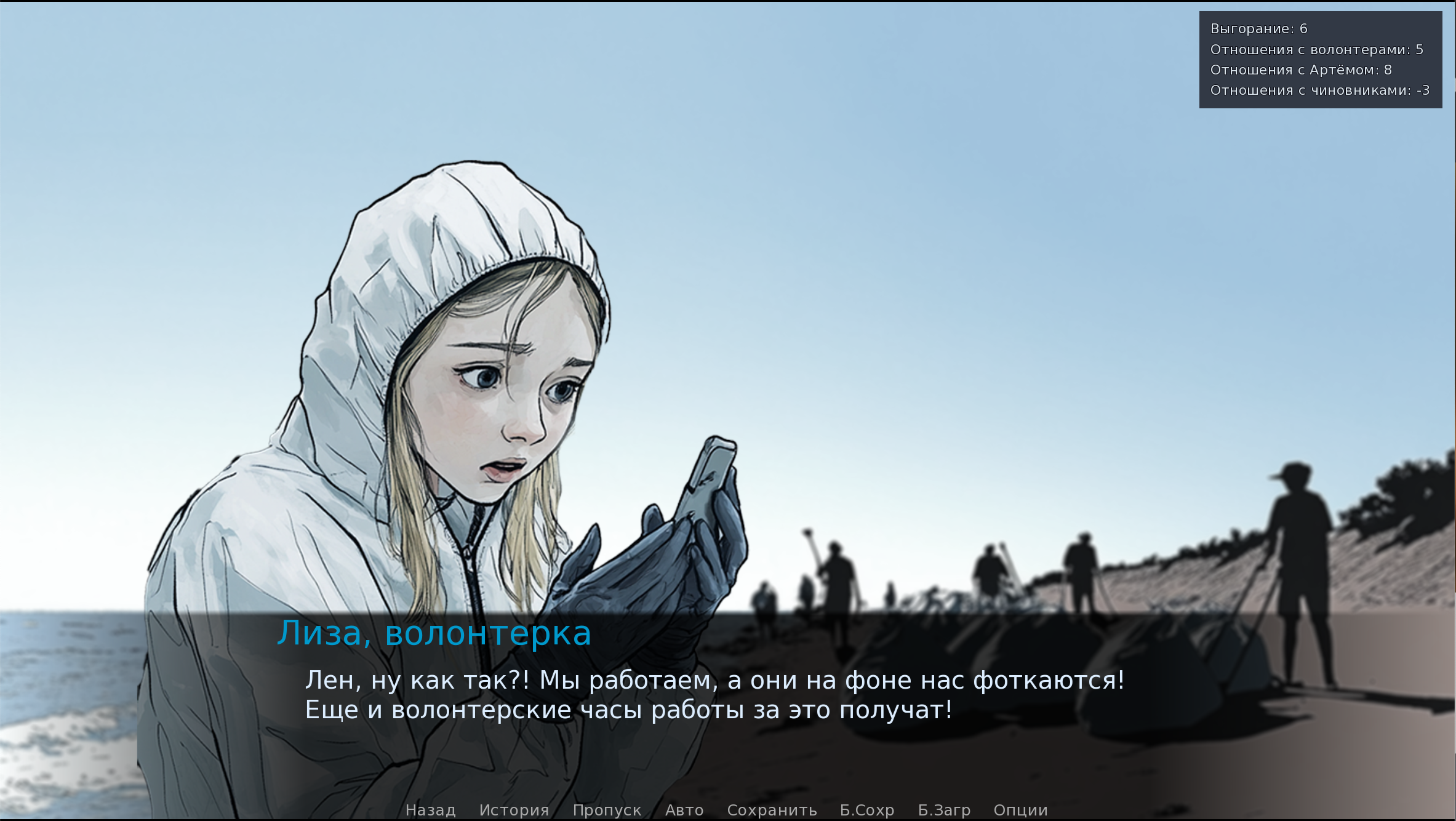
To keep the visual novel from turning into a mechanical point-counting exercise, I made some of the stats hidden. They reflect how Lena interacts with other characters and how her decisions impact them. These invisible stats pay off at pivotal moments: for instance, determining who comes to Lena’s rescue in a critical situation, or how her blog subscribers respond to a crowdfunding appeal. A careless word, an unexplored corner of the beach, or a momentary indifference to someone's plea can lead to tragedy—the death of a living creature. And when Lena finds out, she will carry the weight of guilt and shame.
The relevance of these stats shifts as the plot progresses. At the beginning of the game, it's vital for Lena to grow her blog and avoid burning out prematurely. Later on, however, interactions with fellow volunteers, friends, and eventually local officials take center stage.
The hardest part was balancing the transitions between chapters and the endings. Initially, I mapped out stats that mirrored real human experiences, overlaid them onto the plot, and only then stopped to think: wait, what kind of numbers is it even physically possible for a player to have by the time they reach these key milestones? Striking the right balance was a collaborative effort, aided by colleagues who acted as our first playtesters, my own countless playthroughs, and prompts from the AI editor Cursor, which I used to fine-tune the Ren'Py game code. Even so, the balance is still the thing I worry about the most.
Some of the branching paths might frustrate players, but I tried to design logical, profound endings for a wide variety of stat combinations. Critically low scores don't always lead to utter ruin: sometimes, Lena simply acknowledges that she was too uncompromising or overly optimistic. Her mistakes don’t break her; they harden her resilience.
In short—just like in real life, once again. In this regard, I also looked to the stories of real-life volunteers. They could be dropping from exhaustion but would still keep heading out to the shore. And vice versa—some could admit that they had wasted too much energy for nothing and should have organized their work differently. Some are ready to return to the coastline again (both Anapa and Tuapse still need help in the summer of 2026), while others said the experience left them disillusioned or entirely depleted.
I hope the game helps them reframe and appreciate their contribution. I am absolutely certain that no effort made during the spill was in vain.