
Though, honestly, there’s no escaping it. The idea of making a social statement using an ecological disaster as a backdrop wasn't just used by Hideo Kojima in Death Stranding; my fellow journalists across various media outlets did it, too. I was particularly fond of the posts about the spill made by one anarchist micro-media outlet. They published grainy, black-and-white illustrations, cranked up the sharpness on their photos, wrote about the mystical experiences of volunteers, and viewed the spill both as a living, intelligent force and as an act of political will. I realized that this was the direction I wanted to take.
That’s how the mystical element found its way into the game. From her very first steps on the beach, Lena is haunted everywhere by a strange white haze. She sees it hovering over the rocks near the water, over dead birds, and over fish washed ashore. And sometimes—over the people working at the spill site or living right by the water's edge. Lena herself only notices it a few times, dismissing the haze as just a quirk of the weather. The final interpretation is left entirely up to the players, but the haze will keep appearing in the background, offering gameplay clues if you pay attention to it.
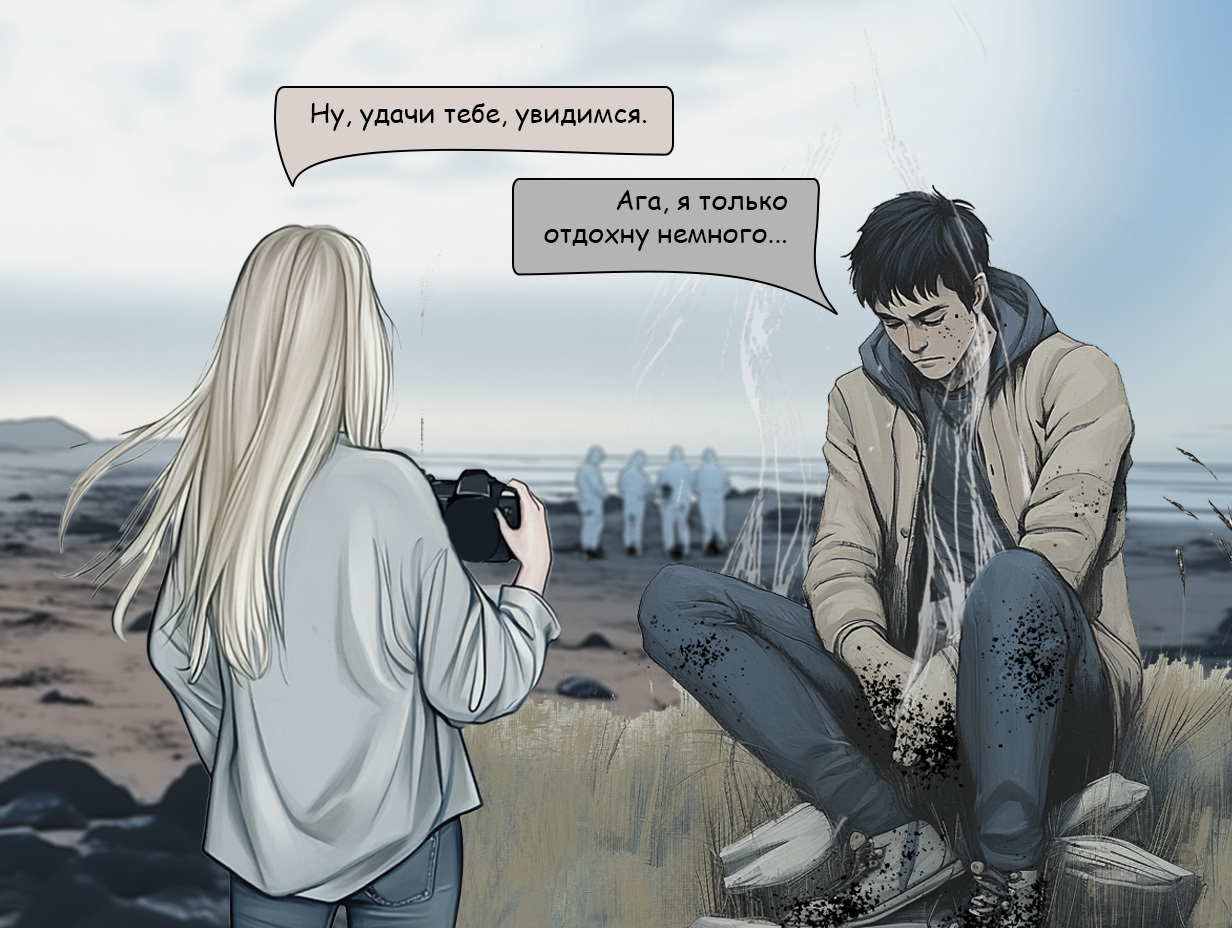
These visions reflect Lena’s extreme fatigue, her vulnerability, and her oncoming burnout. The landscapes of Sinemorsk emphasize this state of mind: deserted beaches, bare tree branches, overcast skies, or sunlight diffused by fog. In the illustrations, Lena often appears as a tiny, solitary figure against the backdrop of a boundless, untamed element. She faces not only external trials but also internal resistance, her own fears, and self-doubt. How she changes by the game's finale is entirely up to the player.
The theme of being alone on your journey and finding people you can lean on is central to this story for me. Lena is looking for ways to help the coastline, but the people around her are trying to do the exact same thing. When she acts completely on her own, she often wastes her energy for nothing. Yet, you can't trust just anyone in this story either. Quite often, seemingly sensible decisions trigger backlash from subscribers, condemnation from volunteers, and rejection from friends. Just like in real life.