
Building Interiors — First Pass Complete Across the City
Last devlog covered the first pass of office building interiors. That first pass is now complete across every building type in Anchorpoint — offices, apartment blocks, retail, bars, cafés, all of it. Every building the game routes an incident to has real internal floors ready for the player to look in on.
That was the biggest single lump of authoring work in the project so far and it's a relief to have it done.
The Interior Cutaway System
The system that lets you see inside buildings is now working in the engine.
When an incident kicks off the officers you dispatch attend the scene. You are able to click on the incident and look inside a building, the game hides the roof and any floors above the one the action is on, so you're looking down into the affected floor while the rest of the city carries on around it. Officers walk in through the front door (or the elevator on upper floors), do what they need to do at the scene, then walk back out and get back in the car. You can watch what's happening inside, from a house call, an office break-in or an apartment domestic, keep an eye on the action.
Crime Scene Evidence Discovery
This is the big design piece of the last stretch — the mechanic that governs what officers find at a scene and what they miss.
The rules are locked and the core code is in:
- Skill-gated discovery. Every piece of evidence at a scene has a base difficulty rating. Every officer has an investigation skill. Whether they find a piece of evidence is a probability roll driven by their skill against that difficulty, weighted by the officer's current motivation and stress. A tired, demoralised officer misses things a fresh one wouldn't.
- Re-search is possible. If a lower-skilled officer sweeps a scene and misses something, a higher-skilled officer can come back and find it. The scene tracks the best skill that has searched it.
- Two tiers of evidence. Some evidence is physical — collected at the scene and taken back to the property store. Some is secondary — swabs, prints, biological traces — that require CSI processing at the lab or the scene before they produce a result. Be careful with your resources though, sending a CSI to every scene takes time and can result in significant backlogs. You will be able to manage this though your precinct policies, though these are not in game yet and are further down the pipeline once I get the full gameplay loop running.
- Contamination. Every piece of physical evidence is stamped with the collecting officer's skill. A clumsy collection shows up in the lab report. Your best officers aren't just better at finding evidence, they're better at not ruining it.
- Witness and victim statements are role-gated. A patrol officer taking a statement will get the basics — description, direction of travel, what they saw. A detective taking the same statement will pull far more. Send patrol first for containment; send detectives when you want depth, but again be aware of workloads send your detectives to the higher level jobs.
What isn't in yet: the search, statement taking and investigation animations. Crime scene prefabs for each crime type, though I have crime scenes setup for burglaries across the city to test, the rest will come once I’m happy the whole system works. These will include numerous crime types.
The Department Computer Operating System
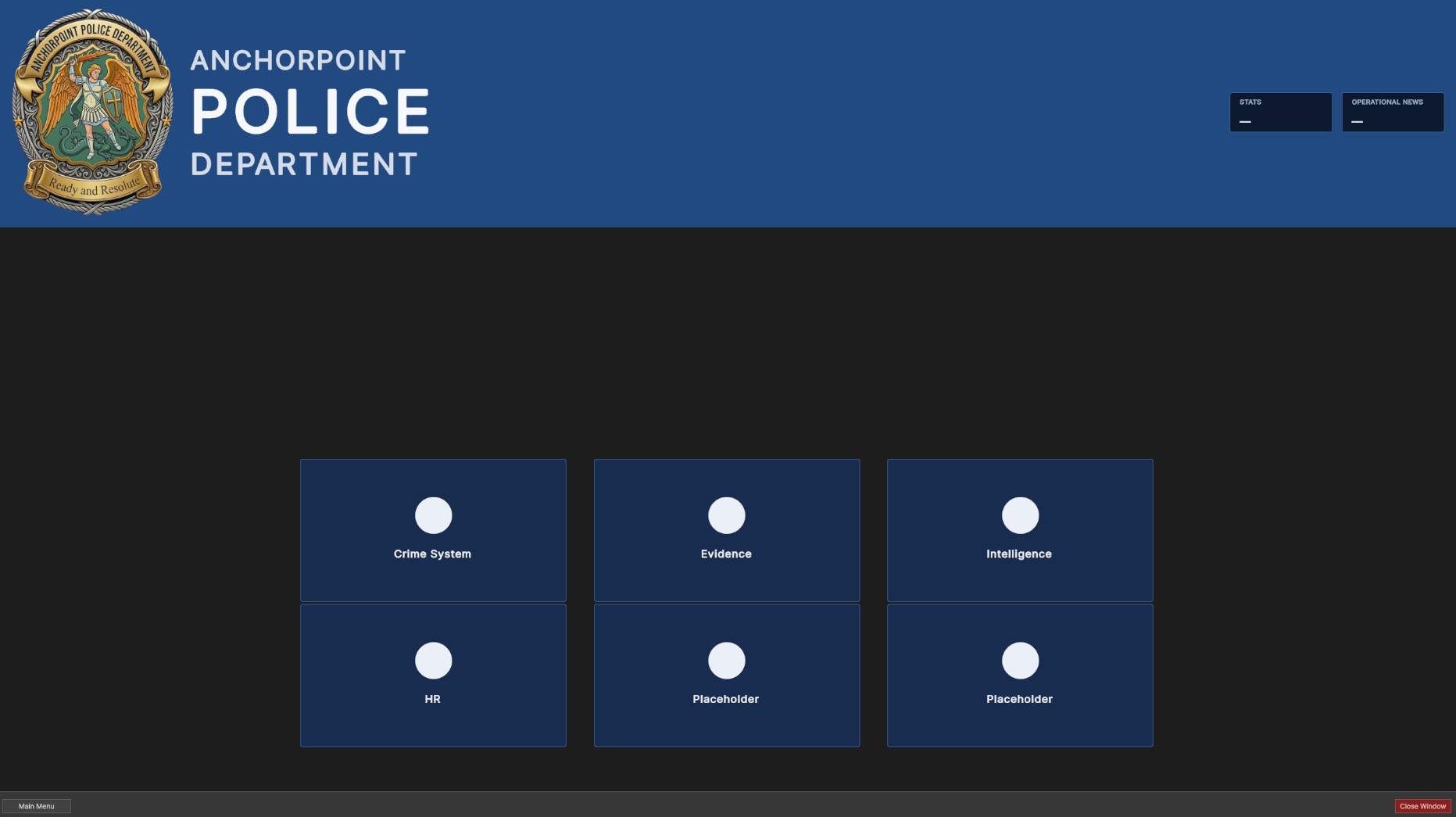
The department now has a computer to sit down at.
The system now has the first implementation of the department OS. It contains the links for various applications. Each app tile is a system the Captain will use: Crime System, Intelligence, HR/Shift management and a couple of placeholders for what's still being scoped.
Right now the app tiles just log to console when you click them — they aren't wired to anything yet. Each tile hooks up as the underlying system comes online. But the shell is done, and it means the department has a proper home for everything that isn't real-time dispatch: managing your officers, reviewing crimes, checking intelligence, and running paperwork. Once I start creating the individual systems they are now able to be wired into the Department OS.
Building the desktop this way now, before any of the systems are wired to it, means each system can slot into a consistent workspace as it's built rather than being tacked on as a separate window.
Note all images are from a game in the very early stages of development and are very likely to change.
Next Up
- Search investigation and statement taking animations.
- Officer crime-scene behaviour — walking the scene, examining evidence, taking statements.
- CSI lab pipeline for processing secondary evidence.
- Initial implementation of crime system.
- Wiring the Department OS app tiles to their underlying systems as each comes online
More soon.
— Mike, Ironkeel Studios