
Patch Notes — v0.3.2
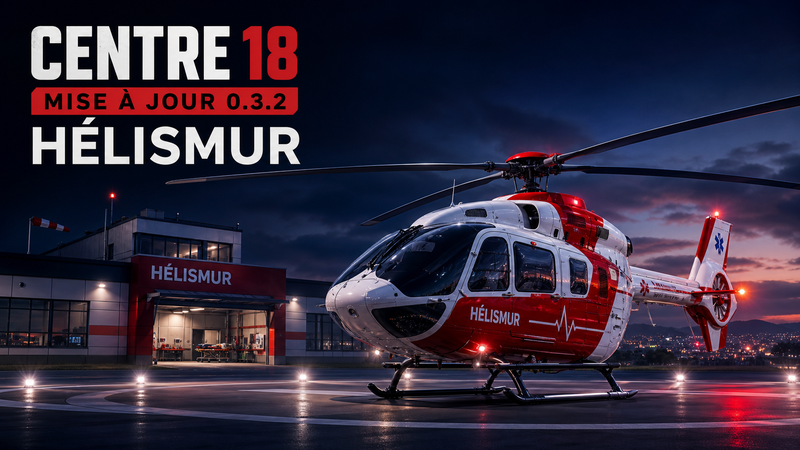
FEATURED — Air Bases and HéliSMUR
Discover a brand-new building type: the HéliSMUR air base.
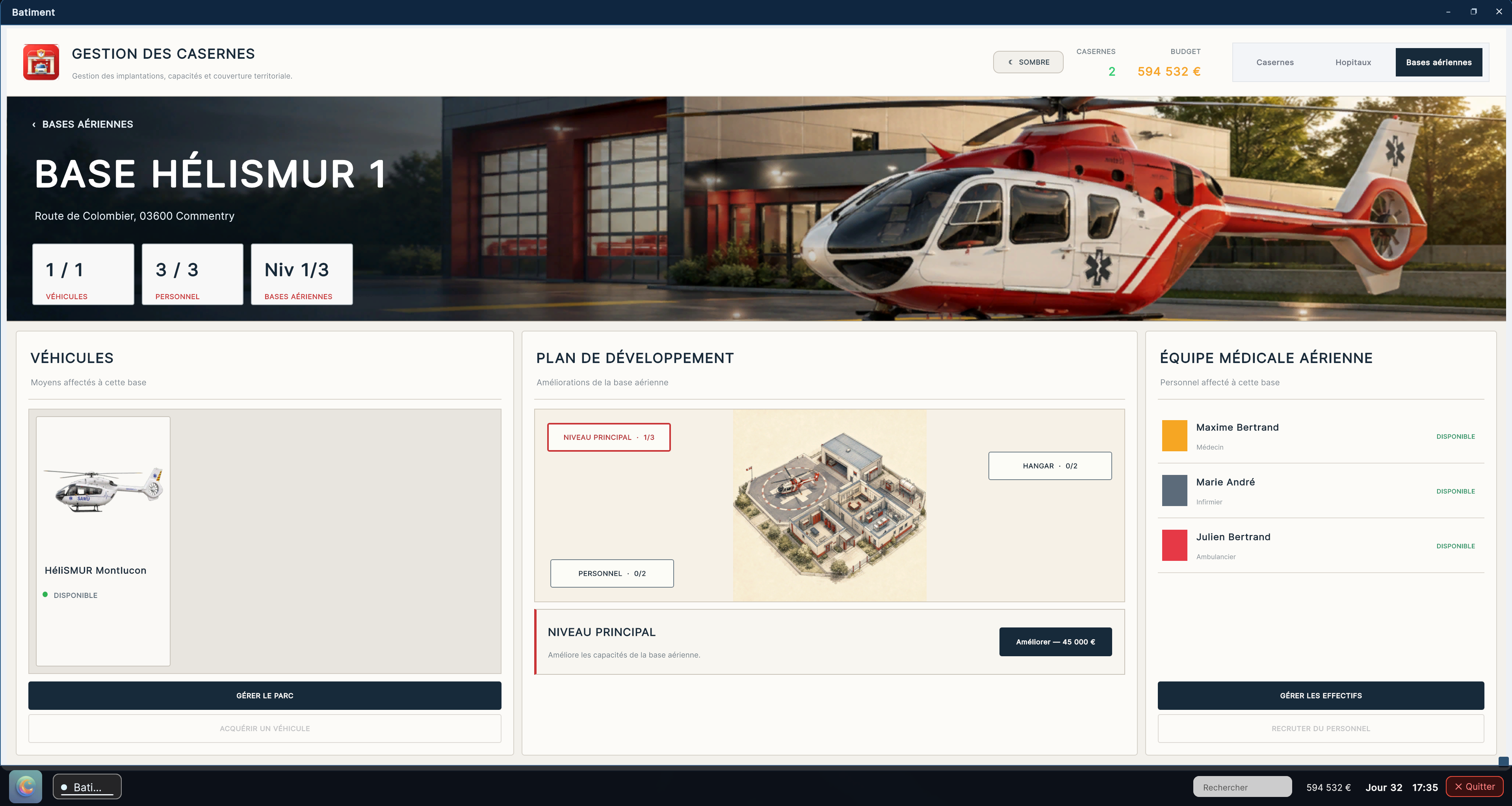
Purchase a HéliSMUR aircraft, recruit its crew of one doctor, one nurse, and one paramedic, then assign them to your base.
Upgrade the base itself, its hangar, and its staff capacity.
Manage the fleet, medical crew, and upgrades from a fully illustrated detail screen.
HéliSMUR aircraft fly directly to incidents without relying on the road network, then return to their base.
They can replace a VSAV or resuscitation ambulance on certain medical missions and transport a casualty to the hospital themselves.
Their onboard medical team can remove the need to dispatch an additional light medical vehicle.
Air bases and HéliSMUR aircraft are integrated into the Buildings, Vehicles, Personnel, Recruitment, Shop, and Operations apps.
FEATURED — A New Call Center
The main building and its rooms have been completely rebuilt.
Workspaces and living areas now feature more detailed, coherent, and believable architecture.
Materials, furniture, decorative elements, and the overall atmosphere have been improved.
Interior lighting has been revised to bring greater depth and a more natural atmosphere to each room.
The center now hosts livelier characters who can move around and use different parts of the building.
Existing saves remain compatible: the first time they are loaded after the update, the character automatically returns to the new building's starting point without losing any progress.
NEW INCIDENTS — 48 New Scenarios
8 fire and major-rescue incidents
Vehicle fire spreading to a home.
Garage fire with a casualty.
Domestic explosion with a developing fire.
Road collision with a vehicle on fire.
Outbuilding fire with possible spread.
Fire in a small workshop.
Boiler-room fire with carbon monoxide poisoning.
Farm-building fire with an injured worker.
12 CCF wildfire missions
Standing crop fire — 2 CCF + VLCG.
Uncontrolled prescribed burn — CCF.
Combine harvester fire — CCF + FPT.
Stored straw bale fire — CCF + CCR + VLCG.
Grassland fire with trapped livestock — CCF + VTU.
Forestry residue fire — CCF.
Reed bed fire in a wetland — 2 CCF + VLCG.
Vegetation fire beside a railway line — CCF + FPT + VLCG.
Vegetation fire beneath a high-voltage line — CCF + FPT + VLCG.
Vegetation fire in a solar farm — CCF + FPT.
Pine forest fire threatening a housing estate — 2 CCF + FPT + VLCG.
Peat fire with underground hotspots — 2 CCF + VLCG.
16 EPA aerial-ladder missions
Rescue of a person trapped on a balcony or roof — EPA + VSAV.
Roof or attic fire with risk of spreading — FPT + EPA + VSAV.
Apartment-building façade fire — 2 FPT + EPA + VLCG + VSAV.
Fall from height with no possible interior access — EPA + VSAV.
Animal rescue from a roof or well — EPA + VTU.
Person trapped at a window during a fire — FPT + EPA + VSAV.
Person trapped on an aerial work platform — EPA + VSAV.
Worker suspended in a harness on a façade — EPA + VSAV.
Person trapped on an exterior staircase — EPA + VSAV.
Person in distress on the roof of a parking structure — EPA + VSAV.
Person in distress on a ledge — EPA + VSAV.
Person trapped on scaffolding — EPA + VSAV.
Water leak on an inaccessible upper floor — EPA + VTU.
Façade element at risk of falling — EPA + VTU.
Damaged antenna threatening the public road — EPA + VTU.
Dangerous branch above a balcony — EPA + VTU.
12 VSAV missions
Medical emergency in a public place.
Fall on a staircase.
Domestic accident with a deep wound.
Acute abdominal pain.
Breathing difficulty in an elderly person.
High fever and seizures in a child.
Person trapped in a bathroom.
Sports accident with a suspected fracture.
Heat-related illness.
Disoriented person in a public place.
Accidental medication poisoning.
Panic attack with hyperventilation.
Every scenario includes a caller, dispatch questions and answers, suitable resources, and translations in French, English, German, and Spanish.
MULTI-CASUALTY MISSIONS — Reinforcements Matched to Your Fleet
Multi-casualty incidents no longer automatically require an unrealistic number of VSAV units.
Collective food poisoning now begins with 2 VSAV units and 2 known casualties.
Additional casualties are discovered during the incident according to the number of VSAV units owned within the operational area.
Each additional deployable VSAV can reveal one extra casualty and its matching reinforcement request.
The system is capped: collective food poisoning can request no more than 4 additional VSAV units.
OVERHAUL — More Realistic Incidents
Mission flow has been completely redesigned around clear progress that begins when emergency crews actually arrive on scene.
You can now dispatch an incident with only some of the requested resources. Work progresses as far as the available units allow, then resumes when the missing vehicles arrive.
Sending several suitable vehicles speeds up incident resolution.
Mixed missions, such as fires involving casualties, now separate fire control from medical care.
Once their work is complete, the relevant vehicles can leave and become available again without waiting unnecessarily for the entire mission to end.
Missing resources and reinforcement requests are clearly displayed during the incident and can be dispatched through the same selection system used for the initial response.
OVERHAUL — Casualties and Hospital Transport
Each medical vehicle now treats a specific casualty with an individual assessment and progress state.
The need for hospital transport is determined after the casualty assessment, not before crews arrive on scene.
Each VSAV, resuscitation ambulance, or HéliSMUR aircraft receives its own hospital selection when transport is required.
On incidents involving several casualties, each treatment progresses independently.
A casualty treated on scene releases the assigned vehicle, which can immediately begin treating another waiting casualty.
After hospital transport and a return to base, a vehicle becomes available and can be sent back to the same mission for another rotation.
The mission ends once every casualty has actually been treated or transported.
Rewards now account for the number of casualties treated and the different transports completed.
MISSIONS — More Variety and Better Pacing
Call generation now favors medical emergencies, fires, and road accidents while maintaining a broad variety of incidents.
Animal incidents, floods, and water-removal calls appear less often to reduce repetition.
Only missions that can be handled with vehicles owned within the coverage area can be offered.
The arrival rate of new calls adapts to the number of operations already waiting.
Up to ten operations can now appear simultaneously in the pending-call list.
The duration of many common incidents has been adjusted for more natural pacing.
Rewards now place greater value on multi-unit responses and major incidents.
NEW — Private Medical Transport
Private ambulances can transport a patient from home to the hospital for an appointment.
They can take a patient home from the hospital after a stay.
They can transfer a patient between two nearby hospitals when the player owns the required facilities.
These missions now focus on travel time, with shorter on-scene patient handling.
BUILDING AND FLEET MANAGEMENT
Clicking a fire station, hospital, or air base on the Operations map now opens its detail screen directly.
These screens show capacity, staff, fleet, and vehicle status in a compact table.
Quick actions let you upgrade the building, recruit staff, or purchase a new vehicle.
The Shop provides a clear delivery-building selection among every owned fire station, hospital, and air base.
The destination can be changed directly from the catalog through the “Deliver to” list.
Buildings are grouped by department and can be displayed as cards or as a list.
A gauge shows occupied and available spaces before each purchase.
Opening the Shop from a building automatically selects the correct delivery destination.
OPERATIONS IMPROVEMENTS
Pending operations and active missions can now be displayed as cards or in a compact list.
List mode shows severity, type, name, and primary action on a single line for each mission.
Active missions display a progress bar and completion percentage directly on cards and in List mode.
Active missions directly highlight missing vehicles, reinforcement requests, and pending hospital transports.
Dispatch cards show the fuel level and maintenance condition of every vehicle.
Vehicles without fuel or requiring maintenance remain visible but are grayed out and cannot be selected.
NEW — Redeployment During the Return Journey
Many of you asked for it, and it is finally here! A vehicle that has completed its work can now be sent immediately to a new call even while returning to its station.
If it is not reassigned, you can watch it continue back to its base on the map.
If it is dispatched elsewhere, it departs from its actual map position with an updated travel distance.
Medical missions remain protected: a vehicle is only released after casualty care is complete and any hospital or reinforcement requests have been resolved.
INTERFACE AND QUALITY OF LIFE
The call-center HUD has been streamlined to leave more room for the 3D environment.
Operational information is grouped into a more compact, readable layout.
Added light and dark themes to the Operations and Buildings apps.
The resolution selected in the options is now correctly applied at startup and in fullscreen mode.
The app launcher and several management screens have received readability and alignment improvements.
Automatic questions, mission tracking, and dispatch now update more smoothly without interrupting your current actions.
Search in the CODIS Wiki now responds instantly as you type.
The new interfaces and features are available in French, English, German, and Spanish.
FIXES
Fixed an issue where the incident type entered by the player could reset during automatic questions.
Fixed several incorrect icons for flooding and water-removal missions.
Fixed several alignment and readability issues in the app launcher and management interfaces.
Fixed various display issues affecting high resolutions and fullscreen mode.