
The same city never looks the same to everyone. People living on the same street can have completely different incomes, backgrounds, and ideas about how things should work. For a lot of people it means opportunity. For just as many, it's a daily grind with no end in sight.
PODER doesn't have one "correct" entry point. Instead, there are 5 backstories: a union leader, a former military officer, a community activist, a doctor, and a businessman. Each of them comes to power with their own history and their own understanding of what the city is. These aren't just different starting conditions — they're different ways of seeing the same system. A decision that feels obvious from one position can be impossible from another.
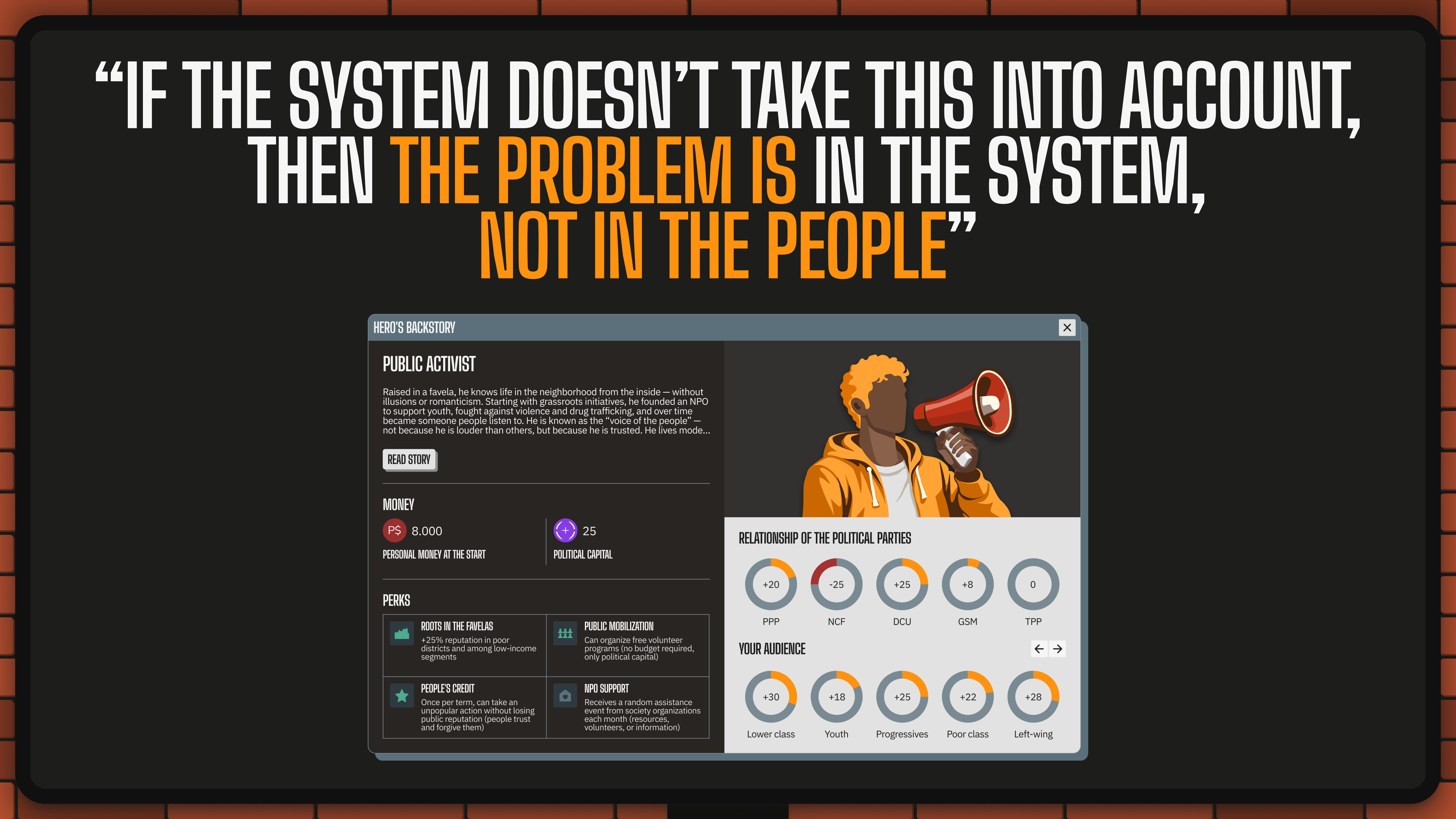
One of them is the community activist.
He grew up in a favela and knows what life there actually looks like — no filters, no illusions. He started with street-level initiatives, built an NGO to support local youth, fought against violence and drug trafficking, and over time became someone people actually listen to. They call him "the voice of the people" — not because he's the loudest, but because they trust him.
He lives modestly, with almost nothing to his name: a minimal NGO salary and the weakest financial start in the game make every resource count. What he does have is people's trust and the backing of community organizations.
For him, the city isn't a set of metrics or a management problem. It's specific people with everyday struggles that get ignored from the top far too often. If the system doesn't take this into account, then the problem is in the system, not in the people.
He has real moral authority and name recognition in poor neighborhoods, but almost no connections inside the halls of power. He's a character who starts from the bottom — his leverage isn't money or access, it's reputation and the community behind him.
He knows how to mobilize people and get things moving without a budget. But when it comes to backroom deals and political maneuvering, his reach hits a wall fast.
That's what the characters in PODER are really about. Each of them has strengths and real limitations. The game doesn't tell you who's right — it lets you try to run a city from their perspective and deal with what follows.
In the next posts, we'll go through each of them in more detail. Because in the end, PODER isn't just about the system. It's about the people trying to run it.