
After the first dev log, someone asked me:
"So your game is basically 'cyberpunk Balatro,' right?"
I smiled.
In terms of rhythm, yes, it looks similar. But if it were just a reskin, there'd be no point in making it.
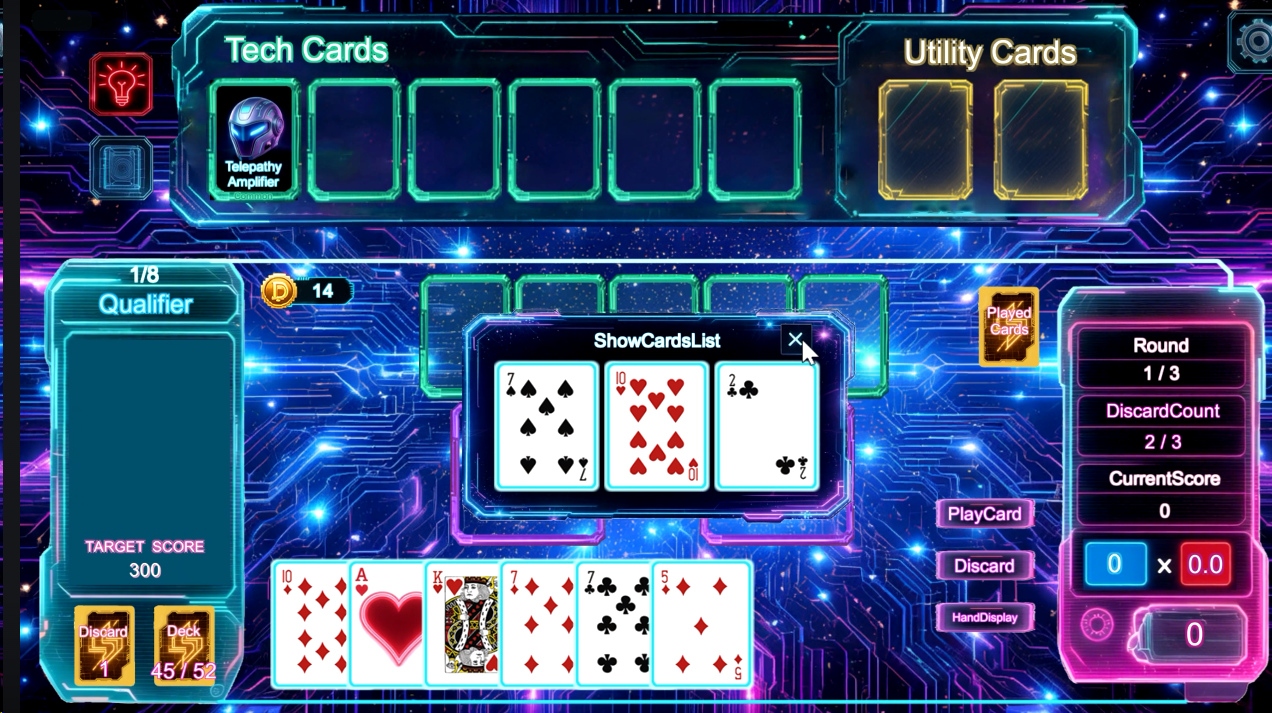
This time, I want to show you — using actual cards — what makes CyberJoker different.
1. From "Modifying Numbers" to "Modifying Rules"
Balatro's core loop is: play a hand → Jokers modify numbers → score goes up.
But in CyberJoker, there's a Tech Card called "EMP Burst":
Disable the current Boss's special ability, but reduce your play hand count to 1.
This isn't modifying numbers. This is rewriting the rules of a boss fight.
You're facing a boss that would normally wipe you out. This card lets you turn off its core mechanic. The cost? You only get one chance to attack.
You either kill the boss in one hand, or you lose.
Innovation: The player isn't "stacking numbers." They're making a trade. Risk for a rules-level advantage.
2. From "Stacking" to "Trade-offs" — Why Only 6 Tech Cards?
Card table has 150 Tech Cards.
But the player can only carry 6 at a time.
Why?
Look at these two cards:
· 「Quantum Processor」: All probability-based effects trigger 100% of the time
· 「Solar Concentrator」: Played Heart cards have a 1/2 chance to x1.5 Mult
On its own, 「Solar Concentrator」 is a gamble. 50% chance — either you pop off or you whiff.
But if you also have 「Quantum Processor」? It becomes a stable x1.5 Mult.
That's a two-card combo. The 6-card limit means: you can't have every combo at once.
You have to ask yourself:
What's my core engine? Is this card "nice to have" or "irreplaceable"?
3. A Nod to Balatro — And Turning It Into Your Advantage
I have to be honest: CyberJoker stands on Balatro's shoulders.
Two cards are the clearest evidence:
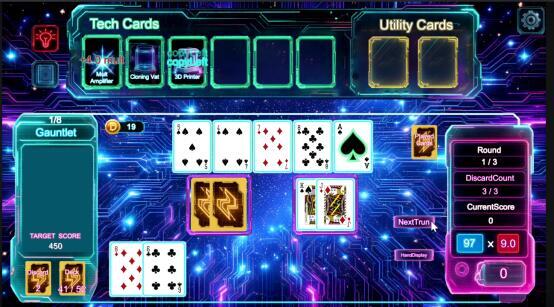
· 「3D Printer」: On score, repeats the effect of the card to its left
· 「Cloning Vat」: Repeats the effect of the card to its right. If it's a 3D Printer, x2 Mult
If you've played Balatro, you're smiling right now.
These are direct nods to 「Blueprint」 and 「Brainstorm」 — the cards that let you copy adjacent Joker effects, essential for high-end "infinite combo" builds.
Why did I include them?
Two reasons.
First, they're just good design. Copying effects is one of the most elegant multiplicative mechanics in card games. You don't need bigger numbers — you just need "let the good thing happen twice."
Second, I want Balatro players to feel at home. You're not starting from zero, learning a completely new card language. When you see 「3D Printer」, you think: Oh, it's Blueprint. I know how this works.
And then you discover: in CyberJoker, because of cards like 「Quantum Processor」 and 「EMP Burst」 — things Balatro doesn't have — 「3D Printer」 can copy more things. Crazier things.
4. The Cards Balatro Would Never Make
Here are a few cards you would never see in Balatro:
Card | Effect | Why Balatro wouldn't do it |
「Scout Drone」 | Look at the top 2 cards of your deck | Information effect. Balatro never gives players "future info" |
「Replicator」 | Randomly copy a card on the table, replace another | Changes the physical position of poker cards |
「Cloaking Device」 | This played hand does not count toward your hand limit | Directly breaks the core resource of "hand count" |
「Coolant Injector」 | The next card you buy from the shop costs 0 gold | Breaks the basic rules of the economy loop |
These cards share one thing: *They don't increase numbers. They increase options. *
The player doesn't get stronger by going "from +4 to +8." They get stronger by having a choice they didn't have before.
5. From "No Narrative" to "Having Weight" — Worldbuilding Inside Cards
I didn't just write a cyberpunk story. I embedded the world into the card mechanics.
Look at these:
· 「Gravity Bomb」: Destroy all Tech Cards in your Tech slots. Gain 6 gold for each card destroyed
· 「Fuel Cell」: Destroy a random Ability Card. Gain 6 gold
· 「Hack Tool」: Generate 2 Crystal Cards
These aren't just "random effects." They're telling a story: in the slums, sometimes you have to cannibalize the gear you worked so hard to build — just to survive.
The player isn't a hero. The player is someone making desperate trades in a desperate world.
Innovation: Mechanics decide how you play. Narrative decides why you're still playing. When they align, the game has weight.
6. What Am I Actually "Improving"?
If I had to summarize CyberJoker's progress beyond Balatro in one sentence:
From "a game of numbers" to "a game of rules."
Dimension | Balatro | CyberJoker |
Core experience | Dopamine of number go up | Thinking through rules trading |
Card effects | Modify chips, modify mult | Modify rules, modify information, modify resources |
Build system | Infinite stacking | 6-card limit, forced trade-offs |
Approach to Balatro players | — | Nod to classic mechanics, lower entry barrier |
Narrative | None | Embedded in card mechanics |
I'm not trying to challenge Balatro. It's already a masterpiece.
I'm just trying to take one small step forward from where it stopped. And at the same time, I want Balatro players to feel that familiar warmth — and then discover: oh, I can do THAT too.
7. One Last Thing
The road for a solo developer is long. You can't compete on budget or marketing. The only things you can compete on are ideas and sincerity.
Every design in this dev log came from the same question:
"If I were a player, what would I actually want?"
The answer:
A game worth playing over and over. And a reason worth remembering.
If any of this resonates with you — wishlisting CyberJoker would mean the world to me.
I'll keep writing dev logs. I'll keep working.