
My dudes! A new era is upon us :)
This one took many moon and grew the codebase from ~90k to ~170k lines. It's the biggest single update this game has seen.
While all of the systems are fully implemented and working, balance is not where I want it (yet) -- and honestly, getting it where I'm envisioning is going to take months of tweaking and scootching sliders and levers. There are things that will feel off. There are numbers that need work. I know this.
But, I'm pushing it live anyway: even with those issues, V2 is light years ahead of V1 in player experience. Holding back something this significant so I can dial in balance that could take months felt like the wrong call. The right call is getting it in your hands now and working through it in the open -- every change communicated here on Steam, in Discord, and in-game, as is tradition.
As for pacing, for most of April, I will be patching every day or every couple days on Beta and every Wednesday on Live.
Here's what's new:
The Skill Tree has been fully replaced by Buildings.
The old skill tree has been ripped out entirely and replaced with a full construction system. 34 buildings across 5 categories, each with 3 upgrade tiers. You hire a Foreman, assign construction crews, and watch your guild headquarters physically grow from a makeshift camp into a grand citadel over time.
Building quality matters in a real way. Your Foreman's skill -- combined with your crew's ability -- determines whether a completed building comes out Masterwork, Standard, or Shoddy. A Shoddy building can be repaired, but it'll cost you time and gold. A Masterwork building produces better effects than its Standard counterpart. The difference is meaningful.
Buildings now gate everything in the game. Want to hire an Instructor? You need a Training Yard. Want to craft gear? You need a Workshop. Want to gather materials? You need a Granary. Want to trade with rival guilds? You need Trade Routes. Your guild hall is no longer a clicker game -- it's a place, and what you build determines what you can do.
Each building has a unique T2 mechanic that unlocks new functionality beyond just stat bonuses. Six building synergies reward smart construction choices -- pair the right two T2+ buildings and you unlock a combined set-bonus-style effect. At T3, buildings can trigger annual events that add flavor and mechanical rewards to your headquarters.
Factions V2
Six fully fleshed-out factions now exist in Hiltcrest, each with four unique named characters: a leader, lieutenant, contact, and apprentice. These aren't quest-givers, they're people you build real relationships with over time, each with insanely deep relationship trees.
Each faction has its own standing track running from Hostile to Exalted across 7 tiers -- and it takes much more realistic timespan and amount of effort to achieve Exalted status (longer). As your standing grows, you unlock correspondence, favor trees, oaths, and eventually faction secrets -- lore about the Tower that you genuinely cannot find anywhere else in the game.
The characters age and die. When a character dies, the succession cascades -- the lieutenant becomes the leader, the contact becomes the lieutenant, and a new apprentice is procedurally generated – each with different energy, vibes, and dispositions.
The world keeps moving whether you're paying attention or not.
Each faction has a unique vendor with rotating stock and permanent upgrades -- and a unique mechanic that changes how you interact with them. You haggle with the Merchants Guild. You manage heat with the Underworld. You earn requisition points with the Military. You tithe to the Temple. Each one plays differently.
You can swear Oaths to factions -- binding obligations that carry real consequences if you break them. Whisper chains let you piece together lore fragment by fragment. Shadow Operations let you run covert missions through the Underworld. Dispatch missions send your faction contacts on letter-triggered assignments. The faction system is where most of the world's story lives now.
Crown Cup League
The old rankings system is gone. In its place: a full competitive season that runs every in-game year across all 32 guilds.
This realm is a scary one and the end is approaching. In turn, the Crown has taken up several initiatives to help encourage growth, incentives, and inter-guild cooperation to push guilds to be strong enough to climb the Tower – this is where the CCL comes in.
At the start of each year, every guild -- including yours -- is assigned to one of four divisions: Merchants, Temple, Military, or Nobles (this changes each year). Each division is named after one of Hiltcrest's factions, and quests that match your division's patron earn 2x Annual Renown. Your division assignment shapes your strategy for the entire season.
Throughout the year you accumulate Annual Renown from quests, raids, tower floors, and contracts. Rival guilds are doing the same. At Weeks 13, 26, and 39, mid-season rival challenge matches fire -- a specific rival issues a direct challenge, and the winner takes renown and gold from the loser.
At Week 51, the top guild from each division qualifies for the Crown Cup. Four guilds. One real-time 1v1v1v1 free-for-all battle that plays out in front of you. Sudden death overtime if it runs long. The last guild standing is crowned Champion of Hiltcrest and earns rewards that carry into the next season.
The standings page shows sparklines, pace projections, and division intel -- how much of that intel you can see depends on your Scouting Post tier. The last three seasons are archived so you can track your trajectory over time.
One key thing to remember, a brand new guild is not meant to win the CCL – it takes time. Think of it like the Stanley Cup or the Super Bowl or the Premier Cup, it takes many years to build up a competitive organization – the same holds true here.
The Academy
The Academy lets you build a youth development pipeline for your roster.
You recruit prospects aged 14-17 from a seasonal pool. Each prospect has a raw potential tier (F through S) and a set of base stats. You enroll them as trainees, assign them an Instructor or two, and choose a curriculum focus -- combat, endurance, magic, leadership, or balanced. From there, they develop week-by-week across semesters.
Semester events fire during development. A trainee can have a Growth Spurt and shoot up in a key stat. They can have a Breakthrough that bumps their potential tier. They can Hit a Wall and stall out. These events are random but weighted by their stats and focus, so your decisions matter.
When a trainee reaches 18, they enter the graduation queue. You get a multi-step ceremony where the game reveals their final class, OVR, and potential tier -- the result of everything that happened during development. Then you decide: sign them to your roster, or release them into the free agent pool for rival guilds to pick up.
The Academy is the only system in the game where you can develop talent from scratch rather than scouting for it. A lucky Academy run can produce adventurers you'd never find in the free agent pool.
Note: Instructors are a little OP, so definitely hire some good ones.
Tower Descent
This isn’t new to V2, exactly, but it is new enough to V1 that I wanted to include it here, because it represents the expanding scope and intended pacing of the game, which you’ll see more changes echoing the idea that it’s okay to slow down and let the game come to you.
The Tower is still 100 floors with a boss on every floor. But it works differently now.
The difficulty scales from ROVR 65 at floor 1 to ROVR 125 at floor 100 -- the endgame boss. The scaling isn't linear. The early floors are a gentle ramp, the middle floors grind steadily upward, and the final ten floors spike hard. Getting to floor 90 and getting to floor 100 are very different problems.
You send 6 parties -- 30 adventurers -- per tower run as usual. Each floor is a real-time battle with multiple phases: Descent, Boss Encounter, Combat, Climax, and Resolution. Deaths are permanent and happen a lot (be prepared for deaths). Injuries pull adventurers out for weeks. The Grimoire of Names is the only protection against a death -- consume it when an adventurer falls and there's a chance they survive with a scar trait instead.
Floors can be reclaimed if you leave them unattended after clearing. The Portal on Floor 100 doesn’t close until you close it, so monsters continue to flow back into the Tower. You can assign Garrison parties to defend cleared floors, but that ties up adventurers who could be questing. It's a resource management problem on top of the combat problem.
A new twist to note: beating floor 100 and defeating the final boss is the endgame, yes, but after victory, you can start a New Game+ run -- bring a full party from your final roster and begin again with a randomized prestige perk.
Correspondence & The Front Desk
The Front Desk is now your unified inbox for everything that happens in writing -- letters from all six factions, Crown Administrator Ser Aldric Thorne, trade partners, and the Great Sage.
Any message you get from any part of the game is funneled into this inbox for easy use, but you can also just go directly to the system and interact there.
Aldric is the Crown's representative and he's paying attention to your guild. He sends seasonal commissions, check-ins on your progress, and passive-aggressive P.S. notes when your performance doesn't match his expectations. Responding to his letters and completing his commissions builds Crown favor. Ignoring them does not go unnoticed.
Faction correspondence works similarly. Your faction contacts send letters when things happen -- when they need something, when they want to offer something, when you've broken an oath, when a character dies. Your responses affect standing, favor, and the relationship over time.
These can stack up fast, so take advantage of the fact that you can filter by letter type, pin important messages, and archive old ones. The inbox is filterable and manageable, it's where a significant portion of the game's narrative lives.
Rival Guilds & Trading
31 rival guilds exist in Hiltcrest. Each is a fully simulated entity that runs parallel to your guild whether you're paying attention to them or not.
Every rival guild has a named leader with a personality, zodiac signs, and a temperament that affects how they negotiate. Every rival guild has a real roster of 35-50 adventurers with actual stats, classes, potential tiers, ages, traits, and flaws. Guild OVR is calculated from the actual roster -- not a fabricated number. These rosters age and evolve over time. Adventurers under 25 are still developing. Players between 25-33 are at their peak. Players over 38 start declining physically. At 45, retirement is mandatory. Underperformers get cut. Gaps get filled from the free agent pool -- the same pool you're recruiting from.
Every week, rivals are out there doing things. Completing quests. Running raids. Climbing the tower. Their annual renown comes from the same activity-based earning system you use. Tier 6+ guilds independently climb the tower, gain floors on successful attempts, lose floors if they stop climbing or wipe badly. You can scout their tower progress.
Speaking of scouting -- rivals start opaque. You see rough OVR estimates with significant variance. As your scout builds progress (0-100%), the fog lifts. At 50% you see class and level range. At 75% you see most stats with some uncertainty. At 100% you have full intelligence on that roster. Multiple scouts stack progress. Your Scouting Post tier affects how fast this happens.
Trading with rivals is shaped by two things: their specialization and their temperament. A Combat-specialized guild is a willing buyer for steel and potions but sells monster parts cheap. A Trading-specialized guild is shrewd. A Raiding guild pays more for consumables and dumps loot at a bit less than market value. Their temperament determines how they negotiate -- a Desperate guild counter-offers 80% of the time with 25% price flexibility, an Aggressive guild barely budges. Trust level determines what's even possible: Hostile guilds trade at a 50% penalty and only approach you 8% of the time. Allied guilds trade freely and reach out 60% of the time.
The Trading Block refreshes every 4 weeks with up to 30 listings per guild. Adventurers get listed for specific reasons -- veterans aged out, underperformers being shed, surplus classes (3+ of the same), or star players showcased by allied guilds only. Asking prices use exponential valuation: OVR 50 runs about 3,000g, OVR 70 around 10,000g, OVR 90 north of 40,000g. Same-division rivals add a 1.15x premium. Age, trust tier, and listing reason all modify the price further.
At Tier 7, the game assigns you a nemesis (the Beef System) -- the rival with the lowest trust and closest renown to yours has a beef with you. Your nemesis gets a 20% annual renown boost in your division. Every week they attempt to poach your adventurers (10% chance), snatch quests off your board (5% chance), and send you taunting letters when you've been behind for 10+ consecutive weeks. The game tracks the rivalry in detail -- score, wins, losses, consecutive weeks ahead or behind, poach attempts blocked. Resolving a nemesis relationship requires a shared Alliance Quest, and even then it's only a 10% chance per week.
Keep an eye on these guys, they can be dicks.
One guild worth knowing: House Valorheim, led by Aldric Valorheim -- proud noble patriarch. Mechanically identical to any other rival, but he shows up narratively at Tier 10 certification to formally object to your Mythic Order candidacy. He's been watching you the whole time.
Crafting System
Crafting is now handled by professional staff -- Blacksmiths, Alchemists, Enchanters, Chirurgeons, Cartographers, and Chroniclers -- each with a distinct gameplay identity.
When you queue a crafting job, you choose a technique: Meticulous (slower, higher quality), Experimental (random variance, chance at exceptional results), or Rushed (fast, higher failure risk). The technique affects both the quality distribution and the material cost.
Factions, the Crown, and rival guilds generate commissions -- specific requests with deadlines and rewards. Completing commissions builds relationships and generates gold beyond standard crafting income.
High-skill crafters can produce Signature Items -- A and S-tier items that get procedurally generated names and are tracked in your guild's history. Improvement synergies reward pairing specific item types and materials for bonus stat effects. Three cross-profession Craftable Sets can be discovered by reaching specific Tower floors -- each requires collaboration between multiple crafter types to complete.
Each profession also has a unique hook. Chirurgeons reduce injury recovery time. Enchanters manage enchantment charge depletion. Cartographers produce Tower maps that give combat bonuses. Chroniclers write Legacy Books that permanently buff your guild.
Treasury & Financial Overhaul
Your finances are now transparent in a way they weren't before.
Every week, the game calculates your net income across 23 distinct categories -- quest rewards, wages, upkeep, trade income, crafting commissions, faction payments, Crown contracts, passive building income, medical costs, and more. Each category is visible in the ledger so you can see exactly where money is coming from and where it's going.
A 26-week gold sparkline tracks your financial trajectory. Rolling 12-week projections tell you where you're headed if nothing changes. A 6-state financial health system (Thriving → Stable → Tight → Struggling → Critical → Bankrupt) gives you an at-a-glance read on your situation, with low gold warnings before things get bad.
Treasury T2 unlocks your Treasurer, who automates buy and sell orders based on rules you configure. Treasury T3 grants annual interest on your gold reserves and sets a golden reserve floor that acts as a safety net. If you've ever lost track of why you're going broke, this overhaul fixes that.
Difficulty System Overhaul
The old difficulty presets are gone -- or more accurately, they've been demoted to what they actually were: starting points.
Here's the problem with the old system: multiplying a broken economy by 0.4x doesn't fix the economy, it just moves where the imbalance hurts. If trade arbitrage dominated questing on Normal, it dominated on every preset. The ratios between income streams were the real issue, and those ratios were identical across all five difficulties because every preset applied the same multiplier to everything uniformly.
So instead of five differently-unbalanced games, here's what I’m doing:
Normal is the one I’m balancing. That's the mode I’m tuning quest income, trade income, raid income, and crafting income against each other on. It's the foundation everything else is built on. It will be a bit on the easier side, but that is my intent.
The presets are now templates. Pick S-Tier and it pre-fills the custom sliders to those values -- but they're immediately editable. It's a starting point, not a locked experience.
You can change your experience mid-game. If you wish something was easier or more difficult, head to your Menu and click "Adjust Difficulty". There, you can change things to fit how you want to play. This was a fancy bit of engineering on my part, so use it to make the game more fun for you.
The custom sliders now have nicer knobs. The old sliders were blunt global multipliers. The new ones let you change the relationship between systems -- trade profit margin, rival aggression, construction speed, free agent pool quality, contract wage inflation, tower difficulty scaling. You can now say "I want a brutal economy but lenient combat" and actually express that. The old presets couldn't do that.
Your existing save is handled. If you were playing on a preset, the game soft-migrates it -- your difficulty string is preserved internally, but the UI shows your values in the custom sliders. Nothing is lost and you can adjust from there.
As someone smarter than me once said, “One mode balanced properly is worth more than six modes that all feel slightly wrong.”
Guild Specialization & Late-Game Systems
At Tier 5, you choose a permanent guild specialization that shapes your identity for the rest of the run.
Vanguard leans into combat -- better party power, elite squad bonuses, and a trade-off on sell prices. Artisan leans into crafting -- faster crafting, better quality outputs, reduced quest rewards as a trade-off. Merchant leans into trading -- better sell prices, Treasurer XP bonuses, reduced combat XP. Wayfarer leans into exploration -- more quest discovery, better tower bonuses, reduced passive income.
Changing your specialization later costs 50,000 gold, 500 renown, and 8 weeks of reorganization. Choose carefully.
Tier 7 introduces your beef rival (covered above). Tier 8 unlocks Crown Contracts -- tiered government contracts with token rewards and a dedicated shop. Tier 9 unlocks Alliance Quests, where multiple guilds reinforce each other on high-difficulty content. Tier 10 grants the Sovereign Charter -- a set of permanent buffs that defines your guild's legacy.
Six building synergies unlock set-bonus-style effects when you have the right buildings at T2 or higher. These reward planning your headquarters deliberately rather than building whatever's available.
What's no longer in V2 from V1:
The Skill Tree: gone entirely, replaced by the construction system. Skill tree investments do not carry over.
5 buildings removed or merged: Storage merged into Granary and Warehouse, Contracts Office into Reception, Auction House split into Marketplace and Treasury, Watchtower features moved to Pathfinder's Lodge T3, Stables removed (refunded if yours was under construction)
Single-stat staff system: replaced with a 10-stat system, converted automatically on load
"Reputation": now called Renown. Same value, different name.
Infinite Inventory: Materials inventory is now capped based upon your Warehouse tier – if you have more materials than what is allowed, your materials will not be deleted, you just won’t be able to add to that inventory until you are either below the cap or increase your cap by upgrading your Warehouse.
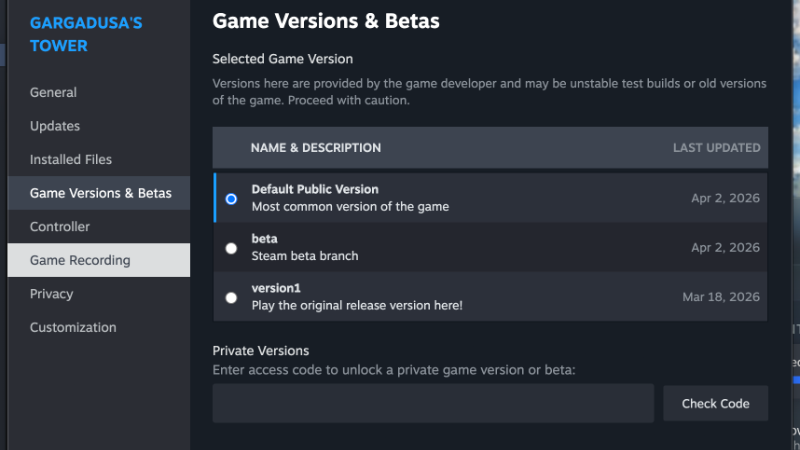
Want to Continue your V1 game in V1?
In Steam, head to the Settings Gear>Properties>Game Versions and select V1:
Playing on a V1 save?
Your save works. Load it and the Legacy Inheritance Package fires automatically -- tier-scaled gold, 8 starter buildings, materials, and a letter from the Great Sage at your Front Desk. You're not starting over.
Full details on exactly what you get and what carries over – read all about that here.
What comes next:
Balance changes are coming and I'll be transparent about every single one. Quest rewards, trade economics, tower difficulty, progression pacing -- there's work to do and I’ll continue doing it in the open.
If something feels off, come find me in Discord. I read everything.