
Hey everyone!
My focus has been on enhancing and simplifying the existing systems in the game, and as part of that effort I have improved the legibility of the genetic targeting-based mechanics, adding more cell body types, improved amoeba, and introduced the new archaea cell type (sized between bacteria and the eukaryotic cells). Also, compounds have been overhauled.
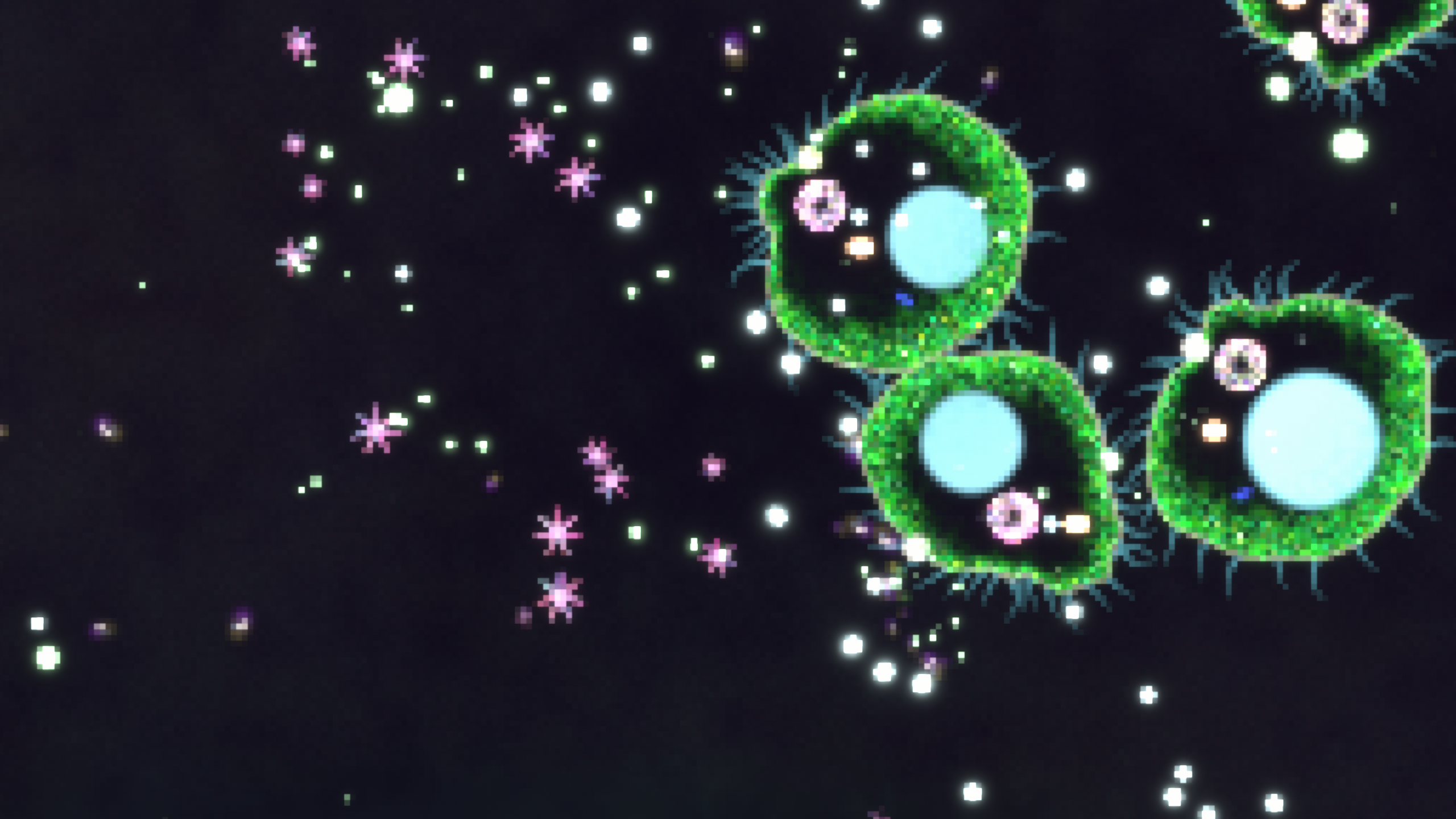
There are a lot of changes in this week's update and I am working on a wiki to covering everything. You can already see some preview pages and read about the new compounds overhaul. I will have an announcement when more pages are ready, I just have to polish some things tonight.
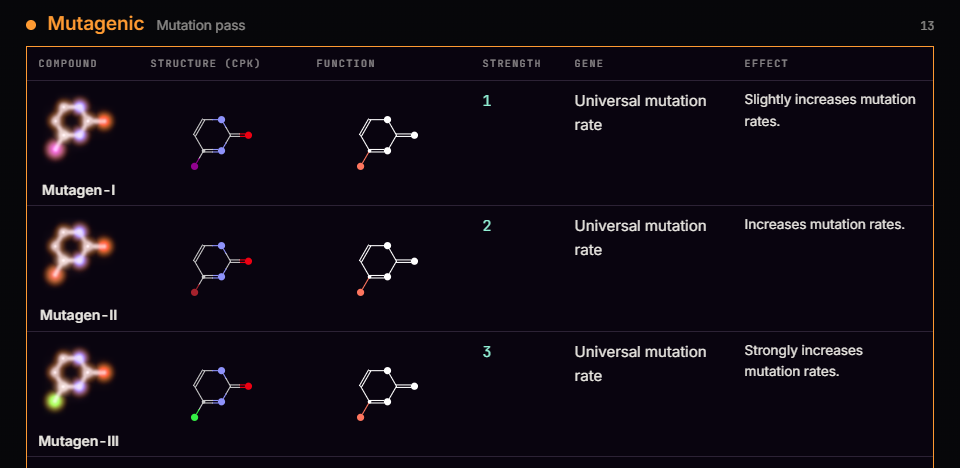 A sneak peak of the compounds overhaul.
The wiki is a living design document and will update often. You can explore it here!
Looking ahead, my main focus is improving the progression and difficulty of the game. I think its simultaneously too easy and too hard, and there is a lot of room for improvement. I am also going to start experimenting a lot more with maps and I'm excited to see where things go. Work on the tutorial and story is also always ongoing. For the wiki, it will take a while to add everything, but this is going to help a lot with clarifying the game and also help me see where I can simplify mechanics.
In the mean time, enjoy these changes! There will be a lot of rough edges, but as always I will patch any issues as soon as possible.
Thanks for being a part of development by participating in Early Access. The community support for Substrate: Emergence means a lot :)
Max
Changelog:
v0.4.8:
Implemented:
* Body shapes now trade stats: Bacilliform cells are faster and take less damage but hold less cytosol and absorb less, Vibrioid cells are faster and hold a little more cytosol but take more damage, Stellate cells are slower but hold more cytosol
* Bacteria show their genetic material and their energy store inside them
* Bacteria can carry a flagellum or cilia and swim only with one; the archaeon or symbiont they become keeps it
* A dividing cell can rarely mutate into an archaeon (smaller complex cells)
* Hovering a compound particle in the dish shows the name tooltip
* Zoom in closer on a compound particle to see its molecule
* A dish preview on the Bionet board shows each crystal as a dot in its color, with its name (WIP)
* The creative cell picker lists a Wild-type row for most starters; wild-type cells have pre-evolved behavior networks
* The creative cell picker has a Control Codon row that selects cell "team"
* A plasmodium with no branch tip ready to bud splits in two instead
* Antibodies now also may target bacteria
* Viruses and gene fragments wear the texture of their genetic material
* Antibodies show as a large disc wearing their genetic target's texture, paired with a small disc in their maker's color
* An armed ER wears its antibodies' genetic texture
* A Clip moment key marks a moment in Steam Game Recording (F2 by default)
* Act 5: the rival lab fields archaea (Early Access only)
* The new text is translated into all 28 languages
Reworked:
* The main menu is rebuilt around PLAY and DATA; CREDITS is now under DATA, and LINEAGE there shows one tab per lab
* Antibodies speed up as they home in and never slow down, and are drawn larger; virus fragments are drawn smaller
* Cells only take in viruses that could infect them
* Viruses and antibodies now tell teams apart
* Crystals are no longer solid blocks in the substrate. Each crystal holds a set amount of its compound, and the particles it gives off and the cells touching it draw that amount down until the crystal is spent. Crystals give off fewer particles, and each one carries more
* Compounds your cells carry are digested over time and take effect: Trophin feeds the cell and mutagens mutate it. Trophin particles a cell picks up from a crystal are carried and digested the same way
* Compounds show their pH as a tint around the molecule instead of coloring its center, and mutagens are drawn in shades of amber
* Gene-targeting compounds such as Zymogen-I, Zymogen-II and Globulin no longer dissolve dense substrate. Saponin is the one compound that does
* Globulin on an infected cell mutates it to have an ER with antibodies that can clear the virus
* Antibodies last over twice as long, travel further, swarm, and home in on viruses, infected cells and the cells they target
* Antibodies that match a virus kill the cells it infected. An infected cell bursts as soon as it cannot pay for its next virus copy, and viruses copy twice as fast
* A digestive enzyme's cytosol cost per burst rises faster than its projectile count
* Zymogen-I pulls a cell's digestive enzyme back toward the starter enzyme instead of making it stronger
* An amoeba with a lysosome digests the cell it eats: each of the prey's organelles shrinks away and puffs out as nutrients. Amoebagen also gives a cell a lysosome
* An amoeba's cup now opens toward its prey
* Rival lab cells wear the color of what their lab is named for, as specks of static instead of an even tint
* Rival lab cells start with genes suited to their name: Acidos Labs at acidic pH, Cryos Labs in the cold with cryochondria, Toxos Labs withstand toxin, Mutos Labs mutate faster and spray mutagen, Nomos Labs grow a cell wall, and Archos Labs are star-shaped with a stiff membrane
* Acidos Labs and Cryos Labs each claim a dish set to the acid or cold they are suited to
* Rival archaea are named Archaeon in the lineage instead of Contaminant
* Cell colors follow one pH gradient and one temperature gradient, ice when cold and fire when hot
* The membrane band thickens toward freezing and boiling, frosts in the cold and shows dark flecks from 40 C
* Cell outlines and plasmodium veins are drawn smoother
* A squeezed plasmodium vein bows instead of folding, and a tip turns along the dish rim instead of snapping
* The music in a dish is now one continuous score whose layers come in as the dish fills with cells
* ARENA LAB and MAP EDIT sit in the new main menu (Early Access only)
* Map editor: the map picker is one table showing each map's name, archaeon tiles are violet hollow hexes, and the editor's screens follow the game's standard layout (Early Access only)
Fixed:
* Random crystals on a new dish landing on the tiles your cells start on and killing them within seconds
* A cell dosed with two mutagens aimed at different genes losing one of the doses when it divides
* A cell with two ER copies dosed with both Globulin and Pheromonagen losing the Globulin dose
* Creative crystals placed from a mix of compounds all mutating the gene of the last compound added. Each compound in the mix now places its own crystal
* Aggressin, Replicasin and Stasin drawing as the same molecule (Early Access only)
* The COMPOUNDS panel running off the bottom of the screen when collapsed, cutting off ADD SLOT
* A cell under antibody attack never dying while it still had income
* Viruses leaving a dead cell from different places than the ones drawn inside it
- Bursting bacteria and misshapen cells still do
* The infection hint saying there is no cure. Infected cells can be cured by dosing them with Globulin
* Cells killed quickly by pH or heat being reported as starved
* Plasmodia paying no nucleus cost for each new cell after the first
* Your cells turning dull and brown at acidic pH
* Bacteria drawing as near-white capsules. They now show their pH color with the same cytosol look as cells
* A flagellum's full speed response not reaching the cell
* Tutorial acts hiding the controls bar along the bottom of the screen. Only the LENS row now waits until a lesson opens it
* Tutorial messages staying unchanged once their task is done. The task text now greys, as it does in OBJECTIVES
* Confirmation windows running off the bottom of the screen at large UI SCALE or HUD TEXT settings. Their text now scrolls and the buttons stay on screen
* More saved names still showing in English in other languages, in the cryobank, lineage, splicer and Bionet panels
* Map editor: undo and hovering no longer lag (Early Access only)