
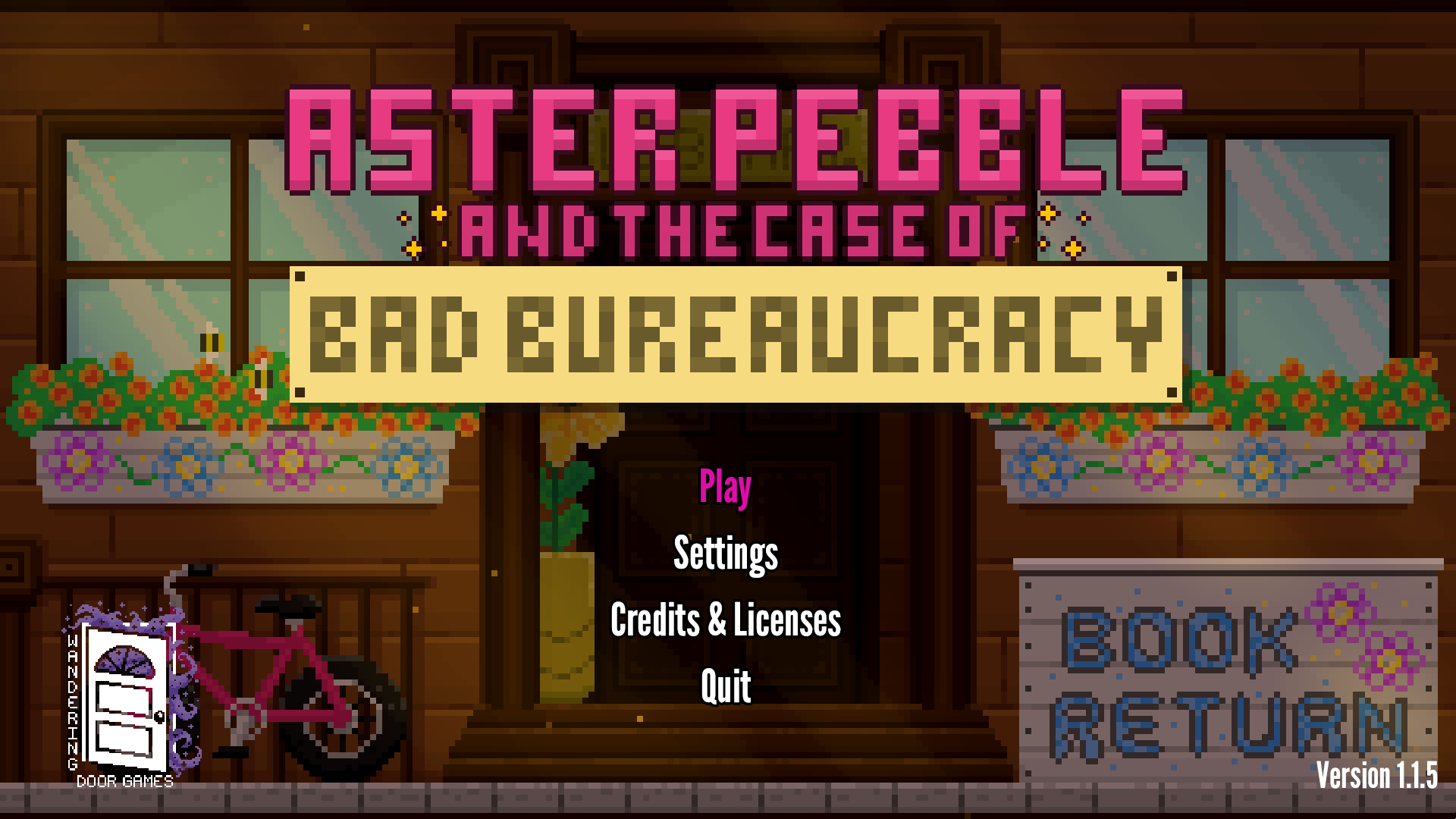
Welcome to our "Lookin' Back On" for the release of our first game "Aster Pebble and the Case of Bad Bureaucracy", alternatively titled "Oops, All Edge Cases!".
Our focus today will be to look back at the development of our game and reflect on what went well, what didn't, and the kind of lessons we'd like to take forward with us.
If you missed it, or haven't seen the game before, Aster Pebble and the Case of Bad Bureaucracy released on Friday, July 24th, 2026.
It's a short and cozy point and click time loop mystery, focused on silly humour, fun characters, and simple puzzles.
Development
We started the development of Aster Pebble on October 6th, 2025. The plan was to make a small game to help us refresh and deepen our Godot knowledge, while allowing us to learn things like how to integrate with and release a game on Steam. We aimed to take about 6 months to develop the game, while ensuring the scope was kept small enough that it could still be a fun and polished experience that we could be proud of.
The game ended up taking closer to 10 months to complete. Some of this additional time was due to this being our first real game release, and we weren't particularly experienced in scoping out a game of this size. Some of this was just due to underestimating how much dialogue it would take to do a time loop themed game justice. And of course, some of this time was outside of our control, because life can hit you in the worst ways when you least expect it.
On the other hand, we're happy we managed to put out a game without any real sense of crunch. The only time that it felt close to that was when trying to get our demo ready for a Steam Next Fest much too early in our development process (which we'll get to later). But even with the pressure there, we never sacrificed time with friends or family, and never worked any unhealthy number of hours.
We wanted this game to be developed in a healthy and sustainable way, with hours we could maintain if we were to continue development of open source games for the foreseeable
future, and on that we were definitely successful.
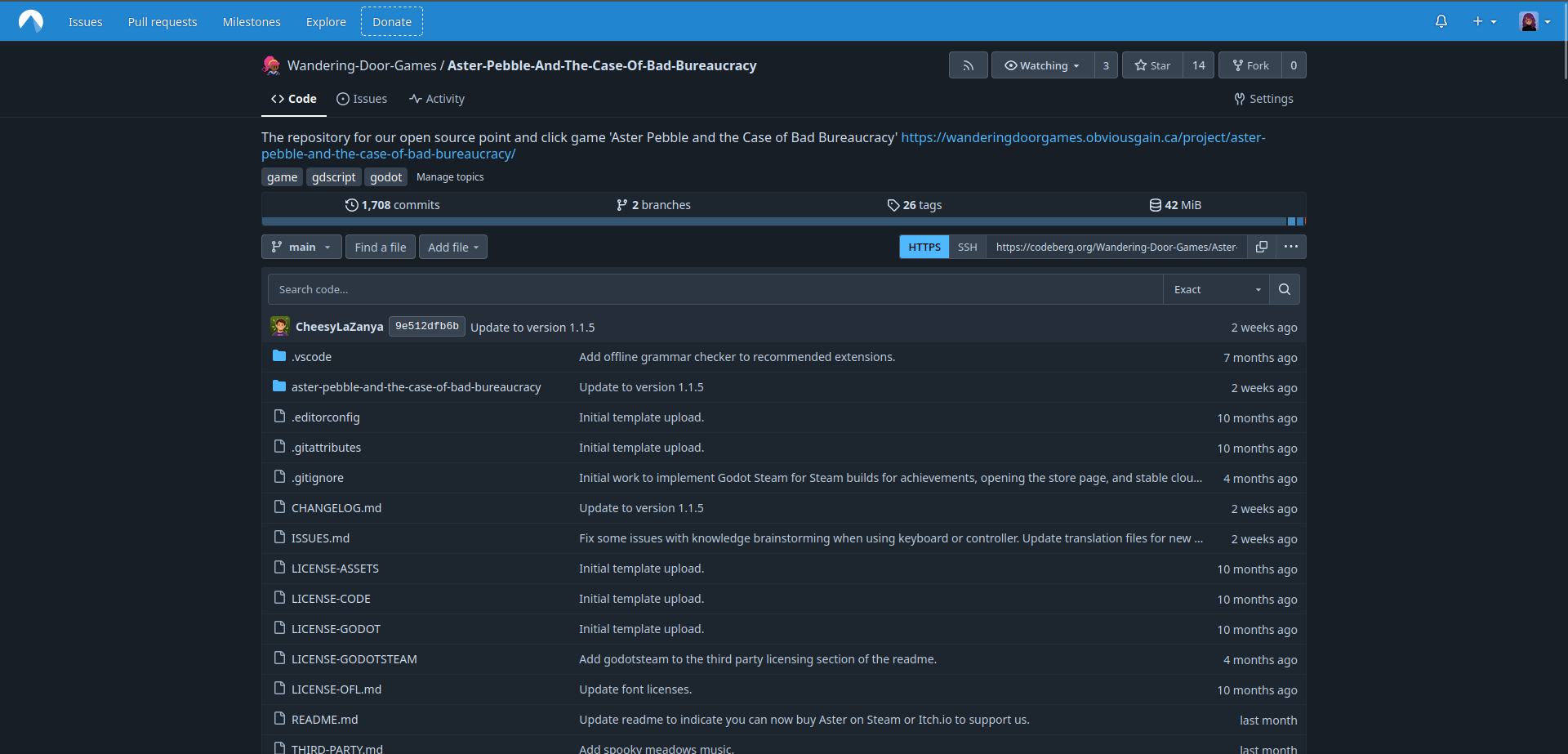
Another aspect of development that went well was not waiting until after release to open source our game. We had some worries that open sourcing our game early would lead to distractions if people were looking at our half finished systems. We didn't want that to take time away from creating the full game we were working towards.
In reality, not only did this not happen, but we even got a suggested improvement via the Codeberg issues system which made the game better. This also let us get on some open source game lists, while allowing us to be clear during our development updates that the game is already available open source for those who have similar values and care about that.
We definitely expect to open source all of our games early in development in a similar way going forward.
Demo and Steam Next Fest
We mentioned above that we put a lot of pressure on ourselves to release the demo for Aster Pebble as part of the February 2026 Next Fest.
This wasn't all bad, as it was good validation to see a few positive comments about our game at the time, and it was where the majority of our wishlists came from at that point.
We had specifically pushed for the February Next Fest, because at the time we were still hoping to release by around April, so we didn't think we could wait for a later Next Fest.
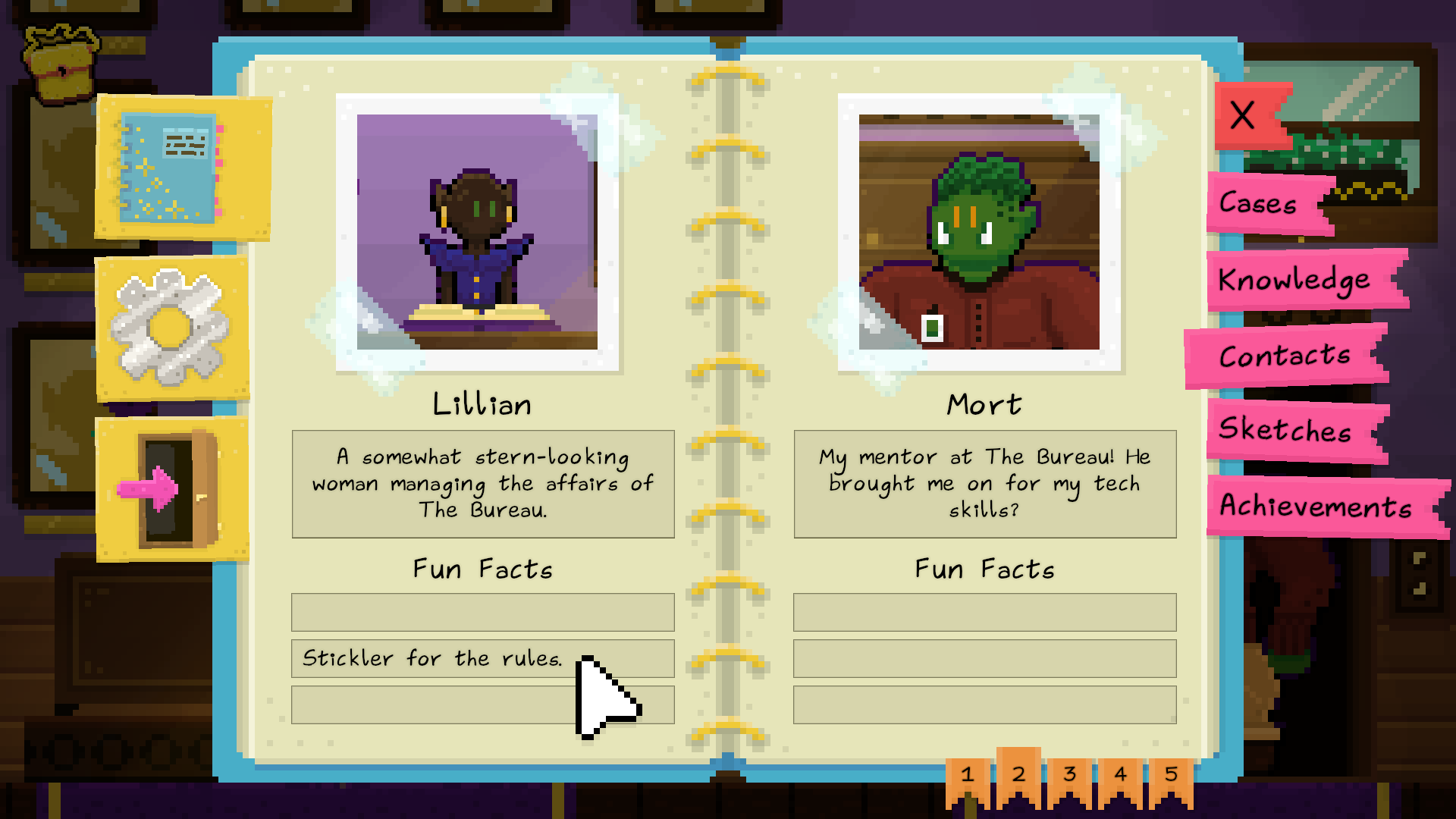
However, this lead to a rushed trailer, and our initial demo that had a lot less polish than the final game. Not that we think it was a bad demo per se, but it would've been nice to release with things we added later like music, blinking portraits during conversations, and the fun facts system.
If we had known life was going to slow things down shortly after Next Fest, and we wouldn't be releasing until July regardless, we would have had a much more polished (and less stressful) demo release for the June 2026 Next Fest. And with the great visibility of Next Fests, this might have made a substantial difference in Aster's final release, but we'll never know for sure.
Planning
One of the main things that took so long with Aster was just the sheer amount of dialogue we had to write. A normal player likely wouldn't see a lot of the dialogue in a single playthrough. But three factors still made this a lot of work on our side.
For one, we wanted to be sure to reward any curiosity when dragging items onto things in the world.
It's also a time loop game, so we wanted to be sure that wherever it made sense, characters would react differently if they gave you a quest on this day or a previous day and things of that nature.
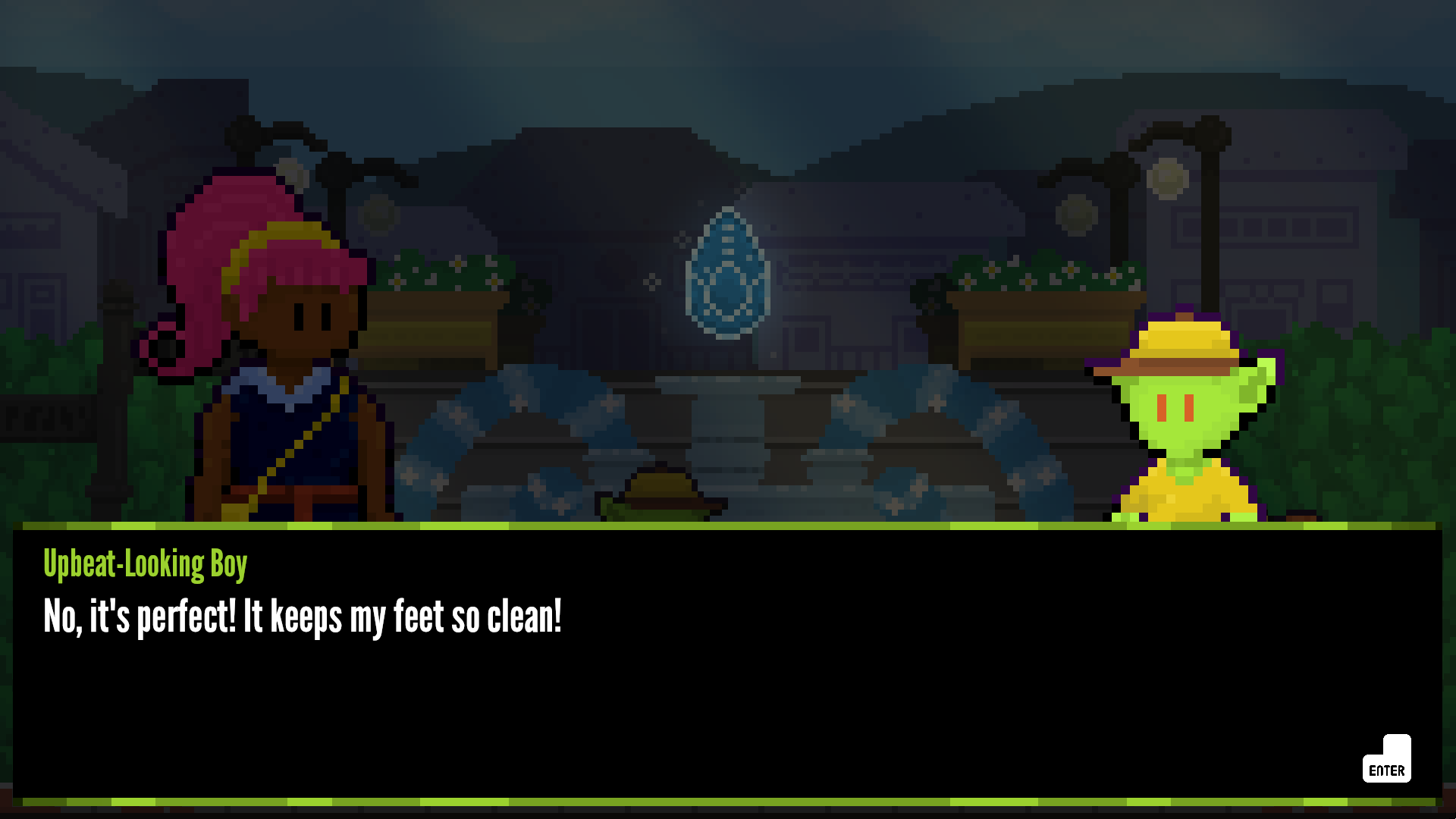
We also allowed for a lot of freedom in the order in which you do things, and some of this was to our detriment. For example, you can entirely avoid learning the name of one of the characters you interact with. Which meant we couldn't casually use it in any dialogue around that character in a way where it wouldn't make sense for Aster to know about it. That specifically is something we'd definitely do differently in a future game, because it was a lot of work for no real benefit to the player.
At first, we were planning dialogue out through either writing it directly in the game, or via a shared online document together. But the code was too complicated and hard to track what was or wasn't done. And a document was too flat and linear to meaningfully track the interactions or complexities of branching dialogues.
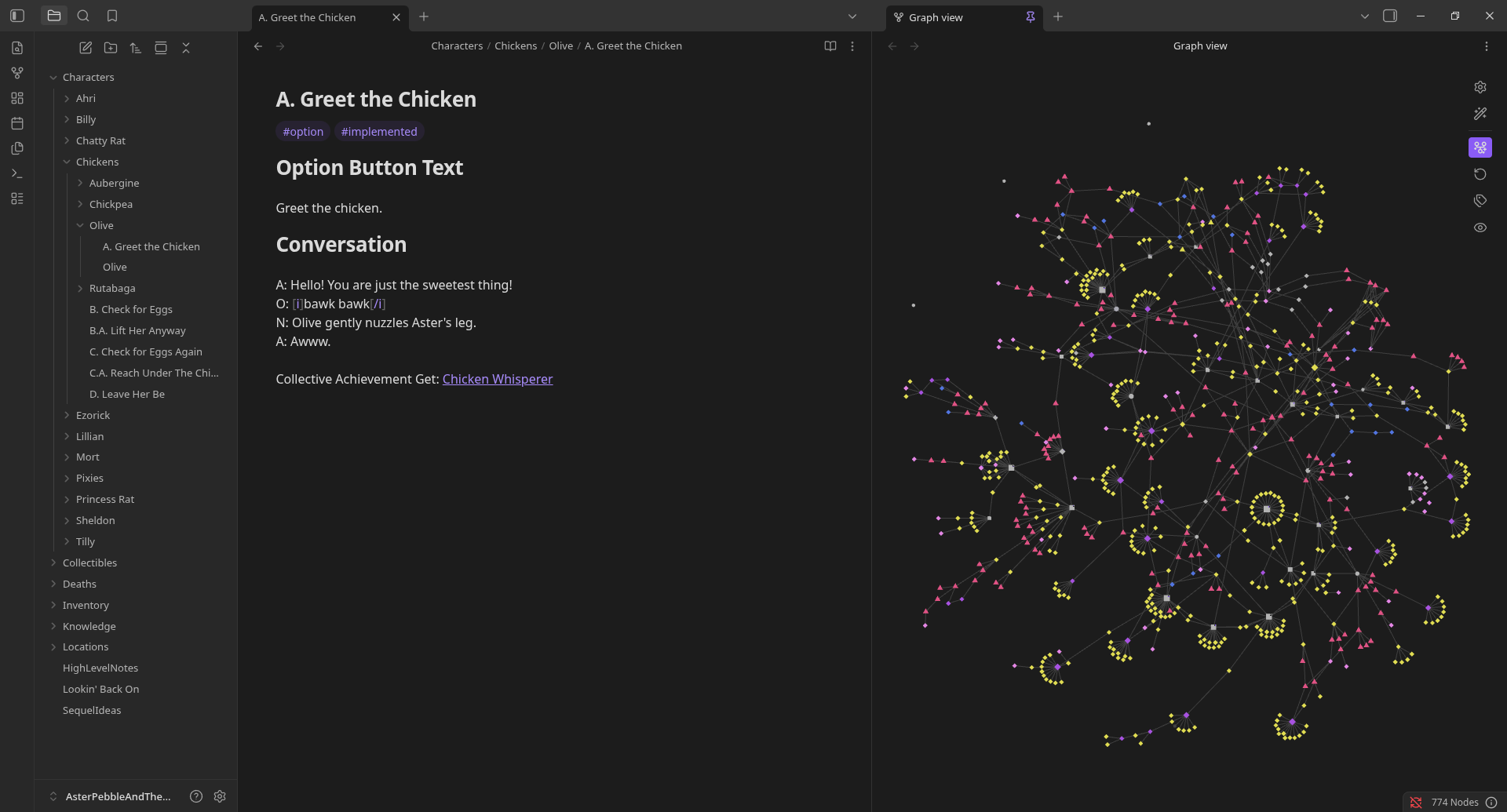
So we ended up using local markdown files with Obsidian to better plan and track dialogue. With it, we could capture all the details for a given conversation, link to related items and characters, and better highlight things like branches or requirements. But it also helped us to get a good overview of the state of things using the node graph system and some plug-ins to visualize how things were progressing.
The con with this was that it wasn't directly readable by the game in any way. This meant we had to manually set up those conversations, and face the inevitable bugs that come with any manual process like that.
And with the complexity of our dialogue system, that was unfortunately quite a pain.
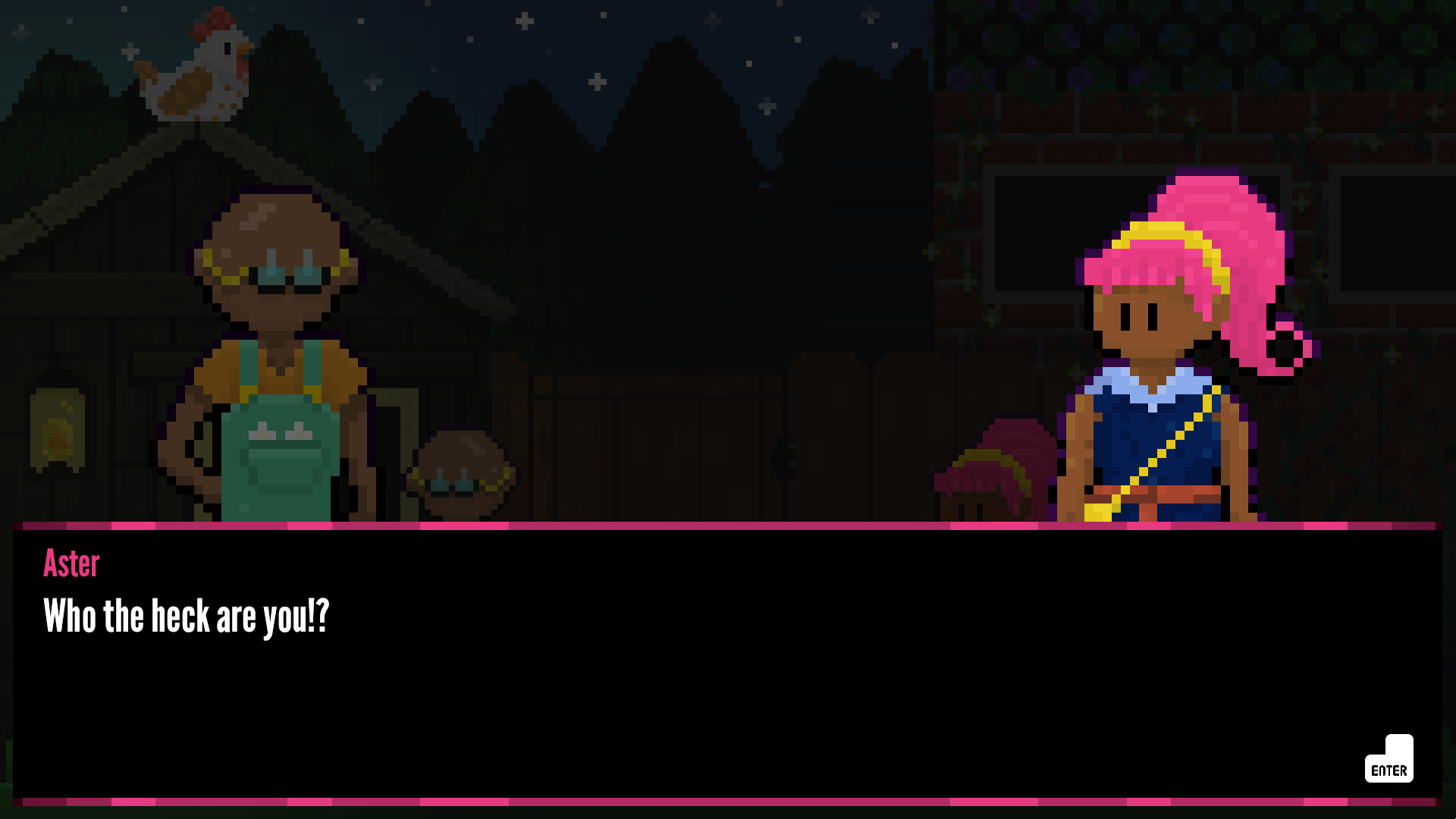
Here's an example where you can see Aster being uncharacteristically aggressive after supposedly taking over Sheldon's backyard.
Dialogue System
Our dialogue system was probably the thing we improved and iterated on the most during Aster's development, even though we still aren't fully satisfied with it.
Of course, we were open to refactoring and redesigning the dialogue system as we went. The problem was, we were building it while we used it. And the further and further we got into the project, the more expensive any small change got. So a lot of early to mid project choices ended up being locked in because it would have been too expensive to change them at that point for "minimal benefit".
Though, when you add all the tiny issues together, it definitely led to a lot of friction when working with our system.
Some of the issues we'd want to try to make better in no particular order are:
Multiple Methods for Creating Dialogue
We had multiple ways to create conversations such as create_dialogue, create_monologue, and create_message. They basically did what they sound like.

The function create_message could create a single message for a single character.
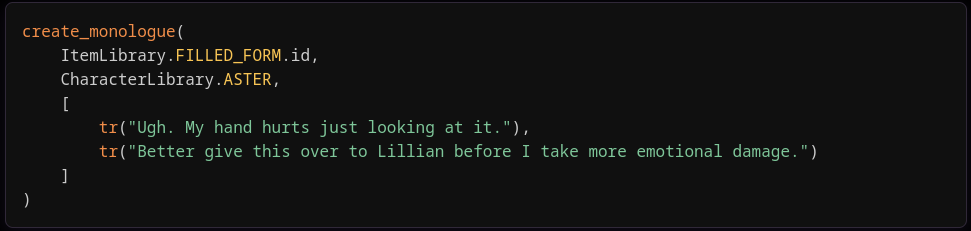
Then, create_monologue allows you to create a list of messages for a single character.
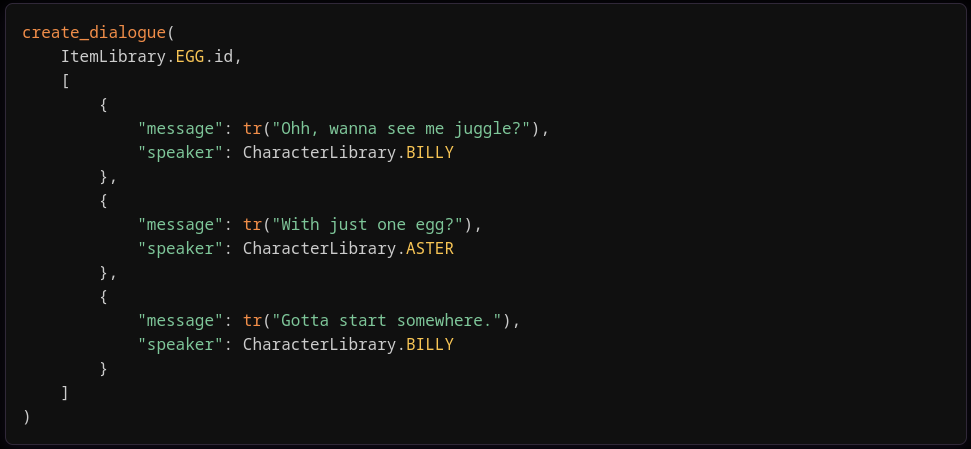
And finally, create_dialogue allowed for a list of messages and their associated character to support full conversations.
In reality, create_dialogue was barely more complicated to use than the other two, with a ton more flexibility. And in particular, create_monologue was, if anything, easier to use than create_message, without the drawbacks of needing to switch functions if we decided to add another line to the conversation in the future. So we'd definitely get rid of at least create_message in the future. Likely, we'd add the functionality of create_monologue into create_dialogue to have a single way of creating conversations.
Complicated Branching Systems
Like any game with contextual dialogue, we needed a way to manage branching dialogue so different conversations could be used in different contexts.
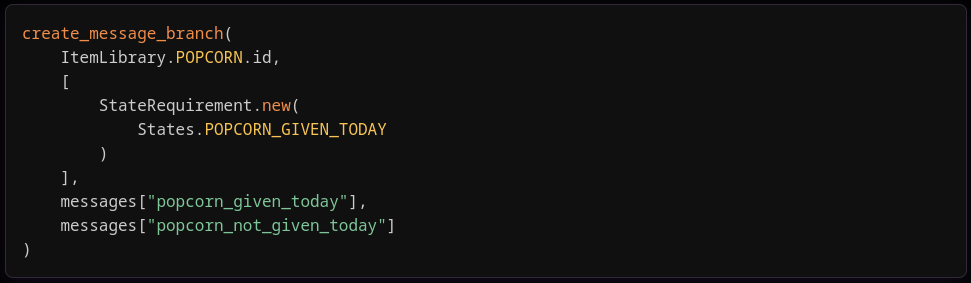
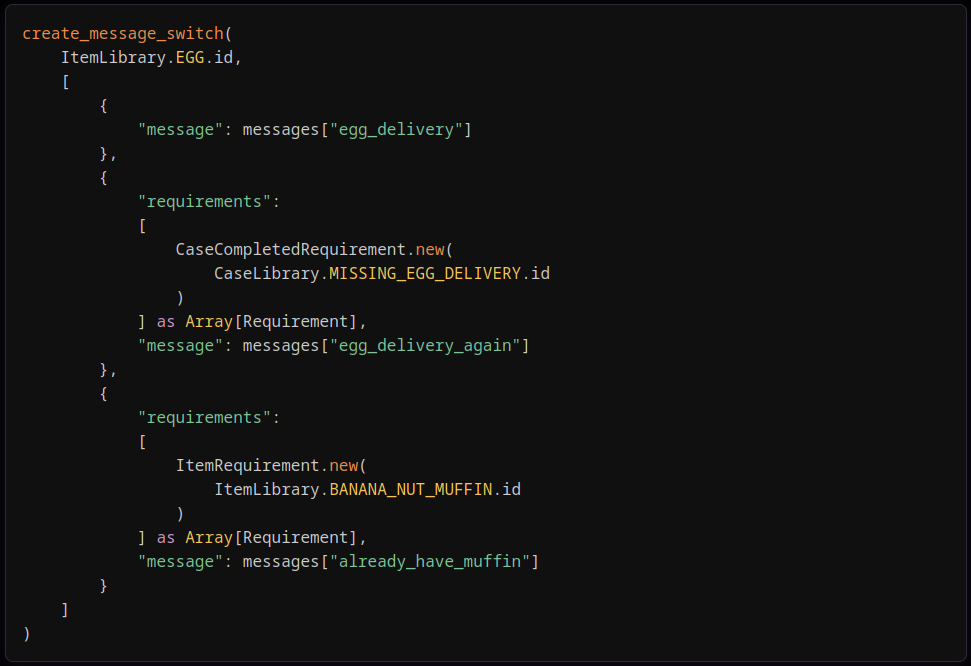
We started with a create_message_branch system, and then tried to force a create_message_switch system on top of that, allowing us to have a list of requirements, and the conversations each would trigger.
However, this switch system effectively just called create_message_branch a bunch behind the scenes. This meant you had to choose from a straightforward branch that could only do one message or another, or a complicated switch system which had issues like checking requirements from bottom to top because of using branches behind the scenes, which was all sorts of confusing.
We'd definitely only go with the more flexible switch like system in the future, after refactoring it to be a top to bottom check like any sane person would expect, of course.
Character Speaking System
We also had lots of smaller issues.
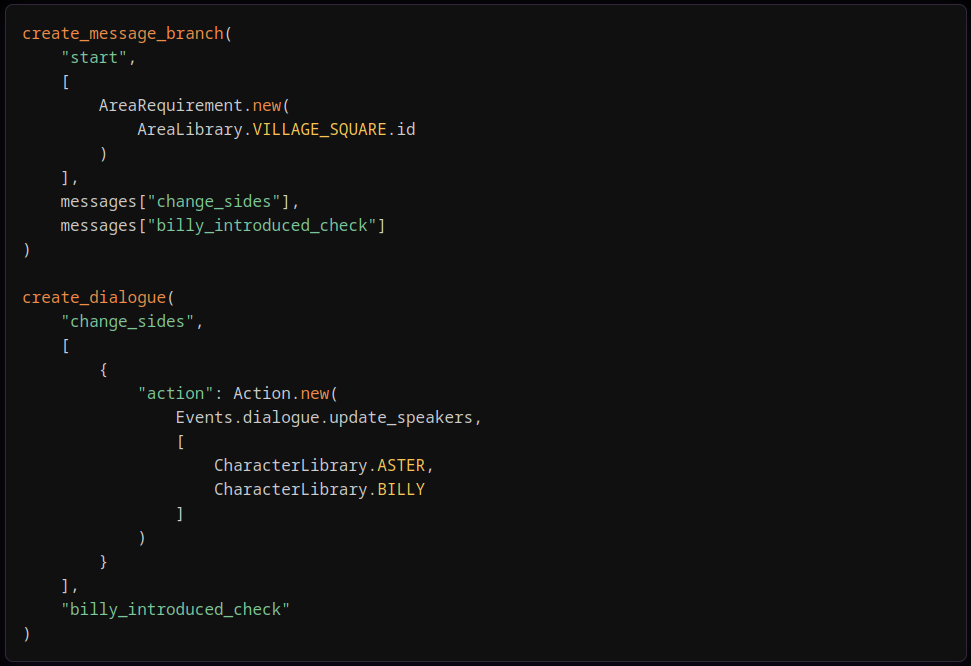
For example, selecting speakers also meant manually setting the speakers to a given side. This is fine in some cases, but in others, you can talk to a character in different locations or at different times of days, and that meant the character should now be on a different side. This would mean needing a dialogue branch just to update the speakers!
We would probably need to create an entirely new system for setting which side a character is speaking from in the future. If we didn't do that, another way we might solve this is by allowing requirements for actions in dialogue directly.
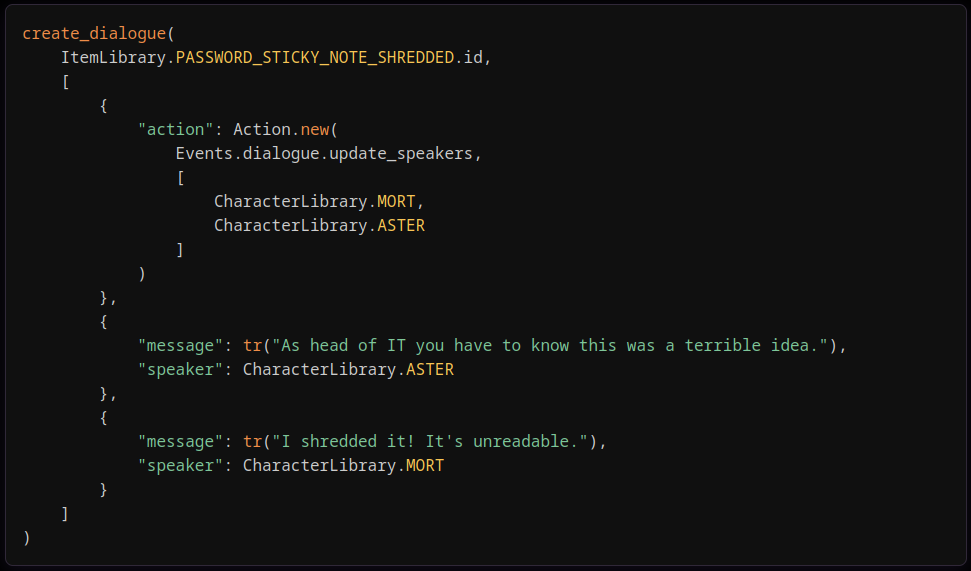
Right now, create_dialogue allows us to trigger an action like update_speakers, but if it's present, it always triggers.
We got around this, by having separate dialogues that just updated the speakers, which we could then trigger by branching to that conversation, and then returning back to the actual dialogue we wanted to say. If we could instead just have requirements associated with that action in create_dialogue, we could have skipped the branching entirely.
Requirement System
We've already briefly mentioned requirements, but that system also had its own weird choices.
Requirements allowed us to control things like which options would display to the player or when different dialogue would trigger. We have many different types of requirements, like ItemRequirements, which check if Aster currently has a given item, or CaseRequirements, which check if Aster has discovered a given case.
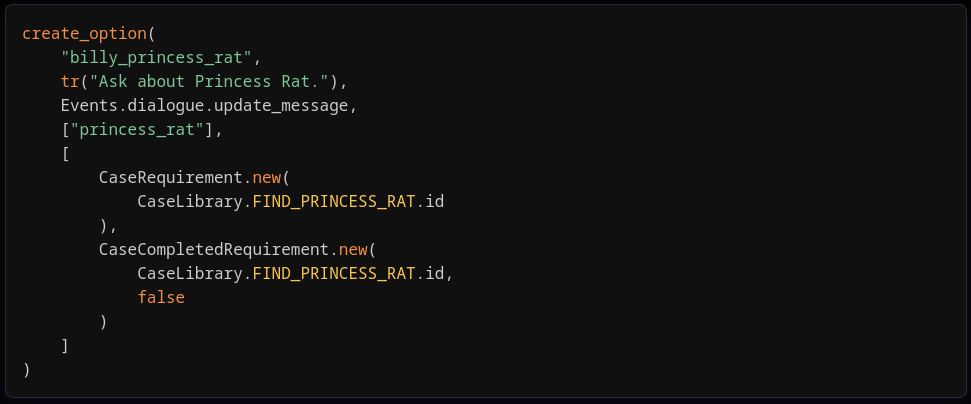
However, despite each of these requirements targeting very different areas with different code to check that they were met, we had each take a single string ID as the actual value to check, rather than using the actual object from the related Libraries such as the ItemLibrary or CaseLibrary.

This meant we then needed to take those items, grab an ID from them for the requirement, then in the requirement, use this ID to figure out which object it was we wanted to compare against in the library!
Obviously, it would have made a lot more sense for requirements to just use these objects directly.
Event/Action/Animation System
We'd also like to have made the event/action/animation systems interact better. Look how stupidly indented this code gets for a straightforward use case.
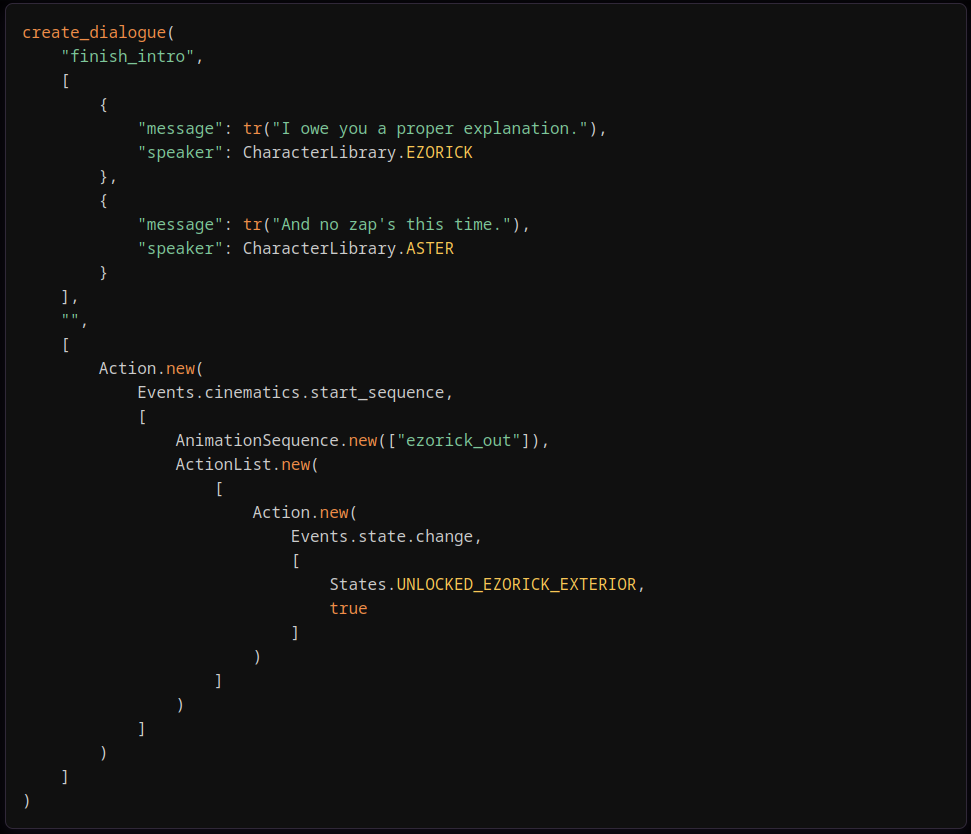
That's really all there is to say about that. Gross.
Dialogue/Case System Interaction
On the user experience side, one flaw we had with the dialogue system was how it interacted with the case system.
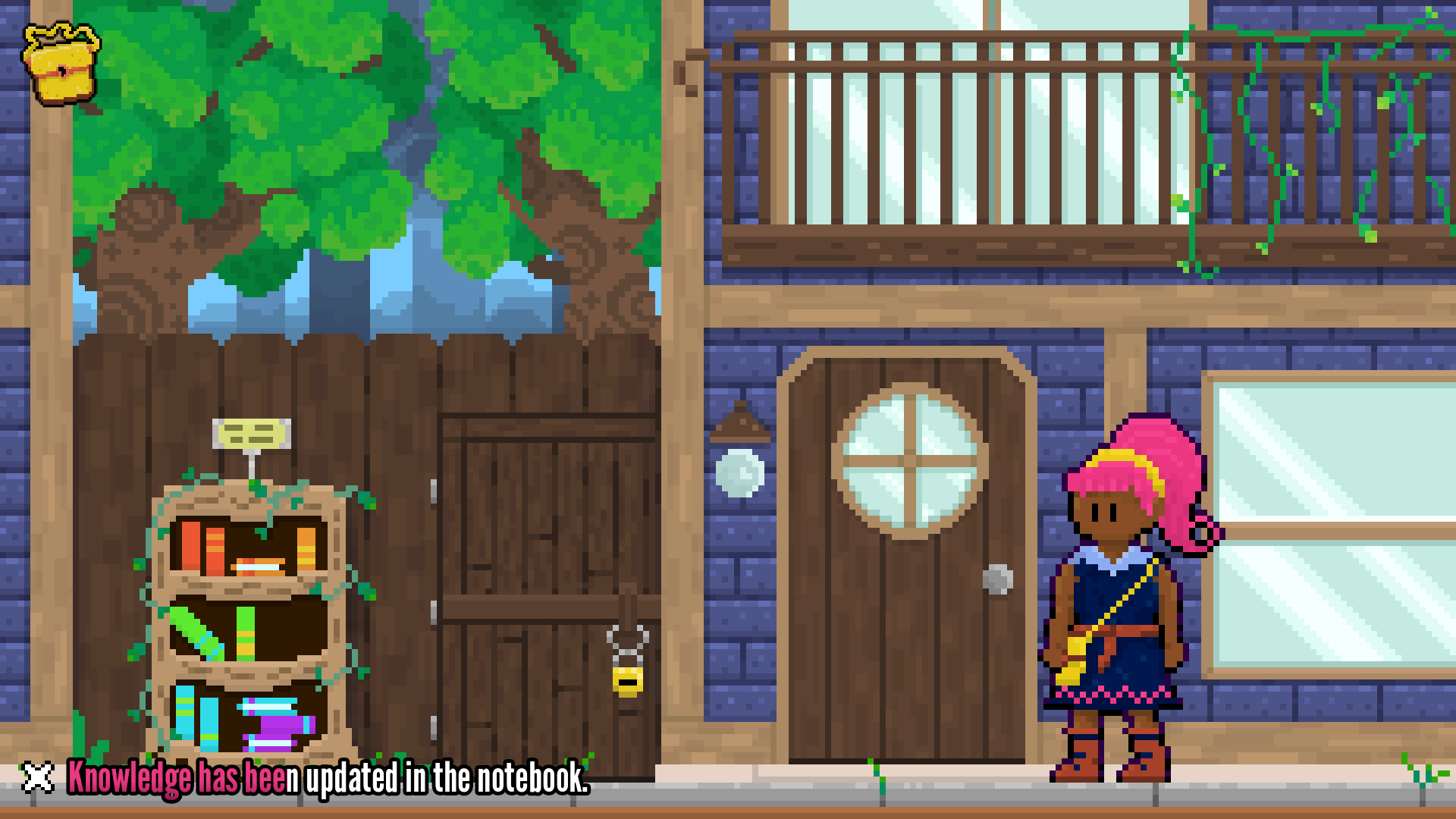
For things like toast messages, we had a queue which would only trigger once you had closed out of dialogue.
But unlike the toast system, which is more a gentle hint so events aren't missed, when we show you a new case or case closed it's a bit more of a key event. So we didn't want to wait until the player happened to leave dialogue for this to appear.
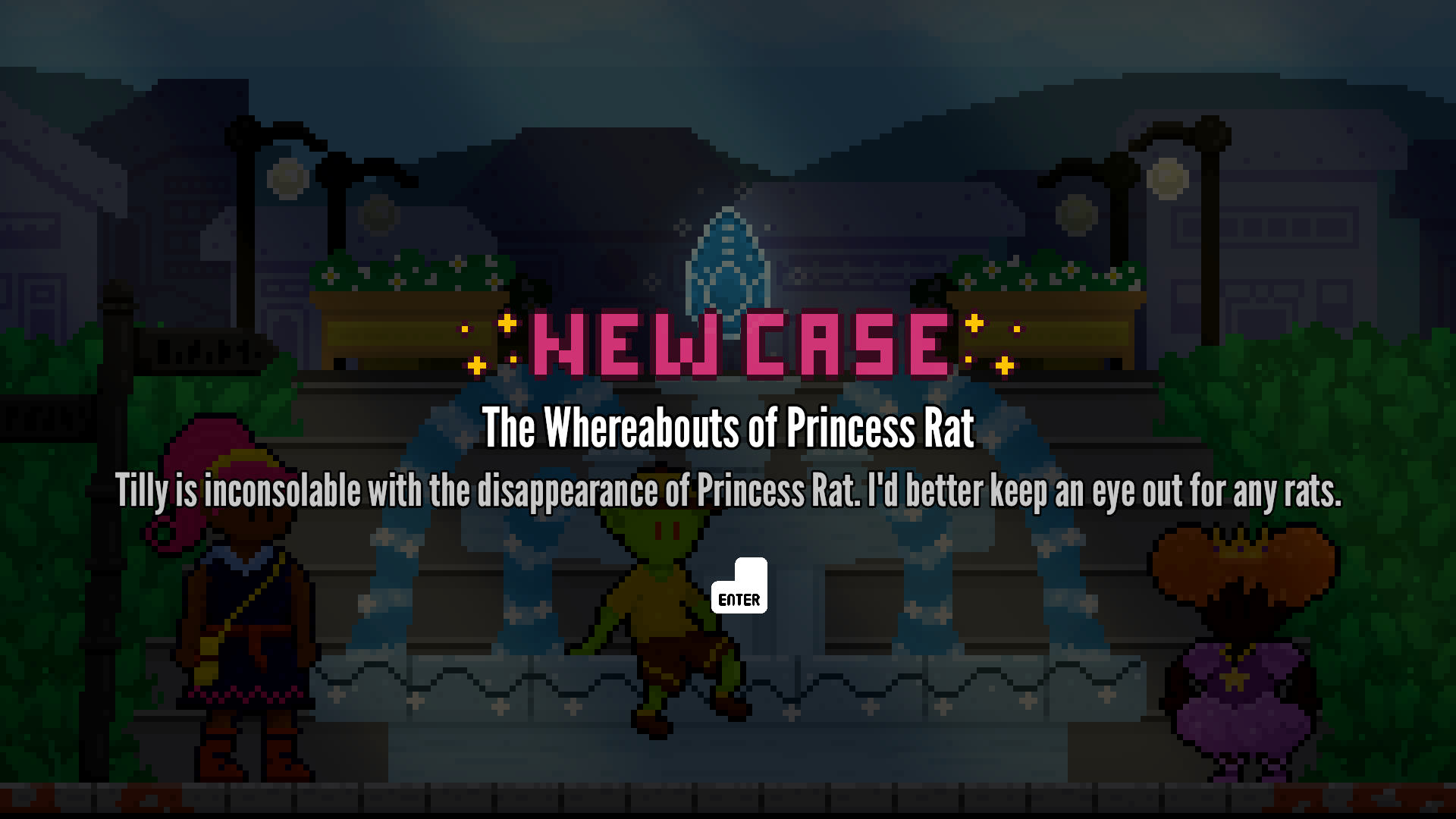
What would've been ideal would have been to open the case panel, then when the player continued, returned them to the correct place in the dialogue. But it wasn't too impactful to just close the dialogue whenever we open or close a case, as the player could always just get back to the dialogue themselves if they wanted.
So it ended up being something we just left as is.
Playtesting
For all the things that weren't great with the dialogue system, one thing that helped was getting feedback from early playtests. We noticed early on that it was annoying to not have the game track that you already had picked a given dialogue option.
Although it wasn't originally in scope, it felt important enough that we added that in early on, so that options you chose would grey out.
Closer to release, we also noticed it would sometimes confuse players that a dialogue option that lead to other dialogue options would grey out, even if they might not have chosen all the options within that sub-dialogue option.
So we stopped greying out those options.
Then we found playtesters would get confused on why those options weren't greying out, and would end up clicking them again even if they had already just done so.
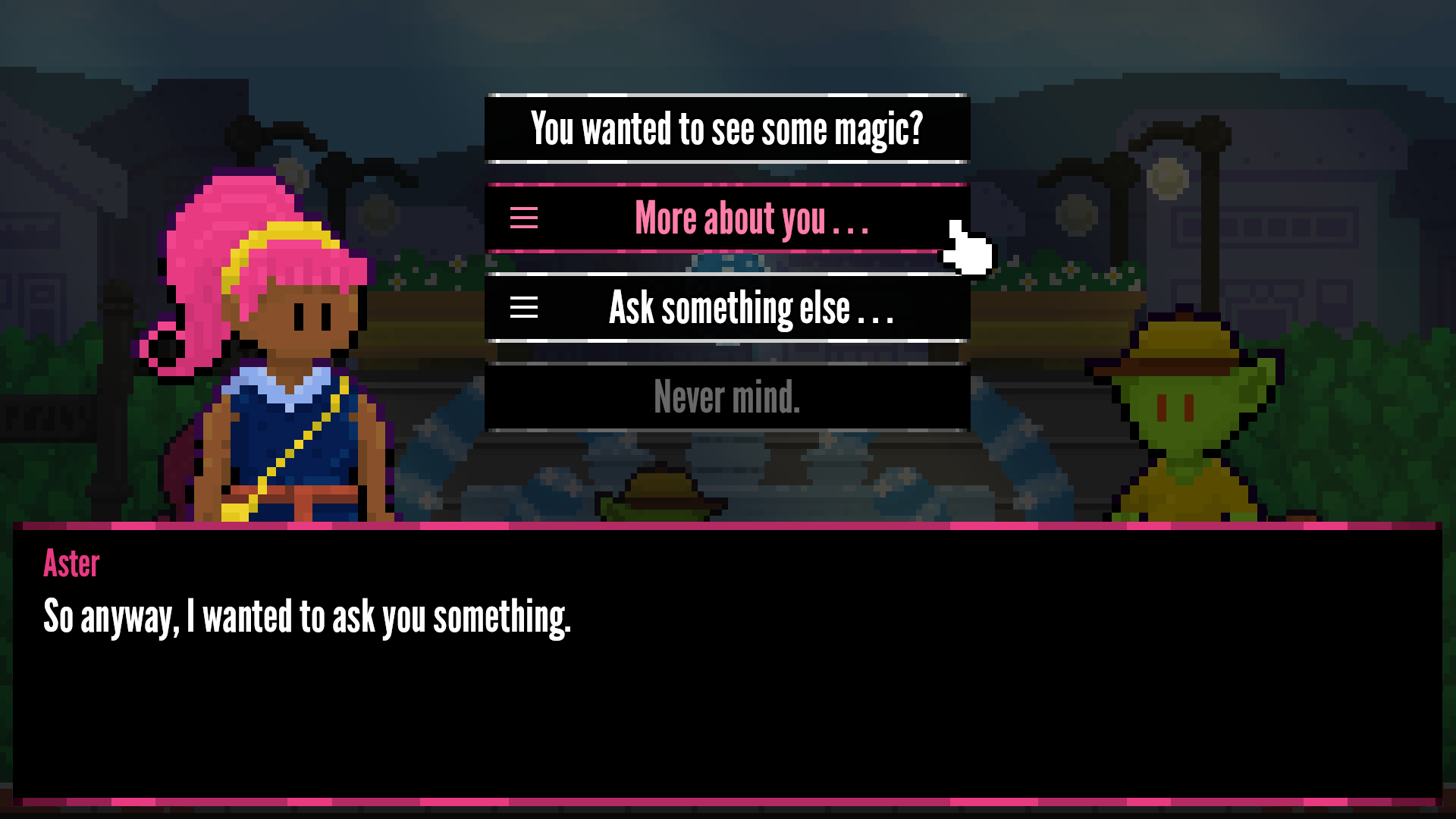
So that lead to our final setup where they show a menu icon on the left, and don't get greyed out, to better understand that dialogue option just opens an additional set of dialogue options, and isn't a choice itself.
This seemed to be the best balance of all worlds, without costing a ton of extra development time.
Debugging/Testing
Speaking of testing, we had to do a lot of testing for our game to ensure we could ship something we could be proud of. This meant we couldn't repeatedly play the entire game from beginning to end each time we wanted to test a change.
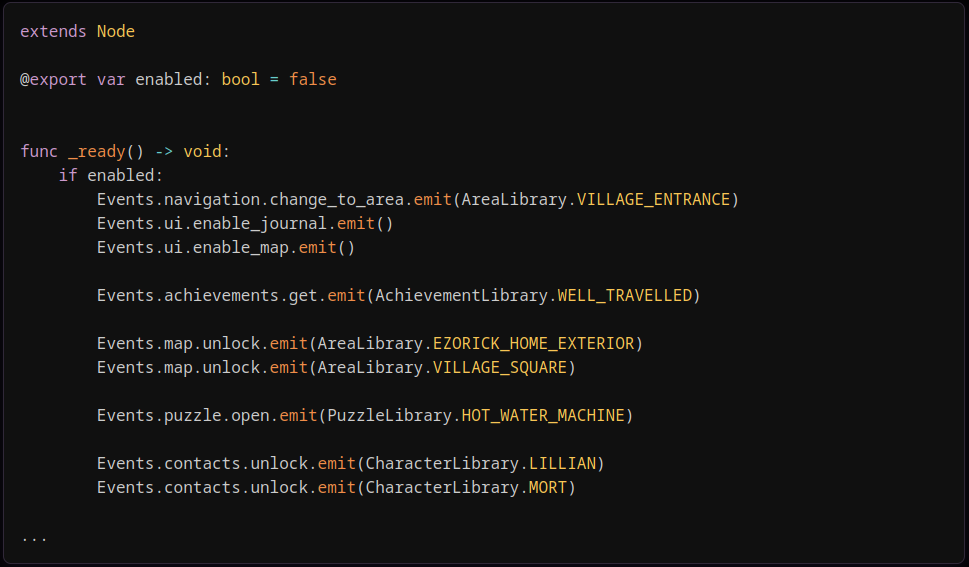
So we added a simple debug script early on that allowed us to quickly trigger events in our event system such as getting an item or setting a state. We put this script on a node in our game scene which we could toggle on via a simple export bool whenever we wanted the script to run on launch.
This worked well, but it also had its own drawbacks.
The biggest one was we still needed to make other changes in the game scene, and too often we'd accidentally commit this debug turned on. Also, it was limiting in that you had to decide up front before starting the game what debug events you wanted to trigger.
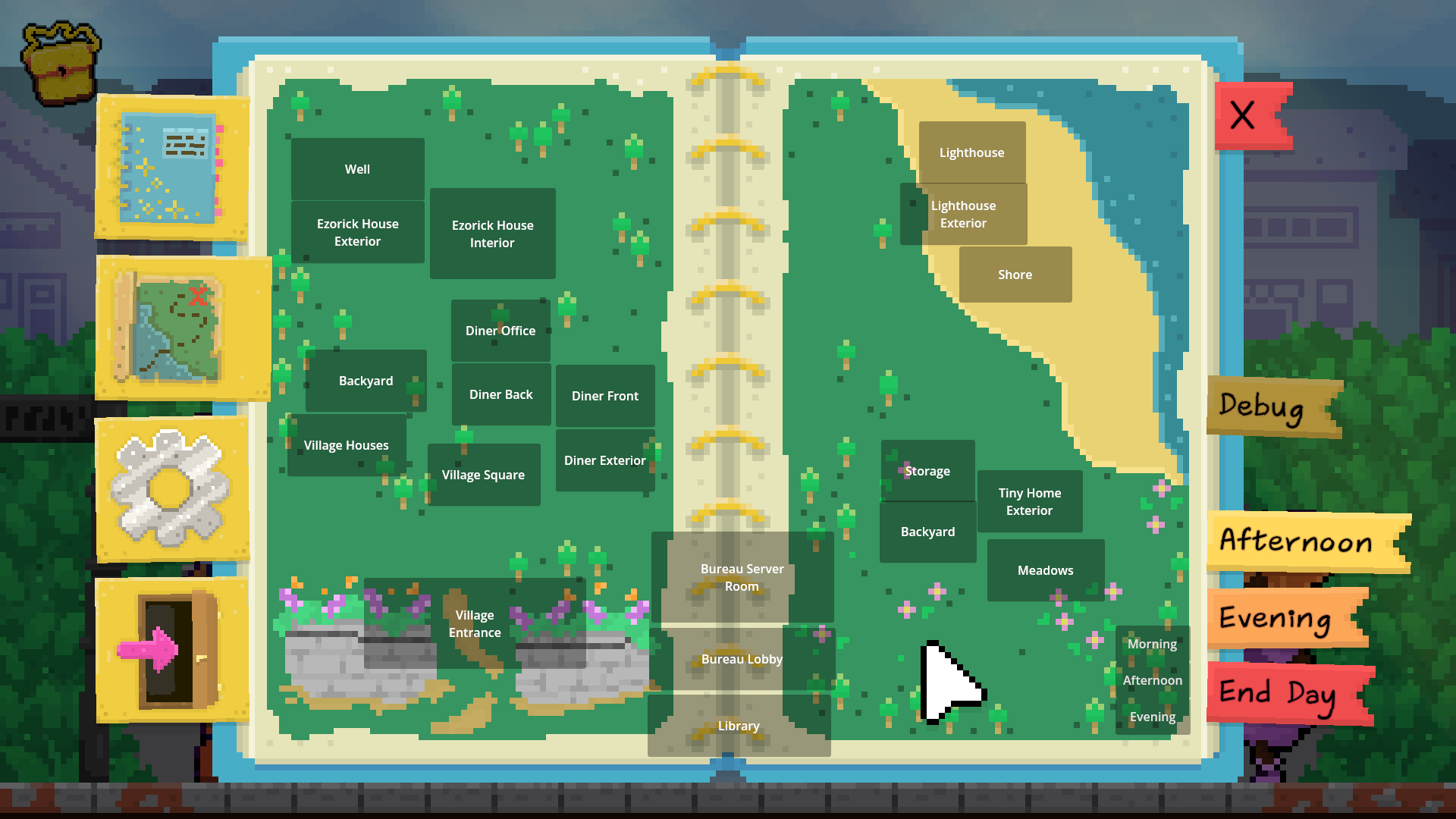
We also needed to be able to quickly access different areas for specific quick tests, which meant adding a debug version of the map only available when playing the game in the Godot editor, which was super helpful.
However, this also meant that we had no access to either of these debug systems while testing a built version of our game.
In the future, we'd likely want the ability to trigger anything we needed from debug at any point via something more like a dev console. And any debug systems like a dev console or our debug map should have been made available in any build, as long as they were behind an option that us (or players) could go out of their way to turn on.
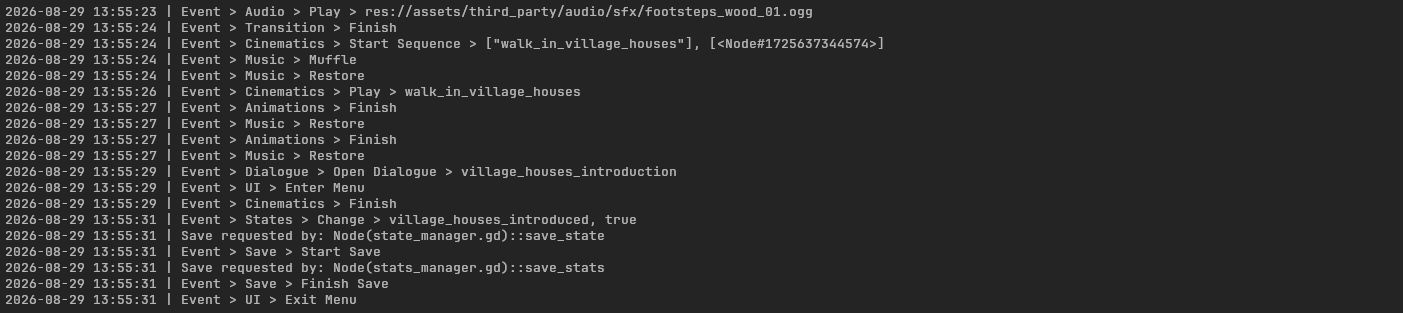
One good thing this forced us to add was a better system for logging events that got triggered. At least that way, we could get an idea of what was happening when things did go wrong. This was hacked in late, and was pretty manual, which we'd like to automate better in the future. But it helped us debug a number of tricky issues later in development, so it was definitely a win.
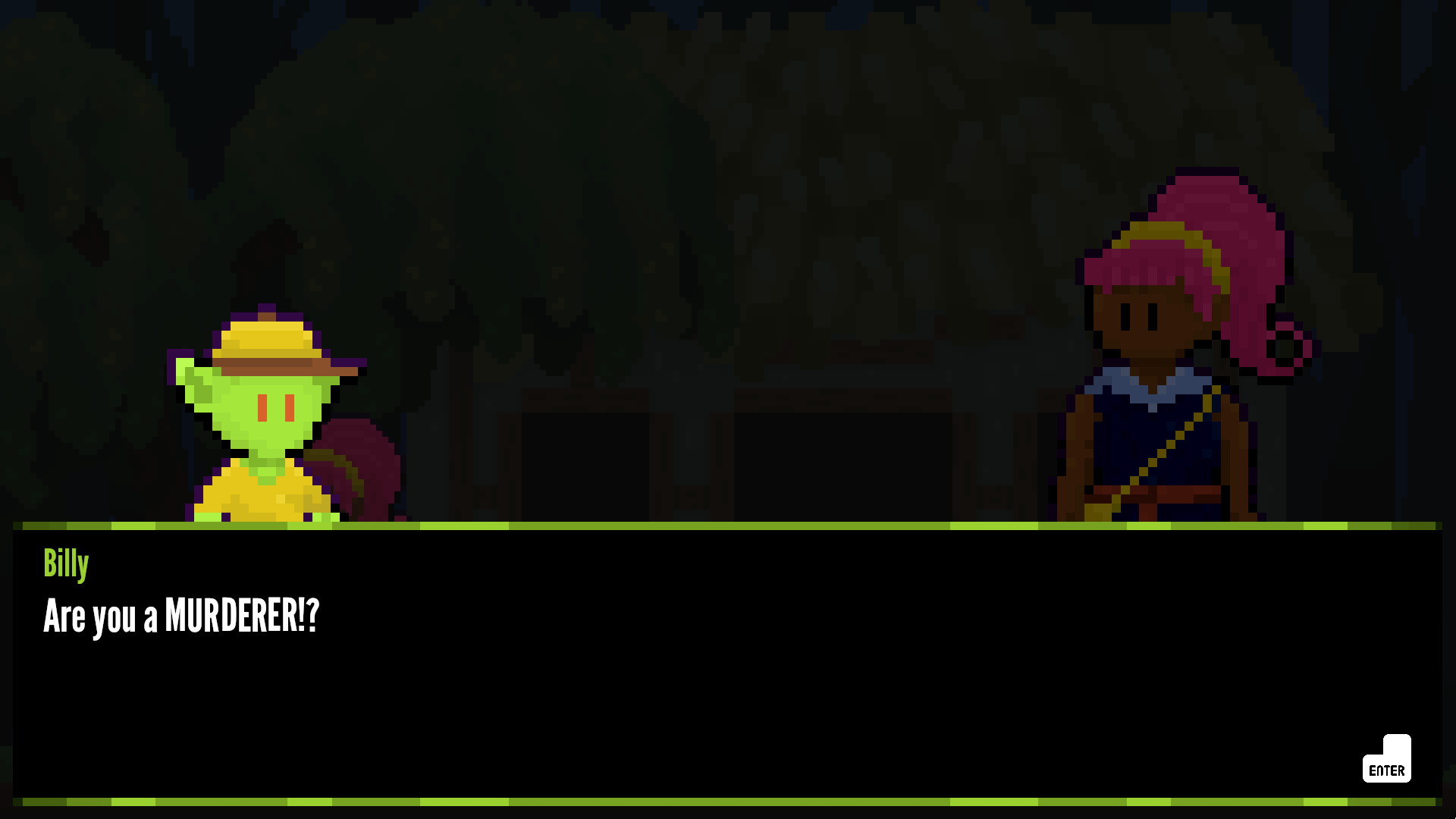
It was pretty unsettling when Billy would just randomly yell his line about you being a murderer when you entered various scenes. We're glad that one got found and fixed before release.
Another thing that would have helped here was more control over our saves. Aster only has a single save, and although you could quit the game and go copy the files to back up a current state, that would be anything but smooth. We think something like save profiles or save states would have helped us at least have the flexibility to keep a save of a given issue, while continuing to test with a separate set of saves.
We could have avoided more issues with the game if we had also done better at using packed scenes and shared resources, which we ignored for way too many things.
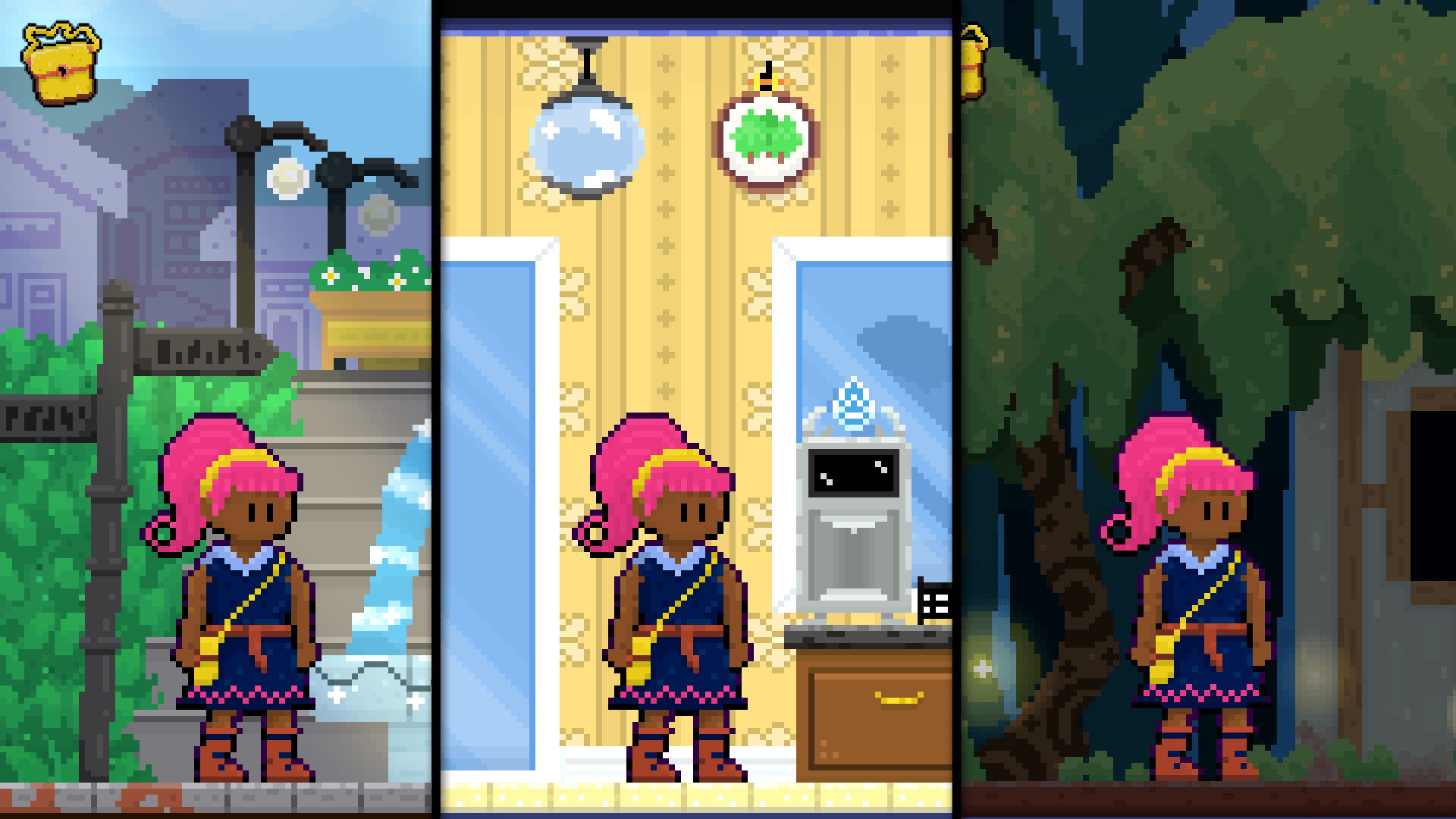
Did you know Aster herself is not a packed scene even though she is included in every scene in the game?
Why?
Because we just copied scenes as a base for a new scene and just kept her in it. We don't feel too bad about it because the goal was to ship a game, not worry about doing things "right", but it still feels like a poor decision in retrospect.
Other Considerations
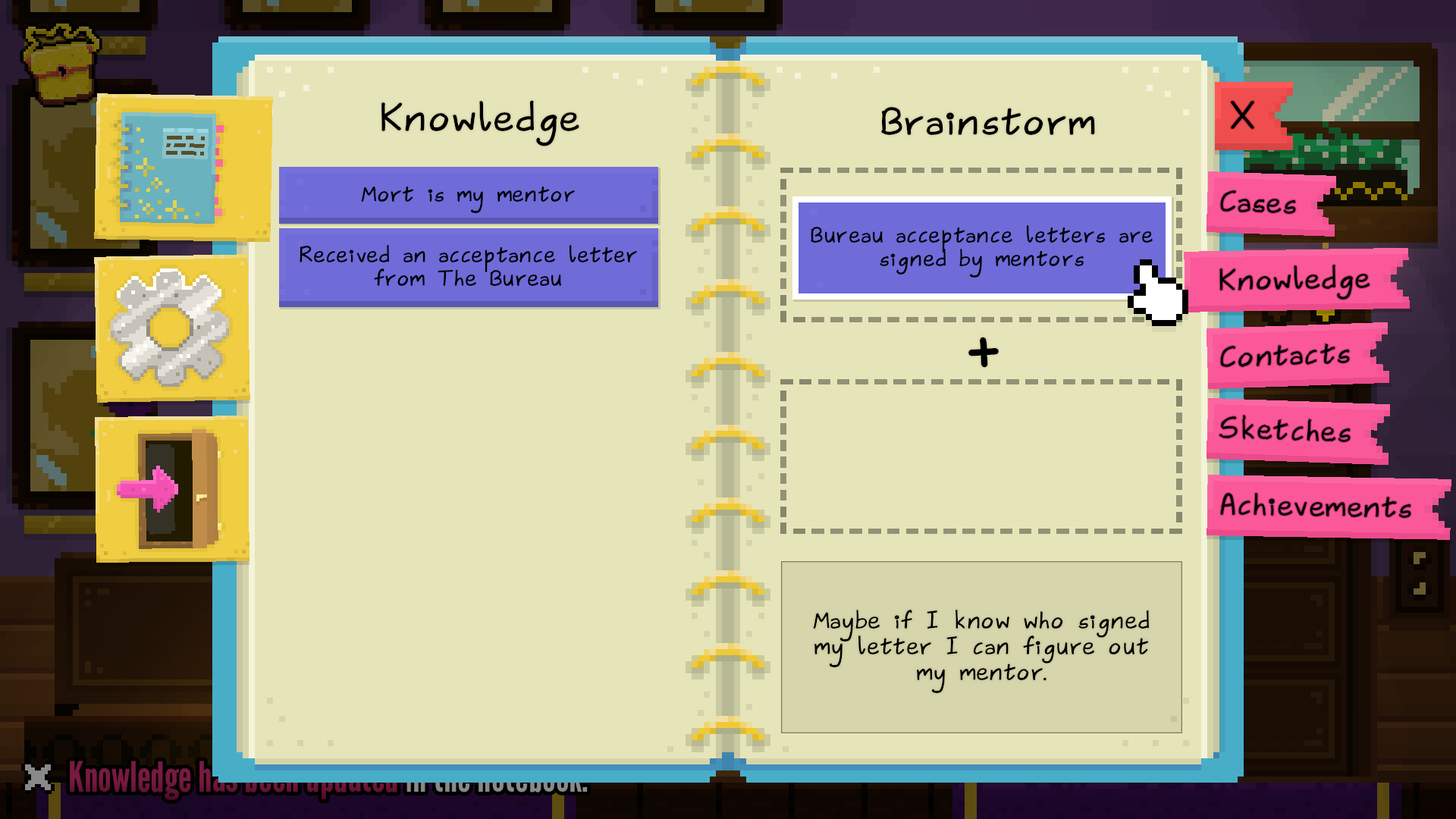
Using a notebook for our menus really fit Aster's vibe, but was also super limiting, and isn't something we'd likely do again in the future. If we did, we'd probably be even more lax on it using the full screen, and having non-book elements such as scrolling, which we had to allow some of anyway.
On a similar point, we made the entire game at the real pixel size that we wanted the art and such to be, aside from the UI which matched the native screen size.
This was nice to enforce consistent pixel sizes, and to keep the game size and resource usage lower than it otherwise might've been. However, movement of pixels on a hi-res screen isn't a smooth experience.
For example, we originally had a screensaver in the game which would drift around and bounce off the edges of its screen. But in game, the movement would just look jittery, unless we made it move weirdly fast.
There was a similar jittery quality to things like our floating dust particle systems, but those moved slow enough that it sort of worked in that it felt more like a lazy drift than an actual problem.
In the future, we might just keep the game at full resolution and uniformly scale up all our assets to allow for smooth "sub-pixel" movement for particles and things like that.
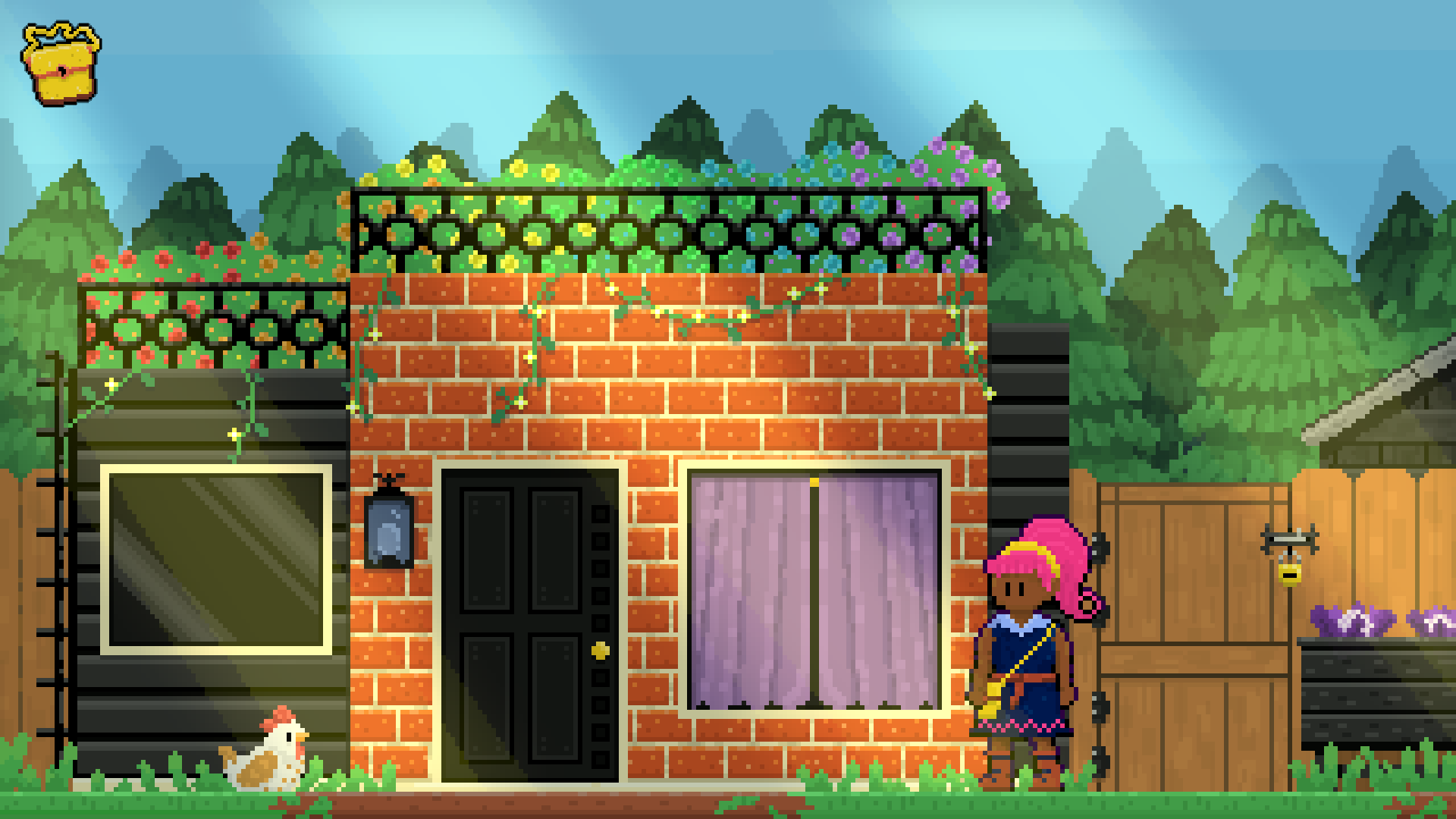
However, we do have some scenes such as outside Sheldon's house or other outdoor scenes where we have a higher pixel resolution to support different levels of "zoom". This was easy to do when the pixel art would naturally work in whichever scene without having to be scaled. So we'd need to be sure we keep that clean functionality and feel if we were going to try a new method.
We also added a changelog for our game, since we wanted to be transparent with changes. We've always been a fan of reading a good changelog, too. However, we think it was a mistake to make this based on commit messages, rather than on handcrafted change notes.
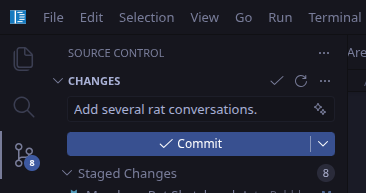
Even if some of the commits are pretty great, they weren't always readable or understandable outside the current context, which isn't a great experience. We ended up not displaying the changelog for Aster in game, but it's something we'd like to do for future projects when possible.
There were lots of little code things we'd clean up outside this too, such as combining our Settings and GlobalSettings classes into just Settings, since there was no real reason for them to be separate.
Sales and Reviews
So, after about 10 months of full time work, how has Aster Pebble done on release?
For context, at the time of writing this, it's been about 1 month since the release. The introductory sale is over, and we've seen a pretty big slow down in activity for the moment.
As it stands, we've sold less than 50 copies in total across both Steam and itch.io.
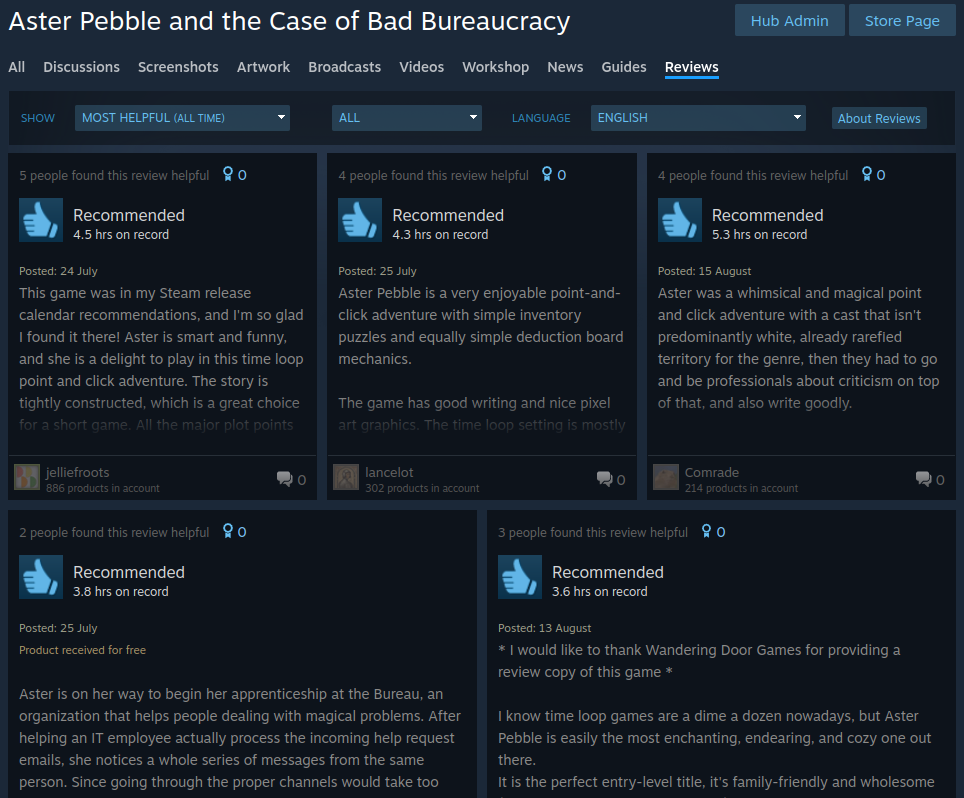
We're currently sitting at 8 reviews, 5 of which Steam counts towards our review score. All of which are positive, and many of which contain thoughtful and wonderful comments which really made our day.
We still have hope that over time we'll be able to get enough reviews to at least get a review calculation, which we know helps a lot on Steam.
If you happened to play Aster Pebble, or you do in the future, we'd love to know what you think!
Until next time, keep creating good.