
Well met, Kindred.
Last time, the Art team showed how an empty Blender scene becomes a painted street in Berlin. This time we are going back one step, to the thing every location, portrait and line of code is waiting for: the script.
Oaths & Ashes is written in Word. Not in a mysterious narrative engine, and not on a wall covered in red string. In tables.
Mutually exclusive versions of the same moment sit next to one another in columns, sometimes four across. Each one has to read as if it were the only version that exists. Then the comments arrive. Canon questions. Editor notes. Codex tags. Instructions for sound such as "the sharp knock of a stiletto heel against a body." Read without context, the margins look less like a script and more like evidence.
This devlog belongs to the Narrative team: how a scene gets built, why Alice was the hardest character in the game to write, and how a punk from East Berlin became much more important than anyone planned.
What does a normal writing day look like?
Mostly arguments.
That sounds like a complaint, but the arguments are the job. Plot gets settled early, while a scene is still a blueprint: what has to happen, what the player can choose, and what must still be true on the other side. Once the actual writing starts, the arguments move down to the sentence. Would Alice ever put a thing that way? Does a dark scene go too far, or not far enough? Does a joke stand any chance of surviving translation?
That last one is its own comedy. We argue in Polish about text written in English about a city that speaks German.
The drafts live in Word tables because our branching is literal. Mutually exclusive versions of the same moment sit side by side, and every column has to be written as if it were the only one. After a while you stop thinking in scenes. There is only this path, for the player who made that choice two chapters ago.
Then the scene goes to everyone else. The editor reads it with tracked changes. The lore gets checked against the tabletop sourcebooks, because this is a licensed setting and our Berlin has to belong in it. Every branch is read separately, path by path, because the classic bug of the format is a character who storms out in one column and keeps talking in the next.
We have caught that one more than once.

Which scene or dialogue was the hardest to write?
The honest answer is not a scene. It is a character.
Alice was the hardest thing to write on this project, and she never stopped being hard. Most chapters are told through her eyes, so the same fight begins in the Prologue and follows us through the game.
A visual novel lives inside the narrator's head. The inner voice is where most of the storytelling happens. Alice, unfortunately for us, never lets anyone in. She has spent almost two centuries perfecting posture, protocol and self-control, until the mask stopped being something she wears and became something she is.
That is great for the story and terrible for the writers, because the person narrating the game is also the person most invested in telling you nothing.
We had to learn to write around her. Alice never says, "I am afraid" Most of the time she will not admit it even to herself. The player gets her version of events: calm, precise, fully composed. Our job is to make the fear visible anyway, in manners that turn colder and more careful, and in sentences that get shorter when they should be falling apart.
Her dialogue works the same way. She says less than she means, on purpose, and the scene around her has to make you hear the rest.
The Prologue makes a good testing ground for this. On the surface, Alice is simply doing her job: an opera house, a traitor to find, a partner at her side and a schedule to keep. Her narration reads accordingly - assessments and contingencies, a field report with excellent vocabulary.
The real story sits underneath. It is in how often her thoughts bend toward Lucinde, the mentor she answers to, and in the score she keeps against a rival she claims not to care about. By the end of the night, the player should understand what Alice wants and how much of her is built around the fear of not getting it, while Alice herself has admitted nothing.
The scenes that cost us the most drafts were the ones where something finally gets through to her. Let her open up too easily and the character breaks. Keep her sealed and the player feels nothing. Every one of those beats had to be balanced one word at a time.
Lenz, meanwhile, tells you everything, all the time, whether you asked or not. With him, the job is getting him to stop talking. With Alice, the job is getting her to say anything at all.
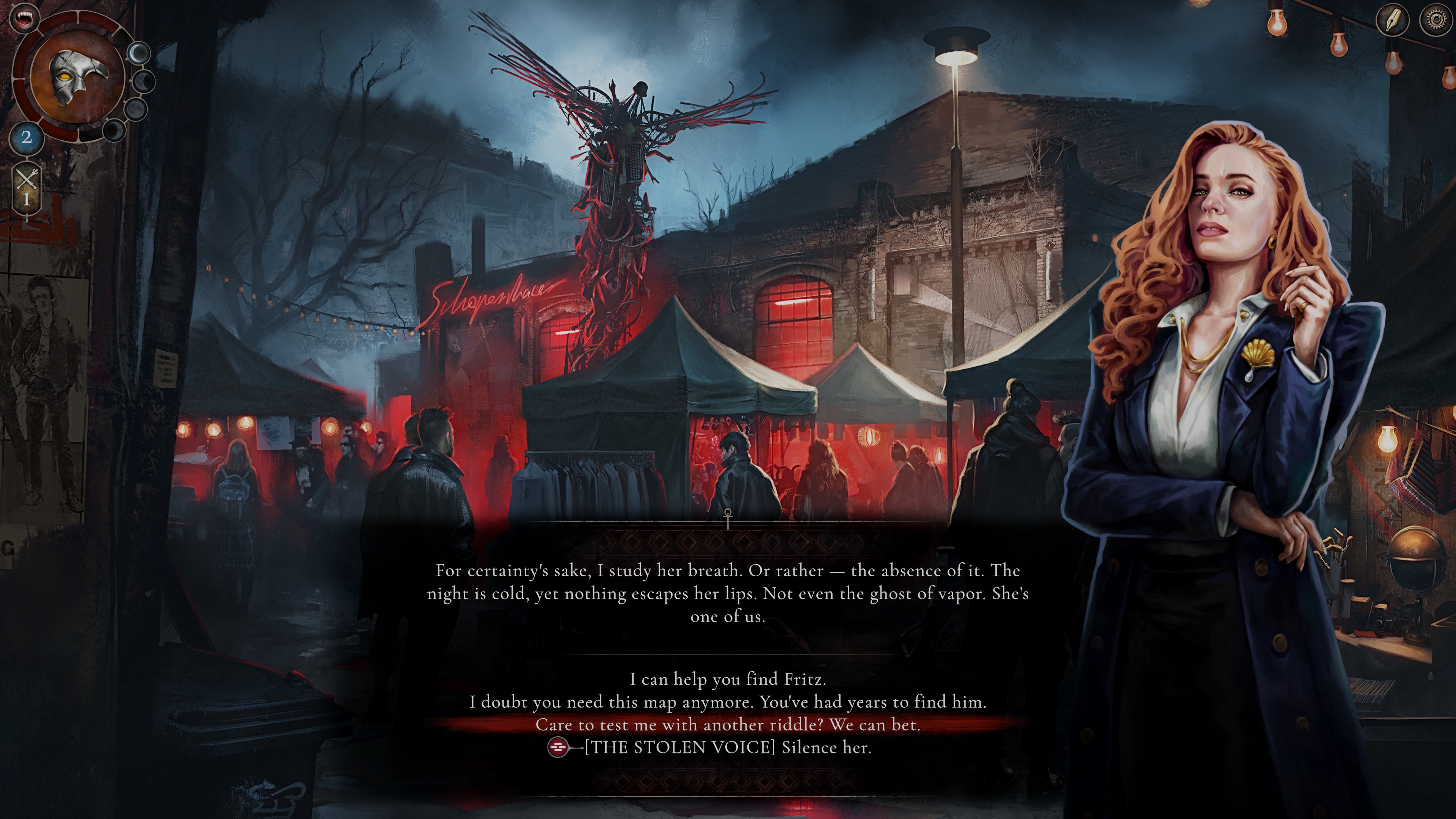 Alice's inner voice: observation, assessment, and the next decision.
Which character surprised you and went in a different direction than planned?
Definitely Lenz.
He started as a straightforward contrast for Alice. On paper, they are opposites in almost every way. She is a Ventrue, blue blood in every sense. He is Duskborn, the lowest of the low in vampire society. She believes structures exist for a reason; he distrusts every institution he has ever met. Since the story is set in Berlin, making him a punk from the east side of the Wall felt like an obvious choice.
Then we made the best kind of mistake: we did the research.
We had placed him in one of the most fascinating and underexplored corners of the subculture's history. Punk in East Germany was treated as a crime against the state. The Stasi surveilled punks, infiltrated their circles, arrested them, and sentenced them to prison or forced labour for "antisocial behaviour." A wrong haircut could put you on a watchlist.
The deeper we dug, the more we realised that when Western punks screamed "no future," East German punks had the opposite problem. They had too much future. The state had your life mapped out before you were born, and that phrase became the emotional core of the character.
Then it clicked with the vampire layer in a way we had never planned. Lenz spent his mortal life suffocating under a future somebody else had written for him, and unlife hands him the ultimate version of it: eternity. He escaped one system that owned his tomorrow only to get locked into another that owns every tomorrow forever.
A character who was supposed to be a contrast ended up with one of the most detailed backstories in the project. Lenz still works as Alice's opposite, only now they are two very different answers to what power, order, freedom and the future mean - and neither of them is entirely wrong.
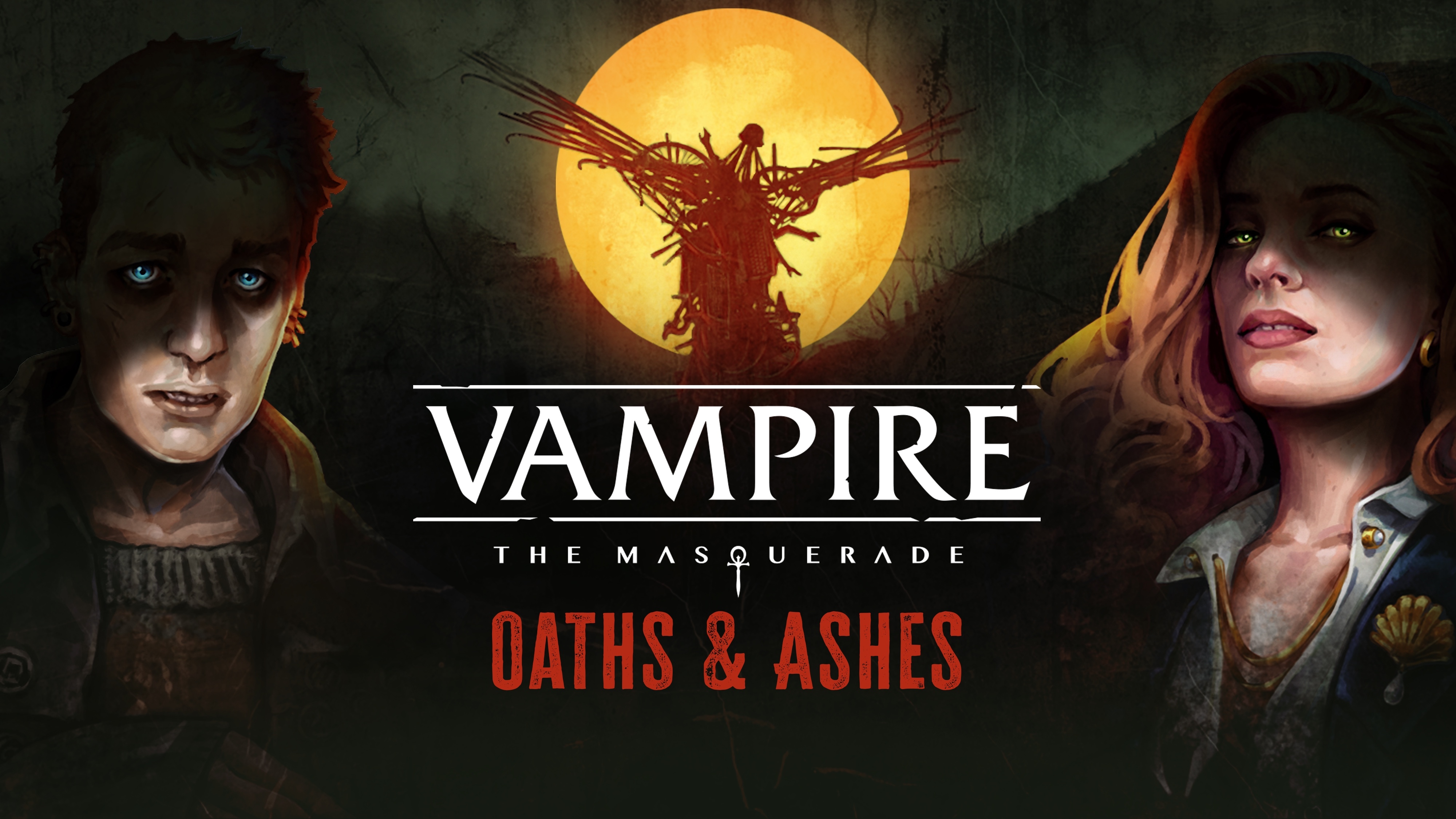 Alice and Lenz, two narrators who cannot look at the same city in the same way.
How do you write for newcomers and longtime World of Darkness fans in the same text?
The starting point is admitting who is on the other side of the screen. One player has never heard the word "Camarilla" in their life. Another has been playing World of Darkness for decades and knows the lore better than we do.
Write only for one of them and you lose the other. Too much explanation puts the veteran to sleep. Too little leaves the newcomer drowning in proper nouns by scene three. The worst solution is the lecture: a paragraph of encyclopedia dropped into the middle of a scene, because it manages to bore both readers at once.
Our working rule is simple. The game does not stop to overexplain things. Characters react to them, and the explanation travels inside the reaction.
A definition helps only the newcomer. A reaction works for both players at once. The newcomer learns from context what the thing is. The veteran, who knew already, gets something better: a character's opinion of it. The same line does double duty, introduction for one reader and commentary for the other.
The two protagonists were built to make this possible almost everywhere. Alice knows the Camarilla inside and out, but Anarch Berlin is foreign to her, so the city can be introduced through her eyes because she needs the introduction too. Lenz is the mirror image. Berlin is home, while the grand vampire hierarchy has only ever looked down on him. Between them, everything in this world is either new to somebody or somebody's sore spot.
What we owe longtime fans on top of that is accuracy: V5 details handled with care, and Berlin's Kindred history treated properly. Newcomers are owed something simpler: no sentence in the game should require a rulebook to parse.
For everyone who still wants the rulebook, there is the in-game journal. Every term, clan, location and face the story introduces gets an entry there.
What did you deliberately want to do differently from other vampire stories?
The biggest decision was who the protagonists are and what kind of city receives them.
Many Vampire stories begin at the bottom. You are newly Embraced and learn the rules of the night alongside the player. We went the other way. Alice is around two hundred years old, a Ventrue, an operative trusted by the Camarilla's highest circles, and a true believer. Then we throw her into Berlin, an Anarch city divided between competing powers.
Alice is not learning how the world works. She is learning that the version of the world she mastered no longer has authority here. Everything that gives her power and identity - rank, protocol, the weight of the Tower behind her name - means much less on these streets.
Lenz approaches the same city from the opposite direction. He was born here. Berlin is not a mission to him. He is Duskborn, and characters like him rarely get to be more than supporting cast. Thin-blood alchemy is one of the most interesting additions to the setting, yet it rarely gets the centre of the stage. We built a playable perspective around both.
That is the argument underneath the whole game. Two narrators. Two places in the hierarchy. Two people looking at the same fractured city and seeing entirely different things.
Meet Alice in the Prologue
For now, there is a much faster way to meet Alice and experience her narration: play the free Prologue.
Wishlist Vampire: The Masquerade - Oaths & Ashes
Goodnight, Kindred.
The Revive the Spark team