
Well met, Kindred.
You have heard plenty from us about Oaths & Ashes by now. The characters, the city, the screenshots, the Prologue. What you have not had is a proper look at the people making it, or at the reasoning underneath any of it.
So we are starting a devlog series. In upcoming weeks we will open up the parts of this production one at a time: the writing, the art, the music, and the technology holding a branching script together. Real process, real work in progress, from the teams doing it.
This first one is the foundations. Not a feature and not a reveal, just the awkward questions that came before any of the rest: why this world, why this city, and why this kind of game at all. We passed them around the studio and asked each team to answer in their own words. No press release voice. Here is what came back.
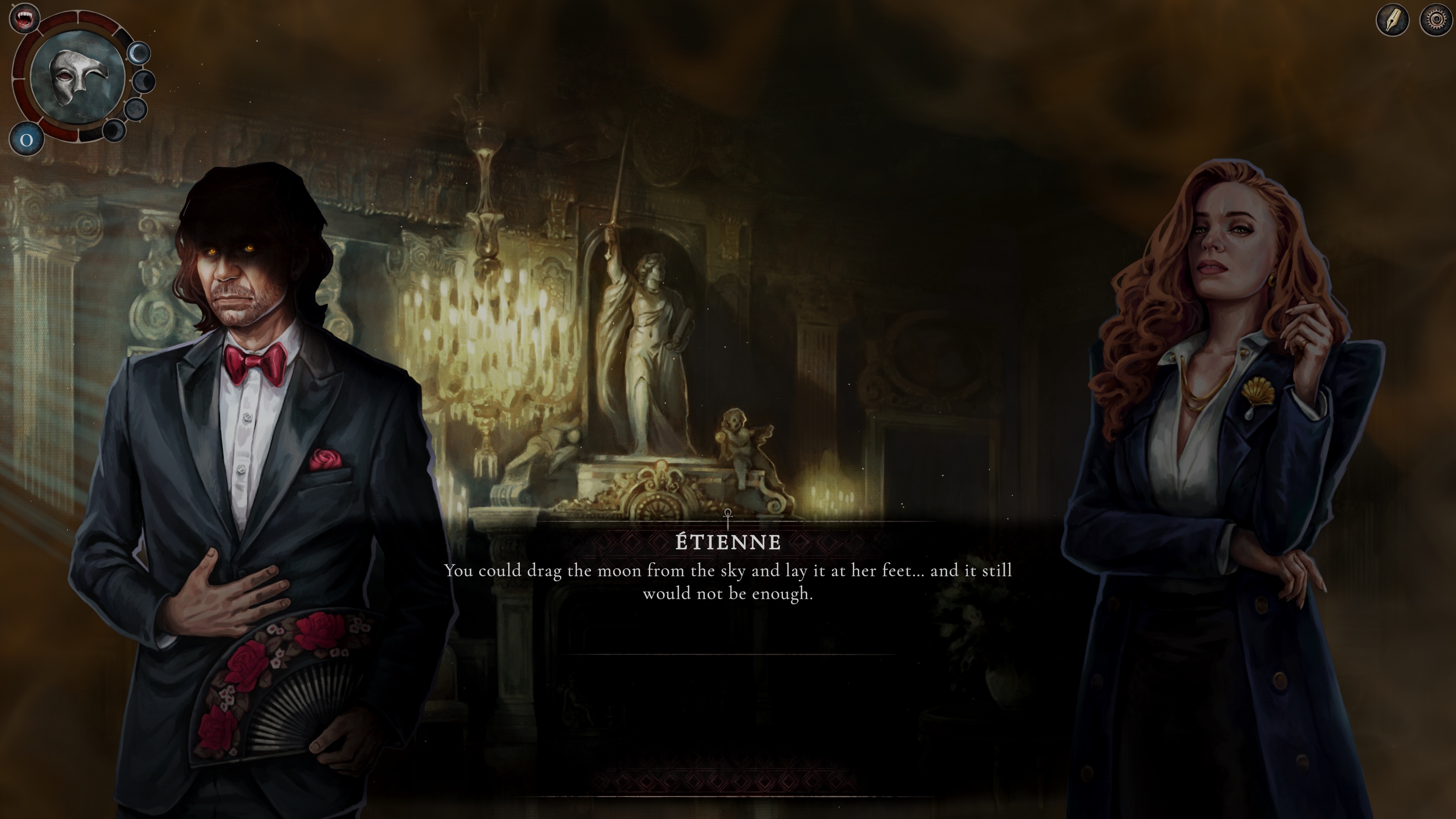
What pulled you into the World of Darkness, and why Vampire and not some other setting?
For us it starts with a grudge. Somewhere along the way, popular culture turned vampires into brooding boyfriends who sparkle in the sunlight, and all the horror drained out of the idea. We never got over that.
Vampire: The Masquerade is the setting that refused to go along with it. Its vampires are monsters rather than teddy bears with fangs, and the game never lets you forget it, least of all when you are playing one. Feeding has a cost, power has a cost, and the person you used to be wears away a little more every decade, so the longest fight is with what you are becoming. On top of that sits the politics: sects, old grudges, a whole society running underneath ours, where every problem you have is another person with a name and an agenda.
We also come to it with some history. We have had the chance to work on games set in this universe before, and part of the team still plays the tabletop version privately, dice, character sheets and all. At some point you stop waiting for somebody else to make the Vampire game you want, and you make it yourself.
Why Berlin as the stage for this story?
It depends who in the studio you ask, because everybody had their own reasons to pick this city.
Narrative team.
The draw was what Berlin is in our setting: an Anarch city, run by a Baron and a patchwork of gangs, with no Prince and none of the etiquette Alice spent two centuries mastering. Her rulebook stops working the moment she arrives, and watching somebody with that much Camarilla faith navigate a city that has no use for it is the engine of the whole story. Lenz is the other half of the argument. He could only have grown up here: a punk from East Berlin, raised under a state that had planned his whole life for him. Neither of our protagonists works anywhere else.
Art team.
Our reasons are sitting in our reference folders. An Altbau facade still carrying its bullet scars, a prefab tower from the East, a glass office filling a gap where something older stood, sometimes all three inside a single photograph. The war, the division and the rebuilding never left the walls, and the references keep proving it before we have painted a single stroke. Every district brings its own palette and its own light, which is what keeps dozens of hand painted backgrounds from blurring into one grey smear. The contrasts are a painter's gift, because the same night can move from an opera house to a squat without ever leaving the city.
And yes, there is a commercial case as well, which we may as well be open about. This mythology has lived in American cities for decades, so a European capital makes us recognisable at a glance, and Berlin's own legend, the clubs, the history, the reputation, pulls in people who have never opened a rulebook. For the old guard there is Berlin by Night, a classic corner of the World of Darkness, and the reaction when we announced the setting told us we had read that right. It is also our half of the world. A European studio setting this story in a European capital felt overdue, and German players do not often get a genre game about their own city after dark.
Why a visual novel and not another genre?
The blunt answer is production reality. A visual novel is the biggest game a team our size can actually finish. In 3D, our headcount would stretch to a few small environments and not much more. Text is different. The size of the game is the size of the script, and writing is the one resource this studio has in surplus.
Narrative team.
Put that question to us and the first thing you get is a grin, because a visual novel is that rare production where the writers run the place. Behind the grin there is a serious point: the genre and the setting want the same things. Vampire runs on conversation. Persuasion, threats, politics, the sentence somebody decides not to finish. A combat first genre would spend most of its budget on the least Vampire part of Vampire. Prose also hands you two narrators from the inside, and the distance between Alice's controlled narration and the noise in Lenz's head carries a lot of this game. No camera gets you in there.
Art team.
Something similar from our side. In most productions a 2D artist ends up supporting the 3D team or making UI, and nobody in the history of games has enjoyed making UI. In a visual novel the illustrations are the game. The artist stands in the front row and answers for how the whole thing looks, which is a rare and welcome change. Every scene becomes a painted, deliberate frame, the light goes exactly where the scene needs it, and the dark keeps the rest.
Programming team.
We will smile at that first joke, because it is half true. In this genre the writers set the pace. Here is what a programmer gets in return, though. On a big production a coder can spend years owning one subsystem inside somebody else's architecture. Here the whole technical side of the game belongs to a handful of people, decisions included. The users on the other side of our tooling are our own writers, so something we ship in the morning changes how the writing team works by the afternoon. The problem is worth the trade too. A branching script this size is an enormous web of flags and conditions, where a choice from the first act has to fire correctly hours later on any route the player took, and keeping that web tight is serious engineering. We do it in Unity, so the effort goes into the game instead of into reinventing foundations. When it all works, nobody notices we did anything, and we take real pride in that.
What do you want the player to feel after the first hour?
We want the player to come out of the first hour doubting the side Alice serves. The opening is a Camarilla assignment, and she walks into it as a believer, two centuries deep in the institution and very good at her job. You get to enjoy that competence first: the opera, the protocol, the quiet rules about doing monstrous things without an audience. Then the evening leaves a splinter in that certainty. Things happen in that hour that Alice cannot square with the orders she was given, and the man she is hunting gets a few words in that stay with her longer than she would admit.
If the player leaves for Berlin wondering whether that institution deserves her faith, we got the first hour right.
Is there a moment from the setting, a book, a game or a tabletop session, that stays with you to this day?
Ask around the studio and the same few answers keep coming back, whatever somebody's job title says.
The one that comes up most often is the Ocean House Hotel from the original Bloodlines. A haunted hotel with no enemies anywhere in it, doors slamming shut around you, furniture flung across empty rooms, and deliberate silence in between that makes every small sound frightening. It stuck with us as a lesson as much as a memory, because a visual novel works under the same discipline: the less movement there is on screen, the more the audio has to do. That is a bar we think about every time a scene gets scored.
Art team.
Ours is older. Tim Bradstreet's black and white portraits from the early sourcebooks, faces lit hard from one side, staring straight out of the page. For a lot of us those illustrations were what this world looked like long before any video game existed, and there is a straight line from those pages to the way we light our own portraits.
What comes next
That was the foundations. From here we stop talking about intentions and start showing the work.
The next devlog belongs to the Art team, and it is the one we are most impatient to publish. How a Berlin district goes from a folder of references to a rough sketch to a finished painted scene, why every district gets its own palette, and how the light gets decided before anything else in a frame does. Expect works in progress and a lot of stages nobody usually gets to see.
In the meantime, the Prologue is free and permanent, and it is the fastest way to find out whether this game is for you.

Goodnight, Kindred.
- The Revive the Spark team