
The Ballad of BrainMess
Hey everybody. Gatsby here.
I've been busy trying to turn the barebones prototype of BrainMess into something that I can be proud to call a demo--even if it isn't quite a real GAME yet.
Initially, I'd hoped to deliver a true vertical slice--something that would showcase the gamification of task
management, how that unlocks progression, the game's narrative, and exploration elements. But, as I tried to create that vertical slice, I realized I was suffering from scope creep--adding and adding and adding, but failing to refine on the foundation of the game's mechanics.
So, I've pulled back a little bit. That has resulted in many fans asking, "Will ____ be in the game on release?"
And the answer to that question is typically "yes, if I can manage to make it fun," but I also don't want to be so high on my own supply that I don't recognize when I'm overworking myself, making something more complicated than it ought to be.
To better demonstrate what I'm talking about, I thought I might just show you all the weird ideas I've had for this game so far.
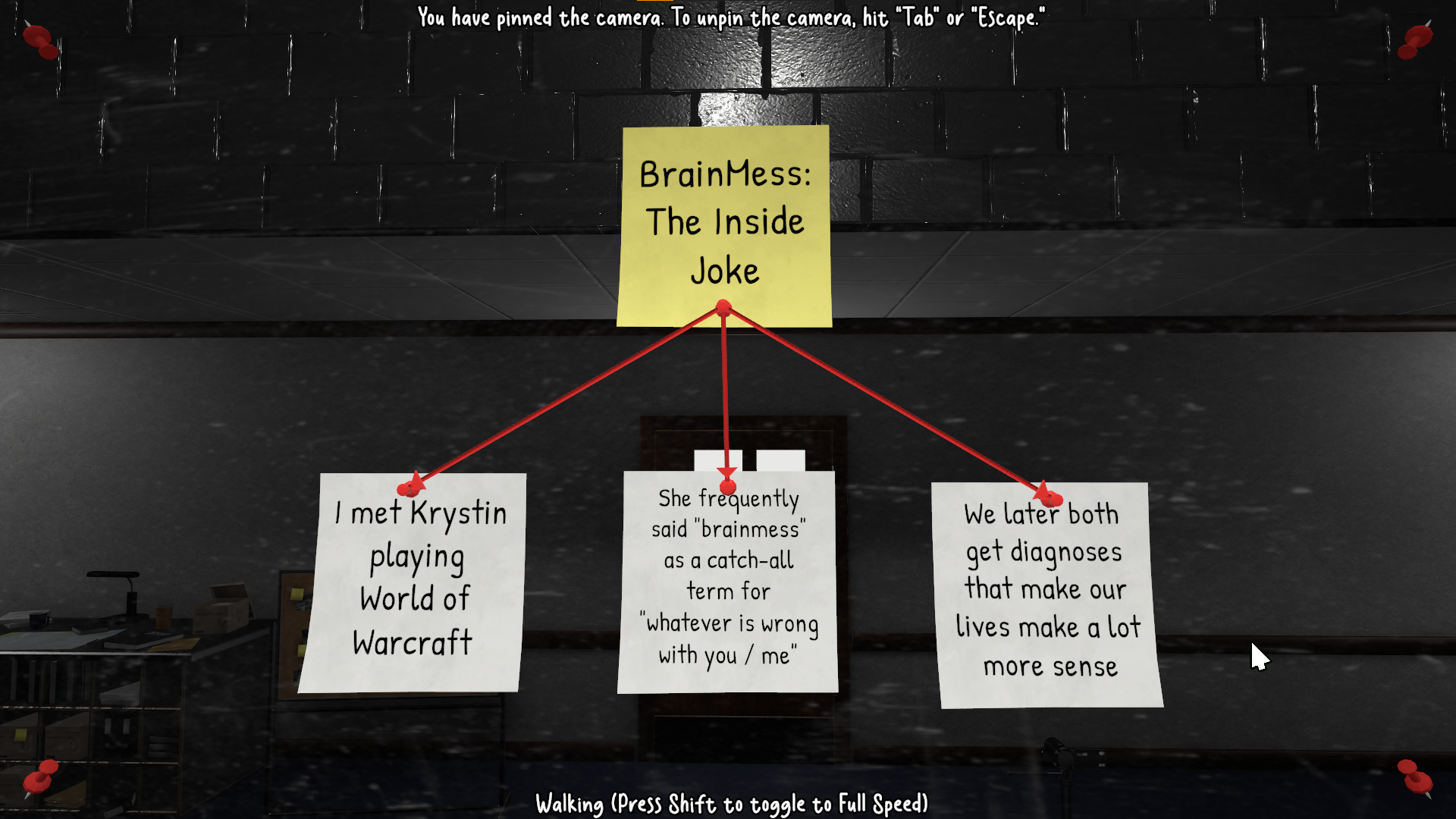
The Inside Joke
Before BrainMess was a notes app, a mind-mapping tool, or a productivity game, it was just a word my friend Krystin and I would use whenever we couldn't think of a better one for "whatever is wrong with me."
Years later, I found out I'd been raw-dogging ADHD all my life without realizing it, so my specific BrainMess is ADHD (and likely CPTSD from undiagnosed ADHD).
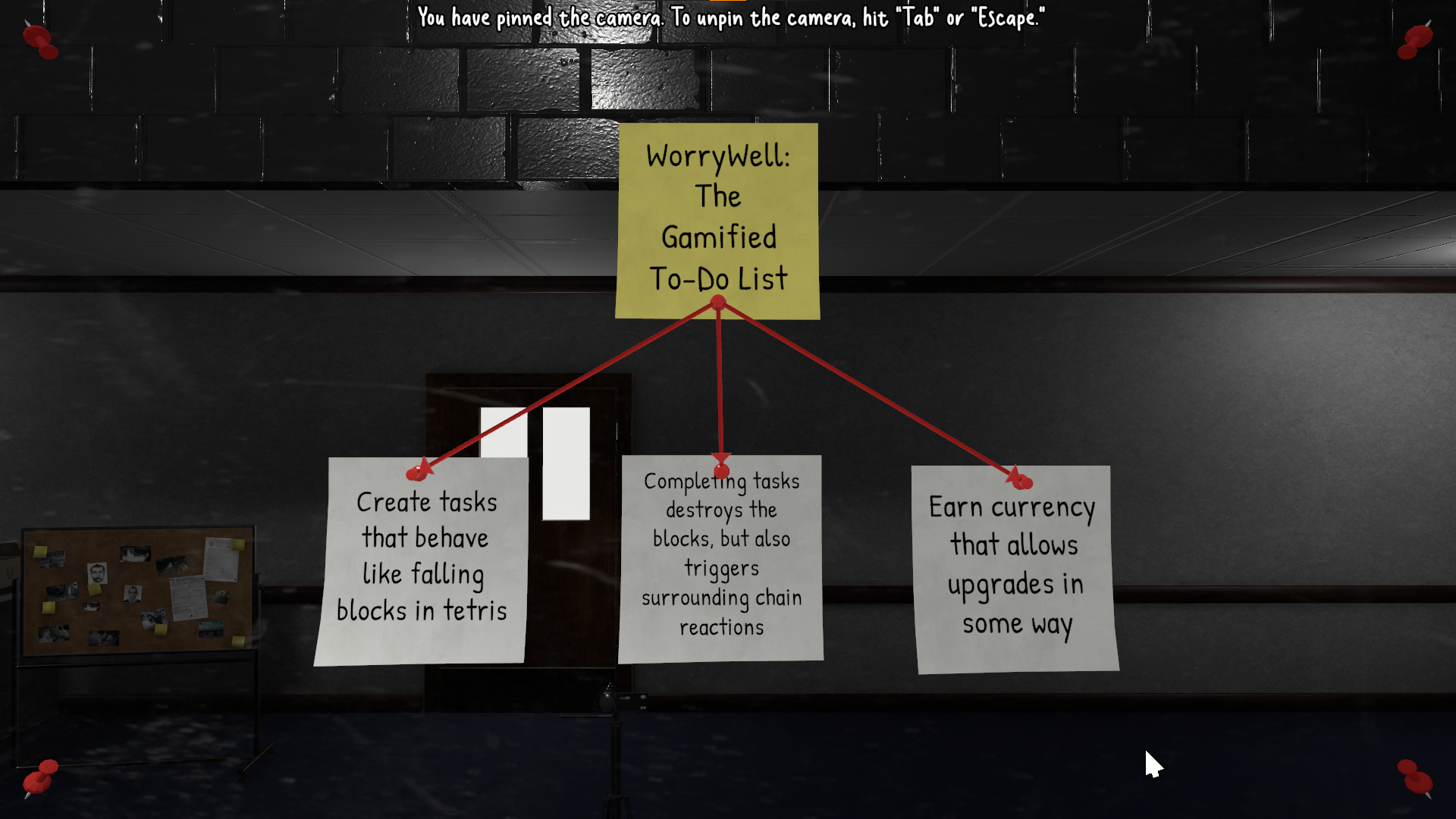
My Return to Game Maker
In 2024, I had a really sweet job that gave me hope that I wouldn't have to go back to teaching. Then, I lost it, and as I struggled to find new work, I decided to try and jump back into game design. I hadn't made games since high school, during which time I'd been playing around with Game Maker Studio. The first thing I made was a little falling block game, where you typed to-do-list tasks into the blocks.
It looked cool, but it wasn't really a game.

The TV With Sticky Notes On It
I got to thinking about games like Habitica, which use your real life productivity as the measure of completion--like if a clicker game progressed when you did chores, instead of from clicking. Personally, I don't think the rewards Habitica offers are very exciting, so I started trying to think of a way to connect your real life progress to a fictional character.
My interface was an analog TV set, with space on the side to put sticky notes. Each sticky note represented a real life task to be completed--but when you completed those tasks, that granted energy to the on-screen character, which he could use to move and fight.
I wanted to try and make it so that, by pushing through your own executive dysfunction, you felt like you were remotely empowering a fantasy hero--like something out of The Never Ending Story.
But this build didn't make much sense.
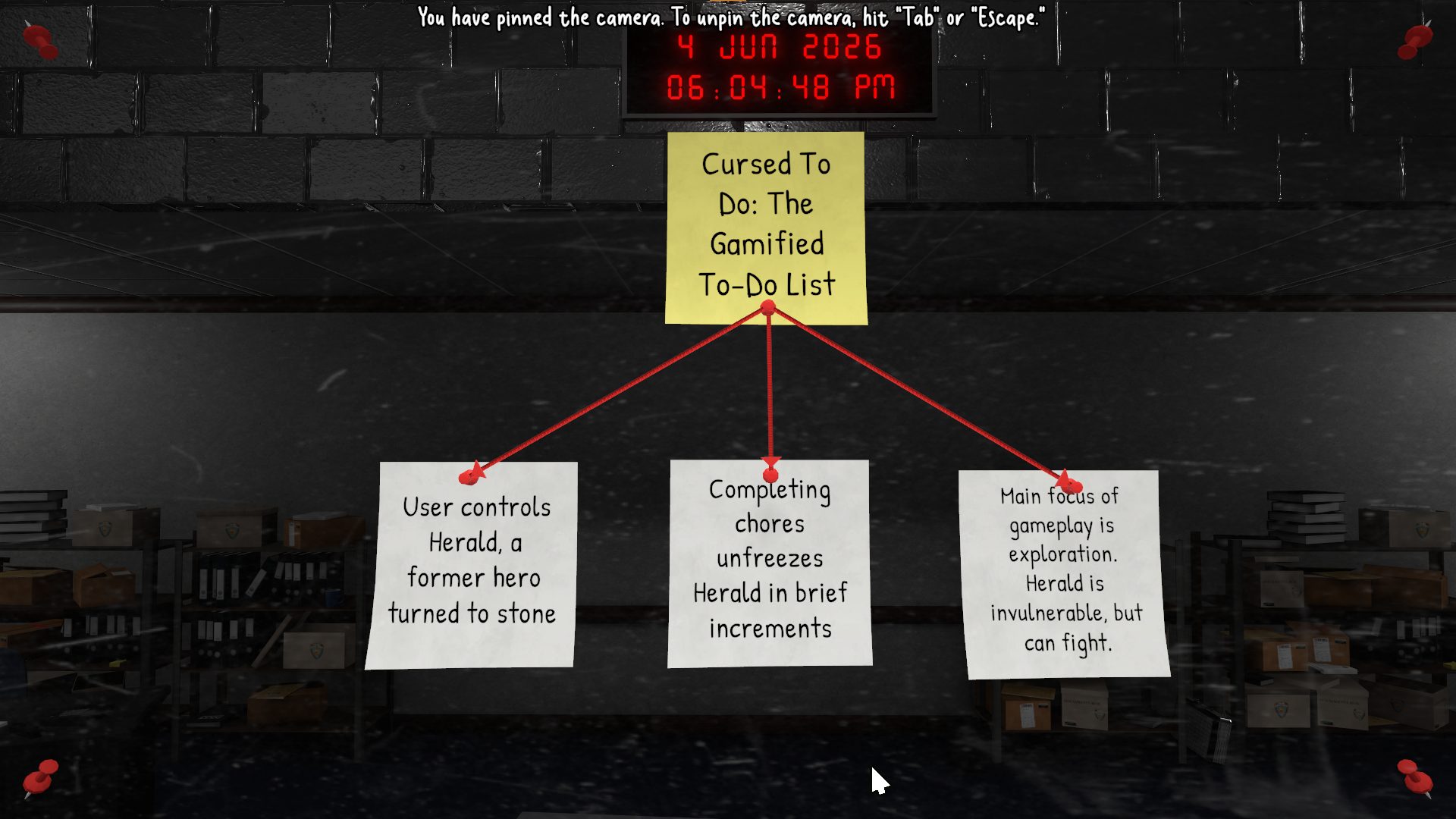
Herald, the Petrified Hero
I recreated this game in 3D as I rehashed the story. Basically, the hero was an elf who had been turned to stone. He was still entirely alert, but sapped of all magic power, only able to sort of astral project and observe people between worlds.
Herald finds you and is impressed by your bravery, overcoming tasks that look simple, but FEEL impossible. A bargain is struck, and through this interdimensional pact, your achievements grant him the power to move in brief bursts.
I liked this game, but I'd ultimately over-engineered it. Still, it had given me enough practice to start playing with game dev in earnest. I began work on a few more serious, non task-management related projects, but burnt out. Those were Hollowfoil and Cursing, which I may return to some day, if I can.
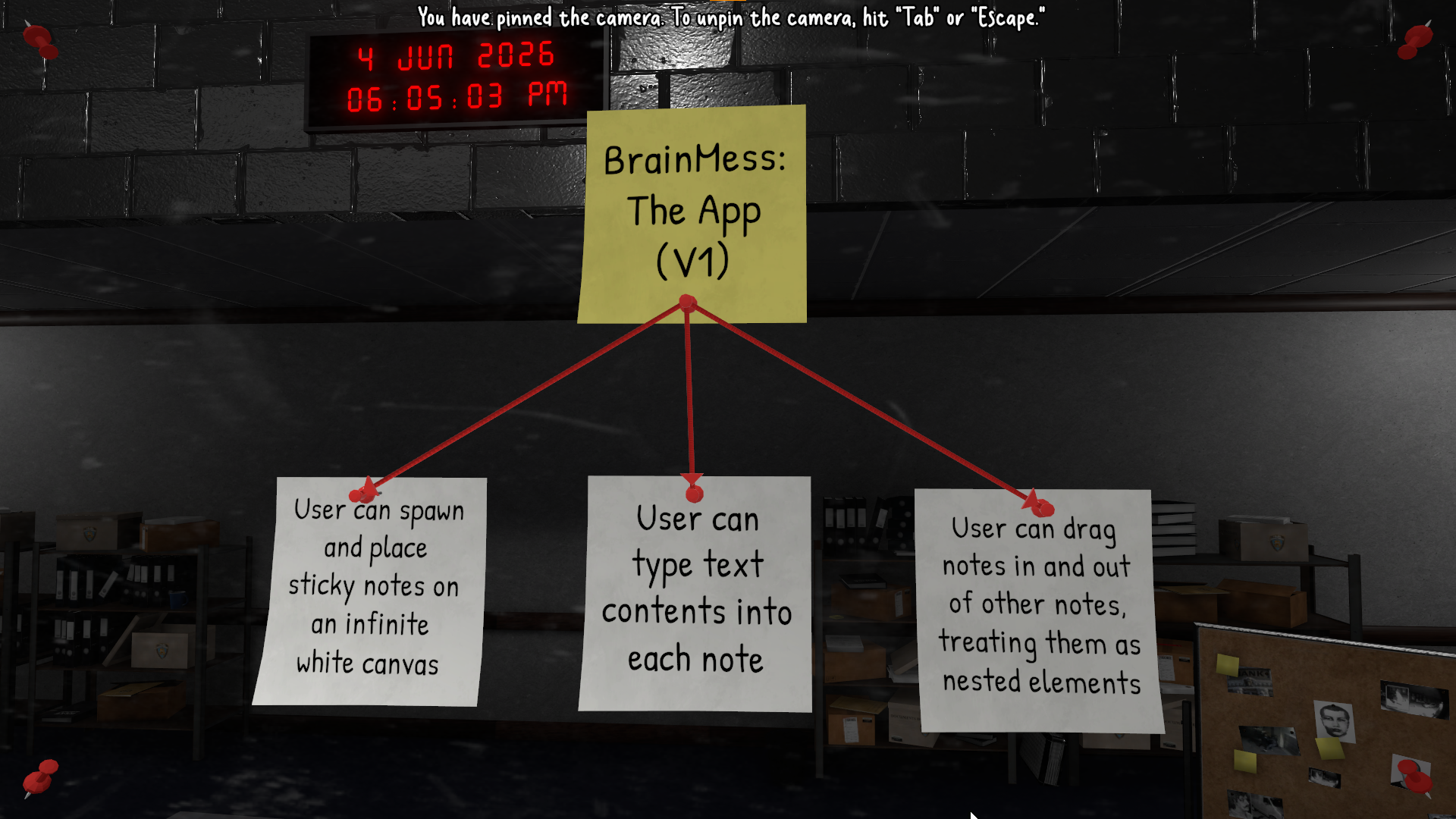
The Side Project
While I was working on Hollowfoil in Unity, I also played around with making React apps. I really like apps like Miro, where you can place shapes and text in an infinite canvas, so I thought that would be a good place to start with a simple "like this, but with features I want" project.
It was pretty cool, but nothing to write home about.
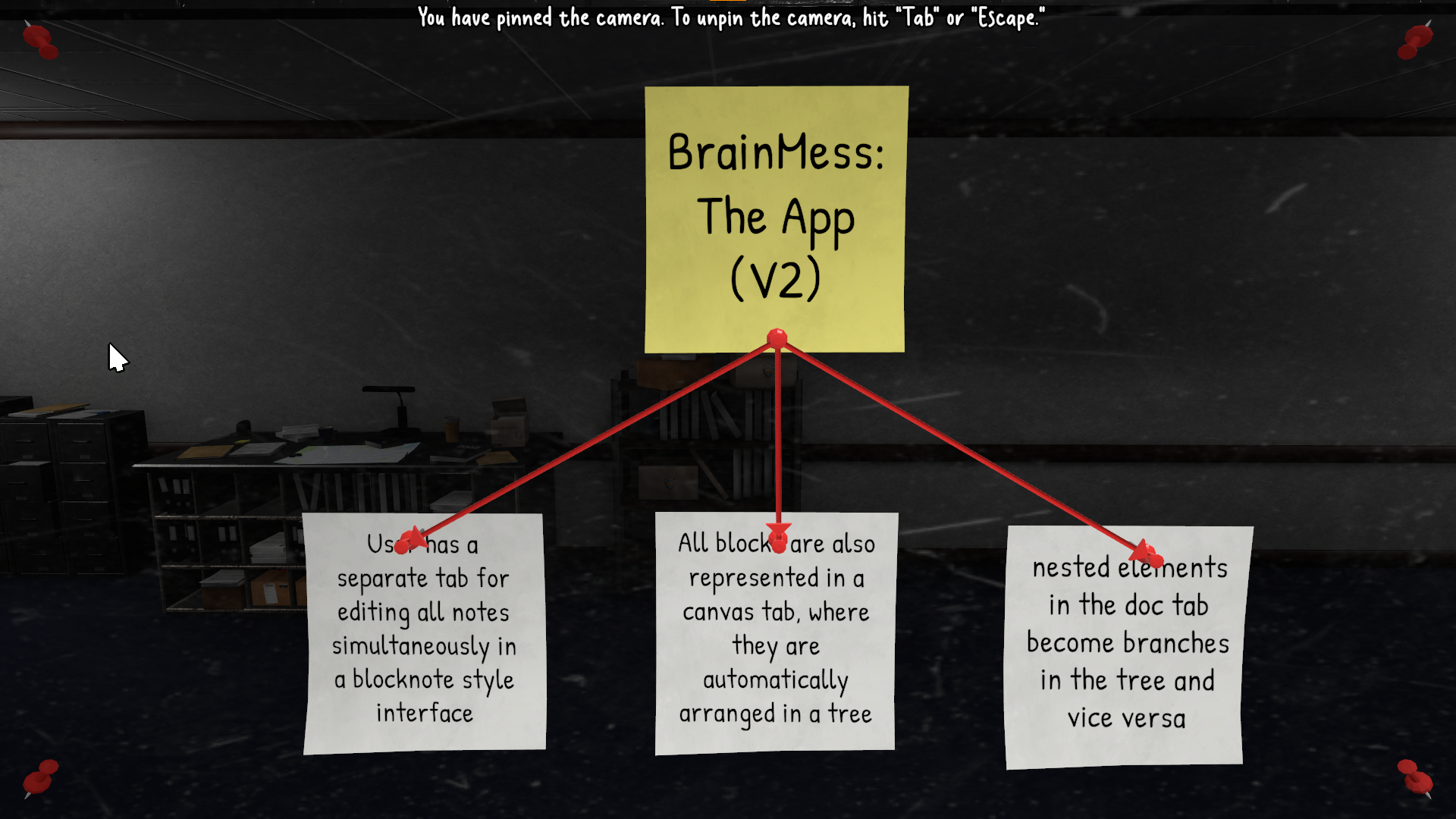
The Iteration
As I played around with it, I made a sort of dynamic index that automatically updated itself with a flattened list of all your notes, and I liked it so much that I restarted the entire project with that index in mind--making a version of the app where you can create a mind map automatically just by typing a bulleted list, and vice versa.
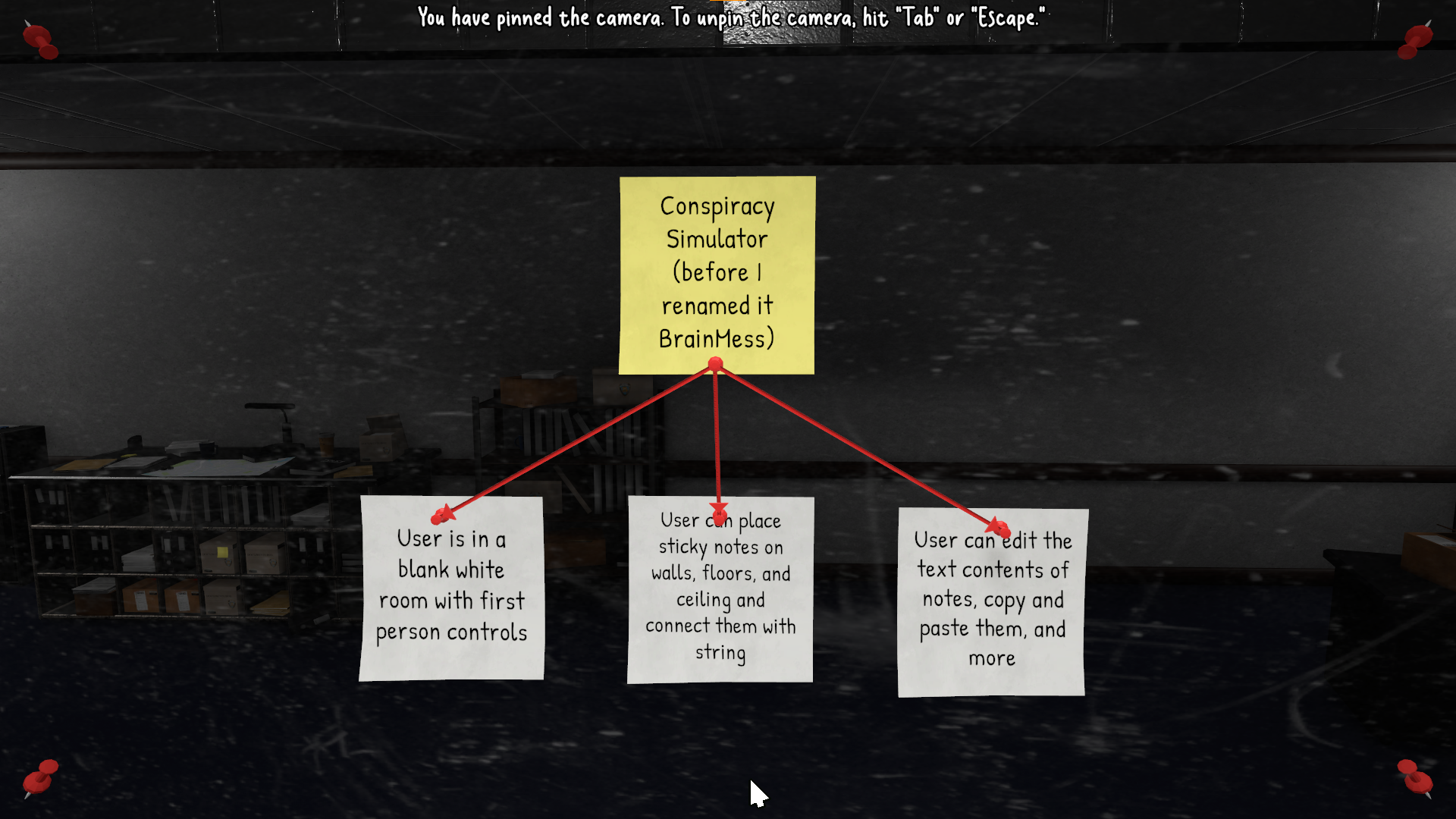
The Video Essay
After several months without interviews, I reflected on how I'd gotten my last job: my old YouTube channel. The content I was making had gotten me an affiliate deal with a games etailer, who was so impressed with me that they offered me a job. So, I figured I should get back to making video content, discussing my difficulty finding work, and chronicling my return to game design.
I'd begun to burn out on my next project after HollowFoil, Cursing, and took the advice of a game dev youtuber who insisted your first project should be very, very simple. So, I started on a 3D version of my mind-mapping idea.
Originally, this was just meant to be a stage for mapping out text, presentation style, to have an on screen visual while I discussed something important to me: the similarities between game design and instructional design. But as I was publishing that video essay in small chunks, the tool I was making got a LOT of interest.
But... it was just a mind-mapping tool. I was terrified no one would go for it in its current state. But I'd already done all this thinking of how an exploration-based productivity game could be driven by tasks on sticky notes... so what if I tried again?
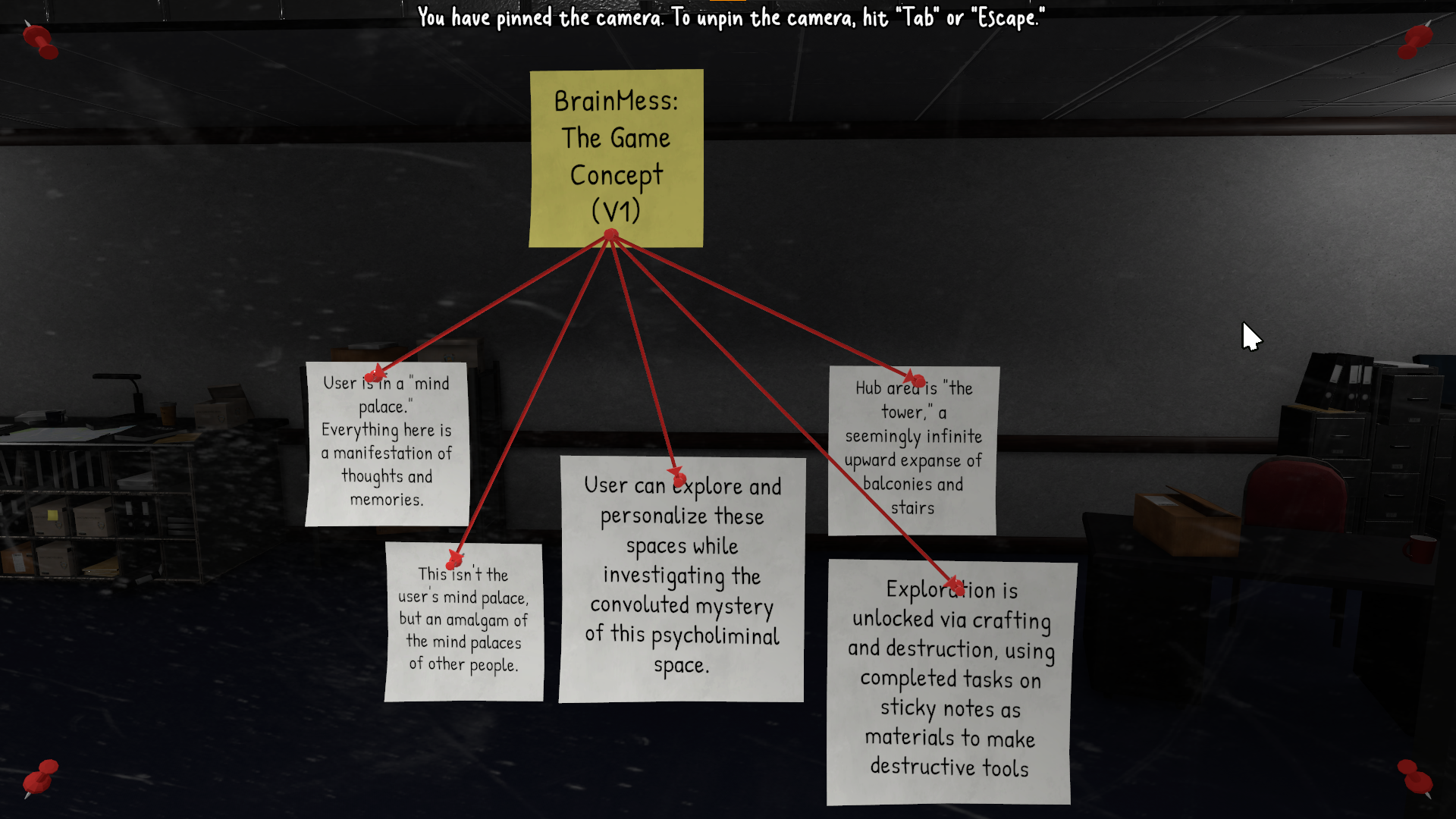
The Convoluted Mess
The version of the game I began teasing from here was... eccentric.
I'm going to try and make an extremely long story into a relatively short one. I saw the backrooms 4chan post way back when it got posted, and forgot I ever saw it. I accidentally came up with a sort of similar world called "The Arcade," and later realized it was remarkably similar to an already well-known liminal space that spun out of the 4chan post. Still, I continued to try and make it my own. Fans of my YouTube channel considered it to be the connective tissue between all the stories we were telling.
So, since this game was one where you were creating your own mind palace, manifesting decorations and furniture from thoughts and memories, I figured, okay, let's make this arcade-adjacent.
After about of month trying to hamfist my narrative into a box that was appropriate for a gamified mind-mapping tool, I realized I was driving myself crazy.
The game is already hard to describe to people who don't already see the value in it. Why make the job harder on myself?
So I backed up and started again.
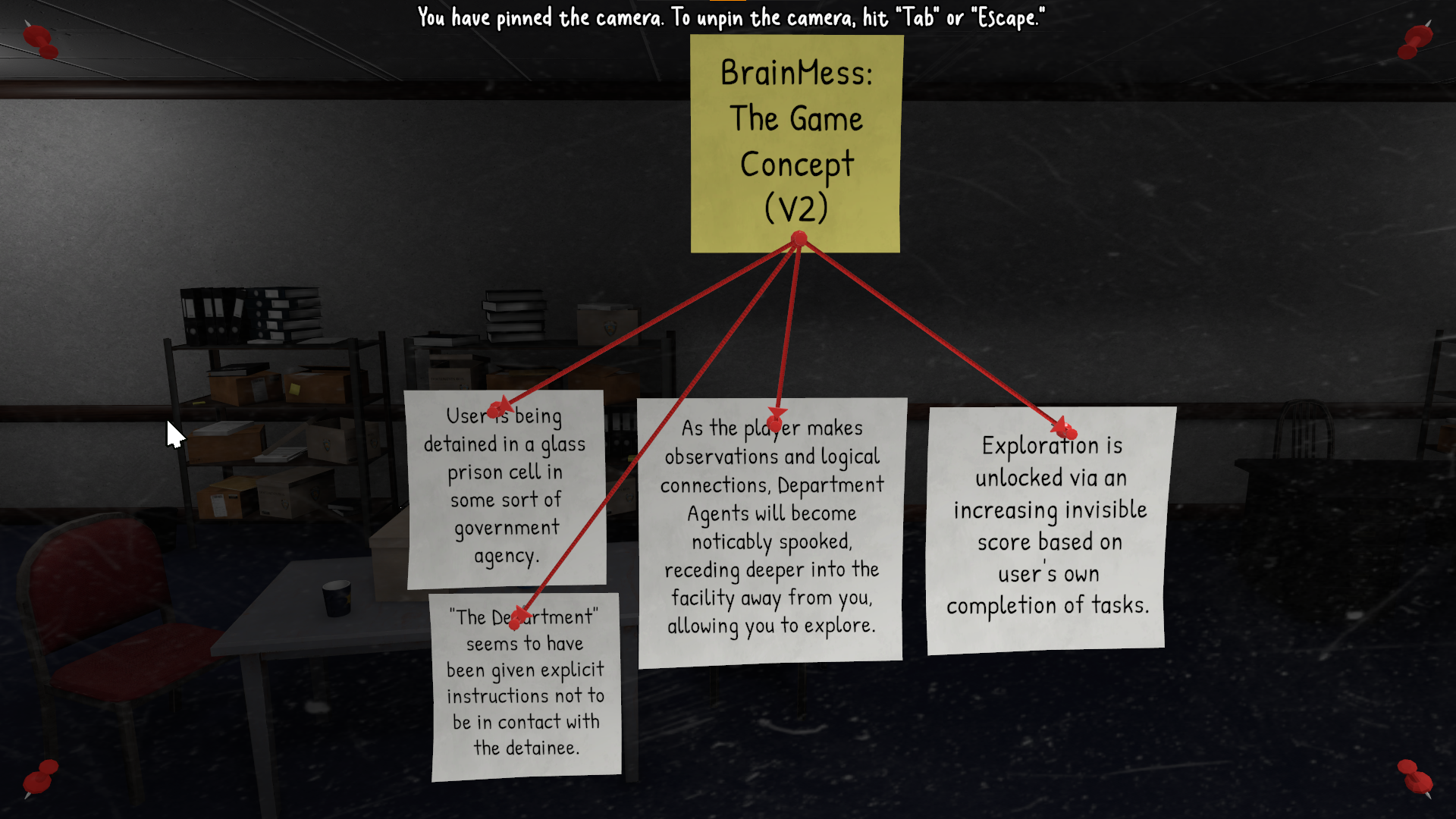
An Acceptable Baseline
In the convoluted liminal space, I'd planned to allow players to breach into other people's mind palaces, which would allow them to collect different themed furniture and decorations to personalize their own spaces. These would have ranged from bedrooms, to office spaces, to police stations, etc.
But, without much time before needing to have a demo public for Next fest, I decided I needed to focus on just one theme--ONE SPACE, so that if I ran out of time, that one space would be enough to sell the function and vibe of the game.
Considering this is a game where you make crime-board style mind maps, I figured a sort of FBI headquarters would do the trick.
Likewise, playtesters had also complained about getting nauseated trying to navigate a tiny room with little to no markings.
So, I was like, "okay, well what if the room itself was still devoid of detail, but you can see out into a larger, detailed area?"
About a year ago, I beat the game CONTROL, which features a few different glass prisons in larger observatory spaces.
I started kind of smashing that together with these planning spaces we used to have when I was a teacher, where each wall was a giant whiteboard. I found myself designing a space where you, as the player, are trapped in the glass prison, but you can observe your surroundings, and maybe even NPCs as they observe you.
I feel like this at least creates a curiosity cue that I can use later when building interest in escaping and expanding out, but for now, it's at least a room with a vibe.
Where To Go From Here?
Some of the critics of the game so far have stated that it would be better off WITHOUT the gamified task management element, and should instead just focus on exploration and investigation.
Don't get me wrong, I see what they're saying. But if the game CAN be used as a mind-mapping and task management tool... I'm not sure I want to just pretend I didn't build the entire system for that purpose.
Then again, they also said "no one will play this."
And I have 1300 wishlists.
Y'all aren't no one.