
0.2 Is Coming!
I've been doing extensive testing and last minute changes for 0.2 over the past two weeks. The update will be massive and I'll be talking and showing screenshots of what is coming, but you can expect a release candidate on August 19th, a month since 0.1 released. This patch notes does not contain all screenshots or even all features coming in 0.2. But it covers most of it. Presidential primaries have been overhauled to be like they are IRL.
Germany and the UK
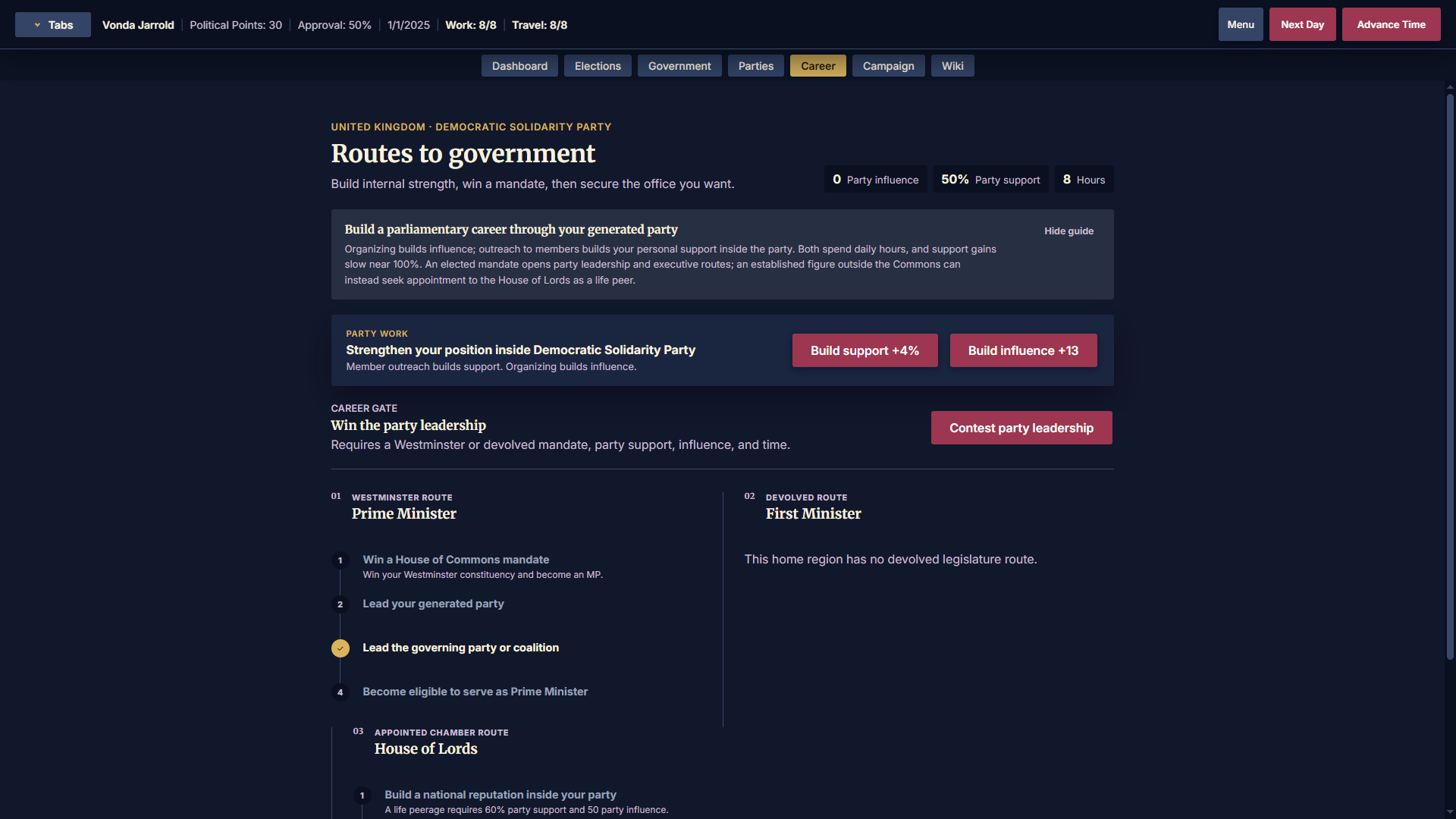
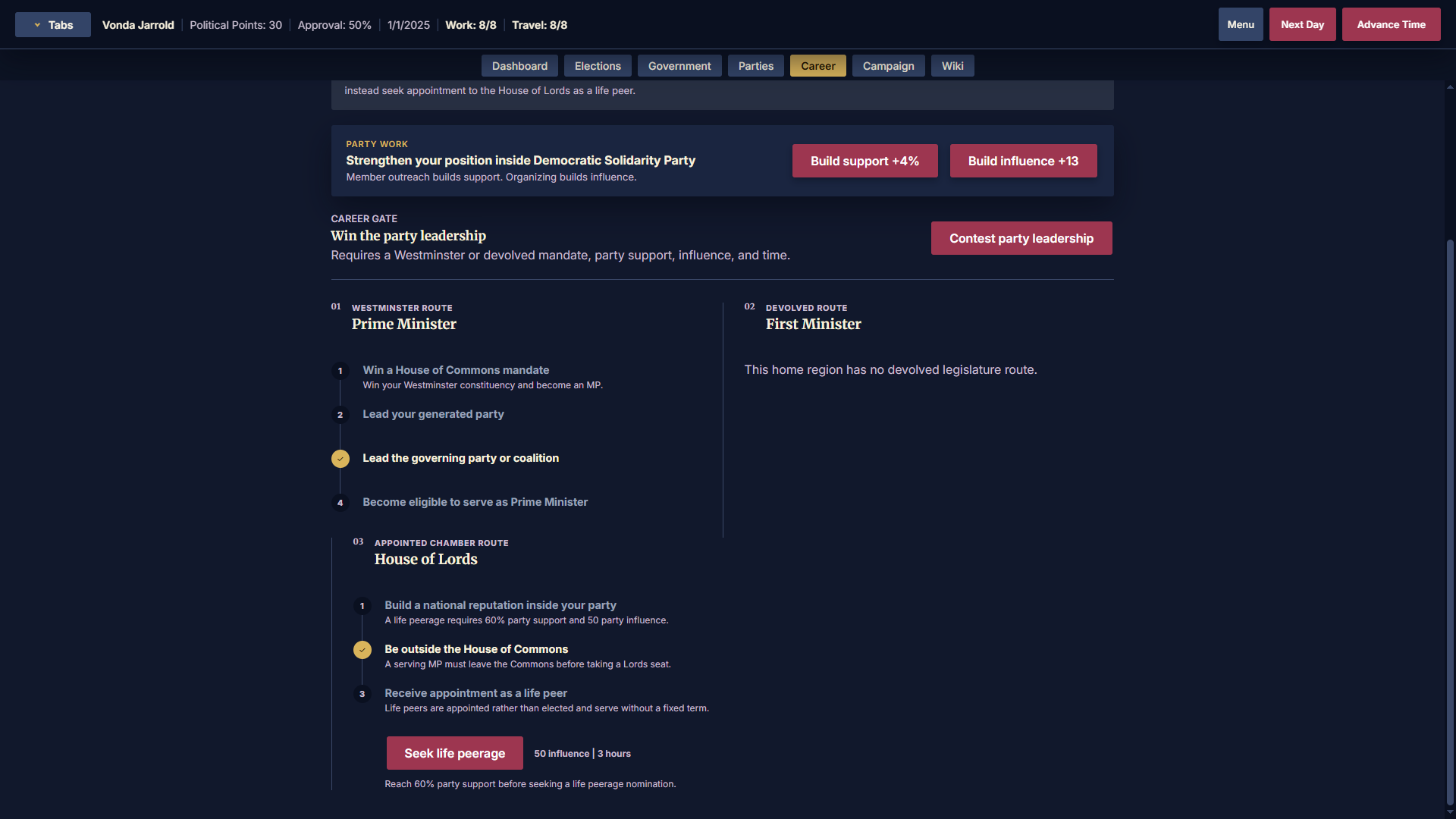
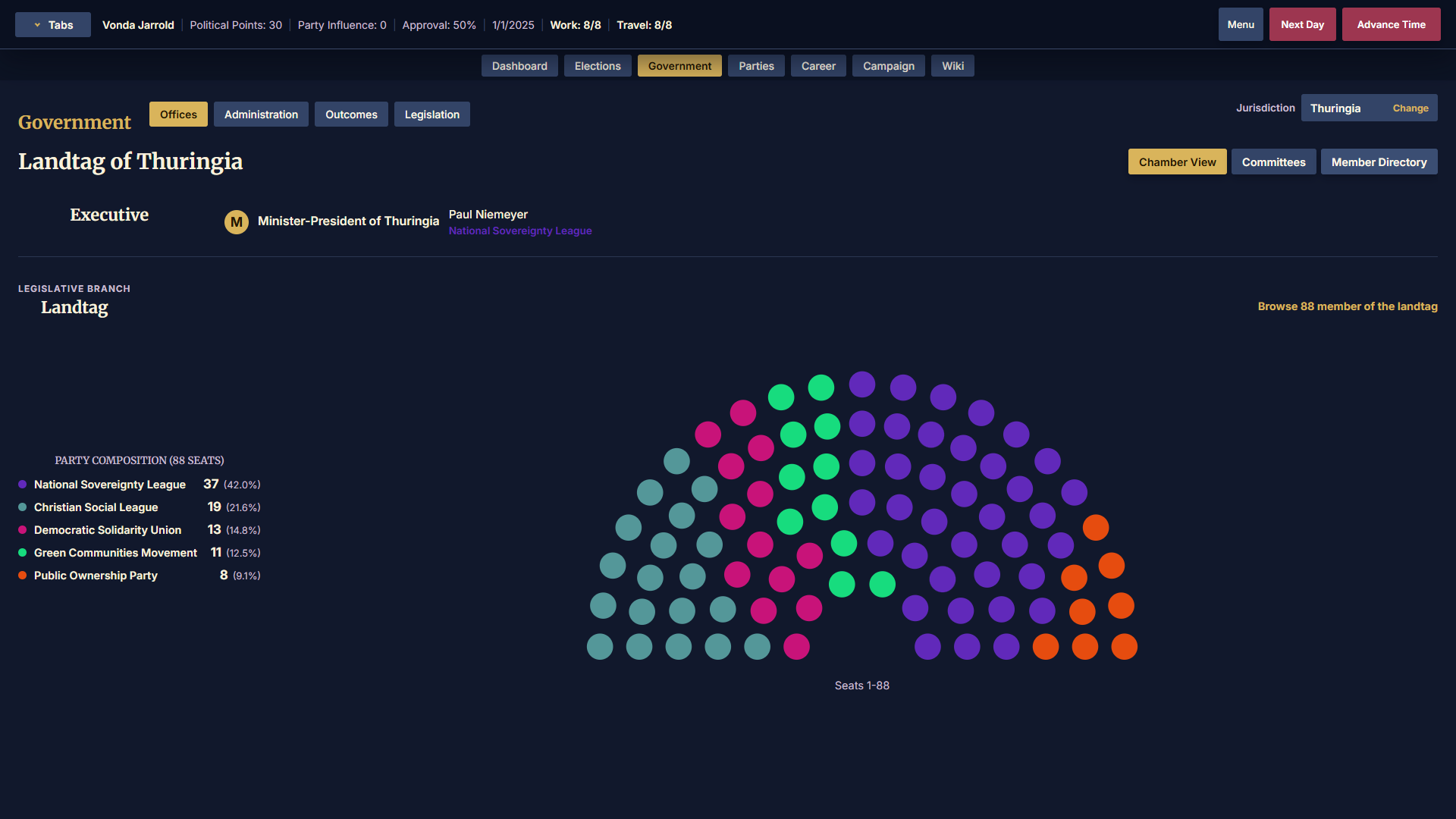
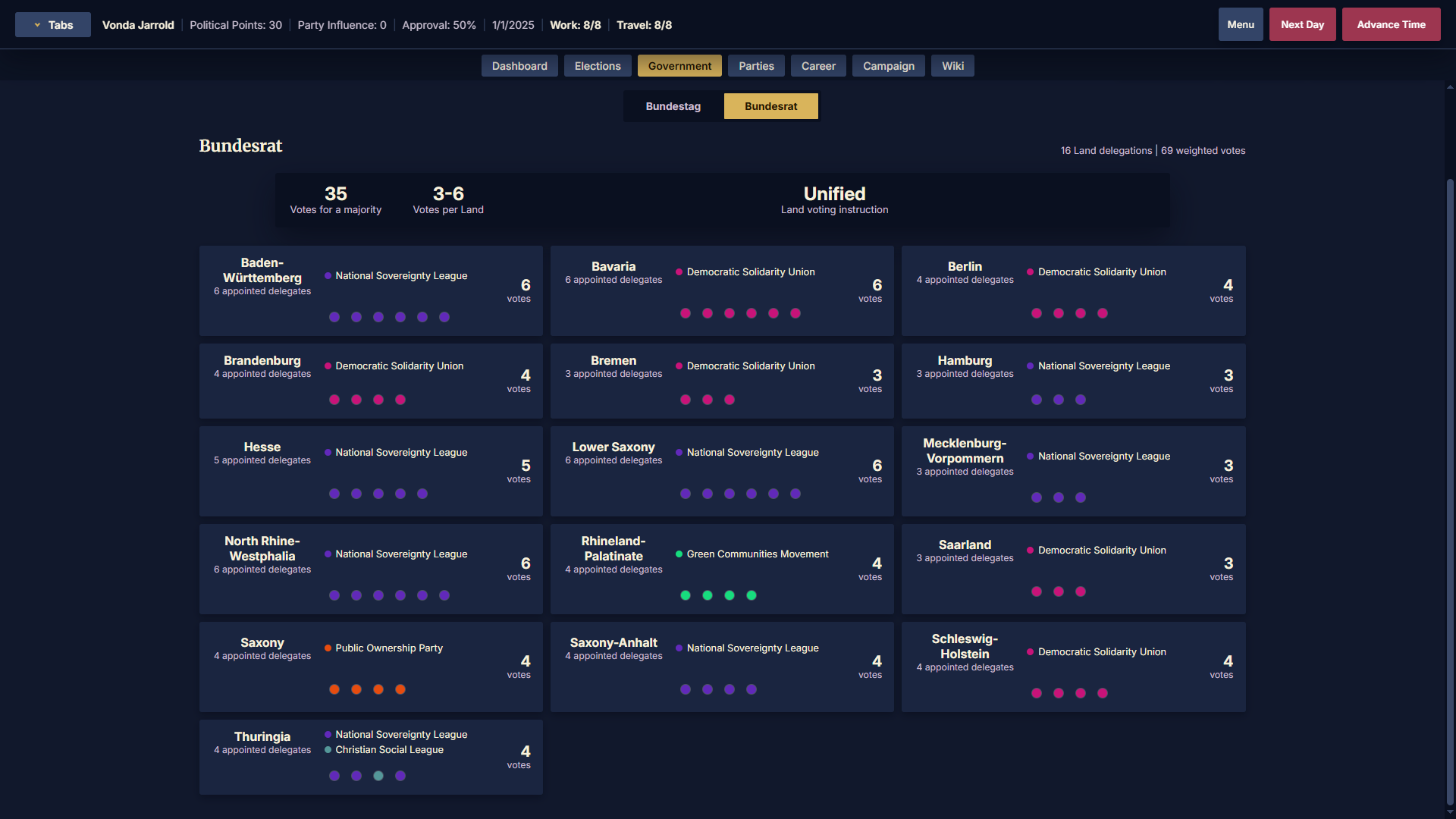
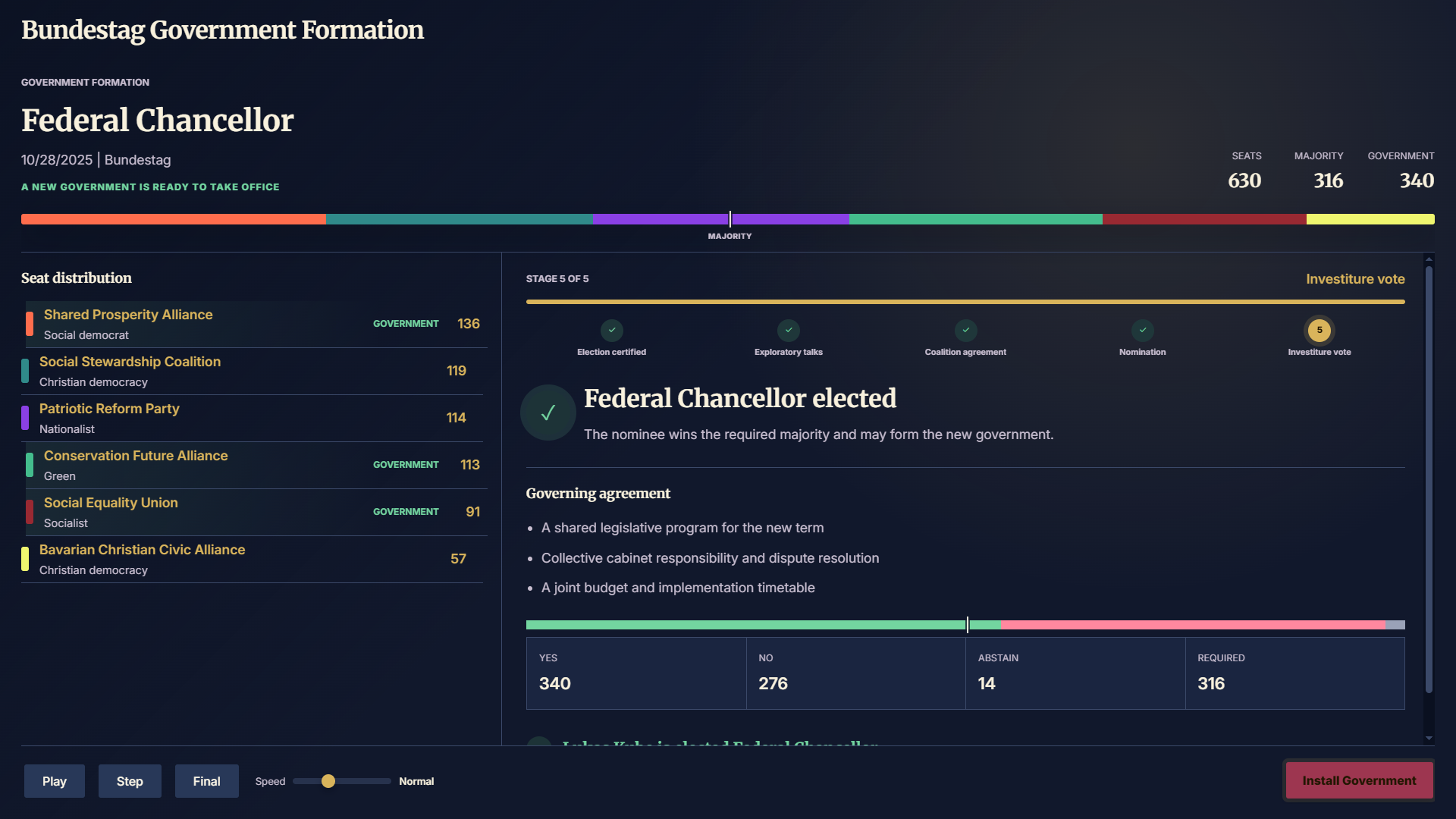
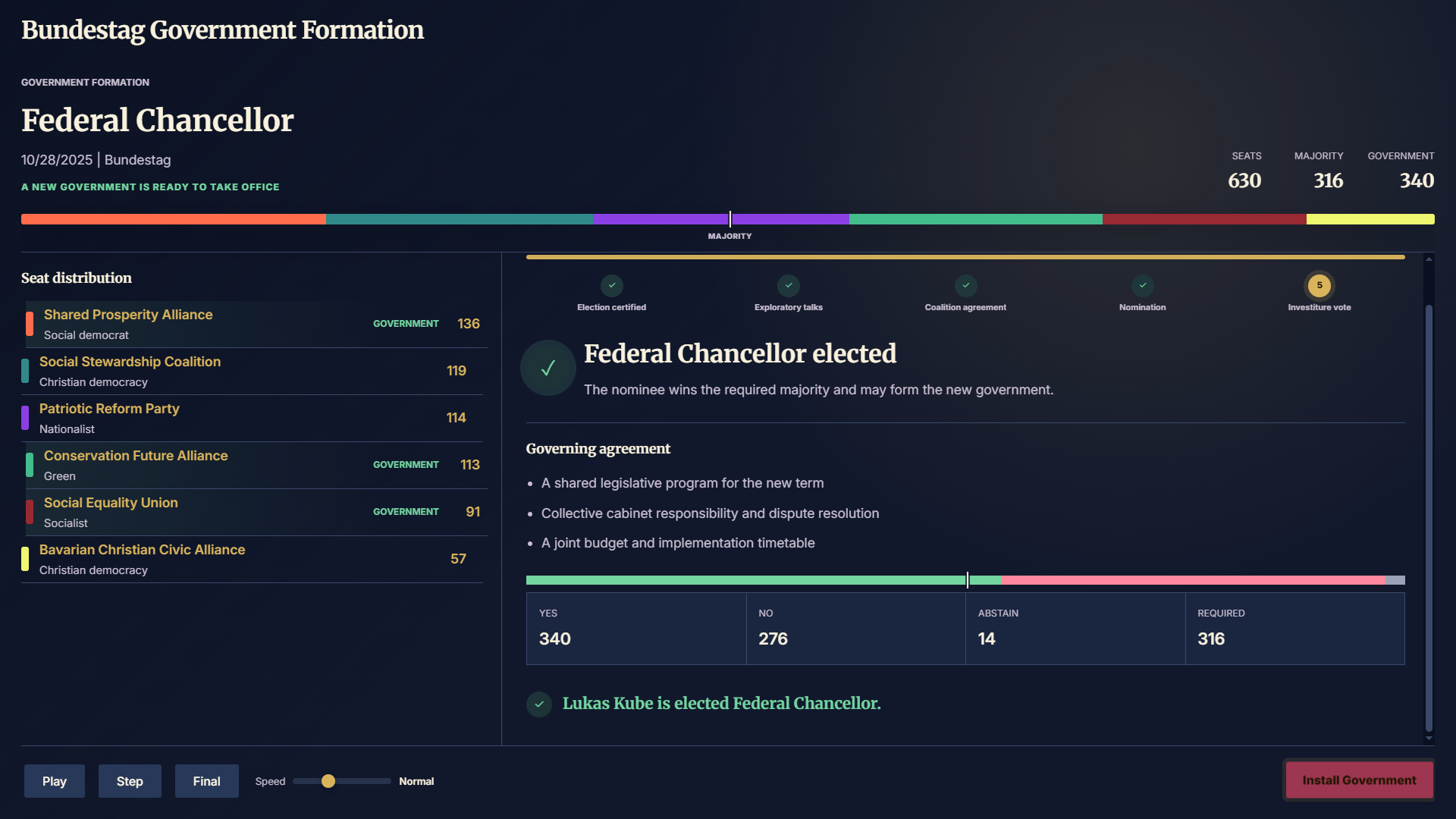
StateOS 0.2 brings in Germany and the UK, each with their own career routes: Prime Minister, Chancellor, the Bundesrat and the House of Lords. The UK has devolved legislatures, and their elections use their own local legislature maps.
Elections work the way each country works. Holyrood counts 73 constituencies and 8 regional lists under AMS, with each party's D'Hondt divisor starting from the seats it already won in that region. The Senedd and the Northern Ireland Assembly race on their real constituencies. A devolved seat is an office in its own right rather than a seat number, so you can stand for one, and choosing a Westminster constituency narrows the devolved seats you're offered to the ones that overlap it.
The Bundestag is MMP with a 5% threshold and the three-direct-seat rule alongside it, so a party that falls under the threshold can still be seated if it wins enough constituencies outright. In a German election you choose a direct constituency and a party list.
Government formation is in for both countries, including Northern Ireland power sharing. One government forms per chamber, and a parliament that is a member or two short still forms one.
Germany has Landtag Kreis, Wahlkreis and regular Kreis maps, with the caveat that potential legal attribution complications mean these have randomized geometry for now. The UK's Westminster and devolved constituencies are drawn from the real ONS boundaries.
The UK has regional parties per devolved legislature, scoped to their home jurisdictions so the SNP doesn't turn up in Kent, and no Great Britain party contests Northern Ireland. Germany has its Bavarian party, which works the way Bavaria actually works rather than the way Northern Ireland does: only the sister party stands aside. A Bavarian christian-democratic party contests Bavaria, its national counterpart doesn't, and everybody else stands in both. It sits around 5% nationally, which means the three-direct-seat rule is what keeps it in the Bundestag, the same knife-edge the real CSU was on in 2021.
Committees speak their own language. A Beschlussempfehlung und Bericht is a German committee's report; a UK Public Bill Committee takes a bill line by line, which is markup under another name. A proceeding can be satisfied by any of an equivalent set, so a committee advertises only work it can actually run, and the Commons keeps its separation between select committees and Public Bill Committees.
The career tab shows your path to each custom seat in both countries.
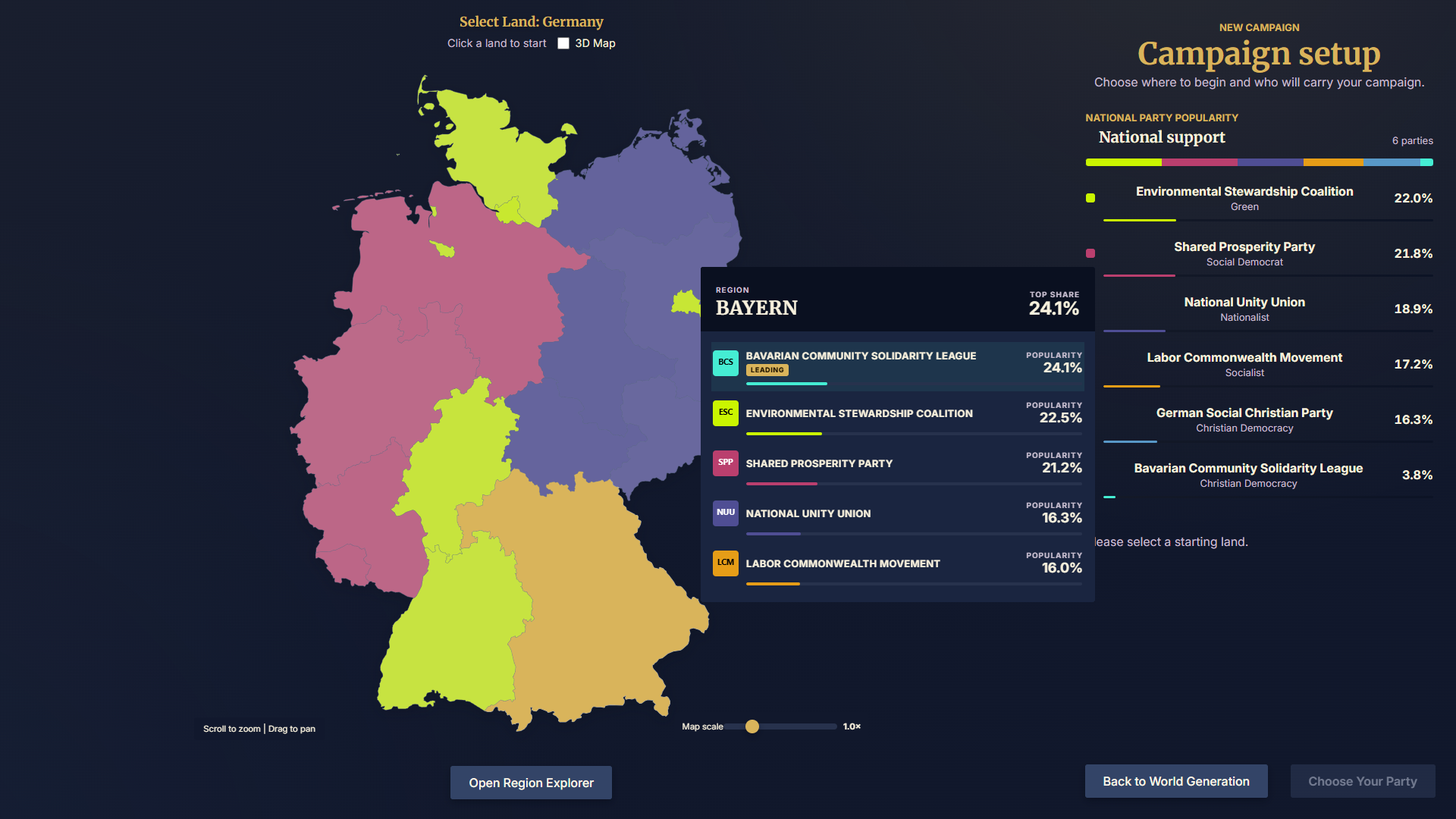
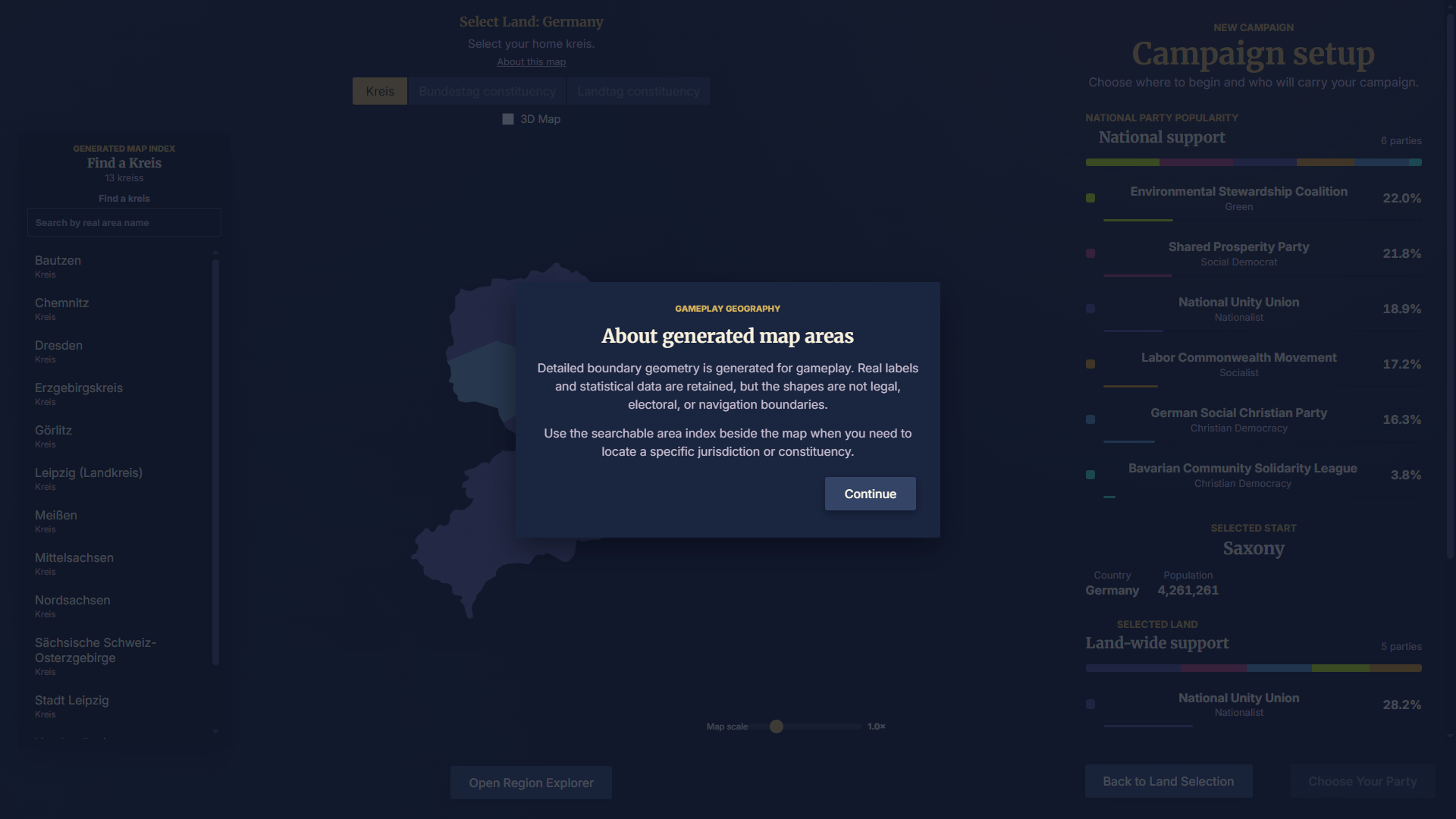
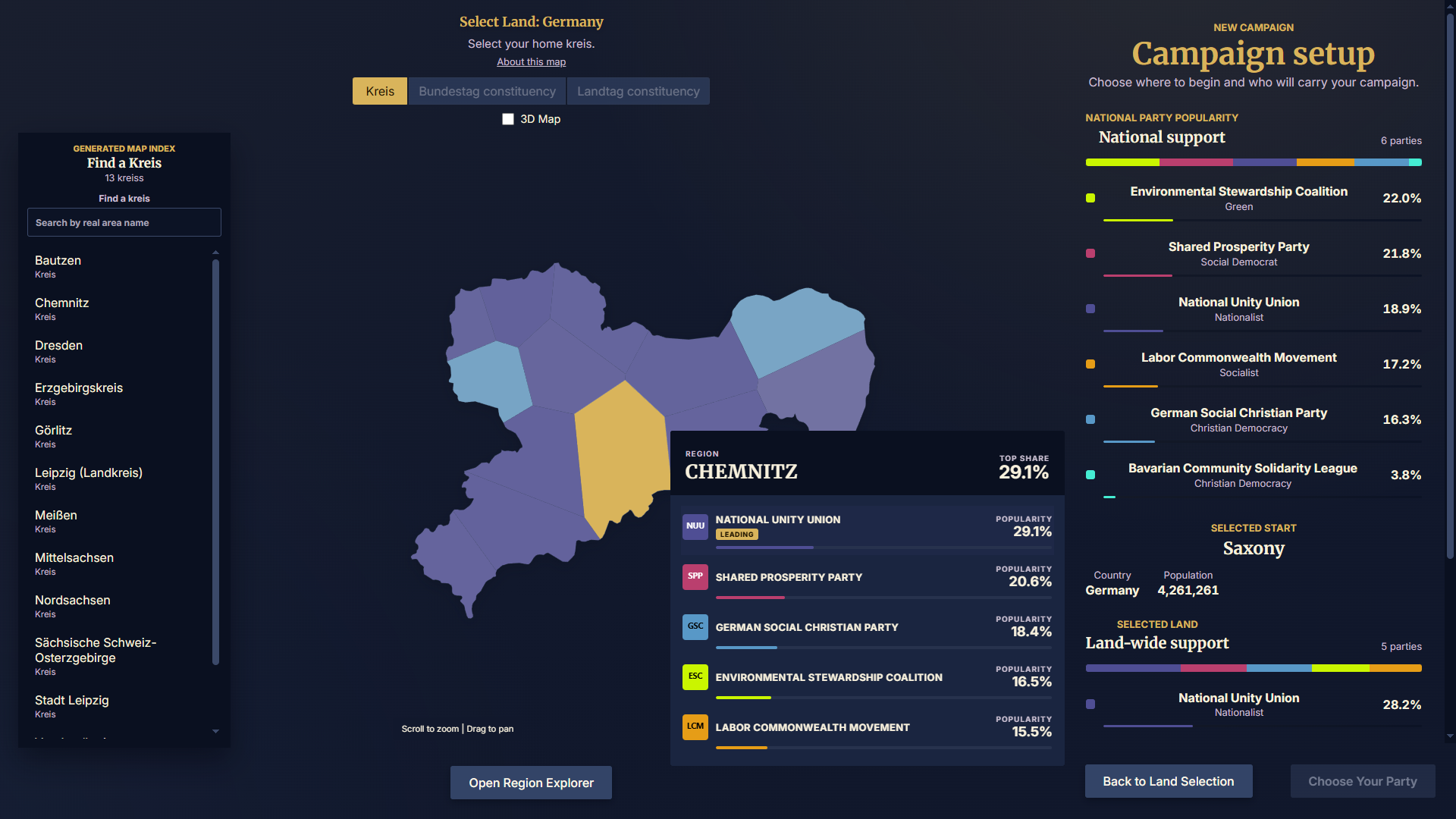
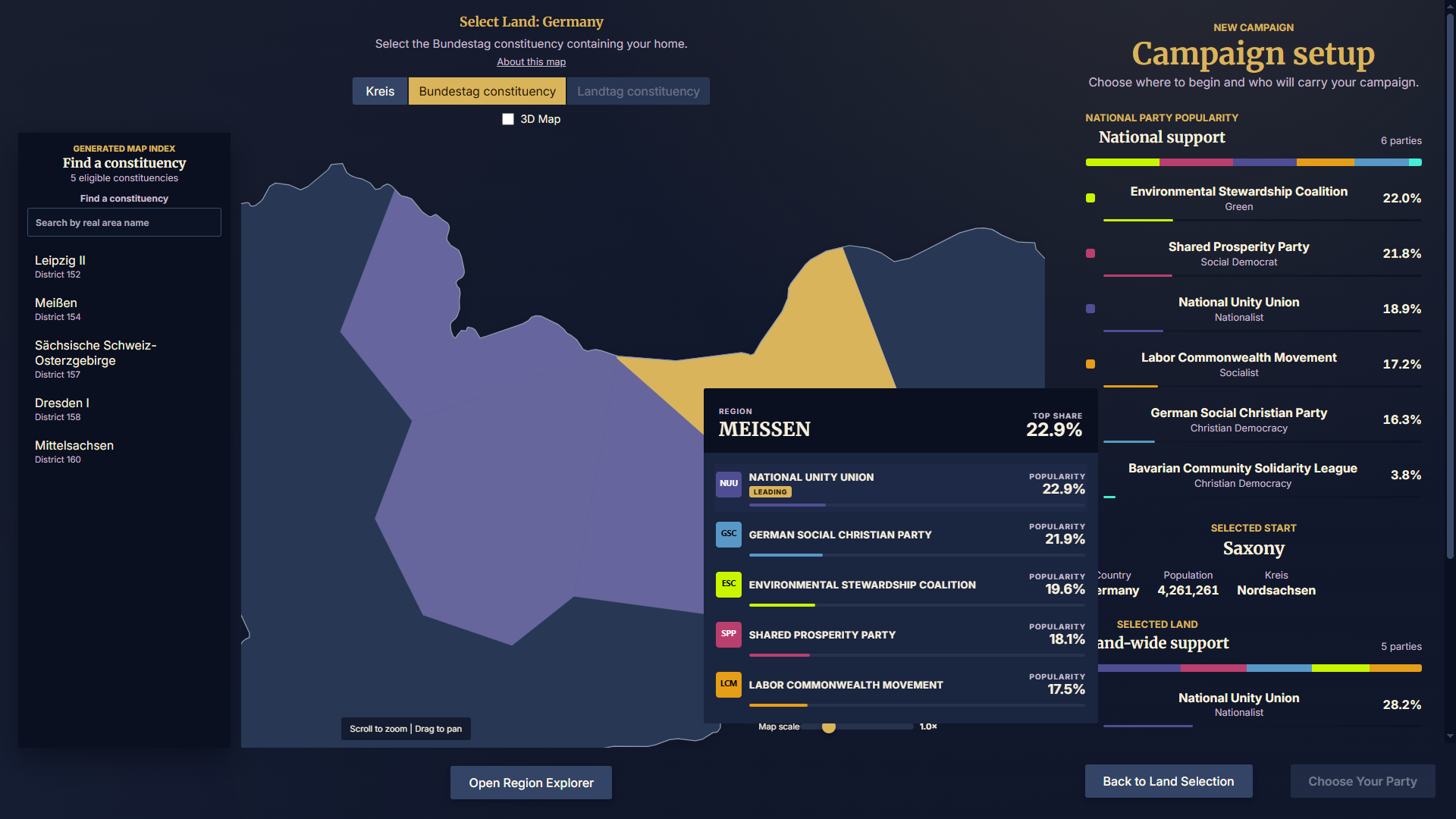
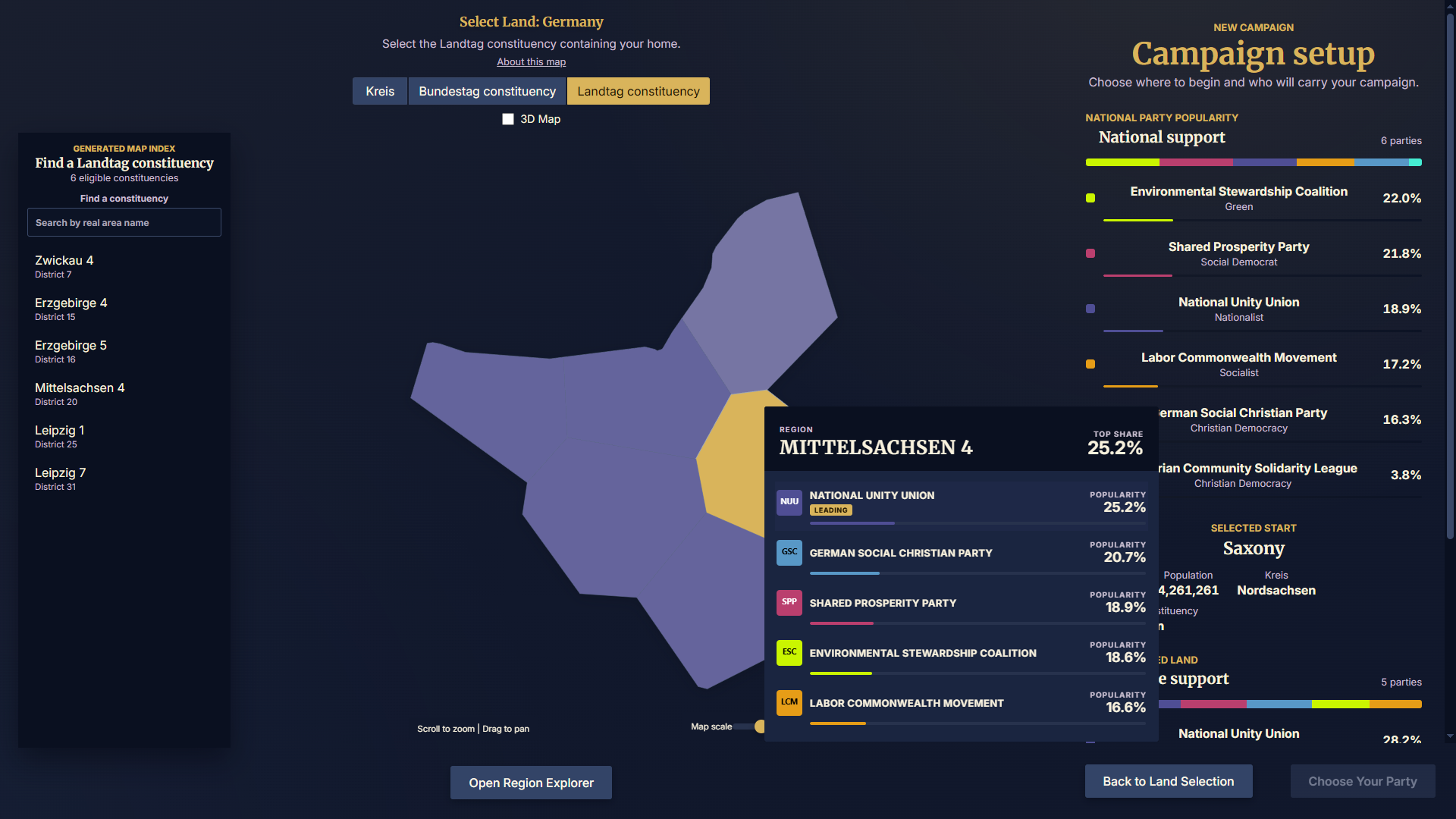
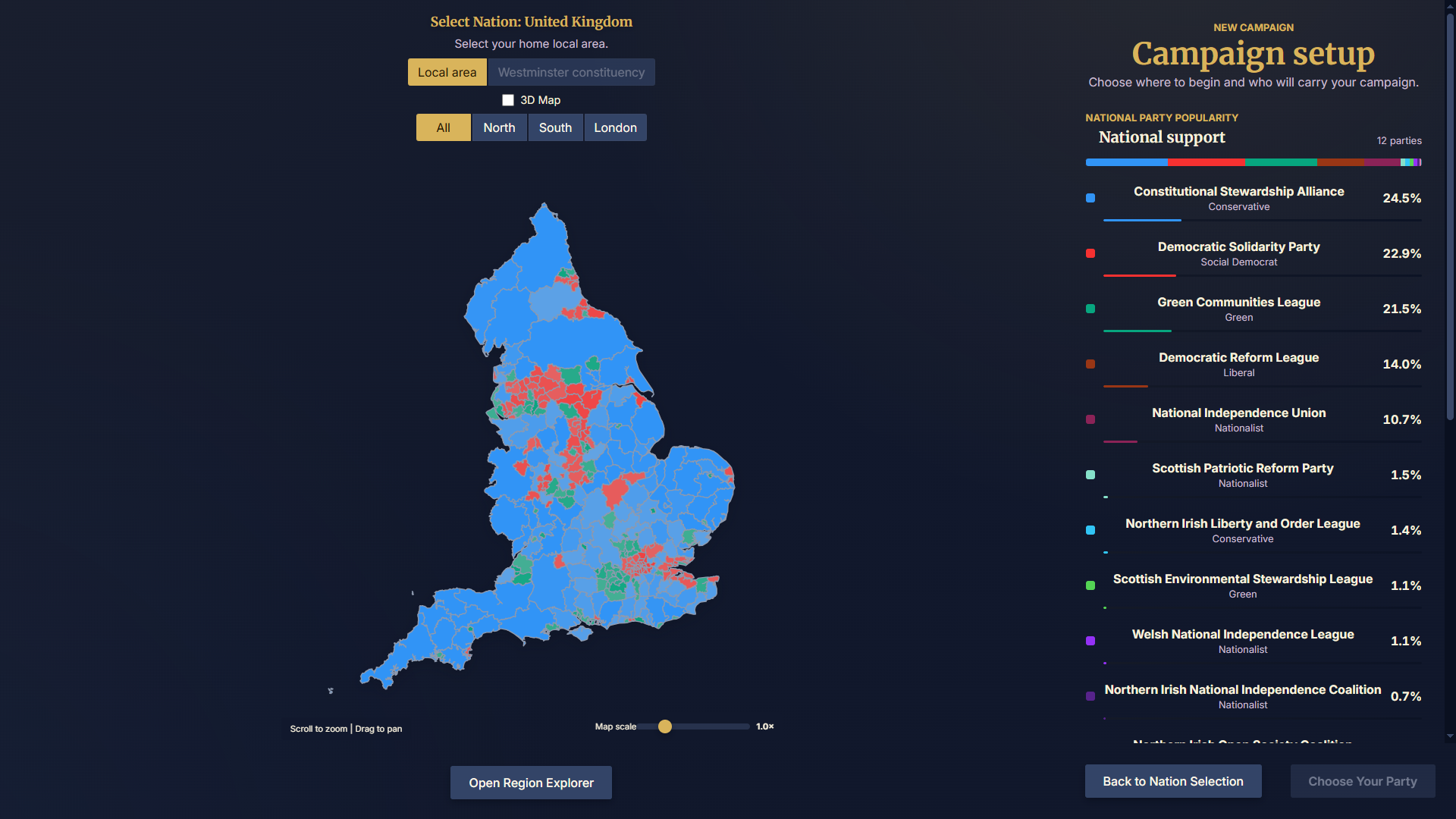
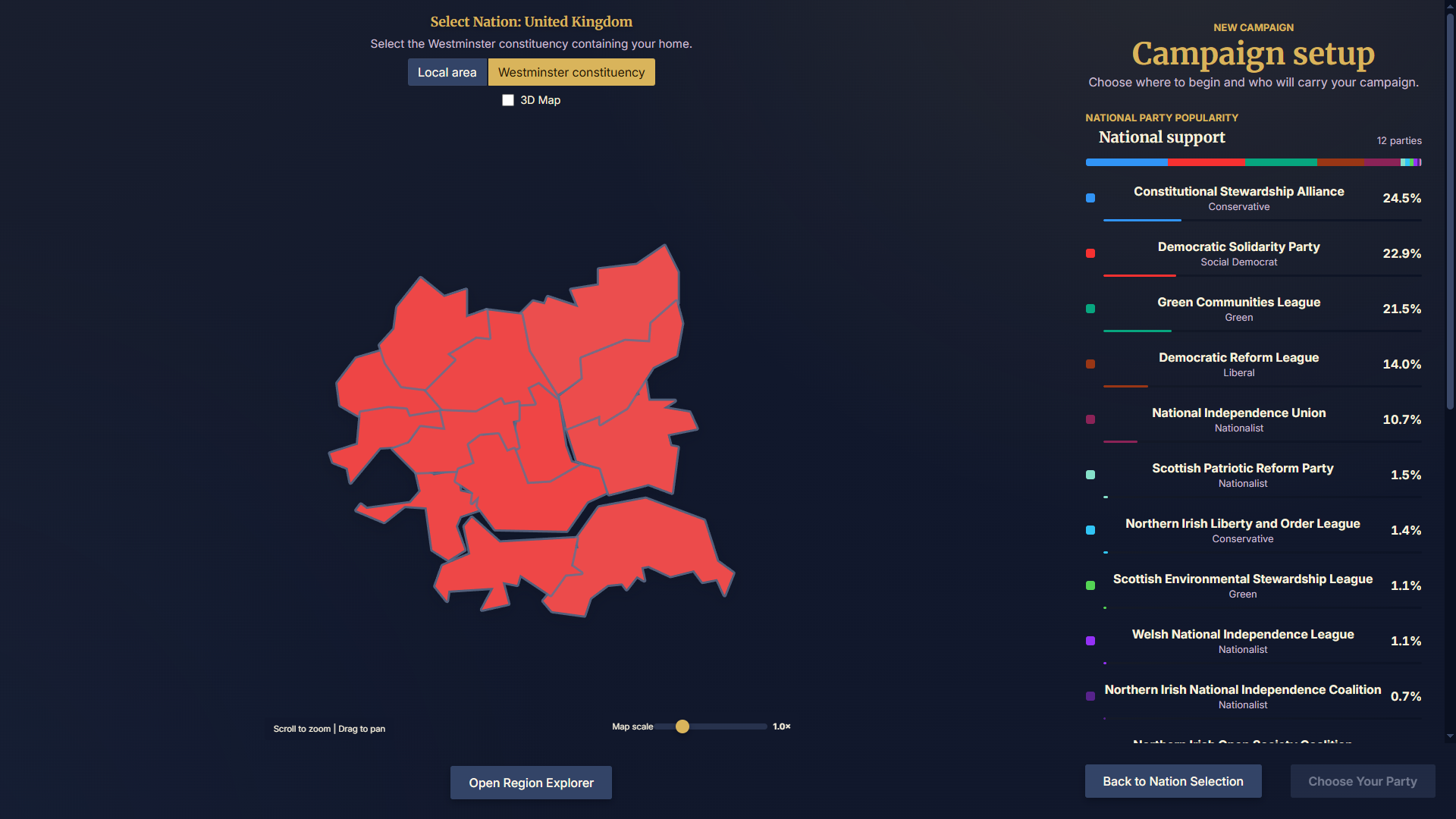
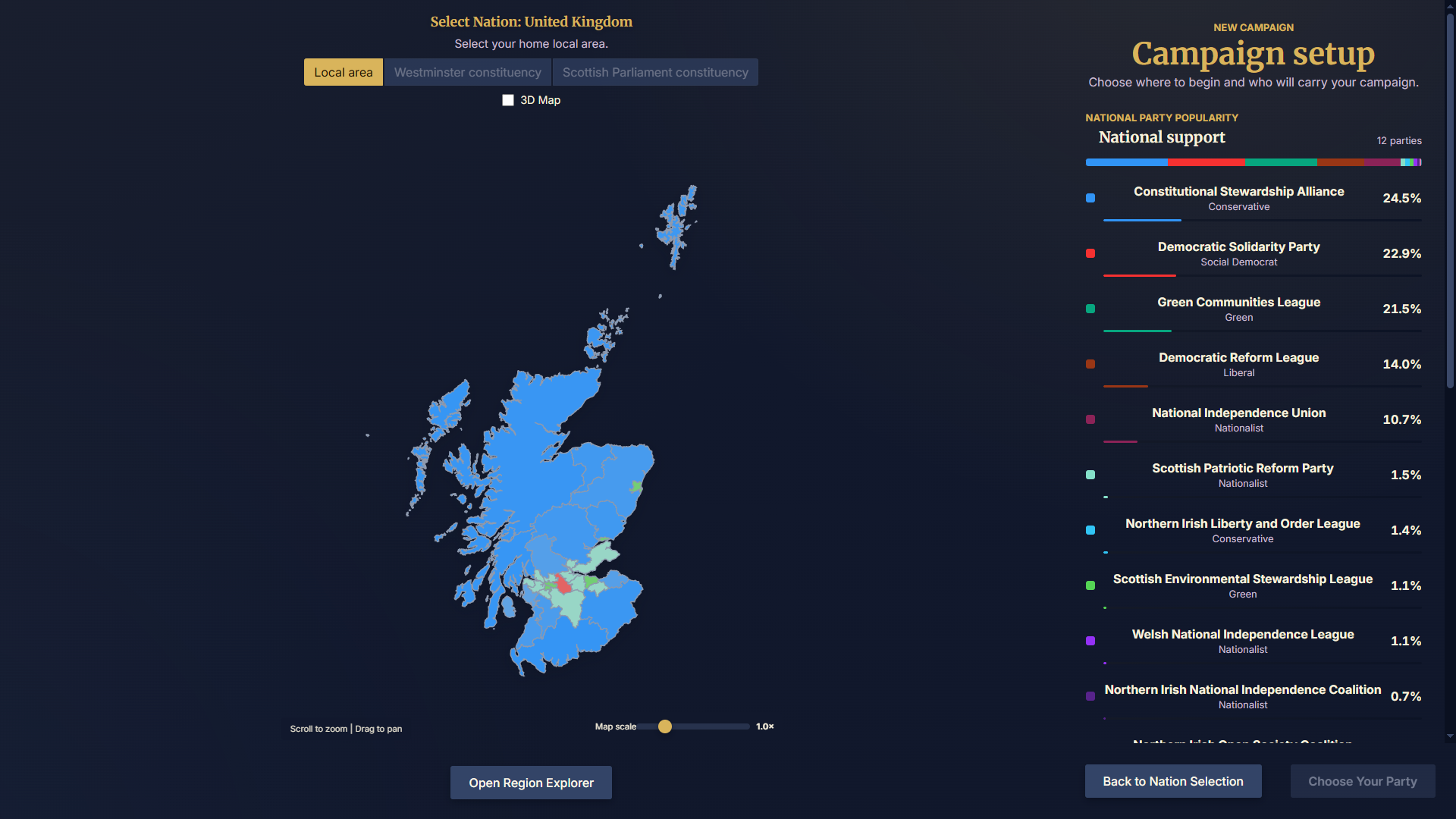
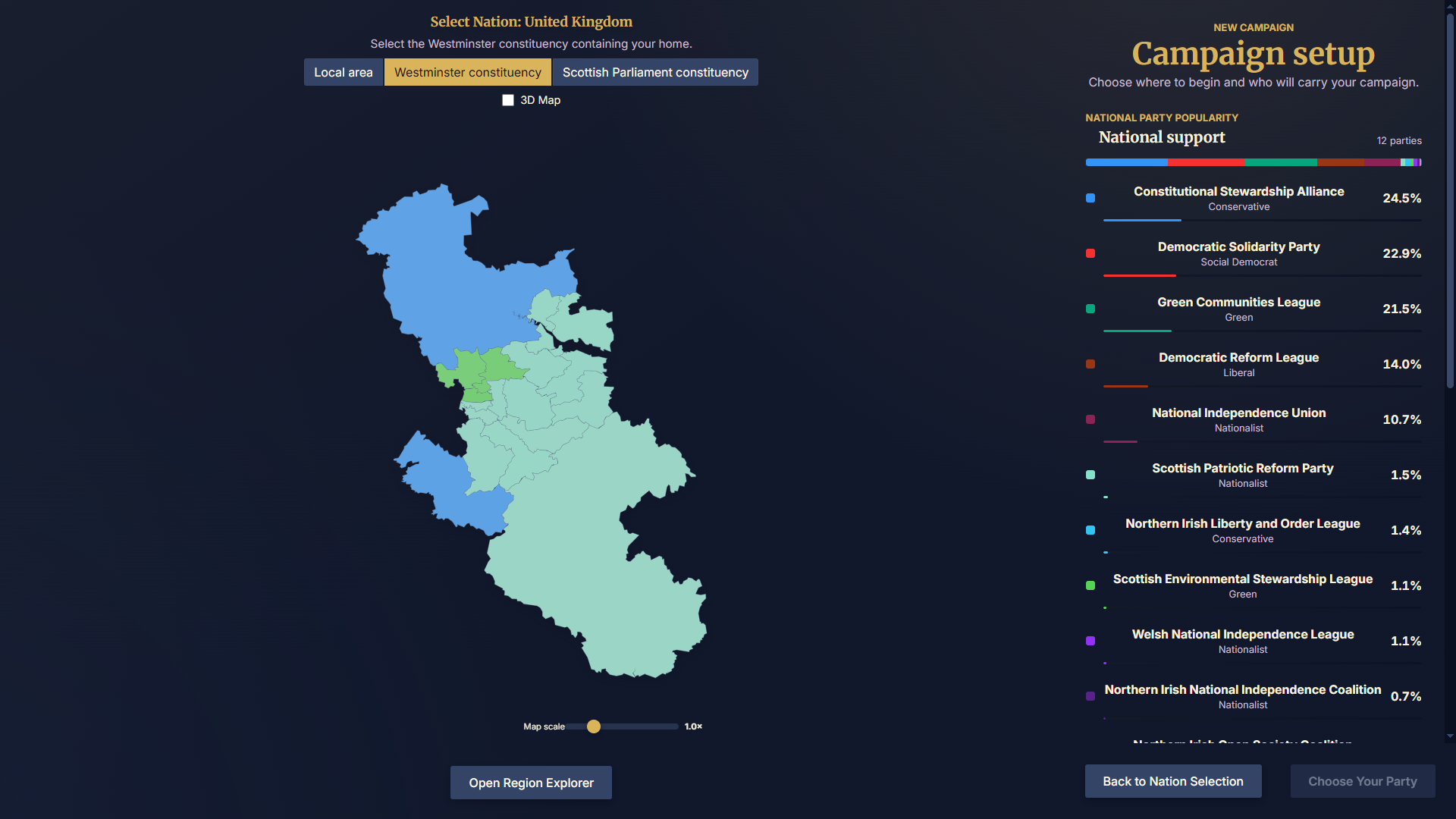
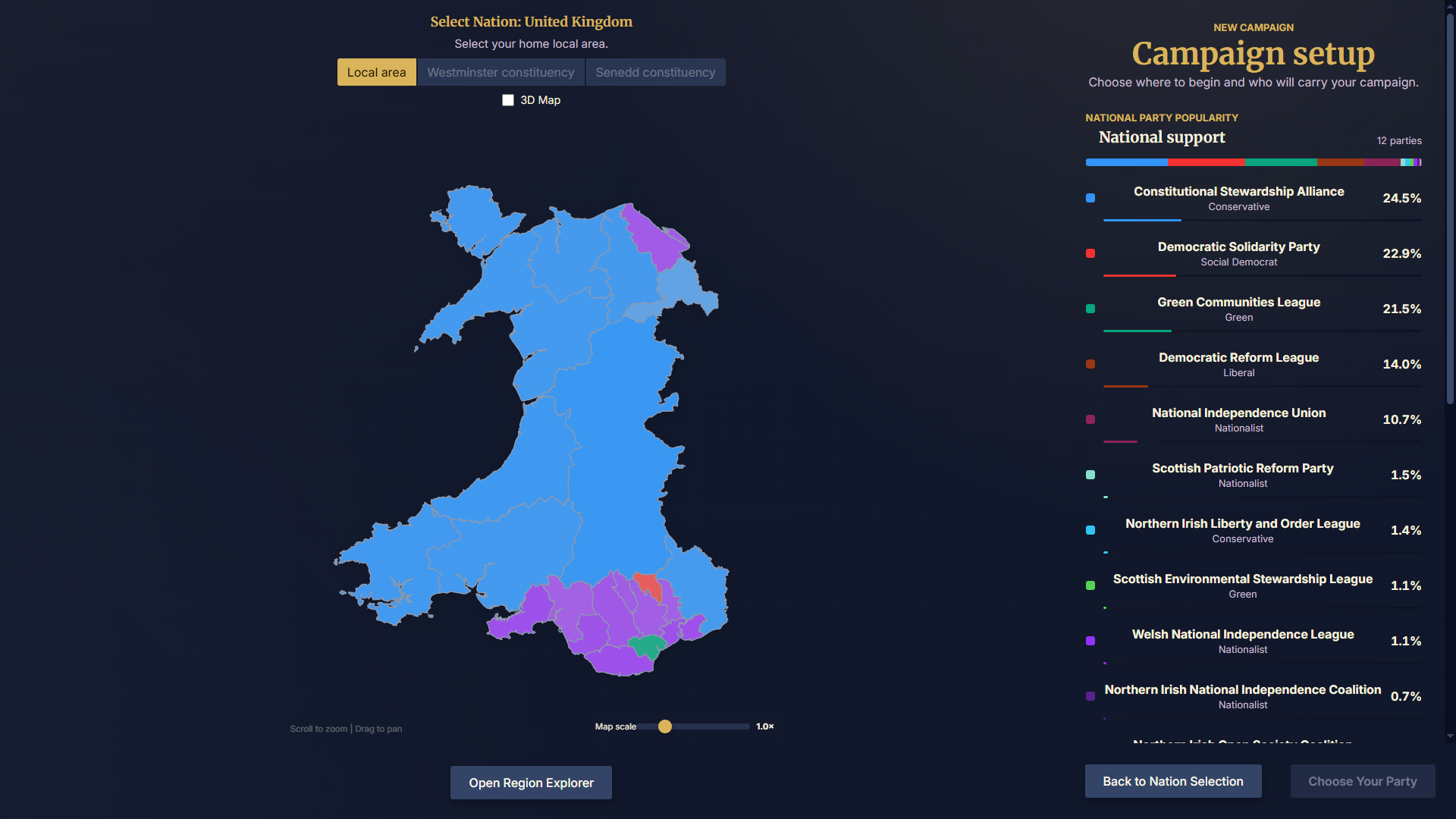
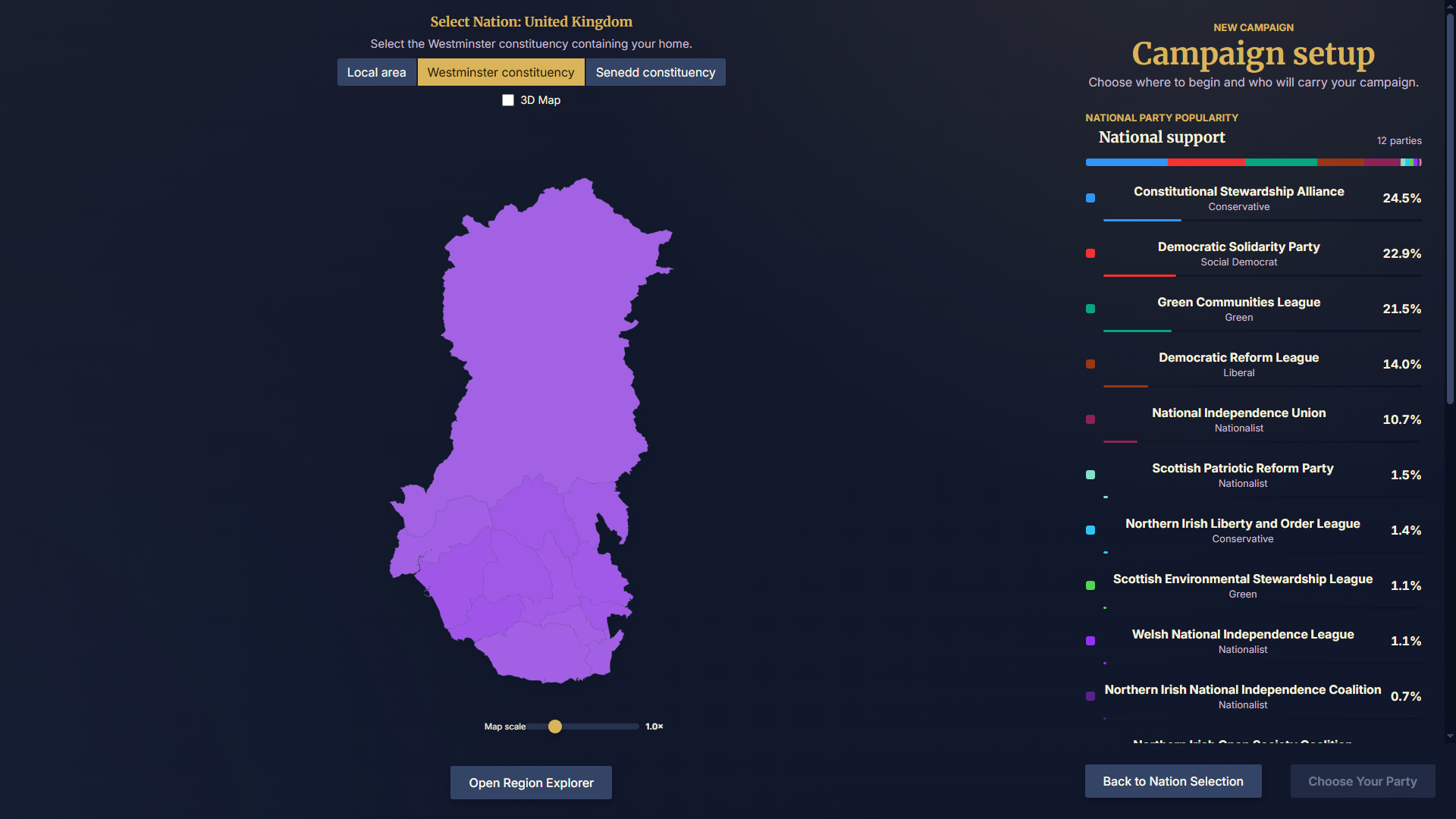

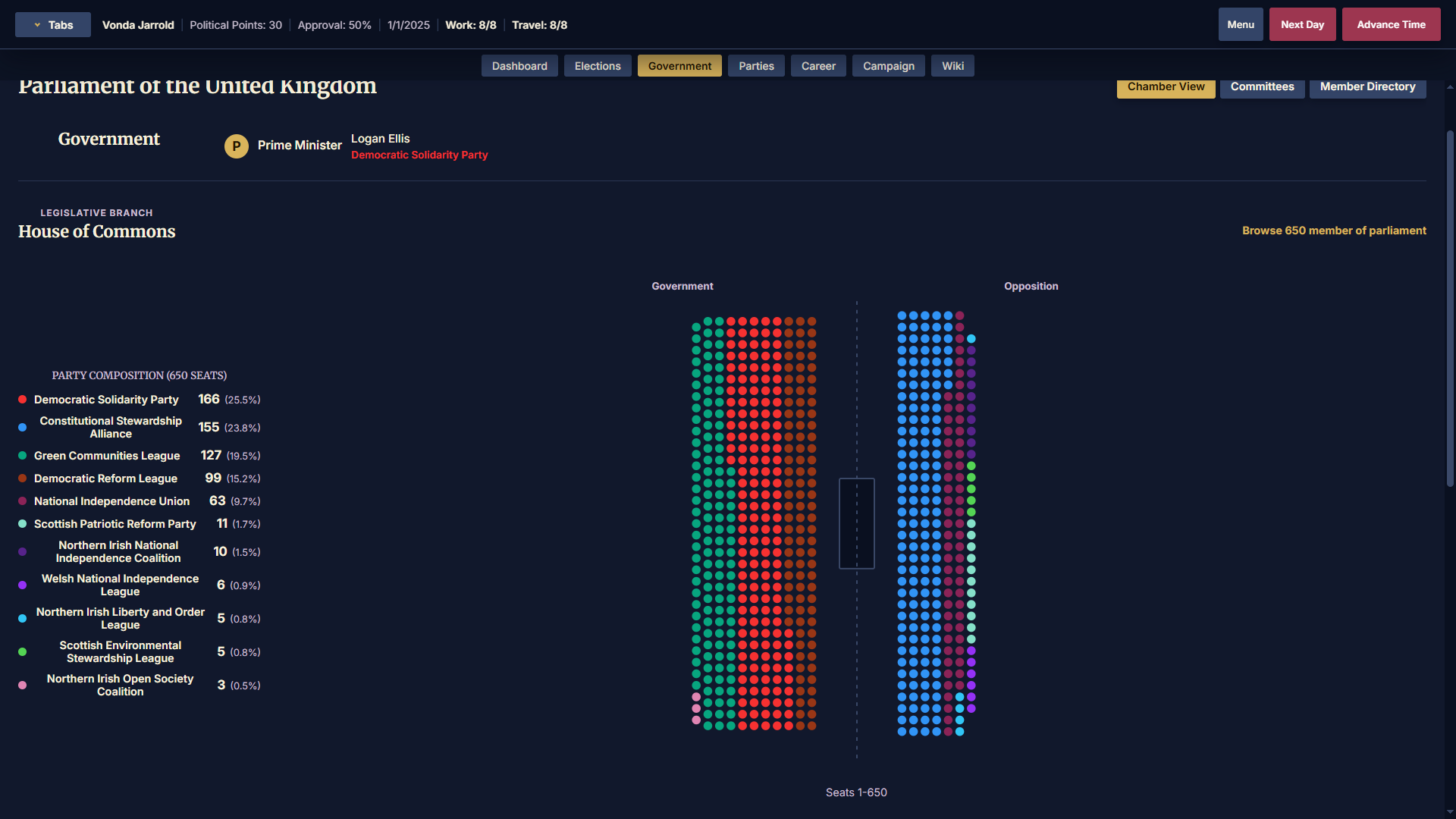
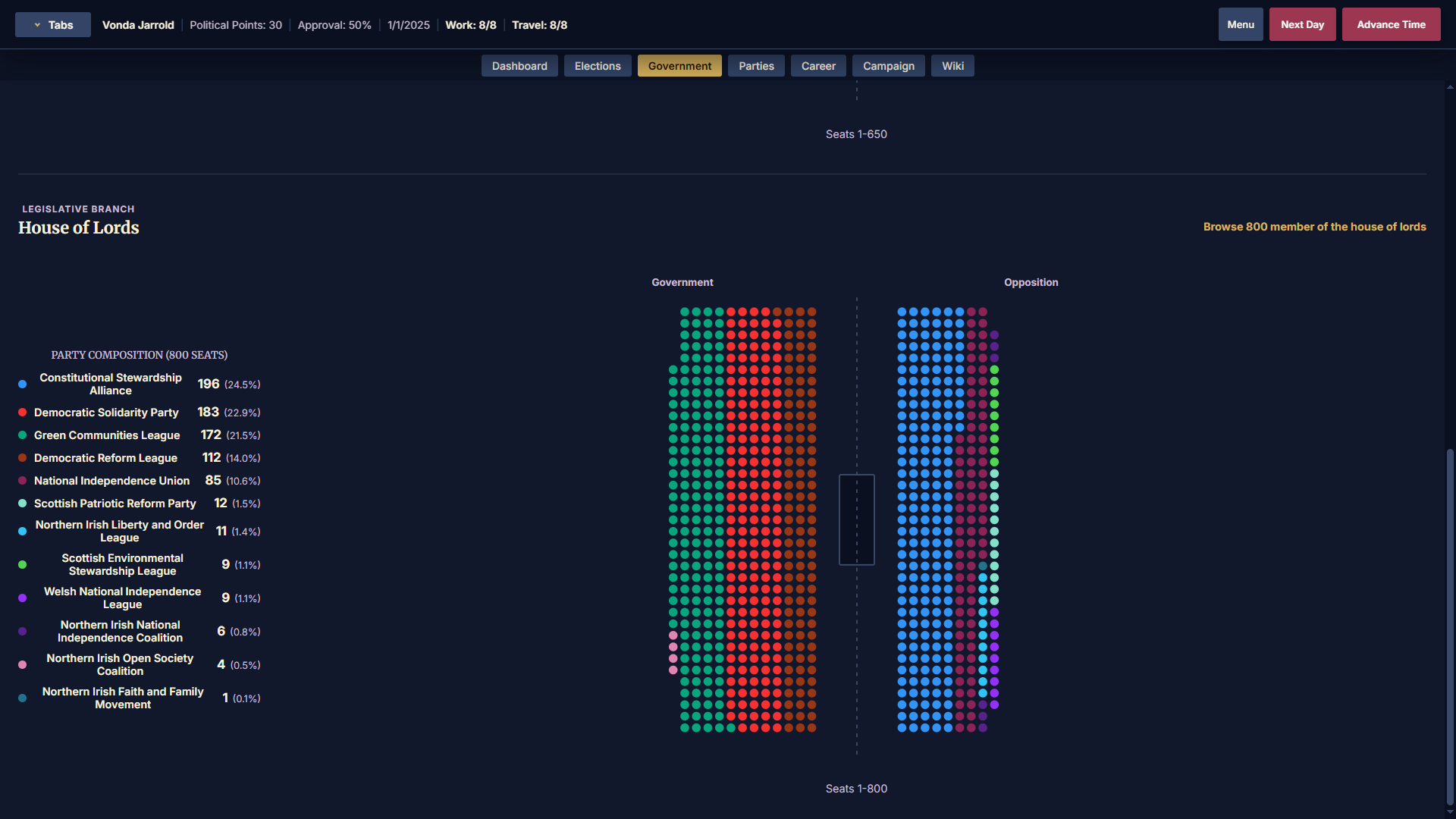
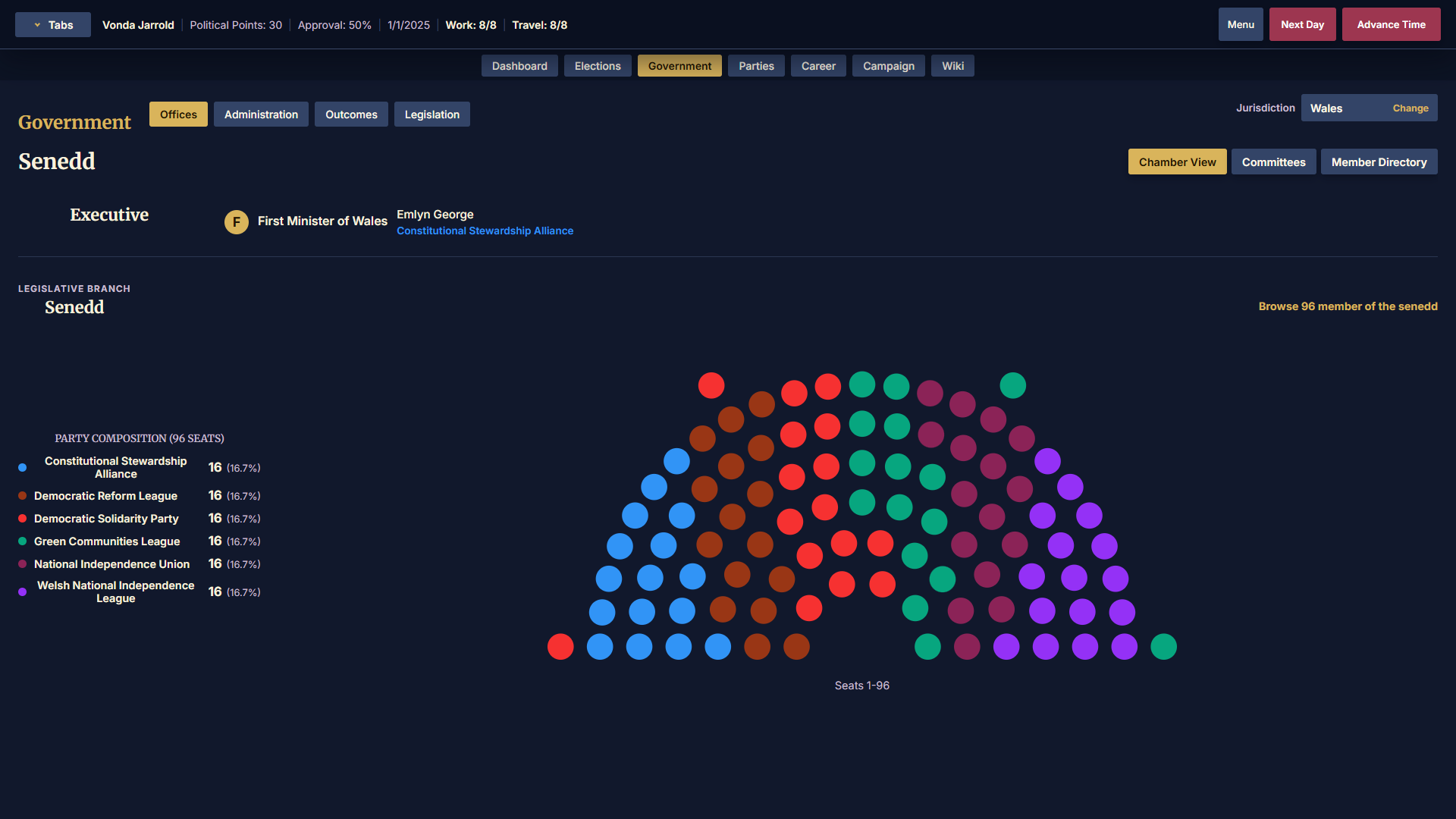
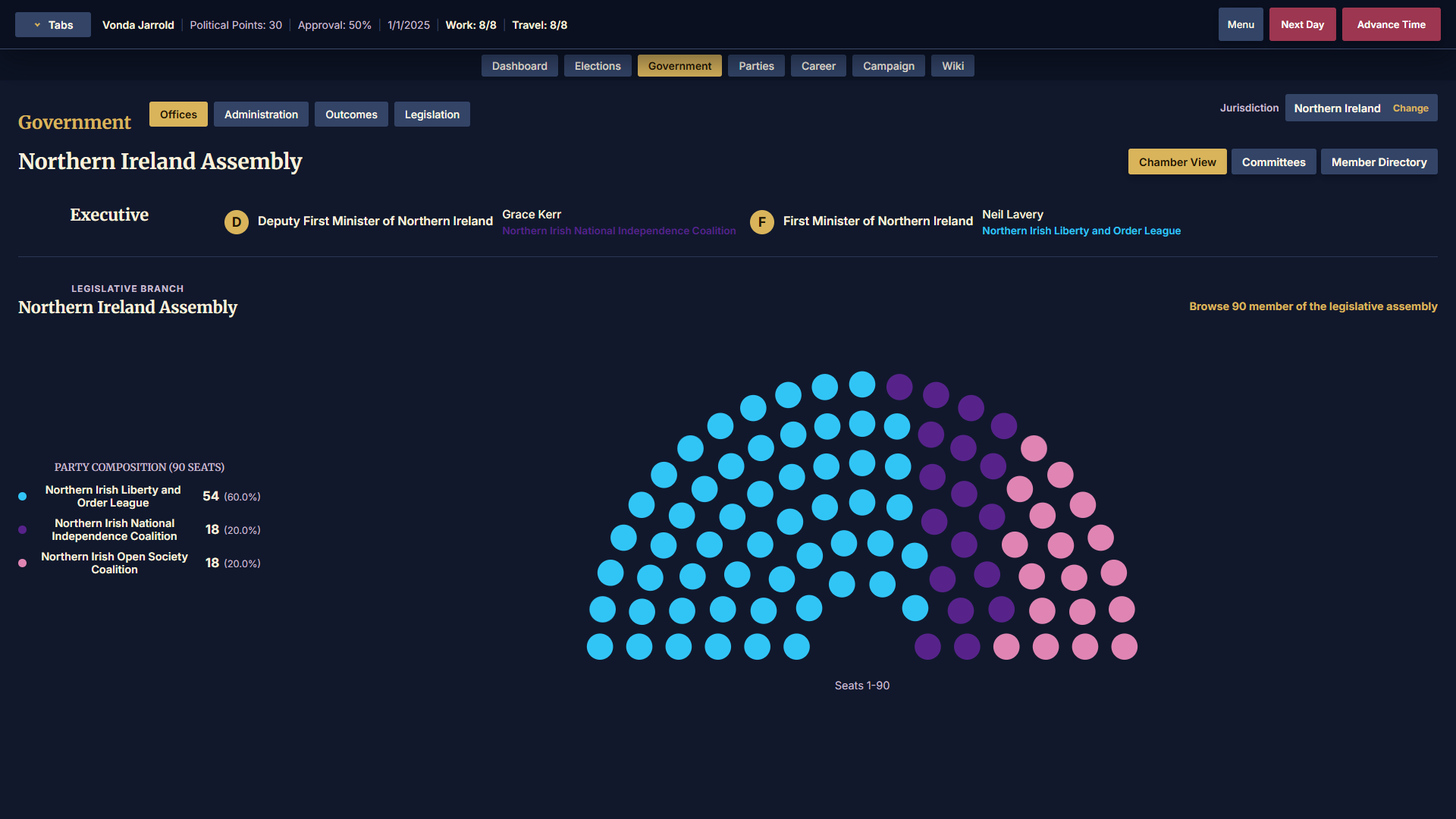
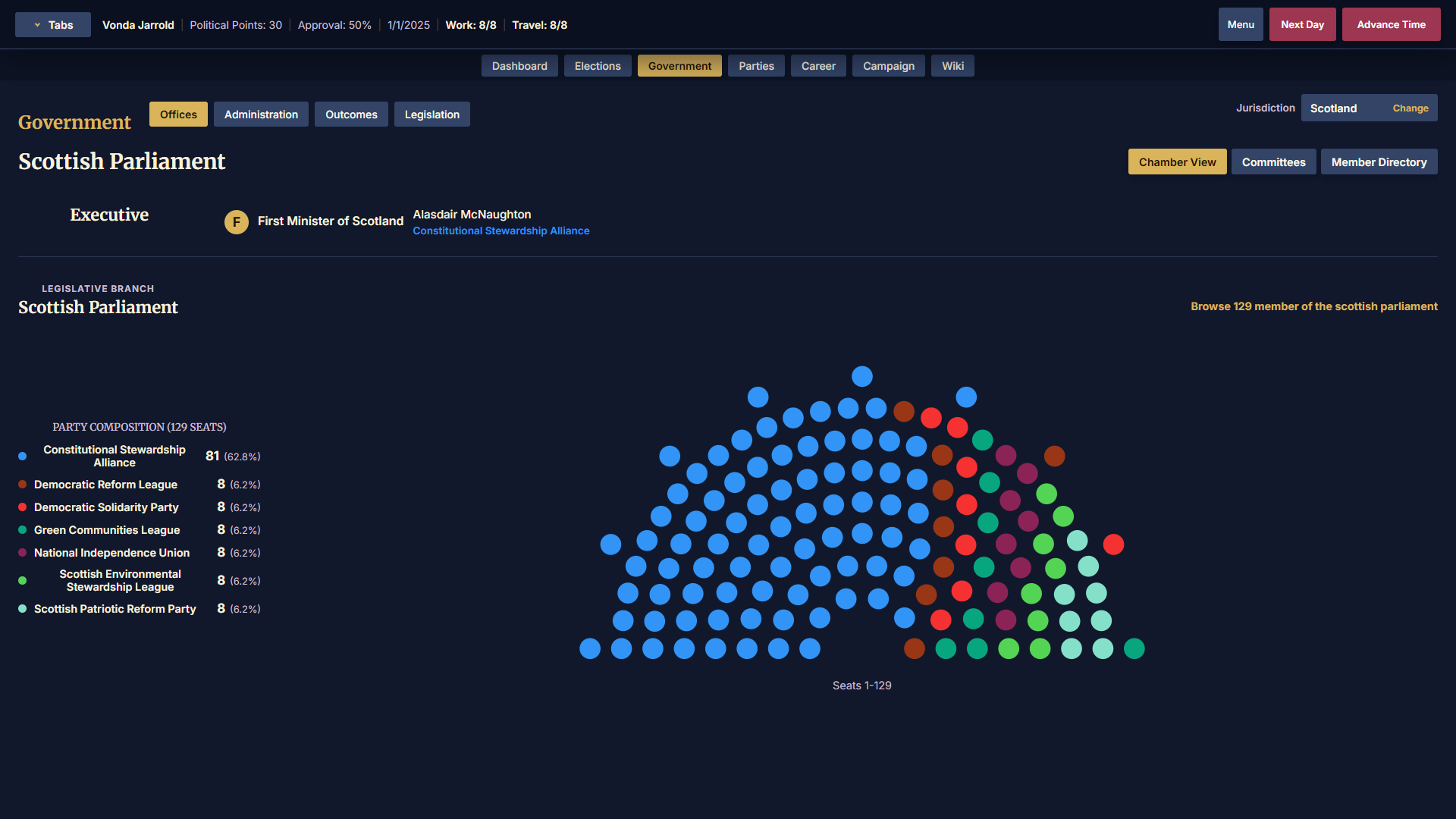
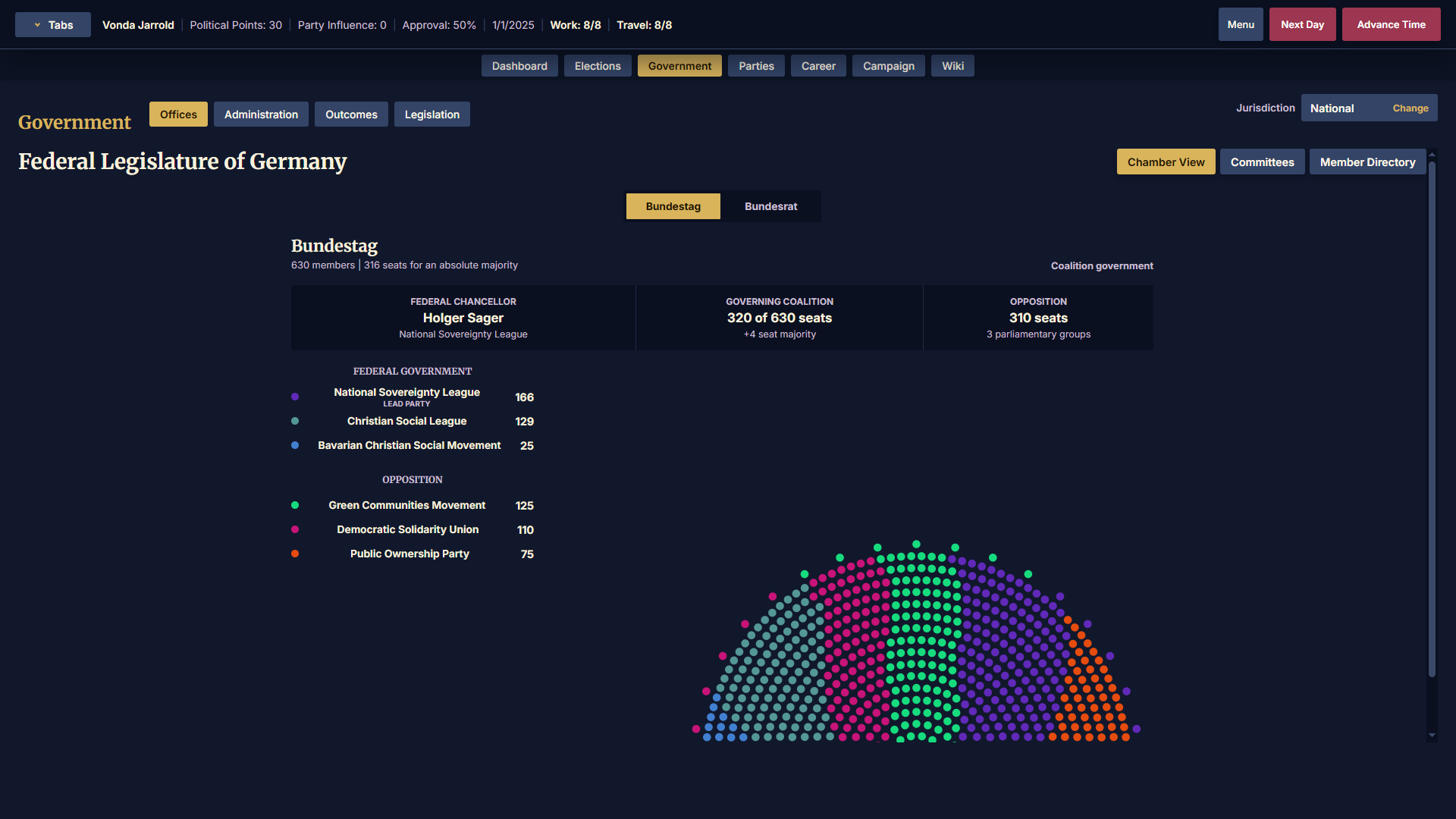
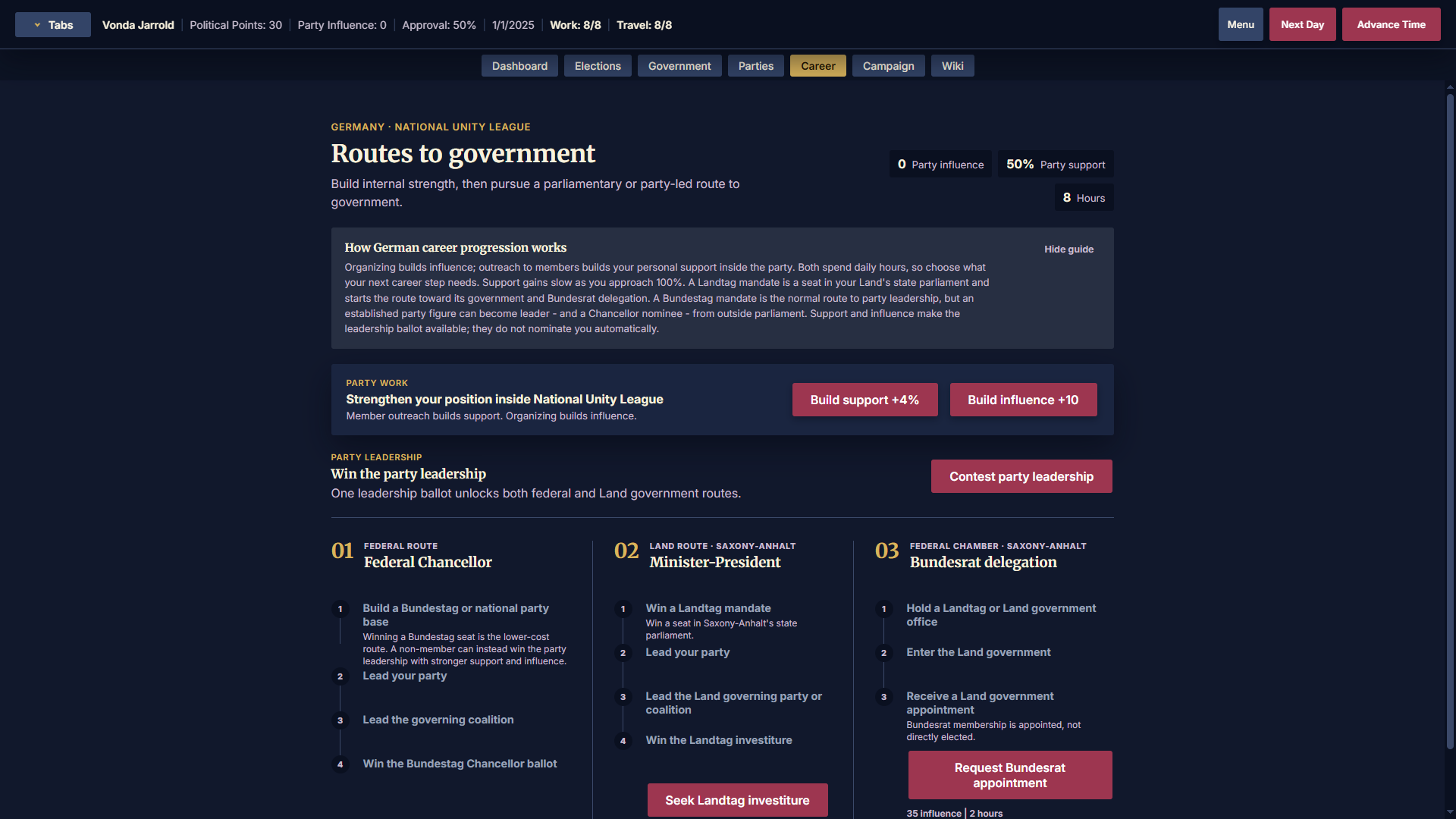
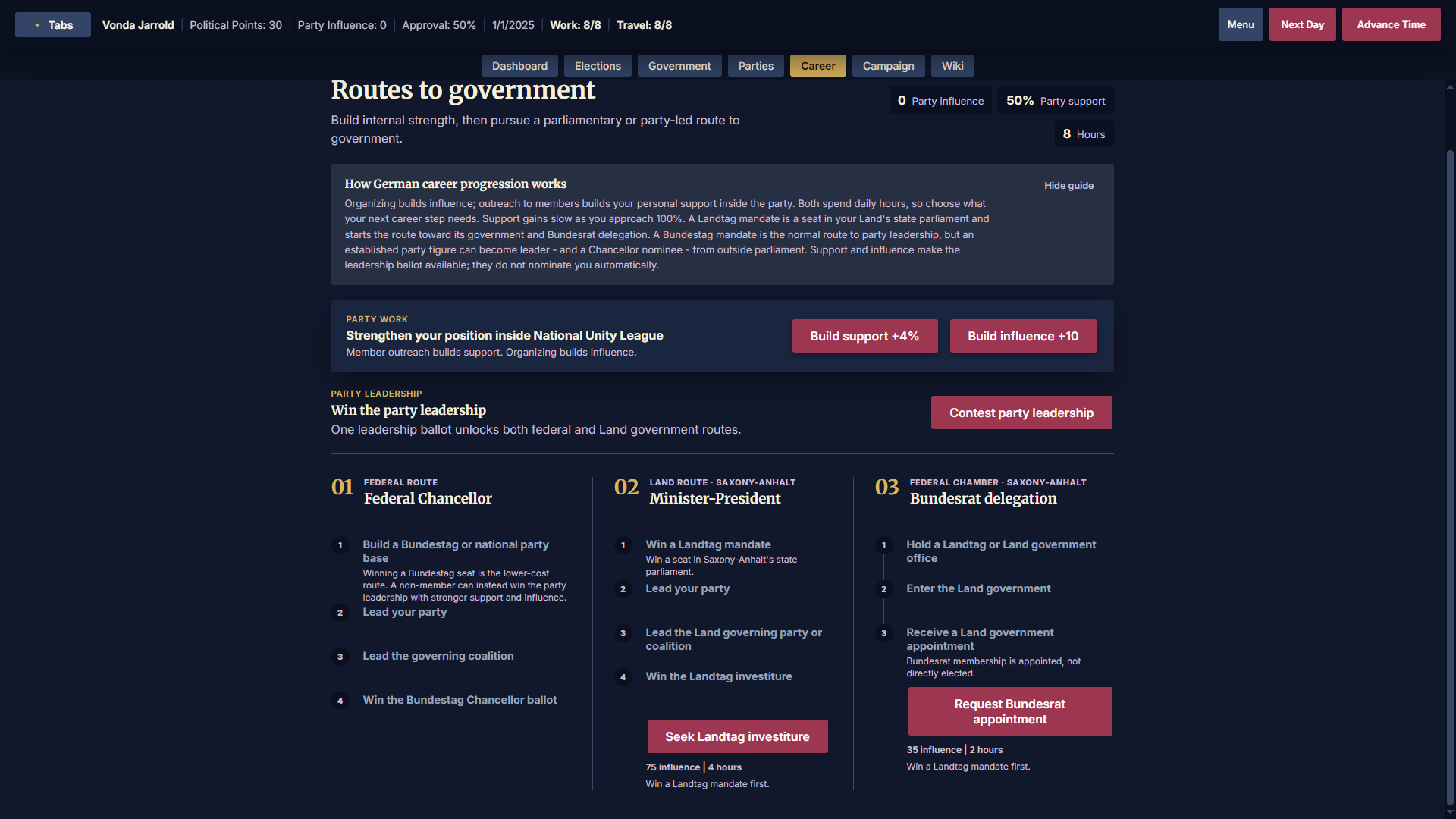
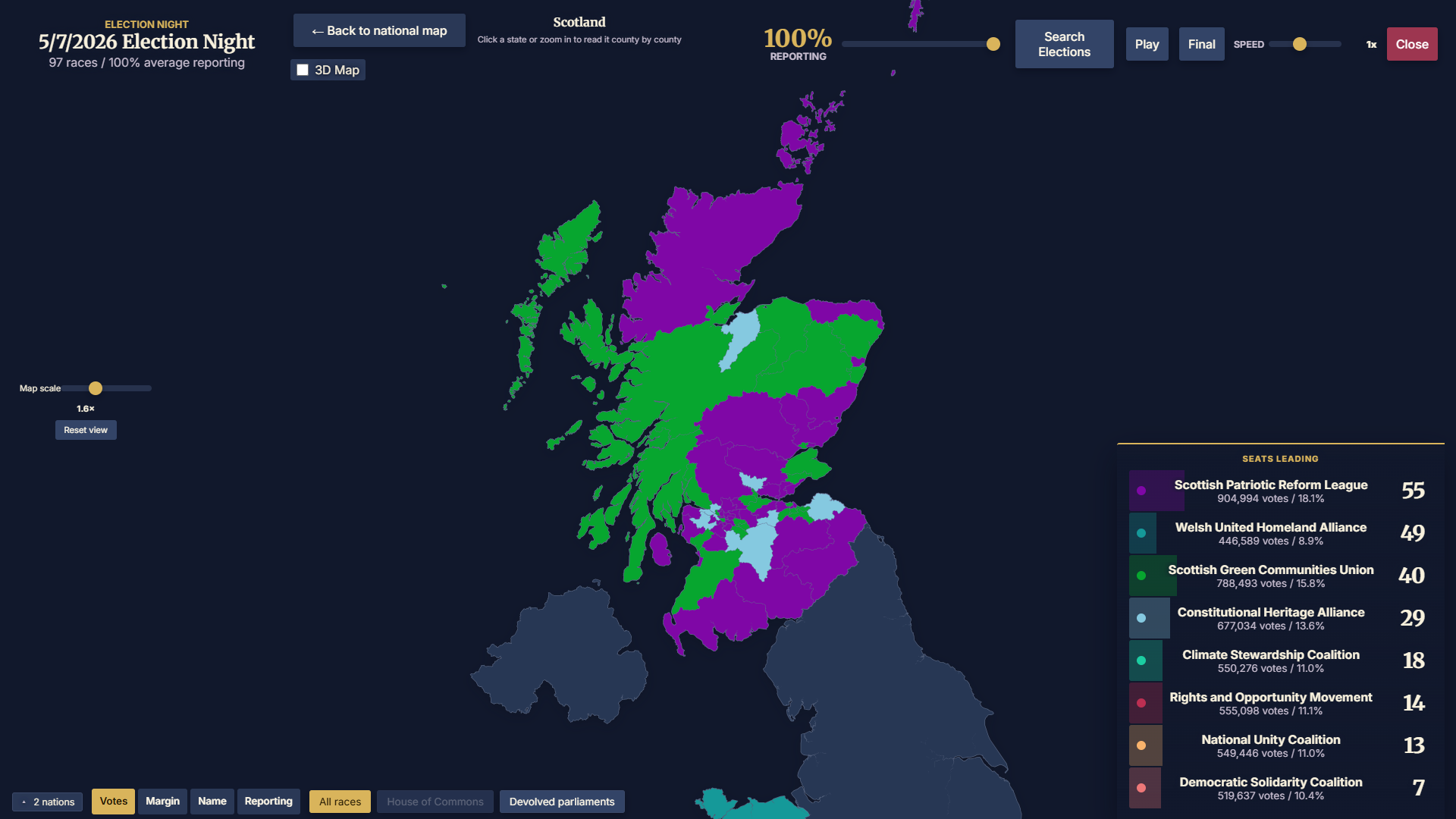
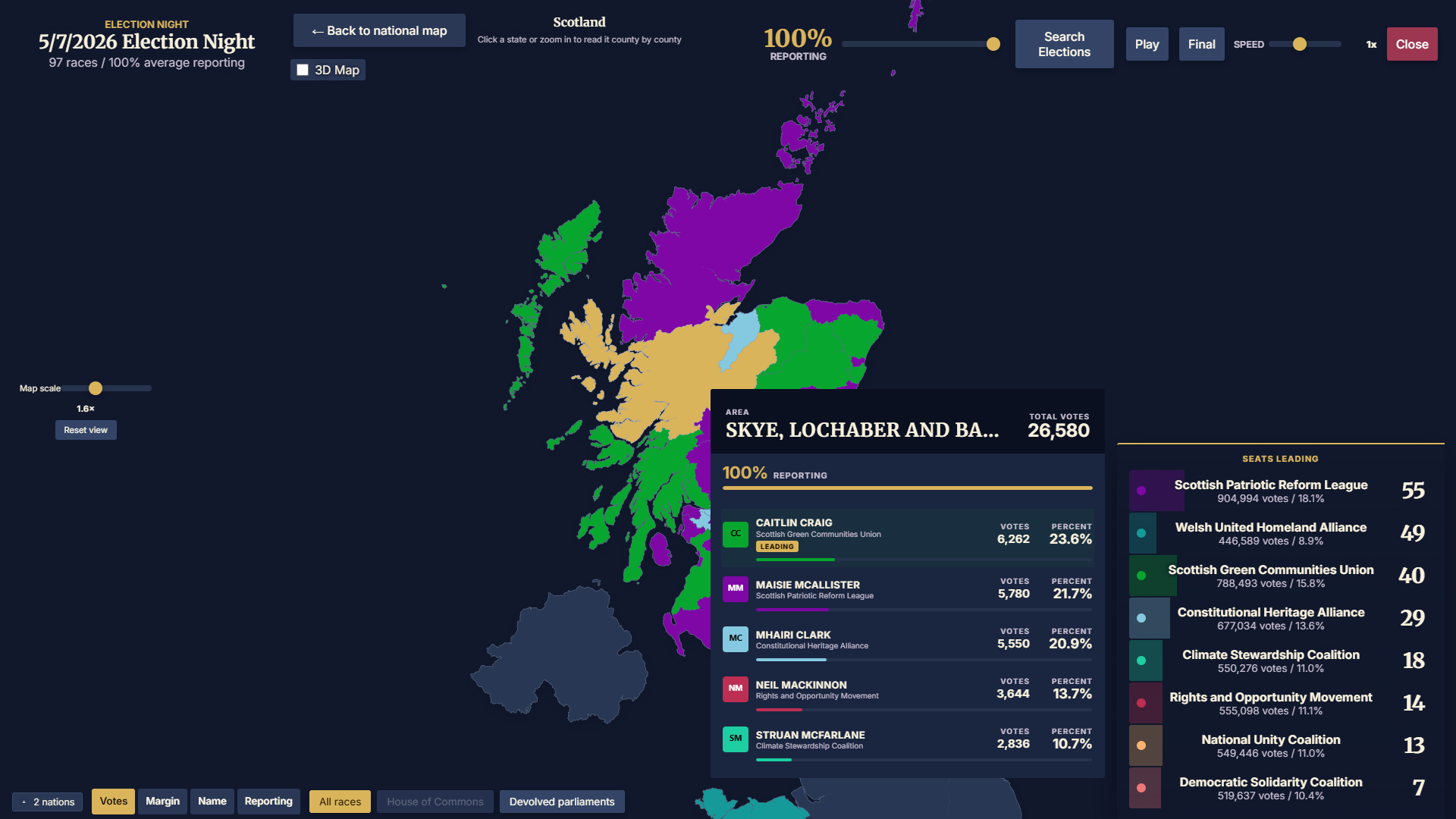
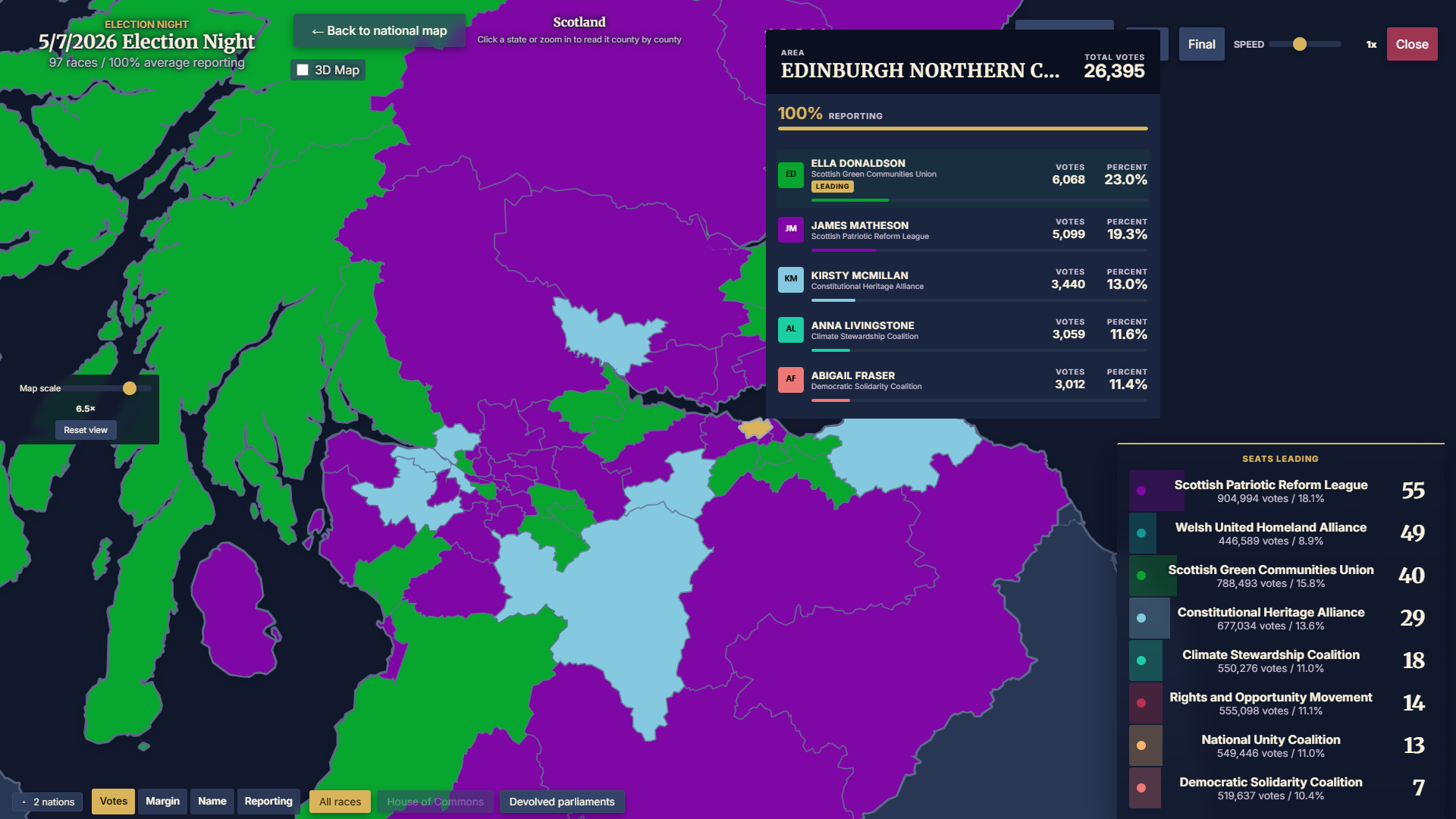
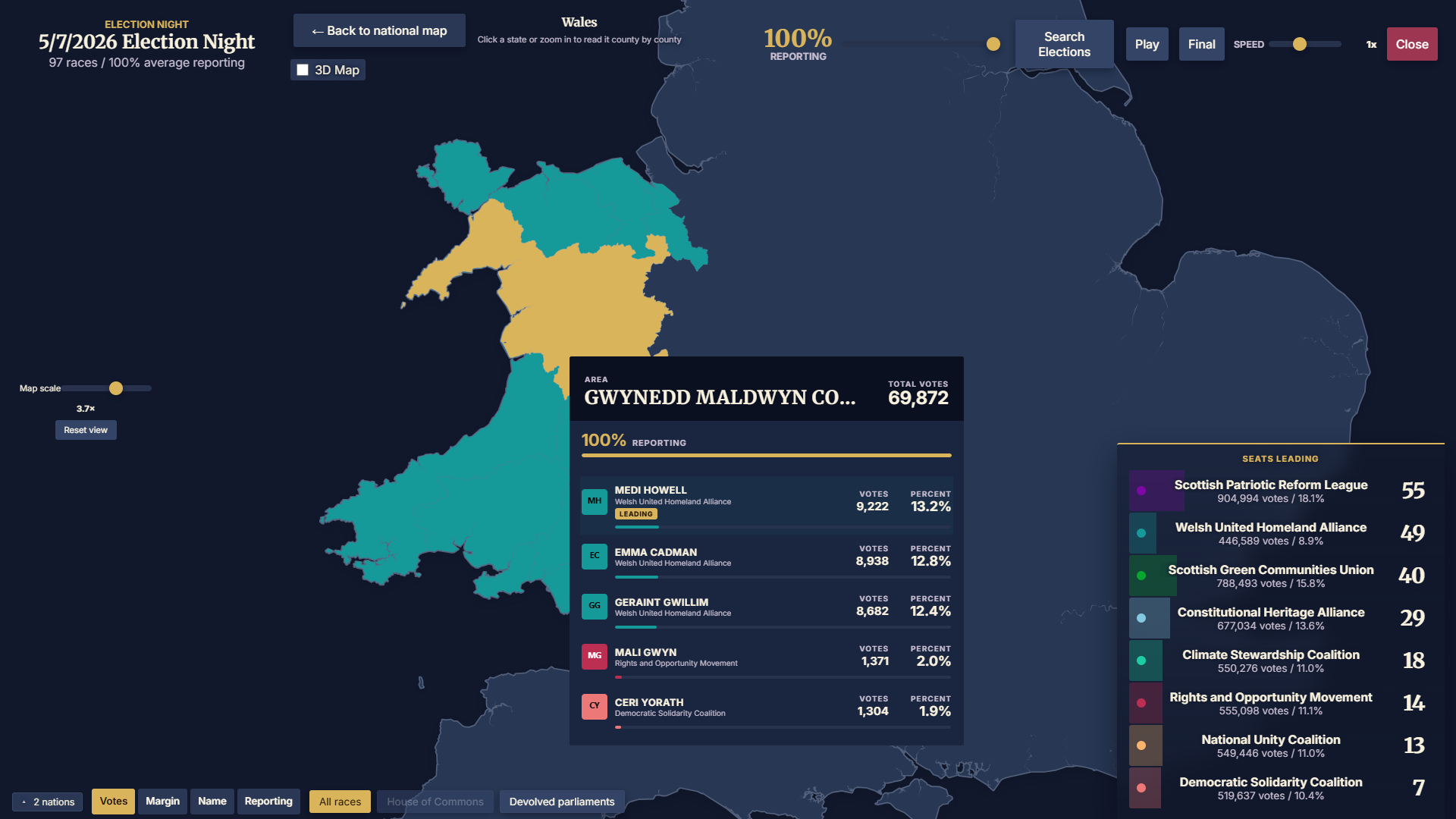
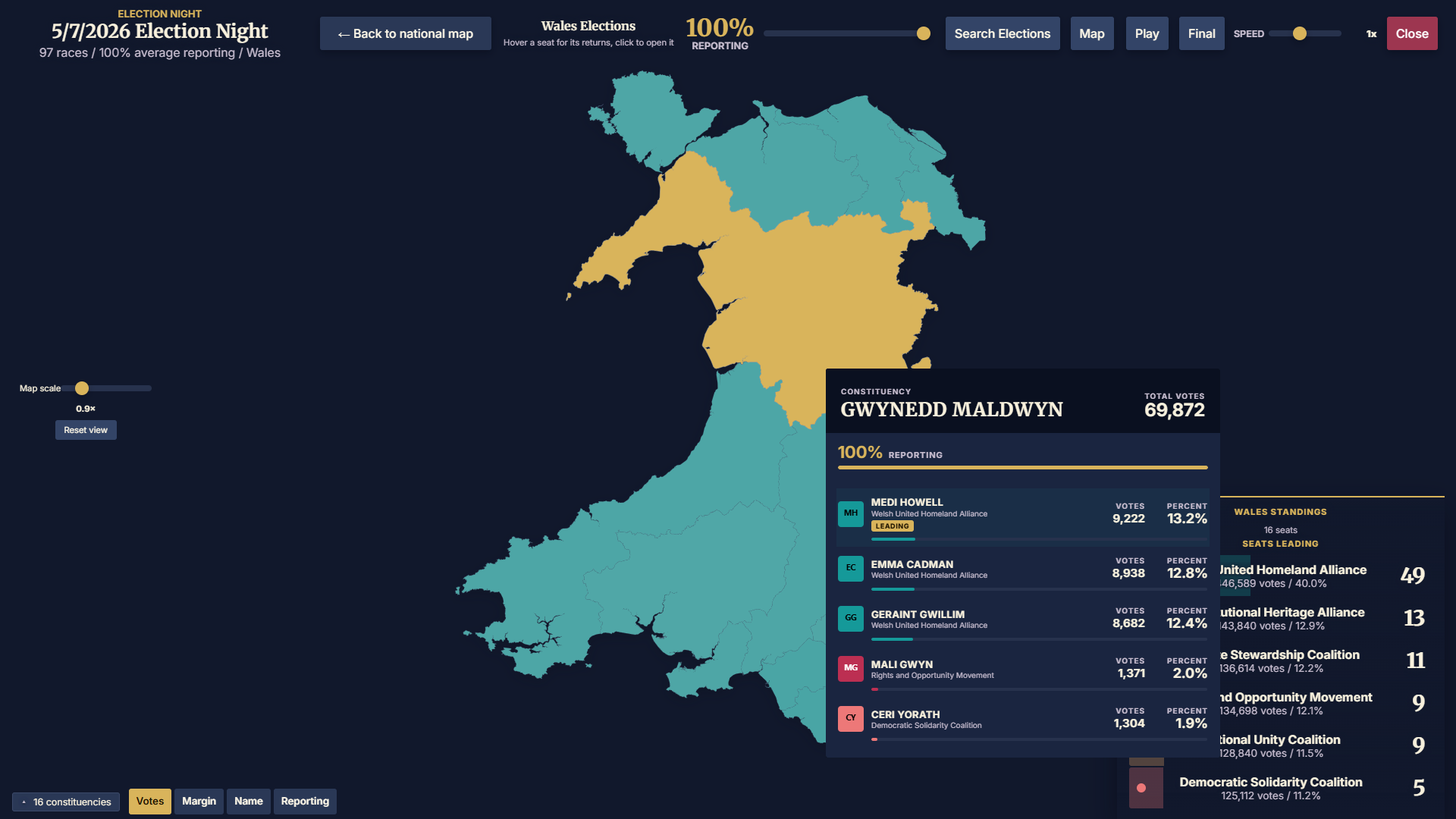 Images for Germany in election night aren't fully ready yet at this time but I may share them later.
Vice Presidents
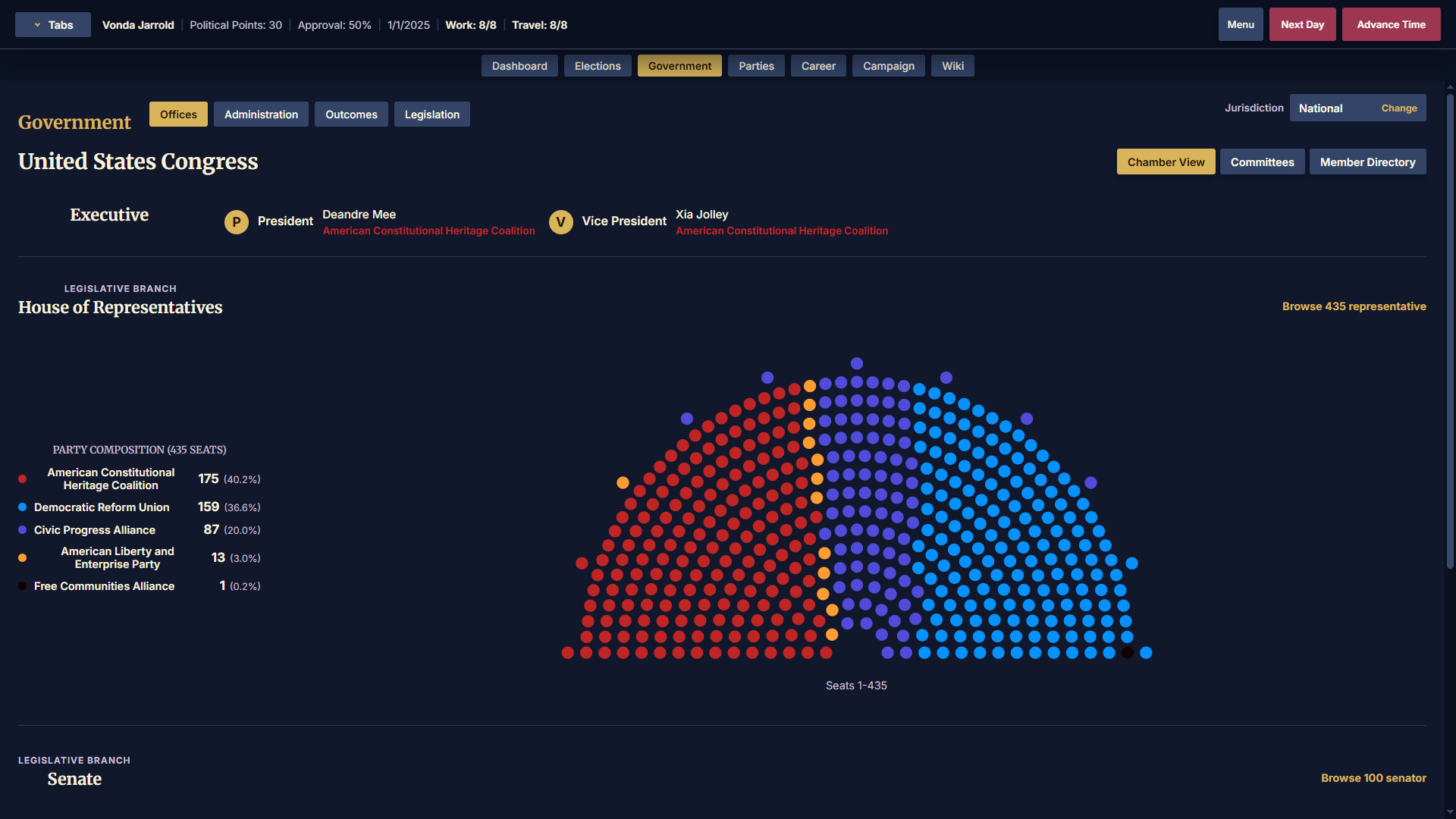
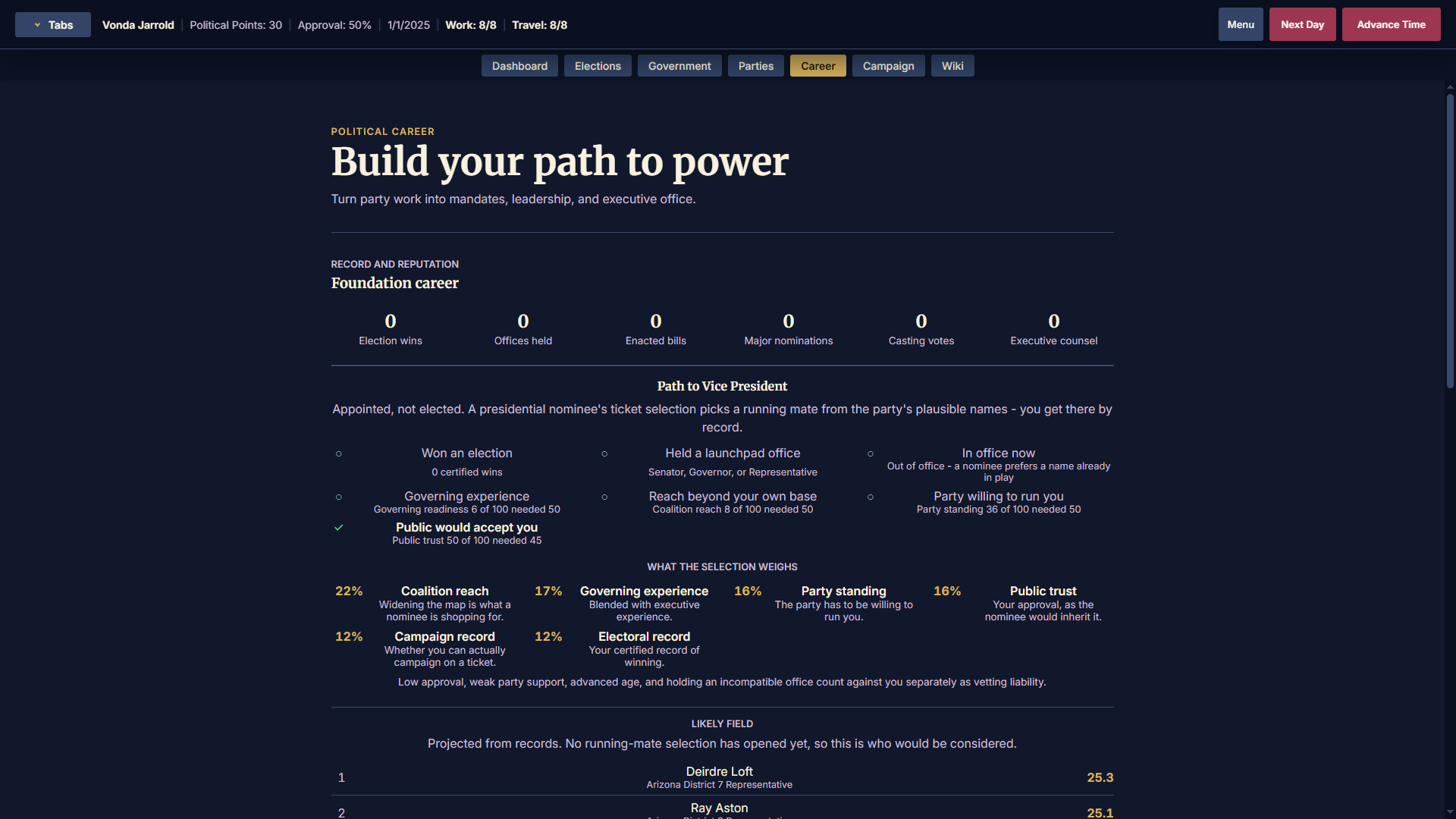
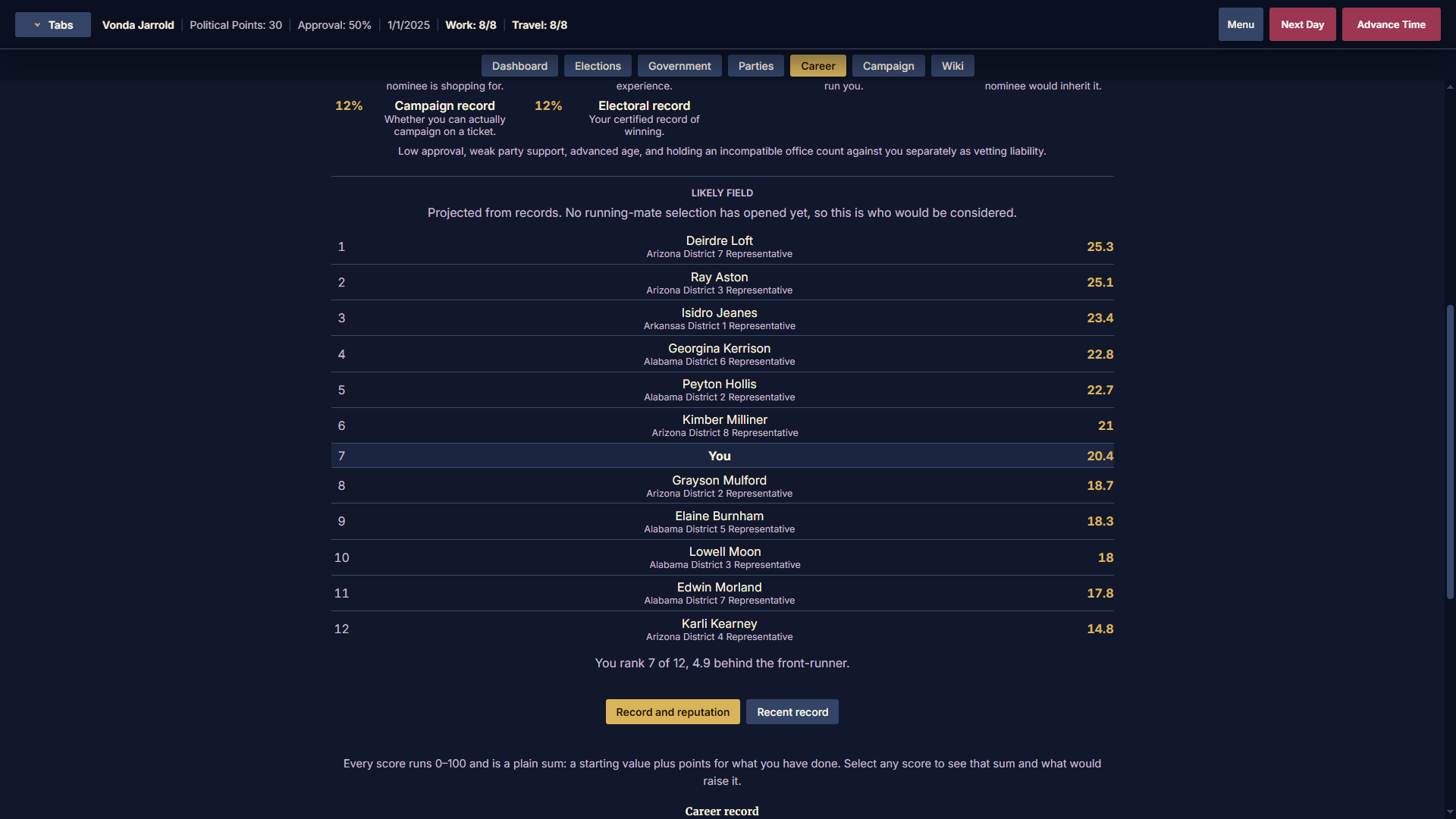
Vice Presidents are being added in 0.2. You can become a VP nominee based on several factors, and you can check where you rank in the race from the career tab when playing as the United States.
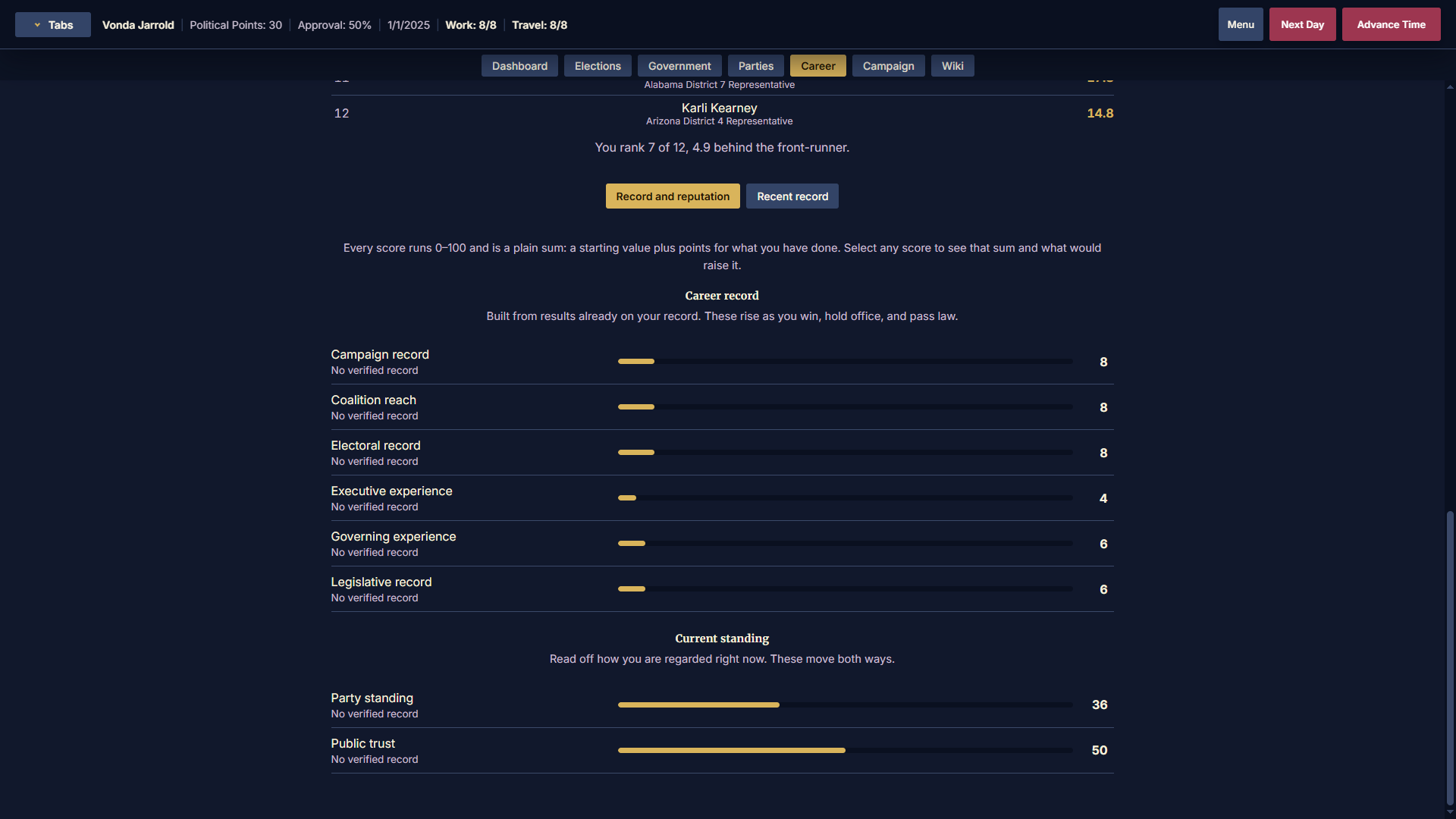
Eligibility needs a launchpad office, Senator, Governor or Representative, held now or previously. The field is the top seven on merit rather than everyone who fancies it, and the career screen's checklist tells you what gets you into it, so being absent from the field reads as a route rather than a refusal. Your score comes from your career record, your standing in the party and public trust, and a base is a floor for an empty record rather than most of the way to a nomination.
Scenarios get a Vice President as well. The office is constitutional rather than something an author opts into, so a United States scenario always has one and the succession and running-mate paths work in an authored world exactly as they do in a generated one.
Dynamic Party Popularity
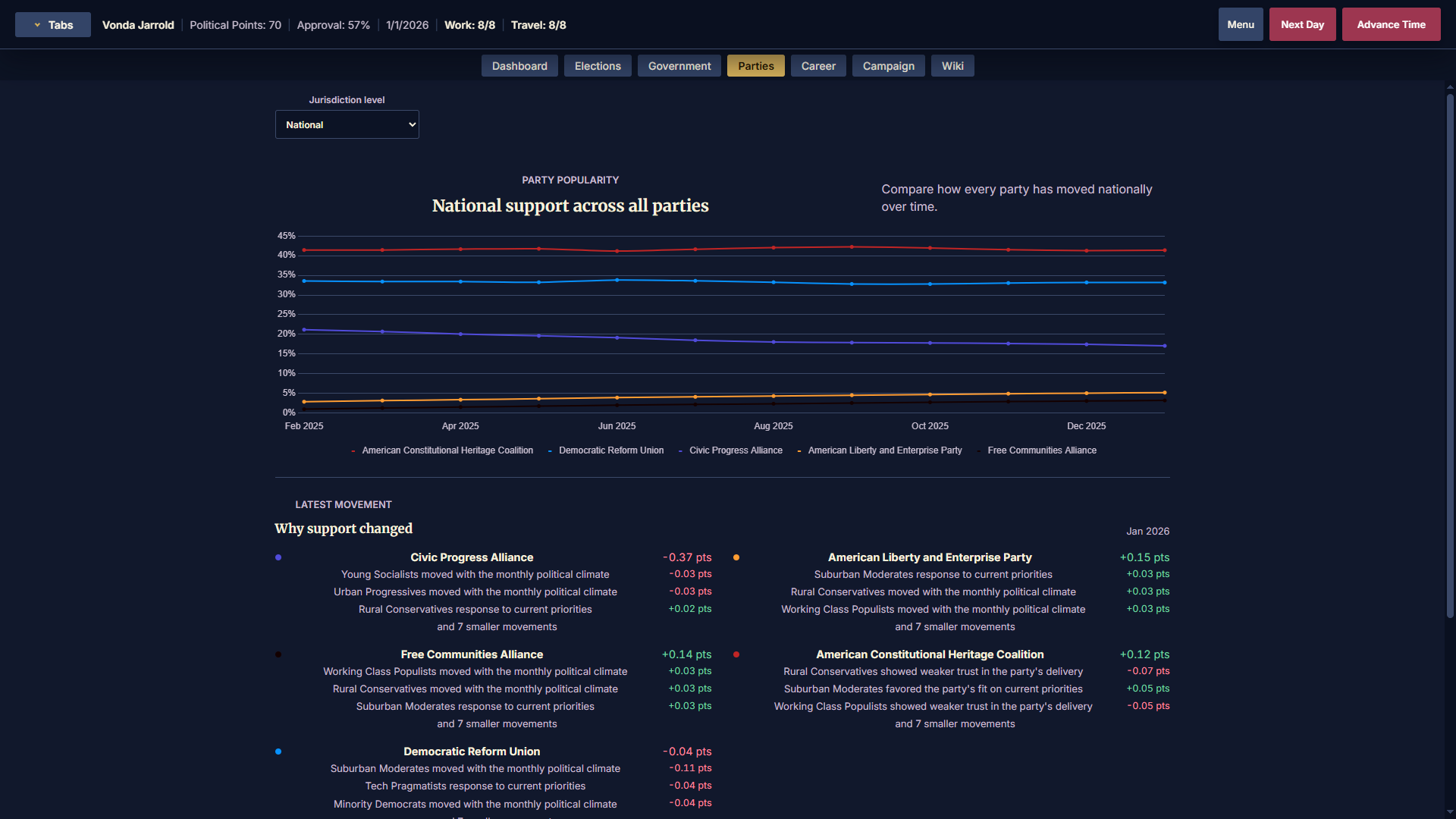
Dynamic party popularity has been re-added in 0.2, creating an evolving and interesting world. Party popularity is based on several factors: appealing to your coalition base and to other coalition blocs, governing well, and avoiding very partisan but generally unpopular bills.
Every coalition judges a bill for itself. Each bloc scores a bill's own policies against its own ideology, and the national figure is what those blocs add up to under their real population weights. No bloc has to move the way another one does, so a law one bloc loves can be a law another resents, and a bill the larger blocs dislike costs its sponsor support.
Every coalition judges the government on what it actually watches. A fiscally attentive bloc and a young urban bloc weight the government's indicators differently. A bad budget balance costs a government dearly among the blocs that follow it and barely registers with the ones that don't, and whether that hurts nationally depends on how many of those people there are.
Ideology anchors a bloc. Each month's target is blended toward where a bloc sits ideologically, so a party that governs well can win a hostile bloc round a long way but not indefinitely, and a party that stops delivering falls back toward its natural level instead of plateauing. Measured over five years of flawless government with a perfect platform fit, a friendly bloc reaches about 94.5% while a hostile one stops near 62%.
Regional landscapes are anchored to the national figure, and coalitions are weighted by their real electorate share per area, so a large hostile bloc genuinely costs a party support where it lives.
The drivers panel leads with each party's own net change for the month, with its three largest movements underneath and a count of the smaller ones, so "why did support change" is answered party by party rather than as one ranked pile.
Election Campaigning Overhaul
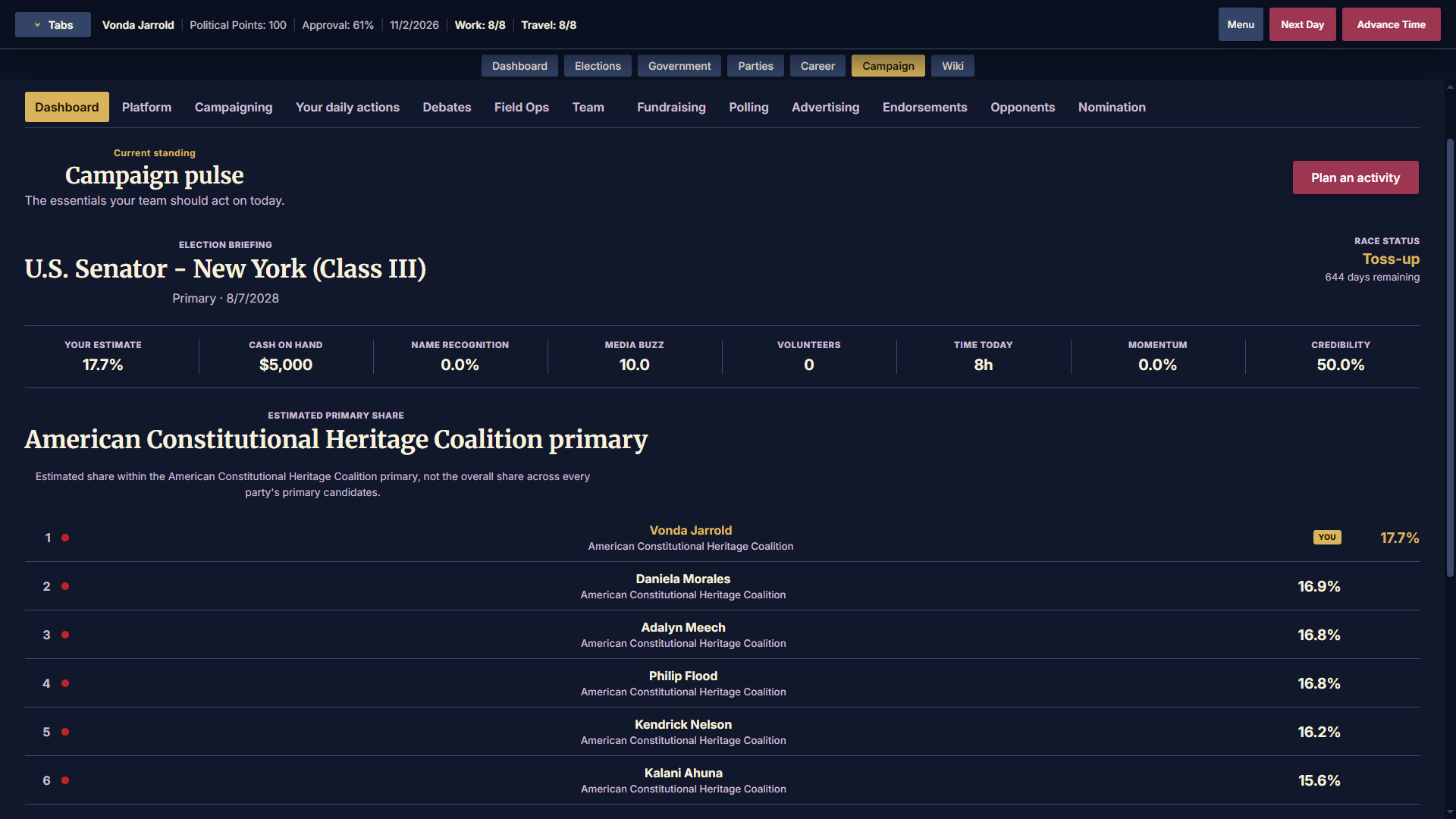
Running for office is a game in its own right in 0.2. Who the candidate is and how the campaign is fought decide races, so a strong candidate on a good operation can overperform their party, and a weak one can lose ground a party should hold. The AI campaigns under the same rules you do.
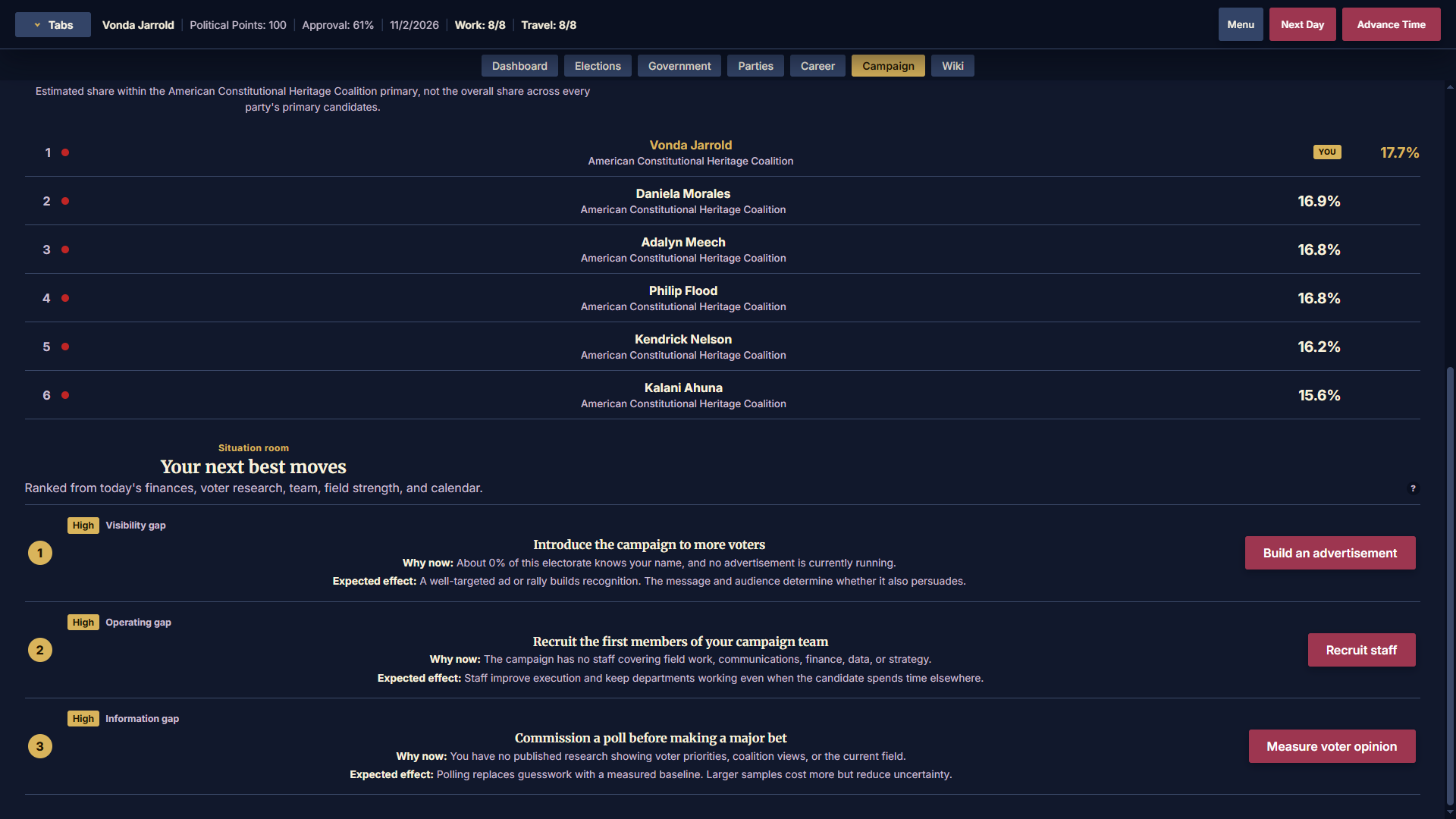
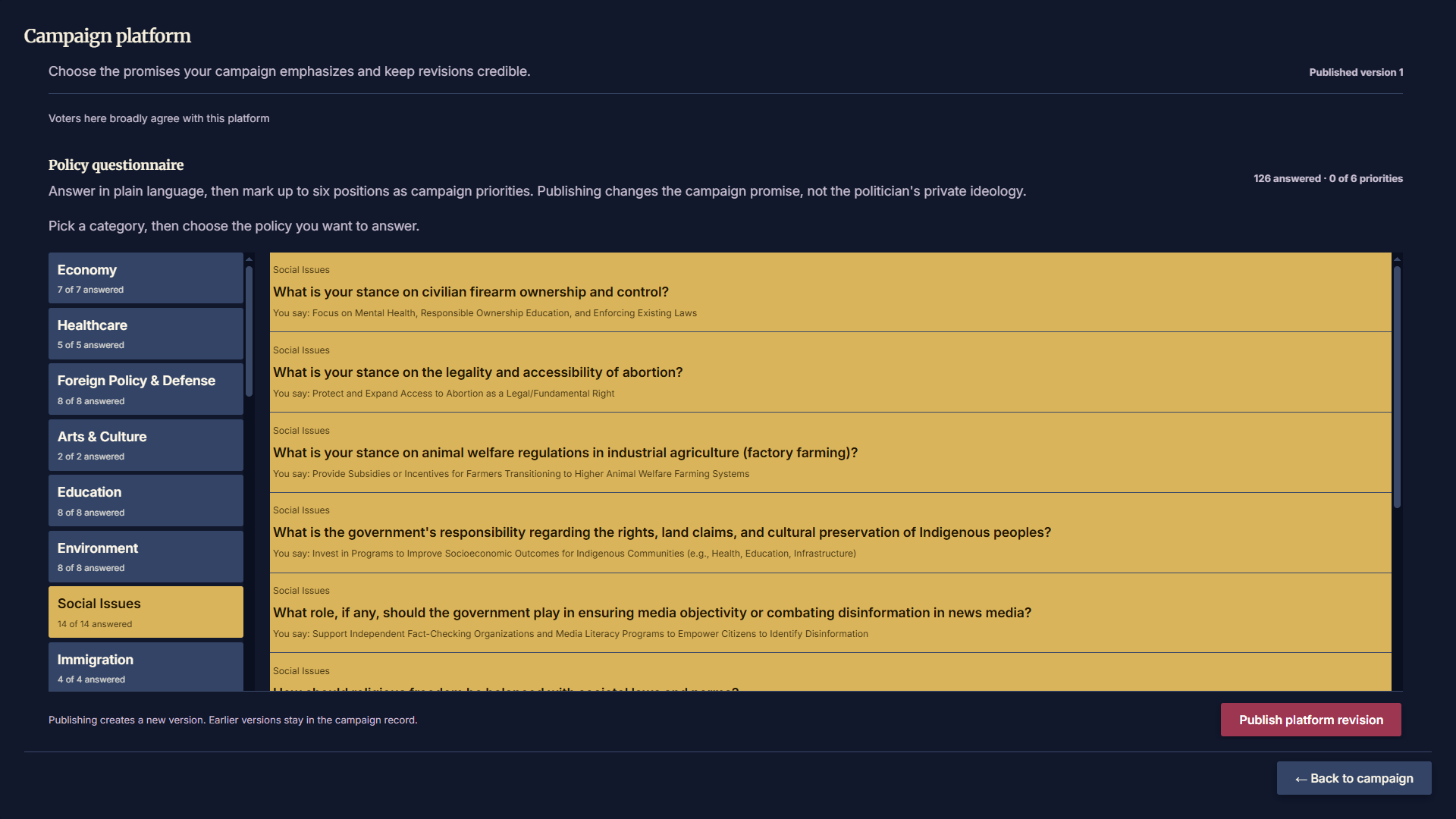
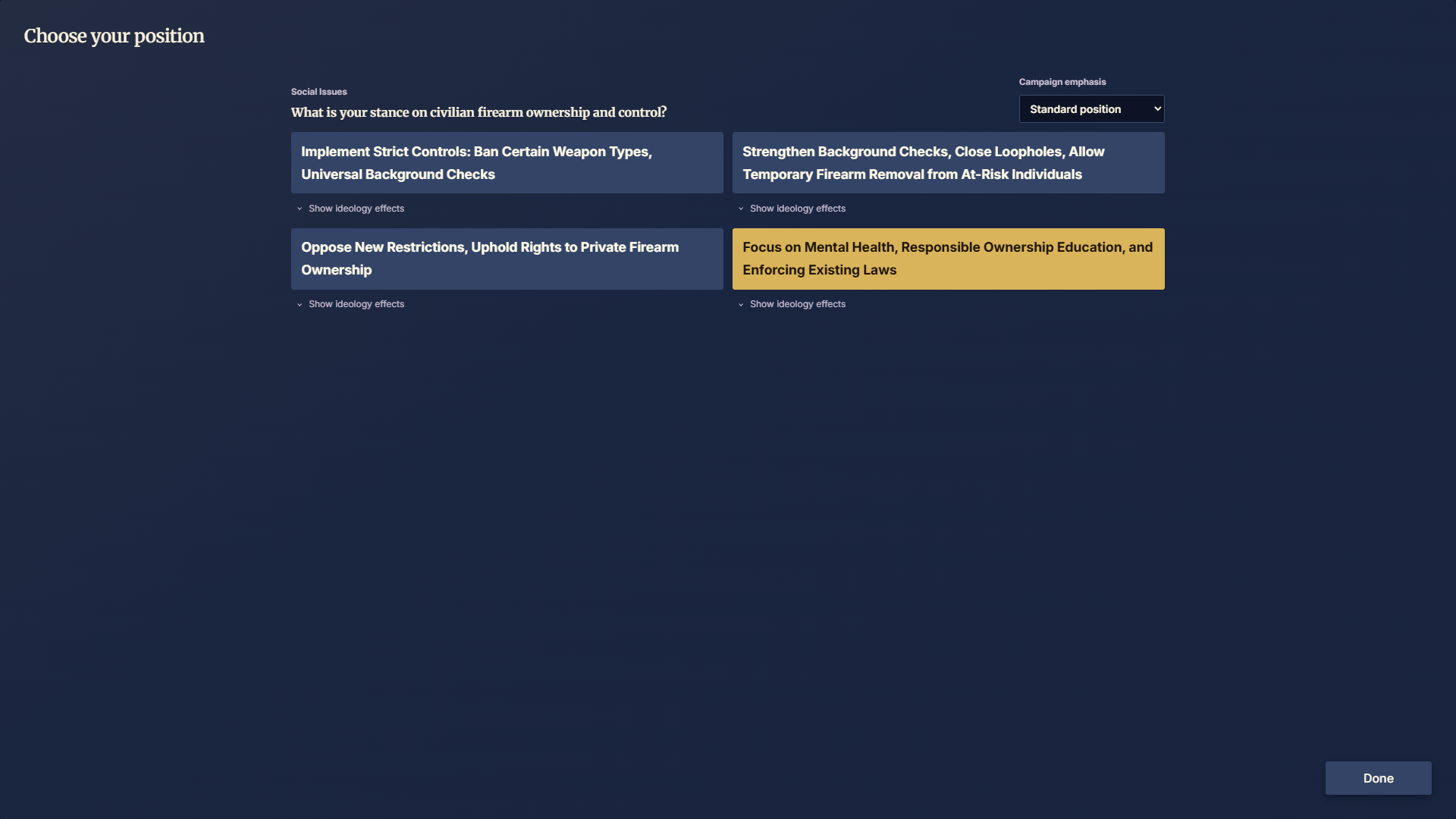
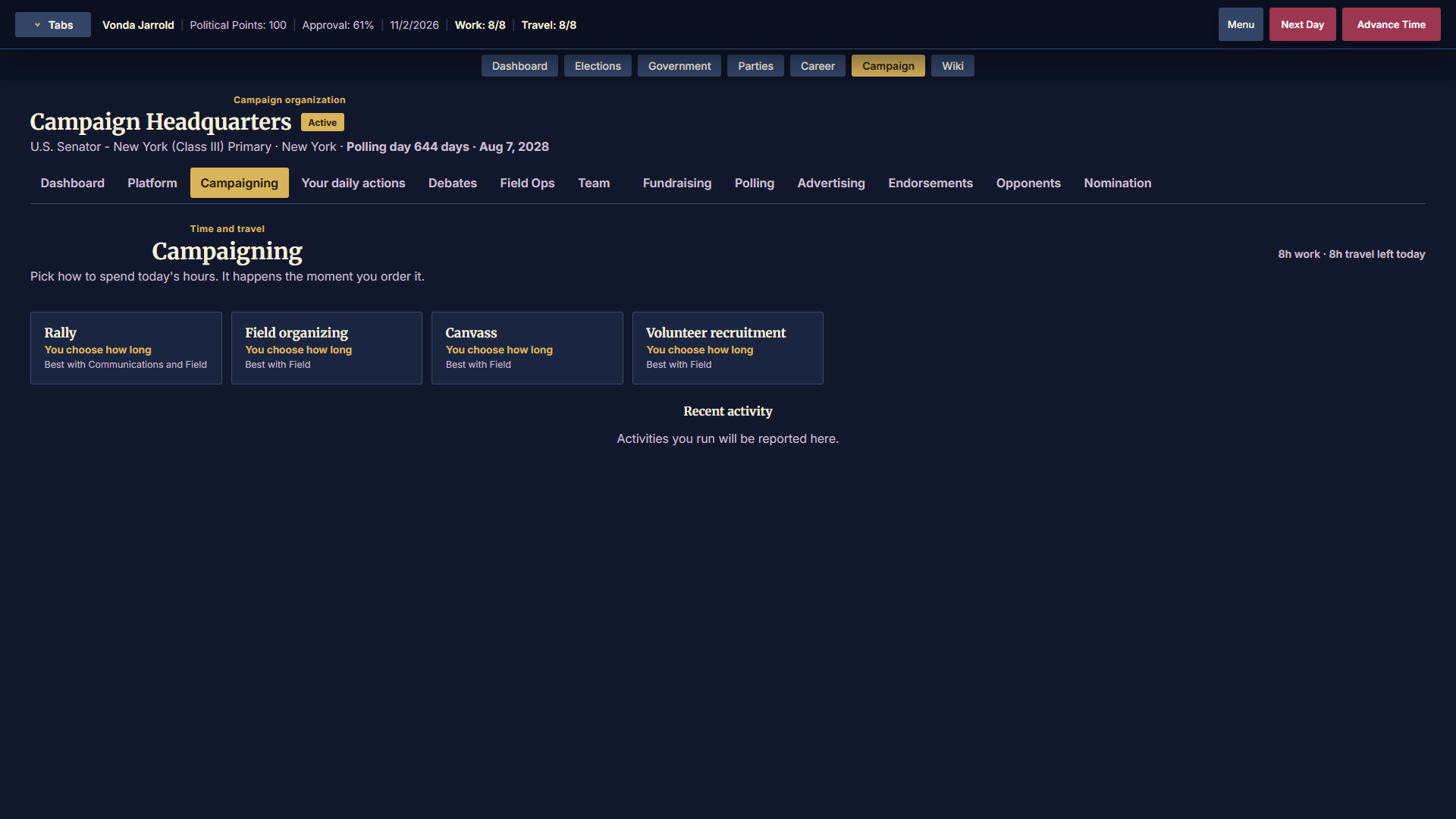
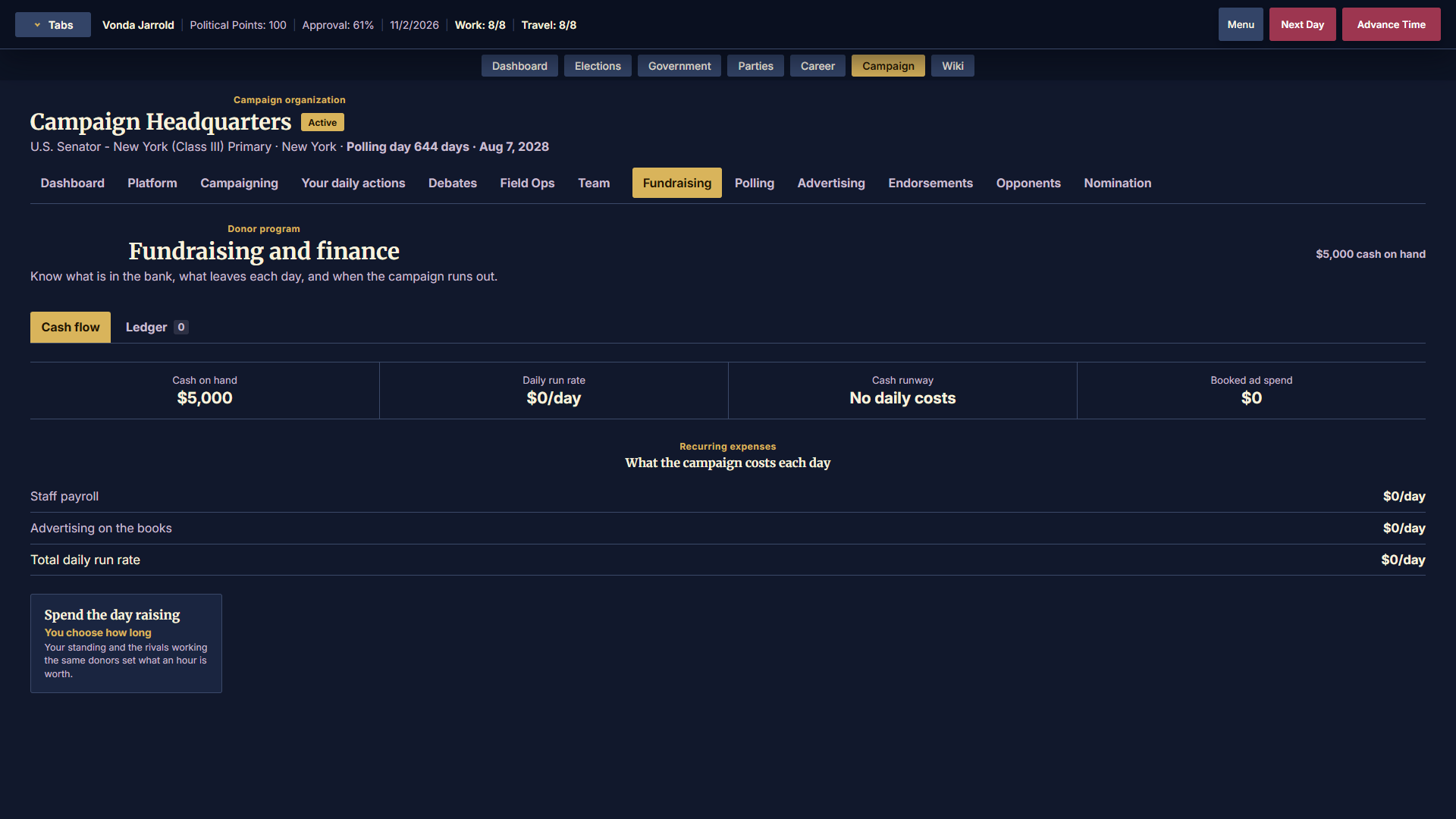
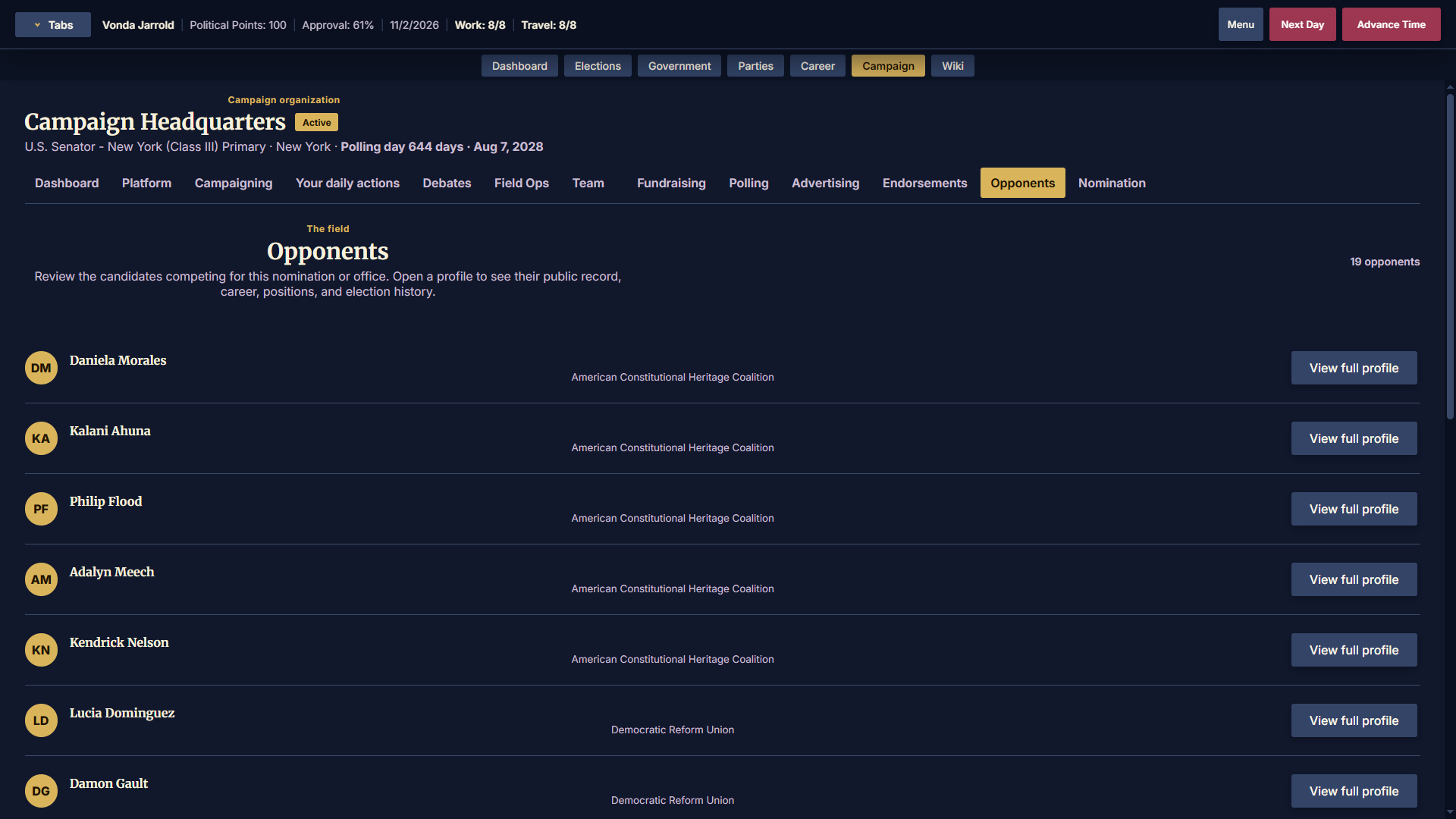
Campaign Headquarters is the home for all of it, with tabs for the dashboard, your platform, field operations, advertising, opponents, research, polling, staff and the department priorities.
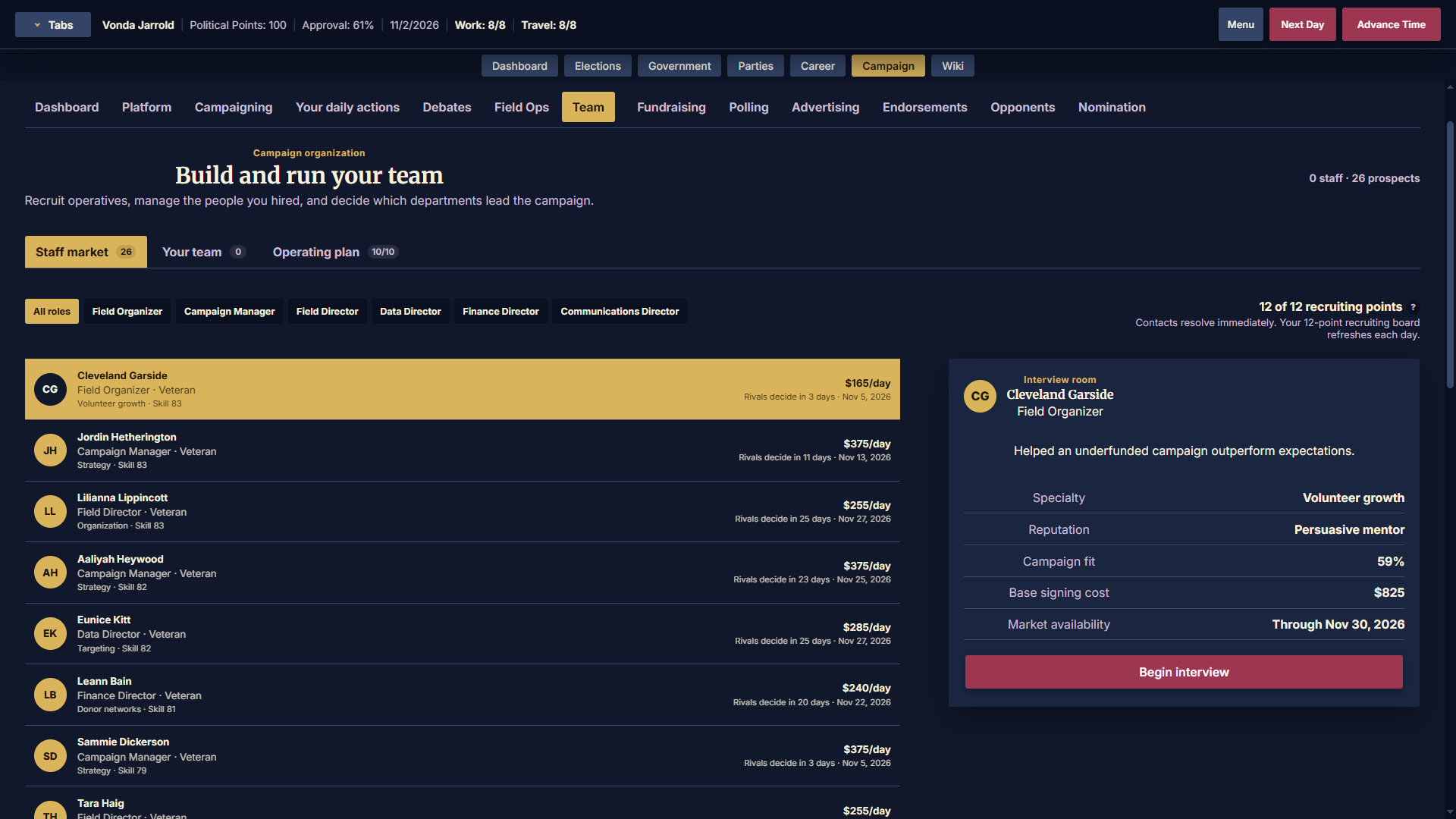
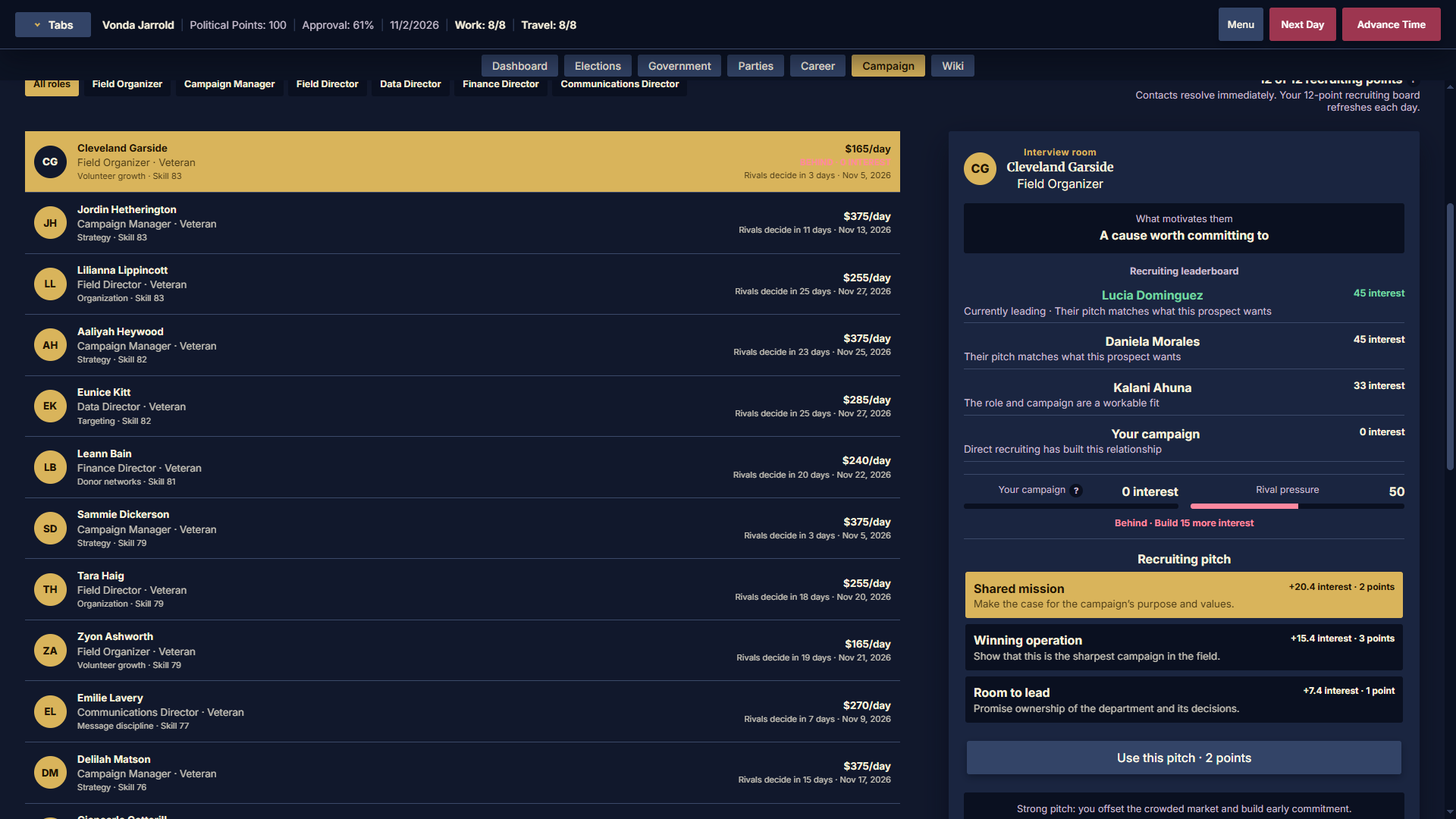
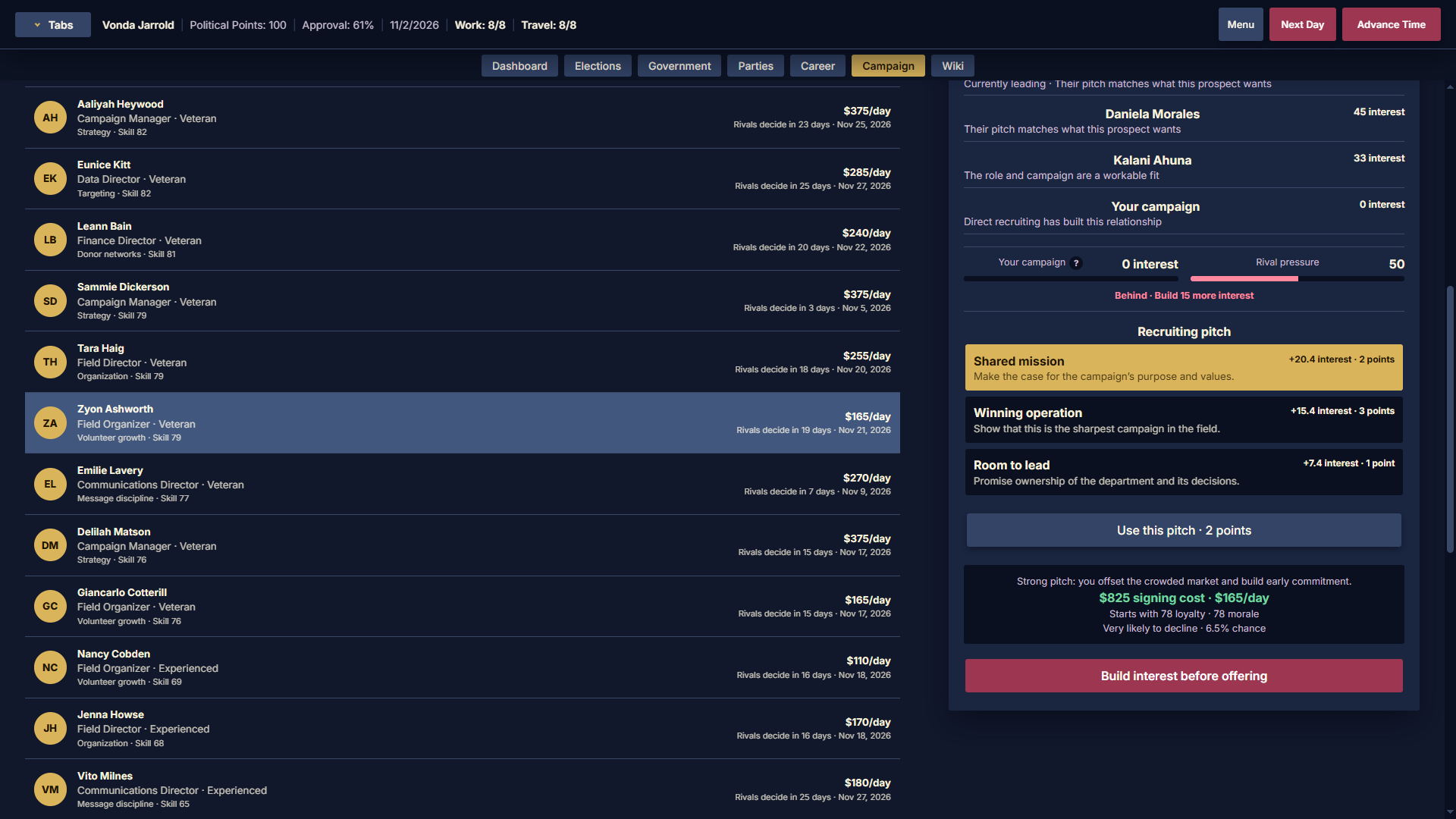
Campaign staff
Campaigns are staffed in 0.2. Scout the market, pitch to prospects against AI campaigns chasing the same people, and hire the ones you win.
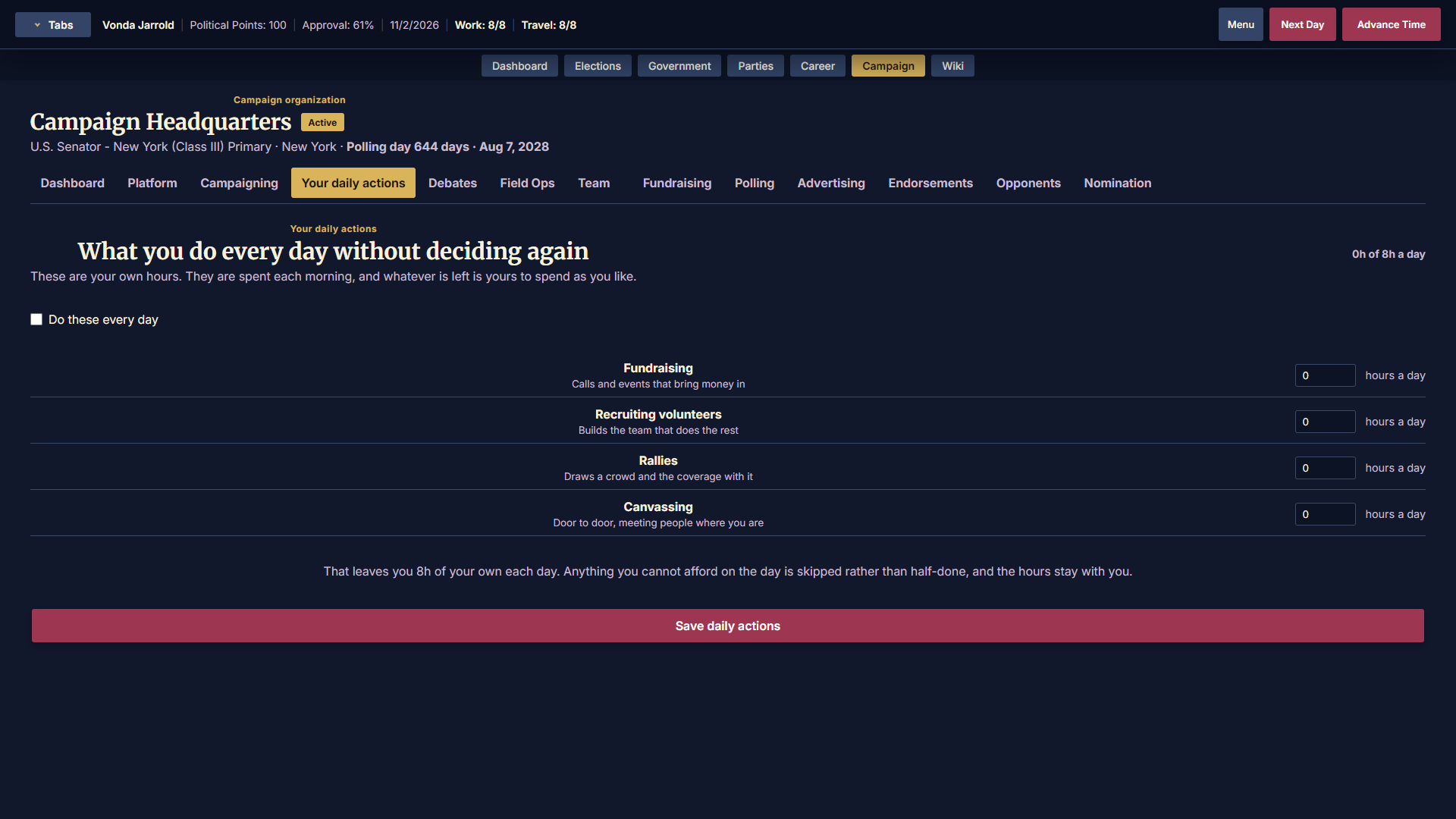
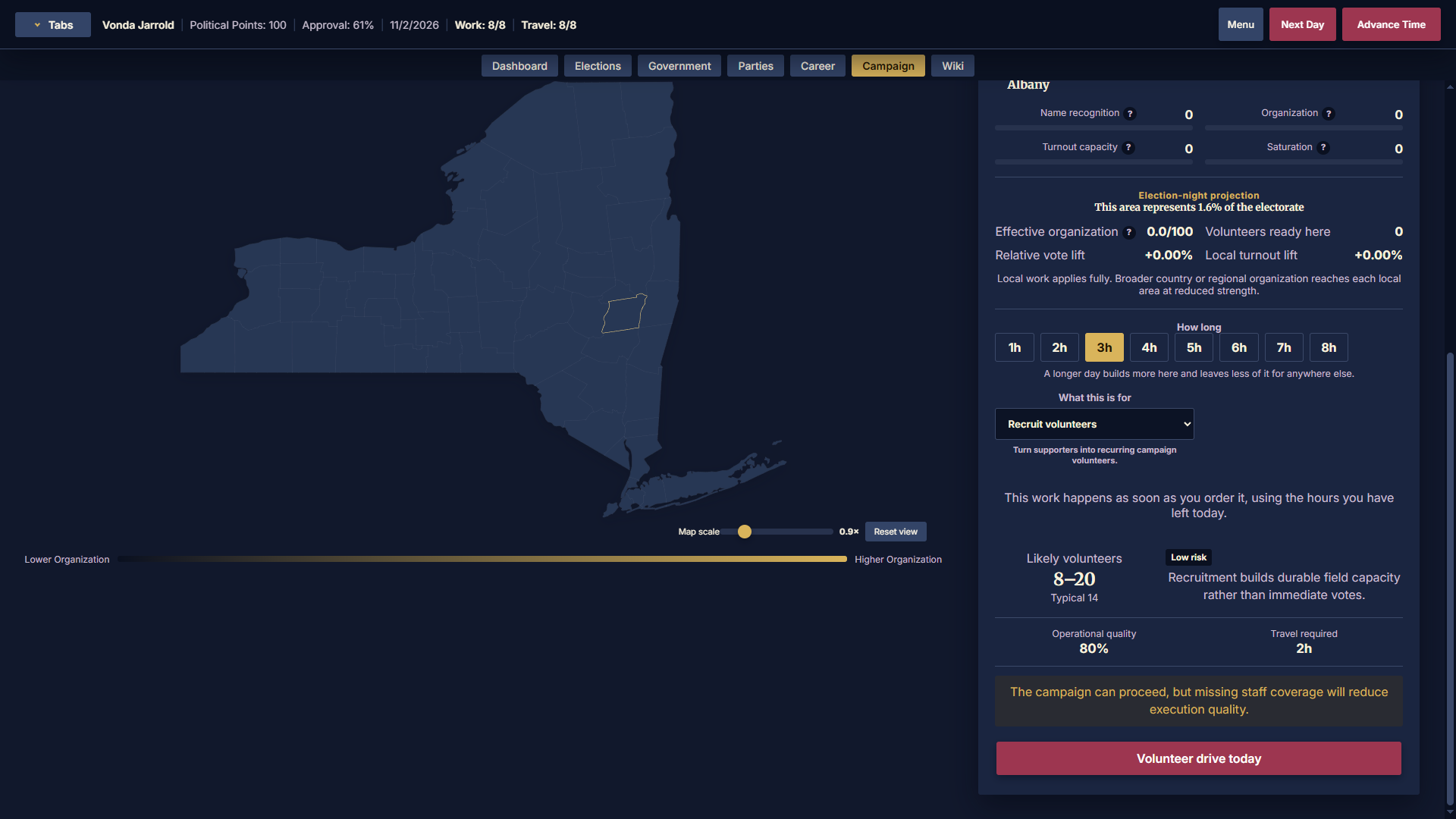
Staff work their own day rather than waiting for you to show up, so a field department builds organisation on a day you spend somewhere else. A built-out field team is worth several of your own canvasses, which is the whole reason to hire one.
They get better at the job. A junior organiser improves fastest and a veteran keeps a slower edge, so a team you keep together for a whole race is meaningfully stronger by the end of it.
Organisation spreads. Once a department has built up the ground it holds, it starts opening new areas on its own. Telling it to lead pushes it into your thinnest ground rather than your safest.
Workload is a real budget. Working people at events every day costs them, and the answer is to hire so the work is shared. A department at standard priority with a normal day's work stays sustainable indefinitely; pushing it to lead, or running events every single day, is what wears people down.
Rested staff recover morale, and staff who are not on a salary recover the same way paid staff do.
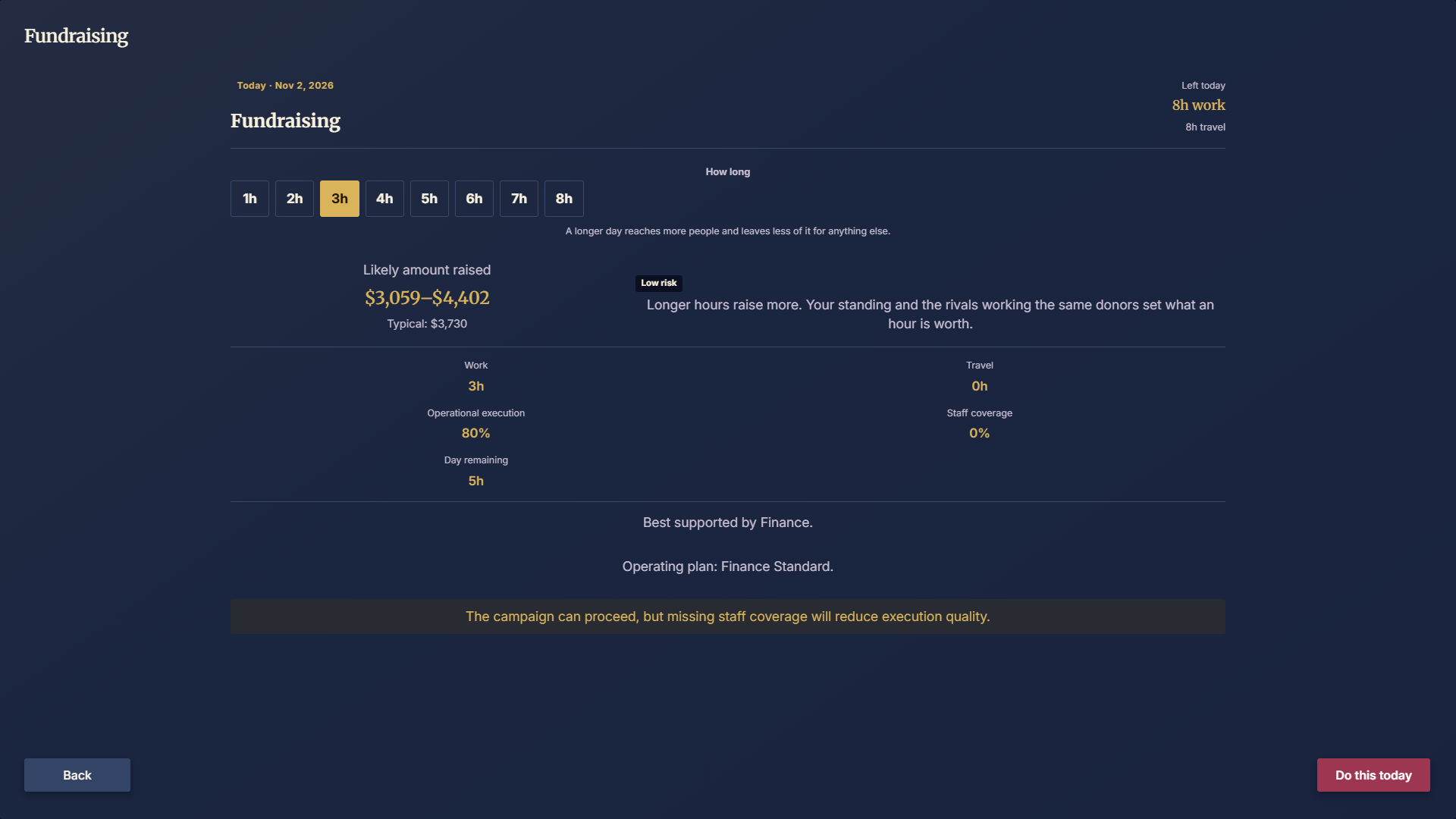
Departments have priorities. Ten points across five departments, and what you promote is what leads. Finance raises money every day and roughly doubles it when it leads; a data team at lead keeps your lists fresh; communications at lead preps you for a debate.
Field operations
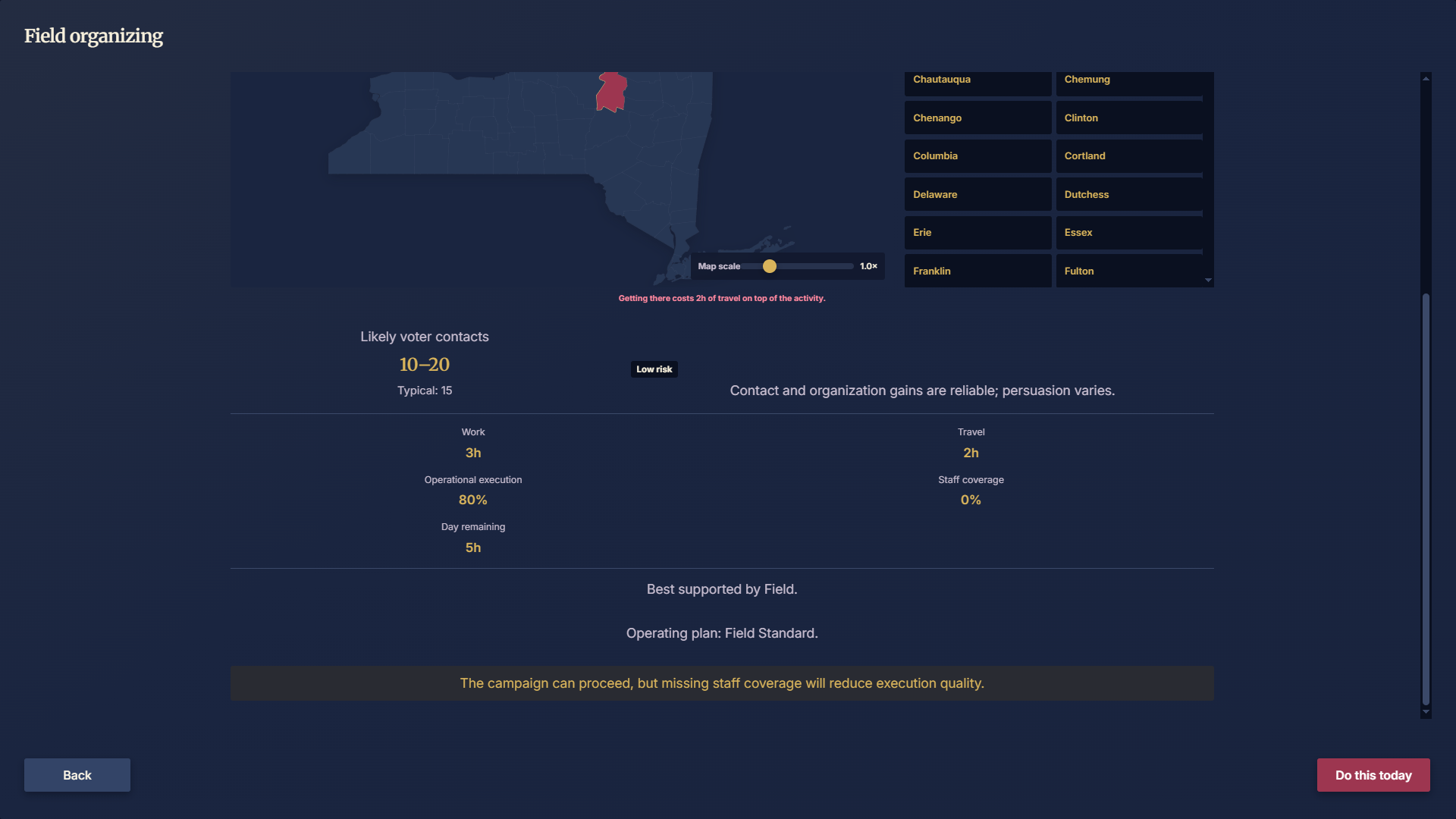
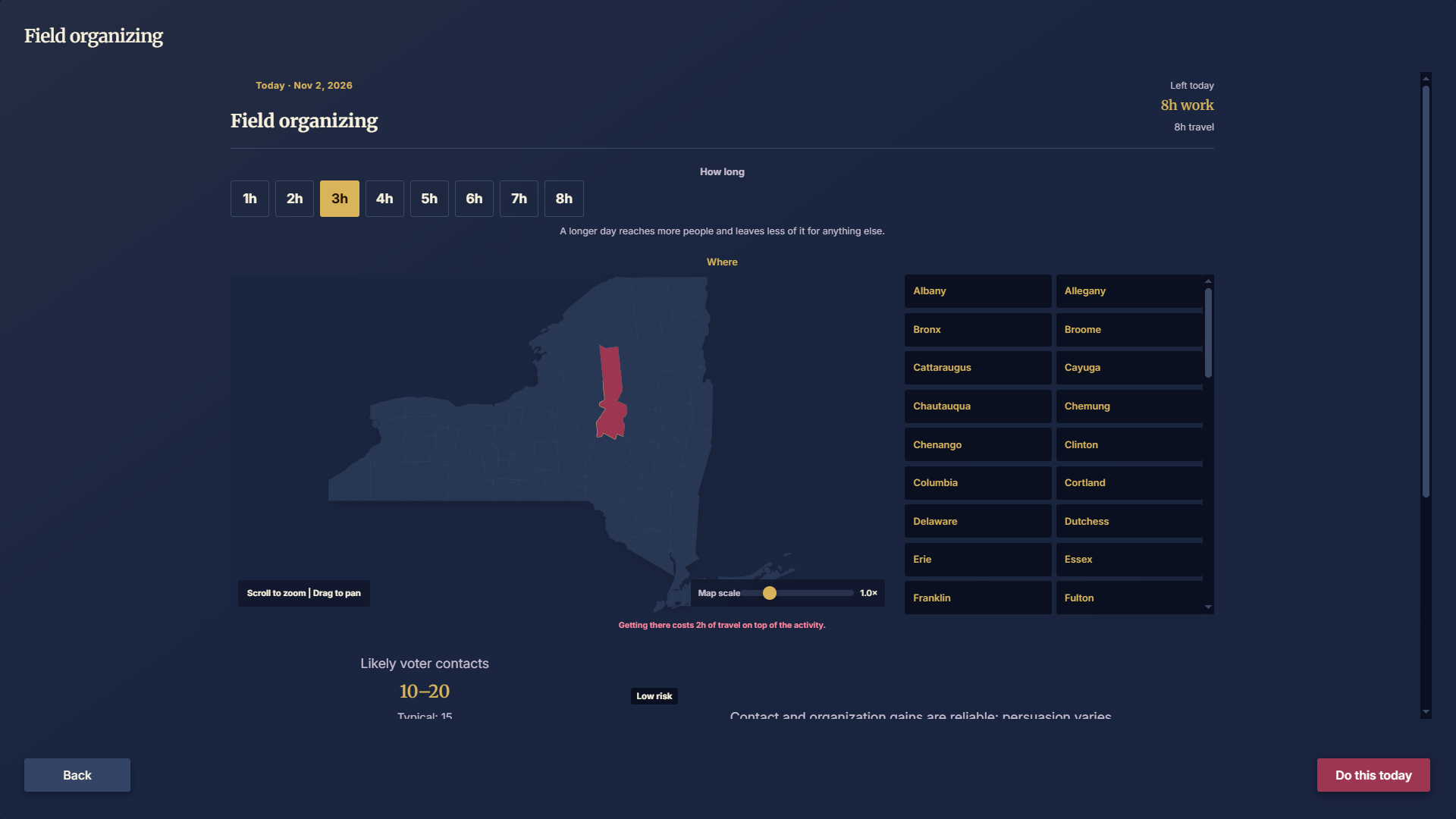
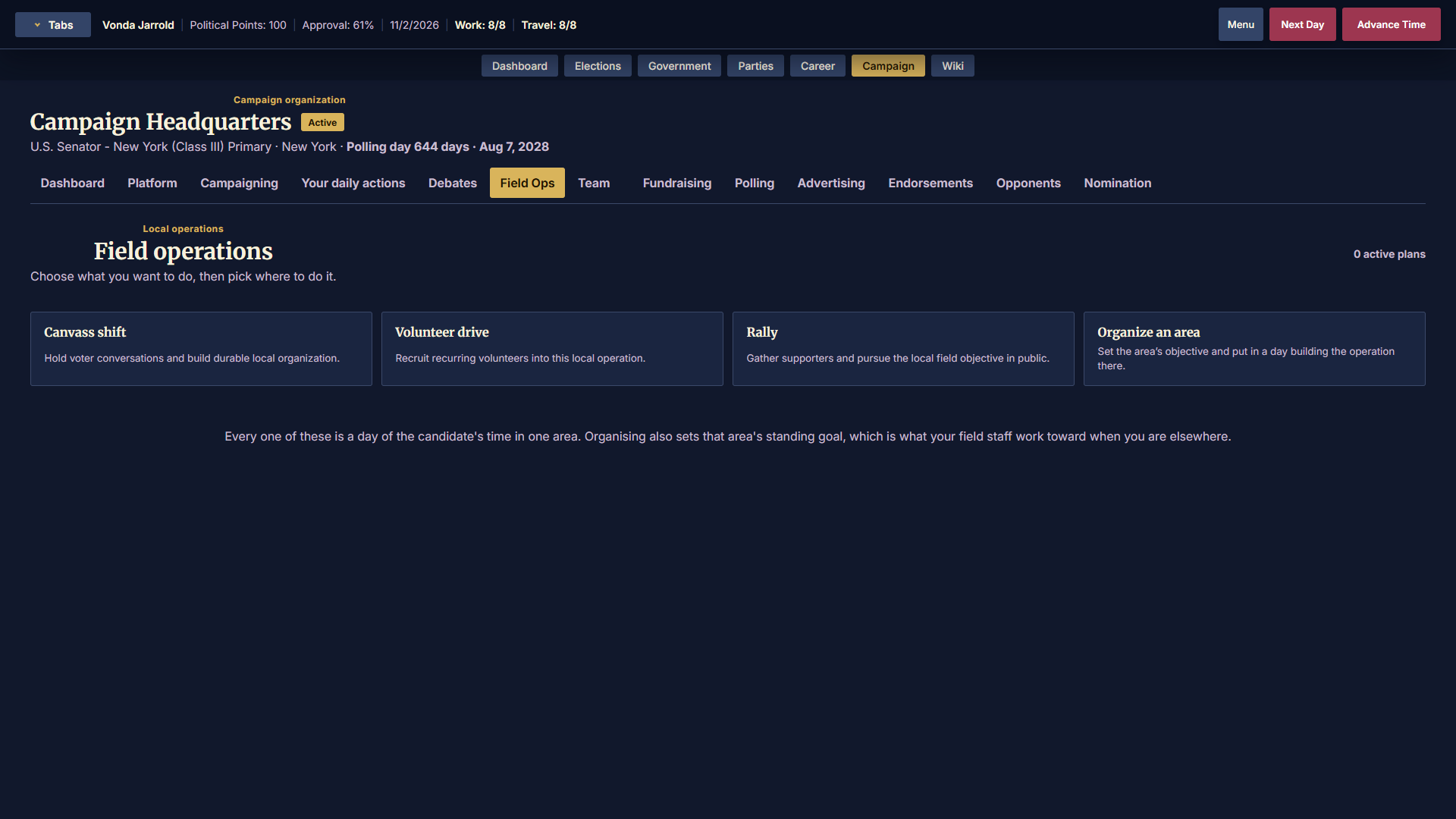
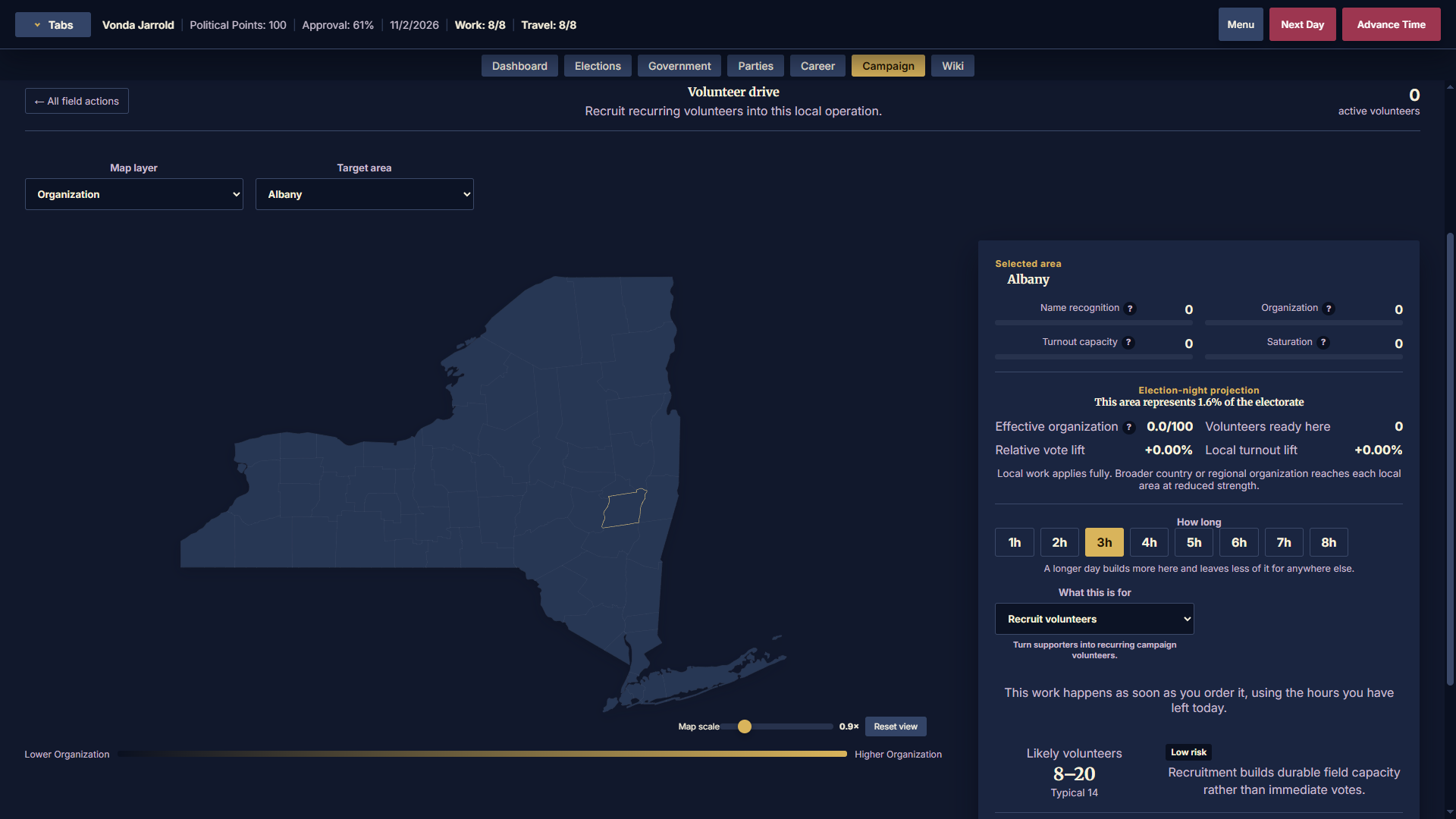
Pick an area, pick what the day is for, and pick your audience. Persuasion, organisation, volunteer growth or GOTV: a rally, a canvass and a volunteer drive all answer to that choice, so the same event does different work depending on what you called it for. Field offices, volunteer allocation and staff deployment all feed what an area's day produces.
Name recognition is the share of the electorate who know you, shown nationally on the header and per area on the field map. Everyone at a rally and every door a canvass knocks is somebody who now knows you, and each area's figure moves with the work you do there.
An area you work hard gets tired of hearing from you and recovers once you move on, so there is a real reason to spread a campaign around rather than hammer one county.
The rest of the operation
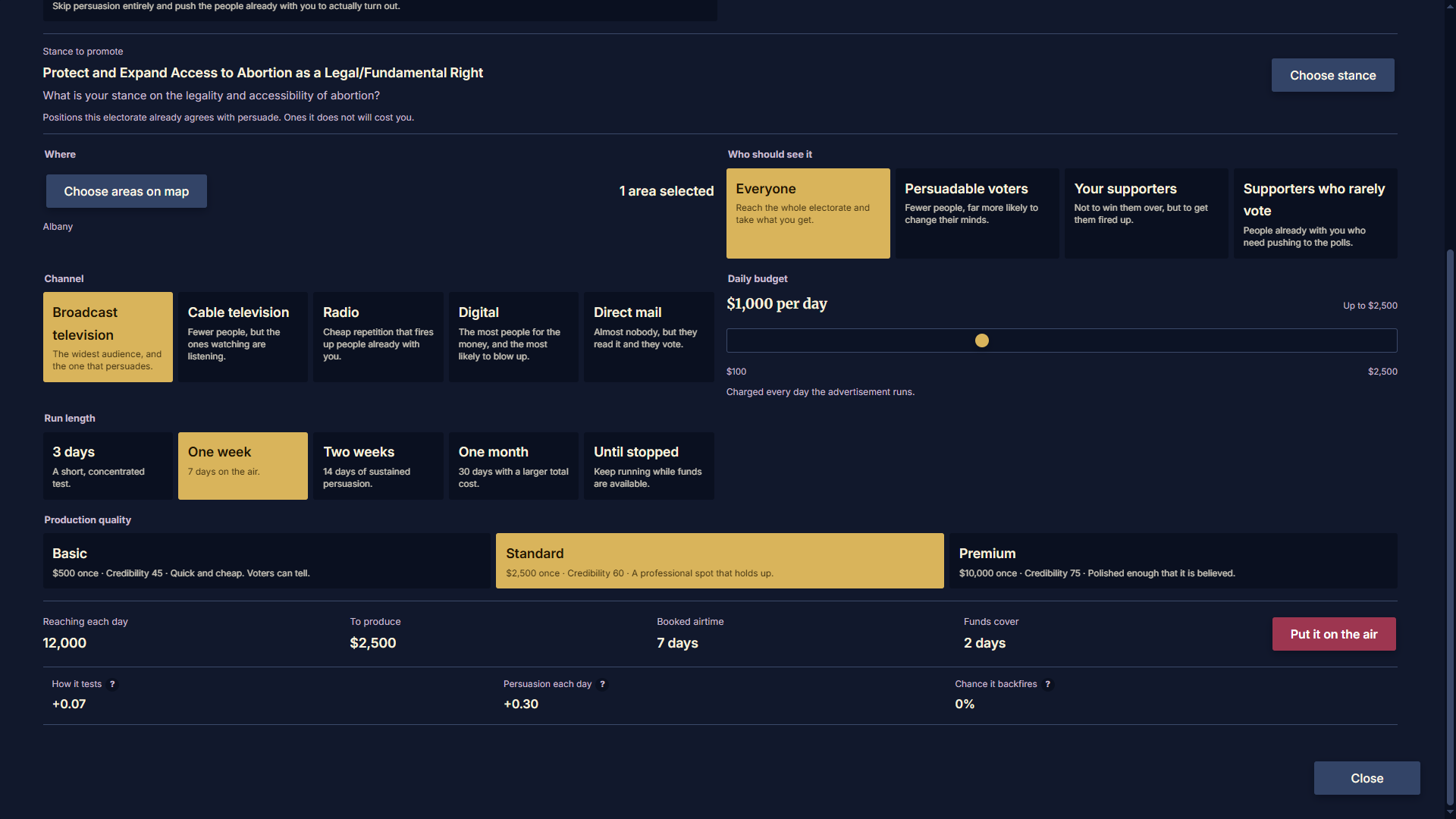
Advertising runs on a daily budget across as many areas as it can afford, with a subject you choose from your own platform, a channel and an audience. It reaches people, moves how well an area knows you, and a spot that misjudges its audience can cost you credibility.
Commission issue polls, coalition stance polls, and a coalition alignment poll that reads your whole platform against every bloc so you can see the trade-offs rather than one blended number.
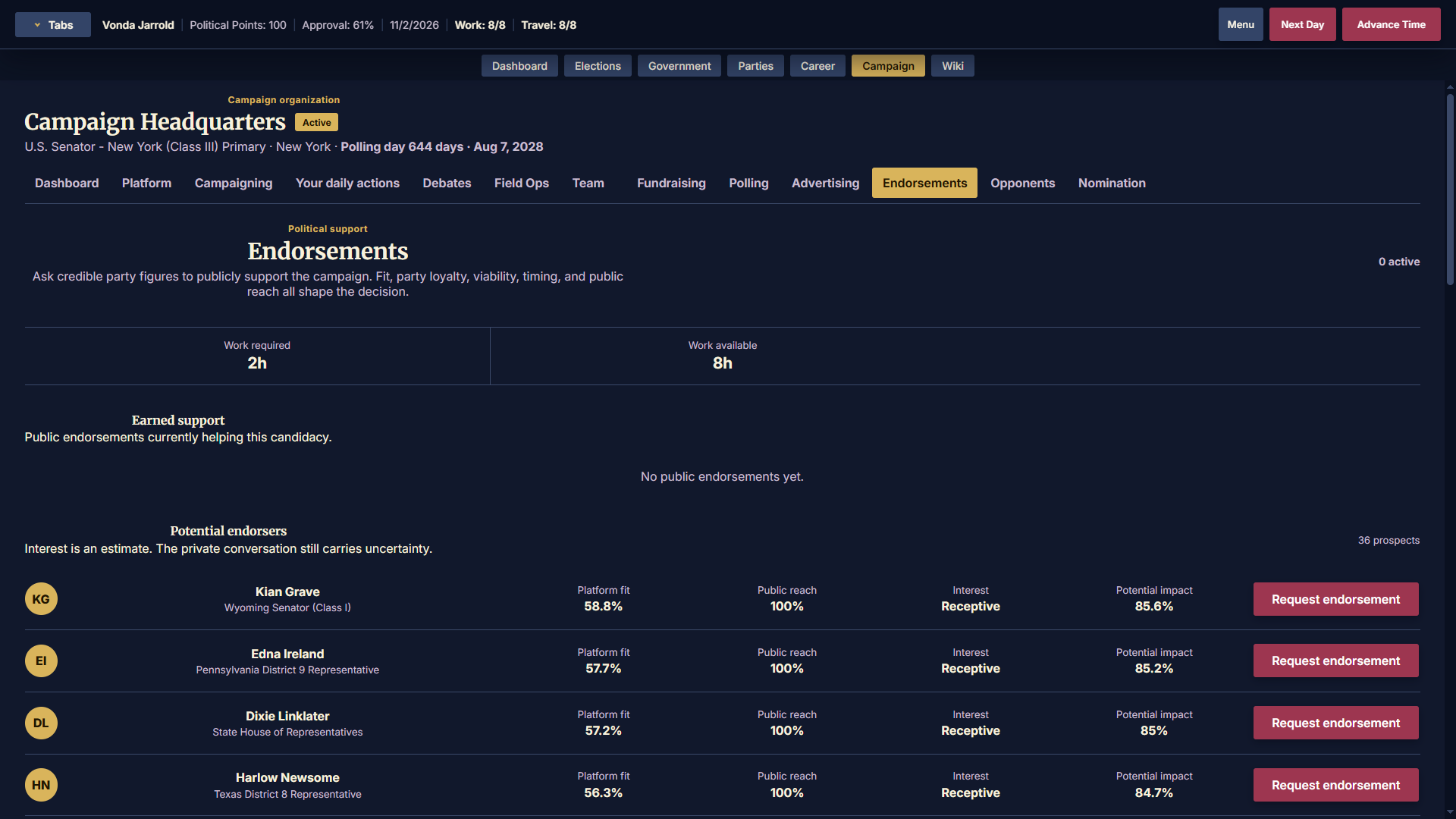
Debates and endorsements are in.
Custom Parties
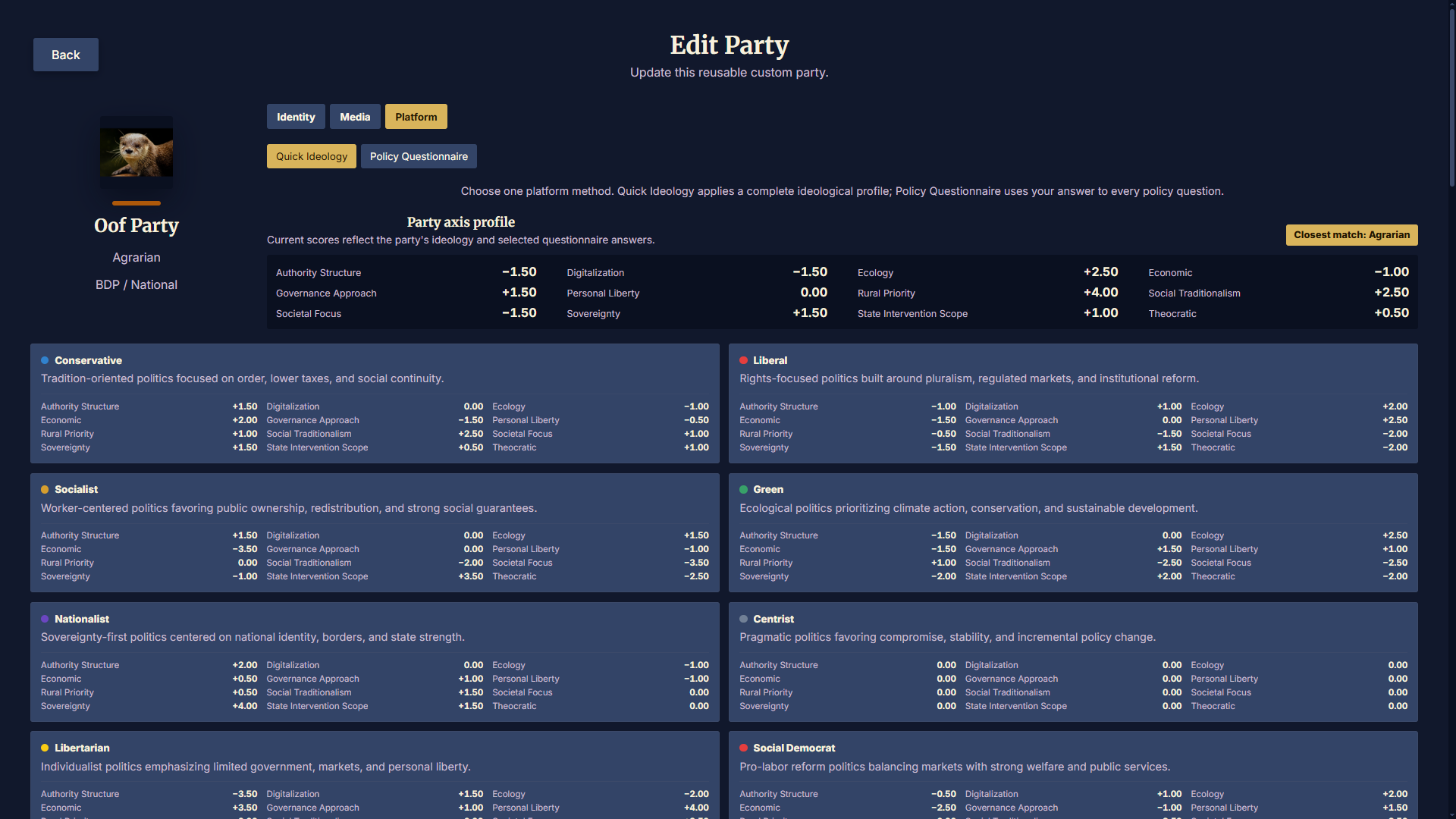
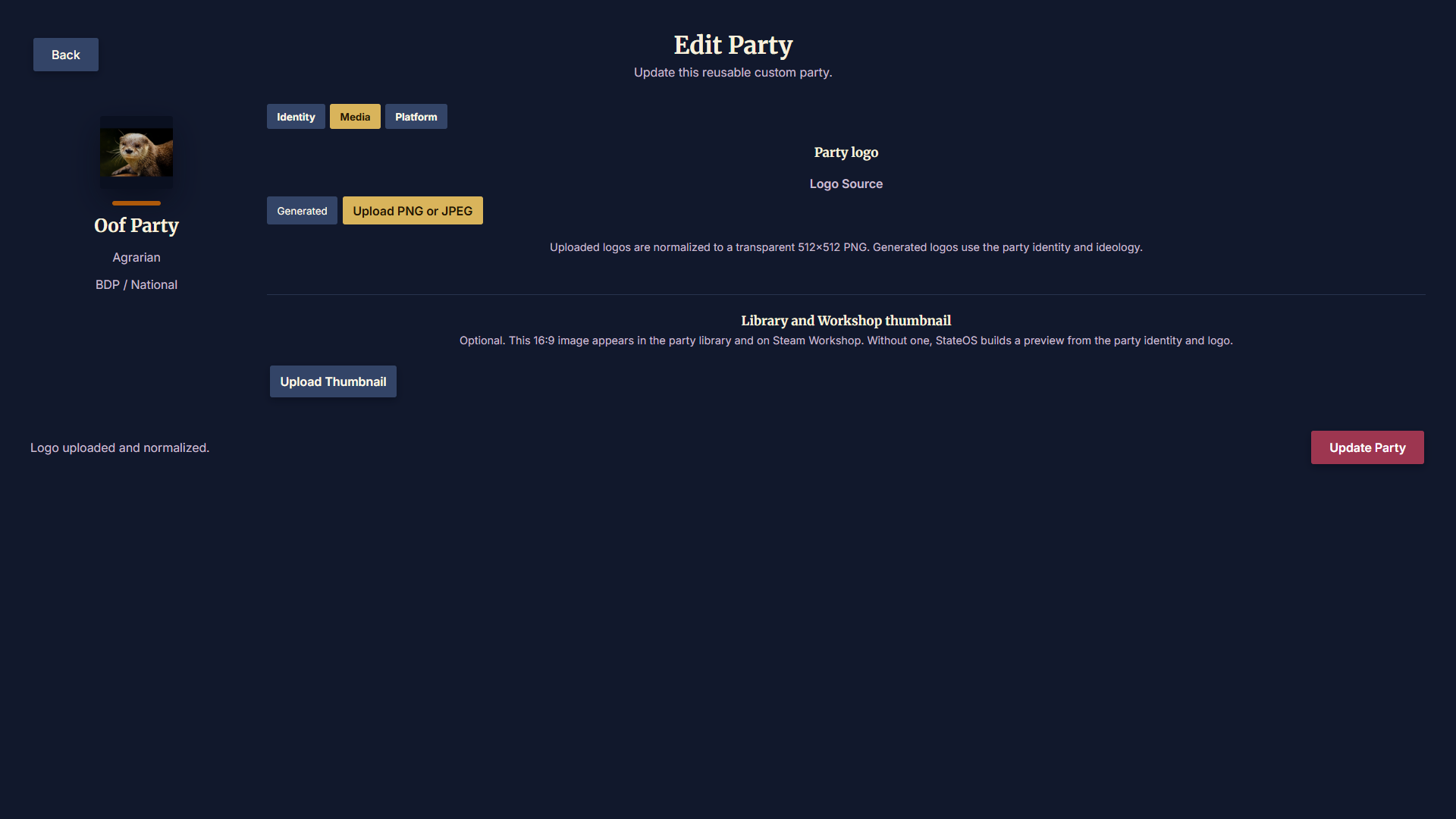
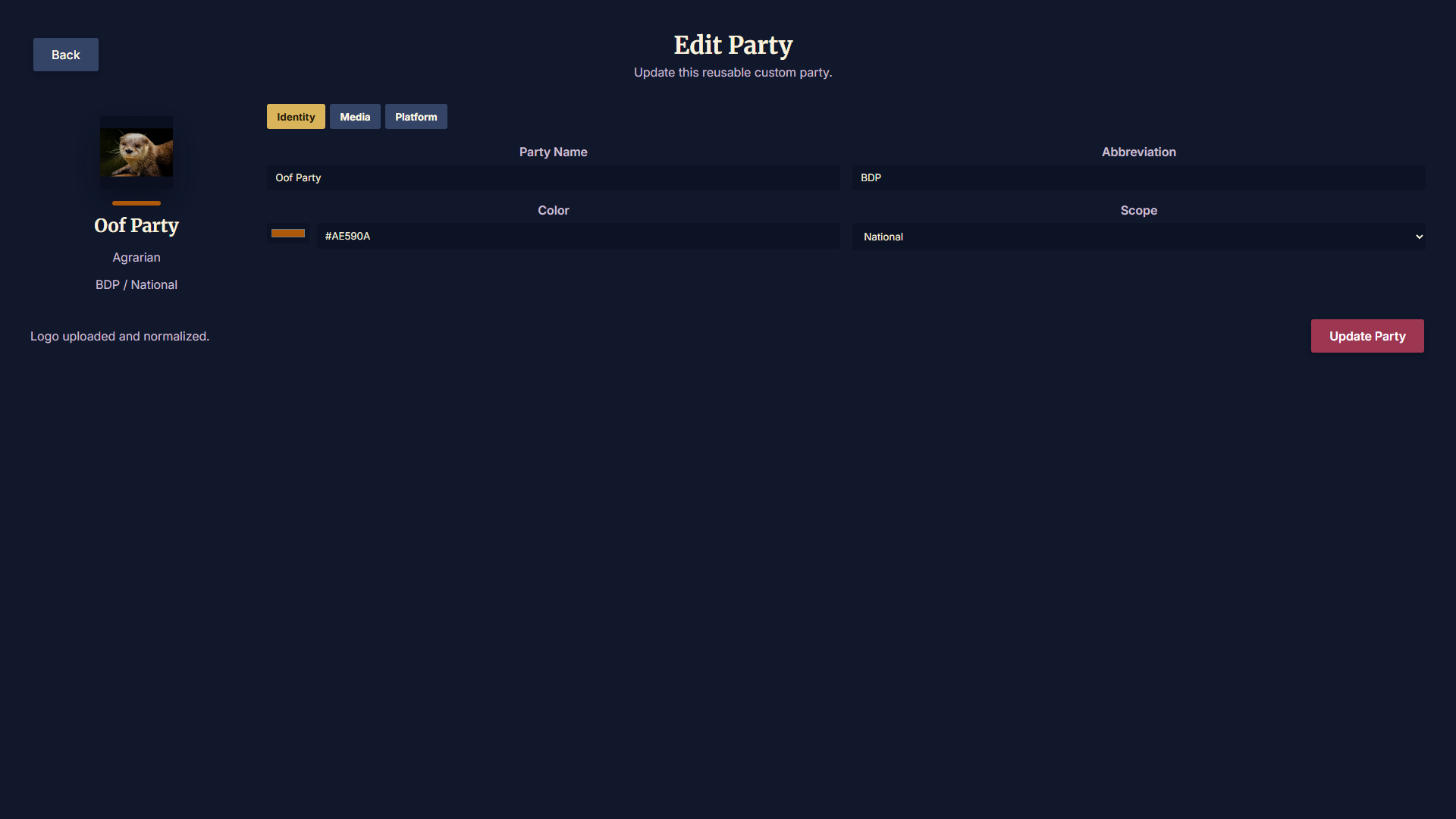
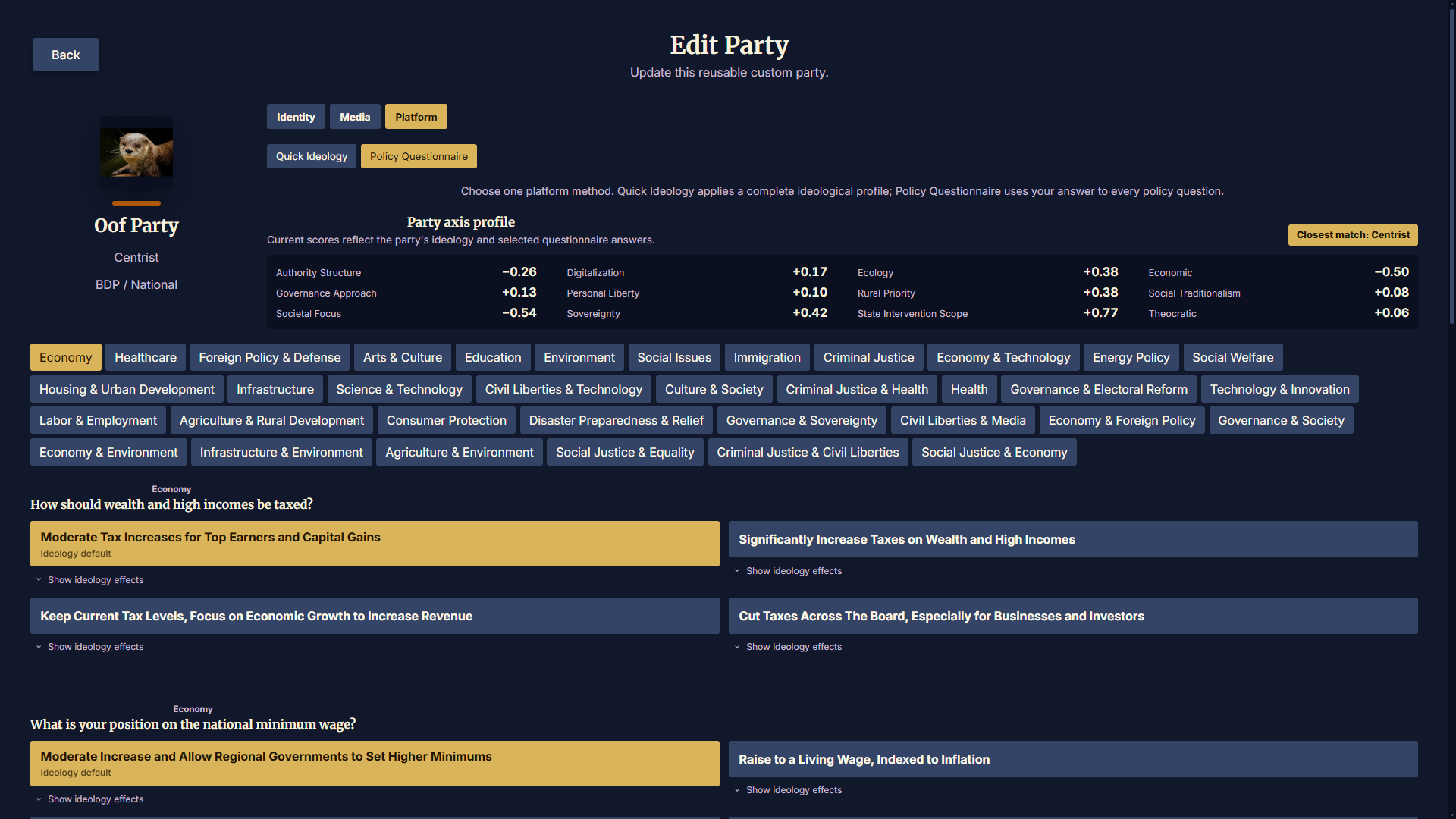
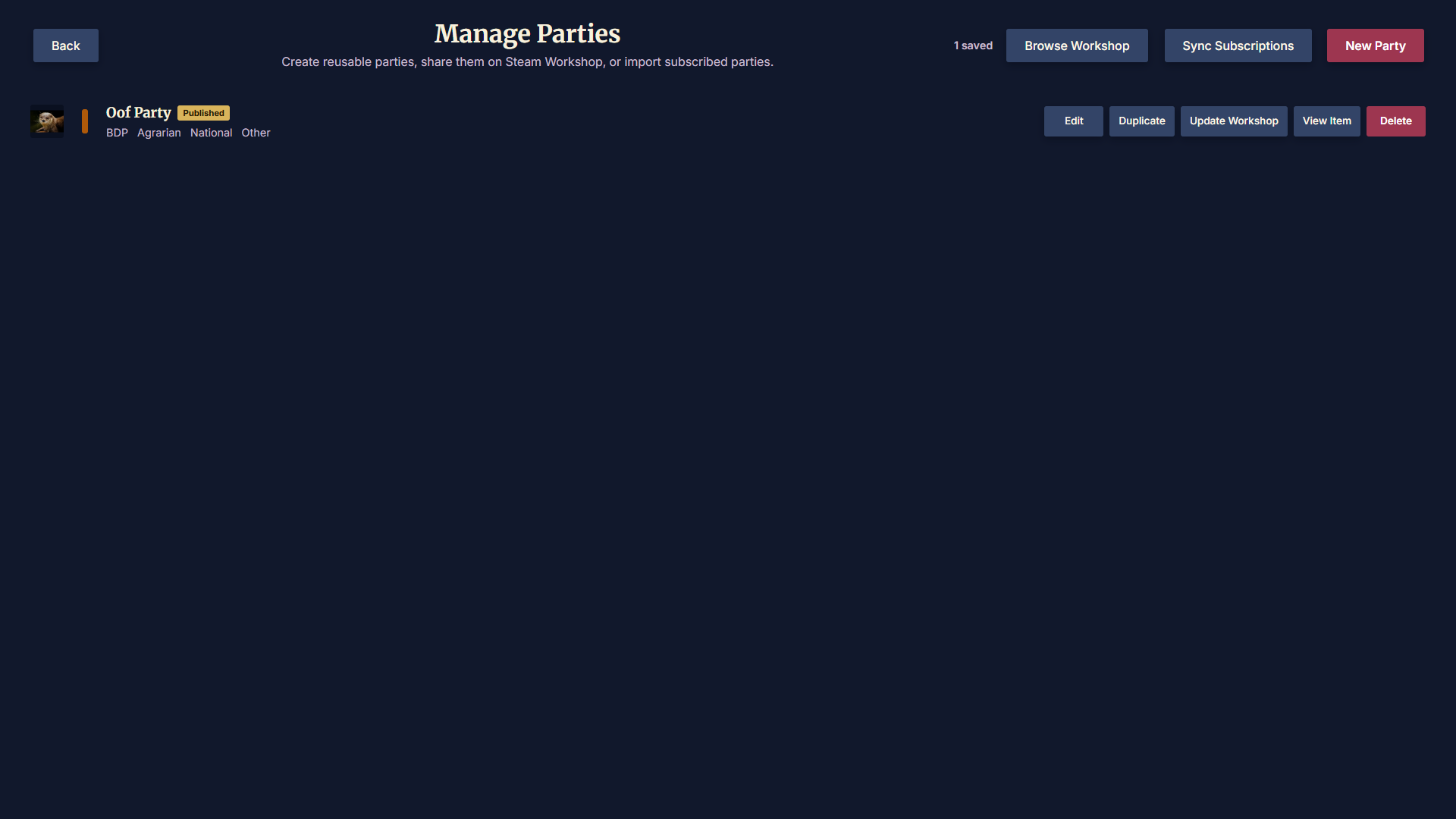
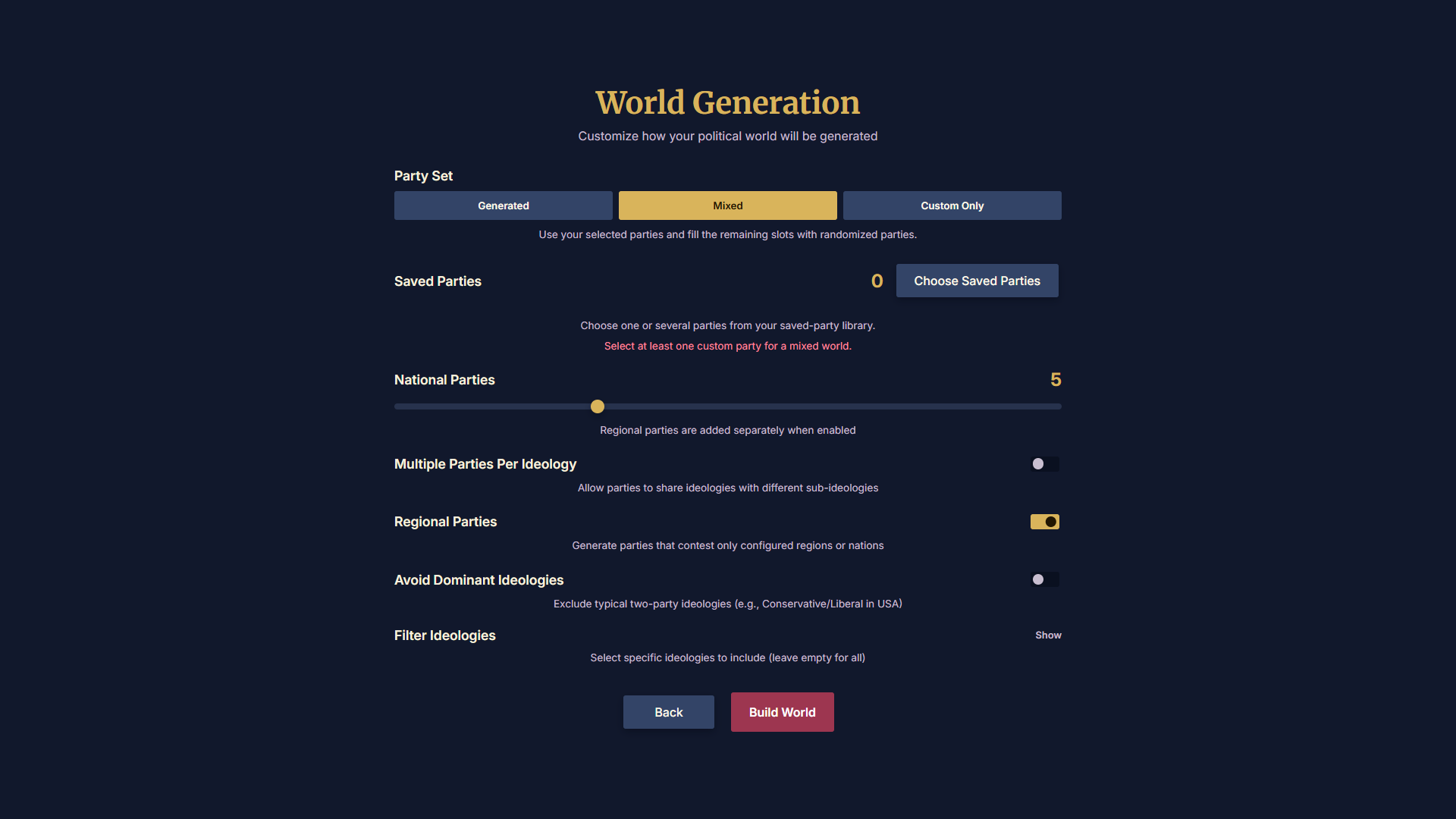
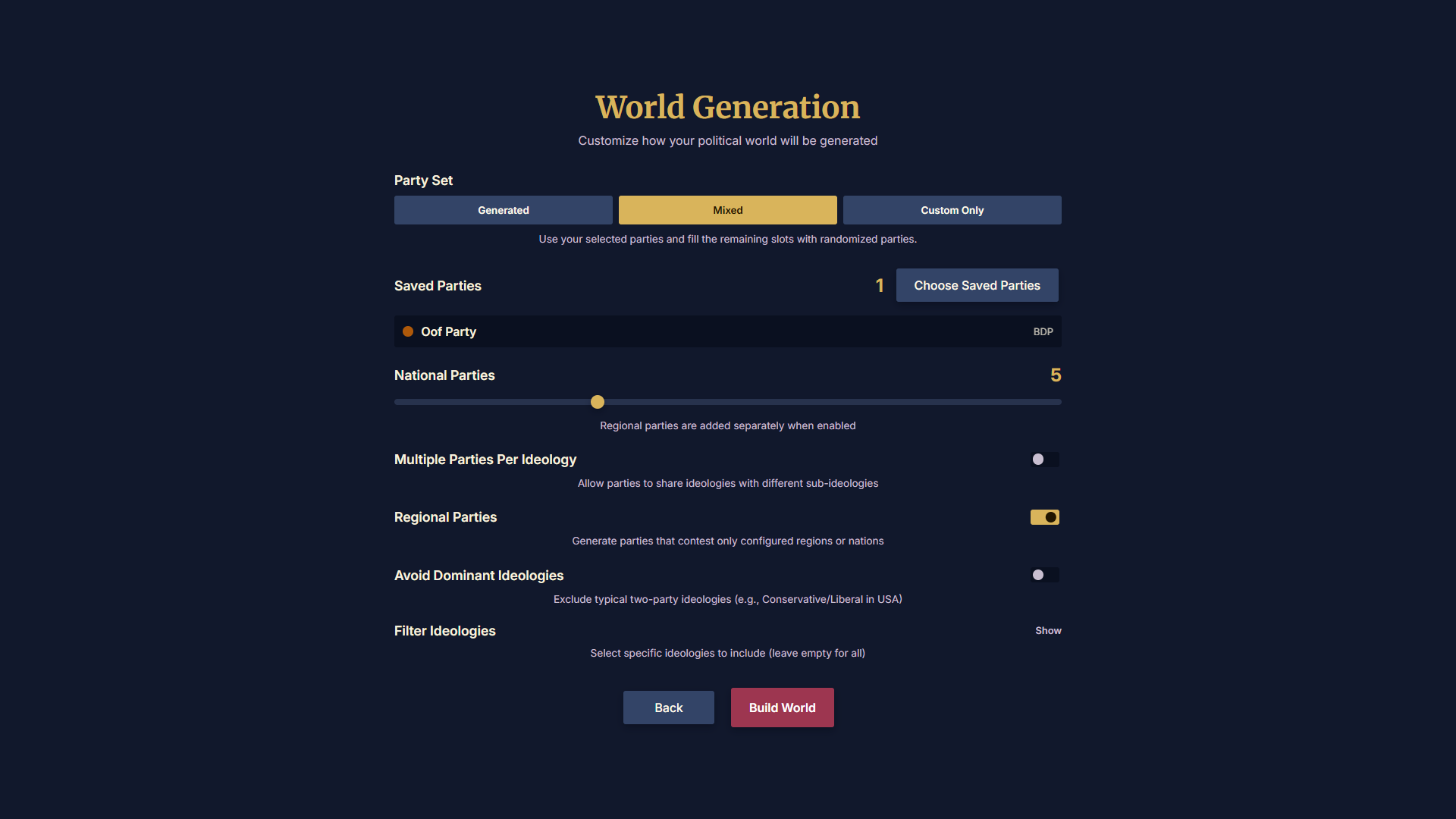
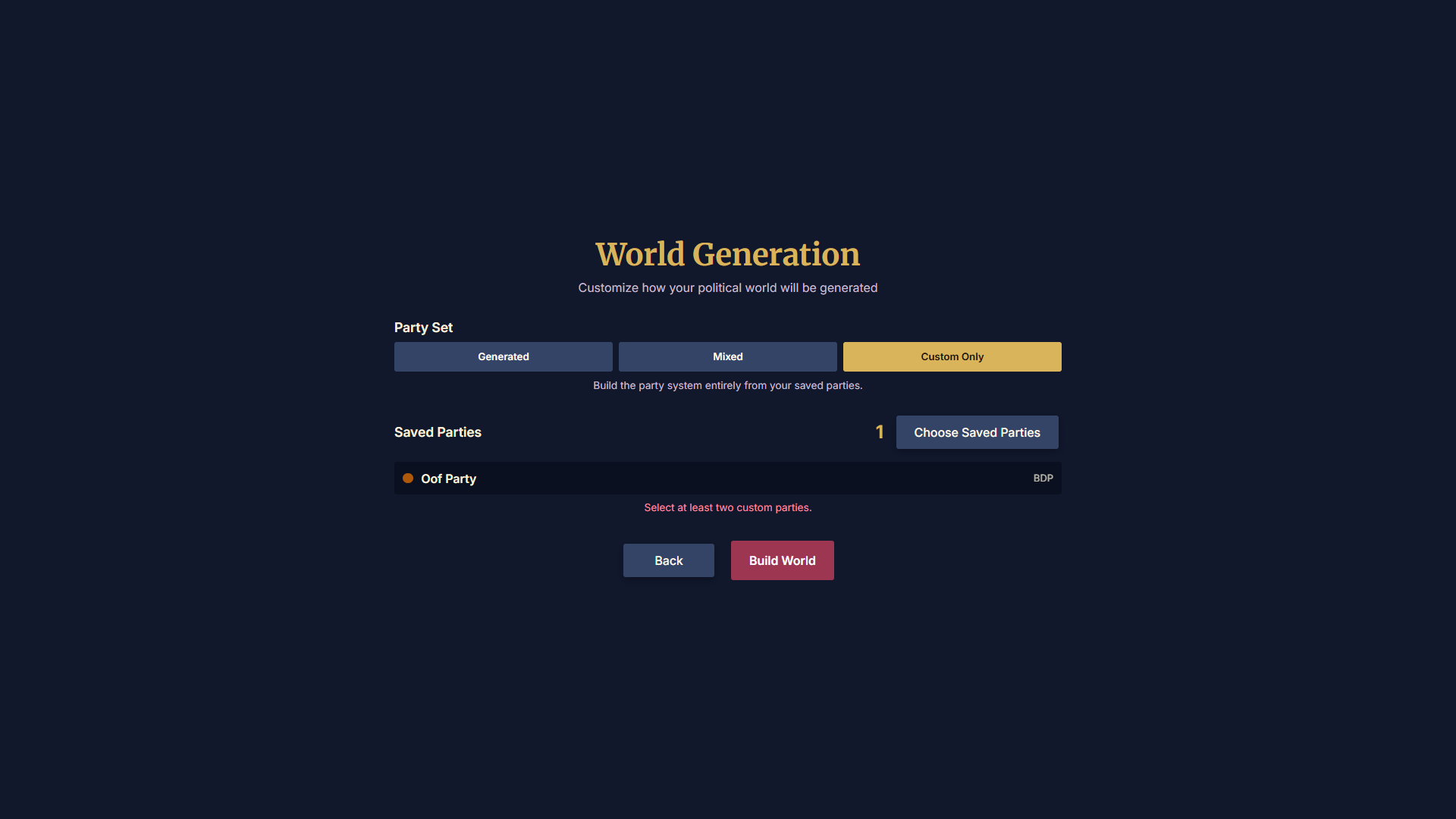
Create parties from scratch in the Party Creator: name, colour, logo, ideology and sub-ideology, and a platform you can set quickly or answer question by question. Manage the whole field from the Manage Parties screen. Party templates publish to and subscribe from the Steam Workshop as their own item type, separate from scenarios.
Custom Scenarios
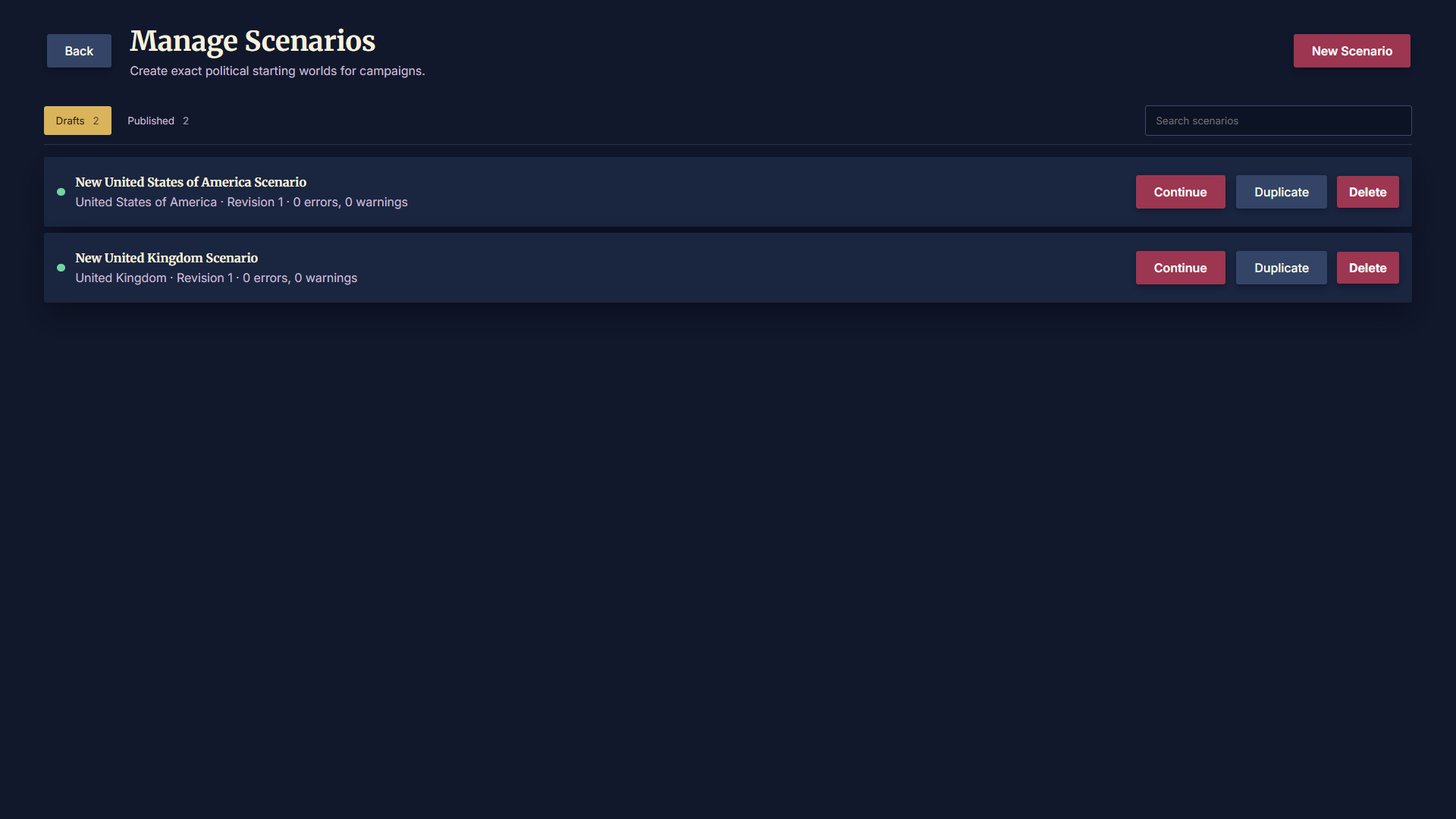
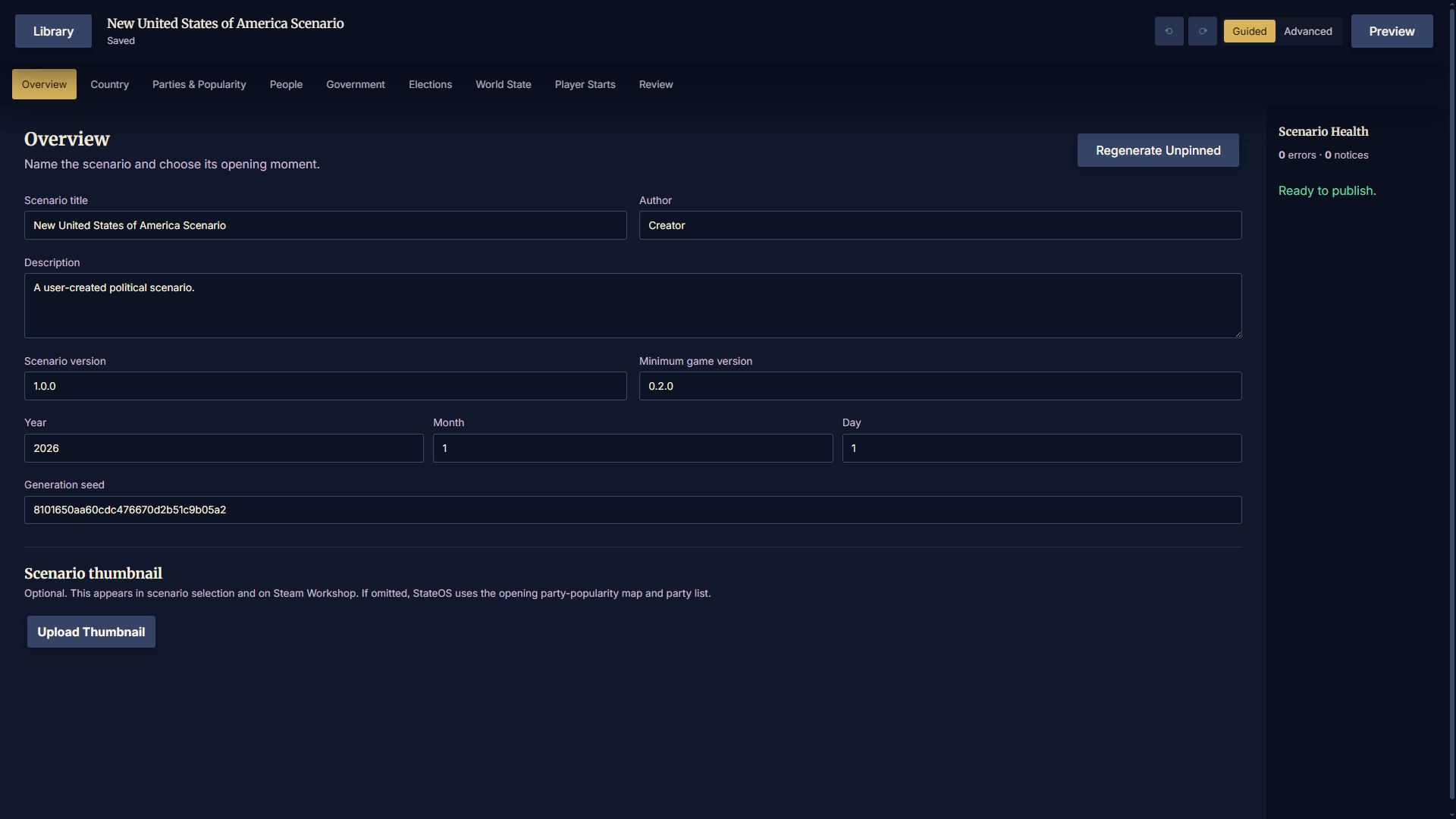
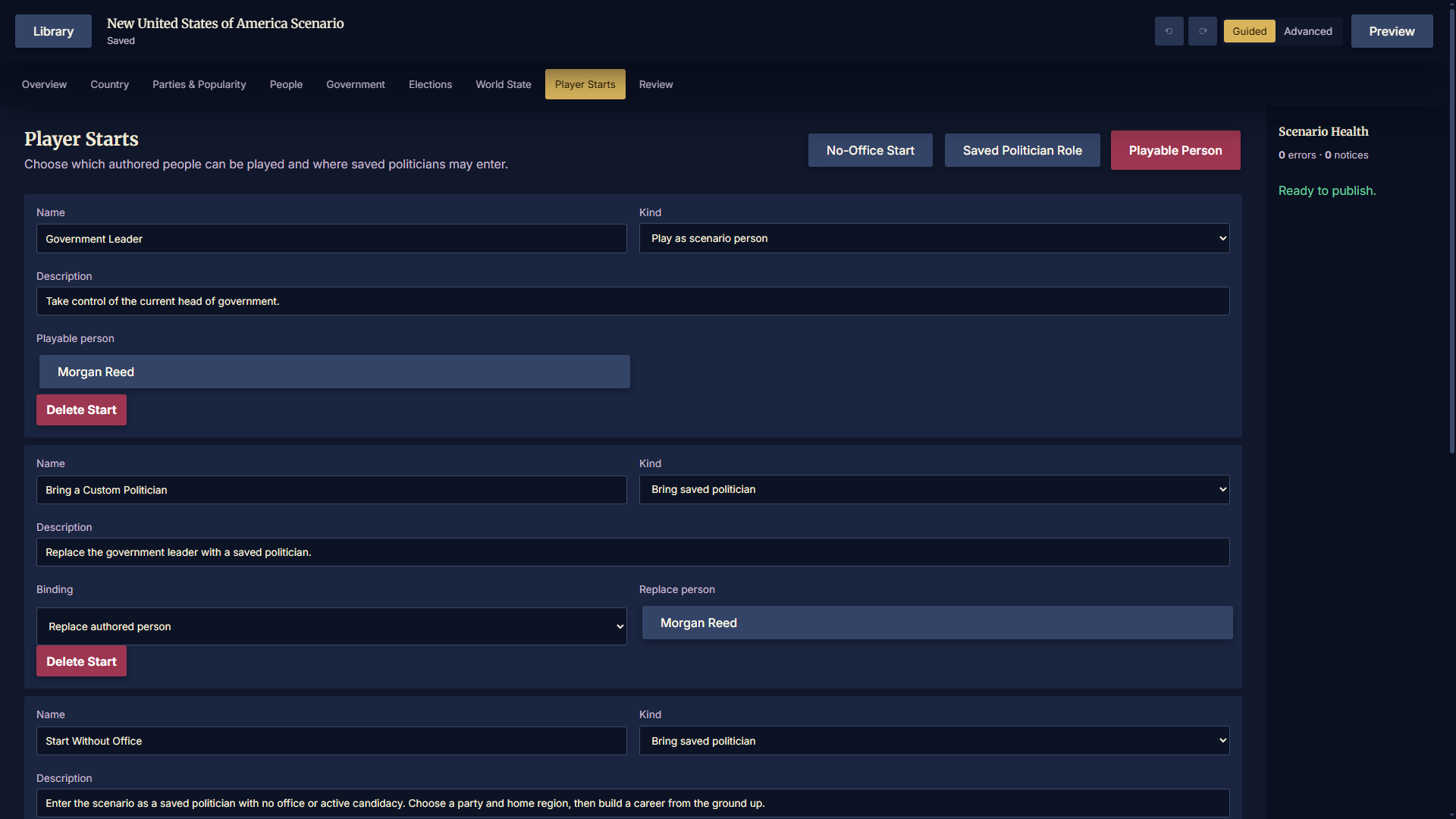
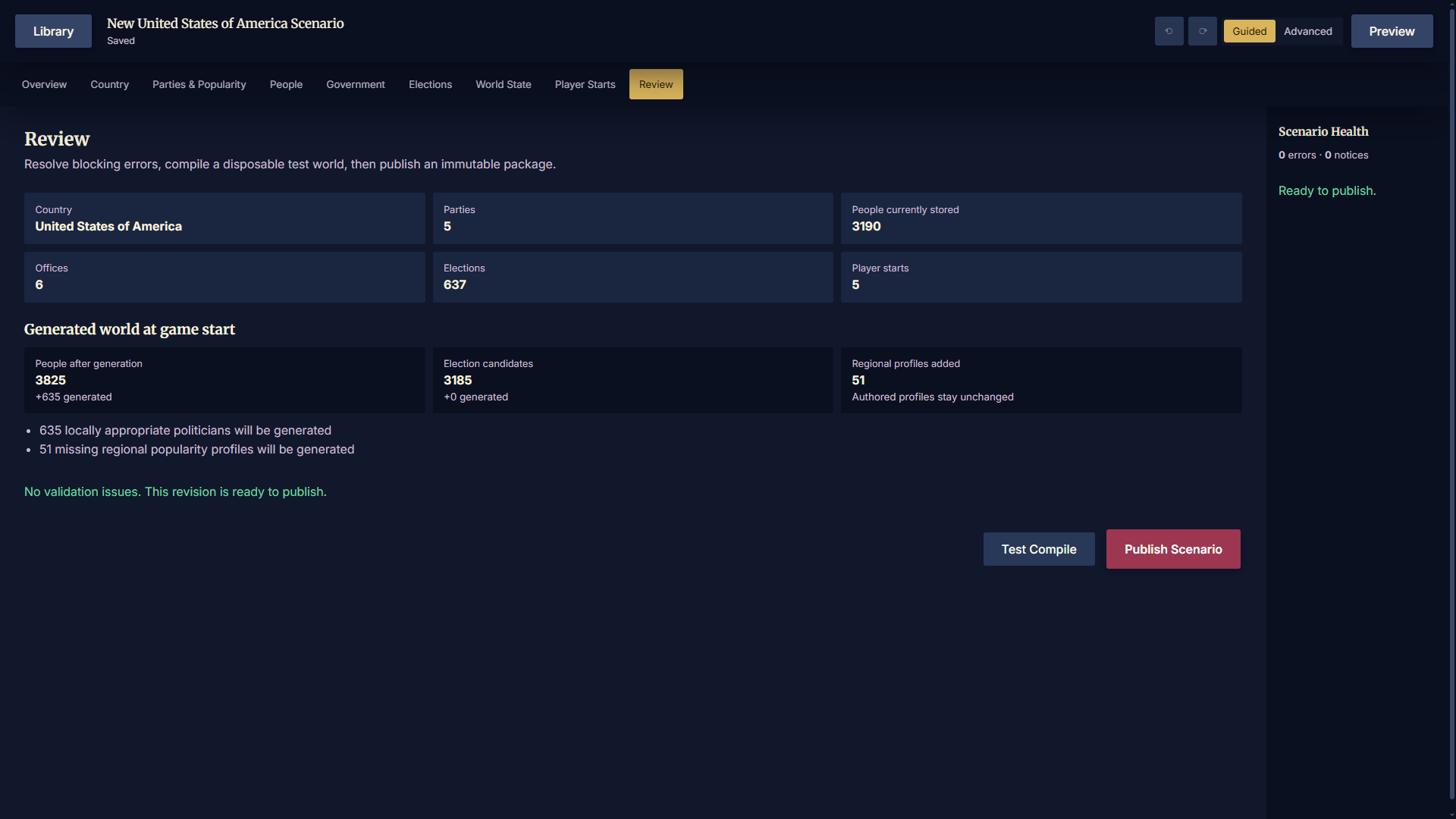
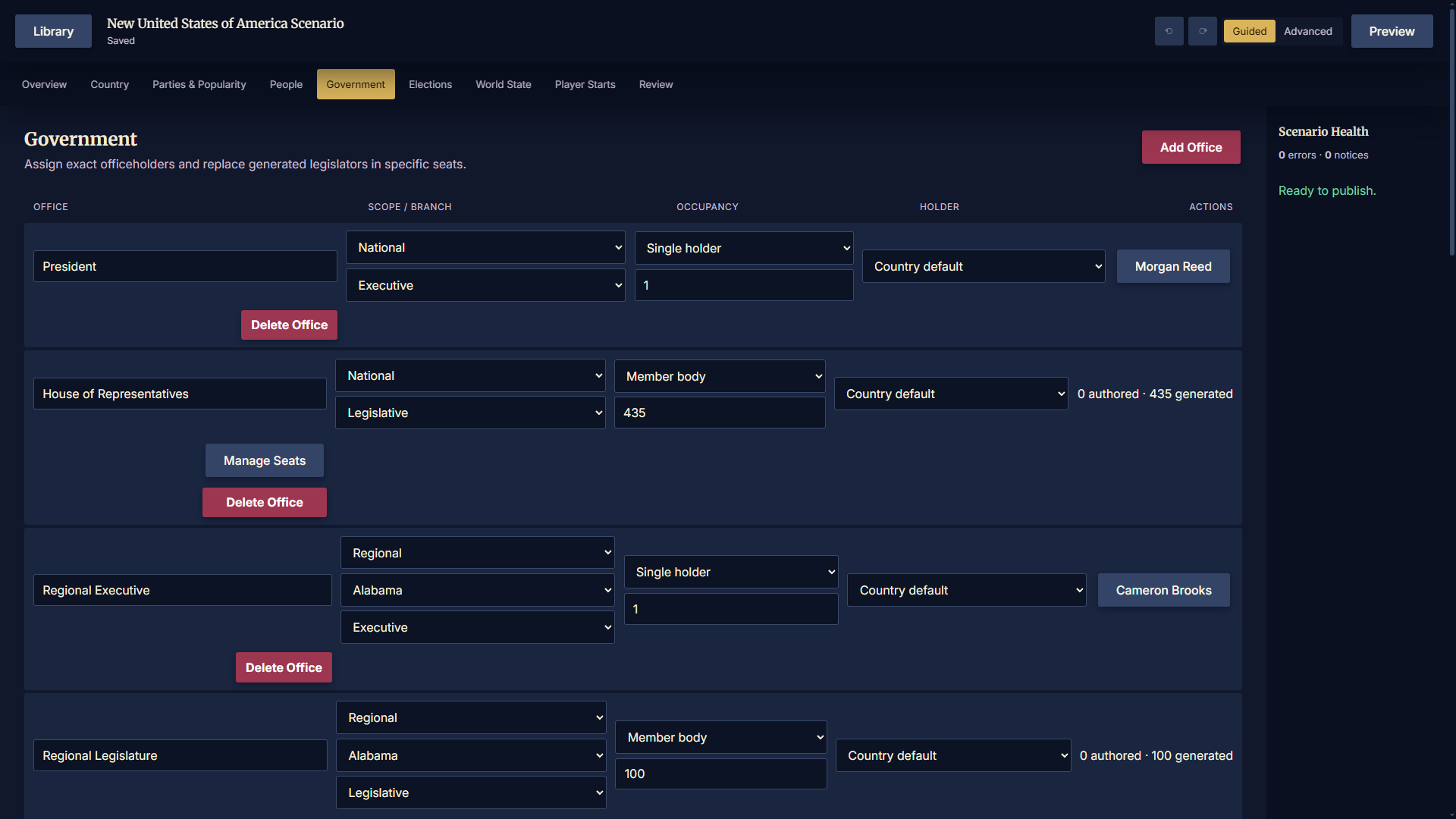
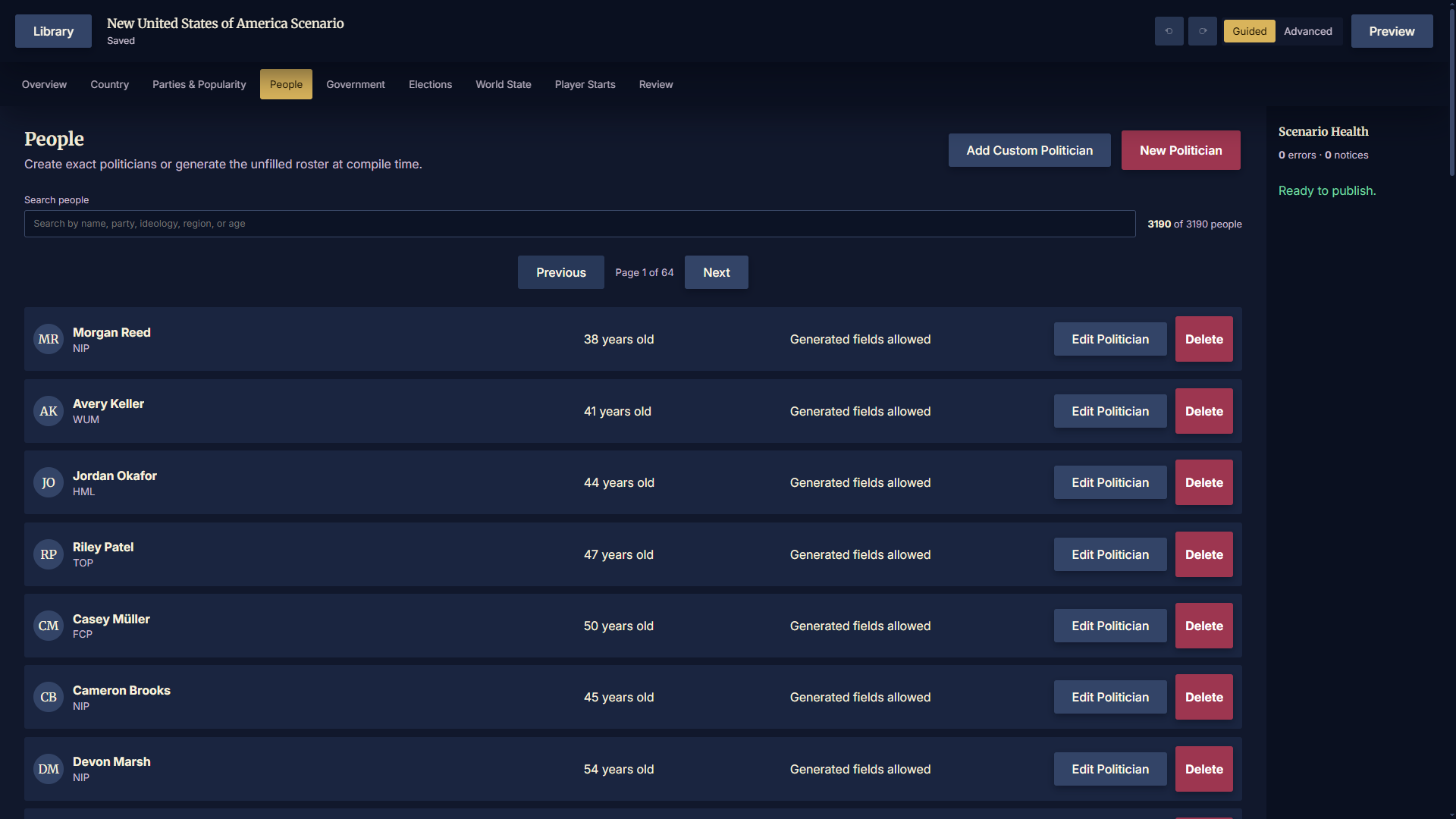
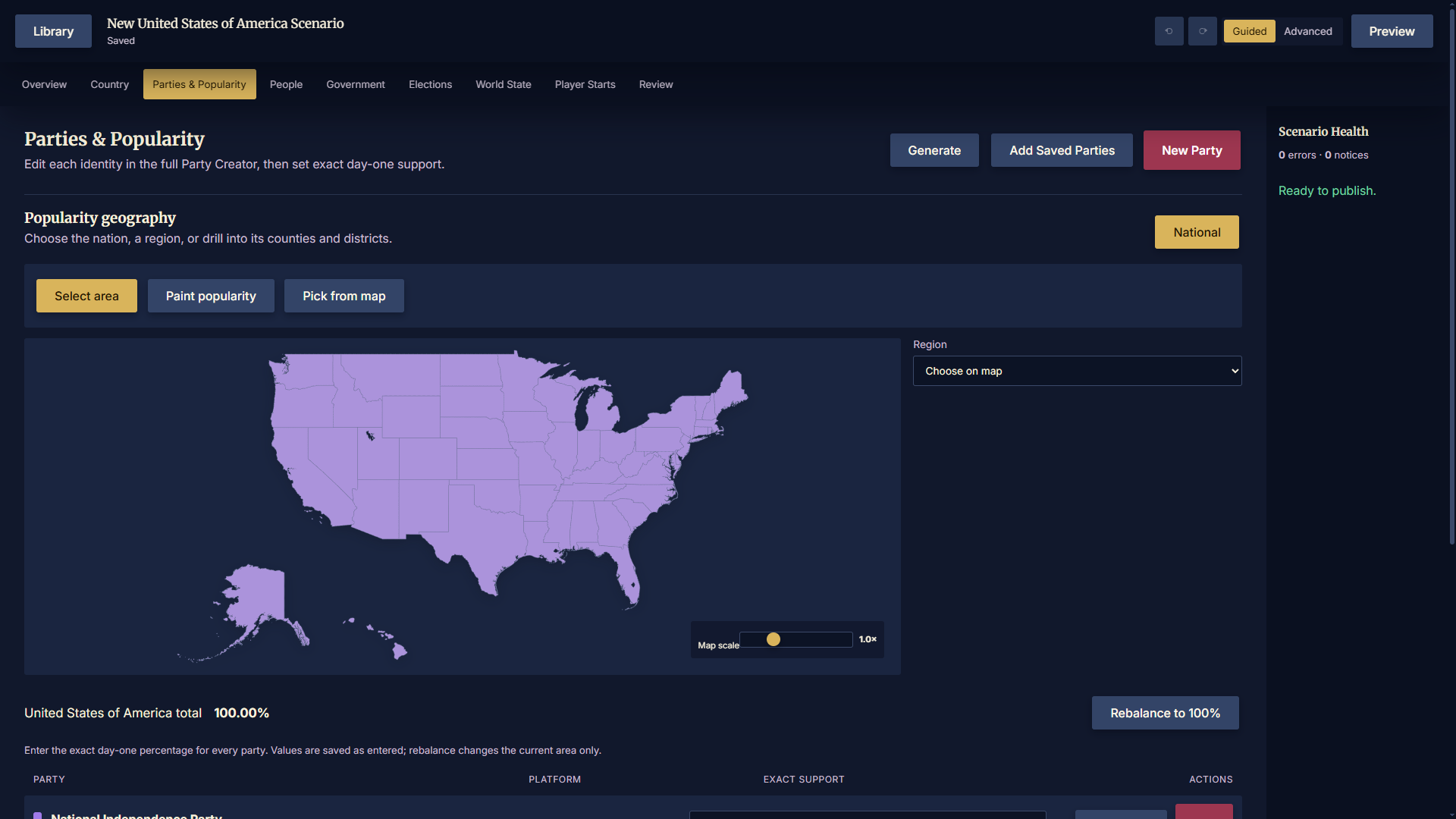
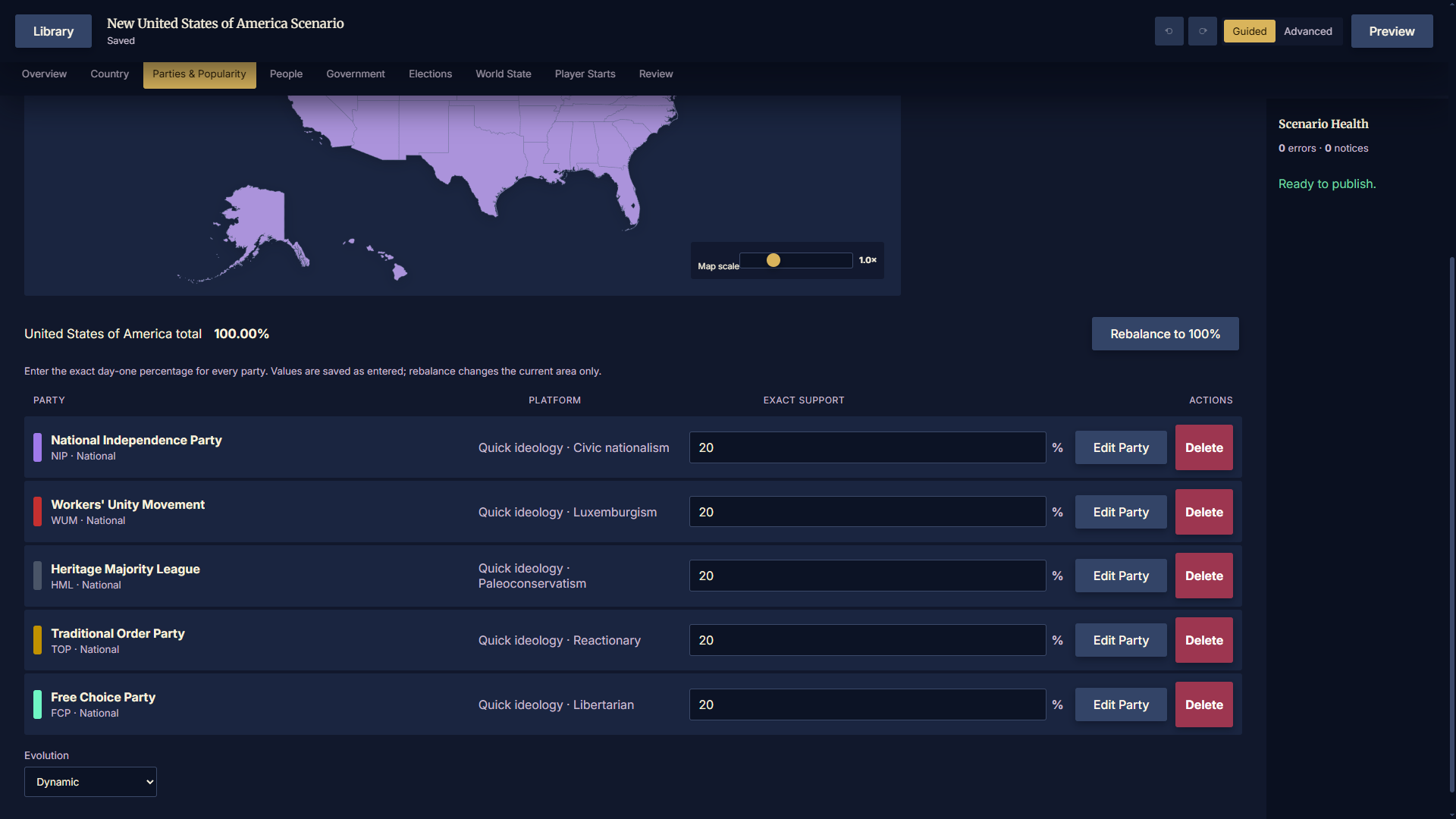
A full scenario editor, organised in the order you'd actually build a world: Overview, Country, Parties and Popularity, People, Government, Elections, World State, Player Starts, Review.
Generated scenarios inherit real local geography, so a county is Elmore rather than "Alabama District 51" and carries its own party data.
A scenario start asks for your home seat, county, constituency or Wahlkreis, and records it.
Committees, three ways. Generate builds a chamber's committees from the country's own committee profile, so an authored legislature carries the committees a generated campaign for that country would. Assign seats people by toggling them, offering only members of that chamber. Author adds an empty committee to name and fill.
Cabinets can be cast, so if what you're writing is 1963 it opens with the cabinet of 1963 rather than a generated one.
Region facts and popularity are editable directly, down to per-region and per-county shares.
Long operations show progress and can be cancelled: generation, publishing, import, test play and compilation.
Test play compiles the scenario and drops you into it without leaving the editor.
Steam Workshop
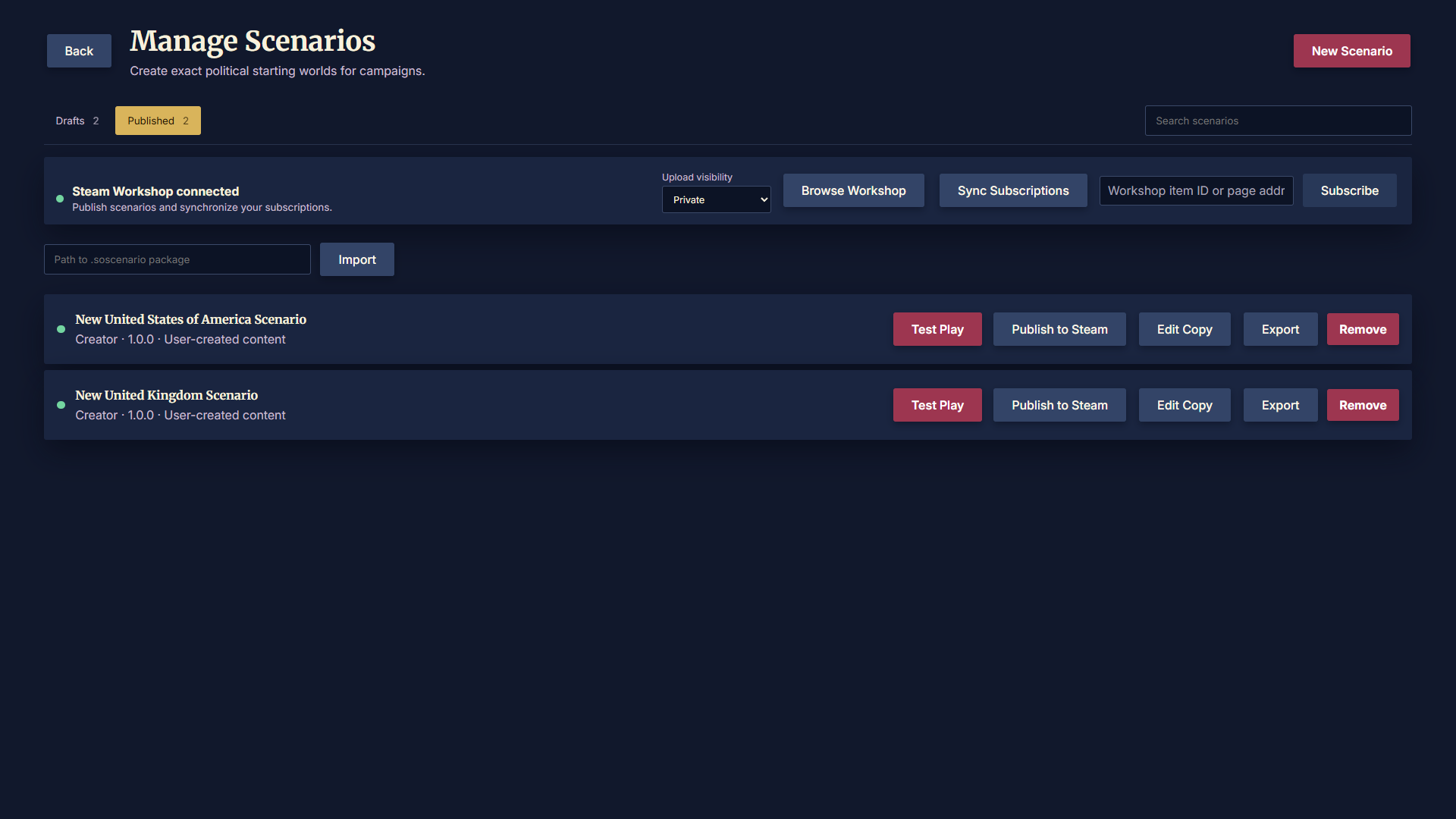
Publish scenarios and party templates to the Workshop, browse the hub, and sync subscriptions from inside the game. You can subscribe from in-game too: paste an item id or a Steam page address and it subscribes and then syncs.

UI Changes
The election calendar is navigable at Senate scale. Races are grouped under the day they're decided, with counts and a jump to that day, and each row spends its meta line on the region that distinguishes it.
Direct apply pages by scrolling and carries the same search and filter row the elections overview does: All, Closing soon, Primaries, General, with counts.
Sub-tabs look like buttons, with the same filled treatment as every other control in the game.
Committee service has its own full-width row in My Office, so a member of a dozen committees can read them all.
Skip and Process on election day finalizes the races you skip and tells you how many it counted, so the clock is never left stuck behind a dialog.
Bill parameter errors are written for the player, and the bill panel only offers to propose a bill it can actually send.
Deadlines are counted in days.
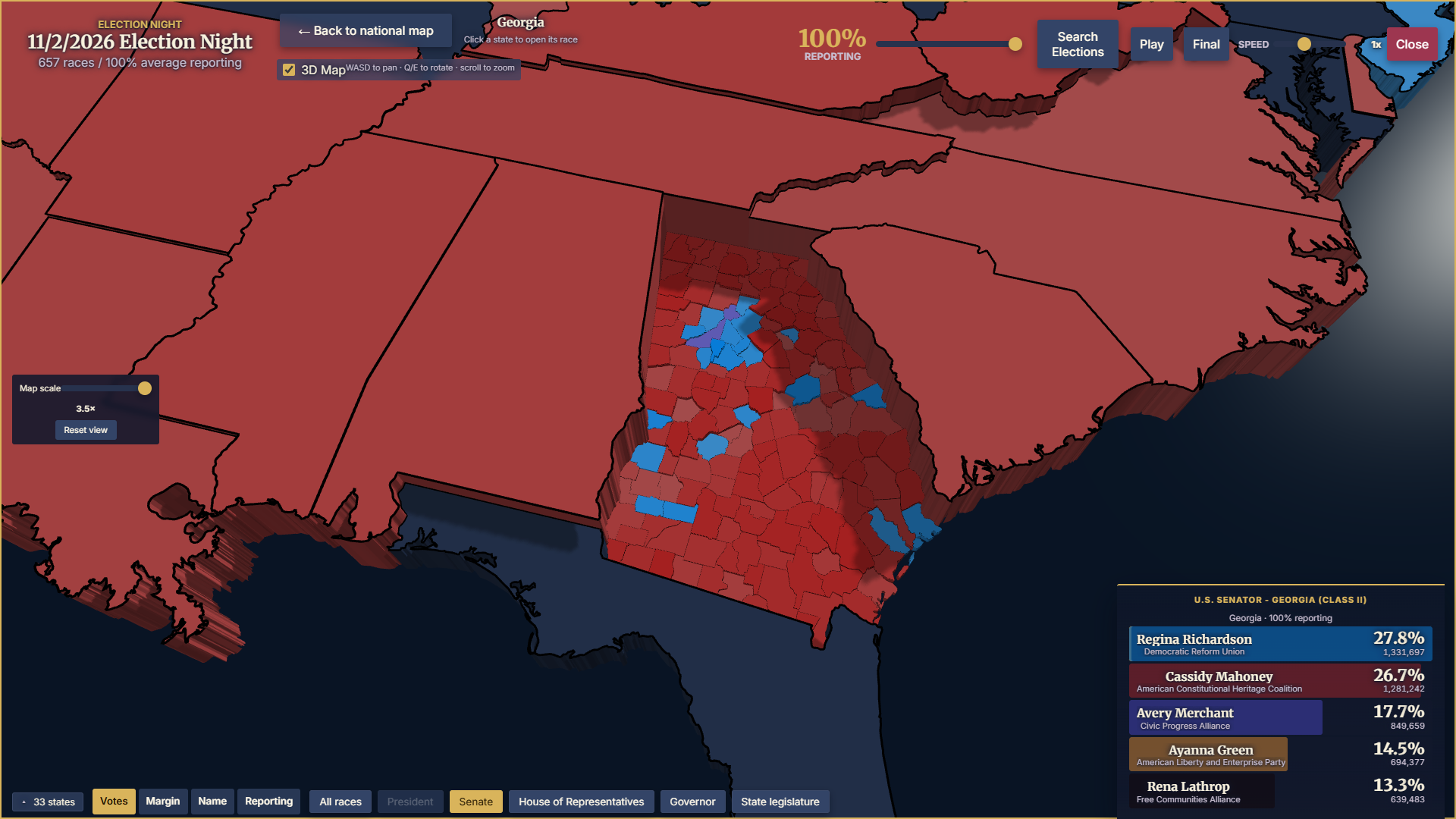
Election night
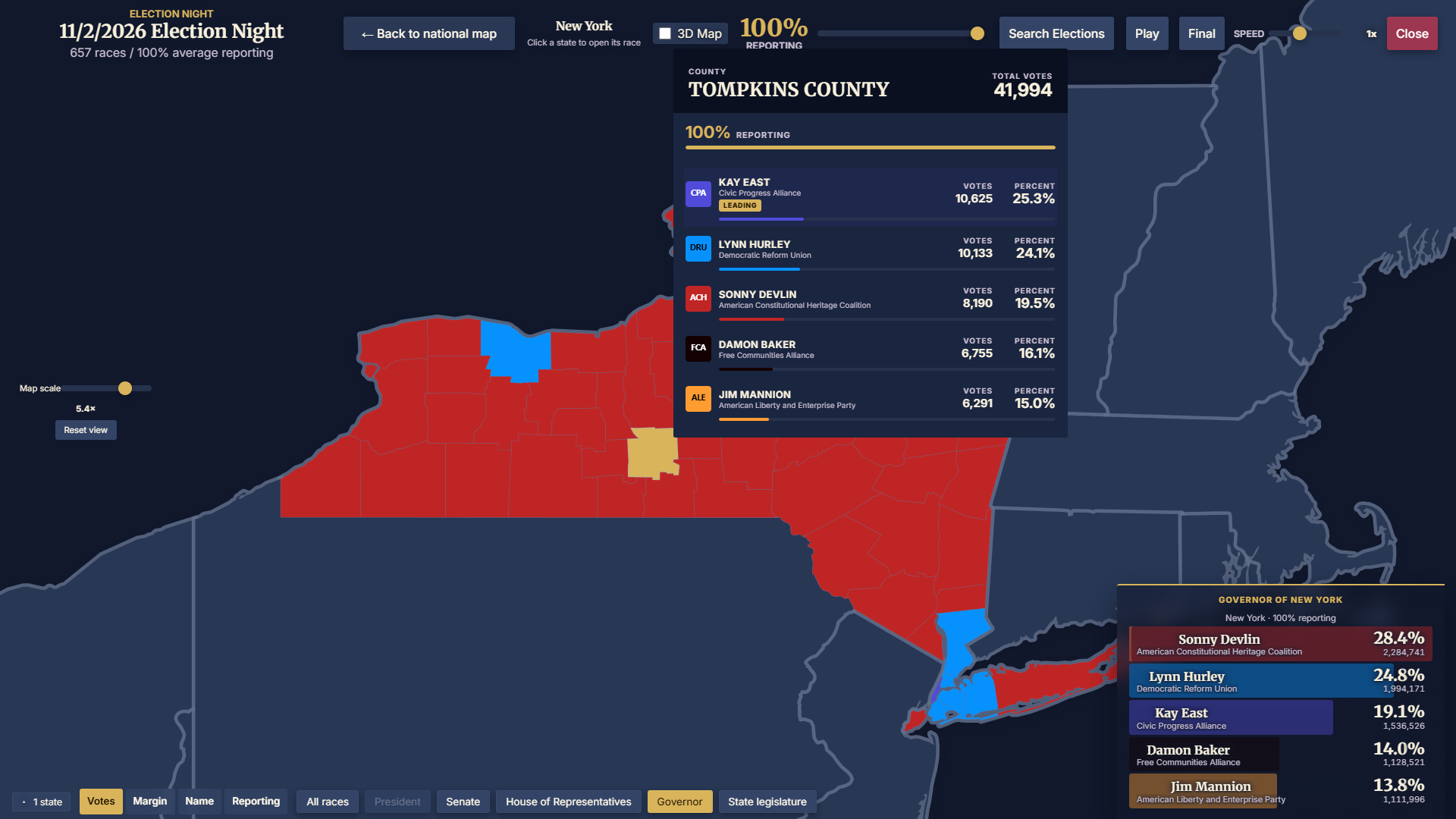
A race built around a map gives it the whole screen. The returns, the filters, the standings and the night's title float over it with no surface of their own, and the places counted sit in a drawer.
A nationwide contest paints every state it is fought in, presidency and Bundestag alike.
A state shows every county, scrollable, with a filter and a sort by votes, margin, name or reporting.
Zoom into a state and you get that state's counties for whichever office you have selected, Senate, Governor or President.
A region opens on its own constituencies, and clicking a seat opens that race in place.
The office filters speak each country's language, so a German night files the Bundestag under its own name.
3D works on every path, general and primary alike, and both 2D and 3D maps have a scale slider with pan and zoom.
Every map has a hover readout, including the presidential national map.
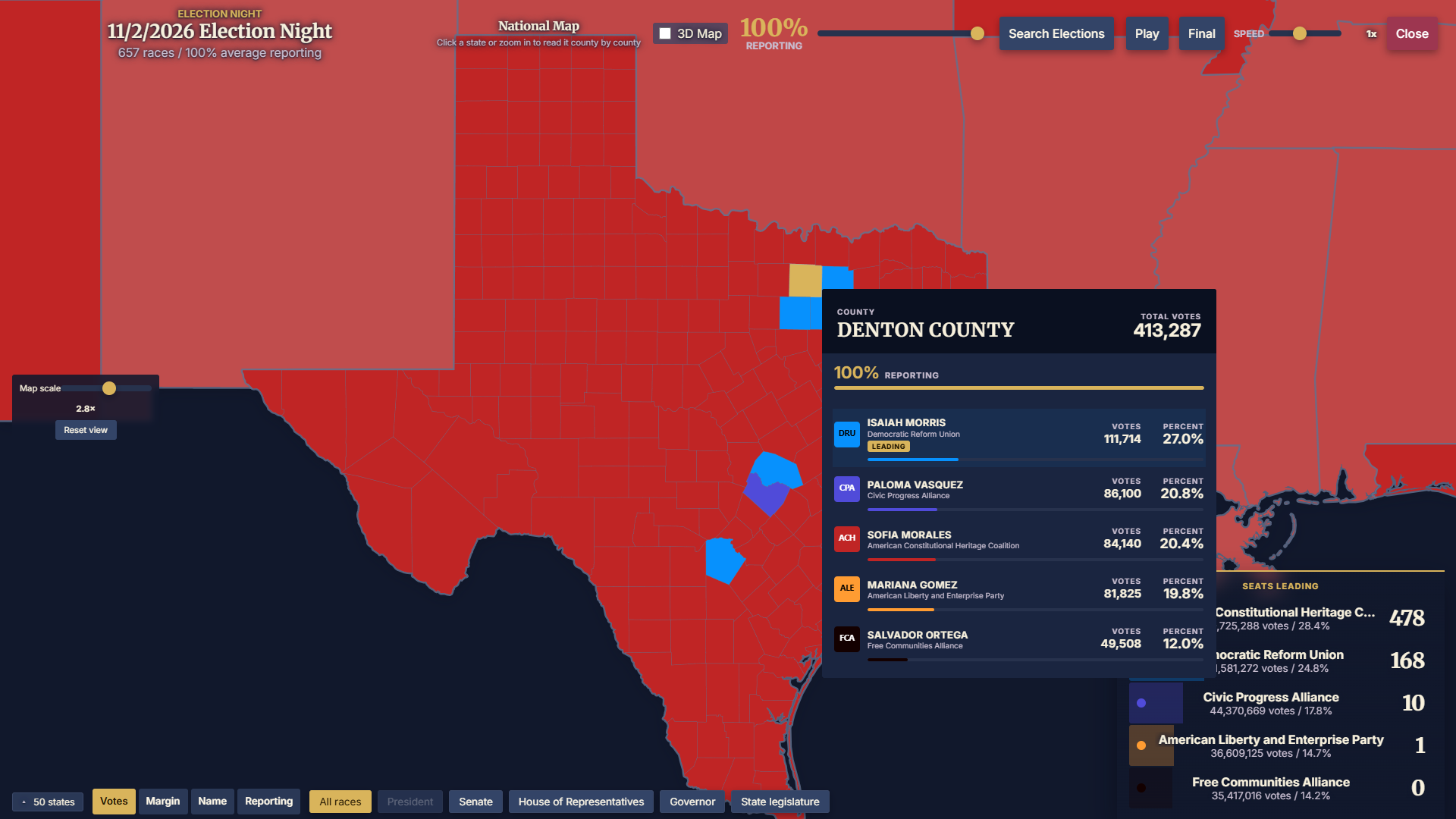 3D is still WIP.
The Wiki and the World Archive
The StateOS Wiki
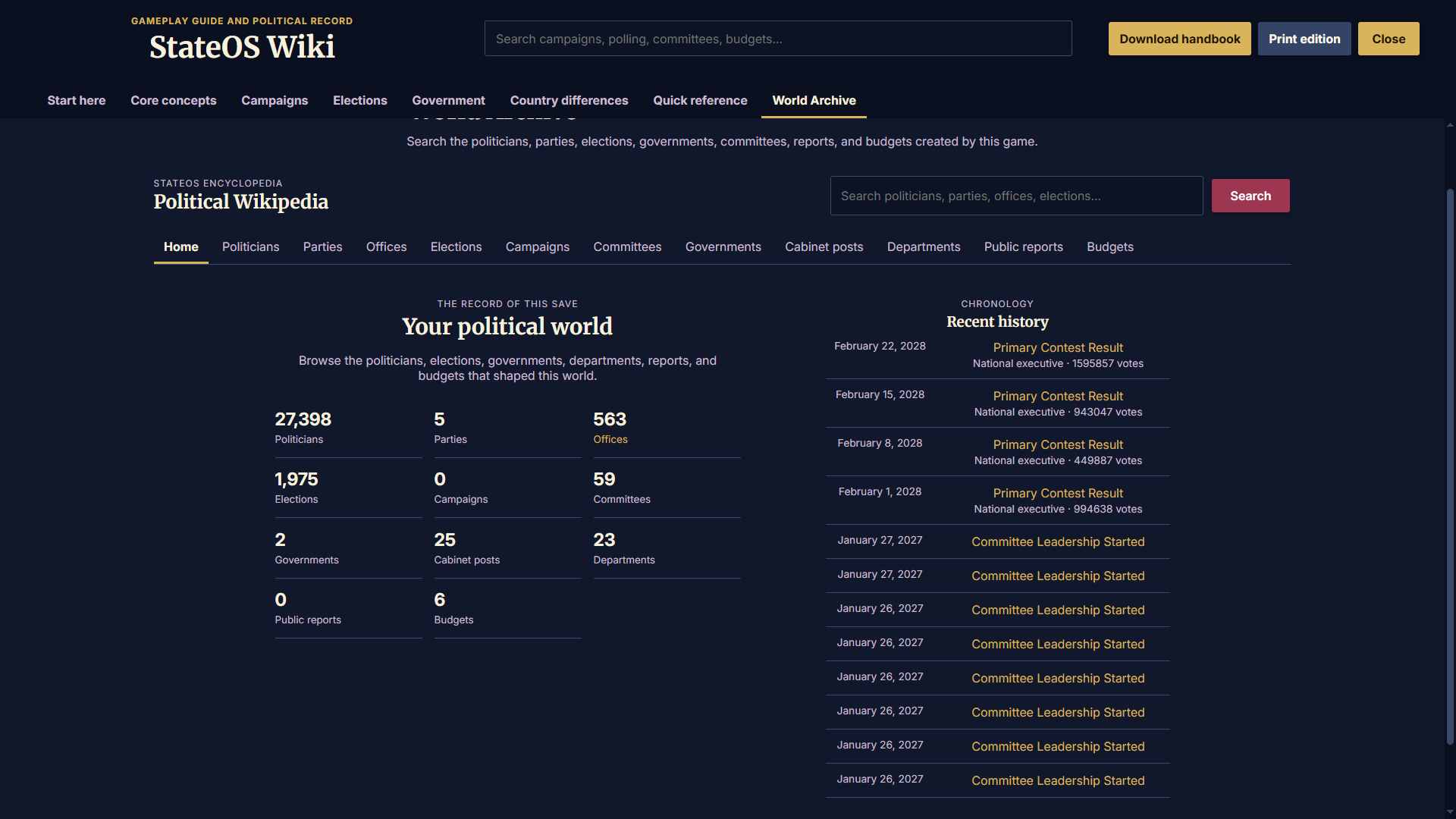
An in-game handbook, opened from the menu at any time without leaving what you were doing. 41 articles across seven sections, Start here, Core concepts, Campaigns, Elections, Government, Country differences, and Quick reference, with a search across every title, summary and keyword.
It is written to answer the questions the game raises while you are playing rather than to document the interface. Start here covers your first days, what advances on its own, and what Political Points are for. Core concepts explains the simulation loop, how campaign opinion is actually formed, how forecasts and uncertainty work, and why an action's execution quality and an area's saturation matter. Campaigns runs from building a platform to recruiting staff to fundraising and runway. Elections covers primaries and nomination series, how votes become seats under each electoral system, and the lifecycle from filing deadline to certified result. Government covers legislation, committees, cabinets and departments, budgets and taxes, and government formation and confidence. Country differences has an article each for the United States, the United Kingdom and Germany. Quick reference has the career checklist, the Scenario Creator workflow, saves and mods, and a plain-language glossary.
The World Archive
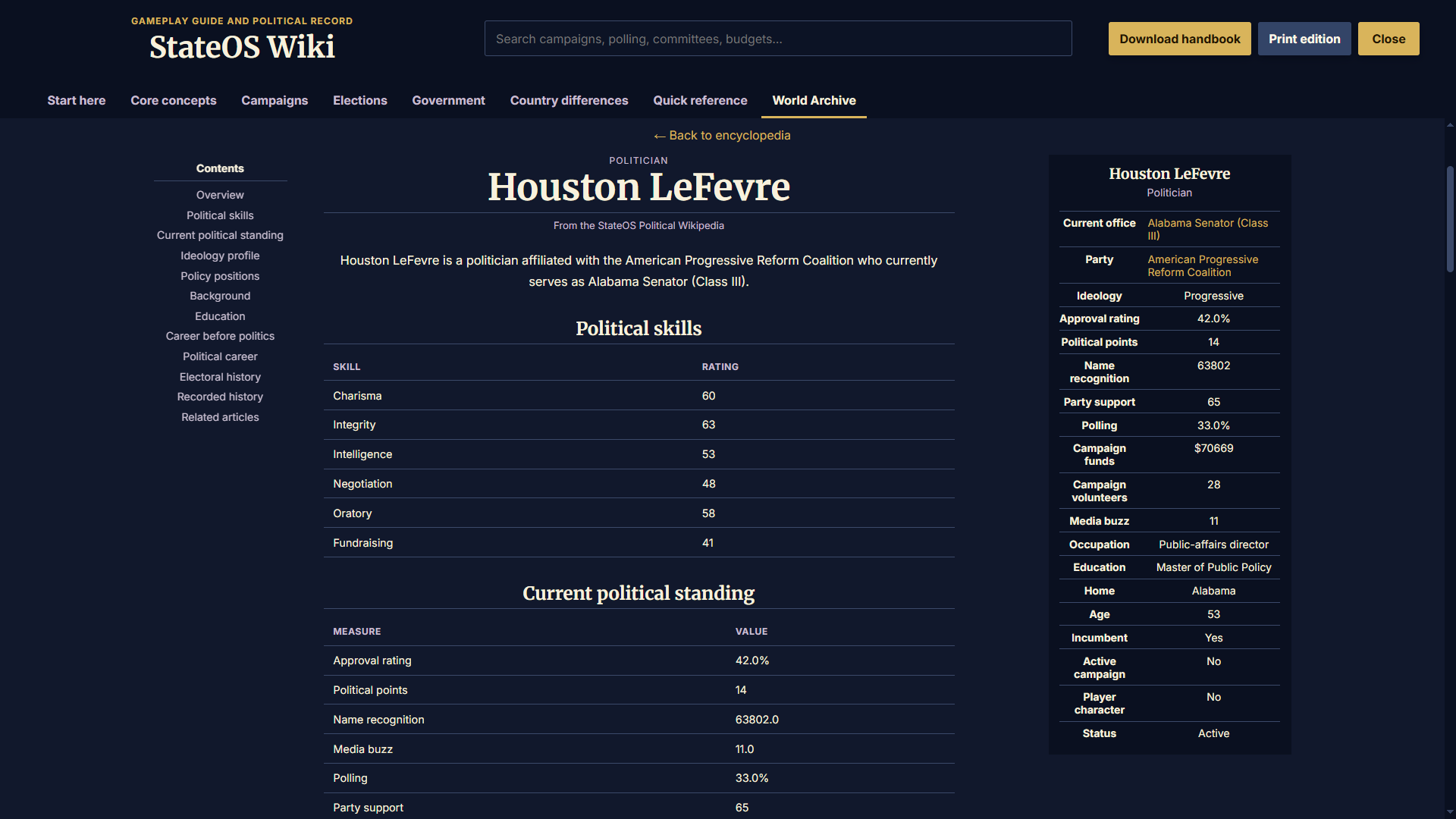
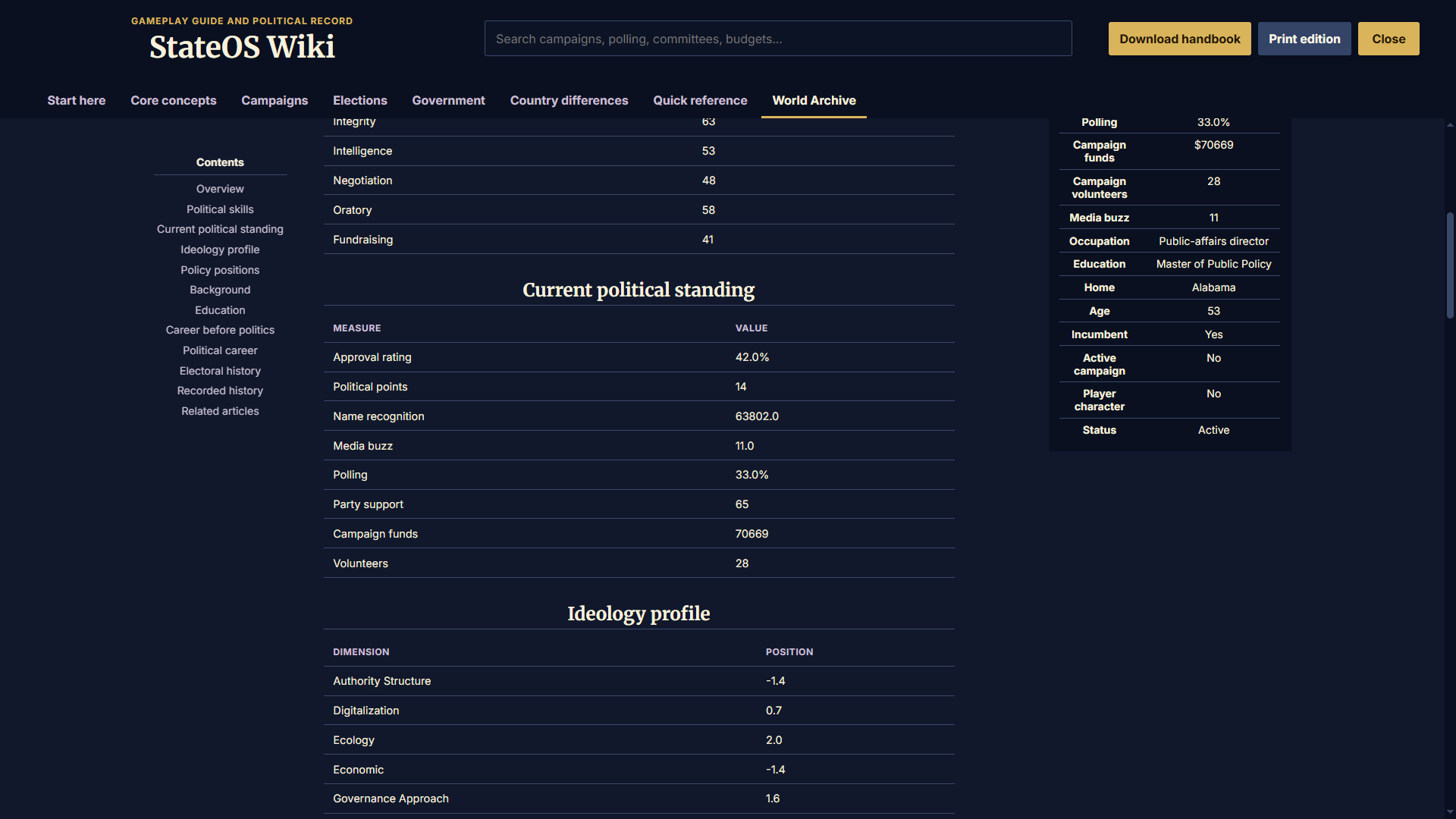
The encyclopedia of your own world, generated from the game as it happens. Politicians, parties, offices, elections, campaigns, committees, governments, departments, budgets and reports all have their own articles, cross-linked, and a politician's name links through to their page from wherever it appears in the game.
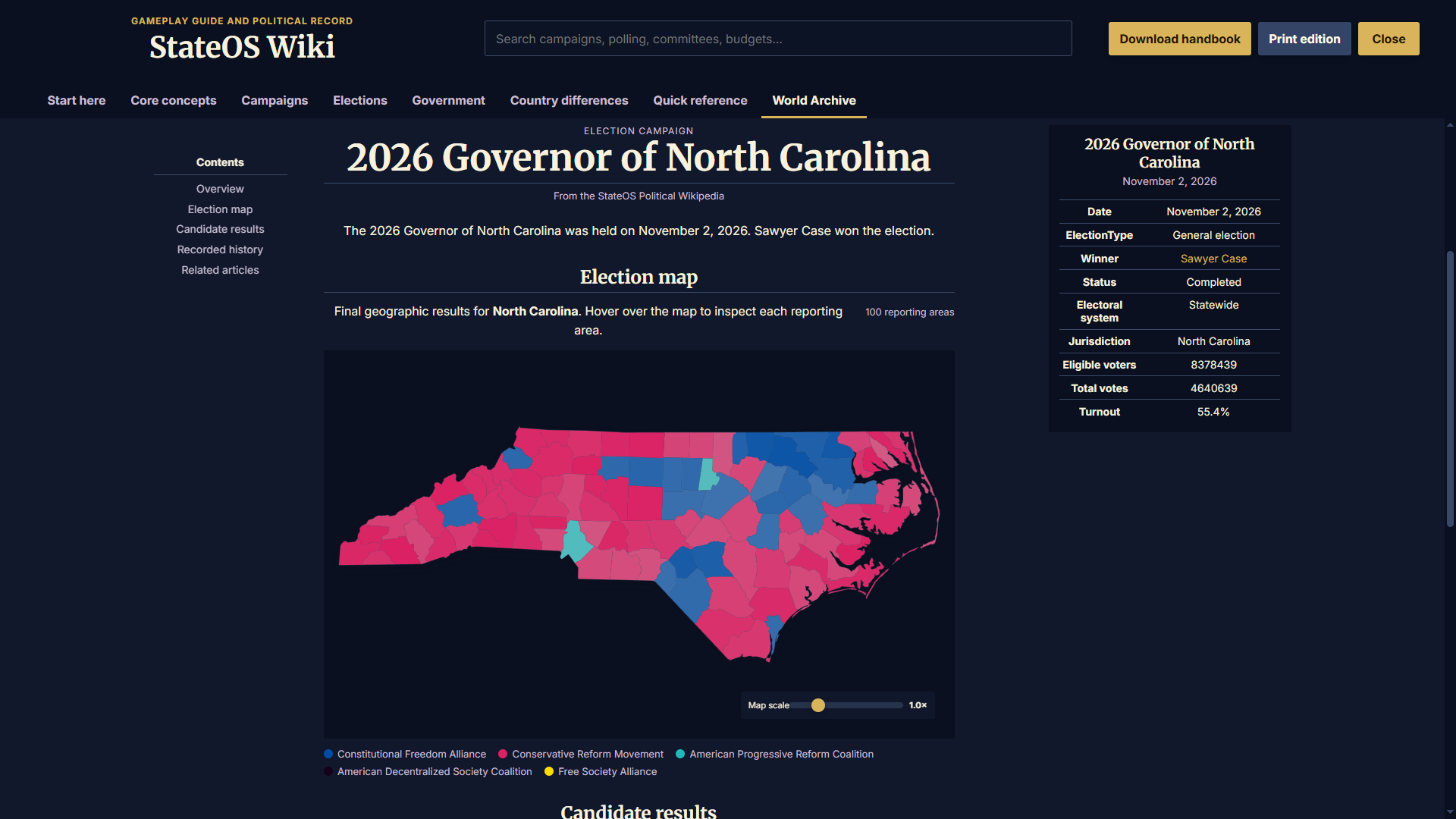
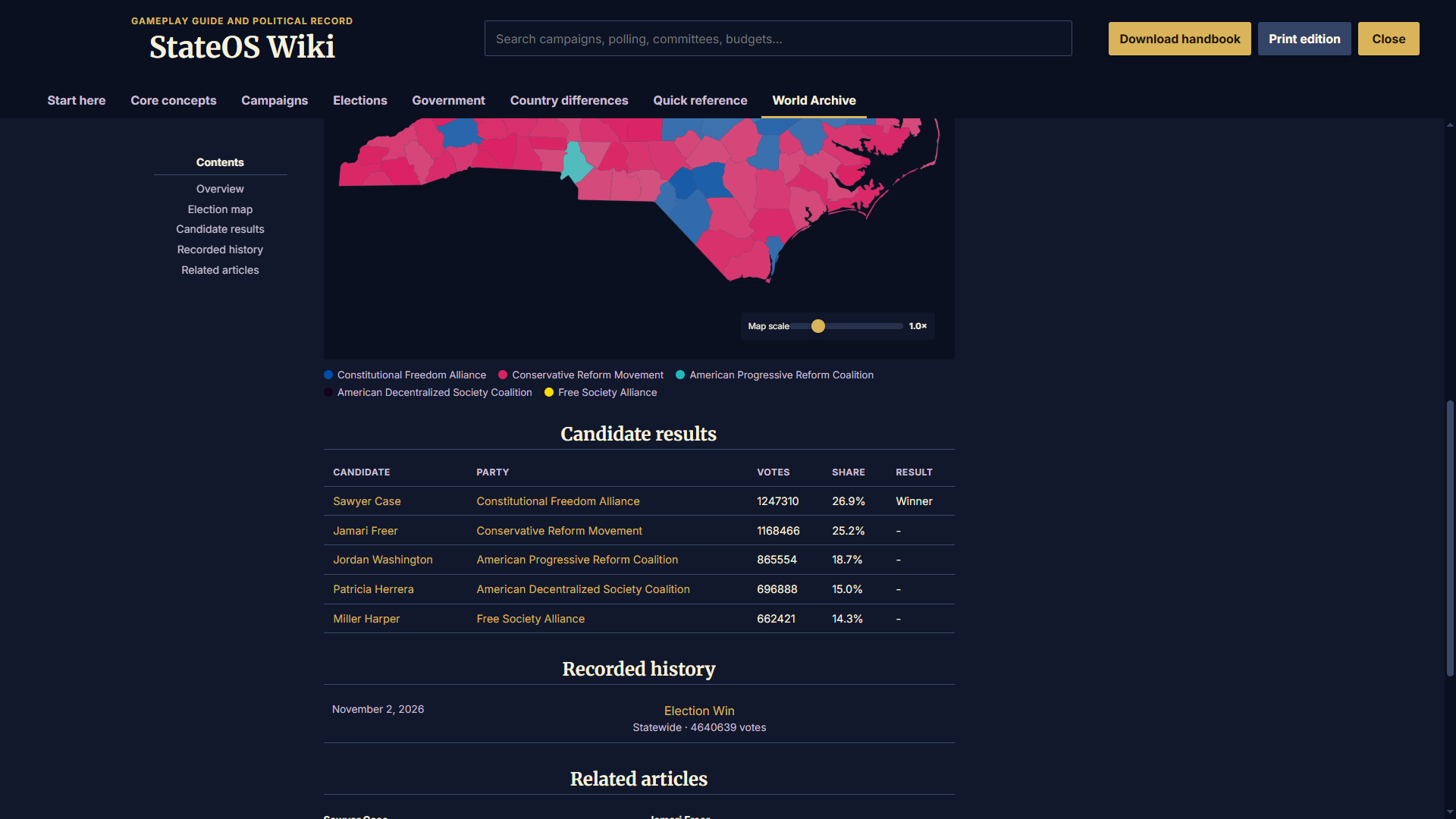
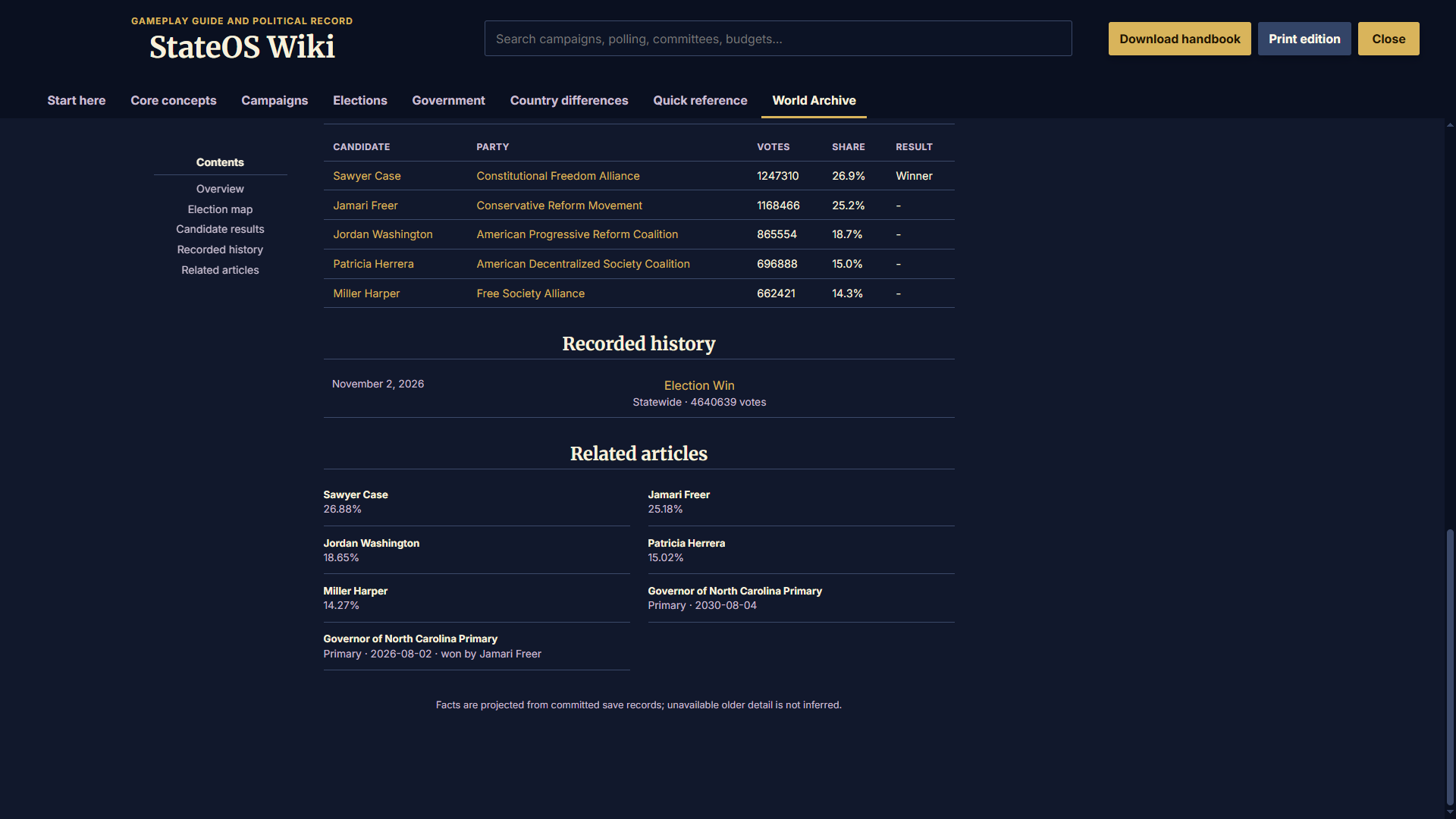
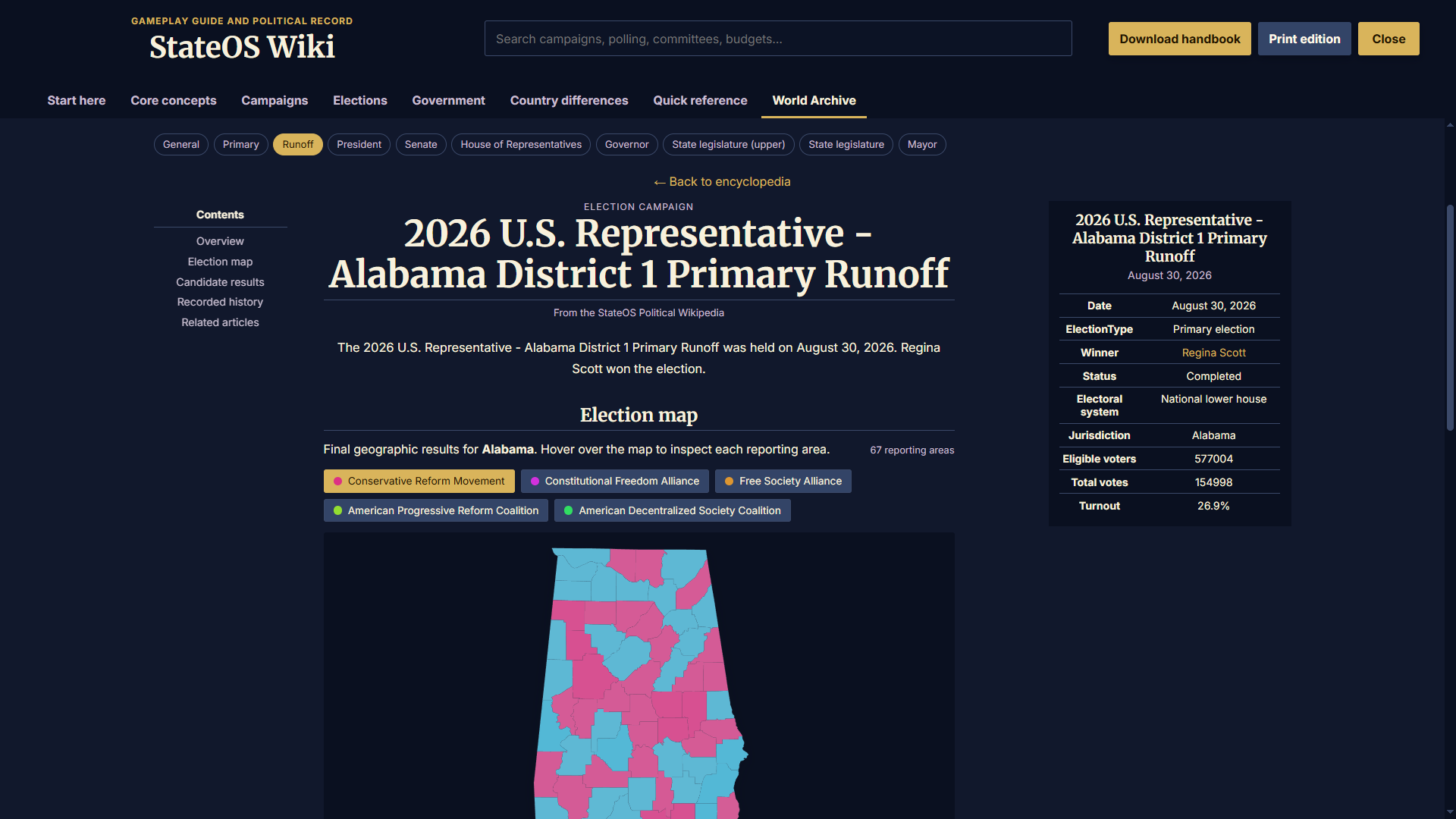
Every election is an article, and they're joined up. An election article links the office's other contests, newest first, each labelled as a primary or a general with its date and winner, and an office's own page carries the same history, so the 2026 race for governor of Alabama leads to 2022 and 2018 rather than being a dead end. Seat number is part of that identity, so one seat's history is its own rather than the whole chamber's.
Results are mapped where a map means something. A governor's race varies across the counties inside a state and gets one; a single House district, state legislative district or Senate seat is the unit being voted in rather than a container of units, so it isn't rendered as one block of colour and called a result map.
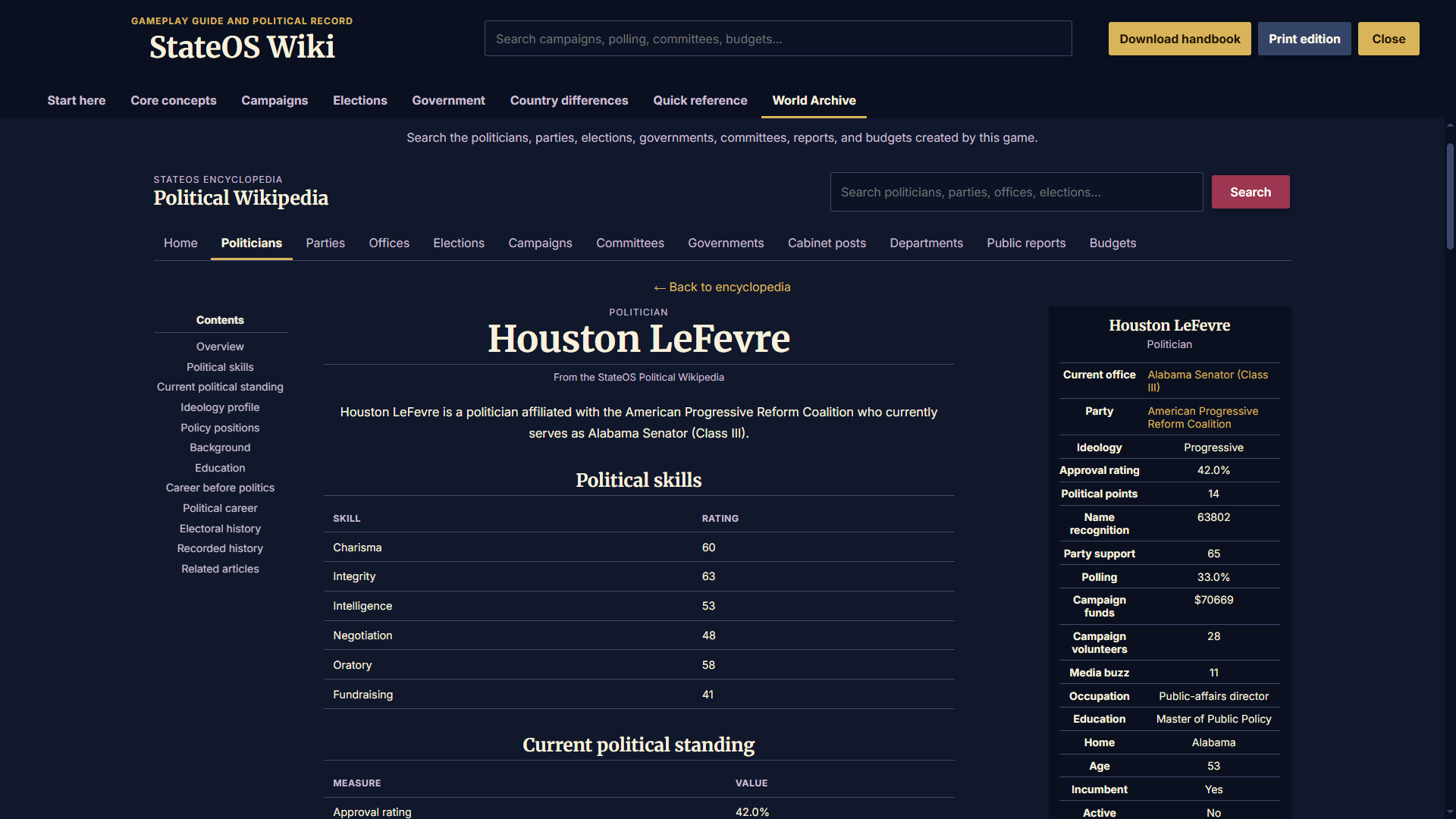
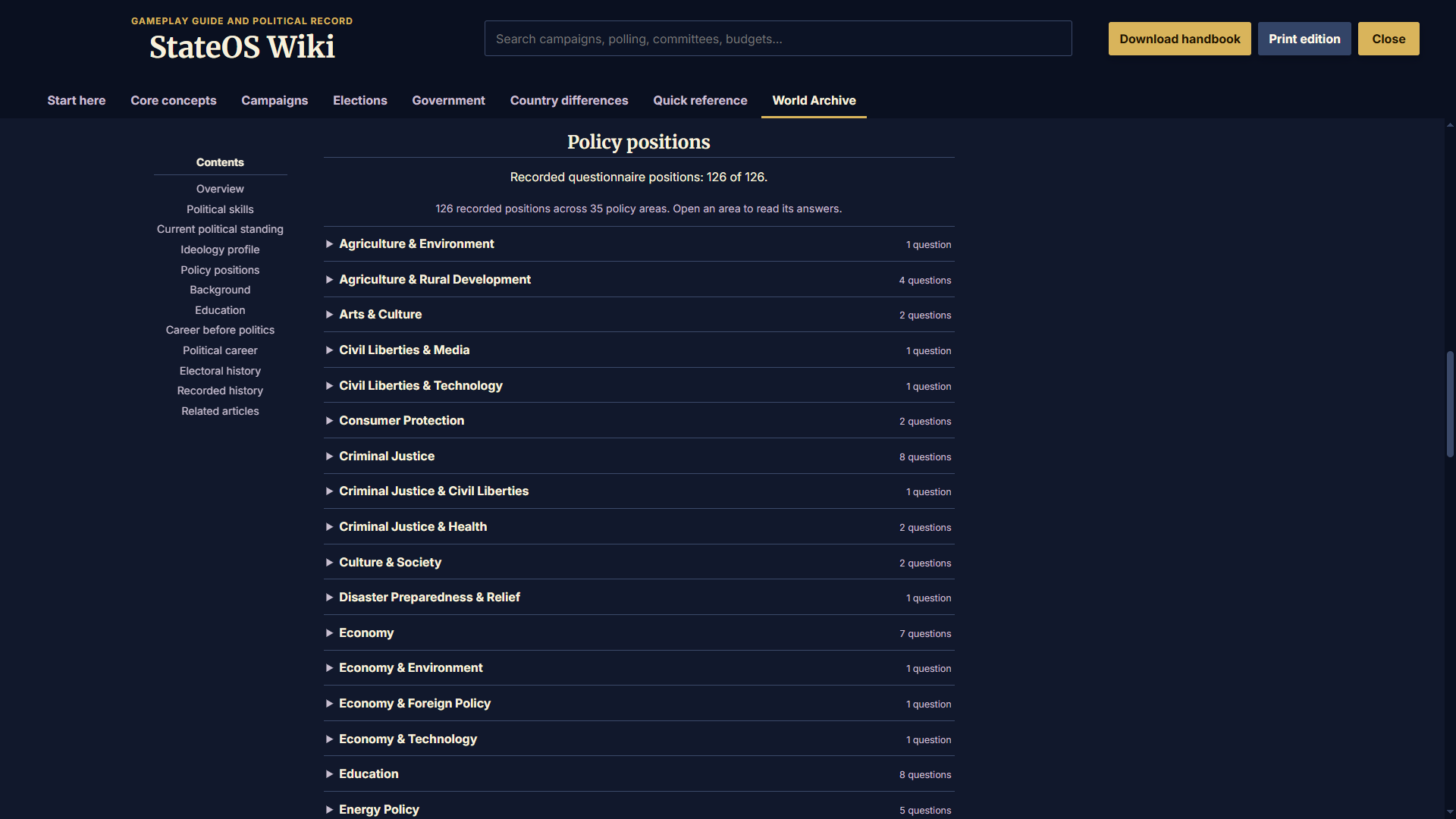
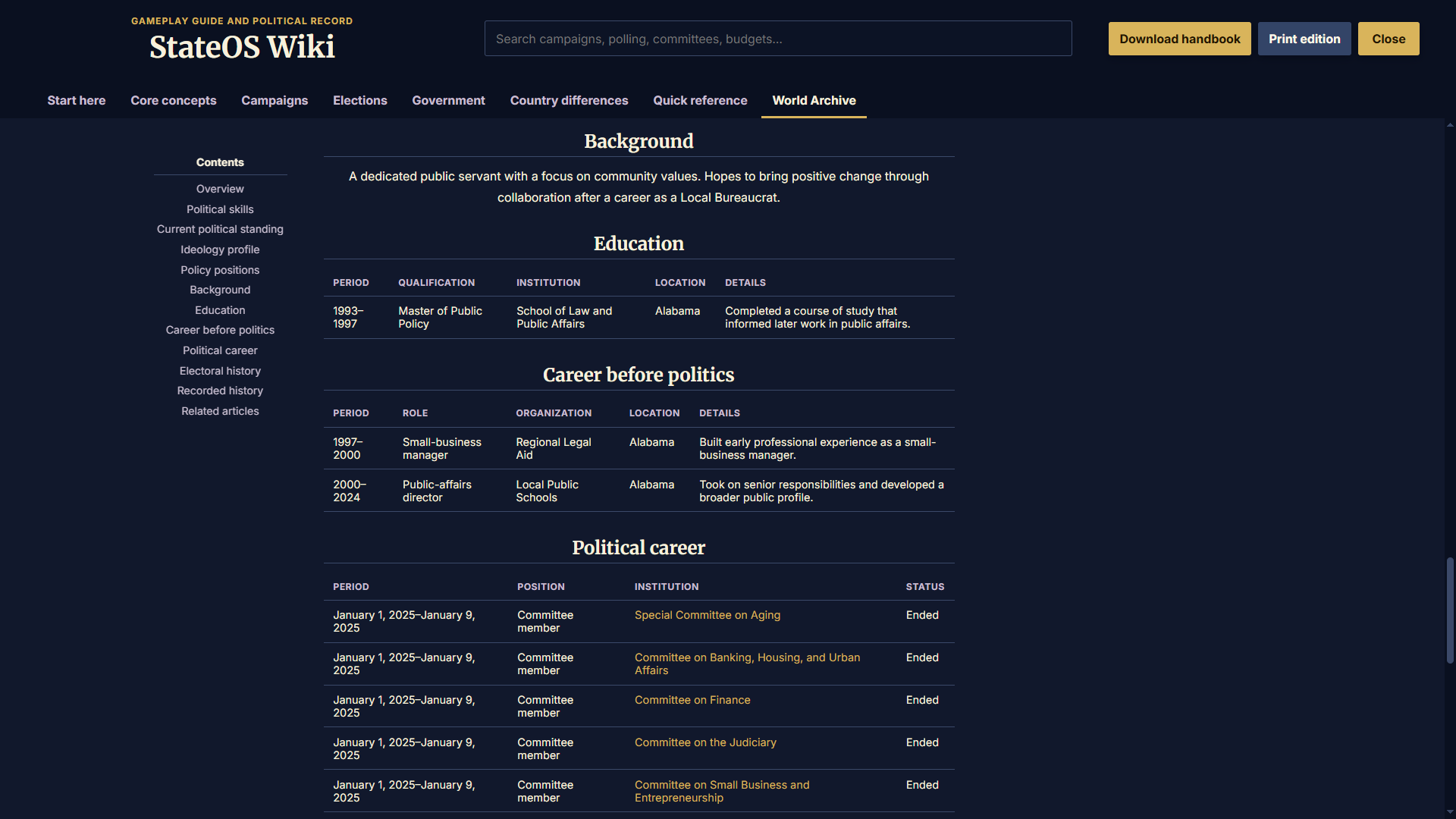
Politicians have generated biographies.
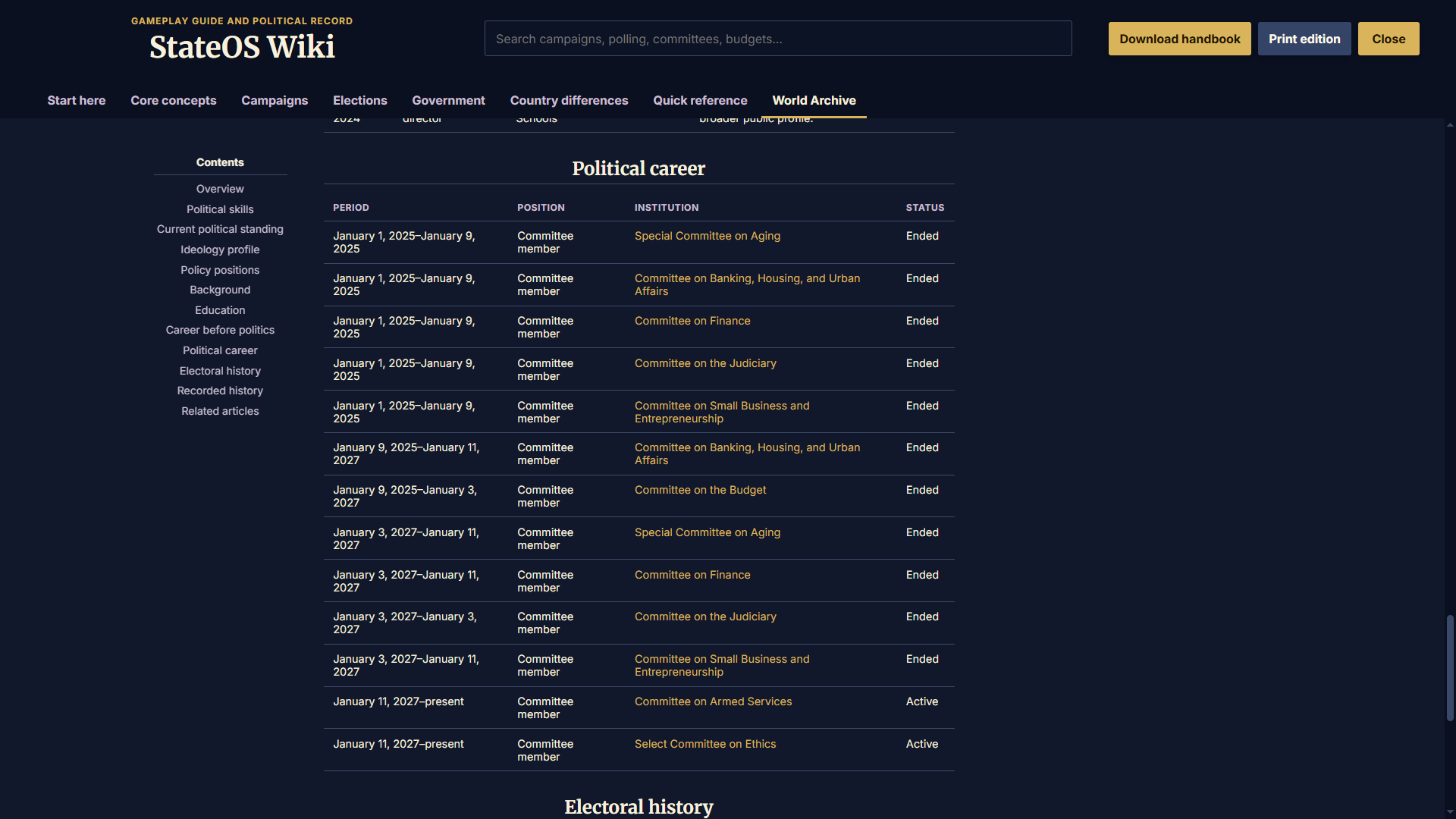
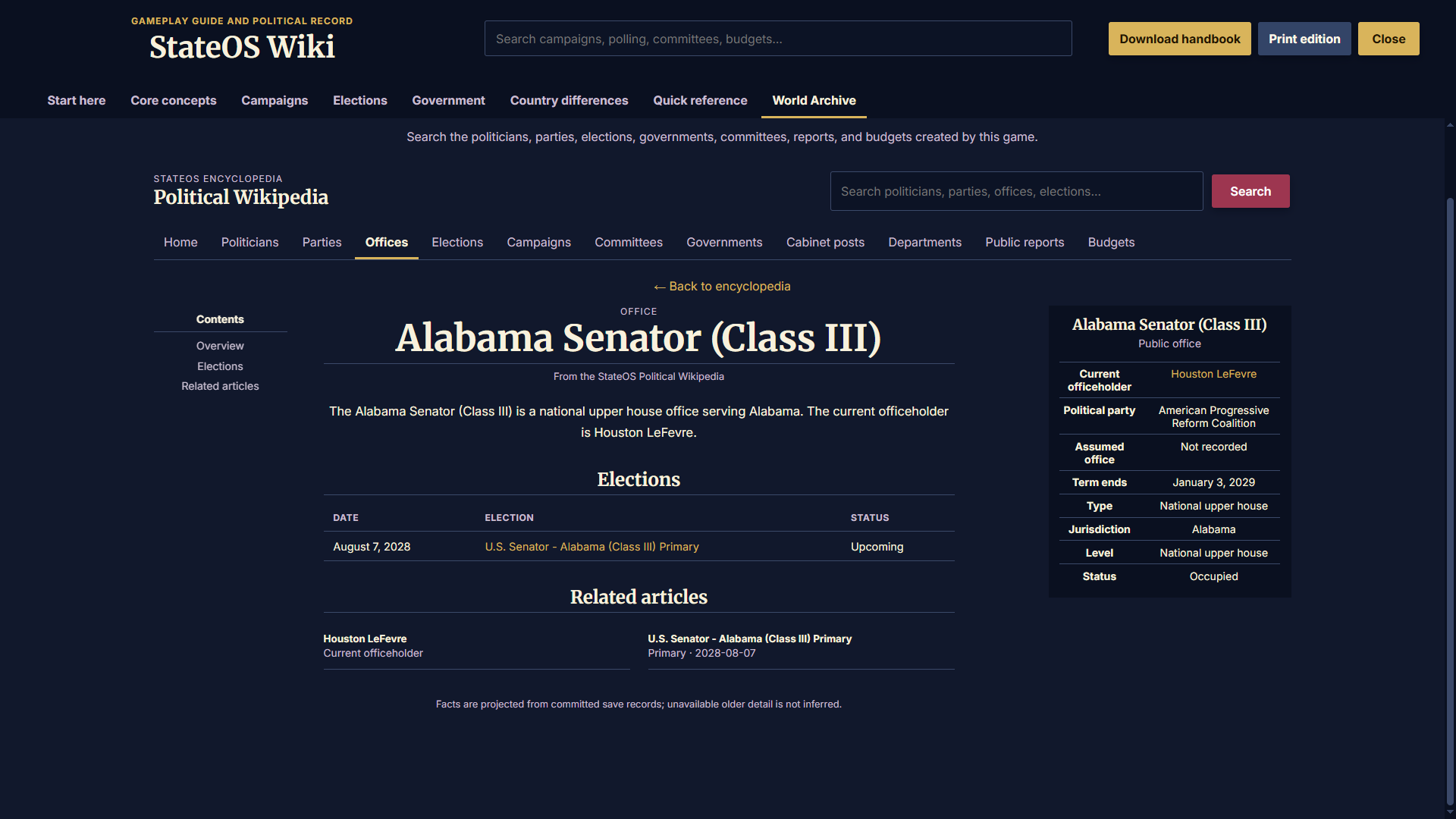
Government Cabinets and Departments
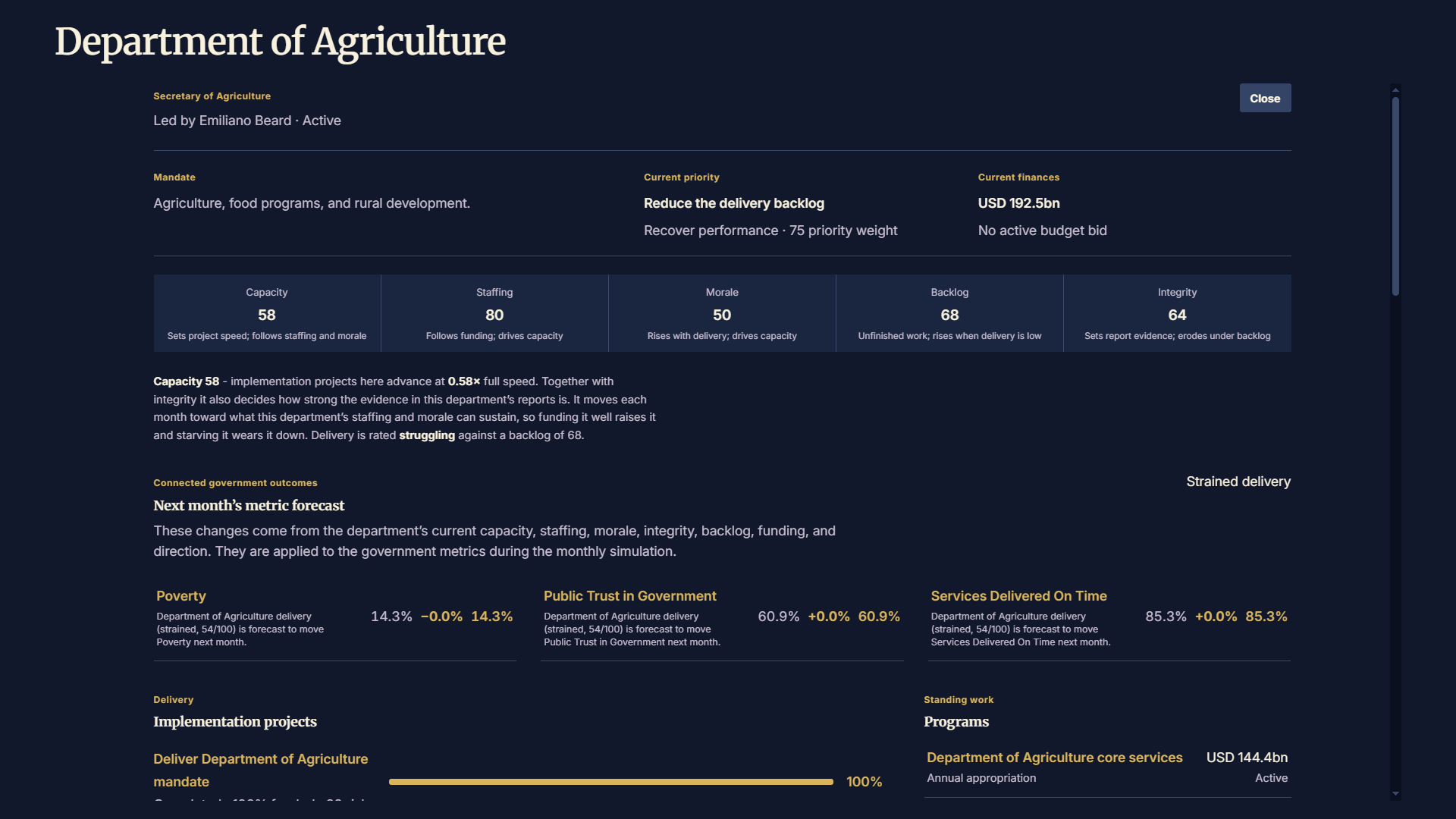
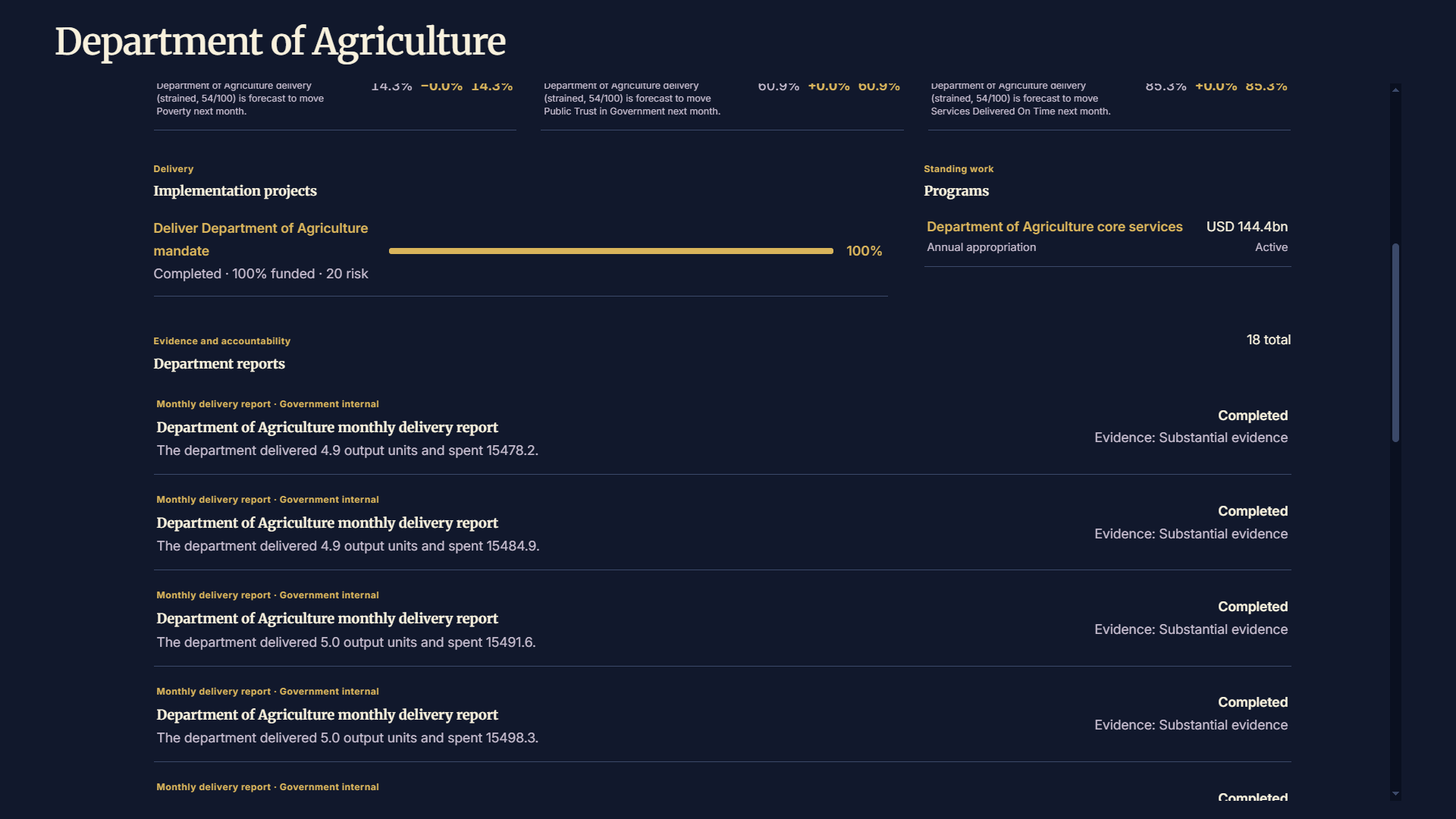
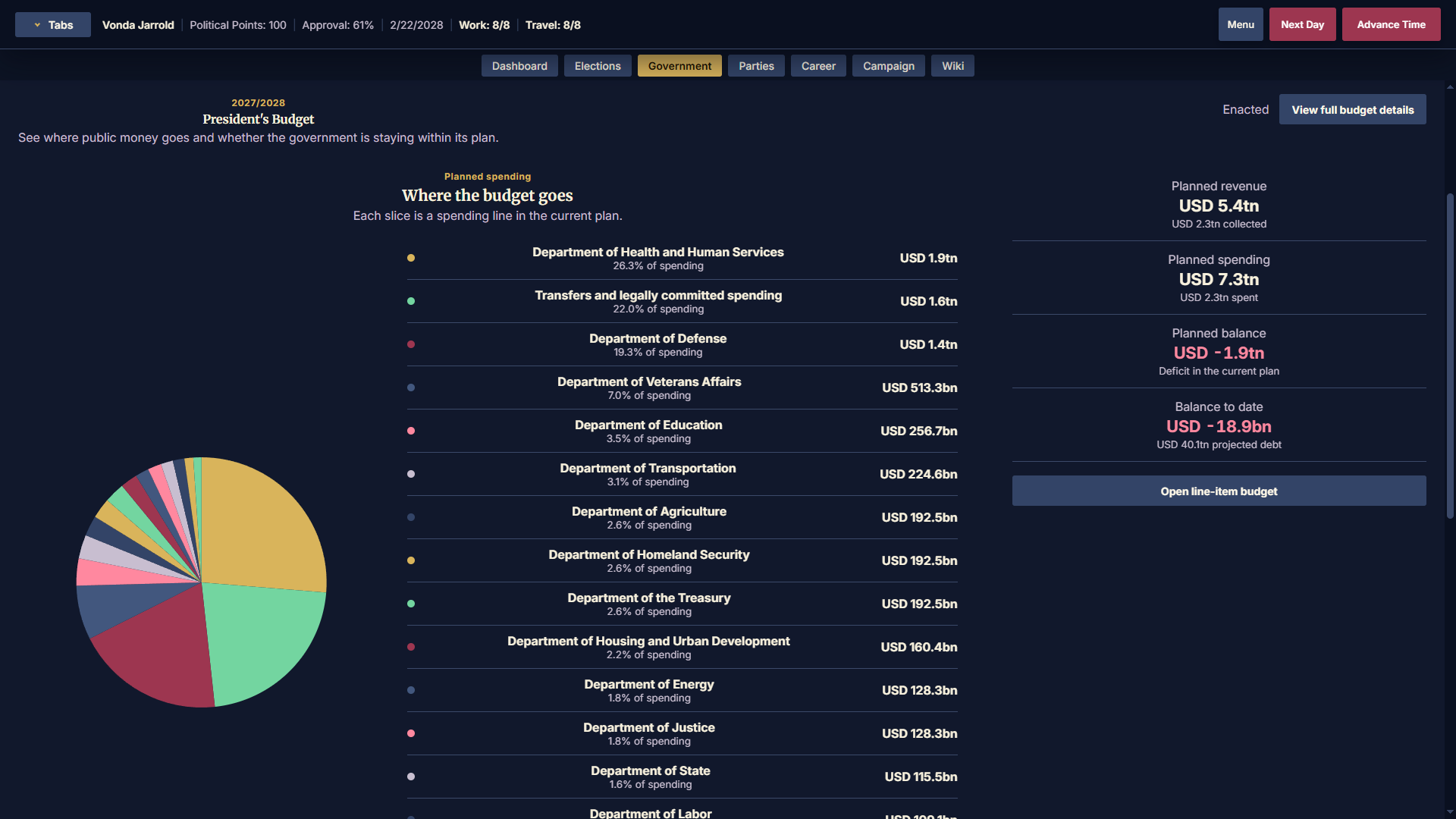
A new executive layer. Appoint your cabinet, run the departments, set the budget, and live with what they deliver.
Choosing someone for a post is the whole of appointing them: it ends the incumbent's tenure and seats the new minister. A new governor inherits their own administration rather than the last one's, and cabinet nominations are voted on where the institution calls for it.
Departments run on a monthly cycle with weekly checks for anything urgent, and what they deliver shows up in the government's metrics.
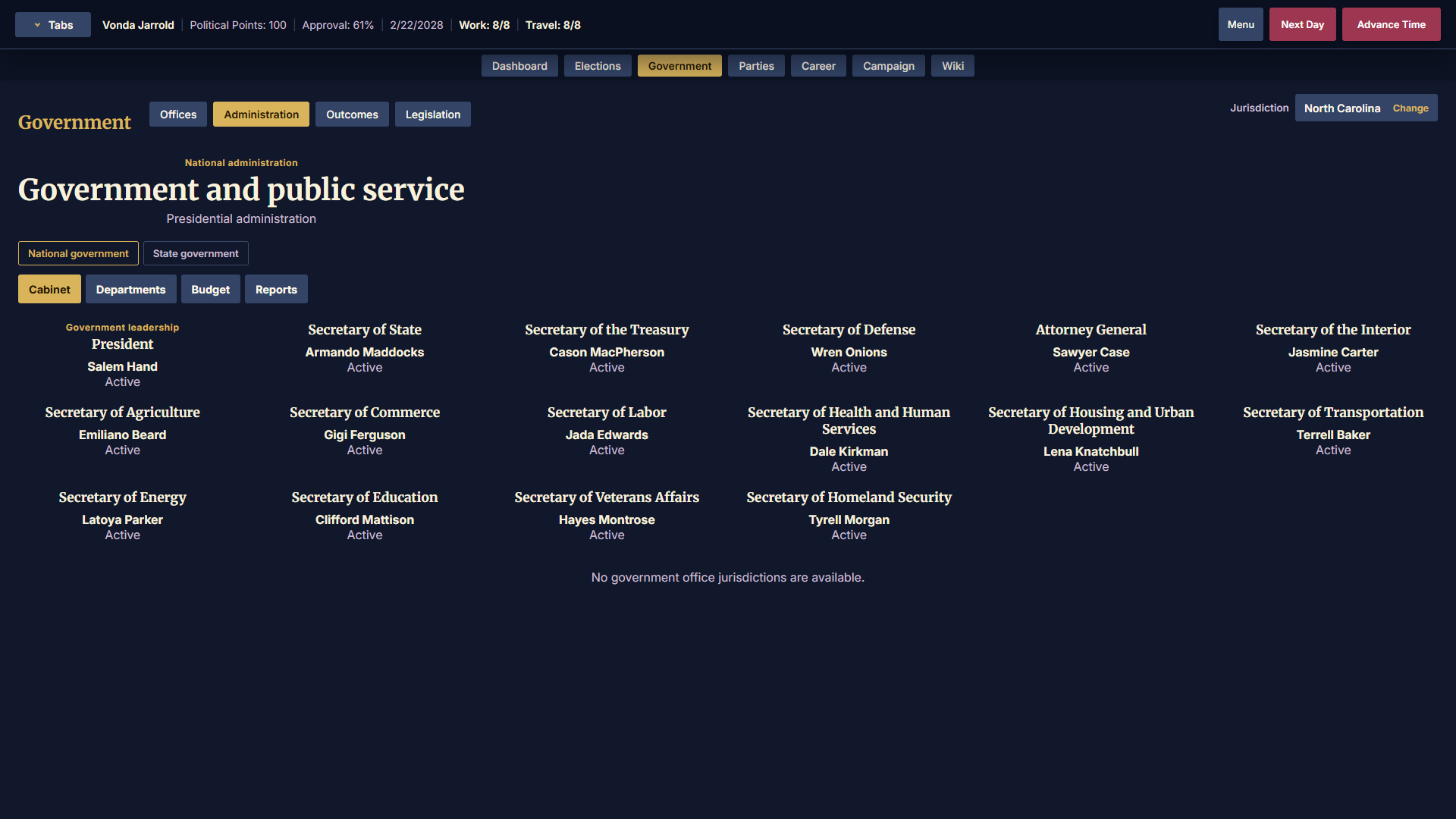
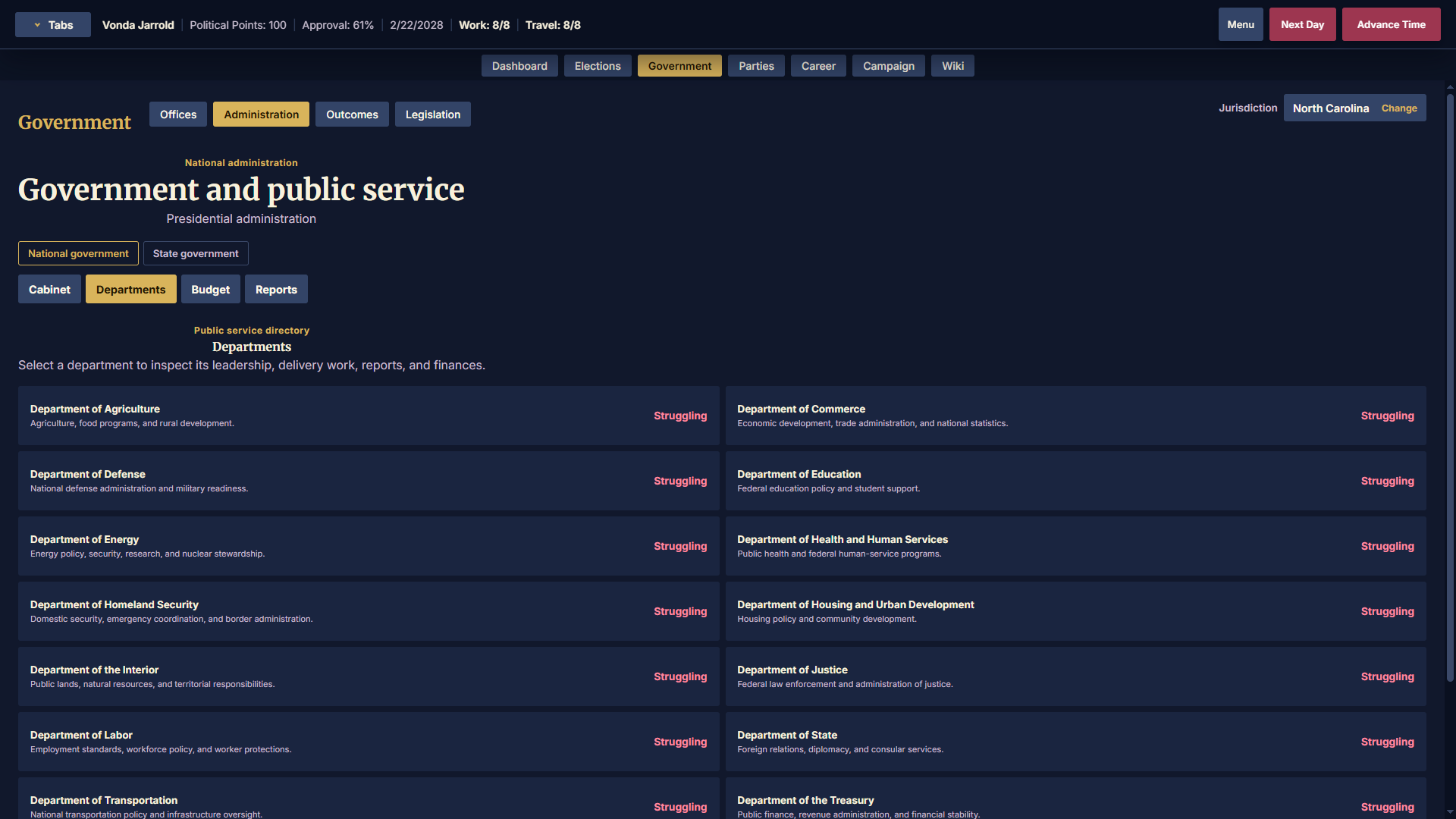
Government Metrics
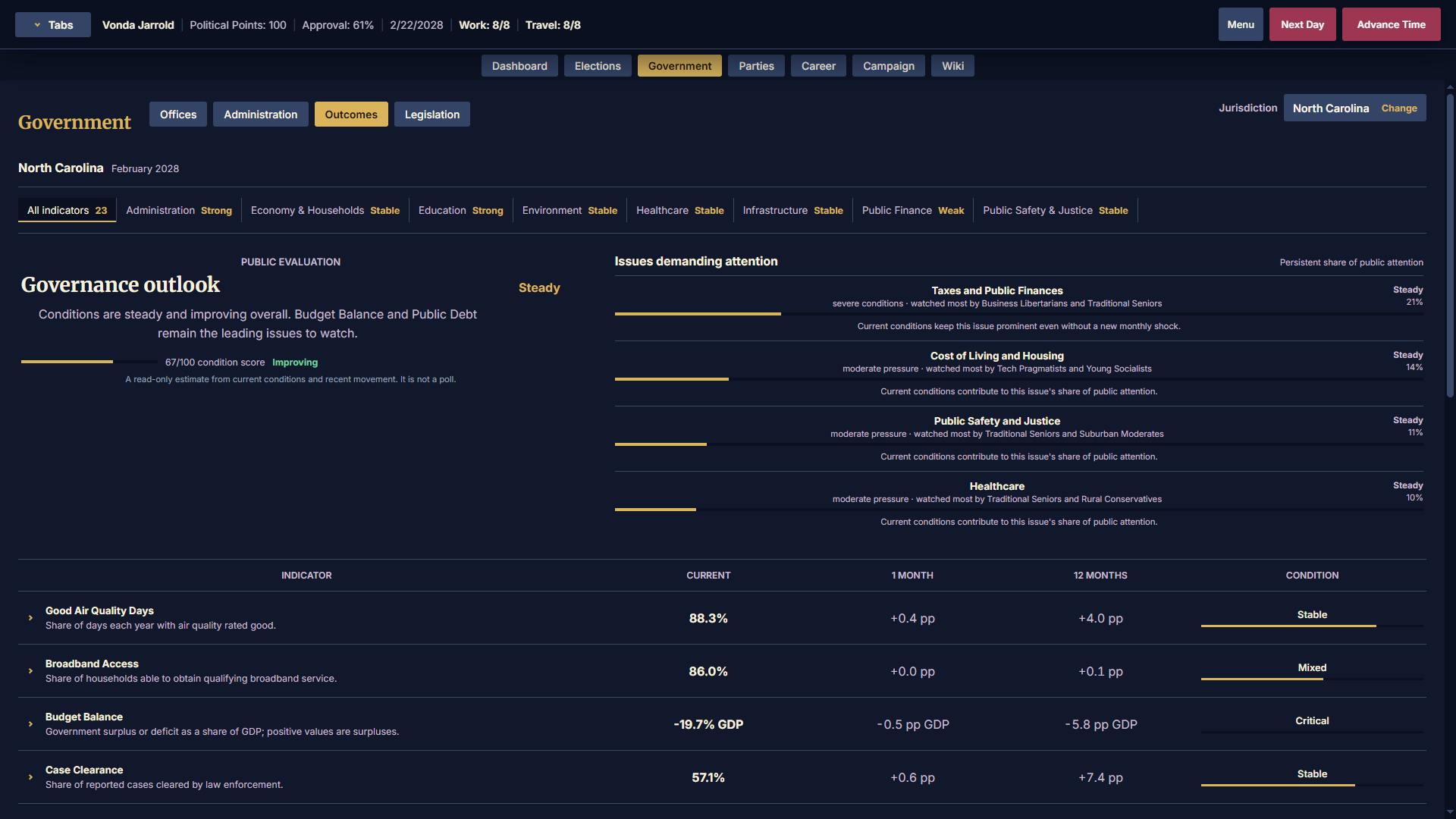
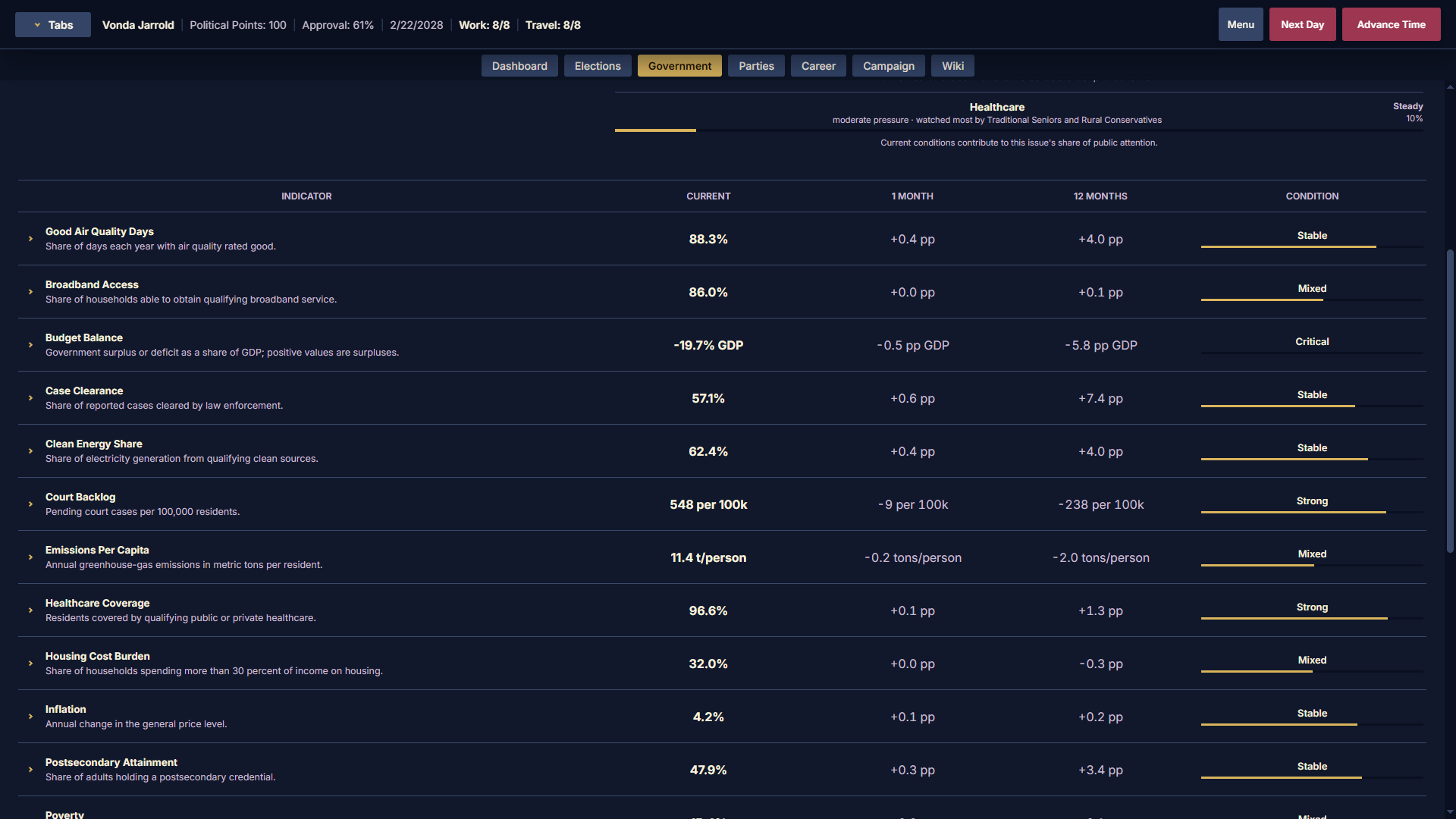
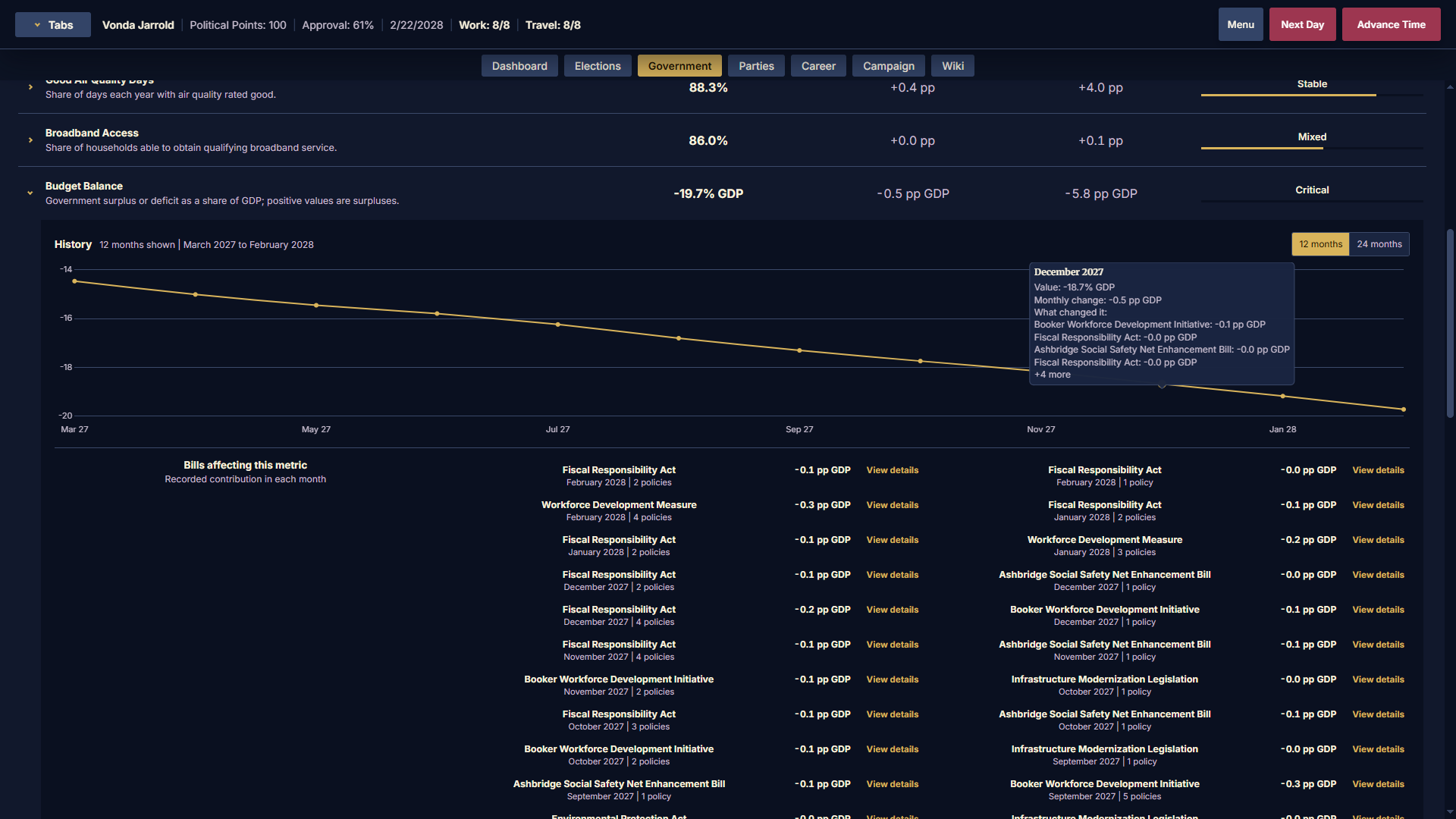
Governments are measured on sixteen indicators across the departments that own them: real GDP growth, unemployment, budget balance, poverty rate, healthcare coverage, housing cost burden, secondary graduation, postsecondary attainment, case clearance, service delivery on time, transport infrastructure, air quality, clean energy share, emissions per capita, defense readiness, international favorability, and public trust.
They're what the coalition blocs read when they judge you, each weighting them by its own attention. Running the departments well moves the indicators; the indicators move the blocs; the blocs move party support. It is the loop that makes governing badly cost you an election.
Party Pages
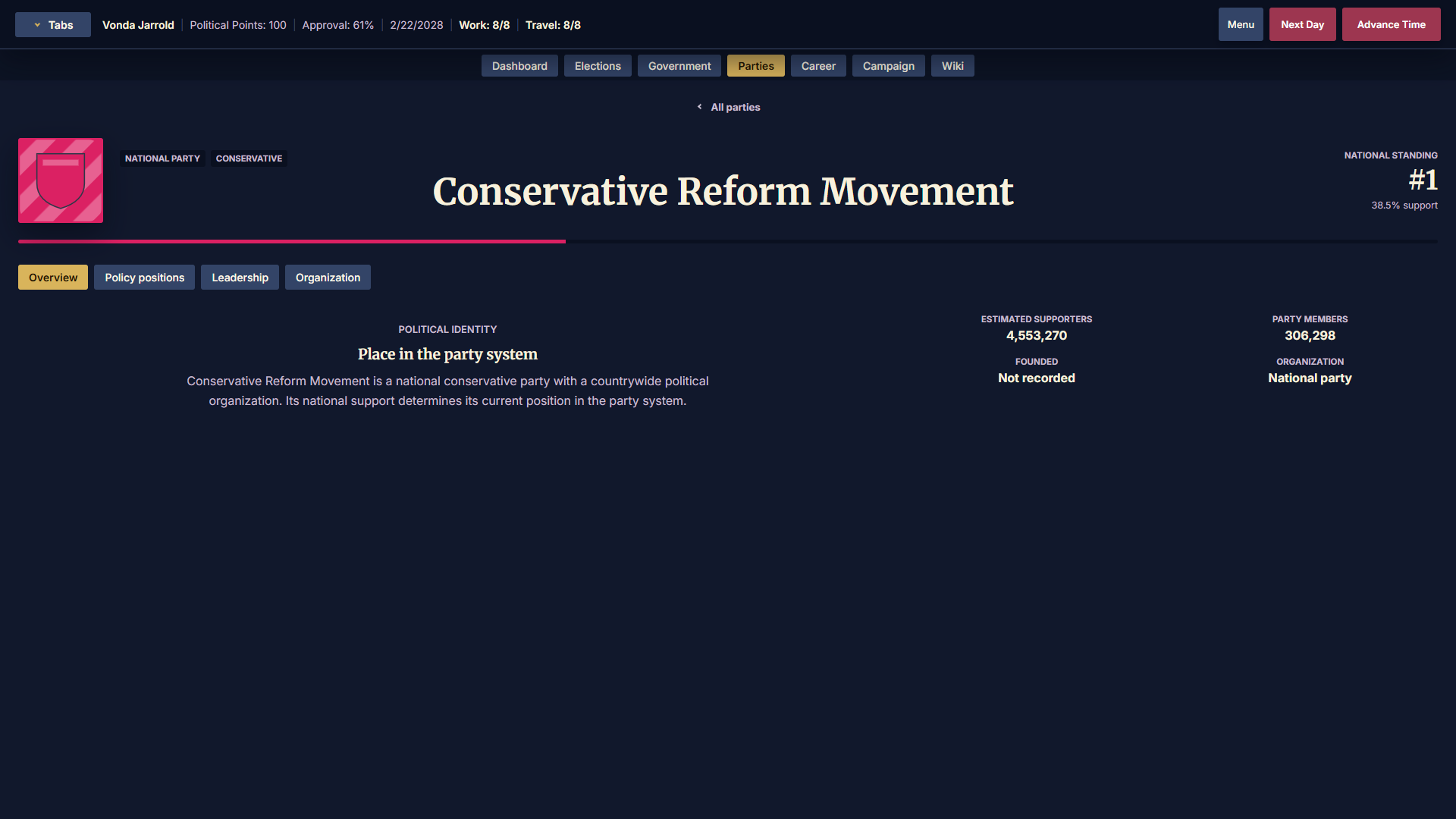
Party pages in the World Archive show a party's seats by chamber, its policy positions, its leadership and its election history, and link through to the politicians who hold them. Also there are regular party pages in the parties tab that show basic information. It is not yet at its former glory yet.
Committees Overhaul
Committees are a real part of holding office in 0.2.
You choose your committee. A new member of a chamber arrives with an empty slate and joins deliberately, ranking preferences and being told what happened: which of your choices you got, who took the seat instead, and whether you were given a lower-ranked alternative.
Chairs are contested. Seniority helps your eligibility, it does not silently hand you a gavel. Standing for chair is its own proceeding, and holding one survives the roster churn underneath it.
Committees run proceedings: hearings, markup, reports and referrals, drawn from each institution's own procedure profile, so a Public Bill Committee, a select committee and a Bundestag committee each do the work that body actually does.
Committees can also be generated, assigned or authored in the scenario editor, and a scenario campaign has committees to join.
Performance Overhaul
A serious pass, with numbers:
Saves are 13% smaller. Two politician indexes covered a column no query ever leads with, while the primary key already started with it. On a real 313 MB campaign that was 40.7 MB of pure index, with every row, column and query still intact. A loaded save drops them once and vacuums to give the pages back.
Clicking a state on election night resolves in about 2ms and allocates 22.8 MB less than it did mid-development, so drilling down through a national map stays instant.
The campaign region screen reads a whole state's counties in one query rather than one each, which is what keeps Texas and its 254 counties responsive.
A Westminster vote day costs 60 to 100ms rather than up to 1.4 seconds, so a 650-member roll call does not stall the clock.
Daily legislation converts each overdue bill once per pass, which matters most for a bill carrying 500+ vote records in its history.
Stability
A long bug hunt ran through this cycle, most of it against systems built during 0.2. The results worth knowing about:
Seat maths. House apportionment, MMP allocation for independents and small parties, and vote conservation across all three candidate allocators are all pinned by tests, and turnout cannot exceed the electorate.
The calendar. Every Senate class comes up for election, seats that were never scheduled get put on the calendar, and a scenario starting before a class base year keeps its own decade.
The clock. Every case found that could wedge the day-advance is closed, including a cancelled uncontested race and a politician dying during a government formation window.
Saves. A save missing a table a migration alters can still be opened, and only one recoverable session is kept rather than every session ever played.
Bodies that should exist. A parliament a member or two short is still a parliament and still forms a government, and committee and party posts are released when their holder dies.