
Hi everyone,
It's been a while since the last Community News post. Much longer than I planned. But I finally have things to show.
This is the first devlog where I talk about actual gameplay and show some of the UI. Everything here is work in progress, so this is a good moment for feedback. Nothing is locked yet. If something looks confusing or feels like it's missing, I can still change it without much pain.
Before the fun part, a short update on where development is.
Where development is right now
I've now put more than 1,700 hours into Resilient so far. I hoped the demo would be ready around now. It isn't, and it needs more time.
The main reason is that my goals for the game kept growing. I don't want Resilient to be one more city builder where colonists are just workers you assign to jobs. I want it to be about managing a community that is still forming. People who have their own thoughts. People who ask you for things, who lean toward certain ideas, and who react to each other and to your decisions.
The other reason is the technical side. I'm building the systems to be flexible, easy to extend, and as mod friendly as I can make them, mostly with a data driven approach. This is my first project of this size built this way, so some systems took much longer than I expected. The good news is that the foundation is mostly developed now, and adding new mechanics is getting a lot faster.
What's already in
Colonist personality attributes
Colonist traits
Colonist skills
Colonist ideological leanings
Colonist thoughts
Colonist requests and reactions to your decisions
Group creation and management
Order creation and management
Inventory and storage
Road building and various modes
And the boring but necessary stuff: saving, settings, menu transitions, keyboard navigation for the UI, camera modes and camera controls etc.
Here are the systems I'd like to share with you today. Your feedback on concepts and interface clarity is very valuable.
Starting Colonists
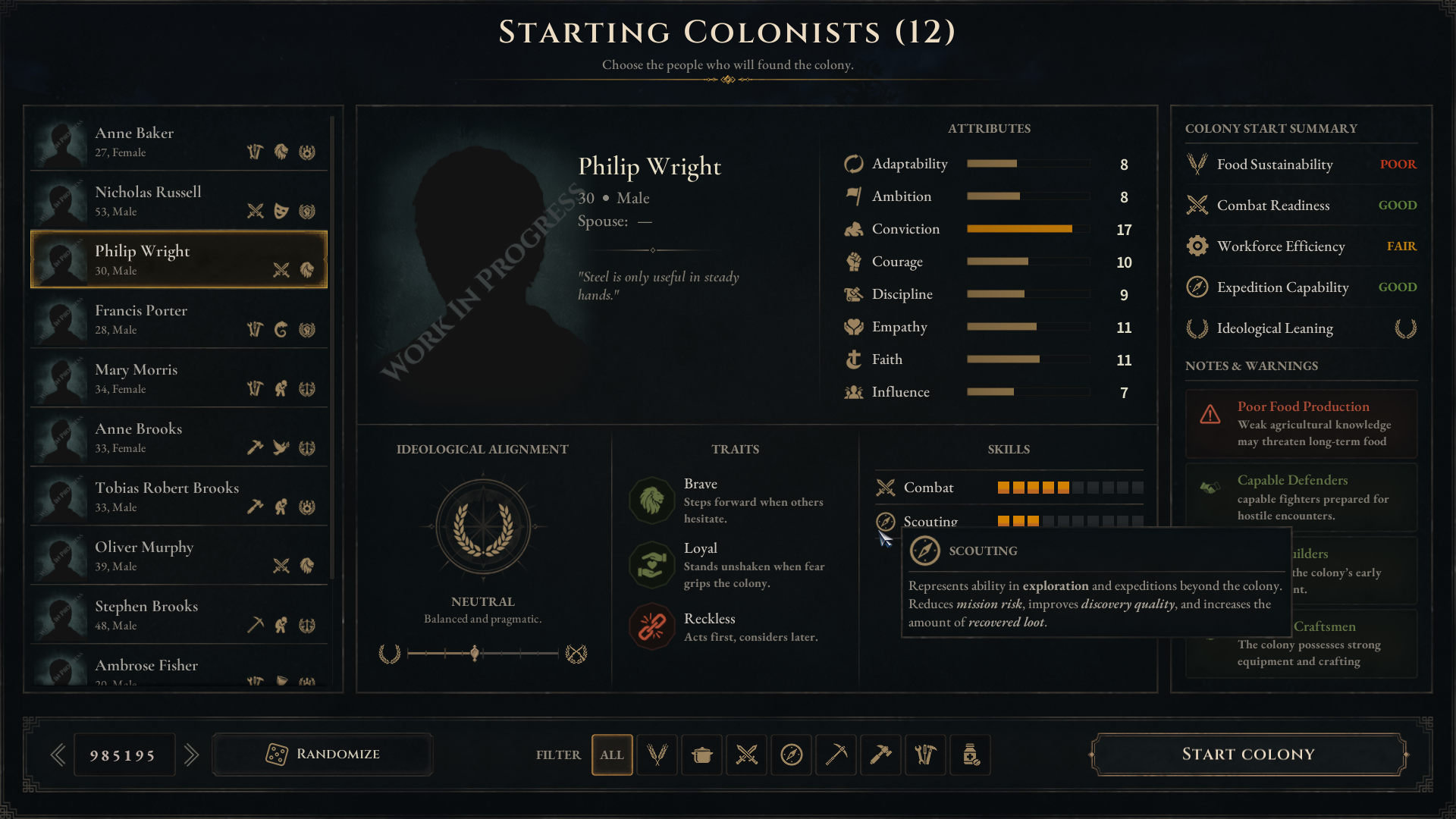
Game starts with you picking the 12 people who will found the colony. Each colonist comes with personality attributes, traits, starting skills and an ideological leaning.
Attributes and traits never change. Skills do. Colonists get better at things by doing them. Ideological leanings can also shift over time, depending on who else she/he interacts with in the colony and what you decide.
You can type a seed, or just hit randomize until you get a group you like. The panel on the right looks at the group as a whole and shows where it's strong and where it's weak. If nobody knows how to grow food, it warns you. Same for combat, building and expeditions.
Looking for one specific skill? The filters at the bottom highlight the people who have it.
Traits and attributes change how colonists work and how they behave when things go bad. A brave colonist reacts to a crisis differently than a cowardy one. Discipline, ambition, and the rest affect both performance and behaviour.
Skills decide how well someone does the job. Doing the same work over and over raises the related skill, so your veterans become more reliable.
Ideological leanings decide how people react to your decisions. If you answer a request with diplomacy, colonists who already like diplomacy will support you. The ones who don't will be unhappy about it.
None of this locks you into a playstyle. You can start with a very diplomatic group and still run the colony like a military camp. New people arrive, old ones get influenced by what you do, and the identity of the colony slowly changes.
Thoughts, Requests, and Reactions
In the video you can see colonists forming thoughts, asking you for things, and other colonists paying attention to it. Every answer option shows how many people in the audience support it, oppose it or don't care. The panel on the right shows what will happen if you pick that option. And your answer can create new thoughts too.
Colonists build up thoughts over time and after events. A thought can heve good or bad effects.
Requests come out of these thoughts. A colonist needs enough reason before a complaint turns into a real request. That can be a few related thoughts, or one very strong one.
When a request shows up, you see a raised hand icon. Althought there will be a single hand icon on a colonist, many colonist might be part of that request. Not everybody cares about it. Some people are directly affected, some are just curious, and the rest ignore it. Hover over the audience indicator to see who is watching. Only these people are affected by your answer.
Support is not calculated the same way for every request response. Depending on the subject, colonists judge response by their ideology, by their relationships with subjects, or by their traits and attributes.
You can hover over the support indicator to see exactly who is in each group and how strongly they feel.
The outcome panel on the right shows what each group gets. Supporters, neutrals and opponents can be affected differently. Anything extra is listed at the bottom.
In the video I pick the less authoritarian answer, so the game reads it as a diplomatic decision. It solves the request, and it also pushes the audience a little bit toward a diplomatic ideology. Small decisions like this are how the colony slowly gets its political character.
No Fixed Professions - Groups and Orders
The video shows how work is organized in Resilient. There are no fixed professions. Instead, you build your own system with groups and orders.
Groups are the base of everything. You decide which groups the colony needs, and you give each one a name, description, color and icon.
A group is not tied to one type of work. You can put several orders in the same group and set the priority for each. The orders don't even have to be related. One group can gather resources, hunt and do other jobs, however you may want to organize things.
Colonists can be in more than one group. So they don't stand around doing nothing when one job isn't needed right now. They just move to the available work in their other groups.
You add orders from the group panel. Some orders need extra settings. A target area, access to some equipment, things like that. For example, a chop trees order only works if the group has access to axes. You manage all of this from the same panel.
The idea is to give you more freedom than the usual profession system. But more freedom also means clarity matters more. So I'm curious: is the connection between groups, orders and equipment access clear enough in the current UI? Let me know.
Building Roads Freely
The video shows how roads are drawn and removed. Next to the normal spline tool, I added a freehand mode and full control over road width.
Roads are built instantly and they cost nothing. Removing them is also free, so you can play with the layout as much as you want without paying for it. Right now there are three tools:
Straight Road
Spline Road
Freehand Road
For straight and freehand roads, you hold the mouse button, move the cursor and release when you're done. Spline roads are placed point by point. Every click adds a new control point.
You can change road width and spline curve from the UI or with keyboard shortcuts. Shortcuts help a lot with the straight and freehand tools, because your mouse button is already held down while drawing.
Removing works in a similar way. You don't have to delete a whole road at once. Hold the button and you erase only the part you want. If you want to delete a full section you made in one go, just Shift-click it.
There is no grid snapping for road tool for now. I wanted to give you flexible tools for natural, organic layouts first.
All the systems here are still in development, and parts of the UI may change before the demo. The colonist portraits are placeholders too. Paid art will replace them later.
This is the first time I show these systems in detail, so I really want to know if the main ideas come across from the UI and the videos.
A few things I'm wondering about:
Does the starting colonist screen give you enough to compare candidates, without being too much at once?
Is the flow from thoughts to requests to audiences to reactions easy to follow?
Does organizing work with groups and orders make sense, or are some parts still confusing?
Is there any info you'd expect to see before you make a decision or give an order?
The systems already work. The UI is still flexible enough to change in a real way. So feedback right now really helps. It's much easier to fix a confusing screen today than after everything is locked.
Resilient just passed 93,000 wishlists. Thank you to everyone who kept following the game during this quieter stretch.
The demo still needs more time. I don't want to give a date until I'm sure I can hit it. But things are moving, and a lot of the groundwork the demo needs is done now.
There are still systems I didn't cover here, and I'll share more of them as I go. For now I hope this first look gives you a better idea of what I'm trying to build with Resilient.
Thanks for reading.