
Even though pacing has become a popular lens through which we analyse media, the general structure of video games is still underdiscussed. Sometimes, that’s probably an aftereffect of the level-by-level logic used in early arcade gaming, sometimes writers simply take the structure of films or TV shows for granted, with mixed success. But since all of this has a MASSIVE impact on the overall experience, today I’m going to dissect the structure of Monster Girl Therapy. A monstrous example, so to say!
SPOILER WARNING from here on!
Macromonster
First, the game as a whole, starting with the basics:
There is an intro that introduces (duh) the overall concept and the protagonist as briefly as possible. 2–3 minutes may not sound like much, but in a text-based game, I wouldn’t want to ask much more of the players. The setting is established along the way or simply relies on stereotypes in people’s heads. After all, the players are here for the monster girls and THEIR rambling!
After that, they can take a walk on the deliberately compact map. Besides five locations with monster girls, it’s also possible to find “corrupted” data remnants that illustrate the setting and tone through a short dialogue. As players continue exploring, they can also discover dialogues between multiple monster girls, essentially functioning as secrets. I affectionately nicknamed them “Bechdel nodes”, if only in my head. ;D
Once you’ve completed the first level of all five locations (more on that later), the path to location number six opens, where the finale takes place; a classic point of no return. The finale, in turn, draws on the events of the previous five locations and brings them together thematically.
All in all, the game usually takes between 3 and 6 hours to complete.
What may catch your eye here are the numbers: 6 “real” monster girls really isn’t that many, and although the corrupted encounters are meant to at least reinforce the FEELING of a lived-in world, I opted for a relatively small cast for several reasons:
Depth is obviously more important than quantity. After all, this game is about people’s inner worlds!
The world is dying. Anyone still here is an exception, and every exception has a specific reason.
At the same time, it’s obviously important to strike a balance, not only for the sake of variety, but also to illustrate the diversity of psychological situations in which players encounter these women.
The second number is the playtime. Beyond pragmatic questions (“How many years of my life do I want to spend working on this game?”), I always think it’s important to ask how long a game’s concept can actually sustain itself, at which point players have had enough of it. In my opinion, many video games would benefit from being a little more self-critical in that regard.
A VERY interesting topic is the player’s freedom to choose the order of events. And first of all, I have to say that “free” is, of course, relative! From the starting position, Shaliva and Equitania are literally the closest locations, and experience shows that this is exactly where most players begin… Which works out nicely, because the two of them provide perhaps the most “solid” introduction! (Incidentally, that’s one reason why I increased the time limits in Equitania’s minigame with an update: the higher difficulty generally fits her, but as an introductory encounter, it scared off quite a few people!) Players who take a “detour,” however, might just as easily end up with Cat, the Madame, or S’Sinbal first, and that can make for a somewhat rough first impression.
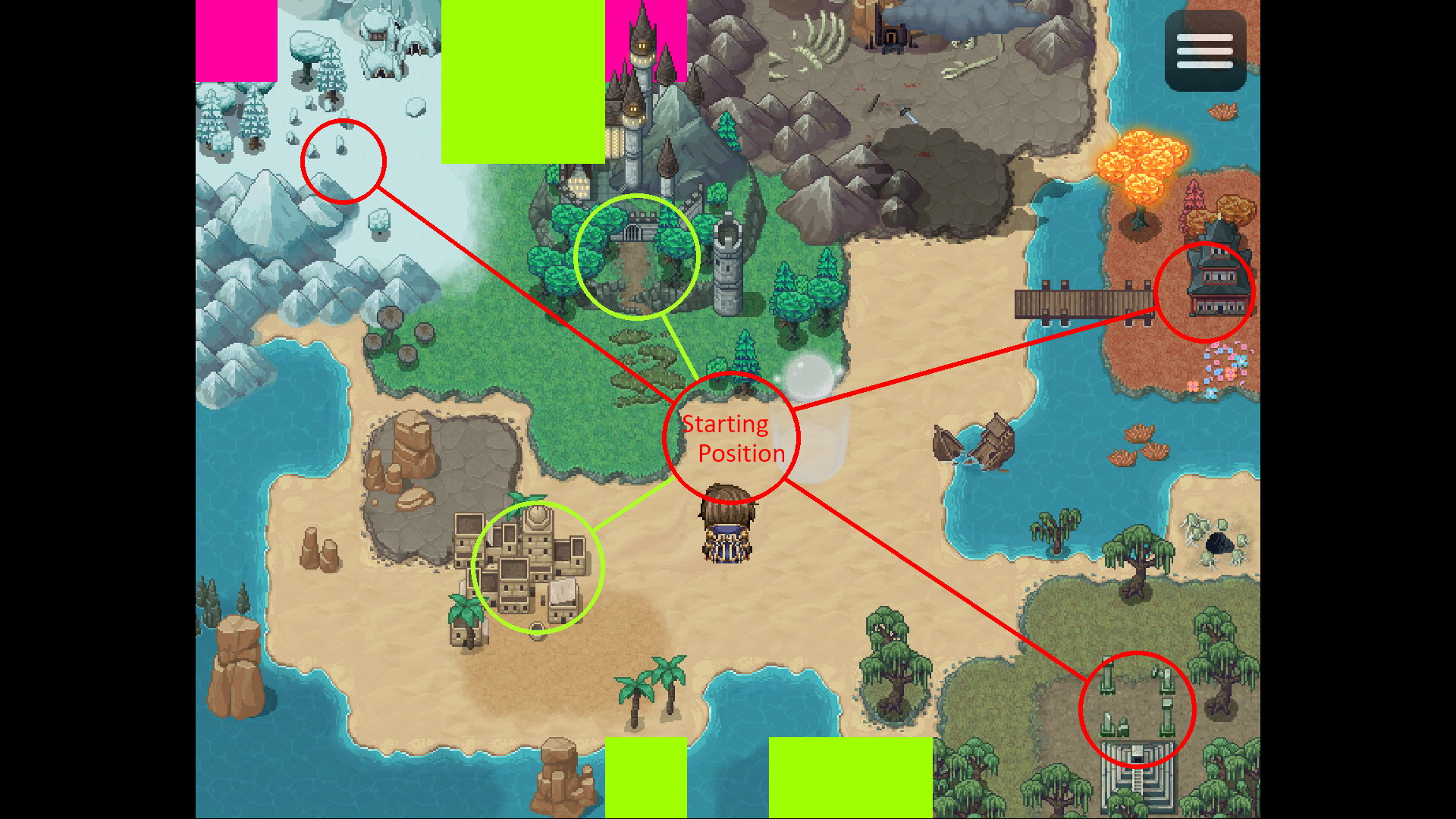
I’ve also received feedback that a fixed order would allow for more focused storytelling, that the story could build up much more effectively that way. And that’s definitely true, point taken! Maybe it would even have been more effective overall. I still kept the open structure to emphasize the feeling of exploration, and the agency that the protagonist has.
Micromonster
Now for the encounters with the six monster girls.
Each encounter consists of mandatory dialogues, optional question-and-answer dialogues, as well as minigames. Every minigame has two levels: a relatively simple first one that’s required to complete the game, and a more difficult second one that helps you truly understand the respective monster girl’s problem, allowing you to have the most positive, empathetic conversation possible during the finale. For Shaliva and Lash, this second level also determines whether they leave the game or not. (No, there is no way to “save” Cat! I absolutely wanted that facet of the theme to be part of the game.)
And exactly that is already an interesting tension: the encounters have to feel coherent and satisfy the players in a certain (limited!) sense, even if they skip the optional questions and only complete the first level of the minigames. That means all essential information belongs in the mandatory dialogues, while everything optional may “only” serve to deepen the characters and further explore—or even relativize—their problems.
“Satisfy the players in a limited sense,” however, is exactly the point: this game is about understanding, so it’s perfectly fine if an incomplete, superficial encounter leaves you with a hollow feeling in your stomach. In practice, the mandatory dialogues are meant to motivate players to really get to know the monster girls through optional content.
And that leads directly to a question: just how optional is all of this “optional” content REALLY? The vast majority of players naturally attempt the second level of the minigames. And do you even get the intended experience if you rush through the game in 2 hours? Maybe that’s one possible experience, one that’s even thematically appropriate in some way—but whether it really gets the point across…? I’m not sure. And in that sense, it could certainly be a design flaw.
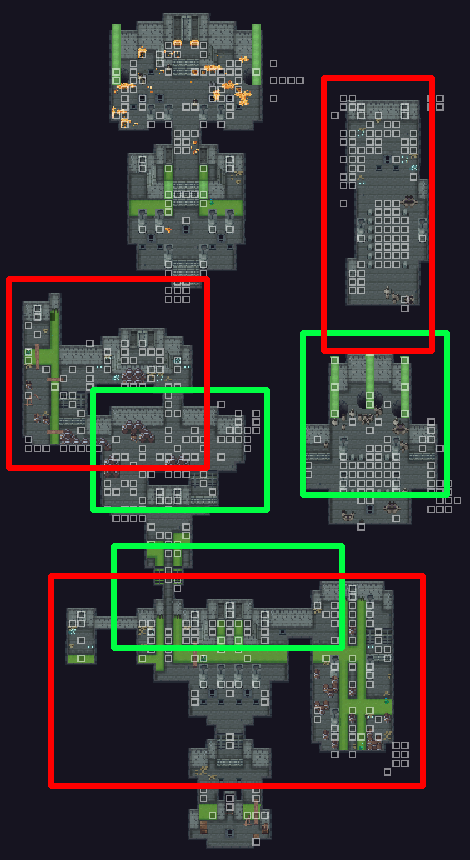
From the bird’s-eye view in the sewers, you can clearly see how the first level of each of the three puzzles (in green) conceals a second level (in red):
Another important aspect is that, despite all this careful structuring, the encounters should feel deliberately individual in a few ways. After all, psychological problems shouldn’t be lumped together any more than people themselves.
That starts with the fact that the minigames are extremely varied—honestly, some of them shouldn’t even really be called minigames! (Which made for an “interesting” marketing challenge… “minigames & puzzles” is much catchier!) The encounters with S’Sinbal and Cat are also SIGNIFICANTLY shorter than the others, simply because it’s easier to explore their situations with the necessary depth. In practice, that means they each have only one node with a single set of optional dialogues, whereas Shaliva, Equitania, and the Madame each have three nodes.
Most importantly, however, the minigames in general—and especially the requirements for the respective second levels—are conceptually tied to the characters. With Equitania, it’s all about becoming even better on the exact same courses (WITHOUT an easy mode!), while Shaliva’s second level is much more about actively uncovering hidden secrets, by enduring additional friction (albeit WITH a little support, if needed). At S’Sinbal’s, the goal is to see through layers of complexity. With Cat, it helps to really vibe with the rhythm of the game. Meeting the Madame, you need to work through confusion and the feeling of being overwhelmed. And finally, during Lash’s finale, you can probably brute-force the first level, at least with a few extra attempts… But the second level? Having actually UNDERSTOOD the other monster girls will help you massively!
Without monsters
So much for Monster Girl Therapy. Looking at the various reviews, you can often kind of tell whether this structure worked for a particular player or not, and where problems may have come up.
Of course, this specific structure won’t work for every game, but that’s also not really the point. If I had to boil all of this down to a general design philosophy, we’d once again end up with the single best piece of advice there is: intentionality! Why is the game structured the way it is? And what exactly does that answer contribute to the intended overall experience?
Thank you for reading!