
First and foremost, I’d love for women, non-binary folks and everyone else to play Monster Girl Therapy. But the character you’re playing? He’s a guy, as cis-het as they come, and definitely not someone who would even use words like that. This blogpost explains how the game makes sure you know that—and of course why!
Celebrating the gender reveal
I know for a fact that a specific moment of my game has hurt its financial prospects. (In case you haven’t played yet, no story spoilers… yet!) Right off the bat, you have to choose an avatar, and you’re shown a bunch of archetypical fantasy characters, clearly divided into two gendered sections. If you go for a female avatar, the protagonist refuses and deletes the corresponding choices from the game.
“Wait, no! That’s a girl, isn’t it?
I’m a guy, so I’ll take one of the guys.”
After that, only the “guys” remain, and you’ll also get an achievement. Congratulations!

As you can see, two thirds of all players tried to pick a female avatar at some point, and when promoting the game, I actually got quite a few comments like this one:

I also heard from one person who refunded the game in this exact moment… Which is of course somewhat unfortunate (I hope they would’ve liked it!), but I also get it. In fact, I think it’s really cool that people want to play their monster girl games as girls! Unfortunately, this was never an option.
But first, what exactly is happening in this scene?
Making the protagonist of Monster Girl Therapy male is not enough: The player, whoever they are, needs to be conscious of this as well. This might sound self-evident, but especially non-male players have identified with male avatars for decades, projecting their own identity onto them. Consciously or subconsciously, they might imagine the protagonist as any gender, which isn’t helped by the pixelated chibi characters of an rpg maker game. So essentially, the game is TESTING the player’s assumptions, and “correcting” them before the game even starts!
If the player chooses a male avatar, the game does literally nothing. It simply assumes the “correct assumption”, which is a gnarly little simplification, of course… but I think it will suffice in most cases. If we have these assumptions, why not use them?
By the way, the achievement is not only a joke, but also a safety net underpinning this correction. It says: “Hey, something interesting is happening right now!” (But it also is a joke. I’m sorry!)
Of course, the protagonist’s little comment also gives a good chunk of characterisation: 1. He sees himself as a guy (cis implied). 2. He differentiates betweens “guys” and “girls”, using these specific terms. 2. He can’t even IMAGINE using a female avatar. Now, none of these things should be read into too aggressively on their own, I think, but in the context of the game, it’s an interesting first look at his world view.
Additionally, this decision also implies a thing or two about the game the protagonist is entering: Even though it offers a somewhat free choice of stereotypical avatars, it divides them up by gender, with no gameplay effect at all.
Finally, I said before that the character needs to be “cis-het”, but the “het” hasn’t come up yet… which is a conscious decision as well. Apart from an interesting scene or two later on, he never thinks about being heterosexual. Because that just means being normal, doesn’t it …?
Is this … a character?
Okay, now players know about the massive male in the room. But why does the game not just GIVE them said massive male, with muscles, loincloth and everything? Why do they get to choose? And why is all of that important for the game?
We’re entering conceptual spoiler territory now. You’ve been warned!
The avatar is really important as a lense for the interactivity of video games, and I’d essentially differentiate between two “tasks” such an avatar can have:
They are a character. They have their own life and character traits, and most likely even some secrets. If you make decisions as a character, you are thinking: “What would they do?” Characters can be understood and interpreted, but even if we identify with them to differing degrees, there will always be an essential level of DISTANCE.
They are a representation of the player. Whoever plays is supposed to project themselves onto this avatar. If you make decisions, you are thinking: “What would I do?” Often, you will be able to choose an avatar or create your own. Although there will always be some distance (if only for technical reasons), IDENTIFICATION is the point here.
Of course, this is very much a simplification, and most video game avatars fall somewhere in between. Think about Link from Zelda (literally a “link” to the player, but with some obvious characteristics for becoming a recognizable character) or Shepard from Mass Effect (very much a character, but with a clearly defined “moral” scale, choice of gender and some limited story decisions for identification).
Monster Girl Therapy tries to muddy these waters as well.
On the one hand, this is a specific story about a specific guy with specific experiences and a specific world view. His interactions with the “monster girls” don’t offer comprehensive, neutral dialogue options to choose from as a player, instead they offer possible comments THIS specific guy might make. In the heart-to-hearts with slime girl Shaliva, for example, there will rarely be a truly empathetic dialogue choice because, let’s face it, this guy is just not that empathetic! There might be degrees of understanding and degrees of being a dick, but every choice has a clearly defined space of possibility.
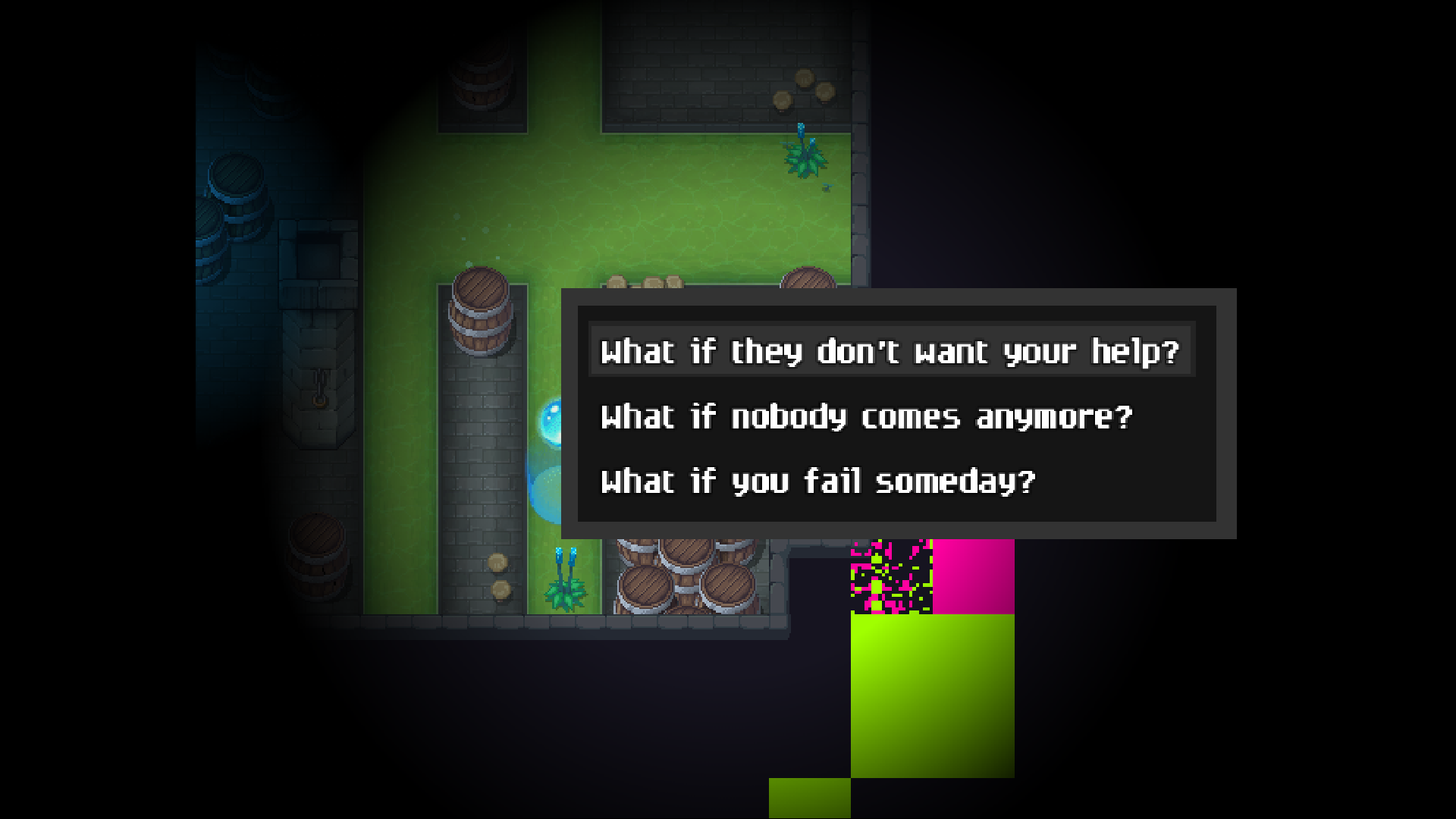
On the other hand, this story also wants to be about the real world and the player. And this player, of course, might be anyone! They might be somewhat similar or at least sympathetic to the protagonist, but they might also loathe him or be unable to empathize at all. The game essentially gives the player opportunities to identify with the protagonist OR distance themselves from him. If he claims Shaliva just wants attention… Well, what do you think? Is this a reasonable reaction? Is it just the best of three horrible dialogue options? Or is it exactly what THIS guy would say (even if you wouldn’t)?
So, what the player chooses isn’t as important as their thoughts about it: Do you identify? Do you distance yourself? Do you fall somewhere in between? And consequently, do you understand the protagonist as a character, or as a representation of yourself?
The choice of an avatar is essentially a first little microcosm of this very design philosophy, and whoever your are, gender is a VERY important part of identification and distance.
And now: Full-blown story spoilers!
I want my games to be about something, but I don’t want to make “message games” that tell you what to think. (Which doesn’t mean I won’t express my world view, obviously!) In this sense, Monster Girl Therapy is a game about masculinity, mental health and helping. It wants people to empathize with others, the protagonist as well as the “monster girls”, and to reflect on their assumptions.
The finale of the game continues to muddy these waters: The story of the protagonist will always end in the same way because it’s HIS story. You might like that ending or not, and in fact, even your opinion is an important part of the whole! But then, there’s this final question: “Will you get help?” Who is it for? Is it asking the protagonist for HIS opinion? Is it asking the player for their opinion ABOUT HIM? Or is it even asking the player for their opinion about THEMSELVES?
So no, you can’t play as a girl because his very masculine (perhaps toxically so!) perspective is central to the story told. But I’d be very interested in YOUR perspective, gender notwithstanding. :D
Thanks for reading!